Why the Warning in Revelation 22:18-19?

Gustave Dore – The Last Judgement

At the very end of Holy Scripture God in His providence determined that the apostle John warns his readers in the following way,

“For I testify unto every man that heareth the words of the prophecy of this book, If any shall add unto these things, God shall add unto him the plagues that are written in this book: And if any man shall take away from the words of the book of this prophecy, God shall take away his part out of the book of life, and out of the holy city, and from the things which are written in this book.”

Revelation 22:18-19

Taken from a covenantal perspective the whole passage above falls on the curses side of blessings and curses. The whole of Scripture ends with this curse upon those who add or subtract from the Scriptures. And to whom is John writing his Apocalypse? The seven churches. John is not warning those wily atheists or stoics about adding or subtracting to the next. No, he is warning the church. There are two verses which remain [vss. 20-21]. 20 says that Jesus is coming back quickly which does not bode well for those who add or subtract from Scripture and in 21 John requests that the “grace of our Lord Jesus Christ be with you all.” Indeed, among other things, the grace not to corrupt the text of Scripture.

So why the warning? Taken from the penman’s perspective, John’s perspective, he sees the need to warn because he anticipates a real danger. From the Author’s perspective, the Holy Spirit’s perspective, God commands to our weaknesses. He knows that humanity is prone to take things that are not ours and desire things that are not ours. He knows that we easily fall into idolatry, blasphemy, adultery, and murder. In like manner, God knows that we are prone to meddle with God’s words. Still, God knows our hearts, but John does not.

So again, why the warning particularly from John’s side of the equation? It stands to reason that John warns not to tamper with the word of God because he has either witnessed this tampering himself in his own books or has heard of it from reputable sources. Which is to say, the Bible has been under siege by those within and without the church. For John, his greatest concern though is not toward those outside the church, but toward those within it. John is primarily concerned with God’s people tampering with God’s word; thus, he warns the seven churches not to do so under pain of plagues and damnation.

John’s warning remains in force today. How are we to know that this or that is tampering of the Scripture? Textual evidence? No. Educated opinions? No. The only way we can know is by the leading of the Spirit of God through the word of God to the people of God by faith. There is a place for textual evidence and educated opinions on this topic and that place is the place of the handmaid and nothing more. The Lord and Lady of the textual process lies with the people of God by faith reading the word of God and hearing the voice of God in those inspired words. In this way and only this way we can have a standard sacred text. All other methods lead to confusion.

Christmas Quiz Answers

A Bible Astronomy Moment - The Star of Bethlehem | A Place ...

This quiz was composed by Henry G. Bosch, originator and 25-year editor of the devotional guide, “Our Daily Bread.” This quiz ran in the Grand Rapids Press in December of 1994 and has been edited for our use.

1.            Jesus was born about how many months after John the Baptist? _6 monthsLuke 2:36_

2.            Jesus’ grandfather’s name was _JacobMatt. 1:16_

3.            The Gospel of Mark does not speak of Jesus’ birth, but it does tell of his boyhood.

True (  ) or False (X ) —  no information at all

4.            The Bible tells us there were three wise men or magi who came to visit Jesus.

True (  ) or False (x ) – just plural

5.            The star which the wise men had seen in the East reappeared long enough to direct them to the stable where Christ was born. True (  ) or False ( x ) – to the house, Matt. 2:11

6.            The wise men did not have to guess which town Jesus was born in as Herod was able to send them directly to Bethlehem. True ( x ) or False (  ) –Matt. 2:8

7.            When the wise men came, they saw Jesus and Mary, but the Bible does not mention Joseph being present. True (x ) or False (  ) –Matt. 2:11

8.            How were the wise men warned of God not to return to Herod? Choose one:

a.            ____ An angel told them

b.            ____ They thought it over and reason and good sense told them it would be unwise.

c.             __X__ They were warned in a dream not to do so – Matt. 2:12

9.            How many dreams did Joseph have in connection with the birth and young childhood of Jesus? 4. 1. Matt. 1:24; 2. Matt. 2:13; 3. Matt. 2:19; 4. Matt. 2:22_____

10.          The Bible says the magi rode on camels. True (  ) or False (x ) – no information

11.          One of the Gospel records traces Jesus’ ancestry all the way back to Adam. Which one? ___Luke 3:23-38_

12.          Mary took Jesus as a baby to Jerusalem. True ( x ) or False (  ) – Luke 2:21

13.          When Mary went to visit the home of Zacharias before the birth of Jesus, she…Choose one;

a.            ______ kissed her cousin

b.            ______ received a message from Zacharias

c.             ______ felt “the babe leap in her womb.”

d.            __x____ saluted Elizabeth – Luke 1:40

14.          And old man and an elderly woman saw Jesus when he was a tiny baby. What were their names? __Simeon Luke 2:25____________ and ____AnnaLuke 2:36______

15.          Where did these elderly saints see Jesus? _temple  — Luke 2:27, 37______

16.          Which one of these aged souls had definitely been married? __Anna Luke 2:37_______

17.          The woman was old, but less than ninety years of age. True (  ) or False ( x ) – 7 married +84 widow= 91 – Luke 2:36-37

18.          Jesus had a distant relative who was struck dumb and probably deaf for a period of time. What was the relative’s name? _ZechariahLuke 1:18ff (John the Baptist’s father)___

19.          The wise men arrived at the manger after the shepherds. True (  ) or False ( X ) – houseMatt. 2:11

20.          When the shepherds came, they found not only Jesus, but Mary and Joseph lying in a stable. True (  ) or False (x ). Luke 2:16 —

Lying – κείμενον  from keimai– Accusative, singular, masculine and Neuter Present Participle

Sacred or Holy Scripture

“Scriptura Sacra: Sacred or Holy Scripture

The Protestant scholastics elaborated the Reformation principle of sola Scriptura into an entire dogmatic locus.”

Richard Muller, Dictionary of Latin and Greek Theological Terms: Drawn Principally from Protestant Scholastic Theology, Term: Scriptura Sacra.

Where part of the Reformer’s battlecry was the five solas; the Protestant scholastics came after them to elaborate extensively on sola Scriptura, making it a locus or location/subject of theological inquiry and conclusion. They did so regarding the Greek and Hebrew they used to defend against Roman Catholic charges. They were not merely talking about the autographs; they included the Greek and Hebrew Bible in their hand – “a canon of copies.” And of this “canon of copies” Muller goes on to observe of this locus,

“…in which Scripture was defined as one of the principia theologiae and then described according to its attributes: dignity, clarity, authority, truth, holiness, and sufficiency.”

Muller, Dictionary, Scriptura Sacra.

These are the distinguishing marks of sola Scriptura or Scripture as the sole rule of all faith and life. That is, Scripture is the dignified, clear, authoritative, true, holy, and sufficient first principle of theological knowledge [principium cognoscendi] for all faith and life. When we believe these things about our Bible perhaps a standard sacred text will not appear so foreign.

Christmas Quiz

This quiz was composed by Henry G. Bosch, originator and 25-year editor of the devotional guide, “Our Daily Bread.” This quiz ran in the Grand Rapids Press in December of 1994 and has been edited for our use. This material makes for an excellent Sunday School lesson on Christmas Sunday morning to enlighten visitors and remind the regulars of the details of the birth of Christ.

  1. Jesus was born about how many months after John the Baptist? ___________
  2. Jesus’ grandfather’s name was _________________________
  3. The Gospel of Mark does not speak of Jesus’ birth, but it does tell of his boyhood. True (  ) or False (  )

4. The Bible tells us there were three wise men or magi who came to visit Jesus. True (  ) or False (  )

5. The star which the wise men had seen in the East reappeared long enough to direct them to the stable where Christ was born. True (  ) or False (  )

6. The wise men did not have to guess which town Jesus was born in as Herod was able to send them directly to Bethlehem. True (  ) or False (  )

7. When the wise men came, they saw Jesus and Mary, but the Bible does not mention Joseph being present. True (  ) or False (  )

8. How were the wise men warned of God not to return to Herod? Choose one:

____ An angel told them

____ They thought it over and reason and good sense told them it would be unwise.

____ They were warned in a dream not to do so.

9. How many dreams did Joseph have in connection with the birth and young childhood of Jesus? _____

10. The Bible says the magi rode on camels. True (  ) or False (  )

11. One of the Gospel records traces Jesus’ ancestry all the way back to Adam. Which one? ___________________

12. Mary took Jesus as a baby to Jerusalem. True (  ) or False (  )

13. When Mary went to visit the home of Zacharias before the birth of Jesus, she…Choose one;

______ kissed her cousin

______ received a message from Zacharias

______ felt “the babe leap in her womb.”

______ saluted Elizabeth

14. And old man and an elderly woman saw Jesus when he was a tiny baby. What were their names? __________________________ and _________________________

15. Where did these elderly saints see Jesus? ___________________________

16. Which one of these aged souls had definitely been married? _________________________

17. The woman was old, but less than ninety years of age. True (  ) or False (  )

18. Jesus had a distant relative who was struck dumb and probably deaf for a period of time. What was the relative’s name? __________________________

19. The wise men arrived at the manger after the shepherds. True (  ) or False (  )

20. When the shepherds came, they found not only Jesus, but Mary and Joseph lying in a stable. True (  ) or False (  ).

Check Standardsacredtext.com later this week for the answers.

Chaos: Paradigm for the Post Critical Christian

Chaos Engineering in Organic Microservice Architectures ...

This is the second installment of a discussion that seeks to discover how post-critical believers have come to reject the infallibility of the Scripture while believing it is God’s Word and through whose truth the Spirit brought them to salvation. The first installment dealt with the intuitive contradictory mindset that codifies knowing without understanding what the Scripture means. This entry speaks to the personal ramifications of believing in the validity of contradictions.

Chaos is the “state of utter confusion.” How one or a society arrives in such a state is through the breakdown of controlling factors. For the believer, the primary controlling factor is adherence to Scripture. When the believer is no longer controlled by Scripture that contradiction is the platform for self-imposed personal chaos, or homo mensura, man is the measure. For the unregenerate, homo mensura is expected, but for the believer, homo mensura is intuitively contradictory to the Lordship of Christ.

Chaos by its nature is intolerant of control, reasoning, or logical discussion. Chaos responds viscerally and harshly to calls for discussion and reason and demonizes efforts to introduce controlling factors to correct the state of confusion. The response is visceral because the question is not simply of what they know but of who they are, what kind of person they are – irrational, confused, immoral? The conscience cannot agree that holding the contradiction is right resulting in guilt and shame and an unamiable response to anyone who unknowingly touches the nerve.

Chaos manifests itself in the intuitive knowledge of a believer when such knowledge is the synchronic acceptance of contradictions as valid. Normalized contradictions on the level of the new birth introduces chaos into every sphere of life because a Christian cannot help being a Christian, no matter how compromised. This paradigm shift for the believer brings about the uncritical acceptance of murder (e.g., abortion), immorality (e.g., homosexual marriage), theft (e.g., serving mammon, avarice), lying (e.g., Scripture is fallible) and coveting (e.g., envidia, envy, wanting what belongs to another) as the second tablet of the Law written on their hearts is compromised permitting the acceptance of a contradiction such as “Thou shalt not commit adultery, etc., ” and the questions that arise from the science of textual criticism and whether “Thou shalt not commit adultery, etc.,” is actually God’s Word and His holy moral standard. Furthermore, the normalized contradictions of personal chaos engender the distortion of traditional Biblical categories. The importance of preaching is denied, evangelism ceases, and separation from the world and sin is refused. Personal and ecclesiastical salt and light ceases as the post-critical Christian lives a synchronic life of maintaining two contradictory claims as valid in the new man. And lest someone quibble as to the efficacy of the textual critical approval of the Decalogue, the point is not the credibility of specific texts but the believer’s intrinsic capacity to accept the validity of contradictions per se. Specifics and evidence in support of or in rejection of the paradigm of normalized contradictions become irrelevant simply because the contradictions are at the core of the believer’s noetic equipment, the “presupposition” from which everything is gauged. Normalizing contradictions in the noetic equipment, the sixth sense, is no less real than saying a blind person is visually challenged. In each case, a sense has been compromised and is not functioning properly.

And so, for the post-critical saint and ecclesiastical gatherings, anything goes, and to say otherwise is to feel the pain of the internal chaos that dwells in those who live an intuitively contradictory life.

The Preface to the KJV, “Meanest,” and Translations

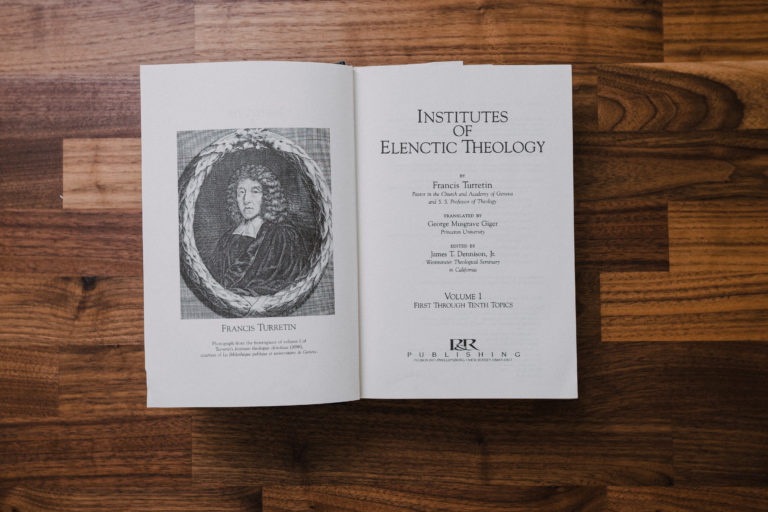
On the heels of our discussion of Turretin’s treatment of the necessity of versions 1, 2, and 3 let us turn to the Translator’s Preface to the Reader of the 1611 King James Version under “An Answer to the Imputation of Our Adversaries” the preface reads,

“Now to the latter we answer, that we do not deny, nay, we affirm and avow, that the very meanest translation of the Bible in English, set forth by men of our profession, (for we have seen one of theirs of the whole Bible as yet) containeth the Word of God, nay, is the Word of God.”

1.) Turretin wrote his Institutes of Elenctic Theology in 1696 or 85 years after the completion of the 1611 KJV. This is to say that the KJV has been the standard sacred text of the English-speaking church for about 50 or so years after the Geneva. In his institutes he addresses two versions specifically, the Septuagint and the Vulgate. He regards both as having ecclesiastical authority. Of the former he writes,

“Among the Greek versions of the Old Testament, that of the seventy interpreters deservedly holds first place with us.”

Turretin, Institutes, vol. 1, Second Topic, Q. 14, Sec. I.

And of the Vulgate he writes,

“The question does not refer to the utility of the Vulgate and its frequent correspondence with the truth (which no one denies); nor to its antiquity and long use in the church (which also is granted by all).”

Turretin, Institutes, vol. 1, Second Topic, Q. 15, Sec. I.

Nevertheless, Turretin goes on to argue of the Septuagint,

“Although we do not deny that it is of great authority in the church, yet we regard this authority as human, not divine, since that was done by the translators was by human effort only, not by prophets and men who were God-breathed (theopenustois) by the direct inspiration of the Holy Spirit.”

Turretin, Institutes, vol. 1, Second Topic, Q. 14, Sec. IV.

And of the Vulgate he launches a similar critique when he writes,

“Although we respect the Vulgate as an ancient version, we deny its authenticity. (1) It was elaborated by human skill and has no God-inspired (theopnueston) author which the authentic edition demands.”

Turretin, Institutes, vol. 1, Second Topic, Q. 15, Sec. III.

Recalling Turretin’s treatment on the necessity of versions, Turretin here means by human authority and skill that capacity of scholars to make a translation which corresponds to the original but does not supersede the original. The reason why the version does not supersede the original is because the translation process is not an immediately inspired process. In this sense, the version has only human authority because the human is not writing in both form and substance of the words of Scripture. Rather a version can only be translated according to the substance/meaning of the words. If the translator were to translate in the form and substance, he would be writing in Greek and Hebrew and thus not produce a translation.

2.) Back to the Translator’s Preface to the Reader, note first that the translators of the KJV speak of the “meanest translations” they do not include those translations immediately mentioned above – the LXX and the Vulgate. They focus their words on the English translations and say of them that they “contain the Word of God, nay, they are the Word of God.” What English versions are in view here? It seems quite apparent that versions like Tyndale’s NT, the Coverdale Bible, Matthews Bible, Bishops Bible, the Great Bible, Geneva Bible, all of which are generally considered to be prior iterations of the King James Bible. So, when the Translator’s Preface references “meanest translations” it is including the King James Bible tradition along with the King James Bible itself. In this sense the KJV translators liken the KJV and its prior iterations as the acorn, oak sapling, young oak tree, and robust oak tree. Put more simply, all of the iterations of the KJV are oak tree but in different stages.

3.) What about this business of containing the word of God versus being the word of God? Given Turretin’s language about versions whether English or not, we are compelled to include that either the translators of the KJV are theologically wrong, or they are right, and consistent with Protestant orthodoxy. We here at StandardSacredText.com hold to the latter.

How is it then that an English-translation can for some be said to contain the word of God and for others it be the word of God? There is no evidence that the translators of the KJV held their translation to be equal to the original in inspired form and content. As such, they admit that a translation can be the word of God and not merely contain the word of God in that a translation can participate in the self-credible substance/meaning of the original. Additionally, I do not take the translator’s “nay” as a kind of edit of thought within the text. By that I mean the translators did not mean to say, “The meanest translations contain the word of God. No, wait, we were wrong in writing that (but we are going to leave it in anyway). What we really meant to write is that the meanest translations are the word of God.”

What the King James Version translators are doing here is what every scholar should do, affirm their particular translation is like all the others and humbly conclude that scholars before them may have gotten it right on this or that points. In short, the King James Versions scholars are not choosing a side on the version issue, as it should be. Here we see in the King James translators a perfect example of scholarly certainty in a version mentioned by Turretin,

“The certainty of the conformity of the versions with the original is twofold: the one merely grammatical and of human knowledge apprehending the conformity of the words in the versions with the original (this belonging to the learned, who know the languages).”

Turretin, Institutes, Second topic, Q. 13, Sec XVII.

But this of course is not the whole story and it is quite clear that the King James Version translators understood this. They understood that their certainty of conformity was merely grammatical and of human knowledge. But as Turretin observes there is a twofold certainty. The first is quoted immediately above but the second is had apart from scholarship. To remind you, Turretin writes,

“…the other spiritual and of divine faith, relating to the agreement of things and doctrines (according to the measure of the gift of Christ, as he himself says, ‘My sheep hear my voice,’ Jn. 10:27; and Paul, ‘he that is spiritual discerneth all things,’ 1 Cor. 2:15).

Turretin, Institutes, Second topic, Q. 13, Sec XVII.

Even further, Turretin declares,

“Although a private person may be ignorant of the languages, he does not cease to gather the fidelity of a version as to the things themselves from the analogy of faith and the connection of the doctrines: ‘If any man will do his will, he shall know of the doctrine, whether it be of God, or whether I speak of myself’ (Jn 7:17).’”

Turretin, Institutes, Second topic, Q. 13, Sec XVI.

The King James version translators did not privilege their translation of the word of God above the other previous iterations of the King James Version tradition. Nor should they. That is for the believing community to do. And the believing community did just that when read and taught from the King James Version for over 400 years. Checkmate.

Van Til and the Infallibly Inscripturated Word

Welcome to the Brickyard. This is a place to find quotes for use in your own research and writing. The bricks are free, but the building is up to you. The following quotes are from Cornelius Van Til’s Christian Apologetics by P&R Publishers, 1976.

“The idea of supernatural revelation is inherent in the very idea of this system of Christianity which we are seeking to present to the natural man.”

Van Til, Christian, 97.

“But if this is so then the idea of a supernatural, infallibly inscripturated revelation is also inherent in this system.”

Van Til, Christian, 97-98.

“Man as a creature of God needs supernatural revelation and man, become a sinner, needs supernatural redemptive revelation. He needs this revelation in infallibly inscripturated form lest he himself destroy it.”

Van Til, Christian, 98.

“The natural man seeks to suppress the pressure of God’s revelation in nature that is about him. He seeks to suppress the pressure of conscience within him. So he also seeks to suppress the idea of the revelation of grace that speaks in Scripture.”

Van Til, Christian, 98

Yes, that infallibly inscripturated form of revelation we call Scripture is currently suppressed by the natural man at the time of Van Til and at our time as well.

“How can the autonomous man be obedient on his own assumptions? He cannot be obedient unless he reverses his entire position, and this he cannot do of himself. It takes the regenerating power of the Spirit to do that.”

Van Til, Christian, 98.

Given Van Til’s approach to submission and obedience to Scripture, I wonder how he would view non-regenerate conclusions about this or that reading being or not being the infallible Scripture of the New Testament?

THE INTUITIVE CONTRADICTORY MINDSET OF THE POST-CRITICAL CHRISTIAN

Contradiction Quotes | Best Famous Quotations About ...

Based upon Paul’s argument in Romans 1 and 2 for what is called sensus divinitatis or the sixth sense which all mankind possesses recognizing God as the source of all things, we see in this passage that though mankind intuitively knows this truth, they do not understand it and change the glory of the incorruptible God into idols, an image made like to corruptible man. This is the internal tension all men inescapably live with. This tension is so real to them that God says this knowledge of God as Creator leaves them without excuse in soteriological matters. Part of this intuitive knowledge in Romans 2 is the “works of the law written on their hearts.” That is, God’s moral standard is likewise inherently part of what it means to be human, the conscience the arbitrator of this internal standard in their lives. In summary, all men are religious creatures with, as C.S. Lewis writes, a God-shaped void that only Christ can fill.

Based on the inherent nature of man, “Is it intuitively contradictory for a follower of Christ to believe that God’s written Word is fallible?” Can a believer, without internal tension and synchronically say “I believe the Bible is God’s Word” and “I believe the Bible is fallible.” For the unregenerate the tension between knowledge of God and idolatry is a constant. For the believer, however, this tension has been removed by regeneration. The unregenerate, we read “hold the truth in unrighteousness” while the believer through the new birth by faith holds the truth in righteousness relieving the inherent tension of their once unregenerate mind. The believer now possesses an inherent sympathy toward God’s truth both as Creator and Redeemer, removing the tension and unifying the sensus divinitatis and testimony of the conscience with the revealed truth of Scripture.

What then are we to make of believers, who by regeneration should have an intrinsic sympathy and belief in the infallibility of Scripture who at the same time hold the truth of God in an unrighteous manner, that is, they reject its infallibility? It is this tension which describes the intuitive contradictory mindset of post-critical Christians. Once this intuitive contradictory mindset is actuated, such ambivalence is unavoidable because it resides at the very core of the person as an intricate element of their humanity. For the unregenerate this tension leads to idolatry, reprobation, and the Romans 1 vice list. For the believer this same tension leads to the weakness of syncretism and a fundamental lack of Spiritual power in their lives. It is impossible to say, “Thus saith the Lord,” while also agreeing that there are textual questions regarding the validity of the words, “Thus saith the Lord.”

Albeit, for the believer, this profound ambivalence can be quickly resolved by the rejection of synchronism as Spiritually destructive and a renewed commitment to hold the truth in righteousness; to treat the revealed truth of God, both General and Special in a manner consistent with God’s Word. If, however, this tension is allowed to persist it would be a manifestation of the power of the passion to overwhelm and control the regenerated reason. If for some reason other than submission to the Spirit, He who guides the believer into all truth, the passion, feeding the tension, is driving the will, inordinate desire rather than reason confirms the acceptance of two opposites as valid. So though regenerated, the believer acts in precisely the same manner as the unregenerate. Though they know the truth and are culpable for their knowledge of the truth, they do not understand the truth. When they read, “Thus saith the Lord,” they do not know what “Thus saith the Lord” means. Rather, what they call the truth is a manifestation of their minds as a non-stop factory of idols. Thus, while knowing and saying “Thus saith the Lord” their contradictory mindset will not allow them to understand what they are reading.

The overwhelming tension of holding two contradictory perceptions as valid feeds an irrational mindset and emotional instability that seeps into every sphere of life – home, church, government. Broken homes and marriages, feckless churches, and voting for governmental wickedness all characterize the post-critical Christian bound to this intuitive contradictory mindset. They know what the Scriptures say but they do not understand the Scripture.

When this mindset is embraced by the Church at large, historically, it takes 1,000 years to resolve the tension. Because the believer can point positively to the knowing element of syncretism, the negative not understanding is avoided and thus a pathetic apologetic is created to persist in and validate this contradiction – The Scripture is God’s Word, and the Scripture is fallible. Willing repentance, turning to the Holy Spirit as the true Teacher, and accepting the Scriptures as infallible only happened after it endured a pruning or persecution. This short entry does not end on a high note. Indeed, this intuitive, contradictory mindset is so embedded in the post-critical Christian only a providential act of God suited to purify the Church will suffice, and for this purifying should be our prayer.

Are Versions Necessary (Part 3)

Continuing our discussion of the necessity of versions of the Bible we now turn to the relationship of the version to the original and the similarities and differences that therein lie.

I. The version is not authentic in itself. The version derives its authenticity from the original which underlies it. Thusly construed, we deny the doctrine of double inspiration or the teaching that God immediately inspired the originals and then immediately inspired a receptor language version of those originals.

“Hence it follows that the versions as such are not authentic and canonical in themselves (because they are made by human labor and talent).”

Francis Turretin, Institutes of Elenctic Theology, vol. 1 Second topic, Q. 13, Sec XV.

II. The authenticity which the version derives from the original is the self-credible substance of the words [e.g., the meaning] found first in the originals and then in the versions.

“There is one perfection of thing and truth to which nothing can be added and from nothing can be taken away; another perfection of the version itself. The former is a strictly divine work and is absolutely and in every way self-credible (autopiston). Such perfection is in the word carried over into the versions.”

Turretin, Institutes, Second topic, Q. 13, Sec XVI.

Note that Turretin divides the original from the version by saying that the original can have nothing added nor taken away from it. If only the vast majority of the American church believed this about their Bible. You would think we could at least get the Protestants on board, but alas this is not the case.

III. There is no doubt that we need educated men to do the work of analysing the Greek manuscripts and understanding the Greek language. That said, while the person in the pew may not know Greek, he/she can still be certain of the conformity of the version to the originals.

“The certainty of the conformity of the versions with the original is twofold: the one merely grammatical and of human knowledge apprehending the conformity of the words in the versions with the original (this belonging to the learned, who know the languages).”

Turretin, Institutes, Second topic, Q. 13, Sec XVII.

Again, we here at StandardSacredText.com affirm the necessity of trained clergy and churchmen and their role in encouraging and bolstering the believing community. But this is not where the buck stops. The unlearned, the non-seminarian, the non-Ph.D. can also have certainty of the conformity of the version to the original.

“…the other spiritual and of divine faith, relating to the agreement of things and doctrines (according to the measure of the gift of Christ, as he himself says, ‘My sheep hear my voice,’ Jn. 10:27; and Paul, ‘he that is spiritual discerneth all things,’ 1 Cor. 2:15).

Turretin, Institutes, Second topic, Q. 13, Sec XVII.

Turretin further drives the point home by writing,

“Although a private person may be ignorant of the languages, he does not cease to gather the fidelity of a version as to the things themselves from the analogy of faith and the connection of the doctrines: ‘If any man will do his will, he shall know of the doctrine, whether it be of God, or whether I speak of myself’ (Jn 7:17).'”

Turretin, Institutes, Second topic, Q. 13, Sec XVI.

This is something we have been arguing from the beginning. Right in the middle of talking about the authority and reliability of versions Turretin reassures the average blood bought saint that they too can have certainty of the versions conformity to the originals without knowing any original languages. In short, the historical orthodox Protestant position has been to say, “Yes, we need scholars to do their work, but their opinion is not the sole or even primary ground for whether the version is in proper conformity to the original.” CT folks reading this, if we can agree on the immediately above sentence, I would say we are closer in position than perhaps originally thought.

IV. Conformity to the original is not equality with the original.

“Conformity to the original is different from equality. Any version (provided it is faithful) is indeed conformable to the original because the same doctrine as to substance is set forth there.”

Turretin, Institutes, Second topic, Q. 13, Sec XVIII.

V. In one respect the version is divine and infallible. Again, something not easily admitted by critical text advocates.

“Although any version made by fallible men cannot be considered divine and infallible with respect to the terms, yet it can well be considered such with respect to the things, since it faithfully expresses the divine truth of the sources even as the word which the minister of the gospel preaches does not cease to be divine and infallible and to establish out faith, although it may be expressed by him in human words.”

Turretin, Institutes, Second topic, Q. 13, Sec XIX.

VI. The version can be corrected because it must be in conformity to the original. The original on the other hand, “neither can nor ought to be corrected.” Again, when is the last time you heard such a conclusion coming out of a seminary lectern?

“If a version could contain the pure word of God in divine words, no correction could take place. For the sources neither can nor ought to be corrected because they are God-inspired (theopenustoi) in things as well as in words.”

Turretin, Institutes, Second topic, Q. 13, Sec XX.

In sum, a version can be authentic and self-credible as to the substance of the words and the original, a canonical apographa, is a document the Reformers claimed to have and believed it to be such. That canonical apographa neither can nor ought to be corrected because it is inspired by God. Put these two beliefs together, this belief in a version coupled with this belief in the apographa and you have a ground for a robust belief in Scripture that will change the English-speaking church and even the world.

The TR as an Object of Knowledge

For the Weekly Question this week I wanted to talk a bit out the TR; it’s existence versus the TR as an object of knowledge.

In my last post I posited that the Early-Modern-English-is-too-hard-to-read argument is an old, outdated argument because of the copious number of learning tools and learning opportunities at the saint’s disposal. Indeed, when Tyndale threatened the Roman Catholic Church with putting the Scriptures in the hand of the plow boy that was a profound threat/promise. But nowadays the “plow boy” has biblegateway.com, biblehub.com, and Alexa all on a device the size of the plow boy’s hand. Thus, I concluded that the aforesaid argument is anachronistic.

Recently it has been argued that the Confessional Bibliology folks [falsely portrayed in said argument as a species of KJV-Onlyism] need to know which TR is the TR. But I believe this question is also anachronistic but in a different way as that above. You see, it is a good thing that the Bible be so accessible by the plow boy through the internet and the YouVersion app, but the American church’s knowledge of Greek in general and New Testament Greek in specific is tragically lacking. The “Which TR?” question is to our shame anachronistic because a vast majority of the English-speaking church cannot read the Greek and as such cannot have the Spirit of God speak through the word of God in Greek to the people of God by faith.

The above meme is right, Greek and Latin were staples in a high-school classical education 100 years ago, but now we teach neither in high-school or college unless you major somehow demands it. What is more, we do teach remedial English in college because we don’t know our own language that well. In the early years of Princeton, a part of meeting your entrance criteria was to demonstrate a working knowledge of Hebrew and Greek. If you read Marriage to a Difficult Man: The Uncommon Union of Jonathan & Sarah Edwards you find that though women were not at that time allowed into formal higher education the Edwards daughters where proficient in the original languages. As recent as my own experience at Westminster Theological Seminary [East], a student could not take an OT or NT course until he/she had either passed proficiency exams in the original languages or took remedial Hebrew and Greek. Still, this is graduate level work, several steps removed from high-school expectations.

Tersely put, the American church cannot read the TR or the N/A 28. They barely read their English Bibles more than once a month. In many many ways we are not more educated than our forebearers. So, when it is asked, “Which TR?”, how is the Christian in the pew supposed to answer that? For that matter if the Christian is asked, “Which edition of the Nestle/Aland?”, how is a Christian who does not know Greek supposed to answer that? The question is basically, How do you know which Nestle/Aland edition is the New Testament in Greek? The same goes for the Latin Vulgate and the LXX. Very very few of the American believing community can read these texts and are therefore unable to determine their respective veracity historically, textually, or by faith. The

Well, if you don’t know the Greek then it seems the best answer rest in warrant transfer. Somebody you trust tells you that version of the TR or N/A is the New Testament in Greek. That person you may trust is some Ph.D. teaching is some seminary or your pastor with one year of graduate Greek under his belt. Either way, dear churchgoer, you are at the mercy of their knowledge so long as you do not know the original languages and the answer the question “Which TR?” or “Which N/A?” is positioned as the sole gateway for your knowing the Bible you read in English is indeed the words of God and not men. So, while some claim that they are all about the Bible for the plow boy in the 21st century they then go on to demand you know the Greek and Hebrew, which of course is the opposite of Tyndale’s claim mentioned earlier.

We here at StandardSacredText.com argue that you can know the Bible you read in English is indeed the words of God and not men and we argue it here, here, here, here, here, and here. That said, because your English Bible is a translation it may stand in need of revision. But who is to determine whether the text should be revised? Certainly, those who know Greek and Hebrew could humbly offer their English revisions the bride of Christ, the apple of His eye. But it is ultimately the English-speaking church which much approve of these revisions. Until which time, there is no approval and persistence on the part of the scholar can amount to casting doubt and aspersions on the Scripture rather than assisting in the care of Christ’s bride.

Still, the English-speaking church ought not to be at the mercy of the academy which is why at a bare minimum I would advocate that every preacher of the word of God know the original languages, and that is a minimum. If the Scriptures are the word of God, then learning two languages in order to better understand what you read in the English and to free yourself from the academic oppressors is a small price to pay. But then there’s that job and Netflix so maybe my ask is too pricey of an ask.

Why then do certain TR advocates hold to the TR they do? I would say a large portion hold to the TR they do because they hold to the teaching and belief of the church that has gone before them. So, while the church of today cannot read the Greek she comes to trust in the work of the Holy Spirit which transpired at an earlier time in the church’s history causing that church to belief this or that. Others undoubtedly hold to the TR or TR tradition because it is the Greek which underlies the King James Version. Some hold to the TR because they actually can read Greek and the Holy Spirit of God speaks to them through those Greek words.

As for the N/A crowd I really don’t know why the hold to the version of the N/A they hold to other than, “Because the evidence compels me.” They don’t rely on the church. They don’t rely on the belief that Spirit guided past generations of the church into truth therefore they hold this or that version of the N/A. I assume the readers of other versions of the Bible are in the exact same boat when it comes to the Greek language [i.e., they can’t read it]. Anecdotally speaking in all my years in the academy I have never heard a critical text advocate claim the reason why they hold to this or that version of the critical Greek is because the Spirit of God speaks through the word of God in Greek and those words bear witness with his/her spirit by faith that these Greek words are indeed the word of God and not men.

I think my argument here cuts both ways – toward the TR crowd and toward the CT crowd. In the end, it is a critique of the sorry state of the American English-speaking church, but that is in large part why we are here at StandardSacredText.com. We want to see the English-speaking church unified around a standard sacred text of Scripture – “Belief in Scripture to Change the World.”