Are Versions Necessary (Part 3)

Continuing our discussion of the necessity of versions of the Bible we now turn to the relationship of the version to the original and the similarities and differences that therein lie.

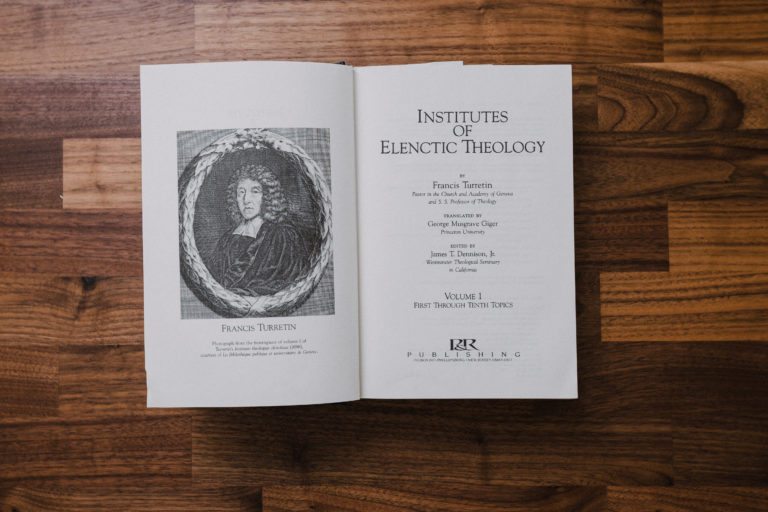
I. The version is not authentic in itself. The version derives its authenticity from the original which underlies it. Thusly construed, we deny the doctrine of double inspiration or the teaching that God immediately inspired the originals and then immediately inspired a receptor language version of those originals.

“Hence it follows that the versions as such are not authentic and canonical in themselves (because they are made by human labor and talent).”

Francis Turretin, Institutes of Elenctic Theology, vol. 1 Second topic, Q. 13, Sec XV.

II. The authenticity which the version derives from the original is the self-credible substance of the words [e.g., the meaning] found first in the originals and then in the versions.

“There is one perfection of thing and truth to which nothing can be added and from nothing can be taken away; another perfection of the version itself. The former is a strictly divine work and is absolutely and in every way self-credible (autopiston). Such perfection is in the word carried over into the versions.”

Turretin, Institutes, Second topic, Q. 13, Sec XVI.

Note that Turretin divides the original from the version by saying that the original can have nothing added nor taken away from it. If only the vast majority of the American church believed this about their Bible. You would think we could at least get the Protestants on board, but alas this is not the case.

III. There is no doubt that we need educated men to do the work of analysing the Greek manuscripts and understanding the Greek language. That said, while the person in the pew may not know Greek, he/she can still be certain of the conformity of the version to the originals.

“The certainty of the conformity of the versions with the original is twofold: the one merely grammatical and of human knowledge apprehending the conformity of the words in the versions with the original (this belonging to the learned, who know the languages).”

Turretin, Institutes, Second topic, Q. 13, Sec XVII.

Again, we here at StandardSacredText.com affirm the necessity of trained clergy and churchmen and their role in encouraging and bolstering the believing community. But this is not where the buck stops. The unlearned, the non-seminarian, the non-Ph.D. can also have certainty of the conformity of the version to the original.

“…the other spiritual and of divine faith, relating to the agreement of things and doctrines (according to the measure of the gift of Christ, as he himself says, ‘My sheep hear my voice,’ Jn. 10:27; and Paul, ‘he that is spiritual discerneth all things,’ 1 Cor. 2:15).

Turretin, Institutes, Second topic, Q. 13, Sec XVII.

Turretin further drives the point home by writing,

“Although a private person may be ignorant of the languages, he does not cease to gather the fidelity of a version as to the things themselves from the analogy of faith and the connection of the doctrines: ‘If any man will do his will, he shall know of the doctrine, whether it be of God, or whether I speak of myself’ (Jn 7:17).'”

Turretin, Institutes, Second topic, Q. 13, Sec XVI.

This is something we have been arguing from the beginning. Right in the middle of talking about the authority and reliability of versions Turretin reassures the average blood bought saint that they too can have certainty of the versions conformity to the originals without knowing any original languages. In short, the historical orthodox Protestant position has been to say, “Yes, we need scholars to do their work, but their opinion is not the sole or even primary ground for whether the version is in proper conformity to the original.” CT folks reading this, if we can agree on the immediately above sentence, I would say we are closer in position than perhaps originally thought.

IV. Conformity to the original is not equality with the original.

“Conformity to the original is different from equality. Any version (provided it is faithful) is indeed conformable to the original because the same doctrine as to substance is set forth there.”

Turretin, Institutes, Second topic, Q. 13, Sec XVIII.

V. In one respect the version is divine and infallible. Again, something not easily admitted by critical text advocates.

“Although any version made by fallible men cannot be considered divine and infallible with respect to the terms, yet it can well be considered such with respect to the things, since it faithfully expresses the divine truth of the sources even as the word which the minister of the gospel preaches does not cease to be divine and infallible and to establish out faith, although it may be expressed by him in human words.”

Turretin, Institutes, Second topic, Q. 13, Sec XIX.

VI. The version can be corrected because it must be in conformity to the original. The original on the other hand, “neither can nor ought to be corrected.” Again, when is the last time you heard such a conclusion coming out of a seminary lectern?

“If a version could contain the pure word of God in divine words, no correction could take place. For the sources neither can nor ought to be corrected because they are God-inspired (theopenustoi) in things as well as in words.”

Turretin, Institutes, Second topic, Q. 13, Sec XX.

In sum, a version can be authentic and self-credible as to the substance of the words and the original, a canonical apographa, is a document the Reformers claimed to have and believed it to be such. That canonical apographa neither can nor ought to be corrected because it is inspired by God. Put these two beliefs together, this belief in a version coupled with this belief in the apographa and you have a ground for a robust belief in Scripture that will change the English-speaking church and even the world.

The TR as an Object of Knowledge

For the Weekly Question this week I wanted to talk a bit out the TR; it’s existence versus the TR as an object of knowledge.

In my last post I posited that the Early-Modern-English-is-too-hard-to-read argument is an old, outdated argument because of the copious number of learning tools and learning opportunities at the saint’s disposal. Indeed, when Tyndale threatened the Roman Catholic Church with putting the Scriptures in the hand of the plow boy that was a profound threat/promise. But nowadays the “plow boy” has biblegateway.com, biblehub.com, and Alexa all on a device the size of the plow boy’s hand. Thus, I concluded that the aforesaid argument is anachronistic.

Recently it has been argued that the Confessional Bibliology folks [falsely portrayed in said argument as a species of KJV-Onlyism] need to know which TR is the TR. But I believe this question is also anachronistic but in a different way as that above. You see, it is a good thing that the Bible be so accessible by the plow boy through the internet and the YouVersion app, but the American church’s knowledge of Greek in general and New Testament Greek in specific is tragically lacking. The “Which TR?” question is to our shame anachronistic because a vast majority of the English-speaking church cannot read the Greek and as such cannot have the Spirit of God speak through the word of God in Greek to the people of God by faith.

The above meme is right, Greek and Latin were staples in a high-school classical education 100 years ago, but now we teach neither in high-school or college unless you major somehow demands it. What is more, we do teach remedial English in college because we don’t know our own language that well. In the early years of Princeton, a part of meeting your entrance criteria was to demonstrate a working knowledge of Hebrew and Greek. If you read Marriage to a Difficult Man: The Uncommon Union of Jonathan & Sarah Edwards you find that though women were not at that time allowed into formal higher education the Edwards daughters where proficient in the original languages. As recent as my own experience at Westminster Theological Seminary [East], a student could not take an OT or NT course until he/she had either passed proficiency exams in the original languages or took remedial Hebrew and Greek. Still, this is graduate level work, several steps removed from high-school expectations.

Tersely put, the American church cannot read the TR or the N/A 28. They barely read their English Bibles more than once a month. In many many ways we are not more educated than our forebearers. So, when it is asked, “Which TR?”, how is the Christian in the pew supposed to answer that? For that matter if the Christian is asked, “Which edition of the Nestle/Aland?”, how is a Christian who does not know Greek supposed to answer that? The question is basically, How do you know which Nestle/Aland edition is the New Testament in Greek? The same goes for the Latin Vulgate and the LXX. Very very few of the American believing community can read these texts and are therefore unable to determine their respective veracity historically, textually, or by faith. The

Well, if you don’t know the Greek then it seems the best answer rest in warrant transfer. Somebody you trust tells you that version of the TR or N/A is the New Testament in Greek. That person you may trust is some Ph.D. teaching is some seminary or your pastor with one year of graduate Greek under his belt. Either way, dear churchgoer, you are at the mercy of their knowledge so long as you do not know the original languages and the answer the question “Which TR?” or “Which N/A?” is positioned as the sole gateway for your knowing the Bible you read in English is indeed the words of God and not men. So, while some claim that they are all about the Bible for the plow boy in the 21st century they then go on to demand you know the Greek and Hebrew, which of course is the opposite of Tyndale’s claim mentioned earlier.

We here at StandardSacredText.com argue that you can know the Bible you read in English is indeed the words of God and not men and we argue it here, here, here, here, here, and here. That said, because your English Bible is a translation it may stand in need of revision. But who is to determine whether the text should be revised? Certainly, those who know Greek and Hebrew could humbly offer their English revisions the bride of Christ, the apple of His eye. But it is ultimately the English-speaking church which much approve of these revisions. Until which time, there is no approval and persistence on the part of the scholar can amount to casting doubt and aspersions on the Scripture rather than assisting in the care of Christ’s bride.

Still, the English-speaking church ought not to be at the mercy of the academy which is why at a bare minimum I would advocate that every preacher of the word of God know the original languages, and that is a minimum. If the Scriptures are the word of God, then learning two languages in order to better understand what you read in the English and to free yourself from the academic oppressors is a small price to pay. But then there’s that job and Netflix so maybe my ask is too pricey of an ask.

Why then do certain TR advocates hold to the TR they do? I would say a large portion hold to the TR they do because they hold to the teaching and belief of the church that has gone before them. So, while the church of today cannot read the Greek she comes to trust in the work of the Holy Spirit which transpired at an earlier time in the church’s history causing that church to belief this or that. Others undoubtedly hold to the TR or TR tradition because it is the Greek which underlies the King James Version. Some hold to the TR because they actually can read Greek and the Holy Spirit of God speaks to them through those Greek words.

As for the N/A crowd I really don’t know why the hold to the version of the N/A they hold to other than, “Because the evidence compels me.” They don’t rely on the church. They don’t rely on the belief that Spirit guided past generations of the church into truth therefore they hold this or that version of the N/A. I assume the readers of other versions of the Bible are in the exact same boat when it comes to the Greek language [i.e., they can’t read it]. Anecdotally speaking in all my years in the academy I have never heard a critical text advocate claim the reason why they hold to this or that version of the critical Greek is because the Spirit of God speaks through the word of God in Greek and those words bear witness with his/her spirit by faith that these Greek words are indeed the word of God and not men.

I think my argument here cuts both ways – toward the TR crowd and toward the CT crowd. In the end, it is a critique of the sorry state of the American English-speaking church, but that is in large part why we are here at StandardSacredText.com. We want to see the English-speaking church unified around a standard sacred text of Scripture – “Belief in Scripture to Change the World.”

Time to Get in the Fight

Apotheosis of War
Vereshchagin dedicated this work “to all great conquerors, past, present and to come”.

For my brothers and sisters in Christ, the following quotes may be helpful in considering an argument from some notion of God’s sovereignty that releases you from your personal responsibility to obey God’s Word and take a stand against evil. The following is a quote showing the German Evangelical Church embracing Hitler as God’s choice because of their misguided notion of God’s Providence.

In G. C. Berkhouwer, The Providence of God (Wm. B. Eerdmans Pub. Co., 1952), 162-63 we read, “We are full of thanks to God that He, as Lord of history, has given us, Adolf, our leader and Saviour from our difficult lot. We acknowledge that we with body and soul, are bound and dedicated to the German state and its Fuhrer. This bondage and duty contains for us, as evangelical Christians, its deepest and most significance in its obedience to the command of God.” The footnote includes this reference: fn. cf. K. Barth, G. Kittel, Ein theologischer Briefwechser, 1934, 5. 600 ministers and 14 professors approved of this proposition.

In the same volume, also see, “To this turn of history (i.e. Hitler’s taking power) we say a thankful Yes. God has given him to us. To him be the glory. As bound to God’s Word, we recognize in the great events of our day a new commission of God to his Church.” The footnote is as follows: fn. Resolution of the so-called Dreimannerkollegium of April 28, 1933 and quoted by Barth in Theologische existenz heute, 10.

Barth escaped; Bonhoeffer was murdered. Time to get in the fight. Do you really think because the government says it, it’s God’s will? or that God’s will and governmental tyranny are synonymous?

“Look down, O Lord, from Heaven behold” by Martin Luther

Penned in 1523, Luther’s hymn elegantly reflects his interpretation of Psalm 12 and that of Jerome in the 4th c. and Ayguan in the 14th. The first strophe of the sixth stanza has as its antecedent the pure Word: “Thy Word, thou wilt preserve, O Lord, From this vile generation.”

Of this hymn Lambert references its importance to the Reformation: “This hymn, and its companion, “Nun freut euch,” greatly furthered the cause of the Reformation. Bunsen, 1833, says, it is ‘A cry, by the Church, for help, founded upon the Word of God, and as a protection against its contemners and corrupters.’ Its strong and passionate temper is easily estimated from Luther’s personal experiences.”[1]

Ach Gott bom Himmel sieh barein

“Look down, O Lord, from heaven behold”

Salvum me fac, Domine

“Lord, Save me!”

Psalm 12

Title: The Word of God, and the Church

“The Silver seven times tried is pure

From all adulteration;

So, through God’s Word, shall men endure

Each trial and temptation:

Its worth gleams brighter through the cross,

And, purified from human dross,

It shines through every nation.

Thy truth thou wilt preserve, O Lord,

From this vile generation,

Make us to lean upon thy Word,

With calm anticipation.

The wicked walk on every side

When, ‘mid thy flock, the vile abide

In power and exaltation.”[2]


[1] James Franklin Lambert, Luther’s Hymns (Philadelphia: General Council Publication House, 1917), 52.

[2] Lambert, Luther’s Hymns, 52.

Name That Story

Below I give you an excerpt from a play of the prolific playwright, William Shakespeare. Being unsure of my audience’s familiarity with Shakespeare I’m not sure how this will go, but after you read the text in that dastardly Early Modern English which so many Christians claim is too difficult to understand, see if you can guess which play the excerpt comes from. Ready? Here we go.

It is a period of civil war.
The spaceships of the rebels, striking swift
From base unseen, have gain’d a vict’ry o’er
The cruel Galatic Empire, now adrift.
Amidst the battle, rebel spies prevail’d
And crush a planet: ’tis the DEATH STAR blast.
Pursu’d by agents sinister and cold,
Now Princess Leia to her home doth flee,
Deliv’ring plans and a new hope they hold:
Of brining freedom to the galaxy.
In time so long ago beings our play,
In star-crossed galaxy far, far away.

Can you guess which of Shakespeare’s plays the above comes from? Has the strange format, grammatical structure, and spelling so hopelessly thrown you off the author’s message and intent?

You may say, “But this looks familiar.” Ah, indeed, to many of you this may sound familiar, and I would argue that it is its familiarity which allows you to understand even the parts of the above quote more foreign to your literary senses. And you would be right to conclude that it is a familiar passage. The passage comes from William Shakespeare’s Star Wars: Verily, A New Hope by Ian Doescher. Seeing aside the fact that Doesher is having fun with and writing books in Early Modern English while the richest most free church in the history of the Church bemoans that Early Modern English as too hard or too boring to read. Even with the Early Modern English, if the reader is familiar enough with the story, the reader understands the story.

My point is that the primary reason why the American church is not familiar with the King James Versions is because the King James Version is not read by those who complain about it. Those that complain about the King James Version do not read out of it, preach out of it, do family devotions out of it and are therefore not familiar with it. What is more, it is not read as the word of God in English. If it were read as the word of God in English it would seem that great attention would be given to each word, to know it, love it, and obey it – but that is not the state of the relationship between the American church and God’s revealed word.

There are certainly other arguments leveled by the multiple version-onlyists. That said, the it’s-too-hard-to-read argument may have worked 200 years ago but with the advent of the PC, internet access, Amazon, and a university on every corner the argument no longer carries weight or at least not to the extent it used to.

Principium (Principle)

“principium: principle, fundamental or foundational principle

namely, that from which anything proceeds in whatever manner”

Richard Muller, Dictionary of Latin and Greek Theological Terms: Drawn Principally From Protestant Scholastic Theology, Term: principium

In theological argumentation there are two principium: principium cognoscendi and principium essendi. The former is the ground and foundation of theological knowledge – Scripture, and the latter is the ground and foundation of being – God. As such, all logical argumentation for the Christian must begin either with the Triune God or with Holy Scripture. We will delve into this more in a later post. For now, let’s further consider principium in general. Muller writes,

“In logic, a principium is, by definition, both self-evidently true and indemonstrable, as in plane geometry, the principle that a straight line is the shortest distance between two points.”

Muller, Dictionary, Term: principium.

For a principium to be a principium it must be both self-evidently true [i.e., known through itself] and indemonstrable. Using Muller’s example of plane geometry, the only way you can prove the shortest distance between two points is a straight line is by referencing the straight line between two points. If a principium is not both self-evidently true and indemonstrable then it is not a principium. In conjunction with the idea of principium, Muller quotes the following scholastic maxim,

Contra negantes principia non est disputandum, There is (or can be) no disputation (or argument) against those who deny foundational truths.”

Muller, Dictionary, Term: principium.

This of course has political, social, cultural, philosophical, and theological implications for the 21st century church. It seems there are many foundational truths being denied [e.g., biological male/female distinction]. Our focus will fall to theology of course, but that is for another post. Muller goes on to make a further distinction which sets the table for the next Essential Vocab. Muller writes,

“A further distinction can therefore be made between the principium quod, the ‘principle which,’ and the principium quo, the ‘principle by which’…Thus is the case of an action on the part of a human being, the person is the principium quod; the person’s will is the principium quo.”

Muller, Dictionary, Term: principium.

In theology and regarding the principium cognoscendi [i.e., Scripture], the principium quod is the words of Scripture and the principium quo is Spirit of God working in the believer by faith through the words of Scripture.

Are Versions Necessary? (Part 2)

As you recall for out last entry in this Bibliology Primer the question of the necessity of versions is divided into two main heads: the necessity of versions and the authority of versions. In this instalment we will look into the latter. Turretin begins and we here at StandardSacredText.com agree,

“Although their [the version’s] utility is great for the instruction of believers, yet no versions either can or ought to be put on an equality with the original much less be preferred to it.”

Francis Turretin, Institutes of Elenctic Theology, vol. 1, Second Topic, Q. 13, Sec. XIII.

And why is this? Why is it that the version cannot be equal with the original, with the Hebrew and Greek? Turretin gives three arguments:

“(1) For no version has anything important which the Hebrew and Greek source does not have more fully, since in the sources not only the matter and sentence, but even the very words were directly dictated by the Holy Spirit.”

Turretin, Institutes, Second Topic, Q. 13, Sec. XIII.

Frist, remember that Turretin has here in the view that the “sources” are the apographs, as specifically a combined Greek and Hebrew canon derived from the copies. The Reformers held to text composed of the Hebrew OT and the Greek NT as the originals, the sources, the very words directly dictated by the Holy Spirit. When you have a robust belief in the apographs, which so many do not now have, the next step to the authority of the version is a very small step. Second, the arguments that God immediately inspired the KJV or any version for that matter goes right out the window. While we can respect Ruckmann for his work and aim, the notion of double inspiration is not supported by either Scripture or historical orthodoxy as evidenced in the quote above.

“(2) It is one thing to be an interpreter, quite another to be a prophet…The prophet of God-inspired (theopneustos) cannot err, but the interpreter as a man lacks no human quality since he is always liable to err.”

Turretin, Institutes, Second Topic, Q. 13, Sec. XIII.

To cut to the chase, the KJV, because it is a version, may be revised. The nature, scope, and method of that revision is what comes into question and is not the subject of today’s post. Still, before you jump all over this point, which many of you will, please consider other posts to this point and our published work. If you do not, you will find our admission on this point to be a platform upon which our critique of textual criticism is strengthened and made more manifest.

“All versions are the streams; the original text is the foundation whence they flow. The latter is the rule, the former the thing ruled, having only human authority.”

Turretin, Institutes, Second Topic, Q. 13, Sec. XIII.

Put another way, an orthodox version is like orthodox theology. Like theology is ruled by the word of God, so the version is ruled by the apographs, the copies. Like theology is not Scripture but is derived from Scripture so also the version is not the original but is derived from the original. And before you jump on the “having only human authority” line, take a look at Turretin’s next line.

“Nevertheless all authority must not be denied to versions.”

Turretin, Institutes, Second Topic, Q. 13, Sec. XIII.

The authority of the version must be divided into two heads: “one of the thing, the other of the words.” Turretin explains,

“The former relates to the substance of doctrine which constitutes the internal form of the Scriptures. The latter relates to the accident of writing, the external and accidental form.”

Turretin, Institutes, Second Topic, Q. 13, Sec. XIV.

In short, we can construe authority in two ways: the substances/meaning of the words and the accidents/shape of the words. The original has both the meaning and shape of the words while the version only has the meaning. That is, the Protestant Scholastics treated the very Greek and Hebrew words to be the word of God in what they mean and in their very Greek and Hebrew shapes. In other words, God meant what He said it and He said it in Hebrew and Greek. Turretin puts it this way,

“The source has both, being God-inspired (theopneustos) both as to the words and things; but versions have only the first, being expressed in human and not divine words.”

Turretin, Institutes, Second Topic, Q. 13, Sec. XIV.

Because God spoke in Hebrew and Greek, all other languages are human languages when it comes to the presentation and translation of Scripture. The version has authority in that they possess the substance of the original though not the form. As such, they are open to revision, which the KJV tradition experienced in the Coverdale, Matthews, Great, and Geneva Bibles. Could the KJV be revised? Sure, but why and how that would come about is a topic worthy of considerable attention and discussion. Spoiler alert, the litmus test for revision is not false friends or corporate profits.

Theology and Hermeneutics

THE NEW HERMENEUTIC:

TOWARD THE FORMULATION OF A NEW EVANGELICAL ORTHODOXY

by Peter W. Van Kleeck, Sr.

A paper submitted in partial fulfillment of the requirements for the course “Interpretation and Application in Expository Preaching,” Bob Jones University, March 2006

Introduction

            The multi-layered dialectic of biblical interpretation called the “new hermeneutic” properly is a radical departure from the old grammatical/historical hermeneutic that characterized pre-critical, Reformation era biblical interpretation.[1] Adopting the same hermeneutical principles designed to express the search for the historical Jesus, the Evangelical implementation of this interpretive methodology, in its present form, is presented as a scholarly interpretive improvement of what it deems the less enlightened historical/grammatical method of interpretation. Evangelicalism, at this stage of its theological and hermeneutical evolution, by accepting the new hermeneutic, displays a theological ambivalence and ambiguity that is both the expression and source of its departure from pre-critical exegesis. Historic orthodox theological formulation and grammatical/historical exegesis are inseparably connected. The churchly, exegetical rendering of the text determines the theology of the believing community and the theology of the believing community restrains the exegetical rendering of the text. The mutual reinforcement of exegesis and theology resides at the foundation of orthodox theological and exegetical codification.

Demonstrating continuity with the grammatical/historical methodology by borrowing the pre-critical template of mutual reinforcement, the historical Jesus, or the radically “this-worldly” Jesus, and the new hermeneutic are likewise inseparably connected. The historical criticism of the text determines the “theology” of its adherents, and this transcendentless search for historical Jesus sets the interpretive parameters for the new hermeneutic.[2] James M. Robinson, on the first major expression of the new hermeneutic, Hermeneutik, written in 1954 by D. Ernst Fuchs[3] remarks,

And perhaps nowhere more clearly than here does one hear the central role of language in a new theology that has its two foci in the historic Jesus and hermeneutics. For the ‘historic’ and ‘hermeneutic’ is heard not at ‘understanding in speechless profundity,’ but as ‘translation into language that speaks today.’ Thus hermeneutic is the method suited to the ‘historic Jesus,’ and the historic Jesus is the material point of departure for a recovery of valid hermeneutic.[4]

The new hermeneutic provides the correlative interpretive methodology to reflect the historical criticism’s Jesus, thus providing a post-critical parallel to the mutual reinforcement of pre-critical exegesis and interpretation.[5]

Pre- and post-critical hermeneutical discontinuity between the two methodologies is, however, manifested in the interpretive result. For the orthodox, churchly tradition, as said above, the correlative results in codified doctrine, a standard, authoritative theological statement of the exegetical findings. The confessions of the Church are specific references to this codification. The new hermeneutic, conversely, because of its design to interpret the evolving scholarly discipline of historic criticism can never provide a standard interpretation. Indeed, as will be shown, the notion of codification, for the new hermeneutic is considered an absurdity.

How one interprets the Bible depends wholly on one’s a priori acceptance of the Scripture as God’s Word or not. Scripture will be rendered in a fashion whereby the communicator is allowed to say only those things God has already said,[6] a methodology, as we will see, its advocates pejoratively call, dogmatics. Contrariwise, being freed from the confines of verbal, plenary inspiration, revelation is defined as “what every sincere religious man believes to be divine truth,” and which is “capable of as much variation as marks the life and thinking of different persons living under different conditions in various periods of history.”[7] Case succinctly encapsulates the quintessential existential factor of the new hermeneutic, the operative alternative to the historical/grammatical method. Although the full ramifications of modern hermeneutical developments have yet to be realized, revisiting the seminal factors of the present hermeneutical trajectory will give a likely indication of the condition of this kind of biblical hermeneutic when fully realized.

The Philosophical Basis for the New Hermeneutic

            Robert L. Thomas’ book Evangelical Hermeneutics sets the trajectory of modern hermeneutics away from the traditional hermeneutic, which is exegetically based grammatical/historical method of interpretation based upon a high view of Scripture’s verbal, plenary inspiration. Though written for a popular readership, Thomas briefly references the philosophical factors that generated the conceptual platform for the new hermeneutic. Being overly careful not to lay a summative template over the contemporary hermeneutical environment, Thomas raises key issues and concerns regarding the course of modern methods of biblical interpretation.

Thomas succinctly introduces the foundational philosophical underpinnings of the new hermeneutic and correctly identifies the writings of Immanuel Kant as the source.[8] The residual results of Kantian hermeneutics trickling down into Evangelicalism and the interpretation of Scripture distinctively and decisively separate pre-critical exegesis and the grammatical/historical interpretation of Scripture from the new hermeneutic. Thomas, however, does not take up the polemic against historic orthodoxy of this radically a-theistic groundwork. Consequently, a little more insight into the writings of new hermeneutic’s progenitor, Immanuel Kant, seems obligatory.

For the purposes of this paper, “The elusive quest to define the Enlightenment”[9] will find its measure in the writings of Kant. Kant rejects the historic, orthodox, churchly exegetical conclusions and theology as the basis for his hermeneutic. This a-theistic premise since Kant’s pronouncement has not changed though the philosophical expressions of this presupposition have.

In his three Critiques, [10] Immanuel Kant (1724-1804) worked out the matter of hermeneutics with “great care” and provided four rules of this interpretation. His first rule speaks “of human consciousness as sufficient in itself and therefore the source of the categories to be employed to determine what can and cannot exist in fact, must be taken as basic for the reinterpretation of any teaching of Scripture.”[11] Rule number one reflects the core principle of the Enlightenment: homo mensura; “man is the measure.”

Kant’s second rule states, “nothing is to be believed on the authority of Scripture as such; the standard of faith is what man’s practical reason regards as morally profitable.” [12] In keeping with the first rule, man’s practical reason will affirm those “concepts without which moral experience would be unintelligible or impossible” (the concept of “the highest good”) while also restraining “dogmatism and fanaticism that claim on moral grounds to have insights into ultimate metaphysical realities.”[13] Kant wholly rejected the authority of Scripture, traditionally accepted as the inspired revelation of God.

Moving beyond bibliology to theology proper, Kant’s third rule states that the idea of a “higher enabling power must be rejected.”[14] For Kant, God exists by “rational faith [faith derived from reason], and not in the form of a claim to metaphysical knowledge of the nature of ourselves and of the being of God.” [15] Kant argued that by making the subject’s perspective an intricate factor of the interpretive process, an unknowing projection of the subject’s perceptual template over the object was avoided.[16] Kant held that metaphysics, including the study of God, was the result of this unknowing projectionism. By refocusing philosophy on the pure and practical reason of man beginning with his own reason, Kant sought to free mankind from the authority of God’s Word.

Once God and God’s revelation to man was removed from the hermeneutic and replaced with reason, what man can know of Scripture can only be known within the limitations of history.[17] Inside this closed causal continuum, “He who observes these four hermeneutical rules may make the message of the New Testament acceptable to modern man. He can interpret Christianity to make it practicable and useful. He can interpret it so that it can be help to him in his desire to lead a true moral life. He has had revelation speak to us through the concepts of our understanding.” [18]

Observing the link from Kant to those that followed his philosophy, Van Til explains the,

reinterpretation of historic Christianity which Kant offers in terms of his hermeneutical rules is, accordingly, largely similar to that which recent philosophers of religion and recent theologians offer. A glance at the teachings of Barth, Bultmann and their followers (who seek to go beyond them) show that their program of an existential interpretation of Scripture follows closely in the direction suggested by Kant.” [19]

Beginning from a radically this-worldly perspective, the new hermeneutic’s purpose is to convey the text’s transcendentless of God’s Word. Once the Scripture is confined to a closed, causal, historic context, a suitable methodology to interpret such a text became necessary and thus the formulation of the new hermeneutic began.

The conspicuous heterodoxy of the new hermeneutic’s beginning raises or should raise some concerns as to the future of Evangelicalism.[20] For Thomas to write with such nuanced caution of Evangelical hermeneutics, warning of the new hermeneutic’s impact on Evangelicalism, says two things, both of which are regrettable. Evangelicalism is embracing a heterodox interpretive scheme and thus in this interpretive practice is heterodox, and its embracing appears to be welcomed by Evangelicalism.

Following Robinson’s definition, Van Til observes,

The method of the new hermeneutic is, accordingly, all comprehensive. Christian faith stands or falls with the historic Jesus. But we cannot know the historic Jesus except as a correlative to the method of the new hermeneutic. This interdependence of the historical Jesus and the new hermeneutic is built upon the presupposition that all reality is historic (Geschichtlich]).”[21]

Therefore, the question remains as to the degree this critical, transcendentless hermeneutic affects Evangelicalism.[22]

Thomas, throughout Evangelical Hermeneutics comes to one telling conclusion relating to the new hermeneutic that has direct significance upon the modern Evangelical tradition, a tradition that purports to hold to a high view of Scripture and in particular Scripture’s inspiration. Thomas concludes the new hermeneutic and verbal inspiration are incompatible with each other. He accents the demise of the churchly definition of plenary inspiration by advocates of the new hermeneutic and emphasizes the need to return to this pre-critical presupposition of the nature of the biblical text. He leans heavily upon the unifying character of verbal inspiration[23] as a backdrop for the hermeneutical discontinuity of the New Hermeneutic.[24] Thomas’ connection between the New Hermeneutic and the rejection of verbal inspiration is forcefully stated by Robert Funk in his article “The Hermeneutical Problem and Historical Criticism.” Supplying the critical basis for the popular expression of the new hermeneutic, Funk explains, “Biblical theology [historical criticism] began by having to challenge the very basis on which it rested, viz., the orthodox doctrine of verbal inspiration. The challenge was necessitated by the desire to break the effective control of dogmatics over the interpretation of Scripture and to establish biblical theology as a historical discipline.”[25] From positions both critical and accepting of the new hermeneutic, verbal, plenary inspiration is either the solution to implement or the problem to overcome. Either way, what one believes about verbal, plenary inspiration is at the crux of the hermeneutical question.[26]

Thomas is unquestionably correct when discussing the demise of inspiration at the hands of the new hermeneutic. He has identified the essential feature of Evangelical biblical interpretation, which is to say a departure from historic orthodoxy to embracing post-critical heterodoxy.

The Composition of the New Hermeneutic

Succinctly stated, three elements comprise the core of the new hermeneutic. The first is that of herald or spokesman, where

the language is itself interpretation and not just the object of interpretation. Hence, hermeneia can mean “linguistic formulation” or “expression” and it can be used to designate a work on logical formulation or artistic elocution, the discipline we today call “speech.” [27]

The second factor is that of transferring meaning, a distinctive of the new hermeneutic that “understand[s] its task of translating meaning from one culture to another, from one situation to the other.” [28] The third element of the new hermeneutic is that of commentary, “where no foreign language was involved but where the obscurity of an utterance or text called for some clarification.” [29]

Lest one think that this threefold hermeneutic reflects only the radical perspective of the historic critic, note the corresponding “fundamental sets of priorities” developed by the father of modern translation technique, Eugene Nida. For linguistic formulation or speech, Nida’s third priority is that, “the aural (heard) form of the language has priority over the written form.” Addressing the matter of translation, Nida’s first priority is that “contextual consistency has priority over verbal consistency (or word-for-word concordance).” Furthermore, the new hermeneutics emphasis upon the rendering also being commentary is reflected in Nida’s second fundamental priority: “dynamic equivalence has priority over formal correspondence.”[30] Of dynamic equivalence Thomas hedges, “Perhaps commentary is too strong a word to describe a D.E. product, but it seems that something such as ‘cultural translation’ or ‘interpretive translation’ would be more in keeping with the principles espoused by linguistic authorities.”[31] Dressed in Evangelical vestments, historic criticism and its surrogate, the new hermeneutic, has adopted a kinder, gentler, easier-to-read look. The goal, therefore, of the new hermeneutic is to replace the exegesis of an inspired text using a grammatical/historical hermeneutic with a self-proclaimed superior, more comprehensive, three-fold hermeneutic (speech, translation, commentary) of a radically this-worldly Scripture,[32] and which necessarily incorporates the receptor’s thought content into the interpretation.

The methodology for formulating this transcendentless text is based in historic criticism. “The rise of historical criticism brought with it the acknowledgment of the contingency of the word, and therefore of the relativity of the expression of every word. It is this proposition which must be affirmed over against theologies of transcendence which emphasize the giveness [intrinsic meaning] of the word.”[33] Funk plainly states his case:

As an antidote to the tyranny of dogmatic theology, historical criticism held up the dogmatic appropriation of the text against the integrity of the text and found the former wanting. As a result, dogmatics was denied the right, at least in principle, to base its claims on the text.[34]

Indeed, the sense of liberty the critical school maintains, having disposed of inspiration and dogmatic projections of the metaphysical, is by them considered a noble venture. What was once for the critic mere exegesis has, with the new hermeneutic, blossomed into a more proficient methodology for relaying meaning. Robinson, building on Funks analysis, adds, “The profound implication that these three functions belong together as interrelated aspects of a single hermeneutic was lost in traditional hermeneutics, which was the theory of but one aspect of hermeneia, exegesis,”and that,

This narrowing of the concept may suggest that some of the dimensions of the hermeneutical task had been lost from sight. Thus the rather explicit return to the breadth of hermeneia on the part of the new hermeneutic is to be seen not an etymological pedantry, but rather as a new grasp of the proportions and nature of the hermeneutical task. [35]

The new hermeneutic links together historical criticism, a reader/receptor conceptual translation technique and an optimistic spirit of making the hermeneutical task a genuinely utilitarian enterprise. This contemporary perspective of the benefits of the new hermeneutic casts the pre-critical grammatical/historical exegesis of orthodoxy in a uniformed, obstructionistic, light.

Having confined Scripture to a closed causal continuum, the new hermeneutic is designed to express the text within this radically historic context. Thus, authentic faith,

is therefore compelled to accept the full historicity of the word since it denies to itself any extrinsic basis. For this reason “faith is at the mercy of the complete questionableness and ambiguity of the historical.”[36]

Furthermore,

If the historian or exegete is engaged in the ruthless exposure of the text as a human word, he is opening the way for a fresh appropriation of the intention of the text because he is helping to let faith be what it is by exposing human pretension in all forms, and also because he is directing his criticism against the text from a locus occupied by himself…If it is understood that the church must renew its life at its source, historical criticism in this sense is not an option but a necessity.[37]

            The new hermeneutic is considered more honest, not projectionistic, and genuine because the critic, in criticizing the text, is criticizing himself, thus keeping both the text and his own preunderstanding in check. This straightforward openness, it is argued, will bring renewal to the church, but only if a radically historic text, conveying a radically historic Jesus is interpreted by critics committed to a radically historic hermeneutic that involves the critics thoughts as necessarily intrinsic to the rendering.

Conclusion

The theologian and statesman Abraham Kuyper (1837-1920), in commenting on the authority of Scripture, penned these words: “If Satan has brought us to the point where we are arguing about the infallibility of Scripture, then we are already out from under the authority of Scripture.”[38] As shown, this kind of pre-critical dogmatism is foreign to and rejected by the proponents of the new hermeneutic. Indeed, it could be argued that Evangelicals who uncritically espouse the principles of the new hermeneutic would agree with Kuyper. The synthesis of the new hermeneutic and pre-critical dogmatic theological confession highlights the noetic ambivalence of modern Evangelicalism.

            The remedy to maintaining the continuity of this contradictory set of principles is a return to a “Reformational philosophy and theology”and the “self-attesting Christ of the Scripture,”[39] but this change is not likely. Silva is correct when he says, “The development of biblical hermeneutics during the past two centuries cannot possibly be separated from the application of critical tools to the biblical text.”[40]

            Accepting the validity of Silva’s assessment, the only conclusion that remains is to admit Evangelicalism’s normative noetic ambivalence evidenced by the synthesis of the two contradictory factors: dogmatic, theological confessions and new hermeneutical practices. That theology and hermeneutic are correlative and given that the hermeneutical trajectory is away from the grammatical/historical exegesis of an inspired, sacred text, the presumption that Evangelicalism will become more secularized is not unwarranted, and without a return to pre-critical exegetical and interpretive methods, inevitable.

BIBLIOGRAPHY

Carson, D. A, Woodbridge, John D., eds. Hermeneutics, Authority, and Canon. Grand Rapids: Zondervan, 1986.

Case, S. J. The Christian Philosophy of History. Chicago: University of Chicago Press, 1943.

Ebeling, Gerhard. “Word of God and Hermeneutic,” The New Hermeneutic, in New Frontiers in Theology, vol. 2. James M. Robinson and John B. Cobb, Jr., eds. (New York: Harper and Row, 1964).

Funk, Robert W. “The Hermeneutical Problem and Historical Criticism,” The New Hermeneutic in New Frontiers in Theology, vol. 2.James M. Robinson and John B. Cobb, Jr., eds. New York: Harper and Row, 1964.

Gaffin, Richard B. “Old Amsterdam and Inerrancy?.” Westminster Theological Journal 44 (1982).

Kant, Immanuel. The Critique of Practical Reason. Translated by Lewis White Beck. Third edition. New York: MacMillan, 1993.

Linnemann, Eta. Historical Criticism of the Bible. Translated by Robert W. Yarbrough. Grand Rapids: Baker, 1990.

Mayers, Ronald B. Religious Ministry in a Transcendentless Culture. Washington, D.C.: University Press of America, Inc., 1980.

Nida, Eugene A. and Taber, Charles R. The Theory and Practice of Translation. Leiden, E. J. Brill, 1974.

Nida, Eugene A. God’s Word in Man’s Language. New York: Harper and Brothers, 1952.

Robinson, James M. and Cobb, John B., eds. The New Hermeneutic in New Frontiers in Theology, vol. 2. New York: Harper and Row, 1964.

Robinson, James M. “Hermeneutics Since Barth,” The New Hermeneutic in New Frontiers in Theology,vol. 2. James M. Robinson and John B. Cobb, Jr., eds. New York: Harper and Row, 1964.

Silva, Moises. Has the Church Misread the Bible? Grand Rapids: Zondervan, 1987.

Thomas, Robert L. Evangelical Hermeneutics. Grand Rapids: Kregel, 2002.

Van Till, Cornelius. The New Hermeneutic. Phillipsburg: Presbyterian and Reformed Publishing, 1974.


[1] James M. Robinson, “Hermeneutics Since Barth,” The New Hermeneutic in New Frontiers in Theology, James M. Robinson and John B. Cobb, Jr., eds (New York: Harper and Row, 1964), 2-5.

[2] For the broader significance of the omission of the transcendent, see Ronald B. Mayers, Religious Ministry in a Transcendentless Culture (Washington, D.C.: University Press of America, Inc., 1980).

[3] Cornelius Van Til, The New Hermeneutic (Phillipsburg: Presbyterian and Reformed Publishing, 1974), 7.

[4] James M. Robinson, “Hermeneutics Since Barth,” The New Hermeneutic in New Frontiers in Theology, vol. 2,eds. James M. Robinson and John B. Cobb, Jr. (New York: Harper and Row, 1964), 61.

[5] Van Til, The New Hermeneutic, 12.

[6] Moises Silva, Has the Church Misread the Bible? (Grand Rapids: Zondervan Publishing House, 1987), 35: “…we can hardly claim to have developed a satisfactory approach if our exegesis is in essence incompatible with the way God’s people have read the Scriptures throughout the centuries.” [Italics in original]

[7] S. J. Case, The Christian Philosophy of History (Chicago: University of Chicago Press, 1943), 170 as cited by Robert W. Funk, “The Hermeneutical Problem and Historical Criticism,” The New Hermeneutic in New Frontiers in Theology, vol. 2, eds.James M. Robinson and John B. Cobb, Jr. (New York: Harper and Row, 1964), 195.

[8] Robert L. Thomas, Evangelical Hermeneutics (Grand Rapids: Kregel Publications, 2002), 425: “Post-Kantian thinkers immediately dismiss this latter option [grammatical/historical hermeneutics]. We cannot, they say, return to pre-Kantian thinking and to a Descartes assumption regarding hermeneutics. They feel that humanity has ‘come of age’ with the advent of Kant’s dualistic philosophy and that to regress to how people thought before Kant would be a drastic mistake.”  Also see pages 41, 44, 53, 69, 124, and 128.

[9] John D. Woodbridge, “The Impact of the ‘Enlightenment’ on Scripture,” Hermeneutics, Authority, and Canon, eds.,D. A. Carson and John D. Woodbridge, (Grand Rapids: Zondervan, 1986), 246.

[10] Critique of Pure Reason, 1787; Critique of Practical Reason, 1788; Critique of Judgment, 1790.

[11] Cornelius Van Til, The New Hermeneutic (Phillipsburg: Presbyterian and Reformed Publishing Co., 1974), 58. Three of the four rules are cited. Kant’s fourth rule rings with hollow anticipation of the future as he prognosticates, “inasmuch as man is obviously unable to attain to the realization of his moral ideals, he may in faith expect their realization after this life.”

[12] Van Til, The New Hermeneutic, 58.

[13] Immanuel Kant: The Critique of Practical Reason, 3rd ed, trans.Lewis White Beck (New York: MacMillan, 1993), xix.

[14] Van Til, The New Hermeneutic, 58.

[15] Kant: The Critique of Practical Reason, xviii.

[16] Kant: The Critique of Practical Reason, xviii.  Note the presence of the seminal dialectic of modern reader-oriented hermeneutics already present in the late 18th c.

[17] Robert W. Funk, “The Hermeneutical Problem and Historical Criticism,” The New Hermeneutic in New Frontiers in Theology, vol. 2,ed. James M. Robinson and John B. Cobb, Jr., (New York: Harper and Row, 1964), 185.  Rudolph Bultmann’s repeated emphasis was on history as a “closed causal continuum as the presupposition for the historical method.”

[18] Van Til, The New Hermeneutic, 58-59.

[19] Van Til, The New Hermeneutic, 59.

[20] Van Til, The New Hermeneutic, 196, 198.  Van Til analyzed the philosophical/theological underpinnings of the new hermeneutic in light of the application of Kant’s ethical dualism and his “sharp antithesis between the world of science” and the “world of freedom and contingency.”  In summary, he concluded that what the adherents of the new hermeneutic must do is “to dispose of orthodox content and retain unorthodox content.  The orthodox teaching with respect to God’s miraculous redemptive work in history must be excluded.”

[21] Cornelius Van Til, The New Hermeneutic, 12.  Geschichtlich: the all reality is historic.

[22] Silva, Has the Church Misread the Bible?, 42-43: “The development of biblical hermeneutics during the past two centuries cannot possibly be separated from the application of critical tools to the biblical text.  This factor raises a series of major problems.  In the first place, the interpretation of the Bible now appears to require expertise in a number of highly specialized subdisciplines.  Does this qualification put the Scriptures out of reach of most believers?  Can we possibly claim that the Bible is clear? [Italics in original]

[23] Thomas never refers to the traditional formula of verbal plenary inspiration throughout the length of his volume. This may be due to his own evolutionary notion of the text of Scripture as noted on p. 438: “The more evidence we have, the higher the degree of probability we can attain for our interpretations. The practice of exegesis, therefore, is a continual search for greater probability and a more refined understanding of the Bible.”

[24] Thomas, New Hermeneutics, 252, 275, 287, 304, 326, 328, 363, 380, 388, 392, 412, 426, 481-82, 509. Thomas questions Eugene Nida’s and Moises Silva’s adherence to inspiration as the unifying nature of Scripture on pages 210 and 211.  Of Nida, Thomas surprisely writes, “Who would dare to say that words written by divine inspiration would show the same redundancy that allegedly characterizes modern communication?” 

[25] Funk, “The Hermeneutical Problem and Historical Criticism,” 193.

[26] See Eta Linnemann, Historical Criticism of the Bible, trans. Robert W. Yarbrough (Grand Rapids: Baker, 1990), 142-149.

[27] James M. Robinson, “Hermeneutics Since Barth,” The New Hermeneutic in New Frontiers in Theology, eds. James M. Robinson and John B. Cobb, Jr. (New York: Harper and Row, 1964), 2-3.  Gerhard Ebeling holds that “in actual preaching God liberates himself from the fixed, presentable, objectified text of the past;” Gerhard Ebeling, “Word of God and Hermeneutic,” The New Hermeneutic, in New Frontiers in Theology, vol. 2,ed. James M. Robinson and John B. Cobb, Jr., (New York: Harper and Row, 1964), 109: Thus the text by means of sermon becomes a hermeneutical aid in the understanding of the present experience. [italics in original]

[28] Robinson, “Hermeneutics Since Barth,” 4.

[29] Robinson, “Hermeneutics Since Barth,” 5.

[30] Eugene A. Nida, Charles R. Taber, The Theory and Practice of Translation, (Leiden, E. J. Brill, 1974), 14.  Nida provides examples of these translational applications of these fundamental priorities in God’s Word in Man’s Language (New York: Harper and Brothers, 1952), 23: John 14:1, “Do not shiver in your livers; you believe in God, believe also in me”; 140-141: “The Eskimos in Barrow, Alaska, describe reconciliation in the simple terms of ‘making friends again.’  That is to say ‘God was in Christ making friends again with the world.’” 152: “In the Kabba-Laka language meekness consists in ‘having the inner being of a child.’”

[31] Thomas, Evangelical Hermeneutics, 95.  Italics in original.

[32] Funk, “The Hermeneutical Problem and Historical Criticism,” 182-183: “…it is necessary to recognize a basic premise without which the historical method is simply irrelevant.  The premise is the radical historicity of the word of God…Only if the word is regarded as fully human and therefore historically conditioned word can historical criticism be of service.”

[33] Funk, “The Hermeneutical Problem and Historical Criticism,” 182.

[34] Funk, “The Hermeneutical Problem and Historical Criticism,” 184.

[35] Robinson, “Hermeneutics Since Barth,” 6.

[36] Funk, “The Hermeneutical Problem and Historical Criticism,” 185-86.

[37] Funk, “The Hermeneutical Problem and Historical Criticism,” 186.

[38] Richard B. Gaffin, “Old Amsterdam and Inerrancy?,” Westminster Theological Journal 44 (1982), 271-272.

[39] Van Til, The New Hermeneutic, Preface.

[40] Silva, Has the Church Misread the Bible?, 42

Daniel Wallace

Welcome to the Brickyard. This is a place to find quotes for use in your own research. The bricks are free, but the building is up to you. The following quotes are from Daniel Wallace. I leave them to you to decide their meaning and worth to the reconstruction of the sacred scriptures of the Christian faith.

 “I would question whether it is an epistemologically sound principle to allow one’s presuppositions to dictate his text-critical methodology. This is neither honest to a historical investigation nor helpful to our evangelical heritage.”

Daniel B. Wallace, “Challenges in New Testament Textual Criticism for the Twenty-First Century” in Journal of the Evangelical Theological Society Vol. 52, Iss. 1 (March 2009): 79-100. 93.

 “A theological a priori has no place in textual criticism.”

Daniel B. Wallace, “Inspiration, Preservation, and New Testament Textual Criticism” in Grace Theological Journal 12 (1992): 21-51. 51.  

 “So if we do not have absolute certainty about the wording of the original, what do we have? We have overwhelming probability that the wording in our printed Bibles is pretty close.”

Wallace, Challenges, 86.

“Until the 1990s there was little question that the primary objective of NT textual criticism was to examine the copies of the NT for the purpose of determining the exact wording of the original.”

Wallace, Challenges, 80.