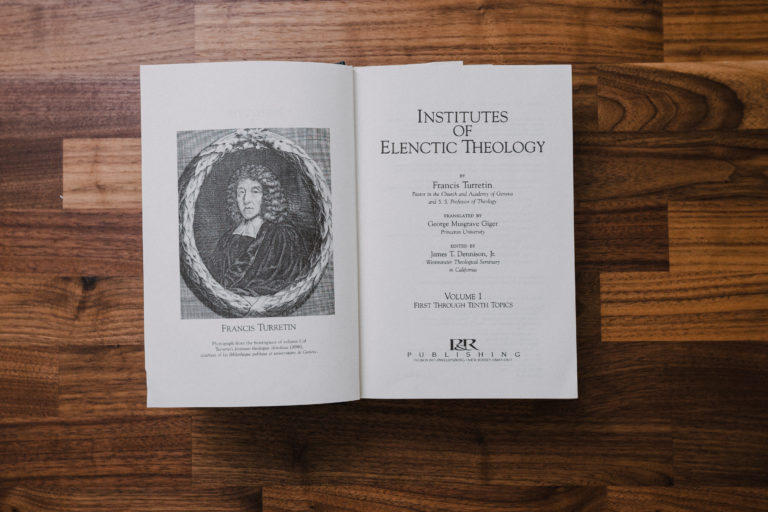
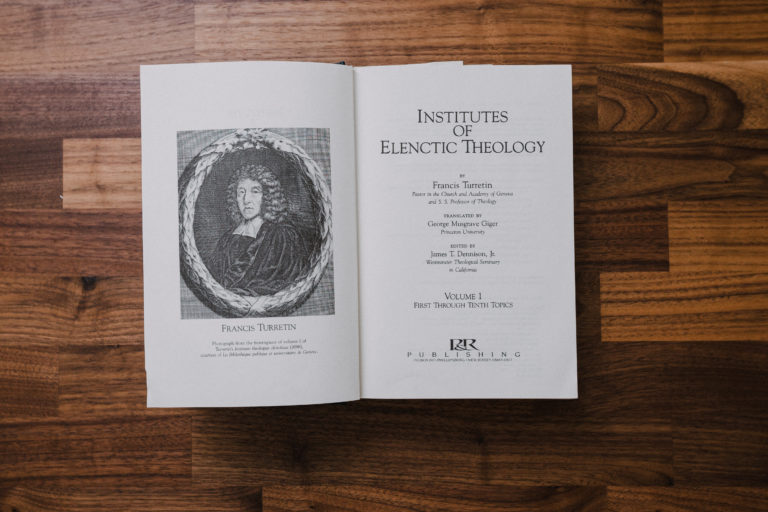
As we continue our way through Francis Turretin’s Institutes of Elenctic Theology as a Bibliology Primer we come to the question, “Are the holy Scriptures truly authentic and divine?” Of course Turretin assumes the affirmative. He then goes on to say that the question could be divided into two sub-heads:
“(1) with atheists and the heathen, who attribute no higher authority to the Scriptures than to any other book; (2) with those Christians who, while acknowledging its authority, nevertheless wish to make it depend (at least as far as we are concerned) upon the testimony of the church.”
Turretin, Institutes, Section 2, Q. 4, Sec. I. 62.
Turretin goes on to clarify these statements and proceeds by first addressing the former of the two sub-heads. It is important to observe that Turretin in addressing the atheist does not begin with rational arguments for the existence of God followed by markedly Christian claims. Instead he begins with markedly Christian claims and then defends those, rather than seeking neutral ground, and then positing Christian dogma from there. Turretin, in identifying what the question is not about, writes,
“The question is not whether the sacred writers (as men simply and in a divided sense) could err (for we readily grant this); or whether as holy men influenced by the Holy Spirit and in a compound sense, they did in fact err (for I think no one of the adversaries, except a downright atheist, would dare to say this.)”
Turretin, Institutes, Section 2, Q. 4, Sec. IV. 62.
He then goes on to define the question as it is.
“Rather the question is whether in writing they were so acted upon and inspired by the Holy Spirit (both as to the things themselves and as to the words) as to be kept free from all error and that their writings are truly authentic and divine. Our adversaries deny this; we affirm it.”
Turretin, Institutes, Section 2, Q. 4, Sec. V. 62-63.
Note the tenses employed here by Turretin. He speaks of the act of inspiration in the past tense [kept] but speaks of their authenticity and divinity in the present [are/sunt]. He could have just as easily employed [were/erant]. If you continue to follow us here at StandardSacredText.com you will see among the Protestant scholastics an intentional and regular emphasis on the possession of the originals in their here-and-now. They held that the Greek and Hebrew Bible in their hand was equal to the original and here we see a glimpse of that confession.
Turretin’s first argument for the authenticity and divinity of the Scriptures is…the Scripture’s testimony of itself. He writes,
“The Bible proves itself divine, not only authoritatively and in the manner of an artless argument or testimony, when it proclaims itself God-inspired (theopneuston).”
Turretin, Institutes, Section 2, Q. 4, Sec. VI. 63.
He then goes on to offer four external proofs and five internal proofs. The external proofs are:
- Quoting Tertullian, “That which is most ancient is most true.” Because the Scriptures are ancient they are true. [Turretin, Institutes, Section 2, Q. 4, Sec. VII. 63].
- Concerning its longevity Turretin writes, “With regard to the duration; the wonderful preservation (even to this day) of the divine word by his providential care against powerful and hostile enemies who have endeavored by fire and by sword to destroy it, while so many other books, against which nothing of this kind has ever been attempted, have wholly perished” [Turretin, Institutes, Section 2, Q. 4, Sec. VII. 63].
- The candor and sincerity of writers in that they do not “conceal their own faults but ingenuously confess them” [Turretin, Institutes, Section 2, Q. 4, Sec. VII. 63].
- Finally, “the number, constancy and condition of the martyrs who sealed it with their blood.” [Turretin, Institutes, Section 2, Q. 4, Sec. VII. 63].
Of the five internal proofs, he writes,
- The mysteries contained therein [e.g., the Trinity, incarnation, Christ’s propitiation, and resurrection].
- The style of Scripture in that “the divine majesty, shinning forth no less from the simplicity than the weight of expression and the consummate boldness in commanding all without distinction, both the highest and the lowest.” [Turretin, Institutes, Section 2, Q. 4, Sec. IX. 64].
- “[T]he divine agreement and entire harmony of doctrine.” [Turretin, Institutes, Section 2, Q. 4, Sec. IX. 64].
- “[T]he direction of all things to the glory of God alone and the holiness and salvation of men.” [Turretin, Institutes, Section 2, Q. 4, Sec. IX. 64].
- “[T]he light and efficacy of the divine doctrine which is so great that, sharper than any two-edged sword, it pierces to the soul itself, generates faith and piety in the minds of its hearers, as well as invincible firmness in its professors, and always victoriously triumphs over the kingdom of Stan and false religion.” [Turretin, Institutes, Section 2, Q. 4, Sec. IX. 64].
This post is getting long so I will leave you with a couple quotes and comments from this question. First, Turretin acknowledges that other religions make the same claims concerning their “sacred texts.” He writes,
“Although false religions usually claim for their doctrine these criteria, the true religion may appropriate these criteria to herself because the vain and false opinions of men do not weaken the truth of the thing itself.”
Turretin, Institutes, Section 2, Q. 4, Sec. XII. 64.
Simply because false religions claim to be true or that their god is the living and true God is not grounds enough for a Christian to avoid or cease from making these claims. The same goes for the Christian’s claims of Scripture. Finally I leave you another hint from Turretin in affirming the priority of Presuppositional methodology.
“Although faith may be founded upon the authority of testimony and not upon scientific demonstration, it does not follow that it cannot be assisted by artificial arguments, especially in erecting the principles of faith.”
Turretin, Institutes, Section 2, Q. 4, Sec. XIII. 64.
First, faith cannot be founded on evidential demonstration, but evidence can assist in supporting “the principles of faith.” The conclusions of textual criticism count as scientific/evidential demonstration. It is the Reformed orthodox position that such demonstration cannot lead to faith, and, given evidentialism and the state of the evidence to date, it is unreasonable to believe textual criticism has yielded a document equal to the autographa. Rather, I submit to you that it is only reasonable to believe that textual criticism has yielding a document somewhat representative of the sources immediately behind the manuscript tradition we currently have.
Next time we will continue down this road with Turretin as he continues to give arguments for the authenticity and divinity of his Bible.