17th Century Textual Apparatus in the Commentaries of Andrew Willet (1562-1621), part 2.

Under the heading, “The text with its diverse readings,” Willet provides the reader with a thoroughly informed account of the churchly tradition as it relates to the subject at hand.  He begins by cataloging the textual variants and various renderings.  For example, in his commentary on Romans Willet cites (Vatabulus (V.), vulgar Latin (L.), Beza (Be.), Syriac (S.), Tremellius translation (T.), Great Bible (B.), Geneva (Ge), Greek (Gr.) and sometime Original (Or.).[1]  To briefly illustrate Willet’s method, four verses from Romans 1 are given:

1:4: Declared to be the sonne of God (not known, T. or predestinate, L. or destinate to bee the Sonne of God V.) in power, L. (not mightily, G.Be. or by power, V. according to the spirit of sanctification, G. Be.V. not according to the holy spirit, T. or the spirit of the sanctifieth, R.) by the resurrection of the dead: T.B.G.Be. (not of the dead) even Jesus Christ our Lord: Be.T. (not of Jesus Christ our Lord, L.V.R.B. for it must be referred to the beginning of the third verse and all that followeth must be enclosed in parenthesis: so the Genevens doe transpose it: but it is safest to put it in the last place, according to the original: with reference, as is said before.)

1:11: For I long to see you, that I might impart unto Be.L. (bestow among you, B.G.) some spiritual gift; that ye may be stablished, B.B. (or confirmed, T.V. to confirm you, L.R. but the word is in the passive.)

1:22: When they professed themselves to be wise: B.G. (saying themselves to be wise, L.R. counting, B. thinking, T. but faskonteV, is better translated professing) they became fools.

1:29: Being full of unrighteousness, fornication, wickedness, covetousness, maliciousness, (rather than, iniquitie, malice, fornication, and wickedness,  L.B. for the order is inverted: for the Greek copies, and the Syriak put fornication in the second place.  See qu. 23 following) full of enview, murder, debate, deceit, evil conditioned, V.B. (taking things in the worse part, G. full of evil thoughts, T. malignity, L. Be., the word is, kakonqeia, churlishness, morosity).[2]

          Noticeable weight is given by Willet to the renderings of the various versions. The version had already undergone the grammatical and syntactical scrutiny of exegetes and thus lent itself to a fuller explication of the apographa. To begin again with the raw data would be to reinvent the exegetical and interpretive wheel.


[1] HR, Preface. By “Original” Willet means the apographa.

[2] HR, pp. 29-30. “See qu. 23 following,” should read qu. 73.  Here Willet catalogs the words listed in verses 29 and 30.

Are Versions Necessary?

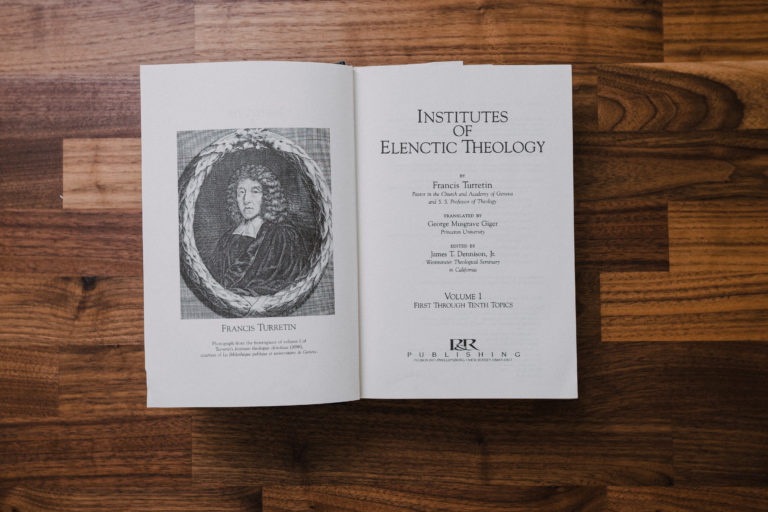
Continuing our trek through Francis Turretin’s Institutes of Elenctic Theology as a Bibliology Primer we now come to the question of the necessity of versions. For Turretin, this question is divided into two main heads: 1.) the necessity of the versions and 2.) the authority of the versions. Today’s post concerns the former. Turretin writes quoting the Roman Catholic, Arboreus,

“‘[T]he translation of the Scriptures into the vernacular tongue is one source of heresies.”

Francis Turretin, Institutes of Elenctic Theology, vol. 1 Second Topic, Q. 13, Sec. I.

He goes on to quote others as saying of the translation of Scripture as,

“a curious invention of heretics banished from orthodox religion, and therefore useless to the church, and impiously and iniquitously devised for the purpose of spreading heresy.”

Turretin, Institutes, Second Topic, Q. 13, Sec. I.

To these objections Turretin offers the following 3 arguments:

“(1) The reading and contemplation of the Scriptures is enjoined upon men of all languages, therefore the translation of it into the native tongue is necessary.”

Turretin, Institutes, Second Topic, Q. 13, Sec. II.

Don’t you think with all this talk about the necessity of versions that Turretin would address, indeed, call for, multiple versions of the Bible for a single native language? But, it’s not there. Certainly, there were multiple English versions by the time of Turretin, but what you won’t find is theologians and pastors arguing that all those versions are essentially the word of God at the same time and in the same way. Even the 1611 KJV Preface to the reader interprets “meanest” versions as virtuous in many forms and in that sense not the same word of God at the same time and in the same way.

“(2) The gospel is preached in all languages; therefore it can and ought to be translated into them.”

Turretin, Institutes, Second Topic, Q. 13, Sec. III

Here we have multiple versions translated from the Greek and Hebrew, but those versions are all in different languages.

“(3) Vernacular versions are necessary on account of the constant practice of the church, according to which it is certain that both the oriental and wester churches had their versions and performed their worship in the vernacular tongue, as their liturgies evince.”

Turretin, Institutes, Second Topic, Q. 13, Sec. IV.

Next time we meet on this topic we will tackle the authority of versions in the Church.

17th Century Textual Apparatus in the Commentaries of Andrew Willet (1562-1621)

Here Willet addresses both textual critical and alternative readings specifically as they address the Hebrew, Latin, Syriac, Greek and cognate languages. Willet utilized an extensive nomenclature and system for noting the diction, grammar, or syntax of the passage in question. In the preface of his commentary on Genesis, under the heading “Certain directions to the reader to be observed in the reading of this book” he informs the reader of his commentary’s continuity with past writers drawing from the commentaries of Mercerus and Pererius after the manner in which Jerome utilized the writings of Origen: “I have caused that our country men should know the best things, and be ignorant of his worst.”[1] Willet then describes the textual apparatus for the critical references he would cite throughout the work. First letters represent the various resources, and abbreviations represent grammatical or syntactical observations: S for Septuagint; H for the Latin thought to be Jerome’s; C for the Chaldee; P for Pagnius; A for Arius Montanus; B for the Great English Bible; G for the Geneva Bible; T for Tremellius, he for the Hebrew text and cat. For cateri, the rest.[2]

It is also important to note Willet’s detail in marginal notes. The full list follows: ad., addeth; differ. ver., different words; diver. Accep., divers takings; app. F. pr., appellative for proper; plu. f. sing., plural number for singular; de., detract or take away; cor., corrupt; div. sig., divers significations; nega. F. affir., negative for affirmative; invert., inverting of order; al, alt., altering of the text; differ. pron., difference of pronunciation; mut pers., change of person; differ temp., difference of the tense; simil. Voc., likeness of the words; interp., interpret, when the sense is kept and not the workds; transp., transposing of words; mut. Temp., change of the tense; mut. Voc., change of the voice, as when the active is put for the passive, or contrariwise; r., right; c., corrupt.[3]

In his commentary on Exodus, he provides this list of sources that span the scope of church history and cross confessional boundaries: Josephus, Origen, Cyprian, Cyril, Chrysostom, Jerome, Augustine, Gregory, Theodoret, Damascene, Lyranus, Thomas Aquinas, Hugo Cardinalis, Isidore, Hugo de S. Victor, Burgensis, Rupertus, Rabanus, Luther, Calvin, Pagnine, Junium annot., Arias Montanus, Junius analysis, Pellican, Simlerus, Gallasius, Marbachius, Pelargus, Borrhaus, Osiander, Aretius, Zeiglerus, Cajetanus, Lippomanus, Tostatus, Ferus, Pereius, Vatablus, Oleaster, Piscator, Genevens.[4]

The reader will note the comprehensiveness of Willet’s resources representing the continuity of orthodox theology throughout the ages. Willet’s work is an expression of the historic ecclesiastical and exegetical tradition. His commentaries served a winnowing purpose for identifying orthodoxy in the labors of his patristic, medieval and Reformation counterparts.

  1. HR, title page.

2. HG, Preface.

3. HG, Preface.

4. The reference to the “Genevens” in the margin of the commentary is directly adjacent to Willet’s list including Luther, Calvin, Simlerus, Junius and Genevens and “other worthie writers among Protestants.” By “Genevens” Willet probably means the consensus of the Genevan exegetes.


Post-critical Theological Schizophrenia

Every epoch of time had it challenges to the validity of the Christian faith, and in every era, there were those who argued for orthodoxy against the heterodoxy of the day. “Earnestly contending for the faith once delivered unto the saints” is a never-ending act of obedience. The rise of Molinism and the rejection of Divine simplicity both attacks of Theology proper are the current heterodox issues today. The rejection of Scripture’s Divine authority by the infusion of rationalistic arguments and methods rounds out the contemporary attempt to dismantle the principium theologiae of the Christian Church. Dr. Ronald Mayers captures the nihilistic contemporary setting for theological study, writing that,

“The current zeitgeist [spirit of the time] is not so much a philosophy as it is the cultural milieu, the background for all philosophies and perspectives in existence. Life is no longer understood as dependent on a transcendent ruler of time and history. There is no infinite reference point…. Personal destiny is seen is beginning at birth and ending at death. In such a totally naturalistic world, theology herself adopts an ontological foundation that is so thoroughly secular that it too finds meaningless and undiscoverable any category of the transcendent.” Ronald B. Mayers, Religious Ministry in a Transcendentless Culture, 1980, 13-14.

Though written in 1980, Dr. Mayers’ assessment is spot on. It is as if there are no categories in the modern mind within which to place pre-critical theological formulation and articulation. What was once mainstream orthodoxy is considered a brief historical aberration, left for dead and ignored in the face of post-critical textual and theological development. So confident are the adherents of post-critical thought that one boldly asserts that if, “Calvin were alive today, he would not believe what he wrote any longer.” At least in this instance, even the Institutes have fallen prey to the arrogant post-critical reconstruction of pre-critical theological genius. The practical result of this milieu is that the Bible is considered a natural phenomenon to which all evolutionary scientific methods apply. Simply stated, the bible is a science project whose honored status has been replaced with a non-exegetically based, scholarly, and ecclesiastical theological consensus which maintains a shell of historic orthodoxy. For example, while holding to the inspiration of the Originals they support a textual critical system that denies the inspiration of the originals. For example, “Little is gained by speculating as to the precise point at which such corruptions came in. They may have been due to the original writer, or to his amanuensis if he wrote from dictation, or they may be due to one of the earliest transcribers.” Westcott and Hort, Introduction to the New Testament in the Original Greek, 208. This confusion is identified as Post-critical Theological Schizophrenia (PTS), or so-called “orthodoxy” based on a contradiction. The authority of scholarly theological consensus usurps exegesis, making the grammatical/historical defense of individual verses irrelevant. The expression, “the Bible is inspired,” is a theological statement, not a statement of fact. The same theological words are used, i.e., inspired, and theological textbooks, for the most part, teach the Doctrine of Inspiration, but the actual inspiration of the Scripture is rejected. Theological statements consistent with the scholarly consensus now possess the authority once held only by sound exegesis. Modern evangelical theology is not derived from the exegesis of an inspired text but is based upon theological, academic, consensus. As long as everyone says the same thing, an inspired, authoritative text is unnecessary for “Christianity” to appear normative and orthodox. Only a return to a pre-critical, exegetically based foundation and interpretation of Scripture will saved the Church and Academy from becoming increasingly feckless and irrelevant to the contemporary culture. After all, when it comes to Bibliology, the common perspective seems to be, “who cares?”

What is a False Friend?

If you think you know somebody but you really don’t there can be two reasons for this: 1.) They are lying to you and so you believe something about that person that is not true. For example, Judas Iscariot. 2.) They are telling the truth and acting consistent with who they are but you are not able to understand who they are by what they say and do. For example, a girl who believes a homeless meth addict who is obviously lazy and a self-professed liar is the kind of guy that she should marry. Certainly, the guy is in all kinds of moral trouble and in need of loving intervention is a host of ways, but the desire to marry this guy rest solely on the girl’s poor judgment and lack of understanding, at a minimum. She’s not really his friend if she won’t, at a minimum, call him out about his sin. As I’m sure you remember, “Faithful are the wounds of a friend; but the kisses of an enemy are deceitful” [Prov. 27:6].

So, let’s talk about words. Which of the two above scenarios makes a word a false friend? Which is it, is the word “halt” or “apt” lying to us? Is “halt” a ruthless terrorist organization determined to rule the world? COBRA!! No, of course not. The word is the word. Some people may use the word to harm or lie but the word itself is a specific series of inert English symbols with no desire to mislead, or rule the world for that matter.

The reason “halt” and “apt” may be false friends to us is because we do not understand them. We don’t hang out together at church or the homeschool co-op. When “apt” wants to go get drinks we don’t go because we are teetotalers. If we aren’t going to go hang out with “halt” and “apt” and the rest of their false friends how else could we get to know them? Well, by reading, of course. And here is the rub. We in America don’t read very much.

According to Statista the average time an American reads per day is 20.4 minutes with minors and young adult [ages 15-19] reading only 8.4 minutes per day. It’s hard to make true friends out of friends you don’t understand when you only hang out somewhere between 8 and 20 minutes per day, especially when you need to divide your attention between all your true friend words while mingling with some of those other friends you are trying to get to know. I mean, who has time to make new friends of misunderstood friends when you only hang out with your regular friends 8 minutes a day?

But you say, “We learn words not only through print but also through hearing these words spoken.” Agreed, but when it comes to Scripture can anyone just say some words and call those words Scripture? No, they may not. The Scripture words we get must come from Scripture, from the printed page. So, when we say there are some false friends in Scripture, we are saying that we haven’t been hanging out with the Bible. There are words in there that we could know but we don’t. They are strangers to us and they are strangers to us not because they cannot be known, but because we have not put forth the effort to know them.

Some say that we need to change them. “These friends can’t be friends” or “It’s too hard to be friends with these friends.” These false friends need to be updated and that will fix the problem. Of course, this is silly and stupid to conclude in part because it sounds like a part out Mean Girls: The Text Critical Version. If the problem is that people won’t acquaint themselves with the Bible then the mere changing of words is not going to heal their akrasia, their weakness of will.

Perhaps the Bible can help us with the false friends dilemma. The Scripture teaches us that if a man wants to have friends, he must himself be friendly [Proverbs 18:24]. If we want to reduce the number of false friends in Scripture, we should start being friendly with Scripture. Friendships are difficult to build. They take time and sometimes the relationship can be rough. The wounds of a friend are faithful, are they not? If you are to be a friend to Scripture and Scripture to you then you must spend time with Scripture, ask questions of Scripture, study Scripture, know what Scripture likes to drink with its steak. Scripture is ready to stick closer to you than a brother. It is the living word of Christ, and Christ is friend and brother to all Christians. The question is, are you ready to return the favor with your scanty 20 minutes?

The Power of the Word of God

“In the beginning God created the heaven and the earth.”

Genesis 1:1

And how exactly did God do this most profound act of creation? He did it with His words. He spoke the world into existence. Unlike our words, God’s words have power to create, change, and destroy. Where we need to combine elements to create or turn on a switch or light a fire to bring a greater light; God simply speaks and things come into existence. We see this familiar refrain throughout the creation account, “And God said…”

But God’s words do not stop at the act of creating. Not only does God speak things into existence He gives them their names. That is, God called the light Day, the darkness Night, the firmament Heaven, and the land Earth. We only name the things we have authority over, the things we are responsible for. God’s naming of creation shows His lordship over creation.

God also determines the bounds and standard of what is good, true, and beautiful by means of His words. At the end of each day, God saw that what He had made with His words was good. God’s words create good things, and not only good in the sense of ice-cream tastes good or a sunset looks good but also in the sense of ontological good, good in its very being. Good things of this sort are also true and beautiful.

Finally, God, with His words, declares what is moral when He commands Adam not to eat of the Tree of the Knowledge of Good and Evil. God creates things with His words. He names things with His words. He creates and names good things with His words, and finally, He declares what is moral with His words.

Scripture is all these things to us. It is creative in that it makes new creatures where old things pass away and all things become new. He names us and names sin with the words of Scripture, thus showing His lordship over us and over sin. In point of fact, “confession” is homologew, which is to use the same word as God does about sin. The Scripture produces the good of faith in the heart of the believer via the good of regeneration and continues a good work through the Scriptures via sanctification. Finally, the Scriptures tell us what is moral because God’s words are the standard, the canon of moral judgment.

And lest we forget, the Scripture speaks of itself in these terms in Hebrews 4:12,

“For the word of God is quick, and powerful, and shaper than any twoedged sword, piercing even to the dividing asunder of soul and spirit, and of the joints and marrow, and is a discerner of the thoughts and intents of the heart.”

Hebrews 4:12

The word of God, Scripture, is alive and powerful in itself. It is the good, true, and beautiful sword that pierces even to the soul, and is the discerner of moral thoughts and intentions coming from the very center of a man’s being. In sum, the reason for this is that the words of Scripture are of the same kind as the words God spoke at creation.

Preaching the Word

Praedicatio Verbi Dei Verbum Dei est: The preaching of the Word of God is the Word of God.

Richard Muller, Dictionary of Latin and Greek Theological Terms: Drawn Principally From Protestant Scholastic Theology, Term: Praedicatio Verbi Dei Verbum Dei est.

For the Protestant Scholastics and for us here at StandardSacredText.com, there are three ways in which we speak of the word of God.

(1) The Archetypal Word of God: This is Jesus Christ, the Word that was made flesh and that dwelt among us. Archetypal speaks of a founding type or the type from which all other types come [e.g., prototype and ectype]. Because Christ is the archetypical Word, the Logos, all other revealed words come from Him and specifically by the One Jesus sent – the Holy Spirit.

(2) The Revealed word of God: This is the audible voice of God, the words of the prophets, the message of the apostles, and in our time, the written inspired Scriptures of the Old and New Testament. When comparing Christ and Scripture we distinguish these two as the Word of God and the word of God respectively. In other news, the same goes for God as Canon and the Scriptures as canon.

(3) The Preached word of God: This of course is most relevant to the above quote. The idea is that the Scriptures are the living voice of God in that the living God, the Holy Spirit, speaks through the word to the saint toward sanctification and to the lost toward repentance or judgment. Thusly construed, when the revealed word is preached, the living God in the person of the Holy Spirit speaks in concert with His own words through the preaching. In such cases and under such circumstances the preaching of the word of God is itself the word of God. This is why preachers should simply preach and teach what the Bible says instead of playing Oprah or Dr. Phil or Jordan Peterson or the latest movie with a mildly redemptive theme.

Sola Scriptura

Welcome to the Brickyard. This is a place to find quotes for use in your own research. The bricks are free but the building is up to you. The following quotes are from Robert Preus’ The Inspiration of Scripture: A Study of the Theology of the 17th-Century Lutheran Dogmaticians. Our focus for this post is on some concluding remarks Preus observes concerning Calvo and his treatment of Sola Scriptura. Preus states,

“There is a statement of Calvo’s touching the use of Scripture which tells clearly what this principle [Sola Scriptura] meant to the dogmaticians and how they thought it should be upheld.”

Preus, Inspiration, 12.

Preus observes that Calvo gives five senses in which we ought to understand Sola Scriptura. The first is most germane to our work here. Still, it is important to note the practical application drawn from this first tenet. Calvo writes,

“(1) We are to recognize and accept without reservation the holy Scripture – all of it, the Old Testament no less than the New – as the Word of Almighty God.”

Preus, Inspiration, 12.

“(2) We are devoutly to give audience to God speaking in the Word, we are to reflect upon His Word day and night and we are to explore it with true piety and utmost devotion.”

Preus, Inspiration, 12.

“(3) We are to turn neither to the right nor to the left from Scripture, nor are we to suffer ourselves to be moved to the slightest degree by the solicitation of others or the desire of our own flesh.”

Preus, Inspiration, 12.

“(4) We are to accord faith to the Scriptures in all [their utterances] and place our trust only in the Scriptures, or the Word of God, and bravely fight with them as with the sword of the Spirit against whatever temptation may arise.”

Preus, Inspiration, 12.

(5) We are to gain comfort from them alone in every necessity of body and soul, and through patient consolation of the Scriptures have a sure hope of life and remain steadfast to the end of life.”

Preus, Inspiration, 12.

The Same Old, Same Old

Under the question, “Are the Hebrew version of the Old Testament and the Greek version of the New Testament the only authentic versions?” Turretin addresses the idea propounded by the Roman Catholics that the original Hebrew and Greek are mutilated and therefore untrustworthy in themselves. He then goes on to deal with three passages which the Roman Catholics say account for this mutilation. Turretin writes,

“There is no truth in the assertion that the Hebrew edition of the Old Testament and the Greek edition of the New Testament are said to be mutilated; nor can the arguments used by our opponents prove it.”

Francis Turretin, Institutes of Elenctic Theology vol.1, Second Topic, Q. 11, Sec. X.

Guess what passages the Roman Catholics pointed to in order to besmirch the Hebrew and Greek originals? Guess. 400 years ago, the Roman Catholics argued that the inclusion of the long ending in Mark 16, John 8:1-11, and I John 5:7 all pointed to the mutilation of the Greek Text. What major passages do you suppose Protestants now have issue with when it comes to the King James Bible over against the critical versions? You guessed it; the long ending in Mark 16, John 7:53-8:11, and I John 5:7. My how the tables have turned. Turretin goes on,

“Nor the history of the adultress (Jn. 8:1-11), for although it is lacking in the Syriac version, it is found in all the Greek manuscripts. Not 1 Jn. 5:7, for although some formerly called it into question and heretics do now, yet all the Greek copies have it, as Sixtus Senensis acknowledges: ‘they have been the words of never-doubted truth, and contained in all the Greek copies from the very times of the apostles’ (Bibliotheca sancta [1575], 2:298). Not Mark 16 which may have been wanting in several copies in the time of Jerome (as he asserts); but now it occurs in all, even in the Syriac version, and is clearly necessary to complete the history of the resurrection of Christ.”

Turretin, Institutes, Second Topic, Q. 11, Sec. X.

My point in bringing this up is that 400 years ago Protestants had to defend these passages from the Roman Catholics. 400 years ago, it was the heretics that questioned the veracity of 1 John 5:7. Now Protestants are called to defend these same passages against…Protestants, and the folks who defend the validity of 1 John 5: 7 are now called the heretics, the schismatics.

“But, but, but we have more manuscript evidence now,” you might say. So. We have more evidence now that dead people do not rise from the grave and that manna does not fall from the sky, but is that going to change your belief so easily simply because I say we have more evidence? If such evidence won’t change your mind so easily about resurrection beliefs or manna beliefs, why do you think “we have more evidence now” somehow automatically and uncritically trumps your Scripture beliefs? Certainly, “we have more evidence now” can inform our beliefs but it need not and sometimes it ought not and sometimes it does not. For example, “we have more evidence now” than ever that dead people do not rise from the dead therefore the evidence continues to mount that Eutychus did not rise from the dead seeing he is a person who died. This evidence ought not apply because the apostle Paul is a full legal representative of Christ on earth and therefore has unique capacities. Furthermore, this new evidence does not apply for the same reason.

Regarding the Scriptures, simply because “we have more evidence” about the long ending in Mark or the woman caught in adultery does not mean that that evidence is the New Testament, is God’s word. Simply by being evidence does not mean that evidence is God’s word. What determines that it is God’s word? For most of you it is Daniel Wallace or the CBGM or David Parker who let you know what is and is not the New Testament. Such a conclusion is no different than the Roman Catholics except that their people wear red robes and your people wear suits and bowties. For us here at StandardSacredText.com, we argue that the Holy Spirit through the word of God to the people of God by faith speaks to God’s people through His words and in this way God’s people hear the voice of the Good Shepherd and know that those words are indeed God’s words.

So, you have more evidence. Good for you. Good for all of us. Is it the word of God? Is it really the original words of the New Testament? That recognition and conclusion rests in the purview of God’s people – the stay-at-home mom, the local plumber, dairy farmer, high-school basketball coach, community college professor, and pastor as a corporate body and the bride of Christ. New Testament scholars, do your work and then step aside and let the people of God by the Spirit of God through the word of God tell us all what is the Bible and what is not by its use and preaching.