The Living Voice of God

“And other sheep I have, which are not of this fold: them also I must bring, and they shall hear my voice; and there shall be one fold, and one shepherd.”

John 10: 16

There is often a question as to how a person can reasonably hold to a standard sacred text. The question goes something like, “How do you know that the words in that Bible or Greek Text are indeed the words of God rather than the words of men?” It is a good question and one that needs to be answered. Now there are broader more theological answers we could give but if compelled to give a simple answer I would point them to John 10 as a whole and verse 16 in particular. How do we know that those words are God’s words? We hear the living voice of God in them. We hear the voice of our Shepherd.

Richard Muller says of the living voice of God,

viva vox: living or spoken word; also viva vox Dei: the living Word or speech of God.

The term applied to the Word of God spoken directly to Israel before the Mosaic inscription of the law and to the Word of God spoken directly to the prophet. In addition, because of the Reformers’ emphasis upon the power and efficacy of Scripture, the term was used by the Reformers and by the Protestant orthodox to indicate the reading aloud of vernacular Scriptures during worship.”

Richard Muller, Dictionary of Latin and Greek Theological Terms: Drawn Principally from Protestant Scholastic Theology, Term: viva vox.

In sum, the living voice of God was first the word of God spoken directly to Israel from Mt. Sinai and then it stood for the word of God spoken directly to the prophets. Then finally, the Reformed position is to speak of the living voice of God as reading aloud from the vernacular Scriptures. In our case here in the USA, that means the English Scriptures. That’s right folks the Reformers argued that the hearing the English Scriptures read in your ears counts as hearing the living voice of God. We’ve come a long way from the English Scriptures being the living voice of God to the English Scriptures becoming a multifarious, constantly changing, quasi-sacred text under the boot of whether or not it could be read by a 21st century child.

Leaving education aside and the fact that any country or church ruled by children is one under the judgement of God (Is. 3:4), the church used to hold that when the word of God was read in their language they were hearing the living voice of God. They were hearing the voice of the Good Shepherd. But for so many Christians this is not the case and if they admit that it is the case they admit it with a host of obligatory qualifications for fear that they will sound uneducated or too Christian.

The Scriptures tell us that Jesus’ sheep hear His voice and the Scriptures are the living voice of God. So again, you ask, How can you know that the KJV is the word of God and not of men? The answer is, I hear the living voice of my Shepherd in those words because those words are the living voice of God. And why is that so bad of a thing to believe about my Bible? It seems consistent with historical orthodoxy. Such a belief does not violate what the Bible says about the Bible and is consistent with my rational and affective experience. So why the burr in your saddle, naysayers? Let us believe this way and we admonish you to do the same.

The Perspicuity of Scripture

“perspicuitas: perspicuity, clarity of thought, lucidity;

one of the traditional attributes of Scripture. The attribution of perspicuitas to Scripture does not imply that all passages are clear; rather, the point is that all thins necessary to salvation are clearly stated.”

Richard Muller, Dictionary of Latin and Greek Terms: Drawn Principally From Protestant Scholasticism, Term: perspicuitas.

As for the more difficult portions of Scripture,

“the obscurities in the text are to be elucidated through comparison to and collation with clear passages in accordance with the analogy of Scripture and the analogy of faith.”

Muller, Dictionary, Term: perspicuitas

The Christian employs the former [i.e., analogy of Scripture] by comparing less clear Scriptures with the clearer passages of scripture on that topic or theme. The latter [i.e., analogy of faith] is based in Romans 12:6 […the proportion of faith] coupled with an assumed sense of Christian teaching for a given theological idea on the part of the Christian. In sum, Scripture is clear [perspicuous] or becomes clear to the Christian when he/she interprets the difficult parts of Scripture with Scripture itself coupled with Christian study in Christian theology.

Have the original texts of the Old and New Testaments come down to us pure and uncorrupted? We affirm against the papists.

We come now to one of the more “sensational” statements in Turretin’s Bibliology. It is sensational at least for the current ecclesiastical climate because of where he claims the purity of the Bible resides. Turretin’s argument here is very different than the standard argument for the originals. Take for instance the Chicago Statement on Inerrancy which reads in Article IV,

“We affirm that the whole of Scripture and all its parts, down to the very words of the original, were given by divine inspiration.”

Chicago Statement on Inerrancy, Article IV

Here the CSI means by original those documents written at the hand of the original penmen [e.g., Moses, David, Luke etc.] by immediate inspiration. This language is in keeping with B.B. Warfield and A.A. Hodge. Looking at Turretin I think you will notice the difference. Turretin says regarding the originals,

“By the original texts, we do not mean the autographs written by the hand of Moses, of the prophets and of the apostles, which certainly do not now exist. We mean their apographs which are so called because they set forth to us the word of God in the very words of those who wrote under the immediate inspiration of the Holy Spirit.”

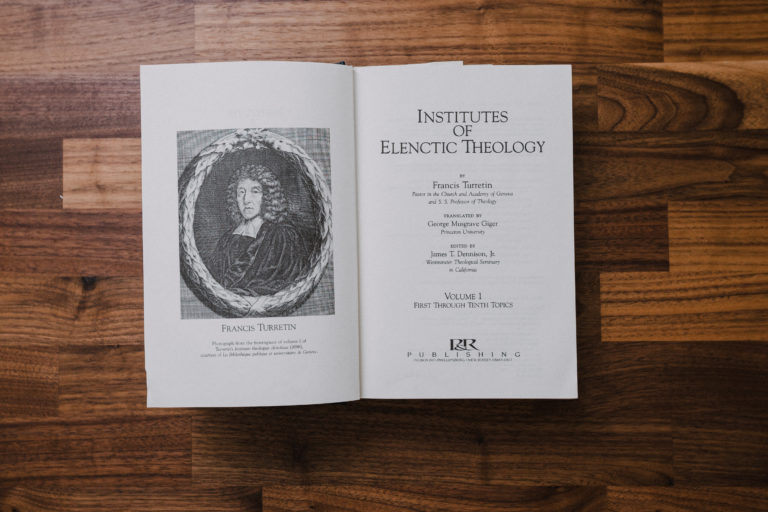
Francis Turretin, Institutes of Elenctic Theology vol. 1, Second Topic, Q. 10, Sec. II.

So then to rephrase the question in the title, Turretin is asking, “Have the copies of the Old and New Testament come down to us pure and uncorrupted.” To which he answers, “Yes.” And why is this? Because the copies, the apographs, “set forth to us the very word of those who wrote under the immediate inspiration of the Holy Spirit.” So where the CSI speaks of the originals as those written by Moses, the Reformers clearly state above that “we do not mean the autographs.” Instead, Turretin speak of the copies as the originals because they have come down to us in the very words of the inspired penmen. On this point, Richard Muller observes a sundering between the way the Protestant orthodox argue for the originals and they way Warfield, Hodge, and the current evangelical academia argue for it. Muller writes,

“A rather sharp contrast must be drawn, therefore, between the Protestant orthodox arguments concerning the autographa and the view of Archibald Alexander Hodge and Benjamin Breckinridge Warfield. This issue must be raised because of the tendency in many recent essays to confuse the two views.”

Richard Muller, Post-Reformation Reformed Dogmatics: Holy Scripture, 414, n. 192.

Muller writes in another place,

“The orthodox do, of course, assume that the text is free of substantive error and, typically, view textual problems as of scribal origin, but they mount their argument for authenticity and infallibility without recourse to a logical device like that employed by Hodge and Warfield.”

Muller, Holy Scripture, 415.

In sum, the Standard Sacred Text position and those like it hold to a different view than the modern critical text evangelical. Where the former claim the original to be the apographa which gives to us the very words of the autographa, the latter claims the original to be the autographa and the autographa alone. We here at StandardSactedText.com hold to the former along with the Protestant church who held to this belief for hundreds of years amidst the rise and fall of critical theories (e.g., JEPD, The Search for the Historical Jesus, Form Criticism, Redaction Criticism, Lower Criticism, CBGM etc.] We are not looking for the original text nor are we looking for the initial text. This is because we believe we have the original in the apographa of the Greek and Hebrew. And from this apographa we get the King James Bible.

Have any canonical book perished? We deny.

As part of our Bibliology Primer we now turn to Francis Turretin’s seventh question in which he asks, “Has any canonical book perished? We deny.” He goes on explain that the Scriptures can be spoken of as canonical in two respects: “either for the doctrine divinely reveled or for the sacred books in which it is contained.” In this question Turretin addresses the latter of the two. He does so by offering six arguments which we here at StandardSacredText.com believe are relevant even today in the modern western discussion of text and canon. Turretin’s first argument is as follows,

“Proof is derived. (1) from the testimony of Christ ‘it is easier for heaven and earth to pass, than one tittle of the law to fail’ (Lk. 16″17; cf. Mt. 5:18).

Francis Turretin, Institutes of Elenctic Theology vol. 1, Second Topic, Q. VII, Sec IV.

Note Turretin’s marshalling of Like 16:17 and Matthew 5:18. We are told now-a-days that Jesus was speaking in an oriental hyperbole at this point. He could not have meant that literally. And yet it is the historical orthodox position that Jesus did indeed mean this literally. As asked in other posts, Were the Reformers aware of textual variants? Yes. Where they aware of differing manuscripts? Yep. Even with these facts before them they still took jot and tittle to mean jot and tittle. Turretin goes on to explain,

“But if not even one tittle (or the smallest letter) could fail, how could several canonical books perish.”

Turretin, Institutes, vol. 1, Second Topic, Q. VII, Sec IV.

Notice here how he moves from the parts to the whole. This is what we call a synechdochic relationship where the part speaks for the whole and the whole speaks for the part. Here Turretin, because of the testimony of Scripture, is so certain of the part that he is able to make a canonical claim. Who in modern Protestant academia would attempt such a feat? Currently the modern American church is not sure of the parts and that is why they speak in percentages – we are sure of 94% of the Bible or 98% of the Bible or the words of God are either in the text of the apparatus. These claims cannot begin with the parts and then conclude which books are canonical. Rather we live in a time where scholars begin with the canonical books and then tell us we have most of the parts.

Turretin goes on to his second arguments by writing,

“(2) From the declaration of Luke and Paul: neither could Luke have made mention of all the prophets and of all the Scriptures (Lk. 24:27), if any portion of them had perished.”

Turretin, Institutes, vol. 1, Second Topic, Q. VII, Sec IV.

He goes on.

“…nor could Paul have asserted that ‘whatsoever things were written aforetime were written for our learning’ (Rom. 15:4), unless they supposed that all the writings of the Old Testament existed.”

Turretin, Institutes, vol. 1, Second Topic, Q. VII, Sec IV.

Here we see in both proof one and two that Turretin begins his argument by allowing the Scripture to tell us about itself. He does not first turn to the manuscript evidence of his time or the authority of the academic elites. He simply states what the Bible says and then believes and argues that. Kind of like what we do here at StandardSacredText.com? Note further that Turretin does no seem to be referencing here the LXX, a translation of the Old Testament. Rather it seems that he understands Luke and Paul to be speaking directly of the Hebrew Old Testament.

From the exegetical arguments Turretin then turns to the theological arguments beginning with the providence of God. Turretin writes,

“(3) From the providence of God perpetually keeping watch from the safety of the church (which cannot be conceived to have allowed her to suffer so great a loss).”

Turretin, Institutes, vol. 1, Second Topic, Q. VII, Sec V.

Interestingly enough here Turretin connects the preservation of the canon to the safety of the church. In modern terms, the work of higher and lower textual criticism is not merely a discipline unto itself as if these can be done apart from affecting the safety of the church. Indeed, it cannot. Textual criticism and the safety of the church go hand in hand. The atheist understands this. The Muslim understands this. But it does not appear that many Christian academics understand this. Is the church now safer and healthier because once they have been taught oldest, shortest, and hardest is best or that the CBGM is the answer? The burden of proof rests with the critical camp and they have yet to satisfy that burden.

“(4) From the duty of the church which is religiously to preserve the oracles of God committed to her and to search them diligently.”

Turretin, Institutes, vol. 1, Second Topic, Q. VII, Sec V.

All we are doing here is carrying on this centuries long belief that it is Spirit of God by the word of God speaking to the people of God by faith. Here Turretin puts that as God has given the church the duty to religiously preserve the Bible – not scholarship, not the academy, not the publisher. This is a God ordained church duty, a religious duty, a duty which demands theological a prioris. The moment textual criticism became an issue of evidence and manuscript traditions is the moment the discipline of textual criticism strayed from orthodoxy and from the teaching of Scripture (Is. 59:21).

“(5) From the purpose of the Scripture which was committed to writing as a canon of faith and practice even to the consummation of ages which could not be obtained, if (by the loss of some canonical books) a mutilated and defective canon (or rather no canon at all) has been left to the church.”

Turretin, Institutes, vol. 1, Second Topic, Q. VII, Sec V.

Here we see the potential catastrophes Turretin would not allow for. For Turretin and for us here at StandardSacredText.com, if the church lost a canonical book or if the canonical books were mutilated or defective then we, the church, could not obtain a canon of faith and practice. So while the missing of whole book would be catastrophic to Christian faith and practice it would be equally as catastrophic to Christian faith and practice if one book of the Christian canon were mutilated or defective i.e., the existence of doctrinally significant errors which average to about 14 per book of the New Testament.

Before moving to the sixth and final argument I think it is good to observe that Turretin here does not begin his presentation with evidence or the manuscript tradition or textual methodology. No, first he begins with what the Bible says about itself and then he moves to theological conclusions. Only after these does he employ historical evidence when he writes,

“(6) From the practice of the Jews; because no more canonical books of the Old Testament were acknowledge by them than by us, nor copied in the Targums, nor translated in the Septuagint.”

Turretin, Institutes, vol. 1, Second Topic, Q. VII, Sec V.

So here we have six proofs representing the historically orthodox arguments for the present existence of the very books penned by the original penmen: 2 exegetical, 3 theological, and 1 historical/evidential. This looks to be fair balance when discussing what is or is not Scripture, what is or is not canon, what is or is not the words of God.

The Strange New World Within The Bible

Welcome to the Brickyard. This is a place to find quotes for use in your own research. The bricks are free but the building is up to you. The following quotes are from Karl Barth’s The Word of God and the Word of Man, Section II entitled, the Strange New World Within The Bible. Certainly there is much to critique Barth about when it comes to Protestant doctrine, but still, he admits to certain Protestant themes which seem inescapable even at his time. I present the following quotes for your inspection and use.

“It is the Bible itself, it is the straight inexorable logic of its on-march which drives us out beyond ourselves and invites us, without regard to our worthiness or unworthiness, to reach for the last highest answer, in which all is said that can be said, although we can hardly understand and only stammeringly express it.”

Barth, The Word of God, Sec II.

In answering what is in the Bible, Barth writes,

“A new world, the world of God.”

Barth, The Word of God, Sec II.

“There is a river in the Bible that carries us away, once we have entrusted our destiny to it – away from ourselves to the sea.”

Barth, The Word of God, Sec II.

“The Holy Scriptures will interpret themselves in spite of all our human limitations.”

Barth, The Word of God, Sec II.

“We read the Bible rightly, not when we do so with false modesty, restraint, and attempted sobriety, for these are passive qualities, but we must read it in faith.”

Barth, The Word of God, Sec II.

“The Bible unfolds on us as we are met, guided, drawn on, and made to grow by the grace of God.”

Barth, The Word of God, Sec II.

Weekly Question – What Would It Take…

What would it take for you to believe the Bible you read is indeed all the words of God that God intended to be in your Bible? Whose opinion would you need to persuade you that your Bible is God’s word down to the very words? How would you know to judge that person’s opinion as worthy of making such claims about your Bible? Who says that you or that person’s opinion is actually the truth and not merely an opinion?

The Prophet Jeremiah and the Status of the Original

In this series we have looked at the themes of inspiration, transmission, and textual criticism from Jeremiah 36. If you remember, Jeremiah is told to write the words of God in a scroll which will pronounce divine judgment upon Jehoiakim, king of Judah. The text tells us that Jeremiah did not write these words himself, rather his servant and scribe Baruch did the honors. We then say that once the text was read in the ear of the king that the text was cut into pieces and cast into a nearby fire.

Subsequently God commands that Jeremiah write the same words again. The Bible says,

“Take thee again another roll, and write in it all the former words that were in the first roll, which Jehoiakim the king of Judah had burned.”

Jeremiah 36:28

First, God commands Jeremiah to write all the words that were written in the scroll that is now destroyed, reduced to ashes in the fire. Has anyone accidently deleted an email or Facebook post your were working on? But it was so good so you tried to duplicate it. How did it go? Do you think you wrote every word in the order in which you first wrote them? Here Jeremiah by inspiration does exactly that. He wrote “all the former words that were in the first roll.” So now we have two originals. One that was burnt in the fire and this new one.

Second, Baruch was again the one to write the text. The Scripture reads,

“Then took Jeremiah another roll, and gave it to Baruch the scribe, the son of Neriah; who wrote therein from the mouth of Jeremiah.”

Jeremiah 36:32

So not only did Jeremiah not forget one single word, but Baruch once again wrote with perfect affinity to Jeremiah’s dictation. Does anyone think that Jeremiah violated Baruch’s will by dictating to him the words of God? It is difficult to say that Jeremiah did anything of the sort. What kept Baruch from committing an error in two different texts? Was Baruch also inspired along with Jeremiah? If not was Baruch providentially preserved from committing a single error in both the first original and then the second original?

Third, which is the original? Jeremiah first wrote a text that was destroyed and then another text was made with all the words from the first but with additions. The Scripture reads Baruch wrote all the words of Jeremiah,

“and there were added besides unto them many like words.”

Jeremiah 36:32

Suppose someone made a perfect copy of the first scroll before it was burnt up in the winter house of Jehoiakim and affirm that Jeremiah has now written a second text. So which of the two manuscripts is the oldest? The burnt up one. Which one of the two manuscripts is shortest? The burnt up one. Which one is the original? The newer longer one and not the oldest and shortest one. We’ve known this story for thousands of years and yet many Christians are convinced that oldest, shortest, and hardest is the best reading. Here the Bible tells us that is not the case. In fact, oldest, shortest, and hardest is not regarded a criteria at all here in Jeremiah. The only criteria is that the words brought to the king are the words of the LORD by the prophet Jeremiah and the truth regarding those words can only be known by reading the actual words of God by faith and through the power of the Holy Spirit.

The Object of Faith

It’s late and I’m tired but the show must go on so today/tonight’s post is going to be brief. What is faith aimed at in the Christian life? For the Protestant scholastics there were two categories: First, Christ and then the Scriptures. Muller writes regarding the object of faith,

“obiectum fidei: object of faith;

distinguished by the scholastics into two categories: the obiectum formalis fidei, or formal object of faith, which is Scripture; and the obiectum materialis fidei, or material object of faith which is Christ, or more precisely, the whole revelation of God as it is fulfilled and given in Christ.

Richard Muller, Dictionary of Latin and Greek Theological Terms: Drawn Principally From Protestant Scholasticism, Term: obiectum fidei.

In short, Christ is what we believe in [material] and the Scriptures are the means by which we believe in Christ and His work [formal]. This interrelation between the formal and material necessitates the existence of a text capable of such a task i.e., to be the means whereby the Christian believes in Christ and His work. An admittedly corrupted Scripture is not explicitly capable of said task, while an admittedly pure text is.