Scripture as Touchstone

“lapis lydius: Lydian stone, touchstone, standard, or benchmark;

originally a hard black flint used by the ancients to test the purity of gold and silver according to the streaks left on the stone when rubbed by the metals, by extension a standard and invariable test of quality. Scripture is thus frequently referred to as lapis lydius.”

Richard Muller, Dictionary of Latin and Greek Theological Terms: Drawn Principally from Protestant Scholasticism, Term: lapis lydius.

Scripture is the touchstone, the standard, the black flint upon which all theological teaching is tested and found genuine or wanting. Scripture is also the touchstone of Scripture being a first principle. Only God’s words can properly verify God’s words so also Scripture, being God’s words, can only be properly verified by Scripture itself through the living testimony of the Spirit of God.

As the Scriptures teach in I Cor. 2:11, “For what man knoweth the things of a man, save the spirit of man which is in him? even so the things of God knoweth no man, but the Spirit of God.” In other words, not only is Scripture the touchstone of all theological claims like Jesus was born of the virgin Mary and I John 5:7 is not Scripture, but Scripture is also its own touchstone and therefore able to answer whether 1 John 5:7 is actually Scripture.

From what source does the divine authority of the Scriptures become known to us? (Part 3)

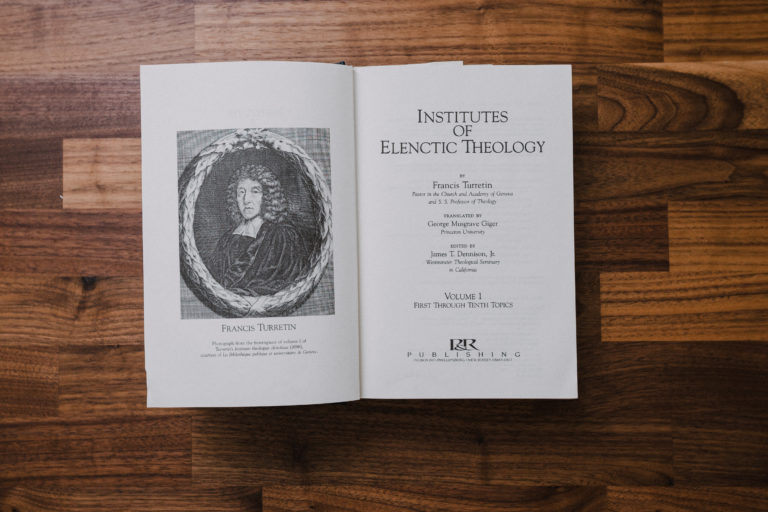
Continuing our Bibliology Primer and specifically Turretin’s treatment of how a Christian comes to know the authority and divinity of Scripture we now turn to the self-attesting and self-authenticating character of Scripture. Turretin writes,

“That the Scripture makes itself known to us is proved: (1) by the nature of Scripture itself.”

Turretin, Institutes of Elenctic Theology, Second Topic, Q. VI, Sec. 11.

And how is it that Scripture makes itself known itself? Turretin gives a familiar example from his time. Again, he writes,

“For as a law does not derive its authority from the subordinate judges who interpret it or from the heralds who promulgate it, but from its author alone.”

Turretin, Institutes, Second Topic, Q. VI, Sec. 11.

In other words, the Scriptures make themselves known by themselves because God’s words can only be known by God’s words. There is no authority or grounding prior to or more potent than God’s words. Therefore only God’s words can prove God’s words to be God’s words.

Turretin takes this point a step or two further by identifying the Scriptures as a first principle.

“(2) By nature of the highest genera and of first principles; for those things are known by themselves and are not susceptible to proof which cannot be demonstrated by any other, otherwise the thing would go on into infinity.”

Turretin, Institutes, Second Topic, Q. VI, Sec. 11.

If there were a more basic, more grounding authoritative principle than God’s words, call it X, then where did that more basic, more grounding authoritative principle derive its basicality, grounding, and authority? And if such a thing did exist, call it Y, then where did Y get its properties of more basic, more grounding, and more authority? Let’s say such a thing did exist and let’s call it Z. Where did Z get said properties? As you can see the list goes on and on into infinity.

This is what is known as an infinite regression of contingent particulars. Such a thing does not and cannot exist because it is infinitely contingent and is therefore infinitely potential and potential things have not yet come into existence, and in this case, infinitely so. Thus there must be a first grounding that is most basic and most authoritative and that grounding is God’s words. Nothing is more basic, more authoritative, and more grounding than God’s words. Therefore God’s words, the Scriptures, are a first principle. Thus Turretin concludes,

“Thus Scripture, which is the first principle in the supernatural order, is known by itself and has not need of arguments derived from without to prove and make itself known to us.”

Turretin, Institutes, Second Topic, Q. VI, Sec. 11.

And…

“If God has stamped such marks upon all first principles that they can be known at once by all men, we cannot doubt that he has placed them upon this sacred first principle (in the highest degree necessary to our salvation).”

Turretin, Institutes, Second Topic, Q. VI, Sec. 11.

Turretin’s third proof as to how Scripture is proved by itself is as follows:

“By comparison, as objects of the sense presented to faculties well disposed are immediately distinguished and known without any other external argument, on account of a secret adaptation and propensity of the faculty to the object.”

Turretin, Institutes, Second Topic, Q. VI, Sec. 11.

For example?

“Light is immediately most certainly known to us by its own brightness; food by its particular sweetness; an odor by its particular fragrance without any additional testimony.”

Turretin, Institutes, Second Topic, Q. VI, Sec. 11.

In like manner…

“the Scripture, which is set for to us in respect to the new man and spiritual sense, now under the symbol of a clear light (Ps. 119:105), then of the most sweetest food (Ps. 19:10; Is. 55:1-2; Heb. 5:14) and again of the sweetest smelling savor (Cant. 1:3), may easily be distinguished of itself by the sense of the new man as soon as it is presented to them and makes itself known by its own light, sweetness and fragrance.”

Turretin, Institutes, Second Topic, Q. VI, Sec. 11.

This idea of self-attesting and self-authenticating will be developed further as we continue our way through our Primer and particularly through this sixth question. But for now, suffice it to sum up in the following way. The Scripture’s attestation to iteslf is shown in three ways: (1) God as author of God’s words is the only fit witness to God’s words because they are His words, (2) Scripture is the most basic and most authoritative grounding principle and is therefore in the genera of first principle. As such, it cannot be proven by something more more basic or more authoritative than itself, and (3) the Scripture is known in a basic sort of way. Just as we know we taste baklava at the moment we taste baklava or smell our wife’s perfume at the moment we smell her perfume, so also we known the “light, sweetness, and fragrance” of God’s words when we by faith see, taste, and smell the words of God.

We do not however know our wife’s perfume by snatching 5,700+ molecules from the air, testing them, comparing them, seeing which are older, pass it through the coherence based fragrance method coupled with the “art” of fragrance criticism and finally conclude that the fragrance we are smelling is probably either our wife’s perfume or in the air apparatus.

Thomas Watson and the Doctrine of Scripture

Welcome to the Brickyard. This is a place to find quotes for use in your own research. The bricks are free but the building is up to you. The following quotes are from Thomas Watson’s A Body of Divinity which was first written in 1692 which is 80 years after the translation of the 1611 King James Version. In the preface, C.H. Spurgeon writes of Watson’s work,

“Thomas Watson’s Body of Practical Divinity is one of the most precious of the peerless works of the Puritans; and those best acquainted with it prize it most.”

Watson, Body of Divinity, vii.

The following is a series of quotes demonstrating the aforesaid peerless work. I hope they are a blessing to you.

“We may know the Scripture to be the Word of God by is miraculous preservation in all ages.”

Watson, Body of Divinity, 27.

“God has preserved this blessed Book inviolable to this day.”

Watson, Body of Divinity, 27.

“The Book of God has no errata in it; it is a beam of the Sun of Righteousness, a crystal stream flowing from the fountain of life.”

Watson, Body of Divinity, 27-28.

“All maxims of divinity are to be brought to the touchstone of Scripture, as all measures are brought to the standard.”

Watson, Body of Divinity, 30.

“The Scripture is to be its own interpreter, or rather the Spirit speaking in it. Nothing can cut the diamond but the diamond; nothing can interpret Scripture but Scripture.”

Watson, Body of Divinity, 31.

“Thou are inexcusable, O man, for God has given thee a rule to go by, he has written his law with his own finger.”

Watson, Body of Divinity, 32.

“Till we are above sin, we shall not be above Scripture.”

Watson, Body of Divinity, 33.

“The Spirit of God acts regularly, it works in and by the Word, and he that pretends to a new light, which is either above the Word, or contrary to it, abuses both himself and the Spirit: his light is borrowed from him who transforms himself into an angel of light.”

Watson, Body of Divinity, 33.

“It is a saying of Luther, Quos Dues vult perdere, &c., ‘whom God intends to destroy, he gives them leave to play with Scripture.'”

Watson, Body of Divinity, 34.

“Think in every line [of Scripture] you read that God is speaking to you.”

Watson, Body of Divinity, 35.

“If the Scripture is of divine inspiration, believe it.”

Watson, Body of Divinity, 36.

“Though we should not be of contentious spirits, yet we ought to contend for the Word of God.”

Watson, Body of Divinity, 37

“We are not left in doubtful suspense that we should not know what to believe, but we have an infallible rule to go by.”

Watson, Body of Divinity, 38

“The Scripture is our pole-star to direct us to heaven, it shows us every step we are to take; when we go wrong, it instructs us; when we go right, it comforts us; and it is a matter of thankfulness, that the Scriptures are made intelligible, by being translated.”

Watson, Body of Divinity, 38.

Again, the King James Version had been in circulation for over 80 years at this time Watson speaks of translations.

From what source does the divine authority of the Scriptures become known to us? (Part 2)

Beginning again with Turretin,

“But although we do not deny that the testimony of the church has its own weight (as will afterwards be seen), yet we maintain that primarily and principally the Bible is believed by us to be divine on account of itself.”

Francis Turretin, Institutes of Elenctic Theology, vol. 1 Second Topic, Q. VI, Sec 4.

Here Turretin plainly states that it the Scriptures itself which is the source of our knowing that the Scriptures are authoritative. But before you charge this eminent Reformation scholar of circular reasoning or begging the question, remember that the Scriptures are a first principle. Indeed, the first principle of theological knowledge and as such are not demonstrated or proven by some prior more basic authority. Put simply, God’s words cannot be demonstrated, substantiated, or proven by some greater authority than God’s words. In this case it is all too natural that the Scriptures authoritatively testify of themselves. That said, Turretin divides our believing the authority of Scripture on account of the testimony of Scripture into three parts. He writes,

“As a threefold cause can be granted for the manifestation of anything (an objective, efficient and instrumental or organic), so a threefold question can arise about the divinity of the Bible.”

Turretin, Institutes, Second Topic, Q. VI, Sec 6.

The three questions regarding belief in the authority and divinity of Scripture are these:

“the first, concerning the argument on account of which I believe; the second, concerning the principle or efficient cause from which I am lead to believe; the third, concerning the means and instrument through which I believe.”

Turretin, Institutes, Second Topic, Q. VI, Sec 6.

For the first – the argument on account of which I believe – Turretin writes,

“For the Bible with its own marks is the argument on account of which I believe.”

Turretin, Institutes, Second Topic, Q. VI, Sec 6.

For the second – concerning the principle or efficient cause from which I am lead to believe – he writes,

“The Holy Spirit is the efficient cause and principle from which I am induced to believe.”

Turretin, Institutes, Second Topic, Q. VI, Sec 6.

For the third – concerning the means and instrument through which I believe – he writes,

“But the church is the instrument and means through which I believe.”

Turretin, Institutes, Second Topic, Q. VI, Sec 6.

Finally, Turretin summarizes these three answers in the following way,

“Hence if the question is why, or on account of what, do I believe the Bible to be divine, I will answer that I do so on account of the Scripture itself which by its marks proves itself to be such. If it is asked whence or from what I believe, I will answer from the Holy Spirit who produces that belief in me. Finally, if I am asked by what means or instrument I believe it, I will answer through the church which God uses in delivering the Scriptures to me.”

Turretin, Institutes, Second Topic, Q. VI, Sec 6.

We here at StandardSacredText.com hold these answer as the paradigmatic answers for how we know the Scripture is authoritative and divine. The interrelation of the word of God, the Spirit of God, and the people God is the primary means whereby the people of God come to know Scripture, to know what is Scripture, and to know its authority and divinity. It is very much the invisible work of the Holy Spirit through His words to His people through faith. And why should this be surprising? This is the same work the Holy Spirit through the word of God does in the life of the believer in sanctification. It is the same invisible work performed by the Spirit through the word in a soul unto salvation.

“The wind bloweth where it listeth, and thou hearest the sound thereof, but canst not tell whence it cometh, and whither it goeth: so is every one that is born of the Spirit.”

John 3:8

One final observation, Turretin does not place scholarship or textual criticism within the paradigm when answering the question, How does the saint primarily come to know the authority and divinity of Scripture? Does this mean that the academy has no place in the Christian theological and apologetic enterprise? Certainly not. But what it does mean is that the academy and it fruits are not the primary means whereby the Christian comes to know the authority and divinity of this or that passage of Scripture. The Christian comes to know the authority and divinity of this or that passage by the Spirit of God speaking in the word of God to the people of God received by faith. Such a paradigm include the long ending in Mark and I John 5:7 among others.

Weekly Question – What is the difference between Confessional, Traditional, Ecclesiastical, and Standard Sacred Text?

If you’ve been around the “version debate” long enough and if you have read at least some of the relevant literature or listened to relevant podcasts you most likely have heard of terms like “Confessional Text position,” or “Traditional Text position,” or the “Ecclesiastical Text.” In today’s post I wanted to give a brief summary/definition of each position and then make some comments.

First, it is important to note that each of these terms/positions have the same goal. That goal is to closely adhere to the teaching of Scripture in the things it says about itself and then believe and defend those teachings. So why the different terms?

Second, the reason for the different terms is two fold: 1.) Just as it is currently the minority position in Western thought to believe that homosexuality and homosexual civil unions are immoral so also a desire and a call to believe and defend what the Bible says about itself is a minority position in the Church at large. As such, systematic pre-critical defenses of what the Bible says about itself have cropped up at different times and under different denominations. Dean Burgon was an Anglican. David Otis Fuller was a Baptist. Theodore Letis was a Lutheran. Jeff Riddle is a Reformed Baptist. The Van Kleecks would be Reformed Baptists as well. This diversity of time and denominational disposition has lead to the multiplication of terminology, and for good reason. 2.) The different terms exists because they focus on different aspects of what the Bible says about itself and the Christian’s relation to that Bible.

Traditional Text – The Traditional Text position anchors in the idea that there has been a traditional text and traditional text tradition in the Greek and Hebrew Original of the Masoretic Hebrew and Greek TR as well as an English text/textual tradition for the English-speaking Church found in the King James Version tradition. The focus here is on the tradition that the believing community has handed down to our believing communities from centuries past. To this we ask of our multiple version only brethren, “What tradition do you hand down to us?” “What ecclesiastical Greek tradition, Hebrew tradition, and English tradition?”

Ecclesiastical Text – The Ecclesiastical Text position retains the elements of tradition and the handing down of a Bible across the centuries while at the same time placing a greater emphasis on the notion that the Bible belongs to the Church. The Bible is not a commodity or asset in some publisher’s printing portfolio. The Bible belongs to and is stewarded by God’s people, the bride of Christ, the Church. Nor is the Bible a possession of academia. The Bible does not lie behind gates of a seminary education. The Bible belongs to and is accessible by both the most educated and the least educated Christian. To this we ask our multiple version only brethren, “In what way is the 1972 NASB possessed by and stewarded by the Church seeing it is no longer in print?” “What is the relevant difference between depending on a Roman Catholic priest for the truth of Scripture who reads only the Latin to us and depending on the evangelical textual critic for the truth of Scripture while he speaks in the academese of minuscules, majuscules, P52, internal/external evidence, CBGM, and the like?”

Confessional Text – The Confessional Text position seems to embody both of the above terms in that “Confessional” infers both the traditional and ecclesiastical custody of the Scriptures. Confessional not only speaks of confessing Christian belief in Christian theology and the Christian Scriptures, but in theological parlance, a Confession of Faith is also a distilled body of historical Christian doctrine. For our purposes, the Confessional Text position confesses belief in a distilled body of historical Christian Bibliology. As such, the term Confessional Text embodies the historical/traditional, ecclesiastical, theological, dogmatic, and practical aspects of orthodox Bibliology. Again we ask our multiple version only brethren, “What theological apparatus do you confess in substantiating the claims, oldest is best, hardest is best, and shortest is best?” What is your confessional ground for giving modern textual criticism its privileged position?”

Standard Sacred Text – As the name implies, the emphasis here is to argue for a single sacred text around which the English-speaking believing community can gather. That single text is the standard whereby all other current and subsequent English sacred texts are to be judged. Because it is in English it is a translation and is therefore dependent upon a standard sacred Greek and Hebrew. Here at StandardSacredText.com we regard the Greek and Hebrew to be the first standard from which the English sacred text is derived. The Greek and Hebrew standard are sacred because God providentially preserved every letter of every word of that standard per its own words about itself. The standard sacred English text is sacred in that the substantia doctrinae found in the original standard transfers to the translation – not immediately but derivatively. We hold these original standards to be the Masoretic Hebrew and Greek TR, and the standard sacred text of the English-speaking community is the King James Version of the Bible.

Postscript: Dear Sceptic, I hope you can begin to see that the arguments promulgated here as traditional, ecclesiastical, confessional, and standard sacred are not King James Onlyism or Ruckmanism or Riplingerism in a different dress. Instead, we hope you see it for what it is, an argument for the superiority of historical pre-Enlightenment Bibliology grounded in the self-attesting, self-authenticating, and self-interpreting testimony of Scripture concerning itself.

The Prophet Jeremiah and Transmission

Today we return to our short series on Bibliology and the prophet Jeremiah. Taking a look again at chapter 36 we find at least four relevant themes: 1.) inspiration, 2.) transmission, 3.) textual criticism, and 4.) the status of the original. Today we will look at the theme of transmission.

“Then Jeremiah called Baruch the son of Neriah: and Baruch wrote from the mouth of Jeremiah all the words of the LORD, which he had spoken unto him, upon a roll of a book.”

Jeremiah 36:4

First, Jeremiah receives a divine message and he is commanded to write that message in a scroll. But the Scriptures tell us that Jeremiah called an amanuensis, a secretary to write the words for him. Some commentators believe that Jeremiah was in some way hindered from the temple given verse 5. Perhaps he was in prison of some kind or perhaps he was merely forbidden from entering the temple. Perhaps this being “shut up” contributed to Jeremiah’s need for a secretary to take down his words. Whatever the reason, we know that Baruch took the words of the prophet as they were spoken in his ears and wrote them in a scroll as God commanded Jeremiah.

The question now is, “Who carried the inspired word?” Certainly Jeremiah did but did Baruch also? Was Baruch inspired as well? I would contend that the answer is, no. Baruch merely heard and wrote the divinely inspired message. The transmission of the text was so copied that the words of the LORD in vs. 4 are also called the words of the LORD in vs. 8 when Baruch reads them. Jeremiah 36:8 reads,

“And Baruch the son of Neriah did according to all that Jeremiah the prophet commanded him, reading in a book the words of the LORD in the LORD’s house.”

Jeremiah 36:8

So here we have an example of immediately inspired words given to Jeremiah who then commands that they be written at the hand of a non-inspired person on a page not written at the moment of immediate inspiration. Both the writing of Baruch and the written page come after the immediately inspired message given to Jeremiah, and the recorded words remain the “words of the LORD.” In theological terms, God’s words were God breathed and kept by God’s providence through the obedient instrumentality of men. The Scriptures we have today are the result of a series of providential preservations no different in kind than that which transpired between the words of Jeremiah and the words of his scribe.

But you say, “Scribes over time have introduced errors. What is to say that Baruch didn’t do the same, all things being equal?” Fair enough. First, if Baruch introduced errors, the Bible does not indicate as much. So the question is based on conjecture and not evidence. Second, most multiple version only advocates seem to argue that even if there were errors said document would still count as the “words of the LORD,” so why the question?

We here at StandardSacredText.com say the Christian Scriptures are without errors and is the “word of the LORD” and multiple version only advocates argue that their texts have some errors an is still the “words of the LORD.” It is easy to see why we believe our Bible is the words of the LORD, but is is not as easy to see why the multiple version only advocates believe their slightly erroneous Bibles are the words of the LORD. So while we both need to argue for inspiration, preservation, canonicity and the like, the multiple version only position must also explain how A can be A and non-A at the same time and in the same way. I do not envy your position.

The Foundation of Faith

fundamentum fidei: foundation of faith i.e., Christ, on whom the faith and salvation of humanity rests.

Richard Muller, Dictionary of Latin and Greek Theological Terms: Drawn Principally From Protestant Scholasticism, fundamentum fidei.

The foundation of faith can be divided into three parts:

“(1) the fundamentum substantiale, or substantial foundation, in Christ, the substance and object of faith.”

Muller, Dictionary, fundamentum fidei.

“(2) the fundamentum organicum, the organic or instrumental foundation, is the Word of God, the principium, or principle of faith, and the chief means of faith.”

Muller, Dictionary, fundamentum fidei.

“(3) the fundamentum dogmaticum, or dogmatic foundation, is that basic teaching of the church that comprises the essential articuli fundamentalies fidei and sustains the faith of the individual Christian.”

Muller, Dictionary, fundamentum fidei.

In sum, the foundation of faith is composed of the incarnate Word of God, the written word of God, and the preached word of God.

From What Source Does the Divine Authority of the Scriptures Become Known to Us? (Part 1)

We are now into the sixth question of Francis Turretin’s treatment of Bibliology. In a more everyday kind of way he asks, what source enables the Christian to know the divine authority of Scripture? The question may also be posed as, what source enables the Christian to know the divine authority of one book of Scripture, or one verse, or one word? Turretin, quoting Irenaeus, obesrves,

“Thus what Irenaeus says concerning the heretics of his day is appropriate to them, ‘When they are convicted from Scripture, they turn round and accuse the Scripture, as being corrupt, and having no authority.”

Francis Turretin, Institutes of Elenctic Theology vol. 1, Second Topic, Q. 6, Sec. I.

Note in the example that the heretic is convicted from Scripture. Some verse or passage or series of passages is used to convince the heretic of his wayward theology to which the heretic accuses the Scripture in those places of being corrupt or having no authority. So by what source do we come to know of the divine authority of Scripture in the twenty-first century?

In Turretin’s time it was the Roman Catholic ecclesiastical authorities which served as such a source. He goes on to quote several who testify to that effect. But what is that source today? What source tells the Church that these words are the true words of the New Testament and these words are not? I propose the answer in the twenty-first century is academia’s evaluation and interpretation of the manuscript evidence – a.k.a. textual criticism. Assuming this to be the case let us now commandeer Turretin’s examples but make one relevant change. Where the example reads “church” I will insert “textual criticism”. Turretin writes,

“Eck says that ‘the Scriptures are not authentic, except by authority of [textual criticism].'”

Turretin, Institutes, Second Topic, Q. 6, Sec. I.

“Baile says that ‘without the authority of [textual criticism] we should no more believe Matthew than Titus Livy.'”

Turretin, Institutes, Second Topic, Q. 6, Sec. I.

“Andradius says, ‘…the power and dignity of [textual criticism] are so great that no one without greatest impiety can resist it.'”

Turretin, Institutes, Second Topic, Q. 6, Sec. I.

Have you not heard these words before? Are they not familiar? What counts as the authentic reading? Why, oldest, shortest, and best of course. The Scriptures are not authentic generally speaking except by authority of these text critical rules. How many times have you heard that the work of textual criticism must be done while excluding theological presuppositions? The NT must be treated like any other text, like Hesiod or Sophocles.

One of the staple evangelical text critical arguments is to tell you that we have an “embarrassment of riches” in the NT textual tradition when compared to other ancient Greek writings. Without the authority of textual criticism we should no more believe Matthew than Hesiod. Have you ever tried to question the power and dignity of evangelical textual criticism? The masters of the craft have explicitly stated in print that such people are intellectually dishonest, dubious, “fundamentalist,” and even cultic. In a word, these are people of greatest impiety.

In sum, these arguments are first old and then boring. What is more, these arguments are funny in a sad kind of way because the very lines used to assault Protestant belief in the Scriptures are now used by Protestants to assault Protestants on the same topic. My how the tables have turned. Or something more like,

Lastly, if you disagree with my comparison in the above quotes, point me to the modern argument defending the words of the NT that does not use textual critical structures, interpretation, and conclusions as its cornerstone. I eagerly await your reply. In short, it seems as Protestants that we have traded the magisterium of the Roman Catholic church for the musings of academia and maybe it’s time for a reformation.

Culture and Scripture

Welcome to the Brickyard. This is a place to find quotes for use in your own research. The bricks are free but the building is up to you. The following quotes are from Hans Rookmaaker’s Modern Art and the Death of a Culture published first in 1970. The Scriptures have been and continue to be, though to a lesser degree, a cultural fixture. It is a common cultural artifact in the West and it is certainly the central element in ecclesiastical culture. Rookmaaker observes that culture has changed particularly in the realm of art and music. In terms of poetry, prose, story telling and the majesty of the subject, Scripture is also an example of art, indeed, of some of the finest art the world has ever seen, but it also has changed.

Consider the words of Rookmaaker as he comments on music starting in the seventeenth century up to the end of the nineteenth century. See if you can spot an correlation between the way music has changed and the way we now talk about the Bible. Rookmaaker writes,

“[I]n the seventeenth and eighteenth centuries, before the deep, dissolving effects of the Enlightenment became apparent, there was a unity in the whole culture.”

Rookmaaker, Death of a Culture, 186.

During the seventeenth and eighteenth centuries, did there not seem to be a unity of the whole ecclesiastical culture on the point of which English Bible to read? By the mid-seventeenth century the KJV was the near exclusive text of the English speaking world. Rookmaaker goes on to observe of these same two centuries,

“Ordinary churchgoers in Leipzig would listen to Bach’s cantatas in church. Even if they did not understand the supreme quality and depth of the music, they could enjoy it. The music was not written for an elite.”

Rookmaaker, Death of a Culture, 186.

Imagine everyday churchgoers listening to Bach played in their church. Imagine they did not understand the finer points of the music played but it was still beautiful and pleasant to the ear. Imagine an ecclesiastical community that had such a sense of beauty which counted Bach’s music among other things of beauty. Imagine Bach was not written for the elites. Imagine now everyday churchgoers listening to the KJV read in their church. Imagine they did not understand the finer points of the language read, but it was still beautiful and pleasant to the ear. Imagine an ecclesiastical community that had such a sense of beauty which counted the KJV among other things of beauty. Imagine the KJV was not written for elites but for the common man with less leisure time, less education, less peace, less healthcare than we do now. Rookmaaker continues,

“Nor were the simpler and folksier kinds of music strange to the ears of the cultivated. There was a sense of normality and genuineness about all this music that made it everybody’s music.”

Rookmaaker, Death of a Culture, 186.

So what Bible is everybody’s Bible? What Bible unites the cultivated and the uncultivated? The KJV did in the past, but what Bible does that for us now? It seems we have lost our Bible along with our art and culture.

In part because things shifted in the culture/art world in the nineteenth century. Rookmaaker writes,

“The nineteenth century made music into a kind of refined, cultural, almost pseudo-religious revelation of humanism, composed by the great heroes and prophets of mankind.”

Rookmaaker, Death of a Culture, 186.

And the same goes for the Scripture. In the nineteenth century the Bible became a human endeavor to find what words were indeed the original words of the New Testament. The Bible was treated like any other book. The manuscript tradition was interpreted and served up by the great scholastic heroes and prophets of mankind, and this trend continues to this day. They will find it for us [hero]. They told us they will [prophet]. And what was the result for the people in the pew? Again, something like what happened to music. Rookmaaker concludes,

“Everyday music became vulgar and coarse, low and without true human qualities.”

Rookmaaker, Death of a Culture, 186.

Everyday Scriptures are now vulgar [i.e., common] and coarse, or in common parlance, more wooden or technical. Everyday Scripture is not now the Scripture of our parents or grandparents. We have broken from them. Now the CBGM is going to do the work for the heroes. Talk about an effort lacking “true human qualities.” That is the goal. One of the main arguments against the KJV is that it is not vulgar enough, it is not common enough. The American culture which has more freedom, more time, and more leisure than any culture maybe ever in the history of man now says Kanye West is an great artist, Marvel Comics are great art and film, Steven Furtick is a great preacher, and the King James Bible is too hard to read. It all makes sense now.