Over at textandtranslation.org you can find a free PDF of Dr. Wilbur Pickering addressing the practice of textual criticism and the spiritual factors necessarily involved when dealing with God’s words. Here is a brief excerpt:
People who deny the existence of the Creator, and therefore of an inspired text, have no reason to participate in the debate (except in an attempt to defend their disbelief). The NT gains its importance by being divinely inspired; if it is not inspired, there is no point in wasting time criticizing its text (it would be irrelevant for today). Even so, most textual critics of the NT do not believe in its divine inspiration. So what motivates them?
Leaving aside those who want to defend their disbelief by attacking the belief of others, that the Sovereign Creator exists and has delivered a written Revelation to our race are given presuppositions. There are several biblical texts that affirm God’s purpose to preserve His Revelation, something logical and necessary, but they do not say how He would do it.
The Bible clearly teaches that Satan exists and that he is the leader of the opposition to God on this earth. This opposition includes the Holy Scriptures – it began in the Garden. Since both God and Satan have a keen interest in the destiny, or the fortunes, of the NT, any model of textual criticism that excludes the supernatural is doomed to go wrong. It follows that people who use such models are condemned to never get to the truth. Worse still, they are serving Satan, whether they believe it or not, as I will now explain.
Gaslighting is being told that what is conspicuous is not at all what is happening. A reporter standing in front of a burning building and saying that the riot occurring before your eyes is “mostly peaceful” is an attempt at gaslighting. Gaslighting is a methodology of authoritarian regimes to cause people to question what they see and accept whatever scenario they are being fed.
What the Church has witnessed for over 400 years is the spiritual fruit of adhering to the King James Bible. Every protestant denomination, congregational, presbytery, or episcopalian have for 4 centuries considered the King James Bible the sacred word of God in English. During this time, by God’s grace, the most extraordinary and exceptional of nations was founded, the United States of America. Now we are being told that 400 years of God’s blessing through adherence to the King James Bible never happened because of the failures of the Greek Received Text tradition. The sweetness and nourishment of the spiritual water for four centuries proves the purity of the well. As Carl Trueman has pointed out, the modern self has triumphed over societal and ecclesiastical institutions, the most egregious of these institutions being the Church which finds its foundation on and authority derived from, the word of God.
In an Orwellian spirit, the modern church goer is compelled to reject what they know to be true for what the authoritarian theological and ecclesiastical elite are telling them, and, because advocates of this critical gaslighting possess information dominance the common church goer has few options other to believe what they are being told. We are witnessing a censoring and erasing of the past, and the authoritarian imposition of a new “day one” from which all biblical analysis originates. I say authoritarian because of the post-critical disdain for pre-critical exegetical and theological formulation, the contempt held for Reformation era theological codifiers, and the derision pointed at the King James Bible. All bibles, except the King James Bible, are part of the panoply of multiple version onlyism.
What then is to be done when the answer to the question is conspicuous but there is a strident prejudice against the obvious, when absurd statements like, the burden of proof rests with identifying the TR with the autographs, when up until Warfield the every Protestant denomination, the believing community, American culture, and academy recognized the King James Bible and TR as the word of God? The question itself indicates the success of modern critical information dominance to erase four centuries of theological and ecclesiastical history from the mind of the questioner. So thorough has been the gas-lighting of post-critical information that reasonable appeals to the pre-critical past is like pointing to a blank slate and saying, “can you not see it?” The answer is no, they cannot see, their perceptual set beginning in the late 19th century, the historic limit imposed by post-critical information dominance.
For example, when Mark Ward says he spoke to multiple resources and together no one could locate any reference to Psalm 12:7 referring to the preservation of words prior to King James Version Onlyism, we should all take this observation to heart. For him this was not lax scholarship. After all the resources cited to the contrary, if his historical context for the theological and exegetical formulation began in the late 19th century, then such a finding is understandable. Ward’s paper is a current exhibit that the late 19th century is where theological and exegetical history begins for the information dominant. I surmise that if Ward finishes his paper, he will simply double down on the “fact” that there are no credible arguments for the preservation of “words” in Psalm 12:7, or perhaps, he will not finish his paper because it would require him to acknowledge the credibility of pre-critical theological and exegetical formulation, thereby breaking ranks with monolithic information dominance of which he is a part. Ward is a perfect example of the next generation of scholars who have bound their academic careers, not to critical investigation and discovery, but to the status quo of the information dominant. The thing ultimately to be forgotten is not Reformation theological codification, but the One, Jesus Christ. A scripture inaugurated in ~1881 is connected to the 1st century only on the word of those who possess information dominance. Christ and Christianity will be what the elite say He and it is.
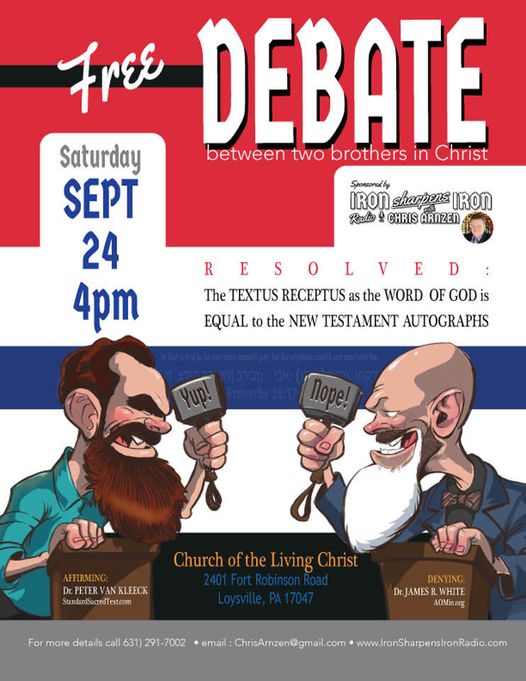
Today I have a brief story for you. As most of you know I am preparing to debate James White on the topic of Confessional Bibliology and the quality of the TR. As part of this preparation many have been sending me things to watch and watch out for. Thank you all for that.
One such person asked if I had ever listened to a particular debate from ages ago in internet terms. I responded by saying that I had watched it at least once. To which he accurately responded, “That debate was not filmed” from which we can infer that I had not watched the debate because there was nothing to watch.
But in the age of the internet something that has never been filmed can still be “watched”. I’m sure most of you can see where this is going.
I had indeed listened to said debate but through the means of YouTube which is something you can watch. It occurred to me in that moment that “watched” could mean that I watched the actual debate filmed [which in this case could not be done] but it can also be “watched” on YouTube though all there is on the screen is a graphic of the speakers and the title of the topic while the audio plays.
So when I said “I watched it”, my brother in Christ made a very accurate observation that it is unwatchable while at the same time because of YouTube you can “watch” a video where the audio of the debate is played over a series of graphics.
As such, it seems that “watched” in this context may have been another sneaky False Friend.
The book of Hebrews was written to religious people who were in the process of marginalizing Jesus Christ and returning to an earlier and less robust iteration of OT Jehovah worship. They were not departing from an historic religious tradition, one established by Moses after returning from Mt. Sinai, but from the fullest and final revelation of the Father in the person of His Son, Jesus Christ, Heb. 1:1-2. This drifting back (Heb. 2:1) is warned against in Hebrews 10:21, “It is a fearful thing to fall into the hands of the living God.” Once Christ was revealed, there was no other way. He alone was the way, the truth, and the life. One might imagine the historic strength of this path to apostasy. “Are we to leave the long-established tradition handed down by Moses on the word of a young rabbi who only taught for a little more than three years?,” they might ask. Miracles like soundbites are soon forgotten or chalked up to enthusiastic tales. Besides, terrible persecutions befall the followers of Christ. “I have a living to make and a family to feed. If I confess Christ, I will not only ostracize my Hebrew support base, but I will endanger my family. Believing the words of Jesus is too high a price to pay.”
And then Paul writes this letter. The Holy Spirit’s words convict the hearers of the weakness of their faith and the deadly, eternal consequences of departing from the faith once delivered unto the saints. “Christ alone” was on their lips as Christianity was propelled out to the 1st century by faithful believers who suffered in unimaginable ways as describes in Hebrews 11. And why? Because they knew, the words of Jesus conveyed by his Apostles, were the words of God. They could not deny their Lord.
In Hebrews 4:12 the Word of God is the weapon that wages war with the deceitful and desperately wicked hearts of man. The message is a savor of life unto life and death unto death, 2 Cor. 2:15-17, but in this passage, it deals with the Word as something that takes life – a sword.
Hebrews 4:12, “For the word of God is quick, and powerful, and sharper than any twoedged sword, piercing even to the dividing asunder of soul and spirit, and of the joints and marrow, and is a discerner of the thoughts and intents of the heart.”
Quick — The Word of God is alive. Scripture’s design is to have a dynamic impact on the hearer. The Word will produce an effect in your life because it is God’s word. It is not dormant. Nothing can be hid from the probing impact of God’s word upon the heart and mind.
“Men living in the flesh are universally impotent, perishing, limited; God, on the contrary (ch. xxxi. 3), is omnipotent, eternal, all-determining; and like Himself, so is His word, which, regarded as a vehicle and utterance of His willing and thinking, is not something separate from Himself, and therefore is the same as He.” Keil, Delitzsch, Isaiah, 143. For the comparison of man with flowers and grass see Isa. 37:27, Job 8:11-12, and 14:2, Psalm 90:5-6
Powerful — Its power is seen in the awakening guilt in the conscience for wrongs done, cf., Romans 7. Of Peter and John before the Sanhedrin: Acts 5:33, “And when they heard that, they were cut to the heart, and took counsel to slay them.” Of Stephen’s defense: Acts 7:54, “When they heard these things, they were cut to the heart, and they gnashed on them with their teeth.” Acts 7:57, “Then they cried out with a loud voice, and stopped their ears, and ran upon him with one accord.” Of Paul in the Jews in Corinth: Acts 18:6, “And when they opposed themselves and blasphemed, he shook his raiment.” Of Paul in Jerusalem: Acts 22:22, “Away with such a fellow from the earth; for it is not fit that he should live.”
Scripture’s power is recognized exposing fears in the mind to damnation and judgment; exposing secret feelings of the heart; “I really don’t like the direction my life is going” leading to repentance; causing the sinner to tremble with the knowledge of the coming judgment.
Sharper than any twoedged sword – Isa. 49:2, “And he hath made my mouth like a sharp sword.” Rev. 1:16, “And out of his mouth went a sharp two-edged sword;”
The metaphor is to show that the word can reach the heart, the very center of action and lays open the motives and feelings of the man.
Piercing even to the dividing asunder – the Word penetrates to divide. This is what swords do.
Of soul and spirit – psuche and pnuema – the life principle and the eternal spirit of man. To separate the one from the other is, therefore, the same as to take life. This is the idea here, that the word of God is like a sharp sword that inflicts deadly wounds by exposing the sinfulness of man. For example – Genesis 2:17, “But of the tree of the knowledge of good and evil, thou shalt not eat of it: for in the day that thou eatest thereof thou shalt surely die.” Deuteronomy 30:19, “I call heaven and earth to record this day against you, that I have set before you life and death, blessing and cursing: therefore choose life, that both thou and thy seed may live:” John 3:18, “He that believeth on him is not condemned: but he that believeth not is condemned already, because he hath not believed in the name of the only begotten Son of God.”
And of the joints and marrow — The metaphor of the sword taking life is continued. Swords take life. Such a sword would seem to penetrate even the joints and marrow of the body. It would separate the joints, and pierce through the very bones to the marrow. A similar effect, Paul says, is produced by truth. It penetrates to the inner part of man
And is a discerner of the thought and intents of the heart – what are you thinking and what do you intend to do with those thoughts. Men then are made to look upon their motives as they had never done before. Scripture illuminates their hearts feelings whose existence they would not have suspected if it had not been for the light of the truth. Many a man has a deep and fixed hostility to God, and to his gospel, who might never be sensible of it, if the truth was not faithfully proclaimed. The particular idea here is, that the truth of God will detect the feelings of the hypocrite and self-deceiver. They cannot always conceal their emotions, and the time will come when truth, like light poured into the soul, will reveal their unbelief and their secret sins.
The power of truth is fitted to lay open the secret feelings of the soul. It is fitted to expose the hearer to spiritual death to the end that they might accept the gift of spiritual life through Christ. Exposing spiritual hostility to Christ in the heart and this hostility’s end in spiritual death is the way the Scriptures produce believing faith. “So then faith cometh by hearing, and hearing by the word of God.” Romans 10:17
“All the great changes in the moral world for the better, have been caused by the power of truth…and, if we may judge of its power by the greatness of the revolutions produced, no words can over-estimate the might of the truth which God has revealed.” Albert Barnes
Have things changed that much since the 1st century? Is Christ alone enough? Is His word enough or must we seek an earlier, less robust iteration? Is trusting Christ’s words too high a price to pay?
Recently I watched a highlight of Dr. White dealing with the concept of Ontological Canon vs. Epistemological Canon. I am familiar with ontological, epistemological, and canon but the comparison/contrast infers two kinds of canons the Canon that is [Ontological], and the Canon we understand as Canon [Epistemological]. White dealt with this comparison in the context of dealing with Roman Catholic dogma regarding who has the authority to determine what is or is not Canon.
In the end, I did not find the distinction to be helpful because most theological systems instantly receive another category which could be easily summarized. Consider the following:
1.) We have the Ontological Trinity, the Economic Trinity, and now the Epistemological Trinity or the Trinity we understand as Trinity. 2.) There is Ontological Justification or Justification that is as God has ordained it. Then there is Epistemological Justification or the Justification we understand as Justification 3.) There is Ontological Prayer or Prayer that is as God ordained it. Then there is Epistemological Prayer or our understanding of Prayer as Prayer. 4.) There is Ontological Math or Math that is as God ordained it. Then there is Epistemological Math or our understanding of Math.
In each of these cases, depending on one’s sanctification in the Holy Spirit through the word, the Ontological element is unchanged but the epistemological element could be different and by differing degrees.
It seems easier and more parsimonious to simply state, “Ontology precedes epistemology” and “While human knowledge is not exhaustive knowledge it can nevertheless be true knowledge.”
Otherwise we end up, if applied to the whole of theology, Ontological Animals and Epistemological Animals, Ontological Sacrifices and Epistemological Sacrifices, Ontological Angels and Epistemological Angels, Ontological Patriarchs and Epistemological Patriarchs, Ontological Redemptive History and Epistemological Redemptive History and on and on.
In this sense, I’m just not sure the distinction [Ontological vs. Epistemological Canon] is helpful or even necessary.
In the aftermath of the Textual Confidence Collective debacle, Dr. Mark Ward thought it best to shoot a video declaring that he is done engaging Confessional Bibliology because he considers our side, for the most part, too rancorous. He then goes on to engage Confessional Bibliology, to share his thoughts on the problems of Confessional Bibliology, to assert his own position in opposition, to accuse certain of those who hold to Confessional Bibliology of being neither Confessional nor Biblical.
But I think this is Ward’s style and I think an anecdote he shares is a microcosm of his style. At one point in the video Ward let’s us know that his paper on Psalm 12:6-7 is on hold because one of his central points [i.e., Psalm 12:6-7 was never or very rarely used to defend the preservation of Scripture until the KJVO folks came along] turns out to be terribly misinformed.
He goes on to explain that he had a bunch of trusted persons review his paper and none of them pointed out the error of his conclusion on this point. It seems that Ward told this last part to say, “Hey, I have trusted advisors and even they didn’t know.” But this makes things worse, not better. More on this later.
Ward in this video and the TCC in general complain about how sometimes the rhetoric can get a little hot. That’s fair. The problem is that Ward et al often lump that hot rhetoric into not being kind/nice [the watchword of tyranny], or in more religious terms, hot rhetoric is not Christian or Christlike.
Setting aside the hard words of our Lord regarding religious leaders, which Ward is, and setting aside the hard words of John the Baptist toward religious and social leaders, and setting aside the hard words Elijah and Isaiah and Jeremiah and Ezekiel had for the religious and social leaders, the fact is that hard words or hot rhetoric are normal in certain contexts, e.g., when someone doesn’t do their job.
If you have ever been a manager of people on the job, part of your job is to hire competent people to fit with the chemistry of your team. Sometimes you hire a dud and the dud needs to be promoted to customer as they say at Amazon. For the rest of us, that means, “You’re fired.” The dud is fired because of his lack of competence or will to work [i.e., he is lazy]. These kind of employees get a verbal warning, then a second, then a written warning, then a second, then a third, then a “Road-to-Success” plan which sets weekly or monthly metrics, which leads to termination if not met.
Fired! That guy is now out on his ear. He has no means to provide for himself or his family. Now he suffers and his family suffers because of his incompetence and/or laziness. The bleeding heart cries out, “Give him another chance”, “It was a mistake. It won’t happen again”, “He has a family”, “Your company already makes so much money, so what if he can’t perform”, “You, the manager, are the problem” and “You set the standards too high”. In other words, “Be nicer.”
The question is, “Is Ward and the TCC good at their job, the job of critiquing Confessional Bibliology?” the answer is apparently, no, and for the following reasons:
1.) He and they regularly mischaracterize Confessional Bibliology. 2.) They regularly and without apology lumped Ruckman, Riplinger, Letis, and Riddle into the same category [i.e., absolutists]. 3.) Never once was a Confessional Bibliology proponent consulted regarding the accuracy of the TCC’s portrayal of Confessional Bibliology. 4.) He and the TCC do enjoy the majority position at this time and given Ward’s testimony regarding his Psalm 12:6-7 paper that majority position seems possessed of an insurmountable group-think at the highest level. I mean Ward has a Ph.D., I doubt he is seeking advice from less educated, less experienced, less wise people. 5.) They never once presented a robust argument for Confessional Bibliology in order to defeat it. The whole show was a Strawman and then when we point it out in strong terms Ward’s feelings got hurt and all because we weren’t nice enough in explaining to a Ph.D. that he Strawmanned our position and his group-think is so pervasive he doesn’t even know it. 6.) The treatment of Confessional Bibliology was so shallow that time and again the TCC resorted to bashing on KJVO and they could rhetorically, because they lumped KJVO in with Confessional Bibliology. This seems by design and if so demonstrates that they were incompetent and so they were “Canceled” as Matt Walsh is fond of saying. 7.) Then for the cherry on top Ward makes a video saying he is not going to engage Confessional Bibliology any more and then goes on for the next ten minutes engaging Confessional Bibliology. I’m beginning to wonder about the quality of this quasi-ministerial team he keeps consulting for advice. I would think that at least one of them would have said, “Mark, isn’t this whole video about how you are done engaging Confessional Bibliology? I mean, if it is, why then is nearly all the content bent on engaging Confessional Bibliology?” But no, Mark and his team of counselors apparently missed that detail.
Mark, this isn’t a Christian thing though there are plenty of examples of hard words spoken by godly men about error, evil, and doubting God’s word. Imprecatory Psalms ought to suffice to make that point.
Our critique is that while you have a Ph.D. as so do most of the members of the TCC you are an incompetent employee, either that or you are lazy. What I am saying is that we would fire you and the TCC as interlocutors. I can simultaneously love a brother in Christ but fire him because he doesn’t keep his schedule as one of my delivery drivers. In like manner, I can love you in the Lord while at the same time acknowledge directly and pointedly that you don’t do your job well [i.e., the job of critiquing Confessional Bibliology].
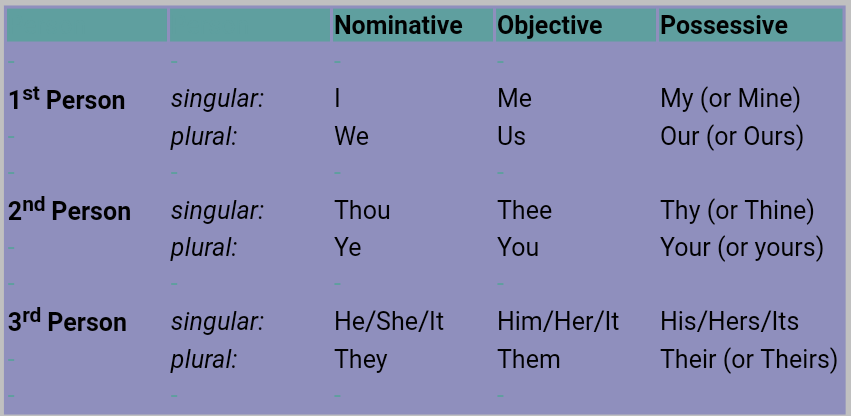
At TextandTranslation.org, Christian McShaffrey and Mark Ward have jointly shared their respective views on the use of “thee” and “ye” in the Authorized Version and whether such terminology should be abandoned. McShaffrey does a fine job defending their use and it seem quite clear that Ward technically concedes McShaffrey’s point.
“Resolved: The TR as the Word of God is Equal to the NT Autographs”
I’m surprised James White took the topic. I don’t think White will say that the TR is not the Word of God. As far as “is Equal to the Autographs”, seeing he has never seen them I’m unsure how he knows the TR isn’t them.
The date for the debate is set for September 24th.