The Textual Confidence Collective Closes Up Shop

We have finally come to the last episode of the Textual Confidence Collective [TCC]. This episode was about 30% shorter than all the others. The bulk of the conversation took place around things each member was thankful for, what they appreciated most about their own podcast, and books they recommended for further study. I was glad to see that I had already read a couple of them. Brash’s book and Myths and Mistakes have been added to my reading list.

Given the nature of this episode they offered little by way of new information and argumentation though they did not wholly escape from such observations. In fact, one of the salient elements of their position on the authority of textual critics was no more clearly stated than in this episode.

1.) Both in the intro and around [10:42-10:50] Tim Berg, in the context of saying that the Holy Spirit has not left the Church, states,

“We want to honor the work Spirit that He does through imperfect people, imperfect translators, imperfect textual critics and not to look at that and take something that is the work of the Spirit and accuse it of being the work of the Devil.”

Here Berg, like the TCC in Episode 6, seems to assume the general goodness of textual criticism. Indeed, he seems to indicate that textual criticism is by default the work of the Holy Spirit and anyone who demurs on this point is accusing text-critical work of being the work of the Devil.

Berg has erred on both extremes. First, he nor the TCC has yet to establish the work of textual criticism as being the work of the Holy Spirit. There is no exegetical or theology grounding for making that point other than, “By God’s providence He causes the rain to fall and the tides to rise and so His providence oversees textual criticism.” This is true, but it does not make textual criticism good. God’s providence thusly construed allows for the death of churches and Christian institutions. His providence oversees the dissolution of homes and nations.

No where does the TCC address this side of divine providence. The side that accounts for the destruction of good things, the pruning side, the testing side of divine providence. The point being, the TCC has not and does not address the reality that divine providence can allow for wolves into the fold nor has the TCC demonstrated that textual criticism is a lamb instead of a wolf.

Until the TCC and those like them make such a robust defense it seems fair to conclude that for the TCC and those like them, the academy is God’s instrument for determining what is or is not God’s word because they are doing the work of the Spirit and all those who disagree are carrying the message of Satan. In kind, this is not different than claiming the Pope or the College of Cardinals are doing the work of God the Holy Spirit and all those who disagree are of the Devil.

We have been making this case for years and it is often ignored. But Berg’s words here in this last episode have made our case for us and made it loud and clear.

By contrast, we argue that it is the Holy Spirit working through not textual scholars but through the rank and file of the Christian faithful. There the Holy Spirit speaks through His words to His people and they accept the Spirit’s words to be His words by faith. The work of the Spirit in God’s people is throughout Scripture and easily defended. The work of the Spirit through textual critics is a much more difficult claim, which may explain why we have yet to receive exegesis on this point.

2.) From the beginning of our critiques of the TCC we have observed the trauma that all four members of the TCC had experienced. In this episode they made a point to call for unity among the brethren on the textual/version issue. And yet at least two of the TCC have experienced horrible familial fracturing, and over what?

The TCC argues time and again that the differences between the KJV and the other versions are minor. They argue that no major doctrine is at stake and yet Tim, Peter, and Mark all profess in this episode to have lost friends and family including the approval of their parents because they forsook a version [the KJV] which according to their words has only minor differences and where no major doctrine is at stake.

Members of the TCC are the kind of people that allow fracturing of their families and the loss of friendships over what they believe are minor details and non-doctrinal issues, and yet in the same breath call for unity. Based on what?! If the TCC is ready to break up families and lose friendships over what they call minor details and things of non-doctrinal significance, I can’t understand why they could ever consider themselves champions of unity within the body of Christ. They are willing to hurt families and lose friendships over minor details which “often aren’t even translatable” and non-doctrinal differences.

And why is it that the TCC is the culprit for this brokenness of family and friendship? Because the TCC is the thing that has moved. The TCC’s friends and families already hold to a Bible. They have not moved. It is the TCC that has caused the ruptures. If the KJV has only minor differences and no doctrine is at stake, then the least the TCC could have done is honor their fathers and mothers, a clear and obvious commandment of Scripture, and they would be far better off. They would have whole families and friendships, they would obey the fifth commandment, and they would have a Bible with only minor differences that don’t affect doctrine. That’s a win, win, win. But instead the TCC has opted for fractured families, wrestling with the fifth commandment, and a Bible [i.e., ESV, NIV, CSB] that also, in their words, has minor differences that don’t affect doctrine.

In sum, the TCC’s argument has traded healthy relationships and a Bible with minor differences that don’t affect doctrine [i.e., KJV] for broken relationships and a Bible with minor differences that don’t affect doctrine [i.e., ESV, NIV, CSB]. All the while claiming to be champions of unity. I hope you can see that unity has been sacrificed, in the confines of their arguments, for nothing. The TCC will sacrifice unity for no gain except perhaps for academic recognition within limited evangelical circles. Yeah, definitely trade familial cohesion for academic recognition. That’s a biblically sound idea.

3.) I appreciated the TCC’s quotations of what they call “absolutists”. In several episodes as in this one, the TCC took the opportunity to quote someone who held to something approximating a standard sacred text or confessional text, and then of course proceeded to belittle the “absolutist” position. The value though of this exchange is that it appears all three positions have existed for a very long time. There have always been those who held to a standard sacred text, those who doubted the text a little, and those who doubted the text a lot.

The TCC likes to think they hold a moderate position, but as the economist and diplomat George Shultz once opined,

“He who walks in the middle of the road gets hit from both sides.”

The TCC’s position is not moderate, it is untenable and simply because they can point to those in the past that held something similar to their position does not mean their position is viable. To this day the whole of their position is stitched together by a scrap here and there demonstrating the existence of there position. What they do not have is a robust exegetical tradition and systematic theology to defend their position.

While the Ecclesiastical Text and the Skeptical position have robust systems drawn from extensive argumentation throughout history on questions of first principles, metaphysics, epistemology, authority, religion, science, Scriptural exegesis, archeology etc.; the TCC and the middle-of-the-roaders are merely attempting to claim “peace in our time” between the skeptic and the Christian worldview and as such are caught in the crossfire.

Overall I thought the TCC has well produced videos and in this regard I was challenged to step up my aesthetic game in presentation. As for the content, their argument was little more than the standard regurgitation you could get out of any intro to text-criticism book or class.

Regarding Confessional Bibliology it would have been a huge help to the TCC to at least have Jeff Riddle or the like review their questions and offer some accurate content to interact with. As it stands, the TCC basically spent their time asserting why their position was the best and then beating up on KJV Only IFB folks, paying little attention to IFB KJVO’s epistemological warrant and the robust theology behind a Confessional Text.

All in all I appreciate the work that the TCC did over these last seven weeks or so. Their arguments did little to move the ball down the field. They provided plenty of opportunity to show their lack of understanding concerning the major issues at stake. In the end, it made for an effortless and fun series of blog posts. Thanks to all those who dropped by to read our work. We hope it has been as much a blessing to you as it has been to us. If you would like to read the whole critique of the TCC, here are the links:

Part 1: The Emotional Trauma Behind the Textual Confidence Collective
Part 2: Ward’s Textual Confidence Collective is Turning out to be a Dumpster Fire
Part 3: My Prediction was Right and the Dumpster Fire Continues to Keep the TCC Warm and Cozy
Part 4: An Analysis of the Textual Confidence Collective’s Collective Doubt
Part 5: The Textual Confidence Collective’s View of Itself
Part 6: The Textual Confidence Collective: Having Confidence in Everything But Scripture

Blessings.

Does Modern Evangelical Textual Criticism Count as Liberal Theology? We Affirm.

While perusing FB I came across an article from Christianity Today entitled A Neoconservative’s Plea to Those Leaving Conservative Churches. This article is a book review of Roger Olsen’s Against Liberal Theology: Putting the Breaks on Progressive Christianity. Olsen focus of attention is on “exvangelicals” or those who “grew up in fundamentalist churches, found them stifling, anti-intellectual, legalistic, whatever, and rushed past the middle ground to the opposite end of the Christian spectrum, to liberal Christianity.”

What piqued my interest was the fact that Tim Berg, a member of the Textual Confidence Collective, shared this article to his FB wall. Admittedly, I find modern textual criticism to be species of liberal theology and the evangelical sort of text criticism to be liberal theology lite at best.

Between the focus of the article and the fact that Berg shared it, I couldn’t help but read to see if the Bible is mentioned in the context of “fundamentalists” leaving “stifling, anti-intellectual, legalistic, whatever” churches only to seek comfort in the bosom of liberal Christianity. Low and behold there is one summary reference to how liberal Christians treat the Bible. That reference reads,

“For liberal theology, the Bible is a repository of human insights into spiritual matters rather than a supernatural communication from the Holy Spirit himself.”

https://www.christianitytoday.com/ct/2022/august-web-only/against-liberal-theology-roger-olson-progressive.html

At first glance, it would seem that the TCC and conservative evangelicalism at large does not believe the Bible is a mere repository of human insight rather than communication from God the Holy Spirit. But given the appropriate context, particularly the context of textual criticism, and modern evangelical textual critics fit the bill quite nicely [i.e., Liberal Christianity abounds]. Observe the following examples.

Let’s begin with the least potent of our examples. Dirk Jongkind writes,

“The church of the Reformation cut through centuries of ecclesiastical theology and confessed the authority of the original Scriptures over against any theological convictions of the later church.”

Dirk Jongkind, An Introduction to the Greek New Testament (Wheaton, IL: Crossway, 2019), 91.

Perhaps Jongkind is merely being sloppy here but to say the Reformers “cut through centuries of ecclesiastical theology” and confessed the authority of Scripture despite “any theological convictions of the later church” seems to tell the reader that the Reformers arrived at their Bibliology apart from Medieval Catholic theology [which of course they didn’t]. It’s almost like the Reformers pulled their Bibliology out of thin air. One possible implication of holding such a position is that if the Reformers could pull their Bibliology out of thin air, so can we. Again, this is the weakest example I have but it certainly degrades the use of the theological in determining the authority of Scripture.

Moving on, D.C. Parker writes,

 “The best it [philology] can do with regard to the New Testament is to use evidence derived from our study of the extant tradition to present a model of the problems with the concept of the author.”

David C. Parker, Textual Scholarship and the Making of the New Testament (Oxford: Oxford University Press, 2012), 26-27.

Here Parker as an evangelical tells the reader that the best philology [a sub-discipline of textual criticism] can do with the New Testament is use evidence to present a “model of the problems with the concept of the author.” Right there, do you see it!? There’s the Holy Spirit right there in the work of philology! Bah…here the New Testament is treated as less than a repository of human insights into the spiritual, let alone treating the New Testament as the communication of the transcendent God in the person of the Holy Spirit.

Parker goes on to say,

“I should add a word of warning, that in the case of biblical research bibliography will inevitably find theology dragged into it at some point.”

Parker, Textual Scholarship, 30.

Dragged in? Here Parker has to warn his readers. Those stifling, anti-intellectual, legalistic, whatever “fundamentalist” Christians are going to try to drag theology into textual criticism sooner or later. Theology like, “The Bible is the communication of the Holy Spirit.” Can anyone say, Liberal Christianity?

Still, Parker remains a treasure trove. He writes,

“This is particularly true for the New Testament, where views on the quality of an editorial text may be closely connected to a strongly held belief…This kind of belief is not something one can engage with at a scholarly level, because it is an a priori view and not one reached by scholarly research.”

Parker, Textual Scholarship, 102.

So for Parker, not only is theology going to get dragged in, but also theology is not scholarly, it is merely a priori or a belief believed before the facts. As such, in Parker’s view, don’t even try to engage these folks in any kind of scholarly debate. In context of the article at the head of this post, if a modern text-critic were to encounter a believer who believed the Bible was the communication of the Holy Spirit, let’s be clear that that is not a scholarly position nor should anyone try to overcome that non-scholarly position with scholarship. In other words, believing the Bible is the communication of the Holy Spirit is stifling, anti-intellectual, and/or legalistic. See a trend here?

From Jongkind and Parker we now turn to Dan Wallace who writing in kind declares,

A theological a priori has no place in textual criticism.”

 Daniel B. Wallace, “Inspiration, Preservation, and New Testament Textual Criticism” in Grace Theological Journal 12 (1992): 21-51. 51.

That is, a theological a priori like the Bible is the communication of the Holy Spirit has no place in textual criticism. Again, this is the very definition of Liberal Christianity as defined by Roger Olsen and reiterated in the Christianity Today article.

Finally, I give you Eldon Epp who writes,

“With a few notable exceptions, the relationship of textual criticism and the theology of the church was much neglected in the second half of the twentieth century – until very recently.”

 Eldon Jay Epp, “Issues in New Testament Textual Criticism” in Rethinking New Testament Textual Criticism (ed. David Alan Black (Grand Rapids, MI: Baker Academic, 2002), Kindle: 624.

Epp here observes that Jongkind, Parker, and Wallace are not the outliers or the odd ones out. No, they are normative. Only until “very recently” has textual criticism thought to allow theology into the text-critical enterprise and it seems quite clear that Parker and Wallace definitely did not get the memo.

So what do we learn from all of this? Setting aside all the other beliefs of these men, it is clear that in the field of Bibliology they, who according to Epp are normative in the field of textual criticism, treat the Bible as something approximating “a repository of human insight” while wholly and positively rejecting Christian theology and Christian a priori from the text-critical process.

This we call Liberal Christianity.

An Oldie But A Goodie: Theodore Letis Radio Interview on KVTT

Here we have a 90 minute interview of Theodore Letis on KVTT. Dooley does a wonderful job asking penetrating question though it is clear he is not an advocate of Letis’ position. The interview is a model interview even among those who differ. As an aside, Dooley gives Letis an opportunity to be Letis and develop his arguments and position.

It is interesting to note that the Dooley offers nearly identical arguments to those of Mark Ward and the TCC regarding “words hard to be understood” and archaisms but Dooley is not so off the mark to call such words False Friends.

Give it a listen. I hope you enjoy it. Blessings.

Christopher Yetzer Addressing the Meaning of “Very Vulgar” in the KJV Preface to the Reader (Part 4)

The following is Christopher Yetzer’s fourth and final instalment in the treatment of the term “very vulgar” as it is used in the 1611 KJV Preface to the Reader. You can find prior instalments here: First, Second, and Third. Recently, “very vulgar” has been co-opted by opponents of the KJV in order to claim that even the KJV translators would want to see the KJV changed because the KJV is no longer a suitable form of English for the modern day.

Yetzer in this four part series has done a superb job showing that while the translators of the KJV desired to put the word of God into the hand of the ploughman it was not their intent to translate the Bible on the level of the “very vulgar” or very common man. Instead, these translators, like those before them, opted to retain difficult words, ambiguities, and majesty of the Scriptural style. What is more, the translators encouraged their readers to study if they could not understand or to turn to someone who had already studied so that they may better understand.

As Yetzer points out the KJV translators were not alone in this as we see in this fourth instalment. Thus Yetzer concludes, ” I do believe that the translators desired them [i.e., the common English speaker] to know God’s words but I don’t think that they [i.e., the KJV translators] consistently translated it on their level. They expected them to study, ask and learn.”

The following words are those of Yetzer presented without modification. He published this material today [08/18/22] on the Facebook group King James Bible Debate.

_______________________________________________________________________________

Part 4: 𝐓𝐡𝐞 𝐊𝐉𝐕 𝐏𝐫𝐞𝐟𝐚𝐜𝐞 𝐂𝐨𝐦𝐩𝐚𝐫𝐞𝐝

COMPARED TO OTHER BIBLE PREFACES

First we need to note that the Bishops’ Bible was the only Protestant English Bible previous to the KJV which was translated after the official ending of the Council of Trent. It was however translated before the recognition of the Clementine text. Up to the Council of Trent, the changes by the inquisitors and the Prohibited Books Index, the Catholic Church was less unified in their position regarding translations of the Bible into the vulgar languages. The hardening of their stance had an impact on the methods and words they began to use in their attacks against the “heretics” which in turn would change the tone of the rebuttals used by the Protestants. The Council of Trent had an broad impact on the world, both Catholic and Protestant.

In the prefaces of the previous English Bibles, we are looking to see how intelligible or understandable the preface authors might have considered the words which they used. How did they think the translation would speak to the common man?

Tyndale’s 1526 New Testament preface:

In time to come (if God have appointed us thereunto) we will give it his full shape, and put out if aught be added superfluously, and add to if aught be overseen through negligence, and will enforce to bring to compendiousness that which is now translated at the length, and to give light where it is required, and to seek in certain places more proper English, and with a table to expound the words which are not commonly used and show how the Scripture useth many words which are otherwise understood of the common people, and to help with a declaration where one tongue taketh not another; and will endeavor ourselves, as it were, to seeth it better, and to make it more apt for the weak stomachs; desiring them that are learned and able, to remember their duty, and to help thereunto, and to bestow unto the edifying of Christ’s body (which is the congregation of them that believe) those gifts which they have received of God for the same purpose. (Text from Bible-researcher. Bold added)

In his preface, Tyndale was honest in recognizing the challenges of translating the Scriptures into English. He knew that some of the language used in the Bible would not communicate to the daily lives of the 16th century ploughman. He also knew that some of his terms and phrases would be unclear and in some points completely unintelligible to his readers (Tyndale is said to have created new words such as Passover, scapegoat, etc). That does not mean that he did not want the illiterate to understand the Scriptures, just that he didn’t translate it on their level.

1535 Coverdale preface:

Now will I exhort thee (whosoever thou be that readest scripture) if thou find ought therein that thou understandest not, or that appeareth to be repugnant, give no temeritous nor hasty judgment thereof: but ascribe it to thine own ignorance, not to the scripture, think that thou understandest it not, or that it hath some other meaning, or that it is happly overseen of the interpreters, or wrongly printed. Again, it shall greatly help thee to understand scripture, if thou mark not only what is spoken or written, but of whom, and unto whom, with what words, at what time, where, to what intent, with what circumstance, considering what goeth before, and what followeth after. For there be some things which are done and written, to the intent that we should do likewise: as when Abraham believeth God, is obedient unto his word, and defendeth Lot his kinsman from violent wrong. There be some things also which are written, to the intent that we should eschew such like. As when David lieth with Urias’ wife, and causeth him to be slain. Therefore (I say) when thou readest scripture, be wise and circumspect: and when thou commest to such strange manners of speaking and dark sentences, to such parables and similitudes, to such dreams or visions as are hid from thy understanding, commit them unto God or to the gift of his holy spirit in them that are better learned than thou. (Text from Bible-researcher. Bold added)

Like Tyndale, Coverdale desired people to have access to the Scriptures. He was aware though that within Scripture there were difficult concepts and that the readers may have to search out more intelligent or studied people to gain an understanding of what was written.

Thomas Cranmer’s preface printed in the Great Bible from 1540 onwards:

But still ye will say I can not understand it. What marvel? How shouldest thou understand, if thou wilt not read, nor look upon it? Take the books into thine hands, read the whole story, and that thou understandest, keep it well in memory; that thou understandest not, read it again, and again. If thou can neither so come by it, counsel with some other that is better learned. Go to thy curate and preacher; show thyself to be desirous to know and learn, and I doubt not but God – seeing thy diligence and readiness (if no man else teach thee) – will himself vouchsafe with his holy spirit to illuminate thee, and to open unto thee that which was locked from thee. (Text from Bible-researcher. Bold added)

Cranmer, like the others, desired people to know the Scriptures. He wrote in the preface that he believed they were written by common men to common men, but he also was prepared for the fact that many would not be able to comprehend them. He used the example of the Ethiopian Eunuch who continued to read even though he could not understand. Cranmer believed that if one would simply read like the Eunuch then God would bring a Phillip their way to open their understanding. He did not believe that they were translated at the level which common men would comprehend the entirety of them.

1560 Geneva Bible preface:

Now as we have chiefly observed the sense, and labored always to restore it to all integrity, so have we most reverently kept the propriety of the words, considering that the Apostles who spake and wrote to the Gentiles in the Greek tongue, rather constrained them to the lively phrase of the Hebrew than enterprised far by mollifying their language to speak as the Gentiles did. And for this cause we have in many places reserved the Hebrew phrases, notwithstanding that they may seem somewhat hard in their ears that are not well practiced and also delight in the sweet-sounding phrases of the Holy Scriptures. Yet lest either the simple should be discouraged, or the malicious have any occasion of just cavillation, seeing some translations read after one sort, and some after another, whereas all may serve to good purpose and edification, we have in the margent noted that diversity of speech or reading which may also seem agreeable to the mind of the Holy Ghost and proper for our language with this mark « …. And considering how hard a thing it is to understand the holy Scriptures, and what errors, sects, and heresies grow daily for lack of the true knowledge thereof, and how many are discouraged (as they pretend) because they cannot attain to the true and simple meaning of the same, we have also endeavored both by the diligent reading of the best commentaries, and also by the conference with the godly and learned brethren, to gather brief annotations upon all the hard places, as well for the understanding of such words as are obscure, and for the declaration of the text, as for the application of the same as may most appertain to God’s glory and the edification of his Church. (Text from Bible-researcher. Bold added)

Again the Geneva preface makes it clear that some of the words would not be understood, and they even made an attempt of putting more comprehensive language in the margins.

1568 Bishops’ Bible preface:

Saint Paul willeth thee to have thy senses exercised in them, and not to be a child in thy sense, but in malice. Though many things may be difficult to thee to understand, impute it rather to thy dull hearing and reading, then to think that the scriptures be insuperable, to them which with diligent searching labor to discern the evil from the good. Only search with an humble spirit, ask in continual prayer, seek with purity of life, knock with perpetual perseverance, and cry to that good spirit of Christ the comforter: and surely to every such asker it will be given, such searchers must needs find, to them it will be opened. Christ himself will open the sense of the scriptures, not to the proud, or to the wise of the world, but to the lowly and contrite in heart… Whereupon for frail man (compassed himself with infirmity) it is most reasonable not to be too severe in condemning his brothers knowledge or diligence where he doth err, not of malice, but of simplicity, and specially in handling of these so divine books so profound in sense, so far passing our natural understanding. (Modernized and bold added)

The Bishops’ Bible preface starts with a long encouragement to search the scriptures. And so it is clear that they stand in line with their forerunners: The Bible is to be read by all. But as their predecessors knew, so did they: That it wasn’t translated for the plowboy. We can also see in the preface the accusations against them, “but more cunningly under subtle pretenses, for that as they say, they were so hard to understand, and specially for that they affirm it to be a perilous matter to translate the text of the holy scripture, and therefore it cannot be well translated.” The Catholics were claiming that the Scriptures were too hard to understand for the people and that it was dangerous to translate them. The Anglicans wanted to bring their people to an understanding of the Scriptures and thought it was a blessing to man to read them at their leisure.

So we see by comparing these prefaces that each author desired the scriptures to be know to the common man and in most cases even to the children. But we also see that they knew that the Scriptures were not written on their level nor were they translated on their level. They knew that the words of the Scriptures contained difficult themes from a foreign land and a foreign time which were not common to the plowman.

COMPARED TO THE TRANSLATORS’ WORDS

A bit of background: as the discussions concerning the Apocryphal books and their position carried on, the Protestants began to emphasize that the canonical books had a sort of style to them which would allow true believers to differentiate canonical books from non-canonical. Richard Stock in his book A Stock of Divine Knowledge answers the question “How doth this appeare, that it was written by divine inspiration from God?” with three thoughts: 1. From the doctrine found inside. 2. From the majesty of the style. 3. From the approval of Christ and his Apostles. On his second point he explains, “Whosoever is exercised in reading the Scripture, shall plainly see, that no meer man was ever able to write it of himselfe. The excellencie of the stile is so great, that, as Eusebius reports, they thereby tried the writing of hereticks; if the stile doth not agree to this of the Prophets and Apostles, they are to be rejected. If wee will know all true authority, wee must know it by the stile… so the writings of other men may bee knowne from the Scriptures, on which the holy Ghost hath set such a stile as is not to bee found in all or any the writings of all the world besides.” This is important to understand because some of the translators’ quotes make reference to the style of Scripture and it seems that this is what was intended.

John Stock was not a KJV translator, but his explanation illuminates the words of the previous generation. Here is a more nuanced quote from a KJV translator and possibly two others:

  • Second Oxford translator George Abbot, “the matter of the books of Esdras is slight and vaine, without majestie, and unworthy the holy sacred spirit of God.” (The Reasons which Doctour Hill Hath Brought, for the Upholding of Papistry)
  • Translator Arthur Lake, “But we hold that which they confesse, that the Word written in the Canonicall books is undoubtedly signed with Thus saith the Lord of Hostes; as for the Apocryphall Scriptures, not only the Fathers, but their owne men have branded them for Bastards, before ever wee challenged them…” (Sermons With some Religious and Divine Meditations.)
  • “For it seemeth to me most agreeable to speak to God, as neere as we can, in the same language he speakes to us, which is the sanctified language of the Bible.” – Daniel Featley (Ancilla Pietatis: Or, The Hand-Maid to private Devotion)

Now let’s look at what some of the translators said concerning the intelligibility of Scripture. Some quotes will be pointing out the style and nature of Scripture as something different then common language while others are commenting on the difficulty interpreting the sense of the Scriptures.

  • “We hold, that God hath given the gift of Interpretation to some (as Saint Paul affirms) and they are such to whom God (as he saith) hath revealed it by his Spirit, that is, a natural man cannot Interpret them aright; nor yet the vulgar or common sort…” – Lancelot Andrewes (The Pattern of Catechistical Doctrine at Large)
  • “If the words be arranged in this manner, the statement will be more majestic.” – Andrew Downes (recorded during translating by John Bois) (Translating for King James)
  • “that we alwaies keepe the maiestie of the sacred word of God, and not give other men occasion, to thinke unfitly and unreverently of so high a mysterie,” – George Abbot (An Exposition upon the prophet Ionah)
  • “This man here is he which before was called the rich-man, rich not in a vulgar sense, but in the language of the Holy Ghost, who by Rich understandeth Noble.” – Arthur Lake (A Sermon Preached At Farneham On St. Iames His Day)
  • “…for the Bible is our Divinitie Grammar, according to which all our lessons ought to bee parsed and construed. And if yee meete with a difficult place, repaire to Gods Usher the Priest, whose lippes should preserve knowledge: Demand of your pastor, as the Disciples of Christ here; What manner of parable is this?” – John Bois (An Exposition of the Dominical Epistles)
  • “And for this purpose did Moses and the Prophets, Christ and his Apostles, and the Fathers of the Primitive Church commend unto the people the reading of the Scriptures. But we advise them to leave unto the learned, at least to learne of them to understand those things that are vailed; and soberly to edifie their pietie with these things which they shall find there unvailed, or laid before their faces.” – Arthur Lake (Sermons With some Religious and Divine Meditations)
  • “The name of ADAM is not to be understood vulgarly, but as the Holy Ghost useth it, and so it comprehends both sexes: so we read Gen. 1. GOD created ADAM, male and female made he them;” – Arthur Lake (Sermons With some Religious and Divine Meditations)
  • “God, in calling Him Lord; for that word must not be understood but according to the style of Scripture,” – Arthur Lake (Ten Sermons)
  • “Unregenerate hearts are termed in holy Bible stonie hearts;” – John Bois (The Workes of Iohn Boys)
  • “This dutie belongs not only to the Clergie, but also to the Laitie, yea to the most ignorant. For albeit every one cannot be learned in the writings of the Prophets and Apostles, which are the great Bible: yet, that he may take heed of false teachers, he must understand the plaine principles of his Catechisme, which, as one saith, is the little Bible.” – John Bois (The Workes of Iohn Boys)
  • “…so the word that now doth plenteously dwell among you, may dwell plenteously in you. Plenteously] Reade, heare, meditate, with all attention exactly, with all intention devoutly, with all diligence throughly…This one word, plenteously, confutes plenteously, first, ignorant people, who cannot: secondly, negligent people, who will not reade and heare…” – John Bois (An Exposition of the Dominical Epistles)
  • “The word of God is committed to the keeping of the Church, and this word is seed, and milke, and strong meat, Heb. 5.14. The Church then as a mother brings forth children to God by the ministerie of the word, and after they be borne feeds them with milke flowing from her owne two brests, which are the Scriptures of the two Testaments.” – John Bois (The Workes of Iohn Boys)
  • “Some things in the writings of S. Paul are hard to be understood: This Epistle containing the chiefe mysteries of all divinity, so difficult as any: this Scripture more dark than other parts of this Epistle: whether we consider the matter, or the words. It is a tract of eternall glory which is not fully revealed unto us here, but shall be shewed upon us hereafter: and it hath a phrase or two not used else-where throughout the whole Bible:” – John Bois (The Workes of Iohn Boys)
  • “What a good speech is that of Irenaeus. Some things in the Scriptures (by Gods prouidence) are hard to be comprehended in this life, Vt semper quidem Deus doceat, homo autem semper discat quae sunt à Deo? That God might haue alwayes somewhat to teach vs, and that man might haue to learne alwaies those things that are of God?” – Miles Smith (Sermons)
  • “And another, Circumcise the fore-skin of your hearts, &c. Neither doe the Scriptures only vse to speake thus, but ordinary wise men also, whether they were in the Church or out of the Church.” – Miles Smith (Sermons)
  • “Doe ye looke, (I speake to the vnlearned,) that as Bees brought honey into Platoes mouth, as they fable; and as Timotheus had Cities and Castles cast into his lap when he was asleepe, as they painted him; so knowledge and the resolution of hard doubts, and the vnderstanding of darke places of Scripture will be breathed vpon you, without once opening of your mouthes, or asking a question?… And our Prophet in my Text, would not haue a man to trust too much to his owne wit or perspicacy, but that he should aske of others.” – Miles Smith (Sermons)
  • “These be demonstrative proofes, that there is more in this word, then mans wit can imagine, that not by sword or compulsion, but onely by speaking and hearing, perhaps this day it creepeth, to morrow it flyeth aloft, and sheweth his head with the mightiest.” – George Abbot (An Exposition upon the Prophet Ionah)
  • “There are many demonstrative proofes of the unmatchable excellencie, and incomparable rarity of the volumes of the Bible, although the dazeled eyes of some know not how to behold them.” – George Abbot (An Exposition upon the Prophet Ionah)

Often in their sermons and writings they will mention a phrase similar to “as the Scripture speakes” (See Arthur Lake’s sermons, William Barlow’s The Sermon preached at Paules Crosse and John Bois’ An Exposition of the Dominical Epistles)

COMPARED TO THE TEXT ITSELF.

Lancelot Andrewes was one of the most important translators. He was director of the first Westminster company of translators which worked on the portion of the Bible from Genesis through 2 Kings. He may have had more impact on that portion of text than any of the other members as in November 1604 he wrote to a Mr. Hartwell saying, “this afternoon is our translation time, and most of our company are negligent”(Two Answers to Cardinal Perron, and Other Miscellaneous Works of Lancelot Andrewes. It should be noted that Andrewes was possibly one of the only unmarried men in his company). In several writings Andrewes taught that rather than make the Scriptures as clear as possible they should actually be translated into the broadest sense permitted, “It were good in translations, that the interpreter would observe this rule, to let the words stand in as large and broad a sense as they will bear, for so if need by they may be restrained by other places;”(The Pattern of Catechistical Doctrine at Large) and “for my part I wish no word ever narrowed by a translation, asmuch as might be, left in the latitude of the Originall tongue…The best way is, where there are two, to take in both: So we shall be sure, to leave out neither.”(Ninety-Six Sermons) This appears scattered throughout the text. Genesis 3:6 is a good example.

Genesis 3:6

  • Bishops’ Bible: …and gaue also vnto her husbande beyng with her, and he dyd eate.
  • KJV 1611: …and gaue also vnto her husband with her, and hee did eate.

Here we can see that the KJV reads more like the more vague Geneva text which permits Adam to have either been present at the moment Eve ate or to have been given the fruit when he was finally present with her. The following verse presents the same situation.

Genesis 11:28

  • Bishops’ Bible: And Haran dyed in the presence of his father Tarah…
  • KJV 1611: And Haran died, before his father Terah…

In Genesis 11:28 it is unclear if Haran died in the presence of his father or simply during his life. The Hebrew is “on the face”. The KJV translators took a more vague approach and copied the Geneva text. Andrewes’ theory of translation passes on to other books in the KJV besides the ones he specifically worked on. Here is an example from the book of Psalms (also see the example from 1 Samuel 24:3 given above above).

Psalms 12:7

  • Bishops’ Bible: [Wherfore] thou wylt kepe the godly, O God…
  • KJV 1611: Thou shalt keep them, O LORD…

Every one of these three examples follows the Geneva and the intent is less immediately clear to the reader.

Besides the places where the translators made the Biblical text slightly less understandable by making it more vague, there are other places where (despite Miles Smith’s words) the KJV continued to use some complex theological terms such as propitiation and technical terms such as presbytery (also see EphodProselyte etc.).

1 John 2:2

  • Geneva Bible: And he is the reconciliation for our sinnes:
  • Bishops’ Bible: And he is ye attonement for our sinnes:
  • KJV 1611: And he is the propitiation for our sinnes:

1 Timothy 4:14

  • Geneva Bible: …with the laying on of the hands of the companie of the Eldership.
  • Bishops’ Bible: …with the laying on of handes by the auctoritie of the eldership.
  • KJV 1611: …with the laying on of the hands of the Presbyterie.

Earlier in this study we noted William Sclater’s complaint just a few years after the printing of the 1611, but we won’t repeat it here. Other contemporary witnesses would include the preface to the 1645 English annotations, “the people complained, that they could not see into the sense of the Scripture, so well as they formerly did, by the Geneva Bibles, because their spectacles of Annotations were not fitted to the understanding of the new Text, nor any other supplyed in their stead.” and A Complete Concordance to the Bible of the Last Translation says, “if in their reading the Bible they fall upon some perplexed sentence and obscure place, let them according to the direction of S. Austin, seek for other parallel texts or places of Scripture, in which the same matter is set down more plainly and evidently…so the Scripture is best expounded by Scripture. But if they cannot meet with any parallel sentence, let them then single out that word or words, the ambiguity wherof causes obscurity in the sentence. This word or words let them search in their Concordance, and observe in each place where they reade it, the severall significations therof, and among them let them make choise of that which upon due examination they finde best agreeth with the analogie of faith, the scope of the place, and circumstances of the text.” John Selden, a friend of several translators, who said, “There is no Book so translated as the Bible for the purpose. If I translate a French Book into English, I turn it into English Phrase, not into French English [Il fait froid] I say ‘tis cold, not, it makes cold, but the Bible is rather translated into English Words, than into English Phrase. The Hebraisms are kept, and the Phrase of that Language is kept: As for Example [He uncovered her Shame] which is well enough, so long as Scholars have to do with it; but when it comes among the Common People, Lord, what Gear do they make of it!” (Table-Talk Thanks to Timothy Berg for recently pointing this out.)

Modern scholars have agreed with the sentiments expressed by the translators and the early contemporary sources. Bible Scholar Edward Hills has said, “…the English of the King James Version is not the English of the early seventeenth century. To be exact, it is not a type of English that was ever spoken anywhere. It is Biblical English…” (As quoted in Biblical English by Phil Stringer) Donald Brake describes that, “By 1611, the ambiguous you (singular and plural) instead of thou (singular) and ye (plural) was virtually the norm; thus, the KJV translators were compelled to employ forms that were already archaic,” and that the translators “were very conservative and retained the fading use of many words…”(A Monarch’s Majestic Translation) KJV scholar David Norton defends some of the ambiguity in the text by saying, “Equally what may appear bad through incomprehensibility or sheer ugliness often comes from its earnest fidelity to the originals.”(A Short History) Robert Alter commenting on the Hebrew text says, “the Bible itself does not generally exhibit the clarity to which its modern translators aspire: the Hebrew writers reveled in the proliferation of meanings, the cultivation of ambiguities, the playing of one sense of a term against another, and this richness is erased in the deceptive antiseptic clarity of the modern versions…” (The Art of Bible Translation).

In conclusion to the 4 parts of this research: The phrase “very vulgar” from the preface was most likely in reference to word units and even at that a bit of publicity which the translators did not universally apply. The text of the KJV was not entirely understandable to the most illiterate at the time it was published. I do believe that the translators desired them to know God’s words but I don’t think that they consistently translated it on their level. They expected them to study, ask and learn.

_______________________________________________________________________________

Confessional Bibliology: The Stronger Apologetic

As many of you know my Ph.D. is in Christian Apologetics. I love Christian Apologetics. I love meeting people where they are and helping them see the person, power, and work of Jesus Christ. I will talk to anyone at any time about their worldview, it’s explanatory force and scope, and whether their worldview stacks up against the Christian worldview. The only thing that can make the apologetic experience better is a hot cup of coffee to facilitate long discussions into the night and a slice of blueberry or pecan pie to keep the carbs flowin’.

So I asked myself this morning whether Confessional Bibliology is a better apologetic, a better defense of Scripture on the world’s stage when compared to the modern evangelical textual approach. To make the comparison I watched the following debate between James White and Adnan Rashid which took place in 2013.

This debate is actually a double-header. The first part of the debate [linked above] concerns whether the NT was reliably transmitted. The second part of the debate [not shown] concerns whether the Quran was reliably transmitted. My interest was to see how James White a noted debater, self-proclaimed Presuppositionalist, Reformed Baptist minister, published author, graduate with an unaccredited Ph.D., and staunch supporter of textual reconstruction would employ Christian Apologetics in defense of the Christian Scriptures.

I take James White’s approach to be representative of the standard Christian apologetic offered in defense of the Christian Scriptures, and after giving it a careful hearing I find White’s apologetic and those like it to be largely bereft of spiritual life and good sense. Allow me a few observations.

1.) White, who boldly claims the banner of Presuppositionalist, no where, not once quotes Scripture to defend his position i.e., no spiritual life. He make exactly zero attempts to being his argument from a position of belief in the Triune God and the authority of Scripture. White’s apologetic on this point is wholly secular in his approach. He sought to meet Rashid on the common ground of textual evidence. White never once made an theological argument to support his position nor did he attempt a theological rebuttal of Rashid’s position. All was evidence. Evidence was king. To this day, White retains the Presuppositionalist moniker but on the subject of textual transmission is an Evidentialist to the core.

2.) Because White is an Evidentialist on this point of Bibliology, it should be no wonder that time and time again in the debate his main authoritative referent was “scholars”, and if not “scholars” then “editors”. Perhaps his greatest use of this authoritative referent was when he asserted that free transmission is to be preferred to controlled transmission of a text. No where is this established. It is largely asserted. What is more, the theologically interesting question of immediate inspiration and whether it was transmitted freely or in a controlled way seems to have bearing on what scholar’s say is best. It seems that the standard Pre-Critical understanding of “immediate inspiration” being dictation would call into question whether “scholars” believe free transmission is preferred to controlled transmission and that in an ultimate sense.

3.) At no point did White confirm any of the words of the New Testament as being THE words of the Original. Rather, it seemed that his emphasis lay on the presence of the Original words being in the manuscript tradition. Which words White believed to be the Original words of Mark or John was unclear. White’s argument then seems to be something like, “Yes, the NT was transmitted reliably…somewhere and we’re pretty sure we have it now.” Such a NT cannot be grounds for life giving faith and as such is bereft of spiritual life and good sense regarding the nature of Christian faith.

Confessional Bibliology on the other hand would treat the whole interaction with Adman Rashid from a wholly different perspective, a theological perspective. The evidence would only come in to play a secondary role. My argument would go something like this.

Positive 1: The Triune God has promised to preserve His words in the mouth of His people [Isa. 59:21; Psalm 12:6-7] and that preservation extends to the very letters and parts of letters [Matt. 5:18]. Now this does not mean that every person always had every word between two covers, but it does mean that God has kept every word and kept each word pure from corruption.

Positive 2: Because God has promised to preserve ever letter of His revealed word I am compelled by Scripture to believe this about the Scriptures in my hand and I can believe this because God cannot lie nor can He tempt any man to lie therefore what God says is true and I must believe it.

Negative 1: The Quran states in Surahs [chapters] 3:54, 7:99, 8:30, 10:21, 13:42 that Allah is a deceiver indeed the “best deceiver”. Seeing this is the case, based on the teaching of the Quran how can a Muslim know that the Quran itself is not in part or in whole a revelation of Allah’s power to deceive? How can a Muslim know that the text of the Quran had been reliably transmitted when the original may be a deception meant to engender absolute trust in Allah even to the exclusion of the Quran.
Objection: Because Allah is the source of truth the Quran must be truth.
Response: Because Allah is the best deceiver your objection may be evidence that Allah has done exactly the thing He is best at – deceiving. You may be believing a lie.

Negative 2: Muhammad, the supposed greatest of prophets, allowed for lying as recorded in the Hadith. Observe, narrated by Jabir bin ‘Abdullah: Allah’s Apostle said, “Who is willing to kill Ka’b bin Al-Ashraf who has hurt Allah and His Apostle?” Thereupon Muhammad bin Maslama got up saying, “O Allah’s Apostle! Would you like that I kill him?” The Prophet said, “Yes,” Muhammad bin Maslama said, “Then allow me to say a (false) thing (i.e. to deceive Ka’b). “The Prophet said, “You may say it.” (Sahih Bukhari, Book #59, Hadith #369)

Conclusion: Both Allah the Great Deceiver and his prophet Muhammad are in the business of telling lies, how much more the men who came after Allah’s prophet? The point being that reliability of Quranic transmission is compromised from the beginning.

If a Muslim where to question the manuscript tradition and the myriad of variants, I would acknowledge the variants but conclude that it was not the Church Fathers [as the TCC seems to assert] nor is it the scholarship of the academy that assembled the Canon for us or decided what words were God’s and what were were not. Rather I would assert a interpenetration of the Spirit of God working through the words of God in the people of God who received those words by faith. Followed by an argument from the sanctifying work of the Spirit in the hearts and minds of the average believer to recognize the words of God all while quoting from John 3 regarding the movement of the Spirit.

Should the Muslim question the trustworthiness of the Christian community I would admit that we are all sinners per Romans 3:23, share the Gospel with the Muslim, and then point out that while we are all sinners the Spirit has indeed moved His people throughout time to more sanctifying belief in doctrines like the Trinity, the hypostatic union of Christ, and the deity of Christ. So also the Holy Spirit does the same in moving His people to accept the words of God as the words of God.

Thus ends the lesson.

So while White and the TCC are all hung up on manuscripts and evidence and subjective judgments of oldest and best all while lacking any distinctively Christian argumentation and worldview, the Confessional Bibliology position can and does regularly employ Scripture to makes it arguments, lean heavily on orthodox Pre-Enlightenment theology, all while presupposing and expressing a distinctively Christian perspective and worldview in our argumentation and rebuttals.

If you want to do Christian Apologetics right it’s time to abandon modern evangelical text-critical approach and embrace the robust historic Christian apologetic of Confessional Bibliology.

Which Came First – The Text or Textual Criticism?

In the most recent episode of the Textual Confidence Collective [TCC] much hay was made about the ongoing enterprise of textual criticism in the history of the Church. In my opinion they did not go back far enough to the inception of textual criticism with the words, “Yeah, hath God said?” brought to us by the Father of Lies himself. Satan is arguably the greatest of textual critics.

He existed before any of the manuscripts we have. He could have been at any of the writing and copying of those manuscripts. He knows which readings are the oldest and he knows in what manuscripts those readings occur. He knows which readings are identical to the original. He knows of manuscripts which were old and accurate which were lost to the wastes of time and use. Conversely, so does God. God knows all these things as well.

The point is that knowing these things is not enough to be faithful and accurate, honest and reliable with these truths. All evidence, to be impactful on the human mind, must be interpreted. Satan will deceive and destroy and God will illumine and enliven. Then there are the rest of us in between who by comparison are fumblers and bumblers even with all our Ph.D.’s. In short, if you are not Satan and you are not God, then you are going to need God in the person of the Holy Spirit through His words in His people to show you, to show the Church what is or is not the words of God. All other methods are merely the Three Stooges at their best.

But that is not the point of today’s post.

The question before us is what came first – the text or textual criticism? The question is important because the answer will tell us something of the nature of belief God enjoined upon the people of God at the writing of His inspired and infallible words. When all is said and done we will get to ask the question, Does God expect a different kind of belief and faith from us today than He did at the first writing of the Scriptures? So let us examine the question for a moment.

1.) It seems quite impossible to perform textual criticism if there is not yet a text to test, criticize, and correct. Therefore it stands to reason that the text came first followed by at some point the criticism of that text.

2.) When was the Scriptural text first written? Well, in the OT it was probably Job and in the NT is was probably 1 Corinthians. Say we had the original of Job or of 1 Corinthians “hot off the presses” as it were. We were the first to touch and hold the actual documents as they were handed down from the immediately inspired writer. How are we to respond?

3.) It seems that we ought to believe the words of Job and of 1 Corinthians to be the very words of God down to the literal actual jot and tittle. And that while we may have subjective misgivings of belief those misgivings would be wrong/sinful in that they are not in submission to the real and immediate revelation of God in our hands, the thus saith the Lord.

4.) What is more, both Job and 1 Corinthians being the word of God in every jot and tittle would therefore have faith producing power in every jot and tittle. That is, at no place in those documents would there be a mixture of human words or uncertain words or merely sufficiently reliable words with the actual and immediate words of God. All the words would be completely God’s words and therefore capable of producing faith in the heart of the Christian.

5.) As a result, it stands to reason that these Christians holding these original documents would be morally duty-bound to accept every word as the revealed words of God, the Creator of Heaven and Earth. Indeed, they would be called to defend those words should a charlatan or heretic come along to besmirch large sections or even a word here or there. In sum, the Christian would believe and know that every word in their possession was the words of God down to the jot and tittle and anyone who tried to change those words must be met with a defense, a Christian Apologetic Bibliology of sorts.

6.) Fast-forward to the 19th century or even today. The TCC tells us that there are places in Scripture concerning which they are uncertain. Dan Wallace says that if we had the original words of Job and 1 Corinthians in front of us today there would be no way we could know that was the fact. The editors of the ECM have seen an increase in doubtful passages in the General Epistles by ~33% and in Acts by ~100%. How are Christians to take this?

7.) Are Christians supposed to be like the Christians who held the original words of God in their hand or are they to be different kinds of Christians because of different kinds of beliefs and knowing? Christians today are told by evangelical leaders in the Church and academy that they may not rightfully believe like the Christians who first received the originals. We are told to be more epistemically humble and accept that God, that’s right, God gave us the Bible in its current certain/uncertain state. So when we compare the believers who had the originals with believers now we find that our beliefs are very different, indeed contradictory. Consider the following,

Have the Originals

1.) Believe every word.
2.) Believe without doubt.
3.) Every literal jot and tittle is God’s word.
4.) God’s word is perfect/complete.
5.) Every word is inspired.
6.) Every word is certain.
7.) Every word is authoritative.
8.) Every word has faith giving potency.

Have Only Copies

1.) Believe most of the words to probably be God’s words.
2.) Uncertainty by use of diamonds and brackets is acceptable.
3.) We don’t know if every jot and tittle is in our Bible, and Jesus didn’t literally mean that anyway.
4.) God’s word is in process in at least a couple hundred places as this time.
5.) It is a high probability that most of the words in your Bible are inspired.
6.) It is a high probability that most of the words in your Bible are certain.
7.) It is a high probability that most of the words in your Bible are authoritative.
8.) It is a high probability that most of the words in your Bible have faith giving potency.

The right column passes as orthodox Christian teaching these days, but if we were to look back on our believing brothers and sisters who had the original Matthew or original Genesis in their hand we would not call them to probably of beliefs, measures of uncertainty, and perished jots and tittles. No, we would enjoin upon them full faith and confidence in every word of that manuscript, and perhaps even defend those words with our lives if someone were to try to destroy or change those words.

Hopefully you can see that the right column is very different from the left column. The beliefs held between the two columns are very different and not by degree, but by a shift in species.

It seems to me that the TCC and broader evangelical world would have two types of belief among the faithful depending on how proximate one is to the originals. If the originals are in your hand then believe every word with all your heart. If the originals are not in your hand then believe with a measure of uncertainty and doubt.

We here are StandardSacredText.com do not call for two types of belief depending on one’s proximity to the originals. We believe in one type of belief and that is to believe what the Bible says about itself. As such we believe as those who held the originals in their hand, because we believe we hold the originals in our hand. We believe every jot and tittle is present in our hand and we believe with certainty, not because we can be certain in ourselves but because we believe the certain testimony of our Lord and Savior Jesus Christ.

In sum, we hold a continuity of belief with those who held the originals in their hands. The TCC and their ilk hold to a different and diverging belief; one which demands a probable faith or doubtful certainty or doubting Christian belief for all faith comes by hearing the word of God and there is not a single word the TCC can say is the word of God without a doubt. Therefore, by their lights, because the source is probable so must our faith be.

Remember, kids. No major doctrine is at stake.

The Textual Confidence Collective: Having Confidence in Everything But Scripture

Today we have arrived at the penultimate episode of the Textual Confidence Collective [TCC] – Episode 6: This Pious Labor. At the beginning I had much higher hopes until around Episode 3 when it dawned on me that the whole thing was probably going to be an If-You’re-On-Our-Team-You’ll-Like-It-If-Not-Ya-Wont kind of affair. Once I had recalibrated my expectations the TCC has been everything I thought and hoped it would be.

Today confirmed those thoughts and hopes.

1.) A Few Preliminary Notes – The greater bulk of the conversation seemed to be carried by Peter, and the content of that conversation revolved around sniping IFB KJVO types. This or course is one of the dangers of lumping so many groups under “absolutism”, a critique we made from the beginning. It is also indicative of their prior trauma as former IFB KJVO folks. Having now listened to 6 hours of this I am beginning to doubt if they ever had enough material to take on the arguments of those like Hills and Riddle. When the TCC can’t poke at Confessional Bibliology they go back to that whipping-boy of their traumatic KJVO past.

Such examples include the insistence on critiquing the 2-Streams theory and the Textual-Criticism-Only-Happened-With-Westcott-And-Hort theory. Hills, Letis, Riddle, and we here at StandardSacredText.com rejected and reject these theories, and the TCC is most likely aware of this fact. It appears then that Episode 6 would have been more aptly titled, This Pious Work of Sticking it to Those IFB KJVO Folks.

2.) Instead, the TCC boldly entitled this episode, This Pious Labor. If we take “pious” in its most charitable light we are to believe that textual criticism is a devoutly religious endeavor. What exactly makes modern textual criticism devoutly religious? Given the title of Episode 6 it appears that the ball has been teed up awaiting the TCC batter to come to the plate.

Unfortunately for them, the TCC does not defend their piety from Scripture but rather from a handful of quotes provided by various Church Fathers and the like. I like Church Fathers and I like quotes but without sound exegesis the standard for why textual criticism is a “pious labor” ends up being because Church Fathers and the like say it is. What is more the TCC seems unaware or unwilling to recognize this shortcoming and as such their argument for a pious work falls flat…or flatly Roman Catholic.

A couple years ago I was teaching a class on world religions at Trinity Baptist College. As part of the experience, I had a 30-something Jesuit Priest come and tell my students about the Roman Catholic faith for about 3 hours. He did exactly as the TCC did in defending their pious work. The priest assumed the Roman Catholic position was pious and defended it not by quoting and exegeting Scripture but by quoting Church Fathers. And why not? The authority of the Bible for a Roman Catholic is derived from the authority of the College of Cardinals. Here it seems for the TCC that the authority of the Bible ultimately derives from the authority of the college of scholars and/or what they think is the best reading.

I’m not saying that the TCC is Roman Catholic, but it is necessary to point out that the support which these TCC evangelicals offered in defense of how they treat the Bible was not from the Bible itself but primarily from Church Fathers and other Medievals. On this point the TCC’s confidence is not a textual confidence but a Patristic/Medieval confidence.

3.) Furthermore, textual criticism seemed to be portrayed as inherently pious or at a minimum, an inherent good. Each time text-critics, who were also noted opponents of the Christian faith, were brought up their opposition was largely ignored and their work uncriticized. At no point was the work of textual criticism critiqued, is the point. The message then is that textual criticism is always good and if it is not good then it is only slightly not good – a superficial blemish not worth noting. On this point the TCC’s confidence is not a textual confidence but an extra-biblical methodological confidence.

4.) At [~53:30] Ward states that “more evidence leads to more stability.” I cringed when I heard this. This is not the case in so many sectors. Indeed, the more evidence there is the more the picture can be obscured and variously interpreted. Take for instance the Kyle Rittenhouse trial. Every piece of evidence introduced each day called for opposing opinions by very educated men: the gun, the barrel length, the sequence of events, the video, the clarity/quality of the video, the admissibility of the video, the number of rounds shot, the sound of the round, was that a rifle sound or a pistol sound, experts saying one thing and then attempted debunking of that expert, and all to prove guilt beyond a reasonable doubt. And then after it was all over and all the evidence was on the table all kinds of professionals and non-professionals disagreed on the verdict. And what did they disagree about? They disagreed on everything from unfounded affective concerns to the interpretation of the evidence to the ineptitude of the lawyers that lost.

Something closer to home would be the debate over the age of the universe. With the advent of the Hubble and now Webb space telescopes neither side has budged from their position given the mountains of evidence that continue to come in. If there is any stability to be had by having more evidence it is that many are more stable in the position they held before the evidence came in. In fact, there are a host of evangelicals Christians who have little problem with a 13.8 billion year old universe so long as God is at the helm. Surprise surprise, Christians are looking at the evidence and saying, “God didn’t really mean 6 six literal sequential day creation. I mean look at all the evidence.” The TCC is playing the same game but instead it looks like, “Jesus didn’t really mean jot and tittle. I mean look at all the textual evidence.” Same song. Different lyrics.

In writing this post something just occurred to me. Since I was a kid my Dad and co-contributor to this blog, who has defended the TR/KJV since I was a kid, observed that Darwin shifted biology, Marx shifted economics, Kant shifted philosophy, Freud shifted psychology, and Westcott and Hort shifted theology and all for the worse. Now we have prominent Christians picking up the mantle of these men in so many ways. Listen, I love these men in the Lord but it is a bit unsettling to me to see the robust efforts of the Church in keeping these things alive. Consider the following.

William Lane Craig, a brilliant Christian philosopher and rhetorician, has recently argued that Adam evolved and that the Genesis story is mytho-history. The evolution of man is THE central and most catastrophic theme of Darwin’s work and it is retained in evangelicalism.

Over the COVID season, the evangelical Church became more the property and servant of Washington DC than she would like to admit. The Church in America was no closer to Socialism in America than at that moment. Religion was seen as a non-essential drug of the masses and churches all over America agreed and found ways to close their doors. Now many of those same churches are having a hard time opening their doors up. The American Church was carrying Marx’s water.

Classical or Evidential Christian apologetics is the rule of the day. As R.C. Sproul points out in The Consequences of Ideas, the reason is because Kant’s treatment of the reliability of a priori knowledge was so devastating and no Christian or Christian dogma has been able to conquer that treatment. Those of us who demur and claim Presuppositionalism does that work just fine are chided for our lack of epistemological humility and circular reasoning. /yawn The point is that most Christian colleges and universities are propping up Kant and castigating those who wont.

As Carl Trueman points out in his excellent book The Rise and Triumph of the Modern Self, we are all Expressive Individualists/Modern Selves even those in the Church, which accounts for church-hopping, pastor-hopping, and while we are at it, Bible-hopping. The more we church-hop, pastor-hop, and Bible-hop the more Modern we become. And what is the Modern Self other than the marriage of Marx and Freud? So here we are propping up the intellectual evils of the 19th century and early 20 century while being proud of it.

Then we get the Wallaces and Whites of the world along with the TCC doing the “pious work” of Westcott and Hort and Griesbach and Lachmann. All the while calling it “textual confidence.” I’m beginning to think the TCC means “textual confidence” in the way the Inflation Reduction Act means “inflation reduction”.

The KJV: The Most Searched For English Bible Version on Google

Around here we often make the case that we know what words are God’s words by the Spirit of God moving through the words of God in the hearts of the people of God. More colloquially we look to the average Spirit-filled Christian and not the scholar to tell us what belongs in the Bible and what does not.

For over 150 years the Critical Text/Multiple Version Only position has tried to replace the TR and KJV. They have have co-opted the colleges and universities and have incessantly badgered anyone who claims the KJV is the word of God to the exclusion of all other versions. Yet with all this artillery leveled against the KJV as well as those who hold it, the KJV remain.

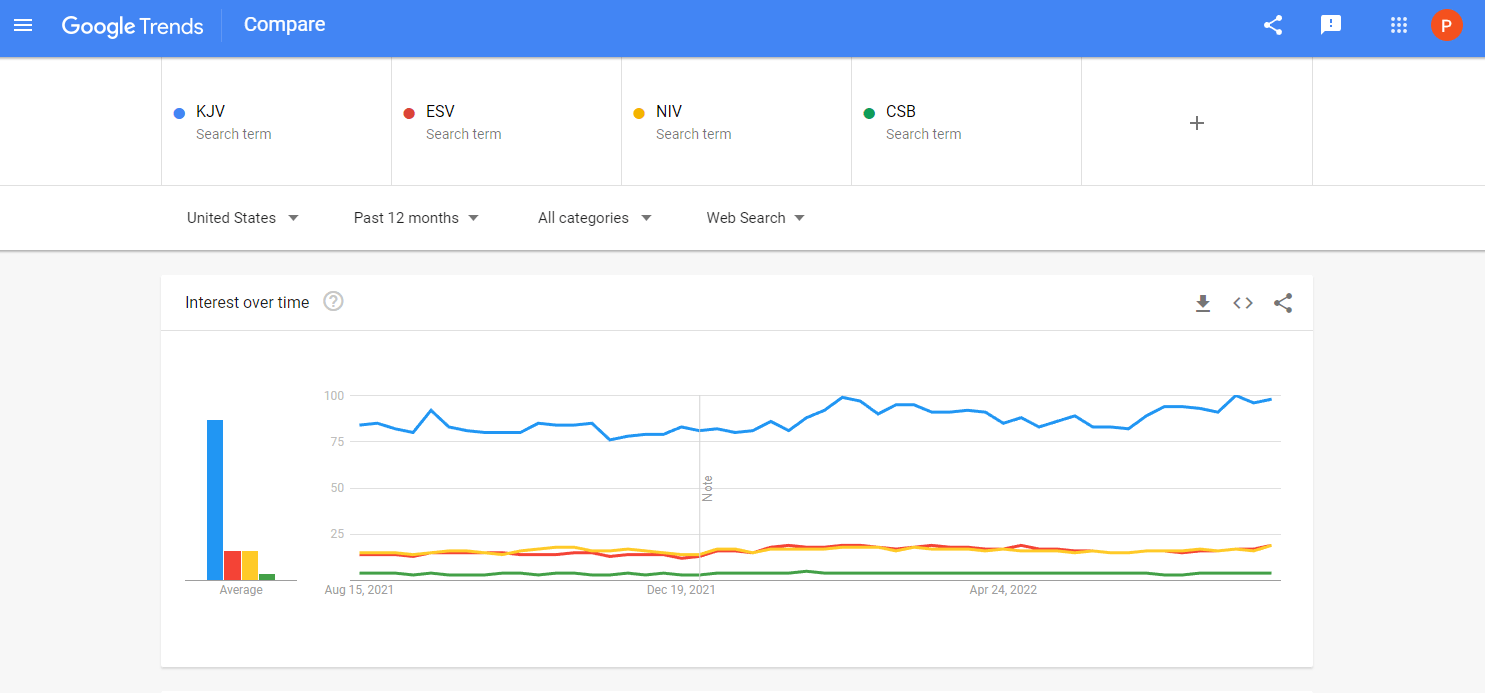
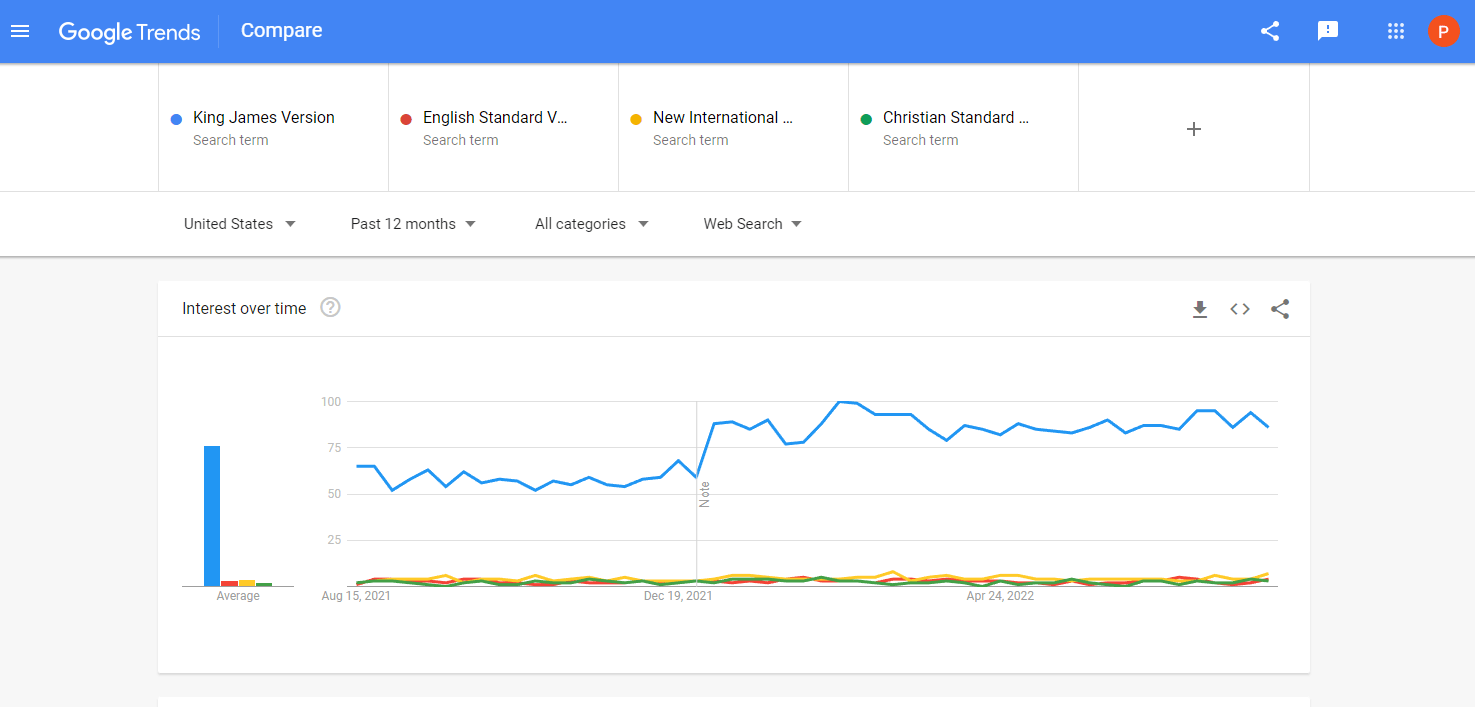
In this vein, I asked myself, “What version of the Bible are people in the USA and around the world searching for?” To give us some sense of an answer to this question I went to Google Trends and compared the following terms: KJV, ESV, NIV, and CSB. The time span for these figures stretches over the last year. Here are the results for searches in the USA,

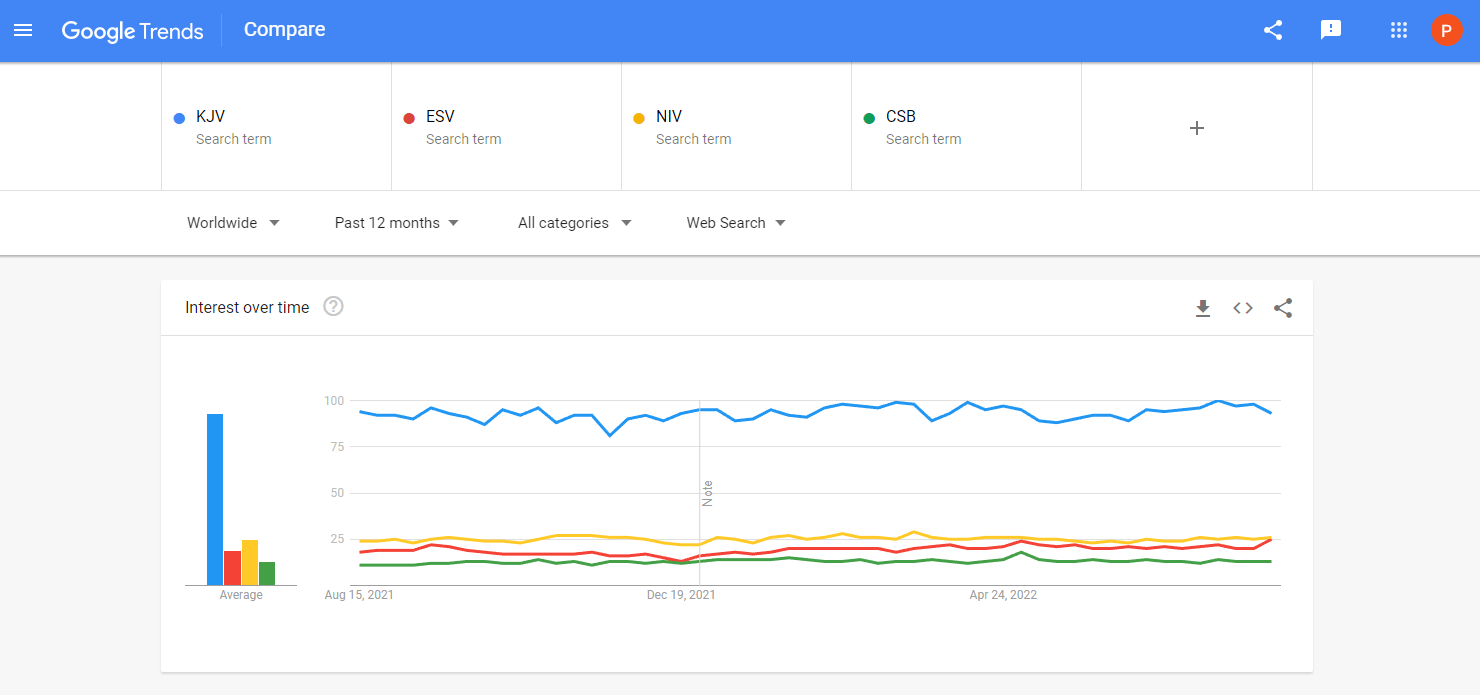
As you can see the blue line (KJV) is far and away the most popular search term among the four in Google. But what about worldwide? Perhaps things will be different there.

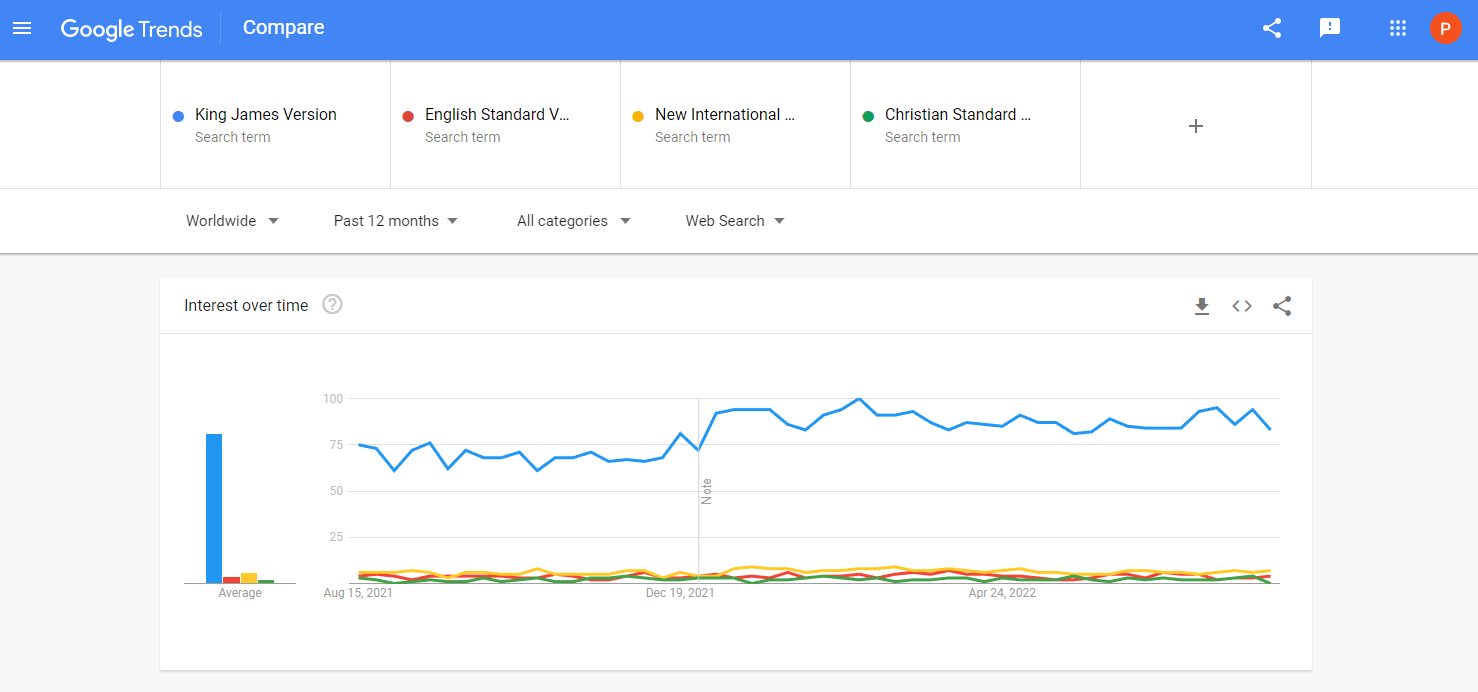
No, in fact searches for KJV are more popular worldwide than they are in the USA while the other search terms (ESV, NIV, and CSB) remain virtually unchanged in comparison with the KJV. How can this be given those pesky False Friends? **The Mind Boggles**

But let’s change the search term. Perhaps a more specific term will render different results. Instead of comparing the acronyms let’s compare the actual names of the respective versions i.e., King James Version, English Standard Version, New International Version, and Christian Standard Bible. Our results are as follows:

Nope, things get worse for the modern versions. Have things changed on the worldwide scene? Let’s take a look.

And…no, things have not changed. In short, when using the names of the versions the King James Version is still the most popular term while the other versions when searched for in this way hardly register on the graph by comparison.

In sum, it is quite clear given the evidence above that despite all the work of the CT/MVO academics and those like the so called Textual “Confidence” Collective, the KJV is still far and away the most searched for English version of the Bible in the USA and worldwide when compared to the ESV, NIV, and CSB according to the world’s largest search engine.

Don’t shoot the messenger. I don’t make the rules.

Canonicity and Whether the KJV Needs and Update

If you hold to Confessional Bibliology or you have listened to considerable amounts of argumentation made in favor of said position you know that questions of Canonicity overlap strongly and often with questions of which TR and which Bible. Regarding whether the KJV needs an update is no exception.

Once upon a time, all New Testament Christians had for written revelation was the 39 books of the Old Testament. This was the Canon. So much so that it was used to judge the words of the apostles as to whether they were true or false apostles.

Along came the writings of Paul which began to add to the Canon, then the work of the Gospel writers and the General Epistles. When all was said and done an additional 27 books were added to the original 39 book Canon of the OT. At the conclusion of the apostolic writings which ended somewhere in the late first century, the Christian Canon was now 66 books.

At the writings of these 27 books, the Canon was closed.

No more additions, modification, or changes. Some have tried by suggesting the Gospel of Thomas belonged in the Canon or that Apocrypha should be regarded as inspired Scripture or Marcion who rejected the whole of the OT as Canon. Still, while these suggestions and objections were raised, they were not accepted by the Church. Why?

Certainly we could look at the testimony of the Church Fathers and artifacts like the Athanasius’ Easter Letter, but the primary way the Church came to believe these 27 books and only these 27 books were to be added to the 39 books of the OT was by the Spirit of God speaking through the words of God into the hearts of God’s people who then received those canonical words, and by extension the Canonical books, by faith.

As the Westminster Confession of Faith says,

”We may be influenced by the testimony of the church to value the Bible highly and reverently, and Scripture itself shows in so many ways that it is God’s word; for example, in its spiritual subject matter, in the effectiveness of its teaching, the majesty of its style, the agreement of all its parts, its unified aim from beginning to end (to give all glory to God), the full revelation it makes of the only way of man’s salvation, its many other incomparably outstanding features, and its complete perfection. However, we are completely persuaded and assured of the infallible truth and divine authority of the Bible only by the inward working of the Holy Spirit, who testifies by and with the word in our hearts.

WCF, 1.5. [Bold: Mine]

So now let’s ask the question, “Does the KJV need to be updated?” Well, how would we come to know if the KJV needed an update? Who has the authority to claim and then enforce an update? Certainly educated people can have their opinion just like Marcion did, but how can mere educated opinion serve as an authority and have the power to enforce that opinion?

The only “opinion” which had sufficient authority to limit the Canon to 66 books was almighty God Himself in the person of the Holy Spirit speaking through His authoritative words in the hearts of His people. As such, it stand to reason that the only “opinion” which has sufficient authority to call for an update of God’s word is almighty God Himself in the person of the Holy Spirit speaking through His authoritative words in the hearts of His people.

Ward, Wallace, and White can all have their opinions and with all the honesty they can muster declare that the KJV needs to be replaced or updated, but in the end, the only means and mechanism whereby such a thing could take place is the same means and mechanism whereby God has done it in the past. The Holy Spirit must move His people through His words to that revision.

Question, Has the Holy Spirit done that?

Those who hold to the KJV say, no. Those who do not keep making the argument “…but but but the evidence.” In other words, the KJV side says the Holy Spirit has not so pointed to a better version and then those calling for a revision are somewhere in left field majoring on the evidential minors. Taken together, it does not appear to either side that the Holy Spirit has pointed His English-speaking Church to a new or updated text of Scripture.

Objection: “But look at the plethora of versions out there. That must mean that the Holy Spirit wants us to move to a different translations.” Bah…just stop it! What if I said, “But look at the plethora of religions out there. That must mean that the Holy Spirit wants us to move to a different religion.” Many ecumenical Christians are making such a case, and they are wrong for doing it. Or how about, “But look at the plethora of denominations out there. That must mean that the Holy Spirit wants us to move to a different denomination.” Right, so all you Presbyterians need to become Southern Baptists and all you Baptists need to become Missouri Synod Lutherans. Most of our opponents would think my examples ridiculous and yet the truth or error of religions and denominations is dependent upon the Scriptures. So “plethora of religions” and “plethora of denominations” is not grounds to change but “plethora of versions” is?

I’ll take “Ridiculous” for 100, Alex.

Bruce Dickinson and Infallible Scripture

In one of the greatest SNL skits of all time Rock legend Bruce Dickinson [Christopher Walken], yes, the Bruce Dickinson, meets with the members Blue Oyster Cult to record Don’t Fear the Reaper. As the recording session goes on there is something missing and Dickinson being a Rock legend was able to put his thumb on it, “I got to have more cowbell, Baby!”

At first the cowbell was too much for the band, but finally everyone was able to work out their differences. Right before the last take, Dickinson exclaims, “Babies, before we’re done here you all will be wearing gold-plated diapers.” To which Chris Kattan’s character replied, “What does that even mean?!” To which Dickinson replies, “Never question Bruce Dickinson.”

I listen to all kinds of preachers from different denominational backgrounds and educational experience. Most of them do not hold to a standard sacred text. Most of them believe that the Bible they are preaching from and the Greek NT which underlies their Bible is not the word of God down to the jot and tittle.

And yet surprisingly enough, as they begin their sermon they say something like, “Turn with me in your copy of God’s word.” or “Turn with me in your copy of God’s inspired infallible word” or before the preacher starts to read he says, “Hear the word of God.” A couple of guys I listen to end the reading of Scripture by saying something like, “The grass withers and the flower fades but the word of God endures forever.”

But to quote Kattan, “What does this even mean?” Why do able and alert ministers of the Gospel regularly talk about their Bible as a copy of God’s word without qualification or as the inspired infallible word of God when under their own rubric they know it is not? In fact, if you pin down the most able and educated [e.g., Dan Wallace and James White], they will tell you that we are not certain, beyond a shadow of a doubt, of any of the words in Scripture being the actual original words of Scripture.

Certainly these pastors by declaring “your copy of God’s word” or “your copy of the inspired infallible word of God” don’t mean the whole of the manuscript tradition, or the body of the text + the textual apparatus. So they don’t mean “all of the manuscripts” and they also don’t believe their Bible to be the word of God in every word. If this is the case then it seems these pastors are engaging in some kind of empty rhetoric or superstitious tradition, and are not saying what they believe. They begin their sermon by saying something they don’t believe and they do it every week.

Then just today I saw a guy on Facebook interacting with Mark Ward asking in effect, “If you believe the Bible is inspired and infallible where is it? Show me the physical book that you believe is the Bible so defined.” Time and time again I have seen the answer to the question to be the equivalent of “Never question Bruce Dickinson.”

The point is that unless you have a Bible that you believe is the inspired infallible word of God equal in certainty and authority as the originals, it is probably best you begin your sermon with something like, “Turn with me in your copy of what is probably mostly God’s word” and “The grass withers the flower fades and so do some of God’s words, at least as far as we know.” Yet, somehow these don’t seem to have the same ring and force.

Or you can believe and assert a standard sacred text and in so doing be able to say with confidence, true textual confidence, that every word of your Bible is God’s word. And so begin your sermon with, “Hear the word of God.”