Thank You, James White

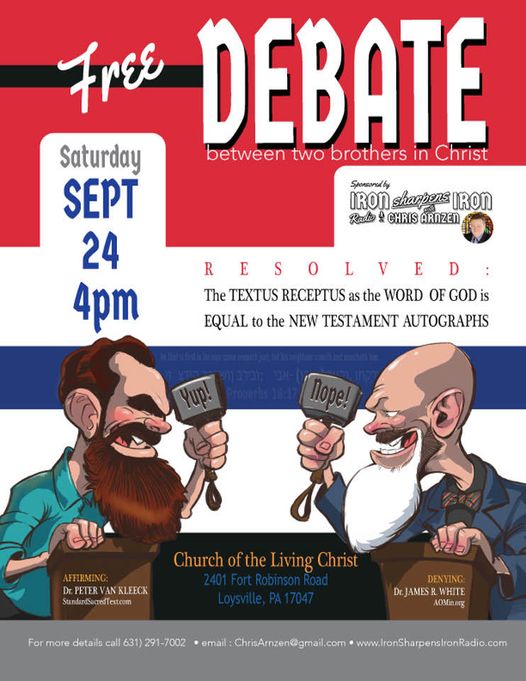
On October 3rd James White [JW] gave us more air time on the Dividing Line, again. Around the 42 minute mark JW begins his commentary on some of our recently published blog posts. After listening to his commentary I struck with a kind of thankfulness. So I thought I would take today’s post and thank JW.

1.) I want to thank JW for taking the debate in the first place. In the broader evangelical world he’s a big fish and I’m a small fish.

2.) I wanted to thank JW for the increase of traffic here to the blog and to our YouTube channel. The argument for a standard sacred text is spreading and in large part because of JW.

3.) I want to thank JW for the increase in opportunity to both answer questions and explain our position. I have lost count how many folks have reached out to me via email, FB private messenger, and here on the blog asking for clarifications, book recommendations, and answers to potential objections. This would not be possible without JW.

4.) I want to thank JW for the opportunity to debate. It has been very instructive in what debates look like among Christians, what Christians care about in debates, and what I can do to meet them where they are.

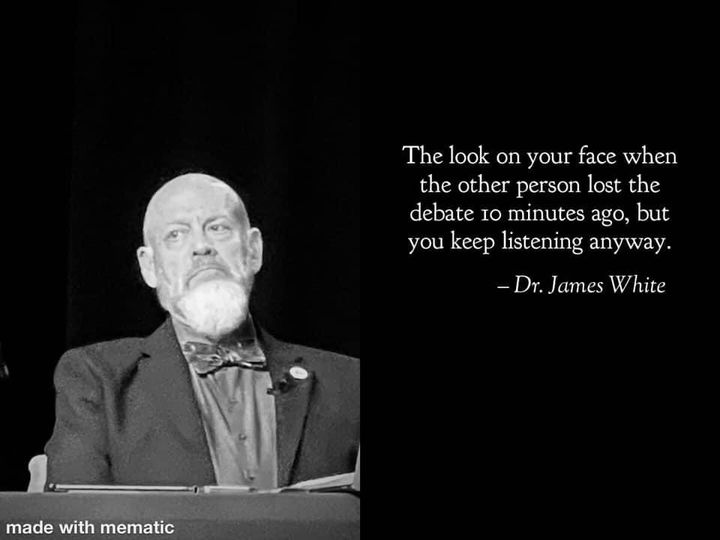
5.) Concerning the October 3rd DL, I want to thank JW for once again demonstrating that my arguments remain undefeated. I mean he complains about the faces I made and the fact that he had never heard these arguments before, but even 10 days later he has offered no substantive response.

6.) Concerning the same DL, I want to thank JW for doing exactly what I said he would do in this post and this post. JW is going to JW.

7.) I want to thank JW for bringing up the same failing stale arguments he always does. They made my work a lot easier and they also leave room for significant improvement for anyone interested.

8.) I want to thank JW for allowing me to live rent free in his head especially considering he regards our position as a minority position and idiosyncratic. Nevermind that in the history of the Church it is his position which is the minority and is idiosyncratic; the fact that JW persists in addressing us tells me that we are definitely onto something. Thank you for that affirmation JW.

I am reminded of the Archbishop who sought to buy all of Tyndale’s New Testaments only to burn them. Augustine Packington, who was in league with Tyndale, replied that he could get most of Tyndale’s New Testaments, at least those that were not yet sold. The Archbishop agreed and Packington sent the New Testaments which the former promptly burned. The comedy of it all was that the Archbishop had unwittingly funded through Packington the production of Tyndale’s second edition of the New Testament. In like manner, JW has been more help to our cause here than he knows and for that we are thankful. By all means, keep up the good work.

Considering Corrupt and Corrupting the Scriptures by John Trapp, 1650, on Proverbs 30:5-6

Verse 5. Every word of God is pure: he is a shield] Albeit all the sacred sentences contained in this blessed book are pure, precious and profitable, yet as one star in heaven outshineth another, so doth one Proverb another, and this is among the rest, velut inter stellas luna minores, and eminent sentence often recorded in Scripture, and far better worthy than ever Pindarus his seventh Ode was, to be written in letters of gold. Every word of God is pure, purer than gold tried in the fire, Rev. 3:17, purer than silver tried in a furnace of earth, and seven times purified, Psalm 12:6, 7. Julian (therefore the odious apostate) is not to be hearkened to, who said there was good stuff in Phocyllides as in Solomon, in Pindarus his Odes as in David’s Psalms. Nor is that brawling dog Porphyry to be regarded, who blasphemously accuseth Daniel the Prophet and Matthew the Evangelist, as writers of lies. Os durum! The Jesuits (some of them) say little less of Saint Paul’s Epistles, which they could wish by some means censured and reformed, as dangerous to be read, and favouring of heresy in some places. Traditions they commonly account the touchstone of doctrine, the foundation of faith, the Scriptures to be rather a Commonitorium, (as Bellarmine calls it,) a kind of storehouse of advice, then Cor [sp] animam Dei, the heart and soul of God, as Gregory calls them, a fortress against errors, as Augustine. The Apostle calleth concupiscence sin, at non liocet nobis ita loqui, but we may not call it so saith Possevine the Jesuit. The Author to the Hebrews saith, Marriage is honorable among all men. But the Rhemists on 1 Cor. 7:9 say that the marriage of Priests is the worst sort of incontinency. Christ saith the sin against the Holy Spirit hath no remission. Bellarmine saith that it may be forgiven. The Counsel of Constance comes in with a non-obstante against Christ’s institution, withholding the Cup from the people at the Sacrament. And the Parisian Doctor tells us that although the Apostle would have sermons and service celebrated in a known tongue, yet the Church for very good cause hath otherwise ordered it. Bishop Bonners Chaplain called the Bible in scorn, his little pretty God’s book, and judged it worthy to be burnt, tanquam doctrina peregrina, as strange doctrine. Gilford and Reynolds saith it contained some things prophane and apocryphal. Others have styled it the mother of heresy, and therefore not fit to be read by the common people, lest they suck poison out of it. Prodigious blasphemy! Of the purity and perennity of the holy Scriptures, see in my true treasure, page 85, 139.

He is a shield to them that put their trust in him] See Gen 15:1[1] with the note and Prov. 29:25.[2]

Verse 6. Add thou not unto his words] As the Jews at this day do by their traditions, which they arrogantly call Mashlamnutha Completion Perfectio: because they think that thereby the Law is completed and perfected, as the Artemonites, (and after them the schollmen) corrupted the Scripture out of Aristotle and Theophrastus, turning all into questions and quillets. As Mohomet joined his Alfurta his service book, an horrible heap of all blasphemies, to the three parts othe Holy Scriptures (as her divides them) the Law, Psalms, and Gospel: as the Papists add their human inventions, and unwritten verities: which they equalize unto, if not prefer before the book of God, as appears by their heathenish decree of the Council of Trent. And when the Counsel of Basil, the Hussites denied to receive any doctrine that could not be proved by Scripture, Cardinal Casun answered that the Scriptures were not of the being of the Church, but of well-being, and they were to be expounded, according to the current rite of the Church, which if it change its mind, the judgment of God is also changed. Lastly, such add to God’s word, as wrest and rack it, making it speak that which is never thought, causing it to go two miles where it would go but one, gnawing and tawing it to their own purposes, as the Shoemaker taws his upper leather with his teeth. Tertullian calls Marcion the heretic Mus Ponticus, of his eroding and gnawing the Scripture to make it serviceable to his errors.

Lest he reprove thee] Both verbally and penally; both with words and blows. Lest he severely punish thee, as one adds to his Will, or imbaseth[3] his coin.

And thou be found a liar] As all Popish forges and foysters[4] at this day are found to be. God hath ever raised up such as have detected their impostures and vindicated the purity and perfection of the sacred Scriptures.

_________________________________________

John Trapp, Solomonis PANAPETOS: or, A Commentarie Upon the Books of PROVERBS, ECCLESIASTES, and the Song of Songs (London: Printed by T.R. and E.M. John Bellamie, and are to be sold at his shop at the three golden Lyons in Corn-hil near the R. Exchange, 1650), 350-51.


[1] Gen. 15:1, “After these things the word of the LORD came unto Abram in a vision, saying, Fear not, Abram: I am thy shield, and thy exceeding great reward.”

[2] Prov. 29:25, “The fear of man bringeth a snare: but whoso putteth his trust in the LORD shall be safe.” “This cowardly passion expectorates and exposes a man to many sins and sufferings. And albeit faith, when it is in heart, quelleth and killeth dreadful fear, and is therefore fitly opposed to it in this sacred sentence.” 343

[3] Imbase or embase (archaic): to lower especially in rank, dignity, or quality: DEBASE

[4] Foyster or foister (archaic): PICKPOCKET; obsolete: a palmer of dice: CHEAT, ROGUE. Trapp’s use of the word denoting deception and trickery is interesting. For the untrained, scholars utilize not reason but “sleight of hand” to deceive the simple.

Debate Commentary: Van Kleeck’s Opening Statement (Part 1)

Here is the beginning of our debate commentary. Lord willing I will be able to do some quick edits and then have a video up each day this week. Given the length of the debate and subsequent commentary, this series should last through next week. We’ll have to see how it goes.

Van Kleeck Was Rude

Thus far, having read critiques of my debate performance, two complaints have arisen: 1.) I offered arguments that were unfamiliar and therefore difficult to understand. 2.) I was rude, angry, condescending, and/or had a chip on my shoulder.

I already addressed #1 in this blog post so let’s turn to the second complaint. As the debate day grew closer I began to ask those around me, those I trusted, whether I should enter the debate “knives out”. That is, whether I should meet JW where he is and play the game the way he plays it. I explained to them that after watching so much of JW on the topic of Text and Translation that it seemed to me that he was often less than professional with his Christian interlocutors. What is more the moderator rarely if ever restrained either debater’s rhetoric so no one was going to stop JW if he started down that road. To illustrate JW’s lack of professionalism and restraint, consider the following debate which was part of my own debate preparation.

This debate was between James White and Pastor Jack Moorman. Beginning at around the [54:48] mark you will find the following (Click the time stamp if you’d like to watch it yourself):

[54:48] – JW is seen visibly shaking his head while his interlocutor is speaking.
[56:38] – JW is shaking his head and speaking over his interlocutor with the words “Not true.”
[01:01:58] – JW interrupts his interlocutor and then takes over the conversation.
[01:03:43] – A listener asks a question and JW laughs at the question with incredulity.
[01:03:50] – After being told earlier by the moderator not to comment JW comments anyway.
[01:09:30] – JW audibly scoffs and shakes his head.
[01:13:20] – JW shakes his head and speaking over his interlocutor with the words “Not true.”
[01:14:20] – JW laughs and then interrupts his interlocutor.
[01:19:02] – JW smiles then scoffs then interrupts.
[01:23:52] – JW smiles then scoffs at a listener’s question. The moderator then calls for summary statements. JW asserts that he will first offer a response to the listener’s question. After which JW offers his summary statement.

And all of this in under 30 minutes. At no point did the moderator step in and tell JW that such behavior was rude and unprofessional. By the time of the above debate JW had been on the debate scene for over 21 years and had already debated Bart Ehrman. Still, JW had not yet worked out of his system the laughing, interrupting, head-shaking, scoffing etc. and the above is only what was caught on camera.

And before we think that this kind of rhetoric is out of JW’s rhetorical system let’s not forget this chippy response from JW when debating Dr. Riddle.

Then of course after our debate JW posts the following meme on his wall which shows a thoroughly non-chippy, non-rude completely professional JW during our debate.

The point is that JW has set the tone of this debate years ago and it continues up until today and that tone includes making faces, shaking your head, speaking over your interlocutor, scoffing, and all the rest.

This is part of JW ‘s legacy. JW engenders heated, rude, and chippy debate because that is the way he debates, especially with Christians.

So as I saw it I could either wait for JW to do the same to me or, seeing that I spoke first, do it to him right off the bat. I chose the latter.

Now, was my rhetoric chippy, heated, and even rude? Indeed, it was. Is that a professional way to debate? No, it is not. I have no problem admitting this. Unfortunately, no one in JW’s camp, no close friend, has helped JW admit as much as I just did in the first couple sentences of this paragraph let alone have that admission lead to real change in JW’s rhetoric. So I tried a different tactic, the tactic of “How about a little of your own medicine.”

And it worked! JW fans were coming out of the woodwork declaring me to be heated, condescending, and having a chip on my shoulder. Right! That was the point. Now take that same critique and help JW see the same light. So every time JW gets short with his interlocutor or interrupts or scoffs or emotes remember that JW is cementing his legacy in this kind of rhetoric and don’t be surprised if a younger man comes behind him with the willingness to play the same kind of game.

To those on my side of the isle, I know many of you disapprove of my tactic here and I can see why. I apologize for throwing you for a loop without warning. But in the end it proved an excellent point. For JW and those who follow him, chippy rhetoric is a “definitely for me but not for thee” kind of relationship when JW debates with Christians.

Amandus Polanus, 1600, Arguing for the Long Ending of the Lord’s Prayer

“Amandus Polanus (1561-1610) wrote extensively on the doctrine of Scripture against the famed Roman Catholic apologist, Robert Bellarmine (1542-1621). His refutation of Bellarmine spanned nearly 800 pages in his Syntagma Theologiae (Hanover, 1610, pp. 95-831). Polanus was a German Reformed theologian who spent much of his academic career teaching in Basel, Switzerland. Historians, such as Richard Muller, have referred to his Syntagma as one of the most important textbooks of theology in Early Reformed Orthodoxy. ” https://www.reformation21.org/blog/amandus-polanus-on-the-churchs-role-in-interpreting-scripture-1

Polanus comments,

“The third part of the Lord’s prayer is a conformation which containeth three arguments, by which our faith is confirmed, that God doth certainly hear our prayers. Two arguments are drawn from the attributes of God, the third from the end of hearing.

The first attribute of God is this: because he is king having rule over all things.

The second, because he is able, who can give us all things which we ask.

The argument from the end is, that he might be glorified for ever, because he is God, and a most bountiful and merciful father.”

Amandus Polanus, The Substance of the Christian Religion, Soundly Set Forth in two books, by definitions and partitions, framed according to the rules of a natural method (London: Arn. Hatfield for Felix Norton, dwelling in Paules Churchyard, at the sign of the Parrot, 1600), 487-88.

The Gauntlet: An Official Call for Discussion and Debate

So it has been one week since the debate with Dr. White. As it currently stands there are almost 22,000 views of the debate so far. Several people have contacted me to say that they watch the debate live and then went back to watch it again and in so doing gleaned further insights into our defense of the Textus Receptus.

This is in part because the defense of the TR is quite broad in explanatory scope and force and a 2.5 hour debate cannot do justice to the material. Those who defend the TR do so with history, manuscript evidence, believing text-critical work, Christian theology, historical theology, philosophical theology, philosophy, epistemology as well as other tools of reason and inference. What is more, we believe it and are passionate about it. And because we are passionate about it we enjoy talking about it to anyone who will listen in nearly any environment from coffee shops to college classrooms.

As such I would like to officially announce that we are available for discussion and debate on the topic of the TR and the KJV. We will accept all invitations with certain caveats.

1.) We are willing to debate anyone so long as they have a terminating post-graduate degree [e.g., a D.Min., Ph.D., Th.M., or equivalent]
2.) If #1 is not fulfilled we would still be willing to have a vigorous, cordial, and moderated discussion of these topics.

We take the difference between a debate and discussion to be in format and aim. The format of a debate is limited in structure according to time parameters and centered on the debate question while a discussion is much freer with the time and can move around as the flow of the discussion dictates. Furthermore, a debate is a kind of competition with the goal of winning via the expression of persuasive truth. A discussion on the other hand is a time of learning and exploration – boldly going where perhaps the audience has never gone before.

Additionally, we are not the only ones willing to engage in debate and discussion. Over the past week several TR/KJV defenders have expressed the desire to debate and discuss topics in defense of the TR and KJV. These people are:

1.) Kent Brandenburg – His work can be found at https://kentbrandenburg.com/. Incidentally, Kent Brandenburg was the “Kent” Chris Arnzen first sought out for last week’s debate, not Kent Hovind. Kent Brandenburg has already had several moderated debates.
2.) Thomas Ross – His work can be found at https://faithsaves.net/thomas-ross/ Thomas has had many moderated debates on topics across the spectrum of Christian theology and apologetics.
3.) Nick Sayers – His work can be found at http://textus-receptus.com/wiki/Main_Page Nick has engaged in many online debates with interlocutors of varying academic acumen on various historical and text-critical issues.

Each has their wheelhouse and will defend the TR and KJV from different perspectives with their methodology but they are certainly faithful and available to make their case as they do.

Additionally, the 2022 Kept Pure in All Ages lectures with Dr. Jeff Riddle have recently been uploaded to YouTube. In the first lecture Dr. Riddle deals with certain apologetic considerations revolving around the work of Bart Ehrman. Then in his second lecture Riddle deals with the claims of Christians who are sympathetic to Ehrman’s position though they do not receive it en tota. Persons like Mark Ward fall into this category. Finally, Riddle addresses the Church, the believing community, and certain canned lines used by evangelicals to cast dispersions on the TR. Dr. Riddle’s lectures can be found here:
1.) Reasoning with the Wise and the Scribe
2.) Reasoning with the Disputer of this World
3.) Reasoning with Them That Believe

Blessings.

The Proclivities of James White (Part 2)

Two days ago I began laying out the proclivities of James White while in a debate setting with fellow Christians. In that post I offered 15 and in this post I will offer an additional 15. Again, the purpose of sharing this list of JW proclivities is to help prepare any other Christian who would seek to debate JW on this topic. Of course it is possible that he would change his tactics so late in the rhetorical game, but that probability seems low to me.

But before addressing that list I wanted to say a word about my chosen debate method. Having read many of the responses to the debate I found that both sides of the debate really really wanted me to address certain of the data behind JW’s Erasmus claims as to get into the nitty-gritty evidence for this or that reading. Let me give a little insight into my approach.

First, in the 5th century BC Chinese military tactician, Sun Tzu, wrote down his tactics in a book we now call The Art of War. In this book he declares that when you go to battle you must dwell in impenetrable darkness. That is, it is of utmost importance that your opponent not know where you or when you will attack. As a result I purposefully employed arguments that I had not yet written or expressed so as to dwell in impenetrable darkness. This is also why the vast majority of posts on this blog during that time was not my own material. I wanted to give no hint of my approach.

Second, Sun Tzu further says that if you desire to prevail in every conflict you must know yourself and your enemy. I offered new arguments in an attempt to show that JW did not know his enemy. If JW knew my arguments well enough he should have been able to address my arguments on debate night. He was not able, and therefore did not know my argument well enough and the first step was achieved. As a result, he did not prevail.

Third, Sun Tzu goes on to say that when you strike you must do so with speed and ferocity of a thunderbolt. In order to do this, it was necessary that I never let off the gas – always be on the offensive. To paraphrase Ralph Waldo Emerson, “If you must strike a king, be sure it is a death blow.” I considered JW a king and that the debate was in the midst of the king’s court. As one FB comment put it, “The gloves were off.” And I believe appropriately so.

Fourth, in a successful attack one must choose the ground, the place upon which his attack should be launched. As a result I clearly and distinctly told the crowd and JW that the debate was not about subjective interpretations of evidence and that JW’s robust but narrow historical argument would not do. I reframed the discussion in theological and philosophical terms on purpose. I was choosing the place where the fight was going to take place and I had the right to do so seeing that it was my responsibility to offer the positive argument.

As a result, we did not get to JW’s foibles regarding Erasmus or the evidence regarding Revelation 16:5. That would have been predictable thus negating points 1 and 3 above. It would have also meant that JW got to pick the place upon which the fight was going to take place and thus negated point 4. To borrow a phrase, “Everyone has a plan until the rhetoric starts flying.” In my case I believe I was able to stick to my time, place, and angle of attack even when the rhetoric started flying.

I hope this helps people understand why I chose the topic and method in the way I did.

Now to the proclivities of JW. Let me first point out that in knowing his proclivities I knew my “enemy” and that in knowing my “enemy” it was going to be very difficult for JW to dwell in impenetrable darkness and therefore very difficult to attack with the speed and ferocity of a thunderbolt. This is why I declared his arguments to be tire, old, and dead because he ignores these basic features of rhetorical conflict. Second, seeing that I ended at 15 proclivities in my last post I am going to pick up with 16 today.

16.) JW regularly attempts to establish ethos [i.e., credibility] by appealing to his debates with Ehrman and at a South African mosque. Ethos is difficult to attack without attacking the person [ad hominem]. Still the fact is that if there is a mosque in your town you could call them up today, tell them you are a Christian, and ask to meet with the Imam and they would meet with you. This has been my experience wherever I have lived. In the end, debating Muslims and Atheists on their turf is eminently available to all of us, it’s just that JW has done it.

17.) JW regularly attempts to establish ethos by appealing to the number of moderated debates he has had. Though he has had many moderated battles, his establishment of ethos doesn’t seem to indicate how many times he was mortally wounded or died in those battles. As such, this play to ethos falls flat. In short, JW never admits to losing.

18.) JW derides our textual positions because we don’t see textual tinkering as progress. When asked why his tinkering matters, he attempted to redefine “tinkering”. earlier, when speaking to a crowd of lay-people he made no attempt at such a redefinition. JW tinkers out of both sides of his mouth. Out of one side he wants us to believe the text is settled and all we are doing is tinkering and out of the other side of his mouth he wants us to believe that tinkering is meaningful enough to continue modern textual reconstruction.

19.) Our position doesn’t doubt our Bible enough. If I doubted a small part of my TR then Dr. White would not have as much of a problem with my position. If I claimed that the TR AND the NA 28 (including the apparatus) were equally God’s word we probably wouldn’t have debated. In short, JW is only fine with my position if I include a measure of doubt which he deems appropriate. If too much doubt, he calls me Bart Ehrman. If too little doubt he calls me KJVO. In short, JW main and bare thesis is “Pete, you don’t accurately doubt your Bible like I do.”

20.) Certain manuscript evidence is an undefeated defeater for JW. Apparently it must be for us too otherwise we are to feel the wrath of JW.

21.) JW regularly declares the Bible to be merely reliable/adequate and yet offers no exegesis. He calls himself a Biblicist when talking about the philosophy of Thomas Aquinas but when talking about manuscript evidence he has no exegesis to defend the Bible as merely adequate.

22.) JW regularly presents a merely historical argument with a little bit of providential preservation garnish on the side. Here I charged JW with naturalism because the vast majority of his argument could be argued by a godless, Christless atheist. There is nothing distinctly Christian about his argument even after he calls himself a Presuppositionalist.

23.) JW regularly quotes Scripture in order to make his audience doubt it. Every Scripture he brought up he did so in order to show that it was worthy of doubt to some measure. Matthew 5:18 doesn’t mean jot and tittle. Revelation 16:5 which reading is it? “In” the temple or “out” of the temple. JW rarely if ever employs Scripture to defend Scripture.

24.) JW only emphasizes the res [meaning] and ignores the verbum [the actual inspired words] of the Scriptural words. Furthermore, he does so based on no other authority than his own doubt concerning certain text of Scripture. We must doubt like JW doubts or else.

25.) JW seems wholly unaware of the meta-didactics of Scripture. The Scripture teaches by simply existing because it is the sui generis sacred words of the living God in time and space. Scripture equals God’s word and God’s word equals a product of divine special revelation. If a product of divine special revelation is mixed with the product of fallen human ingenuity then Scripture by simply existing teaches us that God’s word as a product of divine special revelation is mixed with the product of fallen human ingenuity. This is an indefensible theological position if one desires to remain orthodox.

26.) I have heard JW on several occasions accuse brothers of putting to much stock in the Reformation like they were Reformation worshippers. The irony though is that he makes this claim while claiming to be a Reformed Baptist. He has taken the name of the thing he think people put too much stock in. It’s like a woman who takes the name of her husband only to then turn around and tell others that her husband isn’t as great as you think he is. The irony is so obvious JW’s accusation of “Reformation worshiper” is ridiculous – a bit of the pot calling the kettle black.

27.) JW has said on many occasions, even in our debate, something to the effect, “I want to know the words of the Apostles.” This is an affective plea or an emotional plea and he states it in such a way as to make it seem his opponent doesn’t want the same thing. We all want to know the words of the Apostles as well as the words of Luke who was not an Apostle. The question is, How do we get there?

28.) In the sphere of philosophy I have observed that JW learns his opponent’s position while in the midst of the debate. I observed this when JW discussed Molinism with William Lane Craig as well as in JW’s treatments of Aquinas and Reformed Epistemology. This is yet another reason why I leaned toward some semblance of a probability argument. I had a strong hunch that JW simply would not understand and that he would be learning right there in the moment and therefore not be able to properly respond to my arguments. My hunch paid off.

29.) JW has no paradigm for the preservation of God’s words among the manuscript tradition AND what the Bible calls us to believe, that God has preserved His words between two covers. He only ascribes to the former. This is an enormous hole in his Bibliology which he does not seek to mend. He merely puts the “reliable” or “adequate” Band-Aid over the wound and hopes things don’t get worse.

30.) Finally, JW seems incapable of offering a robust defense for showing one’s arguments AND knowing one’s arguments. JW does not seem to realize that people can know the truth but are unable to show/explain that truth in a way that is convincing. As a result, he treats those people as wrong when in fact those people very well may be right; they just don’t know how to explain it. Of course this is not always the case, but JW doesn’t seem to even have a category for such a thing.

To be honest, I was so sure of JW’s proclivities that I began to construct a Bingo card that had 25 of these 30 proclivities represented on it. Then as he continued in his rhetorical rut I was going to declare “BINGO!” each time I got 5 in a row. Of course I didn’t but I could have been a winner in more than one way had I done so.

We Are Not Alone

A couple of days ago I received this link from a graduate student in Singapore letting me know that the work we are doing here with the TR and KJV is also being done on the other side of the world. They too are engaged in substantive discussions with those who hold their views in contempt. They too at times feel alone or outnumbered. Still, we share the same confidence in the Bible which God has given to us.

Below I have included the post which can be found on the website of True Life Bible Presbyterian Church in Singapore. I hope it can be an encouragement as you consider the scope of the work being done here and around the world in defense of the TR and the Authorized Version.

Persevere my dear brothers.

_______________________________________________________________________________

“I am alone!” That was what Elijah said after he defeated the prophets of Baal, “I have been very jealous for the LORD God of hosts: because the children of Israel have forsaken thy covenant, thrown down thine altars, and slain thy prophets with the sword; and I, even I only, am left; and they seek my life, to take it away.” (1 Kgs 19:14). God had to tell him that he was not alone, “Yet I have left me seven thousand in Israel, all the knees which have not bowed unto Baal, and every mouth which hath not kissed him.” (1 Kgs 19:18). Commenting on this episode, Paul said that there is always a faithful remnant, and we say likewise, “Even so then at this present time also there is a remnant” (Rom 11:5).

When we fought the good fight of faith for the Verbal Plenary Preservation (VPP) of the Holy Scriptures about two decades ago, we were told by our opponents and detractors that we were alone on this, that nobody believed this. They said our belief in VPP was “foolish faith”, that VPP is a “new doctrine” and “heresy”, and that we are going to be “the laughing stock” of the world.

By the grace of God, we held firm to the truth of VPP as taught in Psalm 12:6–7, “The words of the LORD are pure words: as silver tried in a furnace of earth, purified seven times. Thou shalt keep them, O LORD, thou shalt preserve them from this generation for ever”, Matthew 5:18, “For verily I say unto you, Till heaven and earth pass, one jot or one tittle shall in no wise pass from the law, till all be fulfilled”, Matthew 24:35, “Heaven and earth shall pass away, but my words shall not pass away”, and many other verses and passages in Scripture. We believe without doubt that God has indeed preserved every jot and tittle of His inspired words as He promised, and that we have His very words and every word in our hands. Where then are they? They are in the Hebrew and Greek Scriptures (ie the Hebrew Masoretic Text and the Greek Textus Receptus) on which the Authorised Version (AV) or King James Version (KJV) is based.

We may feel we are alone, but we are not. When I wrote to Dr Edward F Hills in 1997 (not knowing that he had already been called home in 1981) for permission to use parts of his book—King James Version Defended—for my lecture notes on VPP, his wife—Mrs Marjorie Hills—so graciously replied, “It is indeed very encouraging to learn that a Presbyterian College is a strong supporter of the KJV. The King James Version Defended, will furnish your students with the facts they will need for its defense.” It was interesting for me to note that she was encouraged by a Presbyterian College taking a stand for the KJV. I suspect Dr Hills who was Presbyterian fought a lonely battle in his day.

In the last century, the Bible Baptists and the Independent Baptists were the ones at the forefront defending the KJV. In those days, we really did not hear of any Reformed or Presbyterian ministers, churches or schools defending the same except for a very few. Dr Hills was perhaps the lone voice. We were also a lone voice in the wilderness of ignorance and unbelief here in Singapore when we earnestly contended for VPP some 20 years ago. But the Lord knows we were not alone; there were others who did not bow their knees to the Baal of modernistic and rationalistic textual criticism, who also upheld the good old Text and the good old Version.

More and more of the faithful remnant are now coming to the fore to speak up for the divinely inspired and preserved Text. They are promoting and defending the inspired and preserved words of God biblically, theologically, and historically. One such faithful scholar is Garnet Howard Milne who authored Has the Bible Been Kept Pure? The Westminster Confession of Faith and the Providential Preservation of Scripture published in 2017. Dr Milne was absolutely right to observe that the preservation of the Scriptures “cannot be construed to mean that God has kept his Word pure in some as yet undiscovered place, and the church must carry on with an imperfect Bible in a seemingly endless hope that one day all the textual critics (most of whom are modernists who reject any notion of biblical inerrancy) will all agree on the identity of the autographic text.”

Dr Milne was also spot on to observe that “The canon was not something decided upon by the elite of the church and then commended to the ordinary folk in the pews. It was something confirmed and received individually throughout the centuries ever since God had first dictated those Scriptures for the church, a church which consisted of the whole multitude of believers. This means that the common or received Greek text of the New Testament and the Masoretic text of the Old were considered by [the Reformers] to have been the authentic text.” Indeed, this is in keeping with what Jesus said, “And when he putteth forth his own sheep, he goeth before them, and the sheep follow him: for they know his voice. And a stranger will they not follow, but will flee from him: for they know not the voice of strangers…. My sheep hear my voice, and I know them, and they follow me” (John 10:4,5,27). The divinely inspired words of Scripture can only be spiritually discerned and recognised by Spirit-filled believers. “Now we have received, not the spirit of the world, but the spirit which is of God; that we might know the things that are freely given to us of God. Which things also we speak, not in the words which man’s wisdom teacheth, but which the Holy Ghost teacheth; comparing spiritual things with spiritual. But the natural man receiveth not the things of the Spirit of God: for they are foolishness unto him: neither can he know them, because they are spiritually discerned.” (1 Cor 2:12–14).

By the grace of God, there is now a growing movement for the “Confessional Text” (also known as the “Traditional Text”, “Received Text”, “Ecclesiastical Text”, “Reformation Text”, “Canonical Text”, “Standard Sacred Text”). This movement, in primarily Reformed circles, is calling all Sola Scriptura believers who regard the Bible to be the sole and supreme authority of their faith and practice to return “to the Bibliology of the men of the Reformation and post-Reformation (Protestant orthodox) eras. Those godly men maintained that the Lord had not only immediately inspired the Scriptures in the original Hebrew and Greek, but that he had also kept them pure in all ages (cf. WCF and LBCF, 1.8). This led them to affirm the classic Protestant printed editions of the Masoretic Text of the Hebrew Old Testament and the Textus Receptus of the Greek New Testament as the standard text of the Christian Bible.”

Dr Jeffrey Riddle and Rev Christian McShaffrey—the leaders of the Confessional Text movement—have compiled and edited an anthology of essays penned by “Pastors, Teachers, Elders, and one Deacon, coming from Reformed, Presbyterian, and Baptist traditions. These men hail from places across the English-speaking world, including Australia, Canada, the United Kingdom, and the United States.” The anthology is published with the title, Why I Preach from the Received Text (USA: The Greater Heritage Christian Publishing, 2022). It is the hope of Riddle and McShaffrey “that each reader’s confidence in the integrity of Scripture will be increased as he moves through the pages of this book. We particularly desire that those ministers and their congregations who have stood fast in their use of the traditional text, even when it seemed they had few allies and many adversaries, will be encouraged by this work, knowing that they do not stand alone and that this position is neither unreasonable nor obscurantist. It is also our hope that a new generation of young believers and young men called to ministry might be prompted by this work to give careful consideration regarding the text of the Bible they choose to embrace.”

I was given the privilege to preview this book before it was released, and I must say I am encouraged by the testimonies of the 25 presbyters and church leaders who have the faith and conviction to preach and teach from the absolutely authentic and authoritative texts of the Holy Scriptures that God had inspired in the beginning and has preserved from the beginning. Ministers of the Gospel today can preach with confidence—“Thus saith the LORD,” “It is written”—when they preach from the traditional Hebrew Masoretic Text and the Greek Textus Receptus on which the AV or KJV and other faithful and accurate translations of the Bible are based.

_______________________________________________________________________________

Trust me, I’m a Text Critic

We at Standard Sacred Text do not see historic, orthodox, theological precommitments as a liability to a sound defense of the Faith and Scripture. Indeed, consistent Christianity demands the Lordship of Christ through the Word and Spirit in every part of life, including research and writing. Dr. White’s presentation reminds us that there are Christian scholars that do see a problem with their Christian precommitments and assure others, for the sake of perceived credibility, that they don’t let their Christian faith get in the way of their academic work. But Theology is unlike any other discipline in that it is the study of the wholly other, self-revealed, God. Scripture is His Word. True theology, then, must only say what God has already said about Himself, and not what others say He said. Putting or taking words in or out of God’s mouth is a failure of submission to the King. The spiritual resistance of restricting the kingdom rule of Christ in their lives from influencing any text critical work or apologetics is now integral to the credibility of modern, so-called “Christian” scholarship. Without being pejorative, scholarship cannot be called Christian if not Christocentric.

Of all the disciplines one might choose to apply this secular model, for White and others, it was the theological principium of the Christian Faith, or the special principle and source of Christianity, the Holy Scripture. They could have decided to manufacture microchips like the unregenerate do, or fly airliners like the unregenerate do, or write computer code like the unregenerate do, but instead decided to recreate the principium cognescendi of the Christian Faith like the unregenerate do, relegating what is uniquely transcendent, the written Word of God, to a transcendentless method. Since the 19th c. this God-less methodology has been standard fare in academia. As one of my Westminster profs relayed in class, once the notion of truth becomes so muddled, historically, it takes a 1,000-years to find realignment. Of course, those creating the muddle believe everything is fine. Dr. Ward disparages the KJV and Dr. White the TR, neither man suggesting corresponding standard, authoritative replacements, and yet we are to conclude that the confusion they are creating in the Church is fine, should be welcomed and endorsed, and rather than our culture’s present slip backward to a second Middle Ages, (when the priests could not read the Latin), is rather producing a new Renaissance (another Erasmus) on the way to a new Reformation (another Tyndale). Scripture is clear, that when God is turned aside, personal, and national calamity awaits, the data Dr. Van Kleeck cited in his closing remarks.

Dr. White serves as a single data point for members of the Church who have finally been convinced by academics, and now say, “We will not believe the Holy Scripture, until we see the manuscript evidence for it.” While preserved manuscripts have always been essential to the preservation of Christianity, the immutable fact, beyond dispute, is that the Original writings of Scripture are forever beyond the scope of scientific discovery, forever lost. Recent critical scholarship accepts this and has moved on to the “initial” text existing several centuries later having given up looking for the Originals. With the undiscoverability of the original words of Scripture, where is the empirical grounding for faith, if the Word of God in the autographs is forever lost? What will Dr. White show the Church to convince them it is grounds for faith. Right now, many are taking his word for something that neither he nor anyone else can ever produce.

The Scripture says, “faith comes by hearing, and hearing by the word of God.” Is this the viva vox Dei, “the living voice of God” to you, or must you see the manuscript evidence that no one knows or will ever know, empirically, is indeed the words of the Original? The Scriptures have always been a target for corruption leading one to ask “how could anyone know what was and was not God’s word?” Considering the insurmountable empirical obstacles to preserving the words of God in a sin cursed world, the providential preservation of God’s word is intrinsic to the words themselves. It seems clear that White likes neat categories that can be classified, categorized, and easily referenced and finds the Divine algorithm of providential preservation throughout history too messy. Yes, history is very messy. There are no external criteria to determine what is or is not God’s Word. Scripture is self-attesting, self-authenticating, and self-interpreting, possessing authority over all other criteria and authorities because it is the Word of God. The existence of the preserved words of God is therefore, empirically, unquantifiable. With support from categories such as Apostolicity, antiquity, and ecclesiastical usage, this theological/critical model produced the TR and KJV.

Without historic Christian precommitments the identification and collation of the written words of God is impossible. The dynamic interaction of the Word, Spirit, and Covenant keeper through the Church — faithful saint, dedicated pastor, erudite scholar, and skilled linguist – performed this unquantifiable labor. Within this believing context, the Bible was read as the viva vox Dei, “the living voice of God” to them. The result of this Isa. 59:21 dynamic is Greek Received Text and the King James Bible.

“Trust me, I’ll recreate your Bible solely from manuscript evidence,” the text critic says. “But you have been doing this work since the 19th c. How much closer are you to the Original writings?” you inquire, to which the critic replies, “I don’t know. I’ve never seen the Original writings.” “Well, if that’s the case, how do I know if any of your work so far is valid?” you ask, to which the critic replies, “Trust me, I’m recreating your Bible solely from manuscript evidence.”