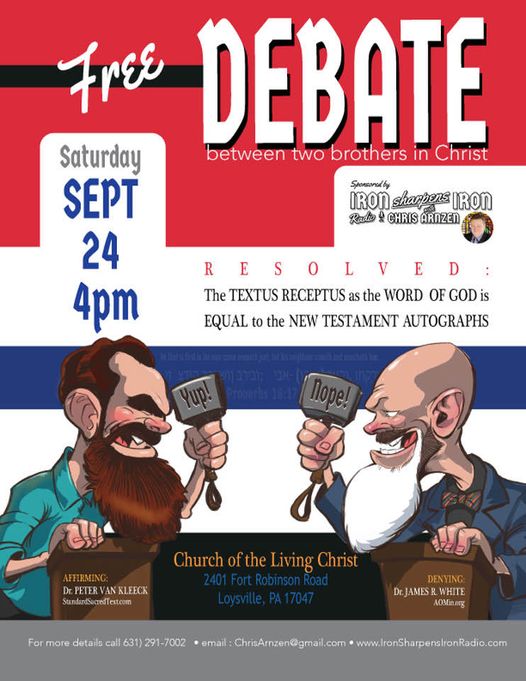
In this episode Drs. Van Kleeck conclude their commentary on JW’s opening statement.
Belief in Scripture to Change the World
In this episode Drs. Van Kleeck conclude their commentary on JW’s opening statement.

So I had the delight of hearing our work mentioned again on James White’s Dividing Line yesterday. I have to thank him for continuing in doing so. The fact is, JW is good for StandardSacredText.com. Again, thank you to James White for furthering our cause.
As JW recounts it, he yet again “stumbled” upon our work now for the second time in the span of a week. It appears to me that JW is still sore about me calling him out on his tired old naturalistic argument because he keeps bringing it up. Perhaps we touched a nerve.
Particularly, JW took issue with the fact that I chose an argument [my probability argument from Bayes] that I had never before presented in public. As JW is apt to do, he compared me to an atheist that he debated one time simply because I presented a new argument. At this point I would be disappointed if JW didn’t compare me to a Muslim or an atheist. JW just wouldn’t be JW without such glittering jewels of colossal ignorance.
He then went on to complain that I didn’t present the arguments from our books only to turn around and admit that the substance of the Spirit/word/faith paradigm was indeed in my arguments even though my arguments at the debate were not carbon copies of those in our books.
Unfortunately for JW it seems that he is so stuck with his narrow and effete argument that he can’t even fathom making a different argument and as such he finds it wholly strange that someone would argue a dozen or so different arguments all aimed at the same conclusion. It seems to me that JW should have at least three robust arguments in defense of Scripture: 1.) his historical/manuscript argument, 2.) an exegetical argument, and 3.) a theological argument.
But if you watch all of his debates about the text and translation he really only has one argument, argument #1. In fact if you watch this series held in a church for church people you’ll find it’s four hundred minutes long in which he quotes Scripture a handful of times and each time it is to demonstrate why the Bible should be doubted in places. And this is because no one who holds JW’s position has a robust exegetical and theological position to defend statements like, “The Bible is sufficiently reliable” and ” The Bible is 99% God’s word” and “The original text of the NT is in the body of the Nestle/Aland 28 or it is in the textual apparatus.”
I explained in the debate that JW’s #1 argument is merely a birdy argument. Someone else has chewed up and partially digested the data and then JW gladly took those chewed up and partially digested remains and graciously offers them to the rest of us and if we politely decline then JW has to “debate” us so that he can explain to you and to the audience that birdy arguments are the best tasting arguments around.
This is not to say that all of us don’t need help from teachers and books. Indeed, the Scriptures teach us that at one point we have all been newborn babes desiring the sincere milk of the word. But there has to come a time when we grow up and recognize that there are a host of substantive, beautiful, and persuasive ways of defending the Bible and most of them can be done without appeal to modern text-critical methodology.
There are arguments to be made from archeology, philosophy, epistemology, metaphysics, mathematics, theology, exegesis, history, church history, and on and on. We cripple ourselves in defending the Christian faith by limiting our arguments to textual criticism and its modern methodology – the one trick pony of JW.
But when we do present new arguments JW complains, cries foul, and then fails to rebut those arguments. He then retreats to the DL, to his rabbit hole, and tries to find grace and help in his time of need but in the end a retreat to the rabbit hole only weakens his ability to contend and overcome when outside that rabbit hole. And that is what we saw during our debate. JW was not ready because JW has spent too much time in his safe space greedily clutching his old moldy argument. So now, eleven days later instead of actually grappling with my argument he simply cries, “Bad Form!” Thanks, Captain Hook.
Maybe JW’s argument worked in his generation but it doesn’t and won’t in mine and certainly not for my children’s generation. If you are happy with old unsubstantiated stories about Erasmus and truncated historical arguments, by all means, stick with JW. But if you are tired of JW’s Hobbit Hole argument, then perhaps it is time to go on an adventure and embrace the depth and breadth that the wide world of right thinking Christian theology and exegesis offers you.

In this episode Drs. Van Kleeck begin their commentary on Dr. James White’s opening statement.

On October 3rd James White [JW] gave us more air time on the Dividing Line, again. Around the 42 minute mark JW begins his commentary on some of our recently published blog posts. After listening to his commentary I struck with a kind of thankfulness. So I thought I would take today’s post and thank JW.
1.) I want to thank JW for taking the debate in the first place. In the broader evangelical world he’s a big fish and I’m a small fish.
2.) I wanted to thank JW for the increase of traffic here to the blog and to our YouTube channel. The argument for a standard sacred text is spreading and in large part because of JW.
3.) I want to thank JW for the increase in opportunity to both answer questions and explain our position. I have lost count how many folks have reached out to me via email, FB private messenger, and here on the blog asking for clarifications, book recommendations, and answers to potential objections. This would not be possible without JW.
4.) I want to thank JW for the opportunity to debate. It has been very instructive in what debates look like among Christians, what Christians care about in debates, and what I can do to meet them where they are.
5.) Concerning the October 3rd DL, I want to thank JW for once again demonstrating that my arguments remain undefeated. I mean he complains about the faces I made and the fact that he had never heard these arguments before, but even 10 days later he has offered no substantive response.
6.) Concerning the same DL, I want to thank JW for doing exactly what I said he would do in this post and this post. JW is going to JW.
7.) I want to thank JW for bringing up the same failing stale arguments he always does. They made my work a lot easier and they also leave room for significant improvement for anyone interested.
8.) I want to thank JW for allowing me to live rent free in his head especially considering he regards our position as a minority position and idiosyncratic. Nevermind that in the history of the Church it is his position which is the minority and is idiosyncratic; the fact that JW persists in addressing us tells me that we are definitely onto something. Thank you for that affirmation JW.
I am reminded of the Archbishop who sought to buy all of Tyndale’s New Testaments only to burn them. Augustine Packington, who was in league with Tyndale, replied that he could get most of Tyndale’s New Testaments, at least those that were not yet sold. The Archbishop agreed and Packington sent the New Testaments which the former promptly burned. The comedy of it all was that the Archbishop had unwittingly funded through Packington the production of Tyndale’s second edition of the New Testament. In like manner, JW has been more help to our cause here than he knows and for that we are thankful. By all means, keep up the good work.

Verse 5. Every word of God is pure: he is a shield] Albeit all the sacred sentences contained in this blessed book are pure, precious and profitable, yet as one star in heaven outshineth another, so doth one Proverb another, and this is among the rest, velut inter stellas luna minores, and eminent sentence often recorded in Scripture, and far better worthy than ever Pindarus his seventh Ode was, to be written in letters of gold. Every word of God is pure, purer than gold tried in the fire, Rev. 3:17, purer than silver tried in a furnace of earth, and seven times purified, Psalm 12:6, 7. Julian (therefore the odious apostate) is not to be hearkened to, who said there was good stuff in Phocyllides as in Solomon, in Pindarus his Odes as in David’s Psalms. Nor is that brawling dog Porphyry to be regarded, who blasphemously accuseth Daniel the Prophet and Matthew the Evangelist, as writers of lies. Os durum! The Jesuits (some of them) say little less of Saint Paul’s Epistles, which they could wish by some means censured and reformed, as dangerous to be read, and favouring of heresy in some places. Traditions they commonly account the touchstone of doctrine, the foundation of faith, the Scriptures to be rather a Commonitorium, (as Bellarmine calls it,) a kind of storehouse of advice, then Cor [sp] animam Dei, the heart and soul of God, as Gregory calls them, a fortress against errors, as Augustine. The Apostle calleth concupiscence sin, at non liocet nobis ita loqui, but we may not call it so saith Possevine the Jesuit. The Author to the Hebrews saith, Marriage is honorable among all men. But the Rhemists on 1 Cor. 7:9 say that the marriage of Priests is the worst sort of incontinency. Christ saith the sin against the Holy Spirit hath no remission. Bellarmine saith that it may be forgiven. The Counsel of Constance comes in with a non-obstante against Christ’s institution, withholding the Cup from the people at the Sacrament. And the Parisian Doctor tells us that although the Apostle would have sermons and service celebrated in a known tongue, yet the Church for very good cause hath otherwise ordered it. Bishop Bonners Chaplain called the Bible in scorn, his little pretty God’s book, and judged it worthy to be burnt, tanquam doctrina peregrina, as strange doctrine. Gilford and Reynolds saith it contained some things prophane and apocryphal. Others have styled it the mother of heresy, and therefore not fit to be read by the common people, lest they suck poison out of it. Prodigious blasphemy! Of the purity and perennity of the holy Scriptures, see in my true treasure, page 85, 139.
He is a shield to them that put their trust in him] See Gen 15:1[1] with the note and Prov. 29:25.[2]
Verse 6. Add thou not unto his words] As the Jews at this day do by their traditions, which they arrogantly call Mashlamnutha Completion Perfectio: because they think that thereby the Law is completed and perfected, as the Artemonites, (and after them the schollmen) corrupted the Scripture out of Aristotle and Theophrastus, turning all into questions and quillets. As Mohomet joined his Alfurta his service book, an horrible heap of all blasphemies, to the three parts othe Holy Scriptures (as her divides them) the Law, Psalms, and Gospel: as the Papists add their human inventions, and unwritten verities: which they equalize unto, if not prefer before the book of God, as appears by their heathenish decree of the Council of Trent. And when the Counsel of Basil, the Hussites denied to receive any doctrine that could not be proved by Scripture, Cardinal Casun answered that the Scriptures were not of the being of the Church, but of well-being, and they were to be expounded, according to the current rite of the Church, which if it change its mind, the judgment of God is also changed. Lastly, such add to God’s word, as wrest and rack it, making it speak that which is never thought, causing it to go two miles where it would go but one, gnawing and tawing it to their own purposes, as the Shoemaker taws his upper leather with his teeth. Tertullian calls Marcion the heretic Mus Ponticus, of his eroding and gnawing the Scripture to make it serviceable to his errors.
Lest he reprove thee] Both verbally and penally; both with words and blows. Lest he severely punish thee, as one adds to his Will, or imbaseth[3] his coin.
And thou be found a liar] As all Popish forges and foysters[4] at this day are found to be. God hath ever raised up such as have detected their impostures and vindicated the purity and perfection of the sacred Scriptures.
_________________________________________
John Trapp, Solomonis PANAPETOS: or, A Commentarie Upon the Books of PROVERBS, ECCLESIASTES, and the Song of Songs (London: Printed by T.R. and E.M. John Bellamie, and are to be sold at his shop at the three golden Lyons in Corn-hil near the R. Exchange, 1650), 350-51.
[1] Gen. 15:1, “After these things the word of the LORD came unto Abram in a vision, saying, Fear not, Abram: I am thy shield, and thy exceeding great reward.”
[2] Prov. 29:25, “The fear of man bringeth a snare: but whoso putteth his trust in the LORD shall be safe.” “This cowardly passion expectorates and exposes a man to many sins and sufferings. And albeit faith, when it is in heart, quelleth and killeth dreadful fear, and is therefore fitly opposed to it in this sacred sentence.” 343
[3] Imbase or embase (archaic): to lower especially in rank, dignity, or quality: DEBASE
[4] Foyster or foister (archaic): PICKPOCKET; obsolete: a palmer of dice: CHEAT, ROGUE. Trapp’s use of the word denoting deception and trickery is interesting. For the untrained, scholars utilize not reason but “sleight of hand” to deceive the simple.
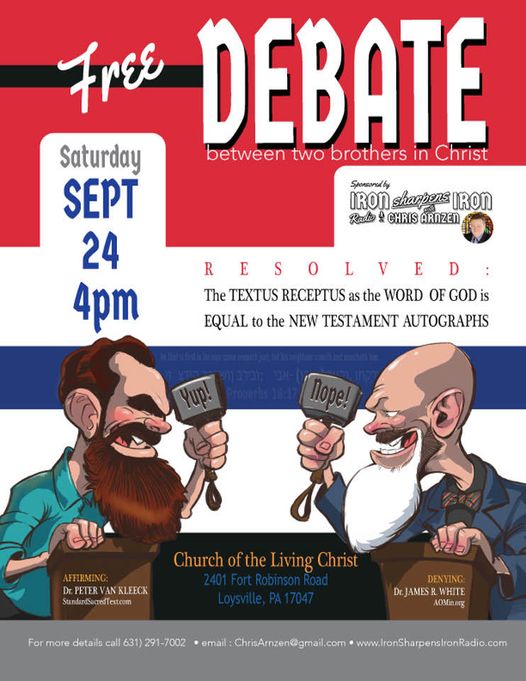
In this episode Drs. Van Kleeck conclude their commentary on Van Kleeck’s opening statement.
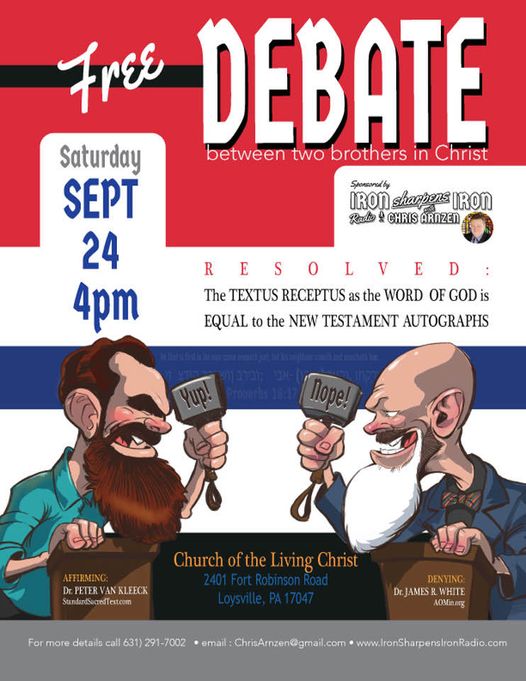
Here is the beginning of our debate commentary. Lord willing I will be able to do some quick edits and then have a video up each day this week. Given the length of the debate and subsequent commentary, this series should last through next week. We’ll have to see how it goes.

Thus far, having read critiques of my debate performance, two complaints have arisen: 1.) I offered arguments that were unfamiliar and therefore difficult to understand. 2.) I was rude, angry, condescending, and/or had a chip on my shoulder.
I already addressed #1 in this blog post so let’s turn to the second complaint. As the debate day grew closer I began to ask those around me, those I trusted, whether I should enter the debate “knives out”. That is, whether I should meet JW where he is and play the game the way he plays it. I explained to them that after watching so much of JW on the topic of Text and Translation that it seemed to me that he was often less than professional with his Christian interlocutors. What is more the moderator rarely if ever restrained either debater’s rhetoric so no one was going to stop JW if he started down that road. To illustrate JW’s lack of professionalism and restraint, consider the following debate which was part of my own debate preparation.
This debate was between James White and Pastor Jack Moorman. Beginning at around the [54:48] mark you will find the following (Click the time stamp if you’d like to watch it yourself):
[54:48] – JW is seen visibly shaking his head while his interlocutor is speaking.
[56:38] – JW is shaking his head and speaking over his interlocutor with the words “Not true.”
[01:01:58] – JW interrupts his interlocutor and then takes over the conversation.
[01:03:43] – A listener asks a question and JW laughs at the question with incredulity.
[01:03:50] – After being told earlier by the moderator not to comment JW comments anyway.
[01:09:30] – JW audibly scoffs and shakes his head.
[01:13:20] – JW shakes his head and speaking over his interlocutor with the words “Not true.”
[01:14:20] – JW laughs and then interrupts his interlocutor.
[01:19:02] – JW smiles then scoffs then interrupts.
[01:23:52] – JW smiles then scoffs at a listener’s question. The moderator then calls for summary statements. JW asserts that he will first offer a response to the listener’s question. After which JW offers his summary statement.
And all of this in under 30 minutes. At no point did the moderator step in and tell JW that such behavior was rude and unprofessional. By the time of the above debate JW had been on the debate scene for over 21 years and had already debated Bart Ehrman. Still, JW had not yet worked out of his system the laughing, interrupting, head-shaking, scoffing etc. and the above is only what was caught on camera.
And before we think that this kind of rhetoric is out of JW’s rhetorical system let’s not forget this chippy response from JW when debating Dr. Riddle.
Then of course after our debate JW posts the following meme on his wall which shows a thoroughly non-chippy, non-rude completely professional JW during our debate.
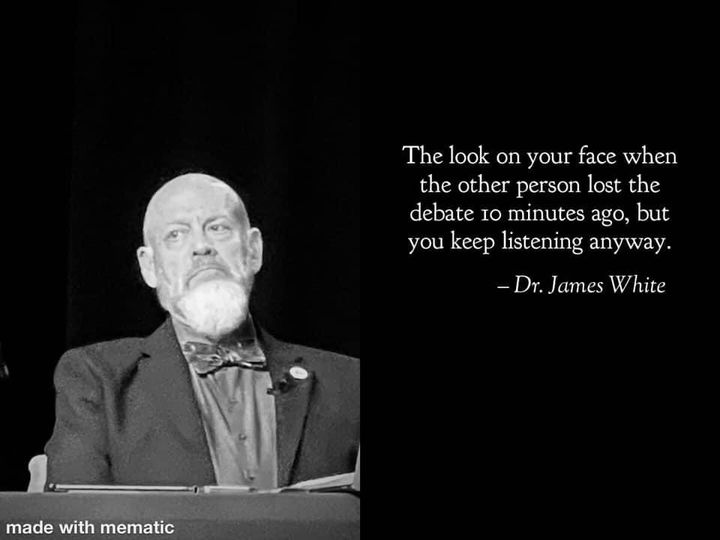
The point is that JW has set the tone of this debate years ago and it continues up until today and that tone includes making faces, shaking your head, speaking over your interlocutor, scoffing, and all the rest.
This is part of JW ‘s legacy. JW engenders heated, rude, and chippy debate because that is the way he debates, especially with Christians.
So as I saw it I could either wait for JW to do the same to me or, seeing that I spoke first, do it to him right off the bat. I chose the latter.
Now, was my rhetoric chippy, heated, and even rude? Indeed, it was. Is that a professional way to debate? No, it is not. I have no problem admitting this. Unfortunately, no one in JW’s camp, no close friend, has helped JW admit as much as I just did in the first couple sentences of this paragraph let alone have that admission lead to real change in JW’s rhetoric. So I tried a different tactic, the tactic of “How about a little of your own medicine.”
And it worked! JW fans were coming out of the woodwork declaring me to be heated, condescending, and having a chip on my shoulder. Right! That was the point. Now take that same critique and help JW see the same light. So every time JW gets short with his interlocutor or interrupts or scoffs or emotes remember that JW is cementing his legacy in this kind of rhetoric and don’t be surprised if a younger man comes behind him with the willingness to play the same kind of game.
To those on my side of the isle, I know many of you disapprove of my tactic here and I can see why. I apologize for throwing you for a loop without warning. But in the end it proved an excellent point. For JW and those who follow him, chippy rhetoric is a “definitely for me but not for thee” kind of relationship when JW debates with Christians.

“Amandus Polanus (1561-1610) wrote extensively on the doctrine of Scripture against the famed Roman Catholic apologist, Robert Bellarmine (1542-1621). His refutation of Bellarmine spanned nearly 800 pages in his Syntagma Theologiae (Hanover, 1610, pp. 95-831). Polanus was a German Reformed theologian who spent much of his academic career teaching in Basel, Switzerland. Historians, such as Richard Muller, have referred to his Syntagma as one of the most important textbooks of theology in Early Reformed Orthodoxy. ” https://www.reformation21.org/blog/amandus-polanus-on-the-churchs-role-in-interpreting-scripture-1
Polanus comments,
“The third part of the Lord’s prayer is a conformation which containeth three arguments, by which our faith is confirmed, that God doth certainly hear our prayers. Two arguments are drawn from the attributes of God, the third from the end of hearing.
The first attribute of God is this: because he is king having rule over all things.
The second, because he is able, who can give us all things which we ask.
The argument from the end is, that he might be glorified for ever, because he is God, and a most bountiful and merciful father.”
Amandus Polanus, The Substance of the Christian Religion, Soundly Set Forth in two books, by definitions and partitions, framed according to the rules of a natural method (London: Arn. Hatfield for Felix Norton, dwelling in Paules Churchyard, at the sign of the Parrot, 1600), 487-88.
So it has been one week since the debate with Dr. White. As it currently stands there are almost 22,000 views of the debate so far. Several people have contacted me to say that they watch the debate live and then went back to watch it again and in so doing gleaned further insights into our defense of the Textus Receptus.
This is in part because the defense of the TR is quite broad in explanatory scope and force and a 2.5 hour debate cannot do justice to the material. Those who defend the TR do so with history, manuscript evidence, believing text-critical work, Christian theology, historical theology, philosophical theology, philosophy, epistemology as well as other tools of reason and inference. What is more, we believe it and are passionate about it. And because we are passionate about it we enjoy talking about it to anyone who will listen in nearly any environment from coffee shops to college classrooms.
As such I would like to officially announce that we are available for discussion and debate on the topic of the TR and the KJV. We will accept all invitations with certain caveats.
1.) We are willing to debate anyone so long as they have a terminating post-graduate degree [e.g., a D.Min., Ph.D., Th.M., or equivalent]
2.) If #1 is not fulfilled we would still be willing to have a vigorous, cordial, and moderated discussion of these topics.
We take the difference between a debate and discussion to be in format and aim. The format of a debate is limited in structure according to time parameters and centered on the debate question while a discussion is much freer with the time and can move around as the flow of the discussion dictates. Furthermore, a debate is a kind of competition with the goal of winning via the expression of persuasive truth. A discussion on the other hand is a time of learning and exploration – boldly going where perhaps the audience has never gone before.
Additionally, we are not the only ones willing to engage in debate and discussion. Over the past week several TR/KJV defenders have expressed the desire to debate and discuss topics in defense of the TR and KJV. These people are:
1.) Kent Brandenburg – His work can be found at https://kentbrandenburg.com/. Incidentally, Kent Brandenburg was the “Kent” Chris Arnzen first sought out for last week’s debate, not Kent Hovind. Kent Brandenburg has already had several moderated debates.
2.) Thomas Ross – His work can be found at https://faithsaves.net/thomas-ross/ Thomas has had many moderated debates on topics across the spectrum of Christian theology and apologetics.
3.) Nick Sayers – His work can be found at http://textus-receptus.com/wiki/Main_Page Nick has engaged in many online debates with interlocutors of varying academic acumen on various historical and text-critical issues.
Each has their wheelhouse and will defend the TR and KJV from different perspectives with their methodology but they are certainly faithful and available to make their case as they do.
Additionally, the 2022 Kept Pure in All Ages lectures with Dr. Jeff Riddle have recently been uploaded to YouTube. In the first lecture Dr. Riddle deals with certain apologetic considerations revolving around the work of Bart Ehrman. Then in his second lecture Riddle deals with the claims of Christians who are sympathetic to Ehrman’s position though they do not receive it en tota. Persons like Mark Ward fall into this category. Finally, Riddle addresses the Church, the believing community, and certain canned lines used by evangelicals to cast dispersions on the TR. Dr. Riddle’s lectures can be found here:
1.) Reasoning with the Wise and the Scribe
2.) Reasoning with the Disputer of this World
3.) Reasoning with Them That Believe
Blessings.

 Standard Sacred Text.com