The Arc of Christian Theology Is Long and Bends Toward a Standard Sacred Text

Generally speaking the doctrines of the Christian faith can be sorted into ten main categories: Theology Proper, Christology, Pneumatology, Bibliology, Anthropology, Hamartiology, Soteriology, Ecclesiology, Angelology, and Eschatology. It seems from these ten doctrines that the case for a standard sacred text is evidently and substantively manifest.

Given the advent of the tower of Babel we know that not all people speak and read the same language. So with this caveat in the place, it seems unnecessary to argue for a standard sacred text for all people, at least at this time in human history. That said, where the Christian religion is present, and where the above Christian theology is sufficiently present, it stand to reason that those Christians in that place given their sufficiently robust Christian theology would bend toward a standard sacred text.

Consider the following:

1.) Theology Proper or the Doctrine of God – The is one Holy God and therefore one standard sacred Revealer whose revelation is consistent with His oneness. Therefore, it is rational to conclude that what God reveals is standard and sacred. If what He reveals is in a book, His revelation is not only standard and sacred, but it is also text.

2.) Christology or the Doctrine of Christ – There is one mediator between God and man. There is one Messiah. There is one fullest and final revelation of the Father. That one is Jesus Christ. Therefore, it stands to reason that there is one standard sacred revelation of Christ to us.

3.) Pneumatology or the Doctrine of the Holy Spirit – There is one creative and indwelling Holy Spirit. There is only one Holy Spirit who indwells believers. There is only one Holy Spirit that carried holy men as they spoke. Therefore, it stands to reason that this unique Holy Spirit gave a singular standard sacred autographic text.

4.) Bibliology or the Doctrine of Scripture – We here at StandardSacredText.com have offered philosophical, exegetical, and theological arguments showing the warranted and rational nature of holding to the belief that God has given the English-speaking Church as standard sacred text.

5.) Anthropology or the Doctrine of Man – Only man is created in the image of God and only man can be redeemed by the shed blood of Christ and only man can come to know this truth unto salvation and only this truth can come through Scripture and only that which is from the one Triune God can count as Scripture. Therefore, it is reasonable that there be one standards sacred text for the English-speaking church.

6.) Hamartiology or the Doctrine of Sin – Only the one Triune God can determine what is or is not sin. God through the standard sacred text of the ten commandments determined what is sin and what is not. As such, Paul professes that until he had known the law he had not known sin. So the one Triune God is the giver of the only written moral code to give humanity the only true measure of morality. Therefore, it is reasonable to conclude that the only true measure of morality be a standard sacred measure and that that measure be found in a canonical – the rule, read, and standard – text.

7.) Soteriology or the Doctrine of Salvation – There is only one way to Heaven and there is only sacrifice which can secure that salvation – Jesus death on the cross for your sins. There is only one place to find the death, burial, and resurrection of Jesus Christ effectual set forth as the means of our salvation and that place is in the words of the Triune God. Therefore it is reasonable to conclude that the place from which we learn of our salvation be a standard sacred place and that that place be in a text.

8.) Ecclesiology or the Doctrine of the Church – There is only one Bride of Christ and that Bride is the Church or community of blood-bought Christians throughout all time. There is one God, one Christ, and one sacred religion. Therefore, it is reasonable to conclude that that religion rest on one standard sacred foundation, and seeing that faith comes by hearing the word of God, that foundation is Christ a revealed through the standard sacred text called the word of God.

9.) Angelology or the Doctrine of Angels – It follows from the Lord’s Prayer, “Thy will be done on earth as it is in heaven,” that God’s will is perfectly done in heaven. Furthermore, the law was received by the disposition of angels [Acts 7:53]. Seeing that God is one and that His will is one then all the words of God which Israel received by the disposition of angels must also be one. Therefore, it is reasonable to conclude that the reception of the word via the disposition of angels, who obey God perfectly, is the reception of one standard sacred word.

10.) Eschatology or the Doctrine of Last Thing – I already dealt with that yesterday with this post.

Even if you don’t grant me a standard sacred text by inductive inference, though I think you should, it seems that you must grant me abductive inference. For what other perspective of the Bible can account for a standard sacred God, a standard sacred word, a standard sacred message, a standard sacred moral code, a standard sacred Savior, a standard sacred Faith, a standard sacred work of the Holy Spirit, a standard sacred revelation of the divine will of God, and a standard sacred eschatological version of Christ’s teaching than an standard sacred text?

Indeed, the arc of Christian theology is long and it bends toward a standard sacred text.

The Social Experiment of Novel Bibles

The usurpation of pre-critical orthodoxy by theological nihilism, or the milieu created in the failed textual critical attempt to reconstruct the autographa, has not only corrupted sound doctrine but good behavior as well. Christian theology and virtue, drawn from the King James Bible, are ideally synonymous and practically the philanthropy of Christianity is evident in America and around the world. Personal autonomy engendered by post-critical theology and modern bible texts, infer that believing in a sort of autonomous individualistic utopia, based on the ability to control the shape of that traditionally held as highest source of authority, the Bible, is superior to pre-critical orthodoxy and historic Biblical benevolence.

The primary thing attacked was the source of all American and specifically ecclesiastical formal structure, the King James Bible. For the theological nihilistic scholarly oligarchy, (a small group of scholars that know more about religion and culture than anyone else) the KJB is considered the source of patriarchalism, sexism, homophobia, failed social justice, etc., and every societal evil. Everyone is “free” of these traditional sins to do as they please as long as formal structure that fomented them is marginalized or outright rejected. Thus, for everyone to be “free” of the Bible’s confining, conscience afflicting teaching, it had to be replaced with “bibles” whose existence was consistent with party orthodoxy. These bibles serve a religious purpose whose authority is granted by the party, and as such, everything traditionally considered sinful was erased and replaced by the laws of the party oligarchy. Once the transition from sell-contained Scriptural Authority to party-rendered authority was complete, the new bible served as a utilitarian party tool to impose party morality.

For instance, the idea that a wife is to submit to her husband as the head of the family as traditionally asserted in the King James Bible, for the modern mind, must be eradicated and replaced with a socialistic, egalitarian family structure. The accentuation of sphere sovereignty or indeed any kind of sovereignty is considered an antiquated relic of a cruel patriarchal society as taught in the King James Bible. If the novel versions mandated the same moral demands, why then have the publishers and advocates of the new versions stringently focused on separating the King James Bible from the new bibles by showing the King James Bible’s unreliability due to supposed conspicuous shortcomings and failures. Because morality was bound to obedience to the King James Bible, with the discrediting of the King James Bible came the discrediting of traditional morality.

The quintessential axiom of post-critical theology is that epistemology precedes ontology or what we know about something creates the reality of it. Those following the discussions on Standard Sacred Text clearly note that objections to the Protestant Orthodox claims are done merely by assertion, not from a theological or often even philosophical grounding, because the brute assertion is held to be authoritative. If an epistemological claim is made, as baseless as it may be, the words expressed make reality what it is. Thinking and saying are the creators of reality. So, if the party says women can be ordained for the ministry that proclamation creates the category of ordained women ministers. If the party says such and such is the bible, then it is the bible. To the old-school congregant, the interpretation in support of party orthodoxy may seem precarious, but for the true believer in party orthodoxy the passage cannot be interpreted any other way than the way he/she is told to interpret it. The party is the unquestionable lawgiver. Indeed, appeal to any other Authority than party orthodoxy is met with the most harsh and unpleasant responses.

What adherents of this “liberating” heterodoxy are blind to or willingly embrace, is that they have given over the most noble parts of themselves to serve as slaves to the post-critical theology of the party oligarchs. Once this path is taken there is no turning back without the harshest repercussions. Rather than rejoicing with those who have forsaken a life of sin and ruin, the blood-washed followers of Christ are of all people detested for rejecting party orthodoxy and for embracing a pre-critical, “back-woodsy” orthodox structure for their lives in the King James Bible, the traditional source of morality in the American culture. The structure of the traditional home must be replaced with autonomous party allegiance. Remember, the antiquated structure of the traditional home in American culture came from the King James Bible, not the ASV, NASV, NIV, ESV, etc. Even if one pusillanimously would claim that the new versions are “better rendered” than the King James Version, the impugning of the English exemplar, the KJB, likewise impugns the successive version either for its continuity with the exemplar, or, for its discontinuity, both comparisons leaving culture with no moral base whatsoever. After all, what gives anyone the right to say that the murder of the unborn is wrong, but not only wrong, but a sin against a Holy God? Remember, the one thing we learned during 2 years of Covid is that killing the unborn is essential. Church attendance is not essential but abortion on demand is.

Post-critical theology advocated from post-critical bibles declaring the theology of false egalitarianism has enslaved the malleable mind, and the acceptance of new bibles is the instigation and manifestation of that cultural enslavement.

A Standard Sacred Text and the Eschaton

As Christians we are citizens of another kingdom, a heavenly Kingdom. This Kingdom is the greatest of all kingdoms and it ruled but the greatest of all Kings. So as we walk this earth we should be giving the world around us a foretaste of that Kingdom and what it will be like when Christ rules and reigns as King of kings and Lord of lords.

Theologically speaking there is a component of already being but not yet attaining. Christ is already ruling but it is not that all things are under His feet [Hebrews 2:8]. Still, we should live Christ and His Kingdom in the present even when things seem to be going sideways. This is to say that we work to live out Christ’s Kingdom though it is already here but not yet completely full in its coming.

For example, we do this by emulating the relationship of the King and his bride as they are depicted in the marriage bond of husband and wife. Image standing in the back of the church and seeing individual representations of the bride’s relationship to the King. The husband as the leader of the home and lover of his wife as Christ loved the church. There in the assembly he worships with his head uncovered and under the lordship of Christ manifest through the teaching and preaching of the word. His wife, with her head covered, shows outwardly her voluntary submission to Christ and to her husband. Then with the husband and wife are their children, each a sign of blessing upon that home in that the fruit of the womb is God’s reward, and it is the parent’s duty to return that fruit to their Lord. In all of this we see the Lordship of Christ in a world that is in stark rebellion against God and His Christ.

So what does this have to do with the textual issue we are so fond of discussing here at StandardSacredText.com? Well it seems to me that if we are to live out the Kingdom here on earth until Christ returns then it seems we ought to live out the words of our King and how they are received until He returns.

The question now is, “Will there be multiple version of Christ’s words in Christ’s Kingdom or will there be one version of Christ’s words?” If the former, then bravo, we are living the kingdom of Christ as versions of God’s word proliferate in the English-speaking Church. If the latter, than the advent of multiple versions and insistence of multiple versions only is a step backward from manifesting the Kingdom of God and of His Christ in the present Church age.

So which is it? In the Eschaton will there be many versions or one version of Christ’s words to us?

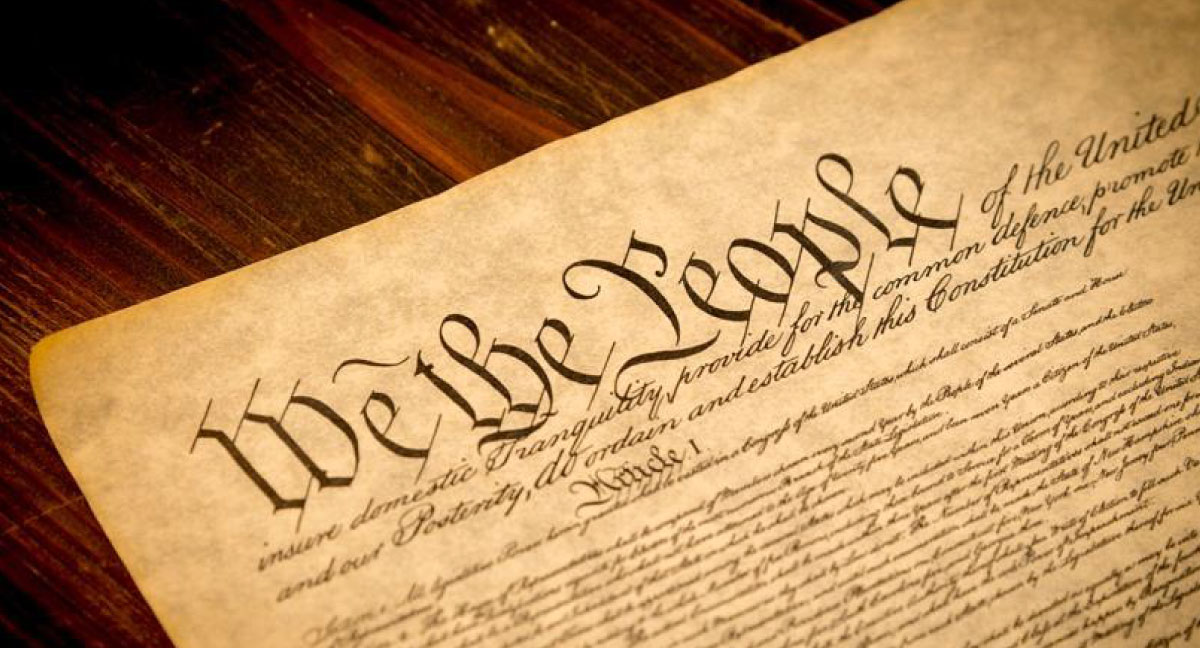
A New Constitution for a New Era in American Civil Life

Where the Bible should reign in the ecclesiastical sphere so the the U.S. Constitution should reign in the civil sphere of these United States. Since starting this blog I have been told more times than I can count how multiple versions is a huge blessing for the American Church. It has been plainly stated and inferred that multiple versions of the Bible have strengthened the Church, built it up, and made the body spiritually stronger.

I figured what’s good for the goose is good for the gander. How about we have 20 different versions of the U.S. Constitution and every couple of years Zondervan in cooperation with the Federal Government can put out a new version of the U.S. Constitution. Maybe next year they can put out a formal equivalence Constitution then a couple years after that a dynamic equivalence Constitution and then maybe the year after that a kind of Message version of the Constitution.

Then we can all sit around and pretend that they are all sufficiently reliable and encourage each other to own these multiple versions of the Constitution. But most important of all, we will band together and say that these multiple Constitutions are the Constitution.

And if anyone comes along and says that the Constitution written in 1787 is the one and only Constitution we will make sure to demean those 1787 Constitution Only folks. We’ll make lazy jokes like, “Don’t tell me you’re one of those ‘Hey if it was good enough for the Founding Fathers then its good enough for me’ kind of people.” Then we’ll all laugh. Hahahaha…get it?

When we go to the Court of Law we’ll bring our preferred version of the Constitution and argue for our innocence or for the guilt of another based on our preferred version. When elected officials swear to uphold the Constitution they mean that they swear to uphold their preferred version of the Constitution, because we all agree that most if not all the versions of the Constitution on the market are sufficiently reliable to be called the Constitution. And then finally, the United States of America will be blessed beyond measure for these multiple versions of the Constitution and we will all live happily ever after. We should start now.

But before you go I thought I would offer an example of what I mean so as to get further emotional buy-in from my readers. Below you will find the first ten amendments of the U.S. Constitution. First, I list that old outdated version written in 1787 with all its archaic language and false friends…ewww. Second, I list a new relevant version underneath which I got from this website. It is much easier to read and has less false friends and that is what matters most. Note also that the new relevant version is shorter and we all know that shortest is best. That said…

Who’s with me?! If we can do it to the U.S. Church we can certainly do it to the U.S. Government!

The First Amendment

The Old Outdated Version – “Congress shall make no law respecting an establishment of religion, or prohibiting the free exercise thereof; or abridging the freedom of speech, or of the press, or the right of the people peaceably to assemble, and to petition the Government for a redress of grievances.”

The New Relevant Version – “Congress is forbidden to pass any law setting up a religion or interfering with religious freedom or with free speech or with the right of people to get together peacefully and petition the government to have their grievances looked into.”

The Second Amendment

The Old Outdated Version – “A well regulated Militia, being necessary to the security of a free State, the right of the people to keep and bear Arms, shall not be infringed.”

The New Relevant Version – “The right of the people to keep and bear arms shall not be interfered with.

The Third Amendment

The Old Outdated Version – “No Soldier shall, in time of peace be quartered in any house, without the consent of the Owner; nor in time of war, but in a manner to be prescribed by law.”

The New Relevant Version – “No solider in time of peace shall be assigned to live in a private home without the consent of the owner, nor in time of war except in a lawful manner.”

The Fourth Amendment

The Old Outdated Version – “The right of the people to be secure in their persons, houses, papers, and effects, against unreasonable searches and seizures, shall not be violated, and no Warrants shall issue, but upon probable cause, supported by Oath or affirmation, and particularly describing the place to be searched, and the persons or things to be seized.”

The New Relevant Version – “The people are protected against search and seizure without a warrant.”

The Fifth Amendment

The Old Outdated Version – “No person shall be held to answer for a capital, or otherwise infamous crime, unless on a presentment or indictment of a Grand Jury, except in cases arising in the land or naval forces, or in the Militia, when in actual service in time of War or public danger; nor shall any person be subject for the same offence to be twice put in jeopardy of life or limb; nor shall be compelled in any criminal case to be a witness against himself; nor be deprived of life, liberty, or property, without due process of law; nor shall private property be taken for public use without just compensation.”

The New Relevant Version – “A grand jury is provided for in serious crimes. Persons are protected from being tried twice for the same offense, or from having to testify in criminal cases against themselves, or from being deprived of life, liberty, or property without lawful means.”

The Sixth Amendment

The Old Outdated Version – “In all criminal prosecutions, the accused shall enjoy the right to a speedy and public trial, by an impartial jury of the State and district wherein the crime shall have been committed; which district shall have been previously ascertained by law, and to be informed of the nature and cause of the accusation; to be confronted with the witnesses against him; to have compulsory process for obtaining witnesses in his favor; and to have the assistance of counsel for his defence.”

The New Relevant Version – “A fair and speedy trial for the accused is guaranteed in criminal cases.”

The Seventh Amendment

The Old Outdated Version – “In Suits at common law, where the value in controversy shall exceed twenty dollars, the right of trial by jury shall be preserved, and no fact tried by a jury shall be otherwise reexamined in any Court of the United States, than according to the rules of common law.”

The New Relevant Version – “A jury trial is provided for in civil suits exceeding $20.”

The Eighth Amendment

The Old Outdated Version – “Excessive bail shall not be required, nor excessive fines imposed, nor cruel and unusual punishments inflicted.”

The New Relevant Version – “Very high bail, stiff fines, or cruel punishment are forbidden.”

The Ninth Amendment

The Old Outdated Version – “The enumeration in the Constitution of certain rights shall not be construed to deny or disparage others retained by the people.”

The New Relevant Version – “Just because certain rights of the people have been stated in the Constitution does not mean that they do not have still others not mentioned there.”

The Tenth Amendment

The Old Outdated Version – “The powers not delegated to the United States by the Constitution, nor prohibited by it to the States, are reserved to the States respectively, or to the people.”

The New Relevant Version – “All powers not given by the Constitution to the U.S. nor forbidden to the states are reserved to the states or to the people.”

Franz Knittel (1721-1792): 18th C. Foundation for Textual Critical Work – Objections and Difficulties

Franz Anton Knittel (1721-1792), German Protestant theologian and paleographer[1] in his 263-page volume entitled, New Criticisms on the Celebrated Text, 1 John 5:7 begins his discussion aware of impending attacks upon his research. He begins with “a remark of great importance” and proceeds to make a distinction between Historical Critical difficulties and Historical Critical objections. Knittel writes,

It may readily be supposed, that scarcely any one of these Propositions has been unassailed. I shall therefore now adduce what has been urged against most of them in its fullest force; and, where illusions have been generated, endeavor to radiate upon them the pure light of Truth.

But I have one remark to make—a remark of great importance; which neither we, nor our antagonists, nor he that listens to us, can dispense with ; unless we all wish to mistake what is the truth. My remark is this : —

In Historical Criticism, we must never confound difficulties with objections: for they differ much, both in nature and in power. The former are concerned with relative, the latter with absolute, incomprehensibility: or, more plainly—He that raises an historical objection, alleges a fact which directly contravenes what we assert, or renders our assertion absolutely impossible. For example: Whoever impugns the proposition, “Moses wrote everything which is found in his Five Books,” by asserting, “No one can write after he is dead; therefore Moses never wrote what is found in Deut. xxxiv. 5, 6, 7: therefore the fact asserted, viz. that everything which we read in the books of Moses was written by his own hand, is impossible;”—whoever, I say, impugns the fore going proposition in this manner, raises an objection.

Objections, therefore, are what the calculators of probabilities call Argumenta necessario indicantia:[2] consequently, there are two kinds of objections. The first, when the existence of the fact on which the contradiction rests is indubitable, and absolutely certain. The example just alleged belongs to objections of this first kind. These therefore are incontrovertible; and completely demolish the positions against which they are levelled. The second sort of objections is, when the existence of the fact on which the contradiction rests, is not absolutely certain, but presumptive. For instance: If this proposition, “In the 2d century after the birth of Christ, the autographs of the Apostolic writings were no longer ex tant,” be impugned thus ; viz. “If some Christians in the time of Ignatius appealed to the Apostolic Originals, these originals must still have been extant in the 2d century;”— whoever, I say, impugns the proposition thus, raises an objection of the second class; for the testimony of Ignatius[3] to the existence of the fact on which the contradiction rests, (I mean, that “Christians appealed to the Apostolic Originals of the Apostles,”) is not absolutely certain, but only presumptive. Therefore, objections of the second class may be refuted; and we may maintain our assertion against them.

We now come to Difficulties.—He that creates difficulties, draws such inferences from a fact as tend not to make what we assert impossible, but its contrary, to a certain extent, more possible, that is, more presumptive.

[The following paragraph speaks to the unquantifiability of the transmission process being quantified by “any ancient Greek Manuscript” for two reasons: 1. MSS not yet discovered; and 2. The ancient MSS that have perished.[4] Knittel is arguing that the possibility of his conclusions makes the case against a reading presumptive. Knittel also seems to intimate that in 1785 some considered that all the extant MSS had been discovered, a lesson for the 2022 critic to consider.]

“For example: Supposing the testimony of the Ancient Fathers, that the clause 1 John V. 7. was formerly extant in the New Testament, be thus impeached: No such clause has hitherto been found in any ancient Greek Manuscript;—such an impeachment is no objection, but a mere difficulty. For, as it is possible that all the Greek Manuscripts of the New Testament have not yet been discovered; as it is possible that the Manuscripts in which the Fathers read it have perished; so the observation just made does not render what the Fathers say impossible: though the contrary proposition, viz. “that hitherto the clause has not been found in any ancient Manuscript,” gains presumptively, to a certain extent; that is, in case our assertion, “that the Fathers actually found the clause in their New Testament,” cannot be perfectly ascertained.

Difficulties, therefore, are what the Ars Conjectandi (or Doctrine of Probabilities) designates Argumenta contingenter indicantia.[5] Consequently there are two kinds of difficulties. First, When the existence of the fact which elicits the difficulty is absolutely certain.[6] The example given, is of this kind.

The second kind of difficulties is, When the existence of the fact which elicits the difficulty is not absolutely certain, but merely presumptive. For instance: If the position, “Matthew wrote his Gospel in Greek,” be controverted thus: Eusebius writes, “It is reported that Pantaenus left the Gospel of St. Matthew, in the Hebrew language, with the Indians: “thence it is evident this Gospel was written by Matthew, not in Greek, but in Hebrew.” Now, this argument consists of a difficulty, and that of the second kind: for, in the first place, the very quality of the fact here laid as its basis is doubtful: consequently, the presumptiveness or calculative value of the analogical inference (the contingenter indicans) = 1/2: for the Gospel left by Pantaenus may have been that written by Matthew; but it may also have been a Translation, made from the Greek Gospel of this Apostle, by another hand. Secondly, Eusebius also does not state the existence of this fact as certain. His words are, “It is reported.”

Consequently, in difficulties of the second class, two calculations (viz. one which bears the analogical inference; another, on which the existence of the fact is based) must be multiplied into each other, if we would determine the total probability of the surmise to be engendered thereby.

And now a few remarks—which I feel to be important—on Historical and Critical Difficulties: I say, on Historical and Critical Difficulties, on which many a fashionable Critic of our day builds his entire triumph, when he impugns ancient truths which he dislikes, and tries to say something new, in order to be stared at ; — on Historical and Critical Difficulties, by which our lovers of innovation are so rapidly seduced from the straight path of Truth, into the romantic by-ways of Imagination.

[Knittel remarks that the critic “impugns ancient truths which he dislikes, and tries to say something new, in order to be stared at,” indicative of the lengths a man’s pride, superbia, will take him. Written in 1785, 100 years before Westcott and Hort’s 1881 New Testament, Knittel knew that the Received Text and specifically 1 John 5:7 was being attacked in earnest by critics and responded accordingly. Scripture is the self-authenticating, self-attesting and self-interpreting word of God. Knittel’s appeal to “the straight path of Truth” confirms the principium (John 1:1).]

Francis Antony Knittel, New Criticisms on the Celebrated Text, 1 John 5:7, translated by William Alleyn Evanson (London: C. and J. Rivington, St. Paul’s Church-yard, J Hatchard and Son, Piccadilly, 1829, 1785), 10-14.


            [1] Paleography: The study and scholarly interpretation of earlier, especially ancient, writing and forms of writing.

            [2] Jacobi Bernoulli, Artis Conjectandi, Pars IV. cap.III. Argumenta necessario indicantia – necessary proofs.

            [3] Michaelis’s Introduction to the Holy Scriptures of the New Testament, Vol. I. § 37. pp. 243, ‘244.

            [4] For the absence of early witnesses see the Translators Preface, xxvii, “being either destroyed in the great conflagration of the Escurial 1671, or disposed of by some ignorant or dishonest Librarian, or concealed in the Library at Alcala, or possibly in the Vatican at Rome, under the apprehension of their proving unfavorable to the authority of the Vulgate.”

            [5] Bernoulli in loc. cit. Argumenta contingenter indicantia – contingent proofs.

            [6] The fact in the present case is this: “No very ancient Greek Manuscript, which we have yet discovered, reads John V. 7.” This fact is certain.

A Wisconsonian Story and Text-Critical Barns

Before I tell today’s story I want to remind you of a commonly recognized phenomena in the transmission of Greek texts over the ages. That phenomena goes something like this: Paul wrote the original of Romans. Scribe A went to copy Romans but made some mistakes. The original was lost, so Scribe B copied Scribe A’s copy of Romans and made some of his own mistakes. Scribe C comes along and, while under severe persecution from Diocletian, copies all the mistakes from Scribe A and attempts to fix the mistakes of Scribe B, but in these attempts, Scribe C mistakenly corrects Scribe B thus making new mistakes of old mistakes. Then Scribe C added more of his own mistakes.

This process of copying, copying mistakes, copying mistaken corrections, and the making of new mistakes happened for over 1,500 years and most of the copies, especially the older ones, have been lost to the wastes of time and use. So not only do we not have the originals, we do not have the vast majority of the Greek copies of the New Testament, and the copies we do have most probably contain mistakes which now may seem to us to be original. If modern evangelical text-critics were honest they would understand with the rest of leading NT scholarship that the task of reassembling the original NT via modern evangelical text-critical methodology alone is a misguided and naïve. The evidence simply does not bear out the necessity of such an aim let alone the probability of achieving that aim. So to glom on to why modern evangelical text-critics remain misguided and naïve I present to you a story illustrating that the modern evangelical text-critics can and will never know that reading X is indeed the original reading.

This story is what is called a Gettier Case or a Gettier Problem, the point of which is to show that the modern evangelical text-critic can never have justified true belief in their conclusions about NT reading X. Put more simply, they cannot know and will never know what reading is an original reading. Our story begins on the Wisconsin countryside…

Once upon a time there was a small town in rural Wisconsin. Travelers often passed through this town on their way to Green Bay. One day the town council innocently decided that they wanted the passersby to regard their town as very prosperous and so they decided to erect barn facades, or merely the face or front of a barn, in order to given the impression to passing travelers that this small town had such fruitful harvests that they needed all these barns. But in point of fact only some of the barns were really barns the rest were barn facades.

One day a father and son were traveling through the countryside of this small Wisconsin town and as they passed all the barns, not knowing that many of them were merely facades, the father commented to his son, ”My, that barn is one beautiful barn.”

Let’s pause our story here for a moment.

The question now is, “Does the father know that ”beautiful barn” is indeed a barn at all?” He does not know that the town folk innocently built barn facades yet the father is sure that said barn is indeed a beautiful barn. If it is barn then he is only accidentally correct in recognizing that red object out there as a barn. That is, even though the father has properly functioning faculties his environment is filled with lies or misinformation [i.e., barn facades that look like barns from a distance]. As such the father is not warranted to hold his believes because he exists in an environment that is misleading his faculties of sight. If it is not a barn, then the father thinks that red thing is a barn when it is not. As such, the father is plainly wrong in saying, “My, that barn is one beautiful barn” because “that” is not a barn at all but a barn facade.

Picking up the story again, suppose the father and son stop at the local gas station and the gas station attendant rats out the whole town and declares, “You know, the town council decided to erect barn facades in an attempt to look more prosperous.” How ought this to condition the father’s belief?

The first thing that would probably happen is that the father would have to second guess whether “that barn” is indeed a “beautiful barn.” The only way he could verify his belief of “that barn” is if he could go back and more closely inspect it. But what if he couldn’t get a close inspection of the barn? What if he is barred by some immovable boundary which keeps him from making his examination? He may think of a series of criteria whereby he could make his judgment from a distance. Perhaps barns with new looking paint are facades, but we know that real barns are often newly painted as well. The appearance of new paint may help him draw a warranted belief but there is still a great deal of doubt. Perhaps he would say that barns with their doors open are real barns but real barns could just as easily have their doors closed. This as well may help but significant doubt remains.

In order for the father and son to know “that barn is a beautiful barn” they must be able to look past the facades and see the real barns for what they are. For instance, if the father and son were to meet the builder of all the facades at a local restaurant he could tell them which are barns and which are not. But without this insight the father and son are not warranted or justified in their belief that “that barn is a beautiful barn.” That is to say, they don’t know it is a barn nor do they have the justification to say it is one.

[Edit: 3/17/2022 – Before we can make an application to textual criticism we need to add one additional component to the story of the Wisconsin Countryside. In order to make a fair comparison we need to assume that the father and son had never seen a barn. That is, they have never seen the original barn, the autographic barn, the barn from which all other barns are copied indeed all other facades attempt to copy. All the father and son have is the barns and barn facades they see in the Wisconsin Countryside and from observing those barns they claim to know what the original autographic barn looks like. The problem is, seeing that they have never seen the autographic barn they very well may identify the milk house as a barn or the tractor shed as a barn or the grain bin as a barn. Then the father and son come back to the city and tell the rest of us about the beautiful barn they saw but none of us have seen the original autographic barn and so we believe along with the father and son that the milk house and the tractor shed are also barns and perhaps the beautiful barn the father identified.]

Let us now make application to modern evangelical textual criticism. Their are true readings which represent the original reading and there are facade readings, and all these readings are spread across the textual countryside. The modern evangelical text-critic then takes a ride through that countryside and views these readings from afar off. Certainly they can hold the manuscript in their hand but historically they hold an ancient artifact and they can’t go back in time to ask the “builder” of that manuscript nor can the text-critic see the blueprint from which the “builder” of that manuscript made his copy.

The text-critic has been to the gas station and met the attendant. The text-critic knows now that the textual countryside is full of real and facade readings, but they cannot get any closer to them to make further inspection. So they resort to comparing readings with readings based on what they think is the probable form of real versus facade reading. They assume all their manuscripts are not facades, but they have no grounding for that assumption historical or otherwise. But because they have never seen the original reading they do not know what an accurate copy of that reading looks like. They very well may be comparing facades with real manuscripts and making decisions assuming both are real manuscripts or real readings. It is just as likely that they regard real readings as facades. They used to think the older the manuscript the better the reading, but now we know that old readings are in new manuscripts and we don’t know how they got there because the manuscript transmission stream is so profoundly incomplete.

In the end, the text-critic can never and will never know because they do not have the testimony of someone who built the original manuscripts and was there when all manuscript or reading facades were erected. They don’t have someone to point out, “This is the original reading. I know, because I was there when it was written.” And so the modern text-critic will forever and always, so long as he follows his current trajectory, offer provisional conclusions on this or that reading, but never really knowing. They will offer arguments from abduction, the weakest form of logical inference, saying things like, “The best explanation of the current evidence is reading Z.” But ten years from now when the method changes so will their abductive inferences.

In sum, the modern evangelical text-critic cannot know what the real reading is because they neither have the original nor do they have many and perhaps even most of the NT copies that have ever existed. And the copies they do have, are the product of copying mistakes, copying mistaken corrections, and the making of new mistakes for over the course of 1,500 years. What is more, as we discussed in this post, the vast majority of these copies are considered corrupt and of little value by the professionals that use them. The point is, the modern evangelical text-critic wouldn’t recognize a perfect copy of the original if it was biting him in the face. His method alone would prohibit him from making such a recognition. As such, modern evangelical text-critics may just as well identify an original reading as original as they would a tractor-shed reading as original.

We here at StandardSacredText have made the argument for years that we do have someone to point out, “This is the original reading. I know, because I was there when it was written.” That person is the Holy Spirit. We’ve argued it numerous times here on the blog. I argued this in my book regarding a Philosophical Grounding for Standards Sacred Text. The other Dr. Van Kleeck made the same case in his book regarding an Exegetical Grounding for a Standard Sacred Text. Lord willing we will have a Theological Grounding coming out before the end of the year, and we’ll be arguing the same thing. Furthermore, our arguments are not new in that the Post-Reformation Reformed dogmaticians made the case theologically and exegetically that the Holy Spirit speaks through His words in a way He does not speak through men’s words. Put another way Christ’s sheep hear His voice and the voice of another shepherd they will not follow.

Someone may ask, “How exactly do we know that reading X is the word of God and not a facade?” I respond with, “How exactly do you know that your saving faith is real faith and not a facade?” However you answer the latter question is how you answer the former. Blessings.

William Evanson’s (1829) Translator’s Preface to the 1785 work of Francis Knittel (1721-1792) entitled, New Criticisms on the Celebrated Text, 1 John 5:7.

On 1 John 5:7 Francis Turretin in the Institutes Q. XI, Sec. X writes,

“all the Greek copies have it [habent tamen omnia Exemplaria Graeca], as Sixtus Senensis[1] acknowledges: “they have been the words of never-doubted truth, and contained in all the Greek copies from the very times of the apostles” [et in omnibus Graecis exemplaribus ab ipsis Apostolorum temporibus lecta] (Bibliotheca sancta [1575], 2:298).

Also, earlier in his 1566 edition of the Bibliotheca Sancta, Sixtus writes the following regarding 1 John 5:7, “there has always been the undoubted truth in all Greek copies from the very times of the apostles” [indubitatæ semper veritatis suisse , & in omnibus græcis exemplaribus ab ipsis apostolorum]. Sisto (da Siena), Biblotheca Santa (Bavarian State Library: Franciscius, 1566, digitized Nov. 30, 2011), 972. 1,069 pages

Contrary to the critical orthodoxy of a single manuscript, Codex Montfortianus, (of which there are interesting questions about whether Erasmus actually referred to the manuscript at all) as grounds for the inclusion of 1 John 5:7, there is much yet to be learned for the passage’s inclusion which confirms the accuracy of Sixtus’ assessment of the passage and the reason why Turretin referenced his work. After hearing one side of a story for so long one might forget that there is always another side. What follows are two excerpts from the translator’s preface written in 1829 by William Evanson introducing the 1785 work of Francis Knittel (1721-1792) entitled, New Criticisms on the Celebrated Text, 1 John 5:7. In his preface, Evanson sets the stage for 251-page defense of 1 John 5:7’s inclusion in the New Testament. Knittel’s work is wonderful to read for the scope and quality of his scholarship.

The following material is a thimble full of Evanson’s preface, introducing the trajectory of Knittel’s writing. Research such as this is not a replacement for Scripture as autopistos, but, it is satisfying and confirming. Through the experience of learning, such research creates a fulfilling environment for the future exploration of information not yet discovered.

We pick up Evanson’s Translator’s Preface on page ix:

The entire evidence against the authenticity of 1 John V. 7. is resolvable into its absence from the majority of Greek Manuscripts, hitherto discovered and collated, which contain the First Epistle of St. John. The number of such may be, at the utmost, 150. Of these, there are only Two of very high antiquity; namely, the Codex Alexandrinus,[2] in the British Museum; and the Codex Vaticanus, in the Vatican Library at Rome. These are supposed, by some, to have been of the 4th century. All other Greek Manuscripts, as yet discovered, are later than the 9th century. Those two omit the disputed clause. But that omission is only a negative testimony, at the best; and it is suspicious testimony, as being contemporary with the prevalence of the Arian Heresy, which unquestionably originated in the meaning severally attached to that verse by Alexander and by Arius, in the 4th century. And, moreover, it is counterbalanced, or neutralized, by antecedent and contemporary positive, i.e., affirmative testimony; because Tertullian in the 2d, and Cyprian in the 3d centuries, (who both understood the Greek Language well, and manifestly consulted the Original Text of the New Testament;) Origen, a Greek Father in the 3d century; the second Symbolum Antiochenum (published at the Council of Antioch, a.d. 341); Gregory of Nazianzen, a Greek Father; Phoebadius and Ausonius, Latins of the 4th century ; and Jerome, in his Latin Version, castigated, as he expressly says, ‘ad Gracam veritatem,’ in the same century[3]; all either directly quote, or make such allusions to that verse, as necessarily infer its existence in the Greek Manuscripts of the New Testament then extant. Therefore, the testimony respecting 1 John V. 7. may be summed up thus :—Eight unsuspicious, positive, against Two extremely suspicious, negative witnesses. And the verdict, I feel confident, should be recorded as follows: “The verse, 1 John V. 7, being tried upon the sole testimony of Greek Manuscripts of the first four centuries—which, if it please some, we will call primary testimony,—we find, after due inquiry, that it did exist, as an integral part of the Greek New Testament, at, and antecedent to, the 4th century;” or, to use the words of Bishop Barlow, (no mean authority,) “We make no doubt it was originally there de facto;[4] and, de jure,[5] should be so still….”[6]

Moving down further in the Preface, we pick up Evanson again on page xxv:

Thus then stands the External Evidence, as regards the disputed verse, under the several heads, 1st, Greek-Manuscript authorities of the first four centuries ; 2dly, Greek-Manuscript authorities from the 4th to the 16th century; 3dly, Printed Editions.

Under the first, we have the positive, or affirmative unsuspicious testimonies of Tertullian, Cyprian, Origen, the Second Symbolum Antiochenum, Gregory Nazianzen, Phoebadius, Ausonius, and the Latin Vulgate of Jerome, either directly quoting or undeniably alluding to the clause: and against them we have only the negative and suspicious testimony of two Greek Manuscripts [Codex Vaticanus and Codex Alexandrinus] of the New Testament; both confessedly Latinized, and (allowing them to have been written in the 4th century) the productions of an age in which Arianism had tainted the whole body of the Christian Church, for forty years.

Under the second, we have the affirmative unsuspicious evidence of at least two existing Greek Manuscripts of the New Testament; of all the most ancient and best Manuscripts of the Latin Vulgate (there being not one in fifty which omits the verse) ; and a large number of quotations or direct allusions to it, in the Works of Greek and Latin Fathers, from the 4th to the 16th century[7]; —against the negative evidence of about 140 Greek Manuscripts, few more ancient than the 14th century; and the great majority belonging to the same suspicious stock, the Eastern Church. And, as it is admitted, that there are probably many thousand Greek Manuscripts of the New Testament in existence, which have never been collated or examined; as the Manuscripts employed by the Complutensian Editors have not yet been discovered, being either destroyed in the great conflagration of the Escurial 1671,[8] or disposed of by some ignorant or dishonest Librarian, or concealed in the Library at Alcala, or possibly in the Vatican at Rome, under the apprehension of their proving unfavorable to the authority of the Vulgate; therefore, until the materials, on which a negative testimony can be admitted, be very considerably augmented in number and authenticity, the affirmative, i.e., in favor of the disputed clause, must be allowed to preponderate under this head also.[9]

Thirdly, As to Printed Editions, the verse is contained in the Princeps Edition, by which Erasmus improved, and Stephens wholly formed, their several Editions of the New Testament; and in the genuine versions of Jerome, edited by Martianay and Vallarsius; names fully equivalent to those of the Deistical Wetstein and the Utilitarian Semler, or any of their servile imitators.

I have confined my remarks solely to the external evidence for and against this verse, and rest in the assured conviction that the former is decidedly preponderant. The Internal Evidence has been so ably and argumentatively discussed by the learned Bishop Burgess, and established on such an immoveable basis, entirely and unanswerably in favor of the verse, that the opponents of that verse have no other resource, than to thrust that species of evidence out of court altogether, and take refuge in a very convenient postulate, which has everything to recommend it —except truth. They tell us, that “no Internal Evidence can prove a clause to be genuine, where External Evidence is decidedly against it.” The falsity of this aphorism is palpable, from the whole history of Various Readings. How is any particular reading to be determined, when there are conflicting testimonies ? By the context ; —by the general scope of the author;—in short, by Internal Evidence alone. But the aphorism is not only untrue, but inapplicable in the case in question ; viz. 1 John V. 7. External Evidence is not decidedly against it: Internal Evidence is wholly in its favor: therefore it is a genuine Text of Holy Writ. One thing has deeply impressed me, in this inquiry. No satisfactory answer has ever been given to the question which naturally occurs, “How did that verse first gain admission and currency, as a text, of Scripture, if it were not so ab initio?”[10]

Francis Antony Knittel,, New Criticisms on the Celebrated Text, 1 John 5:7, translated by William Alleyn Evanson (London: C. and J. Rivington, St. Paul’s Church-yard, J Hatchard and Son, Piccadilly, 1829, 1785), Translators Preface, ix-xi, xxv-xxviii.


                [1] Italian convert to Christianity and anti-Talmudic agitator; born at Sienna (whence his name) in 1520; died in 1569. Besides homilies and mathematical writings, Sixtus was the author of the “Bibliotheca Sancta”(Venice, 1566), a Latin work in eight books, treating of the divisions and authority of the Bible; it contains an alphabetical index and an alphabetical list of rabbinical interpreters of the Bible. https://www.jewishencyclopedia.com › articles › 13792-sixtus-senensis

                [2] “The Codex Alexandrinus is, notoriously, a Latinized Version. Wetstein was prohibited, by the Authorities at Amsterdam, from printing his Greek Testament from that Codex, because it conformed to the Papal Vulgate in many important passages.” (See Goezen’s Vertheidigung der Complutensischen Bibel &c. &c. Preface, p. xiii.) The Theological World is greatly indebted to the learned and laborious Rev. H. H. Baber, Librarian to the British Museum, for an exact facsimile of the Vetus Testamentum Gracum in this interesting Codex ; one of the most splendid additions to our stock of Biblical Literature, and an incomparable specimen of typographic skill.

            [3] All the most ancient and best Manuscripts of Jerome’s Latin Vulgate contain 1 John V. 7. Not one Manuscript in fifty omits it. The majority of those in which it is omitted, contain the words “in terra” in the 8th verse. This is presumptive evidence of the existence of the 7th verse in the Originals from which they were transcribed.

            [4] de facto – existing in actuality

            [5] De jure – by right, legitimately

            [6] See Bishop Burgess’s Letter to Archdeacon Beynon, p. 22.

            [7] The verse, 1 John V. 7, was alleged against the Arians at the Council of Carthage, in the 5th century ; and its authenticity was not disputed by the Arian Bishops then present; nor questioned by any Arian, or other Heretic, from the 5th to the 16th century.

            [8] In 1671, a part of King Philip II of Spain’s intellectual treasure stored in the Escorial library  was destroyed by fire.

            [9] At the same time, I must assert, that no amount of negative testimony can overthrow the positive evidence of those unimpeachable witnesses already adduced, as vouchers for the authenticity of 1 John V.7.

                [10] ab initio: Latin, From the beginning; from the first act; from the inception.
What About Mark 16:9-20, John 7:53-8:11, and I John 5:7?

Over the past couple week we have been discussing, among other things, the fact that the Post-Reformation Reformed dogmaticians were aware of many of the textual variants that we wrestle with today. Some of the take-aways of these observation is that the Reformed Orthodox were aware of these variants and still argued for a standard sacred text in the Greek and Hebrew apart from the standard sacred text Rome found in the Latin Vulgate. Furthermore, we have observed that the method and subsequent conclusions drawn were different in kind than those practiced and observed now.

Today we come to the biggest and perhaps most contested passages in the version debate: the ending of Mark, the story of the woman caught in adultery, and 1 John 5:7. The appropriate question at this point is, were the Reformers were aware of these variants and how did they conclude regarding them? If they were known, and if their explanations possessed sufficient explanatory scope and force then it seems their answers should suffice for us today unless of course new and meaningful objections were to arise.

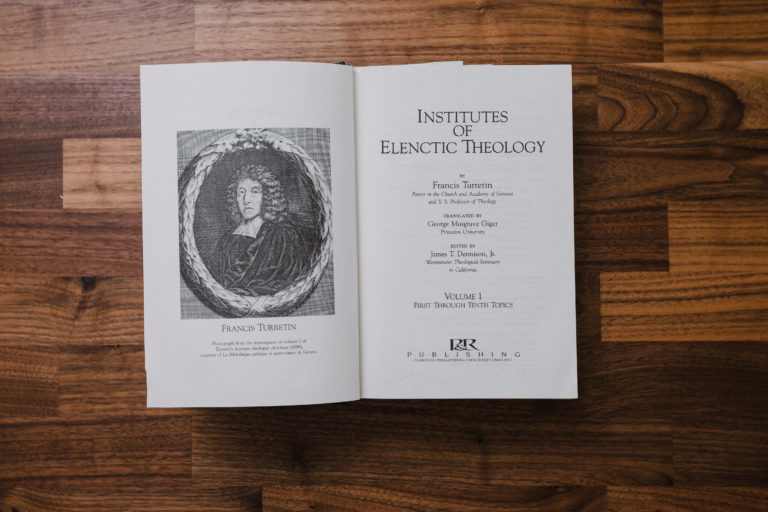
In answering this question let us look again to Turretin to see if he was indeed aware of these variants and if he was, how did respond to their existence. As I have said several times before, Turretin is a unique and potent example because his Institutes of Elenctic Theology served as the first systematic theology at the Academy of Geneva, the first Protestant School of Higher Learning. So, fresh out of the Reformation and during the High-Scholastic period, Turretin formulates the systematic theology of the Protestant movement. So what you see in Turretin’s work is not merely the work of one man but the culmination of three waves of the Reformation with a backdrop of Medieval learning. As such, Turretin’s Institutes represent the systematized and crucial loci [i.e., topics] of the Protestant movement to that point.

Given the above historical context what did Turretin have to say about the three passages in question? He writes concerning the account of the woman caught in adultery,

“There is no truth in the assertion that the Hebrew edition of the Old Testament and the Greek edition of the New Testament are said to be mutilated; nor can the arguments used by our opponents prove it. Not in the history of the adulteress (Jn. 8:1-11), for although it is lacking in the Syriac version, it is found in all the Greek manuscripts.”

Francis Turretin, Institutes of Elenctic Theology, vol. 1, Second Topic, Q. 11, Sec, X.

Concerning 1 John 5:7 he writes,

“Not 1 Jn. 5:7, for although some formerly called it into question and heretics now do, yet all the Greek copies have it, as Sixtus Senesis acknowledges: ‘they have been the words of never-doubted truth, and contained in all the Greek copies from the very time of the apostles.'”

Turretin, Institutes, Second Topic, Q. 11, Sec, X.

Finally, Turretin writes of the ending of Mark’s Gospel,

“Not Mk. 16 which may have been wanting in several copies in the time of Jerome (as he asserts); but now it occurs in all, even in the Syriac version , and is clearly necessary to complete the history of the resurrection of Christ.”

Turretin, Institutes, Second Topic, Q. 11, Sec, X.

In short, like in the other cases mentioned on this blog Turretin and by implication, the Protestant scholastics were well aware that their various opponents tried to use these three passages as a means to weaken the authority and certainty of the Protestant Canon. Now it is Protestants telling other Protestants that their Bible is less certain and authoritative because it contains these passages.

Observe further that Turretin’s emphasis again falls on the multiplicity of manuscripts in drawing his conclusions and in the case of Mark, that the long ending is “necessary to complete the history of the resurrection of Christ,” which is a theological consideration plainly stated as grounds for his text-critical decision. Overall, we see that there is nothing new under the sun. The accusations and attempted ends are the same though they are now coming from different quarters.

This is going to be the last of our examples from Francis Turretin on this point. Next time we will look at William Whitaker’s Disputations on Holy Scripture.

Thomas Jackson, (1579-1640) and Being a God unto All Other Men

Thomas Jackson, (1579-1640) Bachelor of Divinity, and Fellow of Corpus Christi College in Oxford deals in this excerpt with the authority of Scripture in relation to our teachers. As you read, please note that a foundation to accept or reject the teaching is known bv the believing student through the God’s word “immediately in it self and for it self.” If the self-authenticating Word does not ground the student in the Christian Faith, the expositor alone knowing God’s word will become “a God to all other men.” Written in 1613, Jackson could not have grasped the prophetic significance of his observations for the contemporary Church and Academy. He writes,

“Our younger students are bound to yield their absolute assent unto Aristotle’s authority in matters of logic: but not unto any interpreter that shall pretend it save only when he shall make evident unto them that was Aristotle’s meaning. And while they so only, and no otherwise yield their assent, they yield it wholly and immediately unto Aristotle and not to the interpreter, although by his means they came to know Aristotle’s meaning, which once known, without any further confirmation of other testimony or authority, commands their obedience and assent. But ere they can fully assent unto this great Master, or thoroughly perceive his meaning, they must continually assent unto their private tutors, or other expositors, and take his sense and meaning upon their trust and credit. In like manner (say we) in all matters, doctrines, or controversies of faith and Christian obedience, we are bound to yield our assent, directly, absolutely, and finally unto the authority of Scripture’s only, not unto any Doctor, Expositors, or other whosoever he be, that shall pretend authority out of Scripture over our faith, save only when he shall make it clear, and evident unto us, that his opinion is the true meaning of the Scripture. And thus, yielding our absolute assent unto the truth explained by him, we yield it not to him, but unto the Author of truth, whose words we hold to be infallible in whose mouths soever. And once known to be his words, they need not be the testimony or authority of him, that did bring us to the true knowledge of them. And before we be brought to see their truth with our own eyes, and feel it by our own sense, (by the effects or experiments of it upon our own souls) we are to limit our assent and obedience (as it is set down before) according to the probabilities, or impartial inducements, which we have of the Expositor’s skill and sincerity, must be framed according to the rules and precepts of Scripture, not according to our affections or humors. We may not think of him most to be believed, that is in the highest place, or hath he the greatest stroke in other affairs. For as the faith of Christ, so must our persuasion of the faithful dispensers, or skillful seeds-men of faith, be had without respect of persons.

If we yield assent or obedience unto any Expositor, or any other, otherwise than upon these conditions and limitations, then we as said before, whilst we yield absolute obedience unto his doctrine that persuaded us to true belief, because we perceive that which he spake to be the word of God, we did not yield it unto him, but unto God’s word, delivered and made known unto us by him. So here again by the same reason (only inverted) it will evidently follow that if we believe any man’s doctrines or decisions to be the word of God, because he speaks it, or because we hold his words to be infallible, we do not truly and properly believe the word of God, (suppose his doctrine were the word of God), but his words and infallibility only. Hence again it follows, that if we yield the same absolute and undoubted assent unto his authority, which we would do unto God’s word immediately known it it self, and for it self, or rely upon his infallibility in expounding God’s word, as fully as he doth upon the word, (which it is supposed he knows immediately in it self), and unto man which is only due unto him. For the infallibility of this teacher hath the same proportion to all that thus absolutely believe him, as the infallibility of the Godhead hath unto him; his words the same proportion to all other men’s faith that God’s word hath unto his. God’s word is the rule of his, and his words must be the rule of other men’s faith. Or, to speak more properly, God must be God only to him, and he a God to all other men.”

When you hear your professor’s lectures, do you look beyond the professor to the Author of Scripture, and hear in the lecture the viva Vox Dei, the living voice of God, or is he your final authority?

Thomas Jackson, The Eternal Truths of Scriptures, and Christian Belief Thereon Wholly Depending, Manifested by its Own Light. Delivered in Two Books of Commentary upon the Apostles Creed: The Former, Containing the positive grounds of Christian Religion in general, cleared from all exceptions of Atheists or Infidels. The later, Manifesting the Grounds of Reformed Religion to be so firm and sure, that the Romanist cannot oppugn them, but with the utter overthrow of the Romanish Church, Religion, and Faith.  (London: Printed by William Stansby by Elizabeth Crosley, 1613), 305-307. 479 pages.

This Is What the Church Sounds Like.

Over the last 5 years I have had the opportunity to teach at Trinity Baptist College in Jacksonville, FL the faculty of which is quite eclectic. For four years I taught on campus and have this last year started to teach online. In the opportunities in which I had to teach Bibliology or something in the neighborhood of Bibliology I did a particular instructive exercise.

Before starting the exercise I would charge the students not to quit. I explained to them that once the exercise began they would have a desire to quit almost instantly, but they should not if they wanted to get the full force of the exercise. In the two times I have done this none of the students quit even though some obviously wanted to.

After explaining the above I then handed out a sheet of paper on which a passage of Scripture was printed. It was the same passage for all the students but each printout came from a different version of the Bible, the 20 or so most popular versions in circulation. Once everyone had their particular printout with their particular version on it, I began to read from the KJV. Once I began to ready all the other students were to join in with their particular version.

As you can imagine, the result was confusion. Only a handful of words were discernable. And just as I had predicted, as soon as the reading of Scripture became noise some students wanted to stop, but I encouraged them to keep on going until we made it to the end. At which point we were all isolated at best. Given the cacophony of sound most knew what they as individuals were reading but they did not know the words of their neighbor and for some, the very fact that everyone was in disagreement, those gleaned nothing from the reading. The exercise brought confusion, loss of focus, and for some, no learning at all.

To add to the point I offer you this audio aid. I took the opportunity to record myself reading 1 Peter 1:1-5 in the KJV, CSB, NIV, and ESV. I put them all on top of each other to illustrate what the 21st century church in America was to sound like if she read her respective Bibles during the public reading of the Scriptures. Before listening, remember that the greeting at the beginning of epistles is some of the most uniform grammatical structures in all Greek manuscripts, yet even with this commonality things are going to get lost fast. Enjoy!

So we are suppose to believe the American Church is stronger and more unified because of the above phenomena. We are suppose to believe further that translators and publishing houses have done the American Church an incalculable service by assisting in making the public reading of our Bibles impossible both logistically and morally given God’s injunctions to give attention to the public reading of the Scriptures and to do everything decently and in order. But then we here at StandardSacredText.com come along, make a compelling case that a standard sacred text is a good thing and that it is philosophically, theologically, and exegetically grounded and then Christians come to dispute with us why our case is the wrong one while simultaneously supporting the confusion heard above. The mind boggles.

This kind of confusion happens most Sundays in most churches in America. Then when it comes to preaching, the pastor reads one text and the people in the pew read something else. At a minimum the people in the pew are jumping around in their text trying to find where the pastor is reading. Many times his text has different words, in different places, and sometime his text has words or does not have words that are or are not in the congregant’s text. And let’s not forget the children in the congregation. They can hardly read as it is, but then the pastor seems to be jumping around and using words not in the child’s Bible. At a minimum this leads to confusion every time the pastor reads as well as a loss of focus. What is more, seeing that we are to give attention to the reading of the word of God in public worship [1 Timothy 4:13], this confusion and loss of focus can easily lead to not learning from the public reading of the text.

If a church hasn’t totally done away with the divinely commanded public reading of the word of God, she must resort to other means. To combat the confusion, loss of focus, and lack of learning, many churches have resorted to…you guessed it, a standard sacred text in the form of words on a screen or printed passages of Scripture in the bulletin. The pastor or elders know that a simple reading of the Bible is not possible because there is no standard sacred text so they make one up in the bulletin. They choose a text, often from the pastor’s preferred version and the church reads from that for the public reading of the Scripture. The point is, if you are going to obey the commandment of 1 Timothy 4:13 and the additional commandment to do everything decently and in order [1 Corinthians 14:40] you must have a standard sacred text even if that means you make one up every week.

Apparently for the CT/MVO crowd it is worth it that there is barely any public reading of the Scripture in church even though the Bible commands it. Apparently it is also worth it that the saint in the pew has less focus and more confusion at the reading of the Scripture, but then we wonder why Christians are biblically illiterate. But wait there’s more! For an additional cost of children who are just starting to read being completely lost as the Bible is read you can have as many versions as you want. And then we turn around and decry the fact that our children are leaving organized Christian religion at a record pace. Every church has its own problems but for the Standard Sacred Text position, reading the Bible out loud as a congregation is not one of them.