The King and His Laws

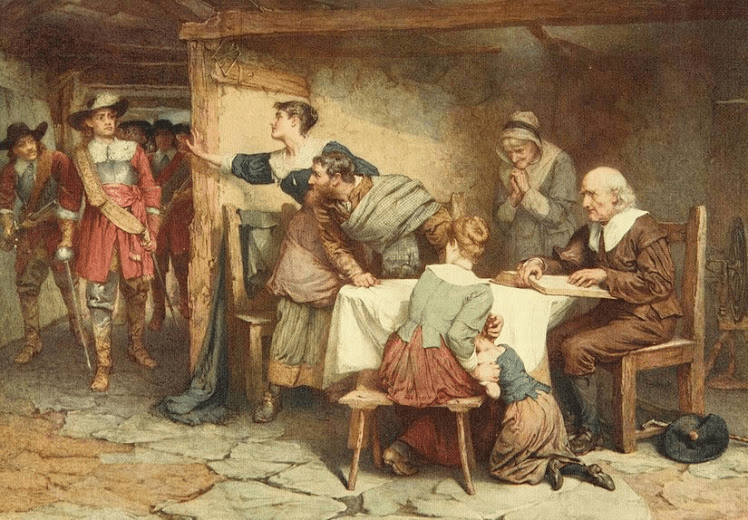
I was reminded yesterday in Church of this truth. Any king can write his laws upon stone and parchment, but only the King of Kings can write His laws on the hearts and minds of men.

“But this shall be the covenant that I will make with the house of Israel; After those days, saith the LORD, I will put my law in their inward parts, and write it in their hearts; and will be their God, and they shall be my people.”

Jeremiah 31:33

and

“For this is the covenant I will make with the house of Israel after those days, declares the Lord. I will put My laws in their minds and inscribe them on their hearts. And I will be their God, and they will be My people.”

Hebrews 8:10

and

“This is the covenant that I will make with them after those days, saith the Lord, I will put my laws into their hearts, and in their minds will I write them;”

Hebrews 10:16

What is more, God writes only His laws and His words upon the hearts and minds of men. God does not stoop to write the words of mere men upon the hearts of other men. Only God’s words are worthy and only God can do the writing.

He does this by the very hearing of the inspired infallible word of God and by the impelling power of the Holy Spirit who resides with and within each Christian.

Textual scholarship, for all of its work and research, is unable to account for this historical phenomenon, and so it doesn’t. But it is this very inability which makes modern textual scholarship unable to determine which words are the New Testament.

Textual scholarship’s inability to determine which words are eligible to be written on the hearts of men demonstrates that textual scholarship is equally unable to determine which words written on parchment are God’s words.

Put simply, if you can’t know which words God would have written on the hearts of men then you cannot know which words God had written on the original of the Old and New Testaments. It is also true, that if you can’t know which words of God are the words God originally gave, then you cannot know which words God would have written on the hearts of men.

How then do we know which words God originally gave? Well, they must be the words which God would have written on the hearts of men. And who knows the words which God would have written on the hearts of men? The Scripture is plain, just as the spirit of a man knows the things of a man so the Spirit of God knows the things of God (1 Cor. 2:11). So, only the Holy Spirit knows which words God would have written on the hearts of men. And where does the Spirit of God reside? The body of Christ, the Church.

Our Artless and Banal Textual Scholarship

“It is impossible to read Shakespeare – the best of Shakespeare, not the four or five weakest plays – and not (1) recognize his genius, and (2) enjoy the plays. Not by trying to read one in a night, but rather reading it in a week, following the footnotes the first time or two, catching up with the language, then reading for pleasure. Similarly, it is impossible not to enjoy Mr. Bach if you start slowly and are willing to devote a little effort at first.”

Phil G. Goulding, Classical Music: The 50 Greatest Composers and Their 1,000 Greatest Works (New York: Fawcett Books, 1992), 108.

You will not find the modern textual scholar making such claims and admonitions as to read something beautiful, something momentous, and to read it multiple times. You will not find them advocating for “catching up with the language the first time or two” in your study of Scripture or to “start slowly” and “devote a little effort at first” in your Bible reading. For Bach and Shakespeare, yes; for the Bible, no.

Instead we are treated to junk suppositions like “That’s hard to read” and “Those are archaic words.” If we are to learn Shakespeare and to understand his genius, and we should, we are going to have to read it in the words he wrote. If we are going to enjoy Bach and understand his genius we are going to have to start slowly and devote a little effort.

But instead of observing the genius of the these and like writers and composers we don’t study them at all. Not in public school and not in most private schools. And once out of school very few actually take it upon themselves to read and study these great works which formed the Western mind.

And now we are fighting to keep I Am Jazz and Sam the Transformer out of public schools because these messages are diametrically opposed to the survival of any society and culture. What happened? Which came first, whining about how difficult it is to read the King James Version or stupidly asserting that reading Shakespeare and the like have no use and are therefore obsolete?

Use?! This is the very thing that Karl Barth, as wrong as he was on so many things, warned the Church about. The Bible is no mere tool given to people to shape and reshape like Michael Jackson’s nose in order to give ecclesiastical credence to evil. The Bible is not a mere object of inquiry. Oh the Bible does have a use and that use is in the same way obedient subjects have a use for an almighty sovereign.

Disposable music, disposable literature, disposable technology, disposable theology, and disposable Bibles are the order of the day. Instantly the rage one day and by next year we need something new. If you don’t have the newest iPhone then you are behind the times, and if you don’t have the latest Nestle/Aland Greek NT you get charged with the same lapse.

We don’t have a use for real works of genius which yield longevity like the King James Bible or Shakespeare or Bach because we as Americans, starting in the academy, have become artless, banal, and misshapen down to our very souls. And we are proud of it, to boot.

Video: Dr. Riddle and the Principles for Handling Differences Between TR Editions (Part 4)

In this video Dr. Riddle presents the reality that God did not merely preserve the TR, but rather God has preserved His words, the Bible, in all ages and that the printed TR is a manifestation of that divine preserving work.

Even Our Opponents Agree: The TR was the Standard Sacred Text of the Church

Kurt Aland

In my perusal of the internet for all things TR/KJV I came across this article by Kent Brandenburg entitled, Another Quixotic Whiff from Mark Ward on the Bible and Its Preservation.

The article is a good one and I would consider Brandenburg to be very much in the Traditional Text/Confessional Text camp as touching Scripture after reading several of his articles. Concerning the article mentioned above, Brandenburg quotes from Kurt and Barbara Aland regarding their understanding of the Church’s relationship to the TR before the rise of the Critical Text.

Undoubtedly some if not all of the following material is familiar to our readership, but it bears repeating. Kurt writes of the Textus Receptus,

[I]t is undisputed that from the 16th to the 18th century orthodoxy’s doctrine of verbal inspiration assumed this Textus Receptus. It was the only Greek text they knew, and they regarded it as the ‘original text.’

Kurt Aland, “The Text of the Church?” in Trinity Journal (Fall, 1987), 131.

In another place he makes a nearly identical observation when he writes,

We can appreciate better the struggle for freedom from the dominance of the Textus Receptus when we remember that in this period it was regarded even to the last detail the inspired and infallible word of God himself.

Kurt Aland, The Text of the New Testament, 11.

Kurt’s wife, Barbara, continues in this vein. She writes,

[T]he Textus Receptus remained the basic text and its authority was regarded as canonical. . . . Every theologian of the sixteenth and seventeenth centuries (and not just the exegetical scholars) worked from an edition of the Greek text of the New Testament which was regarded as the “revealed text.” This idea of verbal inspiration (i.e., of the literal and inerrant inspiration of the text) which the orthodoxy of both Protestant traditions maintained so vigorously, was applied to the Textus Receptus.

Barbara Aland, The Text of the New Testament, 6-7.

I rehearse these quotations for one simply reason, the Church had a received text, a standard sacred text. We have been trumpeting that from the housetops for a while now. Our opponents above have admitted and freely so that the Church had a received text of Scripture which she regarded as the inspired infallible original.

We, those who hold to Confessional Bibliology and a standard sacred text, are not the schismatics (αἱρετικός hairetikos). We are simply holding to the text which our Reformation-era forefathers held to as the inspired infallible original words of God.

Our modern opponents on the other hand approve and applaud the factious proliferation of versions in the Church. They pretend to create standard versions like the Christian Standard Version and the English Standard Version, but in the end they give us no received text in the Greek or English which they themselves regard as the inspired infallible original.

And for what? They admit that a vast majority of the modern versions are sufficiently reliable. It stands to reason then that one of those modern versions would be sufficient, but no, for them there must be many and there must be doubt as to whether the text we have is the inspired infallible original.

We believe our Greek NT in the TR to be the inspired infallible original. The Critical Text folks believe their text to be sufficiently reliable. Which position do you believe is defensible from the teaching of Scripture? Which position do you believe is more consistent with historic orthodoxy?

It is not the TR/KJV side that has divided the Church. It is the Critical Text/Multiple Version Only side which has broken away and for no robust exegetical or theological reason at all. They are the schismatics. They are the ones dividing the Church into factions. Properly speaking, they are the αἱρετικός (heretics).

But it doesn’t have to be this way. Stop dividing the Church through your constant issuing of new versions of the words of God every year. Stop explicitly and implicitly casting doubt on God’s words by claiming we are 95% sure or the words of God are in the text or apparatus. Instead, embrace one of your many Greek editions as the inspired infallible original words of God. Then embrace one of your many English editions as the derivatively inspired and therefore infallible word of God in English.

Why not? What in the Scripture prohibits you from such a belief?

Providential Preservation Argues for a Closed Canon

This post taken from Exegetical Grounding, 96-97,

“argues for the end of the historic, providential process once the text is the replica of the exemplar, both the process and the end according to the plan of God, or a closed canon. The terminus is written by the Apostle John in Revelation 22:18-19. Speaking for not only the letter to the seven churches, but canonically to the whole of Scripture, there is by God’s care and keeping, a 66-book whole, that if added to or taken from will result in that soul’s eternal damnation. For an eternal curse to be merited, the lines of demarcation must be crystal clear. That added must be added to the existing whole, and that taken away must be subtracted from the same. These verses of dire warning are pointless if the text of Scripture is fluid. The Judge of all the earth will do right, and the premise of the condemnation is adding or subtracting from a known quantity, that which has come to completion, the written word of God.”

How 16th c. Scottish Hymns Teach the Doctrine of Scripture

Reformation in Scotland

As I write this entry consider how little of what is posted on Standard Sacred Text that can be utilized by or is relevant to the modern Evangelical MVO critical text adherent. Having thrown off the past and being every day in the process of recreating an uncertain theological future, the ecclesiastical history and historic defense of the Faith is of little consequence to them. The initiation of Christianity, for them, was inaugurated at the end of the 19th century. From this perspective it is relatively easy to understand why modern Evangelicalism bibliology is so anemic and negative. Evangelicalism has little ecclesiastical or theological history to build upon, unless, as has been noted in previous posts, it borrows from pre-critical theology for the sake of deceiving the simple. Rather than building on the rich theological and exegetical tradition built upon the apostolic message and preserved throughout the epochs of time since then, the Church today is spiritually starving on scholarly offerings. Like the Left’s opposition to taking advantage of the wealth of oil in America by drilling and fracking leaving the consumer with $5/gallon gas, the theological Left’s opposition to the historical wealth of theological resources has the church spiritually destitute.

The following are excerpts of a Scottish Hymn published in 1567 as part of a compendium entitled “Followings of the Great Loving and Blessedness of God’s Word.” The hymns of the church, like Confessions, convey the theological sentiments of the Church. The same is true today. The existentially centered music of the contemporary church reflects the ecclesiastical transition from theological doxology to anthropological self-absorption and the distorted notion that “If it’s not about me, why go to church?”

Stanza 1

“We know perfect, the holy writ”

Note here that the Scriptures are perfect and holy, two adjectives unsuited to qualify the MVO tradition. This is the theological and confessed position of the latte 16th c. Scottish kirk.

Stanza 3

“Teach them from thy hand to understand, Thy word to their Salvation.”

Here, the salvific quality of Scripture is addressed. Scripture is not a science project or textbook but the means of eternal salvation from the hand of God. This verse also infers the Scripture to be the means of evangelism and teaching. Epistemologically, being taught to understand also infers that understanding the Scripture is not a natural ability but comes through the illumination of the Holy Spirit.

Stanza 4

“Though Pope or King would so malign, To make the word of God forlorn, Their strength shall fail and not prevail, Though they the opposition all have sworn.”

Here the Church is cognizant of the institutional attack upon the Scripture from an apostate church and corrupt civil government. Attempts to make the Word wretched or miserable in the eyes of the people, even the most resource-rich and entrenched opposition will fail and not prevail against the power of Holy Scripture.

Stanza 5

“They give thy word a false report, Though never fails the truth”

Falsifying the Scripture is the modus operandi of the apostate church and corrupt civil government. In effect, there is an attempt to make the Scripture as wholly unreliable as every other authority except the apostate church and government, neither of which will allow allegiance to anything other than themselves. Once Scripture is accepted as containing prevarications, the gullible masses will have nowhere else to turn than to the church and government. Having abandoned the only thing that argues for freedom of conscience, the naïve voluntarily submit to slavery.

But for those who trust the Word, they know that it’s truth never fails, that it is the source of liberty of conscience, and that God always keeps His promises.

Stanza 6

“Thy word shall stand fast and perfect.”

The providential preservation of Scripture was a constant theme of the 16th c. writers. The Word being preserved is “perfect.” For the word “perfect” to have any relevant meaning it is imperative that God be the Preserver of the words and canon. Only God is capable of fulfilling such a promise. You see, then, once God is removed from the scenario man begins to speak of the Scripture in terms of intrinsic and transcriptional probability, of conjectural emendations and degrees of doubt.

Stanza 7

“To us though he a promise made, Us to convey from pain to Joy, Both in our life, and in our death.”

The eschatological ramifications of this issue is rarely addressed. “What bearing does the version issue have upon the eternal destiny of your soul?” This is usually answered by saying you can come to Christ through any version, or without a printed text through, the quotation of Scripture. All this is true at present, but this stanza deals with not only comfort in death but comfort presently in life. Only the reader can answer the reality of this statement in their own life. Are the new versions a comfort to you in the adversity of life? When on your deathbed, will reading the ESV, et al, give you comfort as you depart this world for the next? In the 16th c. this was not an issue. God made promises in His Word, they did and do convey or move the saint from pain to joy not only in this life but the next. Are believers in the pre-critical text and believers in the post-critical text believing the same thing about the person, word, and work of Jesus Christ? I don’t know. Do you?

Stanza 8

“We hope and trust the Holy Ghost, Shall not forget us at our need, So we thy word, with one accord, Hold in our heart, our Soul to feed.”

In the last stanza the inseparability of the Word and Spirit is presented in the hymn. Note the doctrinal depth of this hymn compared to the repetitious drivel that characterizes much of contemporary music. The Holy Spirit as comforter in accord with the Word satisfies the hungering heart and soul. This is the affectual impact of the Spirit and Word upon the saint. It is love for the Spirit and Word, especially in times of trial, that the saints cling to. To hold the word in the heart is to hold the Spirit in the heart and to hold the Spirit in the heart is to hold the word in the heart.

The attributes of Holy Scripture described in this hymn surpass those of Multiple Version Onlyism. They speak of the fulfilled promises of God, holiness, perfection, preservation, salvific qualities, and the inseparability of the Word and Spirit, all of which is in keeping with the writings posted at Standard Sacred Text. To speak and write this way about Scripture has a doxological focus toward which we should all strive. We “Praise God from Whom all blessing flow” except when it comes to the rational source of these blessings, the Holy Scripture. At that point, everyone has to throw away their Christian theological precommitments and think like a natural man.

A. F. Mitchell, ed., A Compendious Book of Godly and Spiritual Songs commonly known as “The Gude and Godlie Battatis,” reprinted from the Edition of 1567 (Edinburgh and London: William Blackwood and Sons, 1897, 1567), 56-57.

Edification Does Not Require Intelligibility

Mark Ward is known to say, “Edification requires intelligibility.” If we take “intelligible” to mean “able to be understood” as it does after a brief Google search, then Ward’s claim is simply false in nearly all sectors of life. If Ward means something other than “able to be understood” then clearly he has introduced one of his own False Friends into the conversation and we don’t know what he means by “intelligibility”.

Assuming Ward does mean “able to be understood”, let’s break that definition down and see how much of edification falls into the category of “able to be understood”.

So what constitutes ability? Simply put, one is only able if they have the requisite faculty, opportunity, and the time. If you are blind you are not able to see the sun. Therefore you are unable to see the the sun because you lack the faculty of sight. If you are seeing, but in extreme solitary confinement, you are still unable to see the sun. Therefore you are unable to see the sun because you haven’t the opportunity. If you are seeing and free to see the sun, but you work third shift during the winter in Northern Canada, you will sleep during the few hours the sun is up. Therefore you are unable to see the sun because you haven’t the time.

Is the blind man edified by the sun even though he cannot see the sun? Indeed, he is. Is the imprisoned man edified even though he cannot see the sun? Indeed, he is, for without the sun there would be no food for him to eat and no guards to let him out of his cell 1 hour a day. Is the third shift worker edified even though he cannot see the sun? Indeed, he is and so is his family for whom he sacrifices who lives by the sun while he works by the moon.

But what about understanding beyond the senses? Do the same criteria of faculty, opportunity, and time apply to intellectual understanding? They, in fact, do.

Consider a simplistic example of the interrelation of the college professor, the chemical engineer, and the business owner. The college professor has a faculty for abstract thinking, the opportunity to acquire post-graduate degrees, and the time to do so. The chemical engineer has a faculty for advanced mathematics and chemical composition, the opportunity to work for a large semiconductor company, and the time to do so. The business owner has good business sense, the opportunity because his father owned the factory, and the time to be a business owner.

Does the business owner understand how microchips are made? No, probably not. In fact, he very well many not know how to install one in the computers he uses to run his business. Is the business owner edified by what he does not understand? Most definitely especially if you included his house in the Shenandoah Valley and the Beach House in Boca.

Does the chemical engineer understand Divine Command Theory? Probably not. But he is edified by the fact that moral absolutes are indeed expressions of God’s good and perfect will. Does the college professor understand how Amazon Web Services works? No, he probably doesn’t. Is he edified though he does not understand? He very much is every time he uses the internet to order books from Amazon.

If you don’t have the time to learn and to be a college professor, business owner, and chemical engineer then you never understand these things but you will be edified by them. If you don’t have the faculty for the abstract or advanced math or good business sense then you will never understand these thing but you will be edified by them. If you don’t have the opportunity to get the kind of education or receive the kind of position necessary to know and do these things you will never understand them but you will be edified by them.

Do you have the faculties, opportunity, and time to examine all the things in your food? I venture that for most of us we do not and yet we are edified by the food we eat. Do you have the faculties, opportunity, and time to understand your car? Again, I think for many the answer is, no, and yet you are edified by the existence and use of that car.

But I can hear it now, “You are using ‘edify’ in an old [and more robust] way. Edification has an exclusively moral/religious slant to it.”

Fine…

Do the lost understand God – I mean Buddhists, Muslims, and Hindus? Well, sort of. Apart from Scripture, they understand that God is angry at them and desires to judge them. They have just enough understanding to be eternally destroyed.

And yet the image after which God they are made and the conscience which the living and true God put within them brings about moral and religious edification. The God that they do not know gives them daily grace and mercy restraining their wickedness. Billions of people in the world do not understand the Triune God but are morally and religiously edified.

Are the secularists morally and religiously edified by the God they do not understand? Well of course the answer is yes. The presence of the God they do not understand among the people of God they do not understand curbs, redirects, and condemns the immorality of the secularist. The God they do not understand calls them to a holiness they do not understand and that call in itself edifies.

What of the Christian? Many Christians inflate their capacity for free will and they misunderstand the sovereignty of God and yet they are edified by God’s sovereignty in their lives. Many other Christians have become fatalists and misunderstand the role of free will in the life of the Christian but nevertheless are edified by the godly sanctified free choices they make every day by the power of the Holy Spirit.

What about the Bible? Is my two year old edified by the Bible even though she does not understand a single word? She indeed is because her parents know the Bible and as a result we take her to church and sing the Psalms in her ears and teach her truth and obedience. My two year old daughter is edified morally and as a person because of the Bible she does not understand.

This post is already long and we haven’t even begun to discuss degrees of edification. That is, I could listen to a Kenyan Church singing their liturgy and thereby be edified by the symmetry, beauty, comradery, friendship, union of persons, and voices before God as an act of worship without understanding a single word. It is safe to assume that many Christians do not understand the Trinity as one substance in three subsistences but that does not mean they are not edified by fact that the Father, Son, and Holy Spirit are God. Christian’s may not understand what it means for God to reconcile all things to Himself, but they are edified by this truth nonetheless.

Then there is the act of prayer. Christians all over the world are edified through prayers they never heard offered up by people they may never meet. Understanding?! Christians in Ukraine don’t even know who is praying for them or what is being offered up and yet those same Ukrainian Christians are being edified through those prayers. Shucks, prayer itself is something we often misunderstand but we are still edified by it.

Put simply, the list of things that we “are not able to understand” but are nevertheless edified by is so long it is difficult to understand why Ward would say something so clearly false as, “Edification requires intelligibility.”
A Theological Grounding for a Standard Sacred Text

Our third volume in the Standard Sacred Text series is now available on Amazon. In this volume we leverage our work to this point in order to offer a robust historical, exegetical, and theological position in favor of holding to a standard sacred text and particularly the Authorized Version.

In the first chapter we discuss the nature of first principles and particularly epistemic first principles as commonly understood by our Reformation era forefathers. In the second chapter we discuss the role of the first-century apostles and the Apostolic Message in founding and disseminating the Scriptures.

In the third chapter we deal with the weaknesses of merely historical criteria and particularly how our Reformation era forefathers recognized these external historical criteria while at the same time rejecting them as the primary ground and foundation of how the Christian knows the Scripture is the word of God.

In chapter four we pivot to a thorough discussion on the role of the Holy Spirit in the formulation of the Canon by drawing on the works of Calvin, Ursinus, Bucanus, Owen, and Venn. In the fifth chapter we begin our discussion on the nature of inspiration and particularly the nature and implication of immediate inspiration.

Chapter six constitutes the discussion of inspiration in observing a strong link between inspiration and preservation. Particular to this chapter is the treatment of the theological term “providential preservation,” what that term means, and its application to the apographa by making use of the thought and work of Whitaker, Willet, Owen, and Turretin.

In chapter seven we discuss the distinction between immediate inspiration and derivative inspiration recognizing the Scripture as the Viva Vox Dei – the living voice of God. In chapter eight we offer a mechanism whereby the Christian can understand how the Church over the centuries has been able to move from one text to another without doing violence to his/her belief nor to the beliefs of prior generations of Christians.

Finally, in chapter nine we offer a couple dozen or so arguments, both positive and negative, which favor the King James Version as being the standard sacred text of the English-speaking Church. Each argument is brief in part because of the arguments we have heretofore offered in A Philosophical Grounding for a Standard Sacred Text and An Exegetical Grounding for a Standard Sacred Text.

Two final points:

1.) For those who disagree with our work or our conclusions we would love to discuss those things with you in person, on the phone, or online. If we must debate, then we are ready and willing but we much prefer to have a cordial and professional discussion of the issues over a cup of coffee and a piece of pie.

2.) For those who agree with our work and our conclusions you can help immensely by sharing our material with others whether in your own arguments or by pointing them to this blog. I have great confidence that together we can present a belief in the Bible that will change the world.

Thank you.

Wherefore as the Holy Ghost saith…

The writer of Hebrews pointing to the fact the Jesus Christ is one greater than Moses, calls to his readers attention Psalm 95:7-11. But in doing so the writer of Hebrews does not invoke the penman of the Psalm, King David, but rather writes,

“Wherefore (as the Holy Ghost saith, To day if ye will hear his voice, Harden not your hearts, as in the day of provocation, in the day of temptation in the wilderness.”

Hebrews 3:7-8

Why would the writer of Hebrews present the author of Psalm 95 as someone other than David? Did the writer of Hebrews not know that David was the one who put pen to paper and wrote Psalm 95? Was the writer of Hebrews attempting to be less precise? Is “as the Holy Ghost saith” a Hebraism? It is an oriental hyperbole? The answer to all of these questions is, no.

The words of Psalm 95 are the words of the Holy Spirit and are more commonly called, the words of God. We could say the same of the whole of Scripture. Paul says in 2 Timothy that all Scripture is given by inspiration of God. We could also use the words here in Hebrews 3, “All Scripture is what the Holy Ghost said.” Seeing that all of Scripture is only the Old and New Testament, then the New Testament is only what the Holy Ghost said.

If the words of Scripture are properly and precisely what the Holy Spirit said, how then do modern evangelical textual critical principles determine what words are the Holy Spirit’s and what words are not? I mean, they are His words, so how is it that oldest, shortest, and hardest show that the Holy Spirit said X?

Ultimately put, evangelical textual scholars are not looking for the New Testament. They are looking for what the Holy Spirit has said. This is the correct focus and such a focus should shift the scholars focus from mere historical manuscripts to the transcendent nature of words spoken by God the Holy Spirit.

So, what criterion are used in the CBGM to determine which words are the Holy Spirit’s? How do they know any of the words in the entire manuscript tradition are the Holy Spirit’s words? What proof, what evidence, what component of reason eclecticism provides a means for knowing what words are the Holy Spirit’s words?

How many text critical books, from evangelicals or otherwise, offer a robust treatment of how a textual scholar locates and recognizes the words of the Holy Spirit? Who among textual scholars speak of the manuscript tradition as the words of the Holy Spirit?

What authority does the textual scholar possess and from where does this authority come to critique, add, and subtract from their eclectic Greek Critical Text year after year only to call it the New Testament? Where has God given the academic and the scholar the right and privilege to determine what words are the Holy Spirit’s and the additional right and privilege to tell Christ’s Bride what those words are?

The writer of Hebrews has no problem referring to an ancient text which is at least a copy of a copy of a copy of the original as what the Holy Ghost said even without holding oldest, shortest, and hardest as criteria. Can you believe it? It’s almost like you can know what words are the words of the Holy Spirit without so much as a peripheral glance at modern evangelical textual criticism and its varied and multifarious conclusions.

The writer of Hebrews knew this but it is readily apparent that the vast majority of modern evangelical textual scholars do not.