“Easter” is a Perfectly Legitimate Translation in Acts 12:4

The following is a portion of Will Kinney’s work on Acts 12:4 and the rendering of pascha as Easter. You can find the full article here. Today’s gotcha question revolves around whether the KJV translators were negligent in translating pascha as Easter.

_____________________________________________________________________________

Is the word “Easter” an error in the King James Bible?

In Acts 12:4 we are told of Peter being taken prisoner by Herod. “Then were the days of unleavened bread. And when he had apprehended him, he put him in prison, and delivered him to four quaternions of soldiers to keep him; intending after EASTER to bring him forth to the people.”

Definition and origin of the English word “Easter” 

Webster’s 1828 dictionary  Easter – A festival of the christian church observed in commemoration of our Savior’s resurrection. It answers to the pascha or passover of the Hebrews, and most nations still give it this name, pascha, pask, paque.

American Heritage Dictionary of the English language 5th edition, 2011 – Easter: Derivatives include East, Easter, aurora, aur – See page 2037.  Easter, from Old English eastre, Easter, from Germanic austron – dawn. – the direction of the sunrise. 1.b. Ostmark – from the Old High German ostan, east. Both are from Germanic aust – eastern. 1. A Christian feast commemorating the Resurrection of Jesus. 2. The day on which this feast is observed, the first Sunday following the full moon that occurs on or next after the vernal equinox.  — Page 2037 aur – to shine (said especially of the dawn)

Merriam Webster’s New World College Dictionary, 4th edition. Easter – Middle English estre, from Old English astre; akin to Old High German starun (plural) Easter, Old English ast east

Oxford English Dictionary – Easter – 1. The most important and oldest festival of the Christian Church, celebrating the resurrection of Jesus Christ and held (in the Western Church) between March 21 and April 25, on the first Sunday after the first full moon following the northern spring equinox.

2. The period in which Easter occurs, especially the weekend from Good Friday to Easter Monday.

Origin – Old English astre; of Germanic origin and related to German Ostern and east

Oxford English Dictionary online.

https://www.lexico.com/en/definition/easter

Excellent article on Easter from KJV Today.

http://www.kjvtoday.com/home/easter-or-passover-in-acts-124

The etymology of “Easter” on the other hand has nothing to do with “flocks” or animal fertility. “Easter” (“Ostern” in German) is a Germanic word derived from the word “east” (“Ost” in German). Today, “east” refers to the direction from which the sun rises. The direction of east goes by that name because the Saxon word “east” meant “dawn”, “sunrise” or “morning”. The etymology of “east” is as follows:

“Old English east “east, easterly, eastward,” from Proto-Germanic *aus-to-, *austra- “east, toward the sunrise” (cf. Old Frisian ast “east,” aster “eastward,” Dutch oost Old Saxon ost, Old High German ostan, German Ost, Old Norse austr “from the east”), from PIE *aus- “to shine,” especially “dawn” (cf. Sanskrit ushas “dawn;” Greek aurion “morning;” Old Irish usah, Lithuanian auszra “dawn;” Latin aurora “dawn,” auster “south”), literally “to shine.” The east is the direction in which dawn breaks.” (Online Etymological Dictionary)

Paska in the Modern Greek Dictionaries 

The Greek word paska means Easter today. The Oxford Greek-English Learner’s Dicionary 2012 lists the word paska and the very first definition is Easter.  The second one is Passover.  

The same is true of the Collins Greek-English Dicitonary 2003, and in Divry’s Modern English-Greek Dictionary 1991. All three of these modern Greek-English Dictionaries list Easter as the first meaning, and Passover as the second meaning. 

 Here is an online Greek translation site that is very easy to use.  Just click on the link and go to the site.  On the left hand side you can type in the Greek word or on the right hand side you can type in the word Easter.  See what the Greek word means, and how to say Easter in Greek.

http://www.kypros.org/cgi-bin/lexicon/

Paska = Easter

Online Etymological Dictionary

http://www.etymonline.com/index.php?term=paschal

paschal (adj) – early 15th century, “of or pertaining to EASTER”, from Old French paschal (12th century) and directly from Late Latin pastels, from pascha Passover, EASTER, from Greek pascha Passover, from Aramaic pasha “pass over”, corresponding to Hebrew pesah, from pasah “he passed over.”  Past was an early Middle English term for EASTER.

Pascha can mean more than the Jewish holy day of Passover. In fact, Greeks today who wish to send the greeting Happy Easter say, kalee pascha. Literally it means good Passover. However it has come to mean good or happy Easter.

[1] See Dr. Walter Bauer’s, A Greek-English Lexicon Of The New Testament And Other Early Christian Literature (Chicago: The University of Chicago Press, 1957)  Under the Greek word pascha we find #4. “in later Christian usage the EASTER festival” (page 639)

[2] G. W. H. Lampe, A Patristic Greek Lexicon (Oxford: Clarendon Press, 1961), 1048-1049. He discusses the history and meaning of the Greek word Paska.

Dr. G. W. H. Lampe has correctly stated, Pascha came to mean Easter in the early church. Dr. Lampe lists several rules and observances by Christians in celebration of their Pascha or Easter. He also points to various Greek words such as “paschazo” and “paschalua” that came to mean “celebrate Easter” and “Eastertide.” 

https://archive.org/stream/LampePatristicLexicon/Lampe%20Patristic%20Lexicon_djvu.txt

Christ’s observance of Passovers as evidence for chronology of his life,  EASTER.

ref. Quartodeciman and other controversies; dispute about Asiatic observance of EASTER on Jewish Passover day, 14th day of Nisan.  Polycarp and Anicetus dispute the question, each maintaining his own tradition (claimed by Polycarp to be Johannine). councils convened and decision that feast must be kept on Sunday only. EASTER to be observed after vernal equinox and so once only in any year; hence to be further removed from Jewish practice.

The Quartodecimans Controversy. This word (quartodecimans) simply means “the 14th”.

None of the Quartodecimans claimed that it was wrong to celebrate Jesus’ resurrection. On the contrary, the evidence indicates that both Polycarp and Anicetus celebrated Jesus’ resurrection annually. Polycarp’s claim seems to have been that the best day to do so was on Nisan 14. Anicetus argued for the Sunday that was closest to the date of the Jewish Passover, since it changed days every year and Christ rose from the dead on Sunday.

[3] Gerhard Kittle, Theological Dictionary Of The New Testament, Vol. II. (Grand Rapids: Eerdmans, 1965), 901-904.”In Christian usage EASTER is called pascha” (page 897). “The oldest accounts of a Christian Paschal feast take us back to the apostolic period. The N.T. tells us nothing about the details, but the gaps may be filled in from accounts of the Quartodecimans, since their EASTER, as we now know, was a direct continuation of that of the primitive Church.” (page 901). “The paschal feast thus took place in the primitive Church at the same time as the Jewish Passover, that is, on the night of the 15th Nisan…Hence the original Christian EASTER, as we have come to know and deduce it from the Quartodeciman sources, shared with the Jewish Passover not only the time and details of the rite but also the expectation of the Messiah…The first assured reference to a Sunday EASTER is in 155 A.D., but it was probably much older than this.”  (pages 902-903)

From the article “Should it be Passover or Easter?”

There is no doubt that paska means Easter in modern Greek.  The charge, however, is that it did not mean Easter until centuries after the composition of Acts 12:4.  This is not true.  In the Gospel of John there is already a distinction being made between the Christian  paska and the Jewish  paska.  One of the words for Passover in modern Greek is paska (Passover of the Jews).  We see this same phrase already in the time of John the Apostle:

John 2:13: And theJews’ passover was at hand.

John 11:55: And theJews’ passover was nigh at hand.

The fact that John writes, “Jews Pascha” indicates that there was a need to qualify the word Pascha for the immediate audience of John’s Gospel.  Such a phrase would be redundant unless there were already a distinction between a Jew’s Pascha and another Pascha.  Apparently within the first century, Christians had already appropriated the word Pascha to refer to the Christian celebration of the resurrection.

http://whoisisrael.org/should-it-be-passover-or-easter/?fbclid=IwAR0oEPyEXOdT2-eceAUPvb-ao_YLp7LxUvsC3SOqZF1VnRzz2bHx7RRtSsY

King James Bible Dictionary

https://www.studylight.org/dictionaries/kjd/e/easter.html

EASTER, n. – A festival of the christian church observed in commemoration of our Savior’s resurrection. It answers to the pascha or passover of the Hebrews, and most nations still give it this name, pascha, pask, paque.

There are two very different views among King James Bible believers concerning the meaning and significance of the word Easter as found in Acts 12:4. One view is that Easter was in fact the name of the Anglo-Saxon pagan goddess of spring and that Herod was waiting till after this pagan holiday was over before he was going to have Peter killed. There are however many serious problems with this view. Number one is the fact that the pagan goddess was named Eoestre or Eastre or some say Ishtar or Astarte (all different gods and goddesses), but the name is not Easter.  

The King James Bible translators did not have some sort of a collective “senior moment”, and though they translated the Greek word paska as Passover some 28 times, suddenly they had some sort of a memory slip and make it Easter this one time in Acts 12:4.  And they also knew how to spell English words correctly. There is no way that they really meant to say Eostre instead of Easter.

If the King James Bible had read: “intending after Ishtar” or “intending after Eoestre”, they might have a case for their argument. But it clearly does not read that way. It says: “intending after EASTER to bring him forth to the people.”

Let’s look at it from the Greek side of things. The Greek word used here is clearly paska. There is NO way on God’s green earth that the Greek word paska can possibly mean anything remotely like “Eoestre” or “Ishtar”.  The King James Bible translators were not morons. They knew exactly what this word means and it means EASTER, particularly when it applies to the yearly celebration of the Resurrection of our Lord Jesus Christ, and that is what they wrote. The second major problem with this view is that Herod was an Edomite and probably a Roman citizen, but by no stretch of the imagination was he an Anglo-Saxon. 

The term Anglo-Saxon designates the population in Britain partly descended from the Germanic tribes who migrated from Europe and settled the south and east of the island beginning in the early 5th century, and the period after their initial settlement through their creation of the English nation up to the Norman conquest. The Anglo-Saxon era denotes the period of English history between about 550 and 1066. The term can be used for the language, also known as Old English, that was spoken and written by the Anglo-Saxons in England (and parts of south-eastern Scotland) between at least the mid-5th century and the mid-12th century, after which it is known as Middle English. 

So it would be more than a little difficult to have a Roman/Edomite king in the first century celebrating an Anglo-Saxon pagan goddess who was never acknowledged among the Romans and in fact did not even exist until some 4 to 5 centuries later. About the only thing the term Easter and the Anglo-Saxon Eoestre could possibly have in common is that they are both derived from the Middle English word “east” meaning simply the East. Aside from that, it’s a theory totally devoid of and contrary to all known historical facts.

Here is part of a very long sermon given by Lancelot Andrews, one of the original KJB translators, in 1618

  • Lancelot Andrewes Works, Sermons, Volume Two (In case you don’t know, Lancelot Andrewes was one of the King James Bible translators.)
  • Sermons of the Resurrection Preached Upon Easter-Day, 1618.
    Preached before King James, at Whitehall, on Sunday the Fifth of April, A. D. MDCXVIII – 404- 428
    Transcribed by Dr. Marianne Dorman – AD 2002
    Text 1 Corinthians xi:16
    http://anglicanhistory.org/lact/andrewes/v2/easter1618.html

Lancelot Andrews was one of the chief translators of the King James Bible and he gives a lengthy discourse on the custom of keeping the Christian feast of Easter to celebrate the Resurrection of our Lord and Saviour Jesus Christ.

He states:

“Then, will we descend to shew the keeping of Easter, to be such, ever in use with ‘the Churches of God’ from the time of the Apostles themselves. Which, if we can make plain, here is a plain text for it; that if one should ask, what Scripture have you why Easter may not be laid down? It may well be answered, Non habemus talem consuetudinem, nec Ecclesiæ Dei. CUSTOM TO KEEP IT WE HAVE THE APOSTLES, THE CHURCH HAD IT; BUT TO ABOLISH IT, “SUCH CUSTOM HAVE WE NONE,” WE DEPART FROM THEM BOTH IF WE DO.”

EVEN BY AUTHORITY OF DIVINE SCRIPTURE IT IS, THAT EVERY YEAR EASTER IS KEPT SOLEMNLY.’ We have touched two Scriptures heretofore: ‘The day, which the Lord had made,’ applied ever to this feast. That text for the Old. And for the New Testament that verse in this Epistle, ‘Christ our Passover is offered, let us therefore keep a feast.’

He then continues in his discourse to cite many well known early church writers who referred to the yearly celebration of Easter.

It should be obvious that the King James Bible translators themselves believed that the yearly celebration of EASTER had both Scriptural and apostolic authority. 

  • Tyndale also translated several N.T. passages as “the Easterlamb” instead of “the Passover lamb”. Clearly he was not referring to some mythical pagan goddess called Ishtar or Eostre. If people would actually do some research on the Ishtar/Eostre thingy, and not just believe what men like Hisslop have said, there is a lot of doubt that such a thing even existed or was practiced. 
  • 1 Corinthians 5:7  Tyndale 1534 – Pourge therfore the olde leven that ye maye be newe dowe as ye are swete breed. For Christ OURE ESTERLAMBE is offered vp for vs. Coverdale 1535 – Pourge out therfore the olde leuen, that ye maye be new dowe, like as ye are swete bred. For we also haue an EASTER LAMBE, which is Christ, that is offred for vs.Matthew’s Bible 1549 – For Christ oure EASTERLAMBE  is offered vp for vs.
  • There is NO way on earth that the underlying Greek word paska can even remotely be translated as Ishtar or Eostre or Ashteroth. It has nothing at all to do with these things. Never did; never will. I think it was out of some misguided attempt to try to defend the KJB’s “Easter” that some over active imaginations came up with this Eostre thing as a possible explanation. But it is entirely wrong at every level.
  • Had it said Ishtar or Eostre and not Easter, they may have had a point of some kind. But it doesn’t say that, does it. No, the KJB and previous English bibles say Easter, and even in places where it wasn’t correct to do so – like when they place Easter in the place of Passover. But here in Acts 12:4 it makes sense, because it is the only post resurrection mention of the paska, which for the Christian is now Easter.   
  • I think these earlier English Bibles were looking at the Easter lamb in the post-resurrection Christian sense as the fulfillment of the Old Testament “type” that was the Passover and that is why they translated it this way. The KJB perfected this revelation and placed “Easter” in the ONLY post-Resurrection reference in the New Testament.
  • The word “passover” does occur in 1 Corinthians 5:7 “…For even Christ our passover is sacrificed for us.” and in Hebrews 11:28 – “Through faith he kept the passover, and the sprinkling of blood, lest he that destroyed the firstborn should touch them.” but in both cases the verses are referring to a time and an event PREVIOUS TO the Resurrection of our Lord. Acts 12:4 is the ONLY time the word paska is used when it refers to a time and an event that occurs AFTER the Resurrection.

The second view, and the one being increasingly accepted among King James Bible believers who have done a little more research into this matter, is that it really means Easter as Christians all over the world in many languages understand the word – a yearly celebration of the Resurrection of our Lord and Saviour Jesus Christ.

For another brother’s excellent study on the meaning of Easter as found in Acts 12:4 see his article here at KJV For Today – http://www.kjvtoday.com/home/easter-or-passover-in-acts-124

Here is another site, KJB Textual Technology, that has some very good articles defending the truth of the King James Bible. Here is their article called Easter Is Correct: One Place Where Passover Does Not Apply. You can see it here –

http://www.kjvtextualtechnology.com/a–acts-12–easter-is-the-correct-rendering.php

____________________________________________________________________________

Thanks again to Will Kinney at https://brandplucked.webs.com/ for collaborating with us here at StandardSacredText.com.

Again, in the age of Google it is easy to find out for yourself that these gotcha questions have already been answered and it is easy to find those answers if want to.

Our Opponents are Against Multiple Translations as Well

Most of my academic carrier opponents of the TR/KJV position have told me that there are some translations that we all agree are terrible translations of the Bible. Presently, the translations usually cited as terrible translations are those like the Mirror Bible, The Passion Translation, and The New World Translation. Sometimes the Message is included in this list.

Don’t get me wrong, I too hold that these translations are terrible translations, but why, according to the Critical Text/Multiple Version Only position, are these translations “terrible translations”? What makes them terrible? Who determines what makes these translations terrible and by what authority is that claim made?

Let us assume for a moment that The Passion Translation [TPT] is the inspired infallible word of God in English. For any of us to claim that the TPT is terrible is to judge wrongly regarding the words of God in English. That would be quite a weighty failure in judgement, don’t you agree? So by what standard, by what authority, do any of us claim that the TPT is a terrible translation?

Is TPT a terrible translation because it strays from the commonly understood content of Scripture? Is TPT using phrases and making translation changes which are so different from the “accepted” multitude of other translations? This seems to hardly be an objection seeing that once upon a time the current accepted modern versions did the very same thing when they strayed from the Authorized Version. So maybe TPT is not a terrible translation. Perhaps it is just going to take time for the Church to get used to it.

I think it likely that TPT is rejected as a terrible translation because it translates the Bible in a way deemed unfaithful to the originals. And who deems TPT to be an unfaithful translation of the textual tradition? How do we know that current Critical Text proponent simply don’t have the stomach to do what their academic forefathers did in turning the trajectory of the English-speaking Church from the KJV to the RSV? It seems to me that when Critical Texts advocates or Multiple Version Only advocates gripe about TPT or the Mirror Bible or the Message they sound more and more like the King James Version camp, but of course are very late to the game.

Additionally, the Critical Text/Multiple Version Only folks are more in our camp by rejecting TPT. They draw a line in the sand, though it is unclear what authority allows them to draw such a line. Critical Text/Multiple Version Only advocates reject certain translations as faithful translations of God’s words.

They do exactly the same thing as we do though we exclude more translations from the “faithful translations” pool. For our part though we have an argument for why we reject the TPT and the myriad of modern translations. We have philosophical arguments based in properly basic Christian belief and warranted and rational beliefs. We have exegetical arguments grounded in historic orthodoxy and careful treatment of the original languages. We have robust theological arguments, again based in historic orthodoxy and consistent with Reformed Bibliology.

Our opponents on the other hand have arguments like, “I don’t like the way it sounds” and “That translation does not fit the prevailing subjective translations philosophy supposed by the academy.” Or they may argue, “These ‘terrible translations’ affect major doctrine.” Which of course is ridiculous if TPT is God’s word it is teaching major doctrine and ought to be considered an authority in every Christian’s life.

If TPT is not God’s word according to the Critical Text/Multiple Version Only crowd, how much of it is not God’s word? How do you measure that? What is the threshold which makes a translation a terrible translation? Who determines that threshold? Why should we trust that person’s stated threshold?

To my Critical Text/Multiple Version Only brothers, we believe you when you say TPT is a terrible translation, but it is wholly unclear why you believe that and by what authority you hold that belief.

On this point you are no different than atheists. Atheists seem to know rape is wrong, but they can’t explain why without provincial appeal to the assumed relative subjective social contract of their contemporary society. Even then their moral structure falls apart because morality need a transcendent source which has immediate and effectual causal power in the present i.e., God knows your sin, He will judge your sin, and be sure your sins will find you out.

The Critical Text/Multiple Version Only position is the same. It is not Christian. That is, the Critical Text/Multiple Version Only position is not grounded in the revealed words of our Lord and Savior Jesus Christ as revealed in the 66 books of the Canon. Instead all appeals to standards, authority, and threshold are punted to the assumed relative subjective authority of the prevailing contemporary opinions regarding textual criticism.

In sum, the Critical Text/Multiple Version Only position is very much like our position in that certain translations are not faithful to the originals and are in this sense terrible. The difference is we here at StandardSacredText.com know these translations are unfaithful and we can explain why from a distinctively Christian position anchored in exegesis, theology, and philosophy. Our opponents know certain translations are unfaithful to the originals, but their attempts to explain why are no better, no more Christian, and no more effectual than those of common garden variety atheists.

All Promises of God are in Him, Yea and Amen

“For all the promises of God in him are yea, and in him Amen, unto the glory of God.”

2 Corinthians 1:20

1.) Are the words of God given in the original Greek and Hebrew promises to God’s people?

“prom·ise

[ˈpräməs]

NOUN

a declaration or assurance that one will do a particular thing or that a particular thing will happen:

It seems so and in the following ways: 1.) God has promised to preserve His words in the mouth of His people (Isa. 59:21). 2.) God has promised to preserve His words to the very jot and tittle (Matt. 5:18). 3.) God has spoken with the force of certainty that all Scripture is inspired (2 Tim. 3:16). God says that His words are right words (Psalm 33:4, and pure words (Psalm 12:6). These are all declarations by God that His words were, are, and will be preserved, inspired, right, and pure and that He will ensure that such is the case.

Every word of God implicitly carries the qualitative statement, “This word is divine and true, and always will be.”

2.) Given the above, can any of God’s words be regarded as anything other than “yes and amen”?

Albert Barnes, commenting on 1 Cor 1:20, writes,

“Are yea – Shall all be certainly fulfilled. There shall be no vacillation on the part of God; no fickleness; no abandoning of his gracious intention.

And in him amen – In Revelation 3:14, the Lord Jesus is called the “Amen.” The word means true, faithful, certain. And the expression here means that all the promises which are made to people through a Redeemer shall be certainly fulfilled. They are promises which are confirmed and established, and which shall by no means fail.”

I Corinthians 1:20

For a certainty, the giving of Scripture is part of God’s gracious intention both in the saving of His people and the sanctifying of His people. Furthermore, the Redeemer will fulfill the promises He made in Isa. 59:21 and Matthew 5:18. In the eyes of God and our Redeemer, every word of Scripture is yes and amen. As such, can any of God’s words be regarded as anything other than yes and amen?

It seems the answer is, no. Certainly God does not know His words to be not His words nor does He know His words to be “sufficiently reliable” words. If God knows His words to be “yes and amen” and so does not speak of His words as not His words or as merely sufficiently reliable words, by what authority do Christians claim God’s words to not be God’s words? By what authority do Christians claim that God’s words are merely sufficiently reliable? Why don’t Christians treat every word of God with yes and amen?

How are such claims asserting doubt and sufficient reliability be understood in terms of obedience to the will of Father when the Father Himself won’t call His own words sufficiently reliable while Christians do?

***Remember boys and girls. No major doctrine of orthodoxy or orthopraxy is at stake in the enterprise of modern textual criticism.***

Benedict Pictet (1696) on the Duty of Reading the Scriptures

From all that has been said, we may abundantly infer the duty of reading the scriptures. This obligation arises from the positive command of God, directed to all and each of mankind – “These words, which I command thee this day, shall be in thy heart; and thou shalt teach them diligently unto thy children, and shalt talk of them when thou sittest in thine house, and when thou walkest in the way, and when thou liest down, and when thou risest up, “ etc. (Deut. vi. 7-9; xxx. 11-14); “Blessed is the man whose delight is in the law of the Lord, and in the law doth he meditate day and night,” (Psalm i. 1, 2); “Let the word pf Christ dwell in you richly in all wisdom, whereinto ye do well that ye take heed, “ (Col. iii. 16; 2 Peter ii. 19); “Search the scriptures.” (John v. 39). The end also for which the scriptures was given obligers us to read it, namely, the salvation of all men, which it could not effect, unless it were perused. All the encomiums bestowed on the scripture, are so many arguments for the reading of it. It is the will or testament of a Father, therefore it must be read by the children; it is the epistle of the Creator to the creature, therefore to be perused by the latter; it is the food of our souls, to nourish which it must therefore be read; to which we may add, the constant practice of the Jewish and Christian church. All the fathers exhort to this duty, and among the rest Chrysostom, who, preaching to the people, declares, I always exhort, and will not cease to exhort you, not only to give ear to what is aid in this place, also to apply yourselves at home to the constant reading of the divine scriptures. And he reproves those who allege various excuses for their neglect of this duty, such as various occupations, and the care of their families; and who dared to assert that this duty belonged not to them, but to the monks and hermits. We are well aware, indeed, that many abuse the reading of the scriptures; but if any one should make this a reason for neglecting the duty, he would be like a man, who, because of the frequent abuse of meat and drink, should choose to perish for hunger and want.

[Pictet comments, “All the encomiums [high praise] bestowed on the scripture, are so many arguments for the reading of it.” What are the encomiums Pictet refers to? That scripture is the will and testament of the Father, epistle of the Creator, and food for our souls. At Standard Sacred Text we make much for the Christocentricity of the Scripture, and here we see the same emphasis made by Pictet with his reference to “will and testament.” This of course refers to the familiar words of Hebrews 9:15-17 and the New Covenant sealed with by the vicarious, bloody death of Jesus Christ. 162 years earlier, William Tyndale makes a similar comparison in the prologue of his 1534 English NT: “Here thou hast (most dear reader) the new testament or covenant made with us of God in Christ’s blood.” [Note that for Pictet “easier to read” and multiple versional readings do not rise to the level of high praise.] It is indeed high praise to speak of the scripture in terms of the finished work of Christ on the cross. Such commendations edify the church, evangelize the lost, and fortify the soul of the saint. Furthermore, these accolades do not tend to division and perplexity but to unity and comfort around the Savior. When the scriptures are given high praise, the arguments will again be heard for the importance of its reading.]

Benedict Pictet, Christian Theology, translated from the Latin by Frederick Reyroux (London: R. B. Seely and Sons, 1696 [1834]), 58-59.

Benedict Pictet (1696) on Scripture as the Only Rule of Faith and Practice, part 2

From what has been said, we may easily ascertain who is the true and supreme Judge of controversies, viz. God who speaks in Scripture. For he only can be a supreme judge in religious matters, who never errs, nor can err, in his decisions, who is influenced neither by partiality, nor by passion, and from whom there is no appeal. But all these qualifications belong not to man; God alone can claim them, for he is truth itself, is no respecter of persons, and acknowledges no superior. To this judge the prophet and apostles always appeal, as we have already shown; and if there had been any other, the scripture would have mentioned him somewhere, since there was nothing of which the faithful had greater need to be reminded; whereas scripture is perfectly silent about it, as every reader may observe. But here we may remark that God, speaking in the scripture, is called a Judge, because he hath taught in his Word such things, as, being properly understood and applied, will finally settle all controversies of faith.

[Pictet in this section makes an important observation for the believer. If there had been another judge other than scripture to which the believer is to appeal, the scripture “would have mentioned him somewhere.” Take for instance a hypothetical and spurious verse, “The time will come when they will no longer have sound doctrine; therefore, in the fulness of time, text critical scholars will arise to set the scripture and people aright.” Of course, the fact that there is no such verse has not prevented the Evangelical church, with an air of misguided piety, to treat the text critical scholar as if the verse existed and was sanctioned by God. And because God speaking in scripture is no longer the Judge that “will finally settle all controversies of faith” ambivalent textual scholars have successfully left Christian theology frayed and controversies unresolved.]

The scripture, therefore, is the fountain and rule of divine law, by which all controversies of faith both can and ought to be clearly determined, as in the commonwealth all decisions and judgments are found in the law; and even the Turks, in all controversies make a final appeal to the Koran; and this is clearly perceived by the fathers of the church. This Optatus speaks: Ye say, It is lawful; we say, It is not lawful; between your lawful and our unlawful, the minds of the people are divided and perplexed. Let no one believe you, let no one believe us; the arbiter must be sought from heaven; no decision on this matter can be found on earth: but why do we knock on the door of heaven, since here below we have the gospel testament? And Augustine says: We are brethren; why do we strive? Out Father did not die without a will; he made a will, then died, and rose again. So long shall we strive about the inheritance, until the will be brought forward. And when the will is brought forth, all are silent, that it may be opened. The Judge listens attentively, the advocates are silent; silence is proclaimed in the court, all the people are attentive, the words of the deceased testator may be read. He lies unconscious in the tomb; but his words have power; so Christ sits in heaven, and his testament is called into question. Open it then, let us read; we are brethren, why do we strive?

[Pictet reminds us of the currently unresolvable conundrum the church has placed itself by the acceptance of Multiple Version Onlyism. Because no “fountain and rule of divine law, by which all controversies of faith both can and ought to be clearly determined,” exists, indeed, “the minds of the people are divided and perplexed.” When considering that the body being divided and perplexed is the bride of Christ, those for whom Christ died, to create such difficulty for the saints is not a peripheral matter. Resolving this division and perplexity should be of the highest priority but MVO by its pluralistic nature is wholly incapable of finding a resolution. This also begs the question regarding opponents to a standard sacred text. Other than from their own sectarian argument, from what grounds other than “I say so” or “He says so” can they produce something that relates to “a fountain and rule of divine law” first for themselves and then deliver that individualized perspective with such force as to impose such an autonomous rule in a convincing way upon others? MVO advocates are also divided and perplexed, maintain this perspective as ecclesiastically normative, and would have everyone experience the same enigma.]

Benedict Pictet, Christian Theology, translated from the Latin by Frederick Reyroux (London: R. B. Seely and Sons, 1696 [1834]), 55-56.

Gotcha Questions in the Age of Google

Last night I watched a LIVE debate between Nick Sayers, a King James Version proponent, and C.J. Cox who, as best as I can tell, is mostly a King James advocate but has reservations. You can find the debate here.

A large portion of the debate centered around an assertion made by Cox that there are minor errors in the Authorized Version which, in his mind, eliminates the KJV as the only legitimate English Version in his view. That said, Sayers handily dealt with each instance of minor error raised by Cox and the objections amounted largely to nothing.

The thing that struck me though was the fact that Cox’s objections are old and stale, and with one simple Google search anyone looking for a reasonable answer as to why the KJV rendering is a good rendering could easily find such a reason. This is not to pick on Cox. Such is the standard practice of the opposition. Still, I do see the point.

Because we hold such a strict stance on the verbal plenary inspiration of Scripture and preservation of the substantia doctrinae [i.e., meaning] in the receptor language i.e., English, we hold a kind of deductive position. If our opponents can show even one place in the KJV where the substanita doctrinae is not upheld, then the KJV is not inspired in substantia doctrinae as we claim it is.

But again, if our opponents wanted a reasonable answer all they would have to do is do a Google search and with a slight bit of effort would come upon said answer. Why they don’t Google their own gotcha questions makes the question, at a minimum, insincere, mercenary, and even contrived.

As a result, StandardSacredText.com has partnered with Will Kinney of Brand Plucked to make answers to these gotcha questions more accessible to both sides of the discussion. In the days to come we will be making some of his work available to our readership for two reasons:
1.) To show that gotcha questions like, “Why did the KJV translators translate pasca as Easter?” or “Why did the KJV translators translate the text ‘robbers of churches’ instead of “robbers of temples” in Acts 19:37?” have already been answered.
2.) To show that those answers are easily accessible.

Finally, let me say a word on what accounts as a reasonable answer. A reasonable answer is one that evinces sufficient explanatory force and scope. The more explanatory force and scope the more reasonable the answer. So when you read an answer you must ask, does it account for all or most of the relevant material [i.e., explanatory scope] and does it do so in a consistent and cohesive way [i.e., explanatory force].

Considering our opponents more often than not begin with different epistemological presuppositions than we here at StandardSacredText.com do, no doubt our opponents will demur with us on the points of force and scope, but if they take our presuppositions into account I think they will find our answers to possess considerable explanatory force and scope, and robustly so.

The question now is, whose epistemological presuppositions are most consistent with Scriptural exegesis and historic orthodox theology?

***Paging Mark Ward*** Archaic Words Appear in the KJV AND in the Most Popular Modern Versions

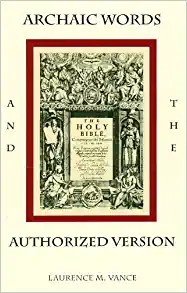
This last Father’s Day my wife bought me Laurence Vance’s Archaic Words and the Authorized Version printed in 2011. Vance’s argument is simply, the Authorized Version/ King James Version is no more archaic than every day magazine articles and popular modern versions of the Bible.

To demonstrate this case, Vance offers an evaluation of hundreds of “archaic” words found in the Authorized Version. In each evaluation he observes how many times an archaic word appears in the Authorized Version and then goes on to observe how many times the same or similar word appears in a sample of modern versions (i.e., NKJV, NIV, NRSV, and NASB). Finally, he ends each entry with a direct quote from a modern magazine or news article showing that the word in question is currently used.

If you follow our blog, you know that we find the particular work of Mark Ward to be largely without merit because of its elementary observations and one-sided scholarship. Seeing that Ward wrote his book Authorized: The Use and Misuse of the King James Bible about a decade after Vance’s work I searched Authorized to see if Ward interacted with Vance at all given the fact that the topic of their books intersect at multiple places. Unfortunately for Ward, Authorized does not even footnote Vance’s work let alone interact with it. It’s like the more you look at Ward’s book the more unbelievable it becomes. Kind of like this video:

After 400 pages of proving his point, Vance offers an epilogue which I will now quote at length.

Does the AV contain archaic words? Certainly. But perhaps a better question would be: Do contemporary publications like Time, U.S. News and World Report, the Chicago Tribune, Forbes, and the New Republic contain archaic words? As we have seen throughout the body of this work, they unquestionably do. Also without dispute is the striking revelation that modern, up-to-date Bible versions like the NRSV, NASB, NIV, and NKJV likewise contain archaic words. We have seen these facts demonstrated in a number of ways:

  1. An archaic word in the AV is corrected and then the same word is inserted elsewhere.
  2. An archaic word in the AV is retained exactly as it appears in the AV.
  3. An archaic word in the AV is retained but in a different form.
  4. An archaic word in the AV is corrected and a different form of the word is inserted elsewhere.
  5. A simple word in the AV is replaced by a form of an archaic word.
  6. A simple word in the AV is replaced by a more difficult word or phrase.
  7. The base or root form of a word in the AV is unnecessarily lengthened.
  8. An archaic word in the AV is replaced by an even more difficult word.
  9. A somewhat difficult word in the AV is replaced by a more arduous word.

So the fact that the AV contains archaic words is just that, a fact that should be accepted. For just as no one revises Shakespeare or Milton, but instead learns the vocabulary necessary to understand those particular works; and just as a certain vocabulary is necessary to understand science, medicine, engineering, or computers; and just as no one ever cancels their subscription or writes a letter to the editor of a contemporary publication to complain that it uses archaic words; and just as no one ever complains about archaic words surfacing in modern Bible versions; so to read and understand the Bible one must be familiar with the vocabulary of the AV instead of dragging it down to one’s own level by revising it. Does the AV contain archaic words? Certainly. Should we therefore replace it with something else? Certainly not.

Laurence M. Vance, Archaic Words and the Authorized Version (Pensacola, FL: Vance Publications, 2011), 431-432.

Benedict Pictet (1696) on Scripture as the Only Rule of Faith and Practice, part 1

“Reason is as it were the eye of the mind,

but scripture is the standard,

by which it measures the objects proposed.”

[Please note that Pictet, writing in the 17th century addresses the same controversies the church deals with today only from the perspective of the superiority of Scripture over reason where the modern Evangel church has adopted the opposite.]

Thus far we have proved that that the scriptures of the Old and New Testament are divinely inspired, and that they fully and clearly contain all things needful to salvation. Hence we easily infer that they are the true and only rule of faith and practice. Now a rule must be perfect in all its parts; not admitting either of addition or diminution. Such we have already proved the scripture to be. A rule also must be certain and unchangeable: but such is the scripture being the truth of the unchangeable God, “that cannot lie.” Human opinions are of such a nature as to be continually subject to changes: but it is not so withy eh doctrine of salvation, which has always been the same. The scripture, as a rule, directs our faith and conduct in such a manner, that the very least deviation from it renders us guilty of error. We cannot doubt of the scripture being a rule, if we consider that the prophets, our Savior, and the apostles, always appeal to it. “to the law and t the testimony,” says Isaiah (viii. 20). “It is written,” said Christ, when contending with Satan, (Matt. xxii). The apostles did the same in their endeavors to convert the Jews: nay, so perfect a rule did they consider the scripture, that they sometimes draw an argument from silence. “To which of the angels said he at any time, Thou art my Son?” (Heb. 1 5) and the Bereans are commended for examining the doctrine of the apostles by this rule (Acts xvii. 11). We may add that the scripture itself calls itself a rule, (Gal. vi. 16), “As many as walk according to this rule, peace be on them,” etc.

Not only the scripture of the New, but also of the Old Testament, is the rule of faith and practice, although we are no longer under the old dispensation, which has been evidently abolished. “For whatever things,” says St. Paul, (Rom. xv. 4) “have been written afore, were written for our learning, that we, through patience and comfort of the scripture, might have hope.” Both testaments contain substantially the same doctrine; they propose the same objects of faith, and enjoin the same precepts; they are both the foundation of the church, which is to “built upon the apostles and prophets,” (Eph. xi [ii]. 20) and peter shows that they “do well” who “take heed to the word of prophecy.” (1 Peter i. 19) The scripture then is the only rule, not can there be any other. Reason is no such rule, for it is blind, and understandeth not the things of God; (1 Cor. ii 14, 15) it is liable to error, and is often deceived; the mysteries of faith are beyond its sphere; the natural man cannot comprehend them. Reason is as it were the eye of the mind, but scripture is the standard, by which it measures the objects proposed. Reason is the instrument which the believer uses in examining the objects of faith by the scripture, as by the infallible rule of truth, but it is not the rule itself of these objects of faith. Yet this does not prevent us from acknowledging that reason ahs many uses. It is of service in vindicating the truth, against those who would deny revelations altogether, or against those who, admitting revelation, endeavor to corrupt it with false interpretations; in illustrating the mysteries of religion by collecting together all that can be gleaned from the book of nature, from polite literature, from historical records, from philosophical and philological science; in drawing conclusions, and determining the truth of them; in comparing the text with the context, versions with the originals, the decisions of ecclesiastical teachers with the scripture, and in distinguishing falsehood from truth, and what is legitimate from what is spurious.

In fact, reason and faith, though of a different nature, are not opposed to each other. Hence we maintain that we must not admit anything, even in religious matters, which is contrary to right reason. For although there is much darkness in the human mind, yet no one can deny that there remain some sparks of natural light, and that the mind has in it these principles of undoubted truth, which faith often makes use of for the confirmation of its own doctrines; but what we maintain is, that reason cannot and ought not to bring forth any mysteries, as it were, out of its own storehouse; for this is the prerogative of scripture only. Also, that reason is not to be heard when complaining of its incapacity to comprehend many things that relate to what is infinite; and to reject a mystery [e.g., the means of Scripture’s providential preservation] because it is incomprehensible to reason, is to offend against reason itself. Neither is reason to be listened to whenever, under the cover of holding the mysteries of the faith, it aims at setting up its own errors (e.g., defenders of Evangelical MVOism]. On the very same grounds we cannot call philosophy any rule of faith, although we again concede that there is of no little use, provided it assume not itself the power of dictating in articles of faith. True philosophy indeed serves very much both to convince men and to prepare their minds; and there is a wonderful harmony between sound philosophy and divinity; for truth is not contrary to truth, not light to light; only we must not imagine that the former is the rule by which the sense of scripture must be tried and examined.

The same observations may be applied to the testimony of the church, to the fathers, and to the decrees of councils; these form no rule of faith – 1. Because these testimonies, being merely human, are liable to error. Augustine, writing to Jerome, makes these just remarks: The books of the scriptures, which are now called canonical, and the only books to which I have learned to pay such respect and reverence, as most firmly to believe that no one of their authors committed any error in writing; whereas other books I peruse in such a manner, that, however they may be distinguished for holy instructions, I do not think anything to be true, merely because they have so considered it, but only as far as they have been able to convince me of the truth, either by reasonable argument, or by appeal to the canonical writers. Nor do I think, my brother, that your opinion on this subject is different; indeed I am persuaded that you would not have your own books read in the same way as those of the prophets and apostles, whose writings, because they are free from all error, it were impious to call in question.—2. Because these testimonies are not only liable to error, but have erred in many things; nay, often contradict themselves and each other. –3. Because the writings of the fathers have been in many ways corrupted, and it is very difficult to know what were their opinions on various subjects. It is therefore indisputable, that the holy scriptures are the only rule of faith and practice.

Benedict Pictet, Christian Theology, translated from the Latin by Frederick Reyroux (London: R. B. Seely and Sons, 1696 [1834]), 52-55.

Benedict Pictet (1655-1724): Four Arguments for the Self-authenticating Authority of Scripture

Having proved the divinity and inspiration of the scripture, we next consider its authority. Now this is nothing else but the dignity and right of the sacred books, whereby they claim our faith in whatever they hold forth as necessary to be believed, and our obedience in whatever they prescribe to be done, or to be left undone. For having been proved to be of God, and not of men, or of the devil, the necessary consequence is, that they have supreme authority over us. For who would deny that to be authoritative which is divine?[1] Now the scripture derives its authority from God only, who is the author of it. If then I am asked on what ground I believe the scripture to be divine, I an only reply, “Because of the marks and characters which I hold in it, and by which it proves itself to be of God, and not because of any other testimony.” As if anyone should ask me why I believe the sun to be bright? Or sugar sweet? Or the rose fragrant? I should reply, “Because I see the sun’s rays, I taste the sweetness of sugar, and I smell the fragrance of the rose.” We must reason concerning the scripture, which is the first principle of faith, in the same way as concerning the principles of other sciences, which do not derive their authority from any source, but ate known of themselves, and prove their own truth. The same may be said of God’s word, which is the law and edict of our heavenly Sovereign, as is said of human laws, which do not derive their authority from subjects on whom they are imposed, or from those who have charge of announcing them to the people, but only from the sovereign, who enacted them. But, least anyone should say that the scripture does indeed possess authority itself, as proceeding from God, but does not obtain that authority in relation to us, except through the testimony of the church, we shall prove that the Scripture does not derive its authority from the church,[2] by the following arguments:

First, if this be the case, diviner authority will be subject to human, and we shall believe God merely on the testimony of man; but this would be absurd; therefore it is absurd to say that the testimony of the church gives authority to Scripture. Now we know that the testimony of the church is but the testimony of men, for it consists of mere men, who are not divinely inspired.

Secondly, if the authority of Scripture be suspended on the testimony of the church, then it will be only a human faith, by which we believe the divinity of scripture.; the latter idea is absurd, therefore the former is absurd also. Now the testimony of the church can produce only human faith, because that only is divine faith which rests upon divine authority, whereas the authority of the church is merely human, unless it can be proved to be under the infallible guidance of the Holy Spirit, which cannot be proved of any church since the times of the apostles, who alone, together with the prophets, were exempt from error. And to believe only with a human faith that the scripture is divine is absurd, because then there would be nothing certain in religion, and nothing on which the mind could securely depend without doubt.

Thirdly, if the judgment of the church does not already suppose the divine authority of scripture, then the authority of the latter will not depend on the former. Now the church is persuaded by the divinity of Scripture, either with or without grounds. The latter idea is absurd even to think of; if then the former is correct, there could be no other grounds than the marks of divinity which appear in the scriptures, and which thereby gain them authority with the church; thus the authority of scripture is at once recognized to be prior and superior to the judgment of the church.

Fourthly, if the authority of the church depends on scripture itself, then it is absurd to make the authority of the latter depend upon the former. Now it is clear that no other church can be acknowledged as the true church, but what is “built upon the foundation of the prophets and apostles,” Eph. xi. 20) i.e., upon the scripture. Nor can it be ascertained that any church is a true church, except first of all it be proved, that the divine and true which the church holds to be such, since it is the belief of the truth to which the church owes its existence as a church. Now, we cannot know whether that be true which the church receives as true, except by weighing it in the balances of the scripture. Moreover it will be evident, that the authority of the church is subject to authority of scripture, if we consider that the authority of the apostles themselves was by them subjected to that of scripture, and surely the authority of the church in any age cannot be greater than that of apostles. But that these holy men did subject their authority to that of God’s word, is clear from the words of Peter, declaring that the “word of prophecy’ (that is the scripture of the Old Testament) is surer than the testimony of the apostles, who were “eyewitnesses of his majesty,” and heard the voice from heaven. (2 Peter ii.16-20). And also the words of Paul, “though we, or an angel from heaven, preach any other gospel unto you than that which we have preached unto you, let him be accursed.” (Gal. ii. 8).

To all this we may add, there is no church which has such clear evidences of its own authority, as the scripture has of its own divinity, and common sense teaches us that no authority of any councils, or of any men, can be equal to that of God speaking in his word, or be put in competition with the writings of Moses, of the prophets, and the apostles. From all these arguments it is plain, that the authority of the sacred books is not to be suspended on the testimony of the church…..

Let us follow those, says Augustine, who first invite us to believe what we are not yet able to understand, in order that, having been enabled by faith itself, we may come to understand what we believe, when it is no longer men, but God himself who inwardly illuminates and strengthens our minds.

Benedict Pictet, Christian Theology, translated from the Latin by Frederick Reyroux (London: R. B. Seely and Sons, 1696 [1834]), 35-38, 40

Benedict Pictet (1655-1724): “Reformed minister, theologian, and hymn writer, Pictet is best known for his vigorous defense of orthodox Calvinism in an age of theological transition. Born in Geneva, he was educated at the university, where he became professor of theology (1686). There he was a restraining influence on his colleagues, including his cousin, Jean–Alphonse Turrettini, who wanted to abrogate the Helvetic Consensus Formula and institute other theological changes in the early years of the Enlightenment. A man of irenic spirit, Pictet authored two major theological works, published many books and pamphlets, wrote texts for numerous popular hymns, organized assistance for Huguenot refugees following the Revocation of the Edict of Nantes (1685), and promoted evangelism in France.” https://www.biblia.work/dictionaries/pictetbenedict-1655-1724/


[1] This rhetorical question remains for the current MVO/CT advocate to answer.

[2] The writer here attacks the opinion of Papists, who maintain that the authority of the scripture over us depends on the testimony of the church. For our purposes, please substitute the focus on external criteria of “post-critical scholarship” for “church.”