The TCC and Psalm 12:6-7

The following was first published on February 18, 2022, in reference to a podcast Mark Ward, Ph.D., where he argued that Psalm 12:6-7 does not teach the verbal preservation of Scripture. It was my hope that the research done while taking a Ph.D. course toward my Th.M. at Calvin Theological Seminary would provide Dr. Ward with a more robust analysis of the passage, but as you may have noticed in the most recent Textual Confidence Collective podcast, it seems that he was under the impression that the interpretation of the passage monolithically refers to preserving the oppressed, which is patently false.

As noted by Dr. Van Kleeck, what we are witnessing is a failure of graduate schools to create critical thinking, research-oriented graduates. The earliest reference in this post for the preservation of words is attributed to Jerome (345-420) by Luther. Also note that this controversy was well known by two leading Medieval Hebrew scholars Abraham Ibn Ezra (1089-1164) and David Kimshi (c. 1160-1235). I suppose, if I were of the TCC tradition, this post would only include pro-preservation research, thus skewing the data. It seems clear that the TCC like neat categories that can be classified, categorized, and easily referenced and find the Divine algorithm of providential preservation throughout history too messy.

But historical research is messy, unless history is merely a foil to confirm a contemporary premise – “There are no verses that teach the providential preservation of words, therefore, there are no historical documents that confirm the Scripture teaches the providential preservation of words.” The manipulation of history to serve one’s own purposes, in the academic tradition in which we were taught, is one of the most egregious. What you will read below does not reflect some “fundamentalist” bent; it is simply researching and reporting on that research. For the purposes of this blog, this is an abbreviation of the larger paper. Of course, we all understand, that if you have already abandoned the doctrine of providential preservation, it follows, that this verse and all the supporting commentary cannot teach providential preservation. Welcome to the scholarly sphere of the TCC.

It will not be enough for Dr. Ward to add more support for the verse teaching the preservation of the oppressed. That argument has been well represented in Church history. The burden for Dr. Ward is to show that the preservation of the oppressed is the sole interpretation of the passage. Such bifurcation of the churchly exegetical tradition cannot be substantiated, a robust argument for the preservation of words is demonstratable, and therefore, the argument from Psalm 12:6-7 for the preservation of pure words stands.

The TCC and Psalm 12:6-7

“The words of the Lord are pure words: as silver tried in a furnace of earth, purified seven times. Thou shalt keep them, O Lord, thou shalt preserve them from this generation for ever.”

אִֽמֲרֹ֣ות יְהוָה֮ אֲמָרֹ֪ות טְהֹ֫רֹ֥ות כֶּ֣סֶף צָ֭רוּף בַּעֲלִ֣יל לָאָ֑רֶץ מְ֝זֻקָּ֗ק שִׁבְעָתָֽיִם                            

אַתָּֽה־יְהוָ֥ה תִּשְׁמְרֵ֑ם תִּצְּרֶ֓נּוּ׀ מִן־הַדֹּ֖ור ז֣ו לְעֹולָֽם                                                       

“words” אִֽמֲרֹ֣ות: plural, feminine, noun

“keep them” תִּשְׁמְרֵ֑ם: qal impf 2ms, 3mp pronominal suffix — ם

“preserve them”תִּצְּרֶ֓נּוּ :qal impf 2ms, 3ms pronominal suffix (him), with the nun energieum — נּוּ

In a recent podcast Dr. Mark Ward referred to Psalm 12:6-7 in a surprising manner. I do not know Dr. Ward personally, my first knowledge of him was his refusal to debate Dr. Peter Van Kleeck, Jr. after [Ward] publicly offered to debate anyone. After watching his podcast, to help clear up some misunderstandings on his part relating to Hebrew grammar, the following post is submitted. To paraphrase, “he knows of no one that argues that the preservation spoken of in verse 7 refers to the word,” supporting that perspective by noting the antecedent “words” in verse 6 is feminine gender, and “them” is masculine, which is of course correct. He may have other objections, but as the podcast stands, his objections were anecdotal with one grammatical reference to gender distinctions. Gesenius on this gender combination writes, “Through a weakening in the distinction of gender, which is noticeable elsewhere…and which probably passed from the colloquial language into that of literature, masculine suffixes (especially in the plural) are not infrequently used to refer to feminine substantives.” Grammar, 440. Diehl objects to the credibility of this assessment arguing that “many of these cases may be set down to corruption of the traditional text, while the sudden (and sometimes repeated) change in gender in suffixes is mainly due to the influence exercised on the copyists by the Mishnic and popular Aramaic dialects, neither of which recognizes such [gender] distinctions.” To this charge, Gesenius counters, “Such influence, however, is insufficient to explain the large number of instances of this weakening, occurring even in the earlier documents.” Grammar, 440.

            One would have to reasonably assume that Dr. Ward overlooked this one of many irregularities in the Hebrew language. In that he did not offer any other objections, except an anecdotal assessment, this material should be sufficient to say that “words” can properly be the antecedent of “keep them” even with the “weakening in the distinction of gender” in accordance with the practices of Hebrew grammar. If, however, Dr. Ward’s, polemic against “keep them” referring to “words” is in fact more robust, the following material is offered as aid to a fuller and more comprehensive comment on the passage.

            Beginning with the 1537 Matthews Bible microfilm, located at Western Michigan University, Kalamazoo, MI, at Psalm 12:7, John Rodgers, aware of the scholarly discussion swirling around this passage, includes a marginal note at “them” stating, “that is often times, that is, such and such and such men, after Kimshi but after Ibn Ezra words.” In Rabbi Abraham Ibn Ezra’s, Commentary on the First Book of Psalms: Chapter 1-41, trans. & ann. by H. Norman Strickman (Brighton, MA: Academic Studies Press, 2009), 103: “THOU WILT KEEP THEM. The mem [Heb. “them”] of tishmerem (Thou wilt keep them) most probably refers to The words of the Lord.” (v. 7 [Heb.]). With Rashi (1038-1105), Abraham Ibn Ezra (1089-1164) and David Kimshi (c. 1160-1235) are recognized to be the greatest Hebrew exegetes of the High Middle Ages. The significance of Rogers’ marginal note is that two renowned Hebrew scholars referred to by the Reformation writers differed on the interpretation of “them” in Psalm 12:7. Rogers was obviously conscious of this difference and informed the reader of the variation of interpretation.

            The weakness of the gender/grammatical distinction argument begins to dissolve when faced with the grammars of Kimshi and Ibn Ezra. Since the 11th and 12th c. the rendering of this passage has been divided between the people and the words for the first “them.” We have then answered Dr. Ward’s objections, both the grammatical objection and the anecdotal objection. By doing so, we have also established a grammatical grounding for “them” referring to the antecedent “words” and for the support of 11th and 12th c commentator Ibn Ezra agreement that the antecedent of “them” is the “words.”

            Perhaps these citations remain unconvincing or the research unfamiliar to Dr. Ward, requiring additional clarity. The next time Dr. Ward as the opportunity to speak on this passage, we want to provide a much help as necessary for him to give an informed presentation.

Take for instance the Medieval scholar Michael Ayguan (1340-1416), on Psalm 12 7 commented, “Keep them: that is, not as the passage is generally taken, Keep or guard Thy people, but Thou shalt keep, or make good thy words: and by doing so, shalt preserve him—him, the needy, him the poor—from this generation. Thou shalt keep Thy word, — “Cast thy burden upon the Lord, and He shall nourish thee; “Thy word, — “I will inform thee, and teach thee in the way wherein thou shalt go;” Thy word, — “Fear not, little flock; it is My Father’s good pleasure to give you the kingdom; and so, preserving him from this generation, shalt hereafter give him a portion with the happier generation, the assembly of the First-born which are written in heaven.” Neale, Commentary on the Psalms, 181. Moving from the 11th and 12th c into the 14th c. Ayguan, again, familiar with the controversy, argues that the antecedent of “them” are the “words.”

            At this juncture, and risking the accusation of name dropping, I am indebted to Dr. Richard A. Muller, P. J. Zondervan Chair of Historical Theology at Calvin Theological Seminary in Grand Rapids, MI, now retired, for his comments regarding the initial essay on this passage submitted to him for a Ph.D. course toward my Th.M. On my original paper, Dr. Muller noted, “Here we do have the use of one option determined by the Hebrew – i.e., the v. 6 antecedent—but the choice of the antecedent is what limits the exegesis, and in fact excludes the broader interpretation of the ‘them’ as a reference to Israel and God’s people generally that is far more frequently (I think) the path of interpretation.”

            Moving from the 14th c. to the 20th c. one of the most accomplished Church historians, especially on Post-Reformation Reformed Dogmatics, states that the Hebrew antecedent,” “words” excludes “them” as a reference to God’s people.

So in addition to the grammar, personal testimony of a renowned 11th c Hebrew scholar, we have added the 14th c testimony of Ayguan, and the recent erudite observation of Church historian Dr. Richard Muller.

            Because at the core of this brief review was a polemic against the use of Psalm 12:7 as a passage that teaches providential preservation, a sometimes-volatile subject, for the sake of bridge-building additional information may be necessary to shore up any apologetic cracks that the debate may have created. Admitted, not everyone has access to Gesenius’ Grammar, University microfilm, books referring to 14th c scholars or Calvin Seminary’s Ph.D. courses, but everyone has heard of Martin Luther.

            It is interesting what Luther has to say in his commentary on this passage. Still arguing for a divided rendering, Luther’s 1519 commentary on this passage contains not only his interpretation but also that of Jerome’s despite the Latin rendering, “keep us,” preserve us.” Luther’s commentary includes three possible interpretations of this passage: the words, the saints, and the ungodly. Beginning with the interpretation supported by Jerome’s Latin text (342-420), Luther’s translation agrees with the Hebrew, “them”: “And he prays God that his words (eloquia) may be guarded, after the manner of protection, that the ungodly might not pollute them. And instead of “thou shalt preserve us,” it is in the Hebrew “thou shall preserve them”; and it refers to the words of God, as Hieronymus (Jerome) translates it.” Noting that “them” is masculine, he includes the alternative reading in reference to the saints, “But it may also be referred to the saints, as it is in the masculine gender servabis eos.”

            Even Luther, with Jerome, at this passage allows antecedent “words” to govern the pronoun “them” I am inserting the following notation in support of Jerome’s 4th c. rendering: See Charles A. Briggs and Emilie Grace Briggs, A Critical and Exegetical Commentary on the Book of Psalms, International Critical Commentary (New York: C. Scribner’s Sons, 1906–1907), 99: אַתָּה] [Thou] emph.—תִּשְׁמְרֵם] [“shalt keep them”]…J, Aq., Θ [that is, the Latin Version of Jerome, the Greek Version of Aquila, and the Greek Version of Theodotian] agree with H [the Hebrew Masoretic text] and refer [the suffix] of the first [verb] [that is, “them”] to the divine words.

            But Luther did also argue for “people” based on the gender, which is true, but please note that none of these scholars, like Dr. Ward, have forcefully argued that the antecedent of “them” cannot be the “words.” “Words” are just as valid as “people” in the exegetical tradition, and it is this nuanced understanding that Dr. Ward has missed and this post hopes to illuminate. A common familiarity with Luther, but unfamiliarity with Luther’s comment on this passage may be sensed as stretching Luther’s interpretation of Psalm 12:7 further than he would. To ameliorate such fears, the following hymn penned by Luther on Psalm 12 :7 is offered. Note the first line of the second stanza.

Psalm 12

Title: The Word of God, and the Church

The Silver seven times tried is pure

From all adulteration;

So, through God’s Word, shall men endure

Each trial and temptation:

Its worth gleams brighter through the cross,

And, purified from human dross,

It shines through every nation.

Thy truth thou wilt preserve, O Lord,

From this vile generation,

Make us to lean upon thy Word,

With calm anticipation.

The wicked walk on every side

When, ‘mid thy flock, the vile abide

In power and exaltation.

James Franklin Lambert, Luther’s Hymns

(Philadelphia: General Council Publication House, 1917), 52.

Luther’s hymn assures the reader that he accepted as valid the “words” to be the antecedent to “keep them.”

Moving into the 17th c Matthew Poole’s 1685 commentary on this Psalm is quite helpful. Matthew Poole, A Commentary on the Holy Bible (London: Banner of Truth Trust, 1979). Poole’s 1685 commentary reflects the language of the King James Bible which united the historically divided rendering of the verbs between the words and people. Poole acknowledges the two renderings but responds with an unambiguous, united interpretation of the pronouns. Rather than the verse referring to words and people, Poole unites the two commenting that both verbs either apply to the people, or both verbs apply to the words. Poole concludes that the keeping of the words or the promises of God is primary, the basis upon which David’s life and posterity would be preserved. He writes: “Thou shalt keep them, either, 1. The poor and needy, Psalm 12:5, from the crafts and malice of this crooked and perverse generation of men, and for ever. Or, 2. Thy words or promises last mentioned, Psalm 12:6. These thou wilt observe and keep (as these two verbs commonly signify) both now, and from this generation for ever, i.e. Thou wilt not only keep thy promise to me in preserving me, and advancing me to the throne, but also to my posterity from generation to generation.” It is interesting to note that the united rendering in v. 7 referring to the antecedent words in 12:6 is, at the time of his commentary what “these two verbs commonly signify.” It is the v. 6 antecedent that governs both v. 7 pronouns while continuing with the larger theme of the care of Israel. The words or promises will be kept not only for David but for the generations of Israel forever. We see then a further refinement within the English translation tradition in the King James Bible at Psalm 12:7 accepted by Poole, in keeping with the historic effort to maintain a unified rendering and confirmed to be so by the ecclesiastical community of saints.

            Poole’s unified rendering is also taken up in John Wesley’s 18th c. Explanatory Notes upon the Old Testament where he comments, “Thou shalt keep them—Thy words or promises: these thou wilt observe and keep, both now, and from this generation for ever.” For Wesley, the single rendering of both pronouns in v 7 refer to the words. John Wesley, Explanatory Notes upon the Old Testament, vol. 2 (Bristol: William Pine, 1765), 1642

            It is understandable how Dr. Ward overemphasized the significance of irregularities in the Hebrew language that limited his understanding of Psalm 12:7. It is also understandable that without a concentrated study of this passage an elementary assessment and application would be made. For everyone reading this post, Dr. Ward’s bold claim that Psalm 12:7 does not teach the preservation of God’s words is completely without merit. Considering the wide scope of the churchly exegetical tradition that speaks to the preservation of words and against Dr. Ward’s assessment of this passage, one can only assume, considering Dr. Ward’s earned Ph.D., that he was just caught up in the moment, overstated the issue, and will, as every conscientious scholar, make the necessary course corrections for the sake of his ecclesiastical listeners. Blessings!
My Prediction was Right and the Dumpster Fire Continues to Keep the TCC Warm and Cozy

Well, I have finally finished watching the third episode of the Textual Confidence Collective [TCC]. First, as I predicted they wholly ignored or were completely unaware of the Spirit/word/faith paradigm prevalent throughout Reformed Bibliology, and they chose a handful of verses and then told us what they think those verses don’t mean. So A+ there. Second, the TCC’s trauma, a result of the weak Bibliology from their youth, took on a new dimension in this episode.

As in prior episodes, there is so much to talk about but we will focus on more major themes. As an aside, though if they would have simply had Riddle or someone of that stripe on the TCC, he could have helped them get our position right, but alas, the TCC is turning out to be a mere exercise in group-think fumbling their way into their own end zone. But if they want to take the field with an inept team, so be it. So let’s begin.

1.) Just as in the second episode that promised to be “The History of Textual Absolutism” but which actually turned out to be “How We Would Like to Critique Textual Absolutism (With Some History Sprinkled In)”, so too this episode, “The Theology of Textual Absolutism,” turned out to be “How We Would Like to Critique Textual Absolutism (With Some Theology Sprinkled In)”. We are now three hours into their discussion and they have yet to offer a robust argument fairly representing their opponents. Admittedly though that is hard to do seeing they intentionally lumped Ruckmanites and Hills into the same category, textual absolutist.

2.) I have two observations about the trauma of the TCC. First, I find it interesting that when each of the TCC were young they abandoned the KJV because they were faced with questions they couldn’t answer. And to the man, the questions they couldn’t answer revolved around textual variants. They asked themselves something like, “How could I hold to a pure Bible if there are so many variants?” This question, or something like it, caused them to abandon their position and set up shop someplace else that could account for these variants. The interesting thing is that now it is the variants upon which they are still fixated. They have not resolved the existence of variants, they have simply come to live with them. So much so, that they are prepared to blame God for their existence [15:10, 29:43, 30:47]. In sum, the TCC was hung up on variants when they were young and ill equipped and now they are older and better equipped but still hung up on variants.

Now, because they cannot resolve the existence of variants with a belief in a pure text, they then go about a campaign of negative theology. That is, they begin to believe and tell us that the standard passages used to defend the preservation of Scripture throughout Church History do not teach preservation. In sum, their journey has been something like:

Weak Bibliology > They are challenged by variants > They abandon their weak Bibliology b/c of the variants > They cling to a modern and equally weak Bibliology > They fail to reconcile the existence of variants with a belief in a pure text > They go with the existence of variants and abandon a belief in a pure text > As a result they reinterpret the Bible to make it fit their trauma.

This leads me to my second observation. In the span of less than an hour Tim [~32:00], Elijah [40:05], and Mark [54:47] all plainly confess that during this time of trauma over the existence of variants in the face of their weak Bibliology they denied the doctrine of Preservation. At this point, I have to say only people with garbage arguments claim that no major doctrine is at stake given the known variants in the manuscript tradition. Three guys, raised in the Church, professing Christians plainly and clearly say that they had for a time abandoned the doctrine of Preservation. What is more, such an abandonment is right next door to Bart Ehrman who just never came back from it. For Elijah, he denied the doctrine or Preservation even into his Ph.D. work. So the full paradigm to this point is:

Weak Bibliology > They are challenged by variants > They abandon their weak Bibliology b/c of the variants > They cling to a modern and equally weak Bibliology > They fail to reconcile the existence of variants with a belief in a pure text > They then go with the existence of variants and abandon a belief in a pure text > As a result they reinterpret the Bible to make it fit their trauma > They abandon the doctrine of preservation.

3.) Then at [10:19] we get from Peter, “If the Bible taught that it was perfectly preserved it does not tell what it is or how to find it.” This crops up again in the words of Mark at [20:52], “If Jesus is talking about perfect textual preservation, It has to be peerrrfect!” The same theme shows up at [10:55 and 36:46]. This is where the TCC should have addressed the Spirit/word/faith paradigm which looks like,

“As for me, this is my covenant with them, saith the LORD; My spirit that is upon thee, and my words which I have put in thy mouth, shall not depart out of thy mouth, nor out of the mouth of thy seed, nor out of the mouth of thy seed’s seed, saith the LORD, from henceforth and for ever.”

Isaiah 59:21

See that? God has made covenant with His people, a covenant He cannot break, to put words into the mouth of His people and accompany those words with His Spirit. Furthermore, those words which God put in their mouth and which are accompanied by the Spirit shall never depart out of the mouth of God’s people from that time until forever. It is no surprise then that right thinking theology repeats this very same truth. Consider the following:

According to the Westminster Confession of Faith, “…notwithstanding, our full persuasion and assurance of the infallible truth and divine authority thereof, is from the inward word of the Holy Spirit bearing witness by and with the Word in our hearts.” [WCF 1.5] Or Richard Muller commenting on Calvin, “What we have in Calvin’s doctrine is the simple assertion of the absolute truth of Scripture, its dictation by the Spirit, and the inward testimony of the Spirit guaranteeing the authority of the written Word” [Post-Reformation Reformed Dogmatics Vol. 2, 301]. God’s Spirit/God’s Word/God’s people by faith – the Spirit/word/faith paradigm. Or as we are like to say here at StandardSacredText.com, the Spirit of God speaking through the word of God in the people of God.” This is the mechanism whereby the Church can receive a perfectly preserved text.

The TCC seems utterly ignorant of this theological truth, a cornerstone of orthodox Bibliology and the ground for the doctrine of providential preservation. And it’s not like you have to dig deep to find this truth. If you read less than four pages of the Westminster Confession of Faith you would encounter the quote above. I can only surmise why the TCC has failed to observe such an elementary truth, but one thing is certain. The TCC’s claim to charity and “getting the textual absolutist position right” are laughable and disingenuous given that at least two of the TCC have Ph.D.’s in theology, or at least that is what their Ph.D. title says, and yet they seem entirely unaware of such a basic element of Bibliology and how it works in preservation.

4.) I am a Young Earth Creationist. Furthermore, I think arguments in favor of a standard sacred text are quite congruous with Young Earth Creationism. For one, evidence is not my final authority in either case. That said, I find the juxtaposition of how the TCC treats the Creation story vs how they treat the text of Scripture is quite telling. They all, with the exception of Elijah, seemed to indicate that no matter how much evidence you throw at them, they are going to believe in literal sequential six-day Creation.

So no matter how much evidence there is for an old universe [trillions of stars and their light, the size of the universe, the number of Christian and non-Christian Ph.D.’s that disagree with them, and on and on], they are going to believe that God spoke the worlds into existence in six literal sequential days. But, all it takes, by their estimation, is a comparatively small number of manuscript variants which are said not to affect doctrine at all, including the doctrine of providential preservation, and they are ready to believe “jot and tittle” doesn’t mean “jot and tittle” while still believing that ‘day” means “day” even with exponentially more evidence leveled against them that the universe is old.

The TCC on Creation: *Mountain of evidence that the universe old* – “So what, ‘day’ means ‘day.’ I’m following the Bible.”
The TCC on Scripture: *A comparatively small amount of variants as evidence* – “Oh yeah, definitely ‘jot and tittle’ does not mean ‘jot and tittle.'”

I fear their weak Bibliology is leading to an incongruous Cosmology as well. But that should be the case given that the source for all their Christian beliefs is the Scripture which they believe is not pure.

In fact, for the TCC evidence is not the primary mover for their belief in a young Creation, the Bible is. Yet for the TCC evidence is the primary mover for their belief in an impure text, and then they reinterpret the Bible in a novel way to suite their belief. This is no different than William Lane Craig reinterpreting Scripture to turn the Genesis account into mytho-history or to claim that God is logically dependent upon man. The TCC starts with something else [evidence] and then makes the Bible fit. We start with the Bible and make the evidence fit, and we believe it fits like a glove.

5.) Miscellaneous Considerations: I do believe that toil and trust can go hand-in-hand e.g., work out your own salvation with fear and trembling. This is not to say we are to go about doubting our salvation as we grow in sanctification but rather that we are to remain sure in our salvation as we grow in sanctification.

The same, I argue, goes for the text of Scripture. At [1:01:43] the TCC admit that all jots and tittles are preserved in the manuscript tradition, which is hilarious because they first claimed that Jesus didn’t mean literal jots and tittles and by the end of the episode they admit Jesus has kept all the literal jots and tittle for His Church. Like, which is it guys? Did Jesus accidently preserve all the jots and tittle because He didn’t really mean jots and tittles in Matthew 5:18?

Furthermore, simply because I work out my salvation with fear and trembling does not mean I should be in constant fear of Hell as a Christian. Rather John would remind us that we may KNOW that we have eternal life [1 John 5:13]. As a true Christian are we to doubt the efficacy of Jesus salvific work even when we fail at some point? No! In fact we are called to believe in that efficacy even when we don’t see it, for He which has begun a good work in you will perform it [Philippians 1:6]. In like manner the Scriptures.

No where in Scripture is the Christian given leave to doubt God’s words or to do as the TCC does and plainly proclaim God’s word to be impure and that by God’s own hand in history. Does that omit toil from the textual picture? No, it does not. Toil away, but know that, and even by your admission, all of the jot and tittles are present in the textual tradition. Therefore, the fight is not about whether we have all the jots and tittles, but rather which jots and tittles are the one’s God gave, and this is were we diverge sharply.

We wholly and unequivocally deny that textual scholars are the ones equipped to make authoritative choices about what is or is not the right choice regarding which jots and tittles. Yet Peter unabashedly says at [58:00] “The people in the congregation should trust what I say unless I give them reason other wise.” Which is about as Roman Catholic as it comes. If Peter were Pope Peter every Protestant watching would have been up in arms, but because Peter is a Protestant Ph.D. candidate he is accepted without criticism.

Instead, we here argue for the Spirit/word/faith paradigm discussed above and which the TCC seems wholly ignorant of.

But one retort might be, as Elijah says at [58:22], “As a text critic I am not strong enough to mess up God’s word.” Yet, he seems wholly unaware that his observation cuts both ways. If he is not strong enough to mess up God’s word he is not strong enough to “fix” God’s word, and yet he persists in thinking he can. Put the other way around. If he is strong enough to fix God’s word then he is strong enough to mess it up. In context, Elijah and those like him are not “strong enough” to tell us what is not God’s word nor are they “strong enough” to tell us what is. Unfortunately Elijah is only half right on this point.

In the end, the TCC continues to show itself bereft of elementary theological constructs and their application while putting themselves forward as experts. They continue to show their trauma precipitated by poor theological training both when they were young AND when they went to seminary. The TCC has turned out to be a preach-to-the-choir exercise rather than a reach-across-the-isle exercise. They have moved the ball no further down the field. Rather and unfortunately they have shown themselves to possess a shallow Bibliology. And like Ward’s False Friends argument, their call is not to do the hard work of answering the conflict between variants and a pure text. No the answer is to reframe theology to fit their current social, academic, and ecclesiastical frameworks.

The Link Between Regeneration and the Scripture

            The Author of regeneration according to John 3 is the Holy Spirit. John 3:6-7, “That which is born of the flesh is flesh: and that which is born of the Spirit is spirit. Marvel not that I say unto thee, Ye must be born again.” Demarest writes, “The Holy Ghost is the Author of regeneration: but the truth, word of God, or gospel, is the instrument he uses in imparting this spiritual life.”[1] Ames and Demarest recognize the continuity of the relationship between seed and word, “seed” a commonly used symbol for the natural generation of new life (Psalm 126:6; Luke 8:11; Mark 4:14-15; 2 Cor. 9:10; 1 John. 3:9) and the literal “word of God.”

            Commenting on 1 Peter 1:23 Ames asserts that “The word is the incorruptible seed or principle”[2] for the regeneration the Apostle writes of. He does not separate the message of the Scripture with the words of the Scripture. God’s words are in the words of the text. He writes,

“Because it is the word of God, (as it is in the Text); which liveth and abideth for ever, whose nature it resembleth in this, that the operation is not momentary or temporary, but abideth for ever.”[3]

            The living word used by the Holy Spirit to regenerate a lost soul, to continue to be used to regenerate those who would be saved, must be an eternal word. To eternally save, the word must itself be eternal. Ames’ quote assigns the eternal life-giving power of God’s Word not simply to the substance of the truth but to the words that convey the doctrinal substance he identifies as the “Text.” The apographa (the original language copy – apo, from) as the Protestant Reformers’ exemplar of the autographa (Original) served as the basis of their translation work. Upon translation to a receptor language the authoritas verborum, “the external and accidental authority that belongs only to the text in the original languages,” was lost.[4] That is, the words of Ames text did not look like the Original’s words. They had changed their shape; the Greek and Hebrew being translated into English characters. However, what remained in translation was the authority of the substantia, or res, the “formal, inward authority that belongs both to the text of Scripture in the original languages and to the accurate translations of Scripture.”[5] The substantia doctrinae or the doctrinal substance of the receptor language is what Ames says is the means the Holy Spirit uses to regenerate a lost soul. The substantia doctrinae abideth forever.

In other words, viva Vox Dei, “the living voice of God,” that lives and abides forever in God’s word performs an everlasting operation of bringing lost men eternal life. The everlasting words of God’s voice that perform an everlasting function are in the text of Scripture. Ames so says,

“Because to speak properly, it is the word of eternal life, John 6:68. For the end and use thereof is, to bring men to eternal life.”[6]         

Upon this truth Ames argues for the eternal security of the believer, and serves

“to refute the error of those that they which are truly regenerated, usually fall away from the grace of God, and so are born again and again after they have been regenerate. This is contrary to…the operation of the Spirit in the hearts of the faithful, and to the nature of the life itself, that is communicated unto them, which is incorruptible and eternal, as it is in the text.”[7]

Ames then says that the Spirit and the nature of eternal life is communicated to the believer by an “incorruptible and eternal” word as it is found in the propositional revelation of holy Scripture, the “text.” An incorruptible and eternal written word, because it is the voice of God, produces a believer who possessed eternal and incorruptible life. The nature of the text and the nature of the regenerated life for Ames are inextricably linked. Because the doctrina substantia of the English Bible is incorruptible and eternal, the spiritual life it imparts is also incorruptible and eternal.

            Ames writes, because “the word of God endures forever,” we ought “to have a singular respect unto the dignity and excellency in the word of God, as it is preached unto us by the Gospel.”[8]


[1] John T. Demarest, Translation & Exposition of the First Epistle of the Apostle Peter, 1851, 93.search.ebscohost.com.newlibrary.wts.edu/login.aspx?direct=true&db=h7h&AN=41239113&site=e

[2]Ames, Commentary, 30.

[3]Ames, Commentary, 31.

[4] Muller, Dictionary, 51-52.

[5] Muller, Dictionary, 51.

[6]Ames, Commentary, 31.

[7]Ames, Commentary, 31.

[8]Ames, Commentary, 32.

Why the Textual Confidence Collective is Going to Get Confessional Bibliology Wrong (Again)

I have not yet listened to the third installment of the Textual Confidence Collective [TCC]. I will later today and post about it tomorrow.

That said, I am going to make a prediction and I am going to make that prediction based on words Daniel Wallace said three days ago on the Reason and Theology podcast. Wallace is of particular import here because one of the TCC, Elijah Hixon, worked directly with Wallace. It stands to reason that they share a similar textual worldview. The video below appears to be the third part of an ongoing series with Daniel Wallace addressing certain text-critical questions.

In this third part Wallace begins by addressing the presence or absence of the Long Ending of Mark in both the Greek as well as in versions. Wallace admits that the Long Ending is printed by the vast majority of modern versions and critical Greek texts. He even admits to agreeing to print it in his own version, the NET Bible.

So if the Long Ending in Mark is so clearly not Scripture and men like Wallace consider themselves servants of God, why then do they print the Long Ending in the Scripture and then pass it off to the people in the pew?

Wallace has a theory. He says the reason why the Long Ending and the story of the woman caught in adultery are left in the text is because of a “tradition of timidity.” [00:30] To what does this “timidity” refer?

Starting around 1:30 Wallace begins to recount the history of those who attempted to do as they believed, those who attempted to act on the strength of their convictions that the Long Ending did not belong in the Bible. Wallace says a few such translators and translations relegated the Long Ending to a footnote; taking the Long Ending out of the body of the text.

How did the believing community respond? Well, according to Wallace’s own account the believing community saw such a relegation to be a sign and symptom of anti-supernaturalism. As a result, Wallace says, “They [the publishers] couldn’t sell the Bible [that omitted the Long Ending].” [2:00] As a result, Bible publishers have had to “go a different direction.”

What direction is that? Why, its the include-the-Long-Ending direction, because if they don’t go that direction they won’t sell any Bibles. As a result, even Wallace won’t stand on the strength of his own convictions for fear that his NET Bible won’t be accepted and so he includes in the Scripture what he says is clearly not Scripture. Interestingly though, he included the Long Ending in a smaller font-size for the expressed purpose of making it “harder to read from the pulpit.” [2:16].

So let’s be clear here. For the sake of acceptance or money, Wallace and his ilk include something in the Scripture they confidently believe is not Scripture. Put more tersely and inflammatorily, Wallace and those like him will put things in the Bible that they don’t believe belong in the Bible to either please men or to make money.

And not just a few verses here or there which would be bad enough. No, they will insert 12 verses in Mark and 12 verses in John simply because timid traditionalist won’t accept their Bible and therefore won’t pay for it. Remember, boys and girls, the love of money is the root of all evil. That love will even get you to put verses in the Bible you don’t believe belong there.

From here Wallace breaks into a one-sided treatment of the external and internal evidence for why he believes the Long Ending should be excluded only to in several places reference Church Fathers who admit the existence of manuscripts containing the Long Ending though said Church Fathers had few of those manuscripts. [e.g., 5:46]

This short video is a perfect example for why Wallace, the TCC, and the like are going to get us wrong every time on the issue of theology. We argue that the reason why the Long Ending and the story of the woman caught in adultery remain in the text is not because of a “tradition of timidity”. Rather, these texts remain in our Bibles because the Spirit of God is moving through the word of God in the people of God who receive these words by the gift of faith. And through this mechanism the Long Ending was preserved for God’s people

Think about it. The Long Ending existed and was disputed at the time of Eusebius [~300’s AD], and yet the reading remains. The Long Ending existed and was disputed at the time of Jerome and his writing of the Latin Vulgate. The Long Ending was included in the Latin. Erasmus put it in his Greek NT even though he knew it was disputed by some. In our current day only two or three manuscripts [Sinaiticus, Vaticanus, and perhaps one other] exclude the Long Ending.

There are only a maximum of three manuscript of Mark 16 that do not include the Long Ending, and yet Wallace tells us that it is not Scripture while simultaneously included the Long Ending for the sake of man’s timid and traditional opinion and their wallets.

In sum, Wallace and the TCC can watch the Spirit of God working through the words of God in the people of God by faith, reject that work, call such working a “tradition of timidity”, and then claim themselves to be on the side of history, orthodox theology, and robust scholarship. The whole thing reminds me of a bit from Lutheran Satire Videos where Donall and Conall debate Richard Dawkins.

Barrowing that bit it would go something like this:

Confessional Bibliology proponent: So your strategy for disproving the preservation of Scripture through the Spirit/word/faith paradigm is to systematically rule out every piece of evidence for the preservation of Scripture through the Spirit/word/faith paradigm solely because that evidence could be used to prove the preservation of Scripture through the Spirit/word/faith paradigm. What a perfectly reasonable use of the scientific method. We’d love to see you employ this strategy in the laboratory.

Scientist 1: Hey, I just proved there is no such thing as Barium.
Scientist 2: And how’d ya do that.
Scientist 1: By throwing out all the sample of Barium.

In sum, what Wallace and his friends call a “tradition of timidity” we call the Spirit of God moving through the word of God in the people of God by faith. Where Wallace sees fear; we see robust theological discourse between Christ and His Church. Where Wallace hasn’t the courage to stand on his beliefs and apparently would trade his beliefs for money or prestige; we here at StandardSacredText.com stand on our theological convictions and precommitments while receiving neither money nor prestige. Rather, the reverse is often true.

I can see an objection at this point and it looks something like, “You point out that Wallace includes the Long Ending for the sake of ‘acceptance’. Isn’t that what you are arguing with the Spirit/word/faith paradigm?” No, not at all. Wallace regards the persistence of the Long Ending as a product of timidity/fear born out of a love for tradition, which is not a product of Spirit-led godliness. I, on the other hand, have argued that the persistence of the Long Ending is a Spirit-led, Bible-based, faith-driven, after-the-fact observable historical phenomenon and the means by which all words of Scripture are known and understood to be the words of God and not men.

My prediction is this. The TCC is not going to understand and therefore not properly construe the Spirit/word/faith paradigm of orthodox Reformed theology. In fact, they may wholly ignore the paradigm altogether. As a result, they are not going to address the depth and breadth of that theology, and are therefore going to wholly miss the mark…again. What is more, I predict that they will select a handful of verses we often use, tell us what they think these verses do not mean, and then confidently leave a theological crater there while portraying themselves as both scholarly and virtuous. The End.

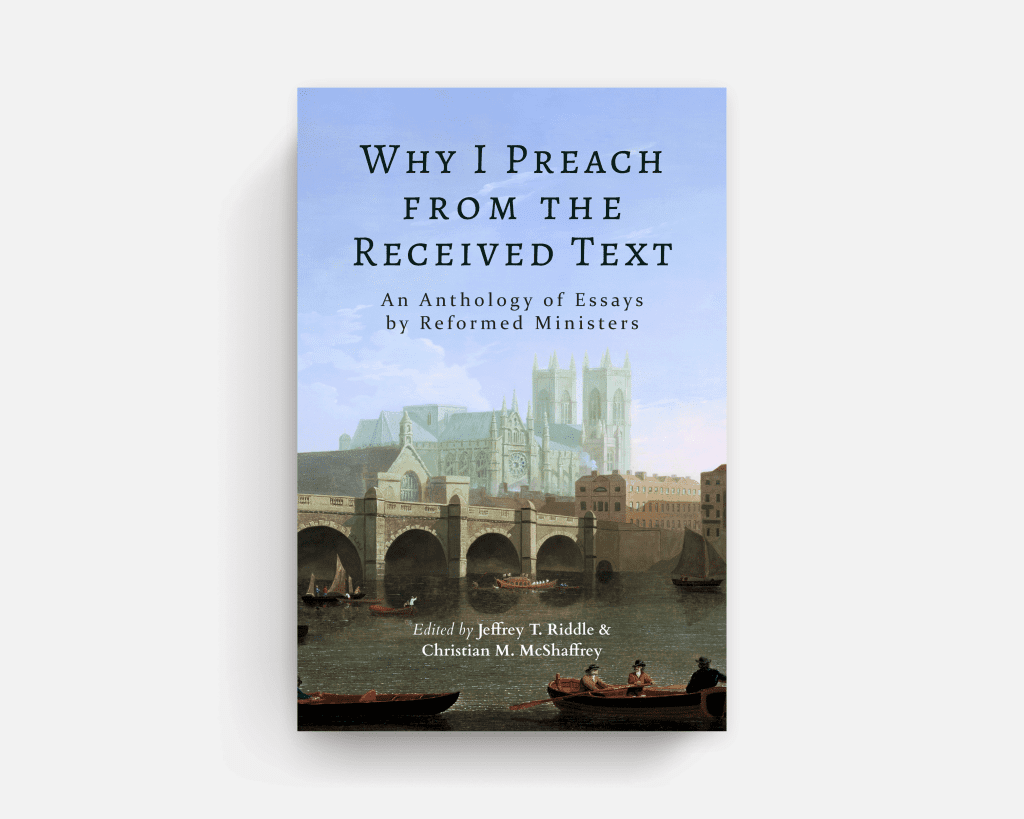
Riddle and McShaffrey: Why I Preach from the Received Text

Why I Preach from the Received Text: An Anthology of Essays by Reformed Ministers edited by Jeffrey T. Riddle & Christian M. McShaffrey became available yesterday. Here is a link to the book.

Dr. Van Kleeck Sr. wrote of this book, “The ‘house of the Lord’ (Psalm 27:4) has always been the best place to do theology. More valuable than a seminary’s clinical evaluation of Scriptural texts, this anthology contains multiple compelling cases for the superiority of the Received Text set in a doxological context. With confessional pre-commitments firmly in place, within these pages the reader will appreciate how historic, orthodox Protestant theology and apologetics is properly formulated. This volume reinforces the argument for the superiority of the Received Text and challenges the interlocular to reconsider the pusillanimous expressions of the historical critical method. Written to both edify and inform, I heartily recommend it.”

We have argued here time and again that the way the Scriptures have been preserved and the way we know what is or is not Scripture is by the Spirit of God speaking through the word of God to the people of God who then received the word of God by faith. What Riddle, McShaffrey, and the contributors of this volume have done is put clear emphasis on the latter part of that paradigm, the people of God receiving the word of God by faith.

Consider the follow excerpts:

First, from Dane Johannsson, “Although there are many reasons why I preach from the Received Text, one of the most important is because the Received Text is the Reformed text. Not only the text of one or two prominent Reformed theologians, but the text of all “Reformed catholicism,” that is, the text universally received and used by the men who established, synthesized, codified, and taught the Reformed faith.” [Italics: Mine]

Pastor Johannsson here makes and excellent point. The Received Text was not some obscure text held by a few of the Protestant Reformers. Rather it was embraced by Protestantism at large. To bolster Johannsson’s observation, consider the words of world-renowned Church Historian, Richard Muller,

“The term [Textus Receptus] was adopted as a standard usage only after the period of orthodoxy, although it does refer to the text supported by the Protestant scholastics as the authentic text quad verba, with respect to the words of the text.”

Richard Muller, Dictionary of Latin and Greek Theological Terms: Drawn Principally From Protestant Scholastic Theology, Term: Textus Receptus.

Then Pastor Robert McCurley writes, “I preach from the Received Text out of personal conviction and commitment to biblical principle. I believe that the scriptures identify the text of Scripture. God alone supplies his Word, specifies his Word, and sustains his Word. And he reveals that to us in the Bible.”

Here McCurley has made an incisive observation. By writing, “I believe that the scriptures identify the text of Scripture” he is in effect stating that the Scripture is self-attesting, self-authenticating, and self-interpreting because it is the self-revelation of the Triune God.

Pastor McShaffrey writes, “My story is that of one who went from certainty, to doubt, and back again. The Good Shepherd that led me through that shadowy valley of doubt also stands ready to lead you back into the green pastures of maximal certainty.”

Here Pastor McShaffrey confesses something found quite rare in the Critical Text camp. McShaffrey states that Christ shepherded him through the process of doubt and subsequent certainty regarding the textual issue. CT advocates like Mark Ward have little to nothing to say about the Good Shepherd leading God’s people through this process. Rather the emphasis falls almost entirely on Ward et al‘s interpretation of the textual evidence followed by an explicit or implicit “All the smart and nice people read a different Bible.” And usually ends with something like, “God clearly gave us corrupted texts, so if our text is corrupted that is the way God would have it” [e.g., See episode 2 of the Textual Confidence Collective].

Pastor Truelove writes, “When I answer the question of why I preach from translations of the Received Text, I am answering a canonical question. It is ultimately the work of the Holy Spirit, authenticating the Scriptures upon the hearts of believers, that leads one to recognize and receive the canon of scripture. This has resulted in the acceptance of those books and texts that are Scripture by God’s people and the rejection of those that are not. This is the Bible’s own teaching on the matter. It is telling that the Bible itself contains no authoritative list of scriptures and yet the biblical authors clearly recognized the scriptures in their own day.” [Italics: Mine]

Here Truelove makes an excellent point in that the Scriptures no where give the list of the canonical books of the Old and New Testaments and yet somehow the faithful know what is or is not God’s word. So it stands to reason, if the faithful can know what is Canon they can know what the Canon contains down the the very words. All is Canon. The books are Canon. The paragraphs are Canon. The words are Canon.

Finally, Pastor Riddle writes, “Why do I preach from the Received Text? I find it satisfying and winsome on many levels, aesthetically, intellectually, spiritually, theologically. It has given me a sure foundation upon which to exercise my ministry, and it has increased my faith.”

Here we see the breadth and width of reason for the use of the Received Text. For reasons of goodness, truth, and beauty. For theoretical reasons and for practical reasons. For the affect and for the intellect. For the body and for the spirit. Usually it seems that Critical Text and Modern Version proponents use and change their Bibles for far less virtuous reasons. Perhaps they read it because it sounds better, or because someone they like on FB recommended it. It seems that rarely if ever has a Critical Text advocate stood up for his NA 28 because of its obviously superior goodness, truth, and beauty.

These are only brief excerpts from 5 of the 25 essays contained in this book. I think you will see that not only do we argue differently about issues like, canon, preservation, inspiration, text, and version; the reasons why we preach from our Bible are also different. To simply sum up that difference, we believe the Bible talks about itself and the Bible that the Bible is talking about is the original. And we believe we have the original in our hand, and its name is the Received Text.

From My Seminary Notes

Both Dr.’s Van Kleeck had the privilege of studying under Dr. Richard Gaffin Jr. at Westminster Theological Seminary [East]. We still have our notes from that/those classes. Gaffin taught Introduction to Systematic Theology which included his lectures on Bibliology. His lectures formed the way we talk about the Bible now at StandardSacredText.com

Gaffin has since retired but his legacy lives on in his writing, lectures, and in our learning. Below is a small excerpt of notes taken in class by a colleague of mine, Tim Black. Tim gave his notes to anyone who asked so long as we promised to pass them on in like manner. Tim Black’s notes saved me more than once on an exam or quiz. And you’ll see why in a minute. Tim was a phenom when it came to the discipline of typing. But what can I say, phenomenal professors attract phenomenal students.

So without further ado I give you a couple of lines from Dr. Gaffin’s lecture which he delivered on day one of ST 101 – Introduction to Systematic Theology. Enjoy.

“We must recognize the function scripture has in revelation.  There are two facets that are the leading function of Biblical revelation: (1) Pointedly redemptive character- it is a redemptive revelation and of crucial significance in a world order corrupted by sin.  Biblical revelation has a unique, crucial significance.  (2) The Bible Alone is Uniquely Linguistic and verbal in character- This is revealed in genuine human language.  In the concrete situation we find ourselves in God’s revelation, Scripture performs its leading function and stands out as the purist exemplification of theology, the purist instance of the speaking of God: the divine speaking of God.  The Bible is theology.  The Bible is the speaking of God.  The speaking of God in the most direct and proper sense.  The Bible is God contemporaneously speaking to us TODAY.  The WCF, Chap. 1, sec. 10: ‘The Bible today is the Holy Spirit speaking in the Scripture.'” 

I offer this quote to make one point. While salvation is indeed a crucially significant function of Scripture, it is not its primary or leading function. The primary or leading function of Scripture is that it is God’s speech. Scripture is God speaking to us in “genuine human language.” This is its primary function. For if Scripture is not God speaking to us then salvation is impossible because faith comes by hearing and hearing by God’s words, by God speaking to us in genuine human language.

So all the theology boys out there who claim sufficient reliability is measured by whether the Gospel is clearly proclaimed in their particular version(s), have wholly missed the point of the primary function of Scripture.

The question is not, Do you believe you can be saved out of that text? No, the question is, Do you believe that text is in its totality, God’s speech or is it mixed with the words of men?

The real test is whether or not the Scriptures are God speaking to His people in ordinary human language or are the Scriptures some kind of alloy composed of God’s words and men’s words. And of course the CT/MVO crowd plainly and confidently tell us that there are many places where God is not speaking [i.e., the Long Ending in Mark or the story of the woman caught in adultery], or where they are unsure God is speaking. Or as Dan Wallace puts it,

” We do not have now in any of our critical Greek texts – or in any translation – exactly what the authors of the New Testament wrote. Even if we did, we couldn’t know it. There are many many places in which the text of the New Testament is uncertain.”

Daniel Wallace, “Foreword” in Elijah Hixson & Peter Gurry. Myths & Mistakes in New Testament Textual Criticism. xii.

The way Wallace was trained and the way he continues to train acolytes is far different from the way we were trained at Westminster. This should give you a small window into why we differ with the Wallace’s, White’s, and Ward’s of the world. We find their arguments to be bankrupt theologically.

Compare Gaffin’s words and Wallace’s words. Which do you think has the best chance of being positively defended from the teaching of Scripture? It seems obvious that Gaffin’s words are best suited to such a defense: “Hath God said,” “Thus saith the Lord,” “As the Lord spoke by the prophet,” and on and on. No where in Scripture will you find our Lord saying of His own divine words of the OT, “We do not now have in any of our scrolls exactly what the authors of the Old Testament wrote. Even if we did, we couldn’t know it. There are many places in which the text of the Old Testament is uncertain.”

Our position: The Bible is the speaking of God in the most direct and proper sense.
Their position: The Bible is the speaking of God in a sufficiently reliable sense.

See the difference? Can you see now why we disagree with Wallace and those like him? And this is just the third page of notes from one class at Westminster. There are plenty of other places where Wallace and his ilk show themselves to be wondering sheep. The question now is, which position is most consistent with the teaching of Scripture regarding itself?

That King James Is Not The Best

So as you peruse the internet have any of you found it interesting that there is another huge debate going on about the King James? When I type in “King James debate” into Google I get story after story and image after image of who is the best basketball player: His Airness, Michael Jordan or King [Lebron] James.

Here on StandardSacredText.com we are going to settle this debate once and for all.

Michael Jordan

6 NBA Championships
6 Finals MVP’s
5 MVP’s
1 Defensive Player of the Year

Lebron James

4 NBA Championships
4 Finals MVP’s
4 MVP’s
0 Defensive Player of the Year

Beyond these numbers, Jordan took the game to a whole other level. Jordan’s ability seemed to show so many other NBA players, indeed the best of his time, to be no match. I mean, watch the game where Jordan scored 63 points while having the flu and then stand in awe. In other words, Jordan was the rising tide which lifted all other NBA players’ game. Lebron has yet to do this. Indeed, he is better than most, but he is not so clearly better that all NBA players have become better as a result of Lebron’s play.

The first year we sent our NBA players to the Olympics, the team on which Jordan played, the basketball players of the world got trounced. In many cases it looked like a Harlem Globetrotters game. In fact it got so bad that network television stop showing the games half way through and switch to something like synchronized swimming. Lebron does not represent such domination in the field and that is because Jordan raised the bar of greatness and it showed itself in the rise of ability and competency both here in the USA and around the world. When Lebron does this, then perhaps he will be the greatest. Until then, he is merely a great player.

Now of course we can’t leave this post as a mere assessment of why Jordan is the GOAT. Let us now turn to a brief discussion on the King James Version debate.

Don’t you find it puzzling that the debate around Jordan and Lebron is about who is the GOAT, the Greatest Of All Time? Don’t you think it would be better to simply refer to Jordan and Lebron as sufficiently reliable basketball players? Can you imagine a Lebron fan or sports commentator saying for a Finals Game 7, “That Lebron James, he’s a sufficiently reliable baller.”?

No, it’s about exceptionalism. Denis Rodman was a sufficiently reliable player for the Bulls, but he is not Michael Jordan, the Greatest Of All Time.

And why is Jordan the GOAT? Is it because he is a man? Is it because he played in the NBA? Is it because he played with the Bulls franchise? Is it because he went to the Finals? No, plenty of other NBA players did these very same things. Jordan is the GOAT because of the details, the shot percentages, the free-throw percentages, the number of wins in a season and in post-season, the number of assists, Jordan’s leadership and many many other factors. It’s the little stuff. Like in American football, it is a game of inches. The point is that greatness is defined by the small stuff.

On the textual issue our opponents would have us abandon exceptionalism. There cannot be one English version that is better than all the others. In fact, to desire such a thing is to be in error. All the versions need to be super. But as that deranged philosopher Syndrome says,

And that is the point of the Textual Confidence Collective. Every man chooses the versions that are right in their own eyes. But as soon as someone comes to cut down the groves, dash their academic idols, and tell them there is only one, out comes the scholastic torches and pitchforks.

And does this not spark thoughts of yet another social ill? Everyone gets a trophy these days. ***whining***Why does Jordan always get the MVP?***the whining continues*** He gets the trophy because he is the best. He performed the best. So as good as other players are they are not exceptional, not like Mike.

So while many in our culture demand that every participant get a trophy so too our Critical Text interlocutors demand that every version or nearly every version get a “Sufficiently Reliable” trophy based on the “You Can Get Saved Out Of That Text” trophy which everyone also gets. While they ignore what is exceptional. They whine and complain that the TR/KJV advocate holds their text to be exceptional, to be better than the rest. And Critical Text advocates simply can’t have inequality like that. In fact, as I argued a week or so ago, in Ward’s case he would have this same society that is degrading by the day, be accommodated for its laziness and misallocation of scholae [i.e., leisure] rather than challenged to reverse course and embrace an exceptional text that is certainly within reach.

Which leads to yet another social ill that modern text-critical advocates continue to stump for in their own way. Everyone has to be equal. We are talking both equal opportunity AND equal outcome. Here again the text-critical advocate claims that all or nearly all English versions are to be given equal opportunity in Christendom and that all these equal opportunity Bibles will yield equal outcomes. Furthermore, anyone who argues differently is a textual bigot. Or again, in the words of Mark Ward, a textual absolutist. Queue the torches and pitchforks.

Returning back to the theme of details and the small stuff mentioned above. Again we see that Critical Text advocates continue to unwittingly or wittingly support further social evils, but of course in their own ways. Consider man and woman and our current cultures’ insistence that man and woman are basically the same thing. And in so many ways the Christian worldview agrees. Man and woman are made in God’s image and are souls that have bodies. These are the major inviolable doctrinal truths. A healthy man and woman both have two ears, two eyes, a nose a mouth, nervous system, a respiratory system, a circulatory system, need oxygen, need water, need digestible calories, have a skeleton overlaid with muscle overlaid with skin, and the list goes on and on and on.

But the details, the details make all the difference: differences in reproductive capacity, water in the skin, presence of testosterone, density of musculature, and on and on. Modern woke intersectionality would have us overlook these “small differences” which in the end would not make a man no longer a man if he had low muscular density or only one ear or one eye. Nor would it make a woman any less of a woman if she were unable to conceive. Both he and she would still be very much made in the image of God and be a soul that has a body.

The same goes for our Critical Text brothers. They would have us believe that the small stuff doesn’t matter because no major doctrine [i.e., all men and women are souls that have bodies] is affected by those errors. Try telling that to a woman who cannot conceive a child though she desperately wants one. “It’s ok Susan. Your inability to have children is small compared to the fact that you are created in the image of God [i.e., no major doctrine is affected by her inability to have children]. In fact, despite your inability to have children you are equal with all other women. ” Just writing this sounds ridiculous on so many fronts. Only a cold and ignorant heart could say such stupid things. But for our Critical Text brothers it is not ridiculous to speak this way about God’s words. Rather such words are thought to be brilliant and balanced.

***NEWS FLASH*** The “small stuff” in Scripture, the stuff that is said not to affect doctrine AND the “big stuff” that does affect doctrine are all the same stuff – inspired Scripture.

Current Woke Biology: Men are personalities that have bodies and women are personalities that have bodies, so both are personalities that have bodies therefore there is no meaningful difference between men and women that affects man/woman doctrine.
Current Evangelical Textual Critic: The NIV is sufficiently reliable, the ESV is sufficiently reliable, and the KJV is sufficiently reliable so there is no meaningful difference between these versions that affects Christian doctrine.

Sometimes you got to laugh to keep from crying.

In sum, the Critical Text/Multiple Version Only [CT/MVO] position objects to exceptionalism among Bible versions and in their own way [i.e., in the field of text-criticism] prop up the false equality trumped up by our broken and breaking culture in the West. All versions or nearly all versions deserve a trophy. To say otherwise is to be a textual bigot. CT/MVO’s continued insistence of downplaying the “small stuff” or “the stuff that doesn’t affect doctrine” plays perfectly into the hand of those who wish to diminish the diminutive but properly important differences between men and women. Biologists do it with people and text-critics do it with the Bible.

The worst thing of all though is that the woke biologist understands what he is doing and its repercussions. The modern evangelical text-critic is utterly oblivious and so much so that he thinks he’s doing the Church and Western Culture a favor. Indeed, the worst tyrants are those who believe they are tyrannizing you for your own benefit.

The KJV Didn’t Makes the Pope’s List…Shocker

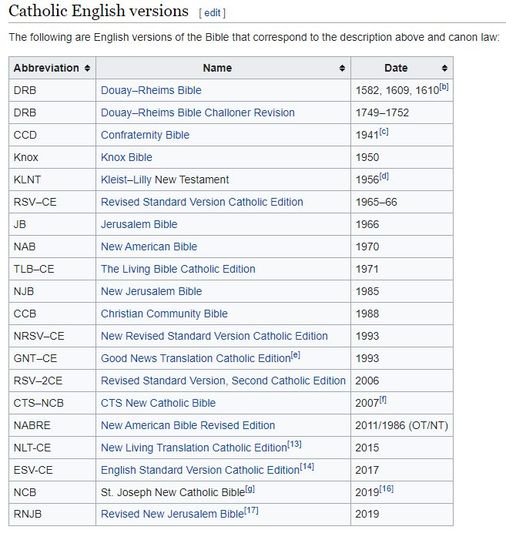
The image below has been circulating around lately in certain familiar circles so I thought I would I would share it here for anyone who had not seen it. It is an image of the current English versions of the Bible approved by the Apostolic See i.e., the Pope. Canon law regarding the authority of Scripture states,

“Books of the sacred scriptures cannot be published unless the Apostolic See or the conference of bishops has approved them. For the publication of their translations into the vernacular, it is also required that they be approved by the same authority and provided with necessary and sufficient annotations. With the permission of the Conference of Bishops, Catholic members of the Christian faithful in collaboration with separated brothers and sisters can prepare and publish translations of the sacred scriptures provided with appropriate annotations.” —  Canon 825 of the 1983 Code of Canon Law

So here is the list.

While the KJV didn’t make the list, nor did all the other TR-based translations, we do see that some familiar modern translations made the list: the New Living Translation, the New Revised Standard Version, and of course the favorite of many evangelicals, the English Standard Version. These all made the cut. Congratulations…I think.

What to Make of Matthew 24:35

As you read through biblical commentaries over the centuries, you will begin to note a rising incursion of secular rationalism into the commentary as the comment moves from the interpretation of the Scripture as a settled standard to a comment that offers alternate, non-exegetically based readings and interpretations. That is, scientific categories – theological, linguistic, historical —  not the Spirit, Word and Covenant keeper began to take precedence and then decide what the Scripture says and means. Most of the commentaries posted on StandardSacredText may seem unusual to the modern mind in that the critical work of the Post-reformation dogmaticians and Protestant Orthodox was positive, aimed toward reinforcing the common faith once delivered unto the saints. The Scripture itself was considered Scripture’s best exegetical and theological “commentary,” theology, linguistics, and history, subject to the self-attesting Scripture.

What follows is a brief comment on Matthew 24:35. As you read it, ask why, considering the simple reading of the passage, someone would assert there is no verse in Scripture teaching the providential preservation of the text. The meaning of the passage seems conspicuous, almost intuitive. How is the Church edified by rejecting this passage as grounds for providential preservation? If there was once a time when the interpretation or providential preservation was maintained by the Church, what philosophical, theological, ecclesiastical, etc., event or events took place to reject the rendering as valid?

Also note that the theology of providential preservation is based on the exegesis of the passage. That is, the idea of providential preservation is not imposed on an unwelcoming passage but that the passage demands such a rendering. If the exegesis of the passage is correct, what transpired to render the diction, grammar, and syntax in a contrary manner?

Thirdly, this interpretation is not sectarian but has been received historically by the orthodox Protestant Church as indicated by well-respected commentators of the Christian religion.

Matthew 24:35

Heaven and earth shall pass away, but my words shall not pass away

ὁ οὐρανὸς καὶ ἡ γῆ παρελεύσονται οἱ δὲ λόγοι μου οὐ μὴ παρέλθωσιν

Exegesis and Exposition

            The “words” in this passage refer to the words of God in general, that unique set of words that were given by immediate inspiration of God. These words in one sense preclude what we call a “text,” a text being one of many representatives of varying worth attempting to capture the inspired words of God. The word parelqwsi translated “pass away” in the second instance is an ingressive (cf., inceptive) aorist tense verb from parercomai. The ingressive indicates an entrance into a state or condition. (Also see John 1:14; Acts 15:12). When expressing prohibition in the form, aorist tense, subjunctive mood and mh, the ingressive aorist conveys the meaning, “don’t start” or “don’t begin” the action referred to, which in this case is to “pass away.” Scripture in the most definite and unambiguous language tells us that though creation as we know it will go out of existence, the words of God will not. Given the historical context of creation’s past and present existence, not one word of God has “disappeared” or “come to an end.” James Morrison, in his commentary on Matthew observes,

What an immeasurable height here must have been within the self-consciousness of our Lord, when he thus contrasted the imperishableness of his own words with the perishableness of the heaven and earth! It is to his prediction in the preceding verse that he specially refers. Its fulfillment might be absolutely depended on. It would not fail. It was not liable to any casualty or transformation. And what was true of the words of this prediction, is equally true of all our Savior’s words,–of the sum total of his teachings. “The grass withereth, and the flower thereof fadeth away,” the sun and moon and stars shall pass away, “by the word of the Lord endureth forever.” (1 Pet. I, 25.)[1]

In the covenant God made with Abram in Genesis 15, the stars of heaven stand as testimonies to God’s faithfulness and power to bring His promises to consummation. This biblical truth is again attested to in Matthew 24:35 and parallel verses in the synoptic gospels.[2] The verse reads, Heaven and earth shall pass away, but my words shall not pass away. Reference to the testimony of “heaven and earth” is a common reinforcement to the certainty of the covenant and its fulfillment. In Genesis 15:5, God illustrates for Abram the numerical prosperity of his descendants by asking Abram to gaze into the sky to consider the number of the stars. This passage quoted by the Apostle Paul in Romans 4:3 solidifies the continuity of salvation and the common saving faith of Abraham, those who lived before the coming of Christ, with the saving faith of believers who lived after the death and resurrection of Christ. The stars were made a comparison by God with Abram’s posterity, a comparison Abram believed “and it was counted to him for righteousness.” “Stars” in Genesis 15 were not hyperbole but objects God used to do the work of faith in Abram’s heart. In this passage, the formula is creation/covenantal/salvific.

In Deuteronomy 30:11-13, the covenant is not off in the distant heavens nor beyond the sea, “But the word is very nigh unto thee, in thy mouth, and in thy heart, that thou mayest do it.” Here, the created order is spoken of in spatial terms; that the covenant is not vast distances away but lives within the covenant keeper. Here, the formula is creation/covenantal/sanctifying.

Again, creation is presented as an empirical testimony to the validity of the New Covenant in Jeremiah 31:35-37 which reads, “Thus saith the Lord, which giveth the sun for a light by day, and the ordinances of the moon and the stars for a light by night, which divideth the sea when the waves thereof roar; The Lord of hosts is his name: If those ordinances depart from me, saith the Lord, then the seed of Israel also shall cease from being a nation before me forever. Thus saith the Lord; If heaven can be measured, and the foundations of the earth searched out beneath, I will also cast off the seed of Israel for all that they have done, saith the Lord.” In this passage the formula is creation/covenantal/protecting

            Referring to Matthew 24:35, Calvin comments, “To win faith for His words, He illuminates their certainty with a comparison which, certainly, is based more firmly and surely than the fabric of the entire world”[3] and Matthew Henry says,

Christ here assures us of the certainty of them (v. 35 [the events]); Heaven and earth shall pass away; they continue this day indeed, according to God’s ordinance, but they shall not continue forever (Ps. cii.25, 26; 2 Pet. iii.10); but my words shall not pass away. Note, the Word of Christ is more sure and lasting than heaven and earth. Hath he not spoken? And shall he not do it? We may build more assurance upon the word of Christ than we can upon the pillars of heaven, or the strong foundations of the earth; for, when they shall be made to tremble and totter, and shall be no more, the word of Christ shall remain, and be in full force, power and virtue. See 1 Pet. i.24, 25. It is easier for heaven and earth to pass, than the word of Christ; so it is expressed, Luke xvi.17. Compare Isa. liv.10…. Every word of Christ is very pure, and therefore very sure.”[4]

Isaiah 54:10, reads as follows, “For the mountains shall depart, and the hills shall be removed; but my kindness shall not depart from thee, neither shall the covenant of my peace be removed, saith the Lord that hath mercy on thee.” Here, the formula is creation/covenantal/kindness, peace, mercy.

Note again Jacob’s blessing upon Joseph in Genesis 49:25 where El Shaddai, the Almighty, “the God of the mountains” are bound together with Jacob’s lengthy covenantal blessing upon his son and posterity: “who shall bless thee with blessings of heaven above, blessings of the deep that lieth under, blessings of the breasts, and of the womb. The blessings of thy father have prevailed above the blessings of my progenitors unto the utmost bound of the everlasting hills” (or the place of blessing upon the “everlasting hills.”)

In Matthew 5:18, Matthew 24:35, Mark 13:31, Luke 16:17 and Luke 21:33 Jesus follows and expands upon this Old Testament formula. Rather than stars, mountains, seas and heavens, Jesus says “heaven and earth.” In these Old Testament passages, we see the unconditional, covenantal language of salvation, sanctification, protection, blessing, kindness, peace, and mercy. The mountains, seas, and heaven and earth stand as a witness to the faithfulness of God in the preservation of His covenant people through His word. This is also the larger theme of Psalm 12. Written as a reminder to Israel of the unconditional covenant first made with Abraham in Genesis 12:1-3 and rehearsed to the Patriarchs and throughout the Old Testament, the existence of the mountains and hills are witnesses to Jehovah’s kindness.

That Jesus follows this model in his teaching ministry should awaken our senses to recognize that the jot and tittle preservation of his word is not simply a theological issue to debate. The preservation of God’s Word is the preservation of God’s unconditional promise of salvation, sanctification, protection, blessing, kindness, peace, and mercy to the Church. Peter Martyr Vermigli (1499-1562) was an Italian-born theologian during the early years of the Reformation who expressed the following foundational theological truth, writing,

Thus says the Lord” (Dominus dixit) ought to be held as a first principle (primum principium) into which all true theology is resolved. This is not, moreover, an evidence derived from the light of human senses or from reason, but from the light of faith, by which we ought to be most fully persuaded, and which is contained in the sacred writings…. Christ himself teaches us, as it is said in Matthew 24, “heaven and earth shall pass away, but my words will never pass away”; and it is repeated everywhere that “the word of God stands forever.[5]

Augustus Strong, in his Systematic Theology, cites this passage in the section that deals with the Trinity being “essential to any proper revelation”[6] and specifically that Christ is the only Revealer of God by linking Christ and His words by arguing the following:

The Christian on the other hand regards Christ as the only Revealer of God, the only God with whom we have to do, the final authority in religion, the source of all truth and the judge of all mankind. “Heaven and earth shall pass away, but my words shall not pass away.” (Mat. 24:35).[7]

Citing Matthew 24:35 Strong adjoins the person of Christ as the “Revealer of the Father” from His message as the “source of all truth” with special reference to Scripture’s preservation. In other words, because Christ is the immutable Revealer of the immutable Father, so also His word is immutable. Because Christ is the eternal Revealer of the eternal Father so also His word is eternal. Because Christ is the Holy Revealer of the Holy Father, His word is holy. Christ is the immutable, eternal, holy “judge of all mankind” and will judge according to the dictates of his word.


[1] James Morrison, Matthew’s Memoirs of Jesus Christ: or a Commentary on the Gospel according to Matthew (Hamilton, Adams and Co., 1873), 531. http://0-search.ebscohost.com.newlibrary.wts.edu/login.aspx?

direct=true&db=h7h&AN=36332946&site=ehost-live.

[2] See 1 Peter 1:24-25 and Isaiah 40:6-8.

[3] John Calvin, Calvin’s New Testament Commentaries, vol. 3, edited by David W. Torrance and Thomas F. Torrance (Grand Rapids: Eerdmans, 1972), 98.

[4]Matthew Henry, Commentary vol. 5 (Old Tappan: Fleming H. Revell Co., 1721), 360-61.

[5] Vermigli, Loci communes, I.vi.2. as cited in Richard A. Muller, “Holy Scripture: The Cognitive Foundation of Theology,” Post-Reformation Reformed Dogmatics, vol. 2 (Grand Rapids: Baker Book House, 1993), 342.

[6] Augustus Strong, Systematic Theology, Valley Forge, PA: Judson Press, 1993), 349.

[7]  Strong, Systematic Theology, 349-350.

Ward’s Textual Confidence Collective is Turning Out to be a Dumpster Fire

So the second episode of Mark Ward’s Textual Confidence Collective [TCC] dropped yesterday. I watch to stay up on the current goings on. I watch to hear a new argument perhaps. I watch to see if someone among them could could offer our arguments a beautiful death. To co-op the words of Stelios,

“I have fought countless times yet I have never met an adversary who could offer my arguments what the Spartan’s call a beautiful death. I can only hope that with all the TCC warriors gathered in one place, there might be one down there that is up to the task.

Stelios of Sparta

But alas none of the reasons I came to watch were fulfilled.

This episode was entitled The History of Textual Absolutism. TCC defines “textual absolutism” as holding to one form of the Scriptural text as their only and final authority. This could be a Greek/Hebrew text, a manuscript, or a version. They then go on to note certain persons who held to one form of the Scriptural text as their only and final authority.

Starting with the legend of the LXX, then Justin Martyr, then onto the Roman Catholics with their Latin Vulgate, and then ending the last five minutes with five modern day absolutist groups as characterized by the thought and work of Ruckman, Riplinger, McClure, Cloud, and Hills respectively. Ruckman being the most extreme and Hills being the most moderate of these five modern-day absolutist groups or positions.

Unfortunately, the vast majority of the episode was bent on critiquing the absolutist position by appeal to opposition contemporaries of Martyr and certain Roman Catholic apologists. So the episode would more aptly be called, The History of Critiquing Textual Absolutism.

This was their opportunity to show that they understand the position they so vehemently protest. They could have given the whole hour to showing their in-depth understanding of Martyr’s position and the Roman Catholic position as well as the robust theological Reformation position. But, no. Almost the whole episode was spent on their personal opinions why the legend of the LXX came to prominence, the virtues of Erasmus’ arguments contra absolutism, and a handful of quotes from the KJV translators, which I am going to get to in a minute.

There were many place where TCC set forth false equivalencies and sloppy argumentation which would have needed attention, but for this post I want to focus on only a few of the more ridiculous things.

1.) One of the huge problems of the TCC is that they set out to define their opponents but fail to properly do so, making the whole show a strawman. It would have been better for them to have an opponent on the TCC, or to have merely stated their arguments without pretending to understand their opponents and then labeling them.

Their hubris is palpable and it tastes a bit salty in that they think themselves able to critique Ruckman and Hills at the same time. I get that Tim doesn’t have advanced degrees but there is no excuse for Ward and Hixon who have Ph.D.’s or Peter who is a Ph.D. candidate. Their scope is too broad and they should know that. But they don’t, or they do and don’t care. And apparently they don’t know the substantive and meaningful differences between Ruckman and Hills so they stupidly lump them all under one title, textual absolutist.

2.) No sooner had they defined textual absolutism than they started to tear it down. Then after ~ 42 minutes of critiquing textual absolutism Ward cluelessly and confidently states, “We are trying to represent them fairly.” [42:18] I laughed out loud at this point. 2/3’s of the episode is over and all they’ve done is critique something they’ve barely defined let alone built up and then Ward, completely unaware of himself on this point, tells the audience that he is trying to represent the other side fairly. This shows you the caliber of scholarship the TCC employs.

3.) I thought it was hilarious around [52:00] when Ward says that he is an absolutist on the resurrection, salvation, and the virgin birth, but then he was not an absolutist on baptism. Then Hixon challenges him on it right then and there and says that infant baptism is no baptism at all. This is a parody of the version issue and they don’t even realize it.

Ward’s position on baptism is in step with his position on the Scriptures. Ward believes in many competing English forms of the word of God and so many competing forms of baptism makes sense to him. Hixon believes in only one form of baptism but in many forms of the word of God from which Hixon draws his beliefs regarding baptism. Hixon’s like, “God has given many forms of His own words to the Church but there is absolutely no way God could give many forms of baptism to the Church.” That part was golden. Then to have Ward and Hixon disagree in their degrees of absolutism was great because Ward would lump himself in with Hixon’s position [at one point Ward quickly affirmed that he was Credo-Baptist] but Hixon would not lump himself in with Ward, all the while the TCC lumps together Ruckman to Hills under the same term, textual absolutist. Good times…

4.) Tim: “If the Bible can be wrong in one point, it can be wrong in every other. It’s that same absolutist logic.” [11:54] Tim is saying here that a hallmark of textual absolutists is that they believe that if the Bible can be wrong at one point then it can be wrong in all other points. And the TCC all nod…

Again, we keep coming back to this point but we have to. The TCC is simply out of their depth on this topic. They were raised in a weak form of Bibliology and then desperately attached themselves to what is currently popular, but their Bibliology is still just as bloodless and effete as when they were in high-school.

Take this quote from Francis Turretin’s Institutes of Elenctic Theology [1696]. Turretin’s Institutes are important because 1.) they were the Systematic Theology of the Academy at Geneva, the first official Protestant school of higher learning in the Third Wave of the Reformation and 2.) Turretin’s Institutes remained the standard Protestant Systematic Theology until the mid-1800’s at Princeton until Hodge’s Systematic Theology replaced Turretin’s.

I tell you this because for nearly 200 years, or approximately ten generations of Christian scholars used Turretin’s Institutes as their standard for Systematic Theology. The quote I’m about to share with you is loudly and clearly this supposed “absolutist logic” and the TCC is oblivious to this truth. Turretin writes,

“Unless unimpaired integrity characterize the Scriptures, they could not be regarded as the sole rule of faith and practice, and the door would be thrown wide open to atheists, libertines, enthusiasts, and other profane persons like them for destroying its authenticity (authentian) and overthrowing the foundations of salvation.” Turretin, Institutes vol. 1, 71.

NOTE: In sum, without “unimpaired integrity” the Bible will be left wide open to destruction by atheist, antinomians, charismatics, and other profane persons which will lead to the overthrow of the foundation of faith. So what does “unimpaired integrity” look like for Turretin?

“For since nothing false can be an object of faith, how could the Scriptures be held as authentic and reckoned divine if liable to contradictions and corruptions? Nor can it be said that these corruptions are only in smaller things which do not affect the foundation of faith.”

NOTE: Every time I read this portion I laugh. 350 years ago Turretin had to respond to the same objection offered now by our evangelical brethren which is, “Well, the corruptions in the New Testament don’t affect any major doctrine.” While Turretin says it cannot be said that these corruptions are only in the smaller things; things that do not affect the foundation of faith i.e., major doctrine.

In the same section again,

“For if once the authenticity (authentia) of the Scriptures is taken away (which would result even from the incurable corruption of one passage), how could our faith rest on what remains? And if corruption is admitted in those of lesser importance, why not in others of greater? Who could assure me that no error or blemish had crept into fundamental passages?”

NOTE: Talk about textual absolutism. Turretin, again writing the standard Systematic Theology of his day, plainly says that one incurable corruption would take away the authenticity and therefore authority of Scripture. Just one. Then he goes on to argue almost word for word what Tim and the TCC believe is “textual absolutist logic”. Turretin’s position is that if we admit error in the lesser things, or in one thing, why can’t their be error in fundamental things, in major doctrinal things?

Also at around [30:25] Hixon says that Dirk Jongkind says every word of God is so important, it is worth losing sleep over. Well, to Dirk and the TCC, here is what losing sleep looks like. If you admit corruption in the small things then you have no grounds to exclude corruption in the fundamental things because the small things and the fundamental things are the same thing, inspired Scripture. That, indeed, is something to lose sleep over.

But wait there’s more. Right around the 15 second mark Peter says, “We don’t need to be more orthodox than God.” This is a clip from later in the conversation where Peter states his belief that because there are errors in the text and textual tradition, that is what God gave us and we should be thankful for that. Turretin, argues quite the opposite.

“It will not do to say that divine providence wished to keep it from serious corruptions, but not from minor. For besides the fact that this is gratuitous, it cannot be held without injury, as if lacking in the necessity of things which are required for the full credibility (autopiston) of Scripture itself. Nor can we readily believe that God, who dictated and inspired each and every word to these inspired (theopneustois) men, would not take care of their entire preservation.”

The point is, Peter and the rest of the TCC, have a low Bibliology and a low Theology Proper because their low Bibliology scared them as kids and now they are scared of variants. So they are comfortable with straying from orthodox Bibliology and Theology Proper so they can make their point based on some shallow view of divine providence. For the rest of you out there, don’t ever tell me that no major doctrine is at stake when I have an example here of two Ph.D.’s and a Ph.D. candidate reframing orthodox Bibliology and Theology Proper just so they can substantiate their novel claims born out of the chaos of their youth.

And this is just Turretin. What about William Twiss, Edward Leigh, and William Whitaker? The TCC simply does not know what they are talking about. They have not done the reading. They have not done the study. The most charitable reason for this I think is that they simply weren’t trained right. I lay a fair bit of blame at the feet of their uninformed and scholastically effete professors.

5.) Lastly, at [54:28] Tim is quoting from Miles Smith and on the screen near the bottom right of the text you see the word “Original”. Note the capital letter “O”. The reason why Smith wrote “Original” and not “original” is because he believed the Greek and Hebrew in his hand were the very words of Moses and the apostles. Note at [47:57] Tim is again quoting but this time from Daniel Featley. Featley is comparing translations and “the originals”. But note how Featley defines the originals, “…or else we must read none at all till we have a translation given by divine inspiration, as the originals are.”

Featley does not day “as the originals were”. No, he says as they “are”. Again, Featley along with Smith believed the Greek and Hebrew in their hand were the exact same words as those written at the hand of Moses and Paul and John. But in case there is still doubt, here is Turretin saying the same thing.

“By the original texts, we do not mean the autographs written by the hand of Moses, of the prophets and of the apostles, which certainly do not now exist. We mean the apographs which are so called because because they set forth to us the word of God in the very words of those who wrote under the immediate inspiration of the Holy Spirit.

Turretin maintains that at his time and 85 years after the writing of the KJV that the Greek and Hebrew in use “sets forth the word of God in the very words” of Moses, the prophets, and the apostles.

The point is that the KJV translators, in fact all the orthodox, WERE textual absolutists of the Hill/Letis sort, and yet these facts have wholly alluded the TCC. These truths were literally right in front of their faces. They were undermining their own position without even knowing it. They were reading the quotes and yet because of their weak Bibliology could not see the forest for the trees.

With such failures in scholarship it is hard to believe anything good will come of the TCC other than continued clear examples of their ineptitude in field of orthodox Bibliology. I love these guys in the Lord, but so far these guys are lost and wondering, and somebody has got to tell them.

Next week they say they are going to discuss the theology of textual absolutism. Be sure there will more and greater scholarly gaffes. I am beginning to wonder if the proper analysis of the TCC come the last episode will be something like: