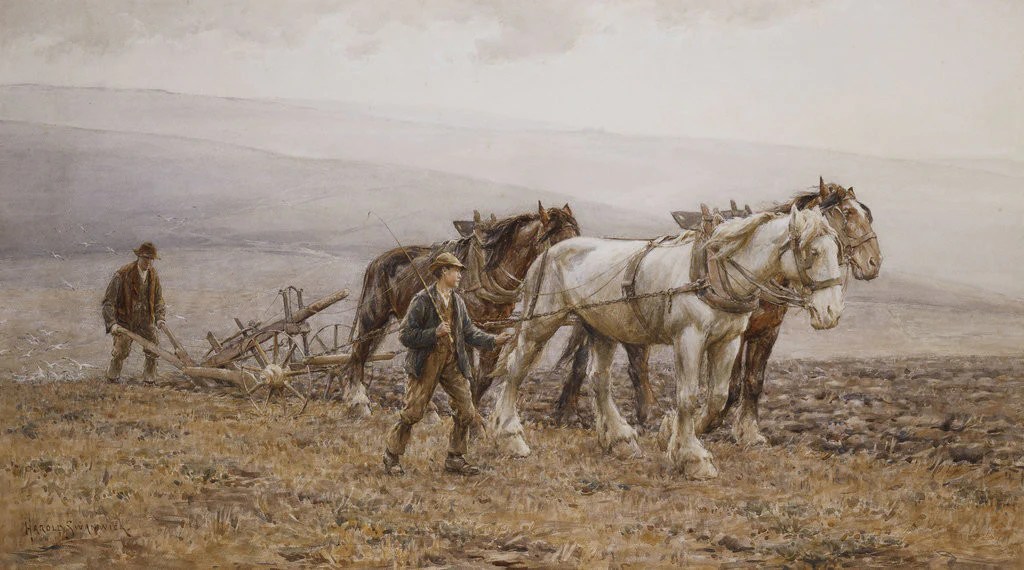
The Plowboy and the Ploughman

Below is a brief history of the theme of “plowboy” or ploughman” in the context of Bible translations their intelligibility. This is part one of a four part series written by Christopher Yetzer on his FB wall [07/26/2022]. Thanks to him for allowing me to repost this here.

I found Yetzer insightful on the point that “plowboy” or ploughman” represents a kind of person. The terms “plowboy” or ploughman” stand as representatives of the common man in his socio-economic and socio-academic condition when compared to academicians. I hope it will be a blessing to you.

_______________________________________________________________________________

Jerome seems to be one of the earliest witnesses to the type of language that has come to be associated with the plowman as it relates to his use of Scripture. Around 386AD he wrote to Marcella[letter 46] describing the condition of the Holy Land using these words: “in the cottage of Christ all is simple and rustic: and except for the chanting of psalms there is complete silence. Wherever one turns the laborer at his plough [arator stivam tenens] sings alleluia, the toiling mower cheers himself with psalms, and the vine-dresser while he prunes his vine sings one of the lays of David. These are the songs of the country; these, in popular phrase, its love ditties: these the shepherd whistles; these the tiller uses to aid his toil.

Around the same time on his first homily on the Gospel of Matthew, Chrysostom speaks about the “few and plain words” which Christ has taught concerning what is virtuous and right. He then says, “And these things even to a ploughman[γηπονω], and to a servant, and to a widow woman, and to a very child, and to him that appears to be exceedingly slow of understanding, are all plain to comprehend and easy to learn.” The word γηπονω has been rendered differently in modern translations. γη means land/earth/soil and πονω means to toil or suffer. In some printings it is translated in Latin as rustico or agricolæ. As early as 1636 in Nehemiah Rogers’ The True Convert, Chrysostom’s word was translated as “plough-man” in English. Most modern translations interpret it as laborer, but this most likely brings the wrong image to mind. It seems to be more appropriate to call him at least a laborer of soil or earth, possibly a farmer or plowman. The main idea is obviously the same, no matter the specific word used.

This image of a farmer or a plowman was then carried on by some Catholics who desired to have the Scriptures translated into the vulgar tongues. In the preface to Erasmus’ first edition of his Greek and Latin New Testament, he uses similar words to those used by Jerome. However, whereas Jerome was claiming to have heard them in his day, Erasmus was desirous that in his day such things could be heard, “Perhaps it is better to conceal the mysteries of kings, but Christ’ mysteries he desires to be published as openly as possible. I wish that all young women would read the Gospel and read Paul’s Epistles. Also that they would be translated into every language, so that they could be read and understood not only by the Scots and Irish, but also by the Turks and Saracens. The first step is to learn them, no matter the cost. There may be many who laugh, but some would be captured. Would that, as a result, the farmer might sing some portion of them at the plough[ad stivam aliquid decantet agricola], that the weaver might hum some parts of them at his wheel and that the traveler might relieve the weariness of his journey with stories of this kind! Let all the conversations of every Christian be drawn from this source. For in general our daily conversations reveal what we are.

The Dominican friar, Marmochino, then mimicked Erasmus in his 1638 Italian Bible preface, “And then if with a pious and Christian eye one considers the truth, would it not seem a most laudable and holy thing if even this plowman, guiding the plow, sang anything in his mother tongue from the Psalms; and if the weaver, while standing diligently at his loom checking over his work, consoled his fatigue with the Gospel; and if the helmsman diligent about the rudder, sang something from it; and so if others like them, diligent on their labors, would ease themselves with the most holy praise of God and word of the Gospel?

The 1582 Catholic Douay-Rheims English New Testament, while clearly opposing vulgar translations, continues the tradition of using the ploughman, “The poore ploughman, could then in laboring the ground, sing the hymnes and psalms either in knowen or unknowen languages, as they heard them in the holy Church, though they could neither reade nor know the sense, meaning, and mysteries of the same.

While the ploughman was mostly used by Catholics up to the time of the Council of Trent, shortly thereafter he was borrowed as a sort of battle cry for the Protestants.

In 1563 John Foxe took the analogy to an even greater level when he reported in his book, Actes and Monuments, that William Tyndale said to “a certain Divine”, “If God spare my life, ere many years I will cause a boy that driveth the plough shall know more of the scripture than thou dost.” This moved the plea from the common laborer to a working young boy. The attribution of this phrase to Tyndale has been challenged and doubted by some. [Jan J. Martin, “William Tyndale, John Foxe, and the ‘Boy That Driveth the Plough’,” Religious Educator, 17, no. 2 (2016): 86–105.] Even if the phrase was never said by Tyndale, the idea was still promoted by Foxe who was no friend of the Catholics and a similar thought (albeit closer to the ploughman than the ploughboy) is still demonstrated in Tyndale’s 1530 preface, “Which thing only moved me to translate the New Testament. Because I had perceived by experience, how that it was impossible to stablish the lay people in any truth, except the scripture were plainly laid before their eyes in their mother tongue, that they might see the process, order, and meaning of the text.

Almost a century later, Thomas Swadlin, although surely not unbiased, tried to give a fair perspective of the differing opinions of the Church of Rome and the Reformed Church concerning the Scriptures. In 1643 he said concerning the position of the “Protestant or Reformed Divines”, “That in respect of the manner of Delivering, the Scriptures are onely easie and perspicuous unto them, who are not hindered by Age or Ignorance of the Language in which they reade the Scripture; and who are endued with the Spirit of God; they understanding them onely as they ought to be understood, though they be but plough-men:”[The Scriptures Vindicated from the Unsound Conclusions of Card: Bellarmine.]

Not everyone used the “ploughman/ploughboy” moniker, in fact most people didn’t. For instance Thomas Cranmer in his prologue attached to the Bishops’ Bible used the phrase “the lay and vulgare people”. KJV translator John Bois described them as, “the common people.” [An Exposition of the Dominical Epistles and Gospels Used in Our English Liturgie Throughout the Whole Year.] Therefore the image of the ploughman (while a historical occupation and also a figure throughout the Bible) was originally an application used by the Catholics which Erasmus’ borrowed from Jerome for his preface. It was then replicated by other Catholics who in that time desired the Bible to be translated into the vulgar languages. After the Council of Trent, Protestants in some rare examples took up the character and furthered its use left by the wayside by the Catholics. The word “ploughboy” is not in the KJV preface and neither is “ploughman”. But I do think the language Smith used had a similar idea in mind. Newman and Houser defined Smith’s phrase “very vulgare” as “the ordinary or uneducated person”.[Translation that Openeth the Window.]

_______________________________________________________________________________

Unfounded Foundations of the TCC

Yesterday the fourth episode of the Textual Confidence Collective [TCC] dropped. As I said in yesterday’s post, I thought this was easily the most low energy episode so far. It is almost like they were bored by their own podcast. Still, they managed to put out some interesting tidbits and enough to critique.

I know that some have already noted certain historical errors perpetuated by the TCC. I will leave those notes to those who made the observations. For my part I want to critique the meta-argument behind the TCC. They are certainly building argumentative structures but it seems they are building those structures on unfounded foundations.

Unfounded foundations?! That sounds like an oxymoron, a contradiction. An unfounded foundation is like a wise fool. Indeed, I believe this is the case that such contradiction lie at the foundation of the TCC. Allow me to put forward my reasons.

1.) I addressed this in a prior post but it bears repeating. The TCC tells us that they have embarked on this podcast to help people have confidence in their Bible and they hope to do so by striking a position somewhere between skepticism and what they call absolutism. Yet in doing so they repeatedly enjoin upon their hearers to embrace a certain level of doubt, doubt about their translation, doubt about the manuscript tradition, doubt about the exegesis of certain Scripture passages, doubt about certain passages of Scripture by the inclusion of brackets in the Greek and in the translation. The TCC seeks to increase people’s confidence in the Bible by ensuring a robust and/or appropriate measure of doubt. In other words they seek for a doubtful confidence or a confident doubt.

In episode four the TCC solidified this truth around [51:25] when Berg claims that certainty in the Scriptures is a Roman Catholic argument, thus employing the guilt-by association-fallacy. Not two minutes before that Ward says the textual sceptic latches onto this idea that a lack of certainty equals a lack of authority therefore the Bible isn’t authoritative. Then Ward skips over his “middle way” position and says of the “absolutists” that their desire for certainty is unwarranted. But interestingly enough he does not mention certainty at all with regard to his position. And fair enough. He is being honest here and is embracing doubt as a fundamental element of his position while at the same time trying to preach confidence. And doubt is no foundation at all, thus this first unfounded foundation undergirds the TCC.

2.) Then there is this persistence in quoting the scholars from the late 16th, early 17th century [20:42]. I completely understand why the TCC is quoting these men. It’s so the TCC can somehow shoehorn themselves into the Reformation. But at least two facts remain and again the TCC seems wholly ignorant of these facts.

One, scholars have their opinion on what text is the text of Scripture. Fine, but the scholars opinion, whether that be Erasmus or the KJV translators is not authoritative in the choosing of that reading. So what if Beza and Erasmus didn’t believe their text was the original. 1.) On a personal level, their failure to believe is between them and God. 2.) On an ecclesiastical level, the believing community is not bound to what Beza or Erasmus believe about their Bible. Indeed, any Christian who puts their faith in Beza or Erasmus’ belief is a Christian who has misplaced their belief. In the end though it is the Spirit of God moving through the people of God in the words of God by faith that Erasmus’ or Beza’s choice or scholarly opinion is regarded as true or false.

Here the TCC has built so much of their argument on scholar X doubts this or that. Again, scholars doubt but their doubt is not authoritative nor is it ground for affecting one’s faith. Erasmus could say until the day he dies that this or that passage is not original but his opinion, being a man’s opinion is not autopistos [self-credible in itself] and therefore has far less bearing on a person’s belief than the words that currently appear in his Bible and have appeared their for centuries.

In other words, if the words are in the Bible the scholar faces an insurmountable obstacle in attempting to change those words because only the Spirit of God moving in the people of God to believe the text has matured in space and time can cause that change. In short, the words of Erasmus can at best only be a footnote, a commercial, compared to the profound and impelling work of the Spirit in the lives of His people to recognize His words.

While the TCC’s argument is almost wholly dependent upon the deliverances of text critical scholars, it is not so for Confessional Bibliology. In the end scholars are but humble tools who work in submission to the Holy Spirit as He moves the Bride of Christ to receive the words of the Bridegroom.

Two, the Reformation sources chosen by the TCC are those at the fledgling stages of the debate over the authority and certainty of the Scriptures. These are not the giants of the Reformation who constructed complex Bibliologies in response to Roman Catholic polemics like those of Bellarmine and Stapleton. Rather the people quoted by the TCC are those at the very beginning of the struggle. In fact, most of them if not all of them even refrain from a formal treatment of Bibliology. Look at John Calvin’s Institutes for a perfect example.

Calvin used the loci method in presenting his Systematic Theology and low and behold he has no formal treatment of the doctrine of Scripture, in large part because it was thought there was no need for one. Enter the second wave of the Reformation and the story changes. Rome has ramped up its offensive, the Reformation is taking hold, and formal Bibliologies begin to form. Then comes the Third Wave and the Reformation response is even greater. But this is not where the TCC goes. They simply say, “Hey, we are quoting Reformers so that makes our Bibliology Reformed, or we have fairly represented your position.” Bah, it’s laughable.

They certainly wouldn’t let us hold them accountable to the textual criticism of Westcott and Hort because they would say the textual criticism of today is different enough, and yet they insist on choosing the most fledgling expressions of Reformed Bibliology.

I remember writing a paper on Aquinas once and to vary my sources instead of quoting from his Summa Theologica I quoted from his Summa Contra Gentiles but the quote was more obscure. I remember my prof critiquing me because there were plenty of places in Summa Theologica in which the argument was clearer and the point better made. The same is the case here for the TCC. They chose the least refined Bibliology of the Reformation and set up camp like Midianites in the time of Gideon. Their foundation in Reformed theology is not a foundation at all and its not like Riddle and the rest haven’t tried to point them in the right direction. I mean how many times have we said, “Turretin, Whitaker, and Owen”, but somehow they never make the list in times of critiquing our position.

3.) It was interesting that around the [16:35, 19:50] mark that the TCC blamed the cohesion and codification of Beza’s TR and subsequent TR’s, not on the providence of God, but on the lack of technology. But when the TCC is charged with supporting and/or creating multifarious Bibles the TCC claims that the technology IS the providence of God.

This again seems to show the myopic approach of the TCC. To casually introduce the role of technology in an ethical environment [i.e., the source of Christian ethics, the Bible] and insinuate that advancement in technology is good while primitive technology is bad is yet another trait which puts the TCC squarely in the camp of Deathworks indicative of modern Expressive Individualism.

The point is that we regard the continued codification or cohesion of the text at the time of Beza to be the providence of God. Indeed, that cohesion continued in the TR line for centuries and in America for over 400 years. Furthermore, the TCC regards this cohesion as merely a symptom of the limitations of technology without giving any thought to the fact that current technology may be bad, indeed worse for Bibles and the Church.

What is more the TCC’s treatment of providence here again highlights the fact that the TCC seems to think that the providence of God over a thing is always for its betterment. This of course is a ridiculous thing to hold. Simply because you can say that God’s hand of providence was over Tregelles, Tischendorf, Westcott, and Hort does not mean the work they were doing was de facto good God-honoring work consistent with what the Bible teaches about itself.

In fact, they could simply be the equivalent of what the Babylonians where to Israel. The Babylonians were instruments of God’s providence but the work they came to do was to slaughter God’s chosen people and send them into exile, into a land that did not serve God nor spoke their language. Tregelles, Tischendorf, Westcott, and Hort could simply be instruments of God’s providence to attack and harm the Church and to send the West into spiritual exile.

So how do we know if Tregelles, Tischendorf, Westcott, and Hort are destroyers like Bablyon or deliverers like Gideon? Well, there is only one way to know and that is to compare the thoughts and work of these men with what the Bible teaches about itself. And seeing that the TCC have been unable to point to a single verse teaching the providential preservation of God’s words, it appears the TCC will never know if Tregelles, Tischendorf, Westcott, and Hort are destroyers like Bablyon or deliverers like Gideon. But that doesn’t keep the TCC from building their arguments on the deliverances of these men. So again we see now for the third time the unfounded foundations of the TCC.

4.) Two quick notes. One, at [47:50] Matt says “If you think you have everything nailed down your problem is one of pride.” First, this is a strawman. No one is staying they have everything nailed down. Second, if Jesus says every jot and tittle is preserved then I can believe that without being proud and certainly Jesus isn’t in need of epistemic humility. Third, having grown up in the IFB at my Christian High-School this quick charge of pride is a hallmark of the IFB. It is apparent for Matt that he can get himself out of an IFB church but he can’t get the IFB church out of himself.

Two, at [58:38] Ward says the Bible is for the plowboy. Sorry, such a statement is silly and incorrect to boot. The Bible is for the Church and the Church is not merely composed of or led by children. The KJV is for the Church in America and the Church in America has free government education up to the first two years of college. The vast majority of “plowboys” in this country are so because they will themselves to be and because of the teaching of those like the TCC, not because the KJV is out of their intellectual reach.

William Tyndale, 1528: Discerning the poison from the honey — a 16th c. critique of modern Evangelical text criticism

The sermons which thou readest in the Acts of the apostles, and all that the apostles preached, were no doubt preached in the mother tongue. Why then might they not be written in the mother tongue? As, if one of us preach a good sermon, why may it not be written? Saint Jerome also translated the bible into his mother tongue: why may not we also? They will say it cannot be translated into our tongue, it is so rude. It is not so rude as they are false liars. For the Greek tongue agreeth more with the English than with the Latin. And the properties of the Hebrew tongue agreeth a thousand times more with the English than with the Latin. The manner of speaking is both one; so that in a thousand places thou needest not but to translate it into the English, word for word; when thou must seek a compass in the Latin, and yet shall have much work to translate it well-favouredly, so that it have the same grace and sweetness, sense and pure understanding with it in the Latin, and as it hath in the Hebrew. A thousand parts better may it be translated into the English, than into the Latin. Yea, and except my memory fail me, and that I have forgotten what I read when I was a child, thou shalt find in the English chronicle, how that king Adelstone caused the holy scripture to be translated into the tongue that then was in England, and how the prelates exhorted him thereto..

Moreover, seeing that one of you ever preacheth contrary to another; and when two of you meet, the one disputeth and brawleth with the other, as it were two scolds; and forasmuch as one holdeth this doctor, and another that; one followeth Duns, another St Thomas, another Bonaventure, Alexander de Hales, Raymond, Lyre, Brygot, Dorbel, Holcot, Gorram, Trumbett, Hugo do Sancto Victore, De Monte Regio, De Nova, Villa, De Media Villa, and such like out of number; so that if thou hadst but of every author one book, thou couldst not pile them up in any warehouse in London, and every author is one contrary unto another. In so great diversity of spirits, how shall I know who lieth, and who sayeth truth ? Whereby shall I try and judge them? Verily by God’s word, which only is true. But how shall I that do, when thou wilt not let me see scripture? Nay, say they, the scripture is so hard, that thou couldst never understand it but by the doctors. That is, I must measure the meteyard by the cloth. Here be twenty cloths of divers lengths and of divers breadths: how shall I be sure of the length of the meteyard by them? I suppose, rather, I must be first sure of the length of the meteyard, and thereby measure and judge of the cloths. If I must first believe the doctor, then is the doctor first true, and the truth of the scripture dependeth of his truth; and so Antichrist the truth of God springeth of the truth of man. Thus antichrist turneth the roots of the trees upward. What is the cause that we damn some of Origen s works, and allow some? How know we that some is heresy and some not? By the scripture, I trow. How know we that St Augustine (which is the best, or one of the best, that ever wrote upon the scripture) wrote many things amiss at the beginning, as many other doctors do? Verily, by the scriptures; as he himself well perceived afterward, when he doctrine, looked more diligently upon them, and revoked many things again. He wrote of many things which he understood not when he was newly converted, ere he had thoroughly seen the scriptures ; and followed the opinions of Plato, and the common persuasions of man’s wisdom that were then famous.

They will say yet more shamefully, that no man can understand the scriptures without philautia, that is to say, philosophy. A man must be first well seen in Aristotle, ere he can understand the scripture, say they. Aristotle’s doctrine is, that the world was without beginning, and shall be without end; and that the first man never was, and the last shall never be; and that God doth all of necessity, neither careth what we do, neither will ask any accounts of that we do. Without this doctrine, how could we understand the scripture, that saith, God created the scripture, world of nought; and God worketh all things of his free will, and for a secret purpose; and that we shall all rise again, and that God will have accounts of all that we have done in this life! Aristotle saith, Give a man a law, and he hath power of himself to do or fulfil the law, and cometh righteous with working righteously. But Paul, and all the scripture saith, That the law doth but utter sin only, and helpeth not: neither hath any man power to do the law, till the Spirit of God be given him through faith in I Christ. Is it not a madness then to say, that we could not understand the scripture without Aristotle? Aristotle s righteousness, and all his virtues, spring of man s free will. And a Turk, and every infidel and idolater, may be righteous and virtuous with that righteousness and those virtues. Moreover, Aristotle’s felicity and blessedness standeth in avoiding of all tribulations; and in riches, health, honor, worship, friends, and authority; which felicity pleaseth our spiritualty well. Now, without these, and a thousand such like points, couldst thou not understand scripture, which saith, That righteousness cometh by Christ, and not of man’s will; and how that virtues are the fruits and the gift of God s Spirit; and that Christ blesseth us in tribulations, persecution, and adversity! How, I say, couldst thou understand the scripture without philosophy, inasmuch as Paul, in the second to the Colossians, warned them to beware lest any man should spoil them (that is to say, rob them of their faith in Christ) through philosophy and deceitful vanities, and through the traditions of men, and ordinances after the world, and not after Christ?

By this means, then, thou wilt that no man teach another; but that every man take the scripture, and learn by when no himself. Nay, verily, so say I not. Nevertheless, seeing man will not teach, if any man thirst for the truth, and read the scripture by himself, desiring God to open the door of knowledge unto him, God for his truth’s sake will and must teach him. Howbeit, my meaning is, that as a master teacheth his apprentice to know all the points of the meteyard; first, how many inches, how many feet, and the half yard, the quarter, and the nail; and then teacheth him to mete other things thereby: even so will I that ye teach the people God’s law, and what obedience God requireth of us to father and mother, master, lord, king, and all superiors, and with what friendly love he commandeth one to love another; and teach them to know that natural venom and birth- poison, which moveth the very hearts of us to rebel against the ordinances and will of God; and prove that no man is righteous in the sight of God, but that we are all damned by the law: and then, when thou hast meeked them and feared them with the law, teach them the testament and promises which God hath made unto us in Christ, and how much he loveth us in Christ; and teach them the principles and the ground of the faith, and what the sacraments signify: and then shall the Spirit work with thy preaching, and make them feel. So would it come to pass, that as we know by natural wit what followeth of a true principle of natural reason; even so, by the principles of the faith, and by the plain scriptures, and by the circumstances of the text, should we judge all men’s exposition, and all men’s doctrine, and should receive the best, and refuse the worst. I would have you to teach them also the properties and manner of speakings of the scripture, and how to expound proverbs and similitudes. And then, if they go abroad and walk by the fields and meadows of all manner doctors and philosophers, they could catch no harm: they should discern the poison from the honey, and bring home nothing but that which is wholesome!

William Tyndale, “The Obedience of a Christian man,” Doctrinal Treatises and Introductions to Different Portions of the Holy Scriptures, edited for the Parker Society(Cambridge: The University Press, 1528, 1848), 148-156.

Lancelot Andrewes Institute

I was able to listen to the Textual Confidence Collective today. The episode had some interesting historical facts but overall it was easily the most low energy episode to this point. The one major critique I had was the TCC’s insistence upon scholarship as our epistemological grounding for the text [i.e., the TCC ignores truths like autopistos and the Spirit/word/faith paradigm]. More on that tomorrow.

The point of this post is to introduce you to the Lancelot Andrewes Institute which is a branch of brand new offerings here at StandardSacredText.com. The short of it is that I have an incredible set of notes taken from over 20 classes from my Westminster Theological Seminary days.

The story of how I came to acquire these notes can be found here as well as the class offerings for this semester – Fall 2022. The classes offered are:

1.) New Testament Introduction
2.) Old Testament Introduction
3.) The Theology of John Owen
4.) Introduction to Systematic Theology
5.) The Ancient Church

Our goal at the Lancelot Andrewes Institute is to give you a taste of seminary and to broaden our readers’ minds in the fields of biblical theology, systematic theology, practical theology, and church history.

Dr. Gaffin taught us that the theology of the Church belongs to the Church and so what has come to be my seminary notes are now your notes. In the end, a robust argument in defense of the Bible is one that is broad in scope and deep in substance. What was once mine is now yours. Blessings.

J.C. Ryle on John 10:35

Ryle, writing on the plenary authority of Scripture, admonishes the reader,

“That is, that everything which it says must be received reverently and unhesitatingly, and that not one jot or tittle of it ought to be disregarded. Every word of Scripture must be allowed its full weight, and must neither be clipped, passed over, nor evaded. If the 82nd Psalm calls princes who are mere men ‘gods,’ there cannot be any impropriety in applying the expression to persons commissioned by God. The expression may seem strange at first. Never mind, it is in the Scripture and must be right.”[1]


[1] Ryle, John, 251. (italics added)

If Only Ward had as Much Conviction as Shakespeare Students

A couple of years ago I picked up Shakespeare’s Words: A Glossary & Language Companion by David and Ben Crystal at a huge used book store in Jacksonville, FL. I am fan of Henry V and Shakespeare’s love sonnets. Those last one’s were especially helpful while dating my wife. In any case, when I saw this book I thought it worth the price given its comprehensive nature and its relevance to the English in the KJV.

In reading the preface to this work, written by Stanley Wells, I am surprised by the faithfulness of the Shakespeare scholars in their retention of the original language of Shakespeare’s work. Even with all the supposed False Friends many scholars and readers continue to insist on the use of the Early Modern English. In fact, it looks like such has been the case for centuries. Consider the following observations from the aforementioned preface,

“Throughout the twentieth century anyone concerned with Shakespeare’s language has had to rely essentially on out-of-date works deriving from the nineteenth century.”

That’s right folks, while 20th century students of Shakespeare are willing to study and even limp along on “out-of-date works” taken from the prior century, English-speaking Christians at the same time are told in the academy that the same Early Modern English in which the KJV is written is simply too difficult to understand even with mountains of commentaries, study helps, and hours of preaching – all contemporary.

In sum, Shakespearian academics continue to labor under “out-of-date” sources and while Christian academics can’t stop complaining about the same English as it appears in the KJV.

The major out-of-date source in Shakespearian studies was Alexander Schmidt’s two-volume set Shakespeare-Lexicon and Quotation Dictionary. Wells observes though that both of Schmidt’s works were

“completed without the benefit of the great Oxford English Dictionary.”

Schmidt’s work was finished nearly 50 years before the completion of the OED. In fact, 10 years after Schmidt had completed his work the OED was only to entry “ant”. Again, Shakespeare studies move forward with the OED while it seems Mark Ward, 150 years later and with the power of the internet, can hardly make an argument against the KJV without referring back to the OED. My point is, that neither updated sources nor the OED were necessary to do the work of Shakespeare studies and that without the internet, but Ward and those like him plead with KJV advocates to abandon their version of the Bible even though they have updated sources, the OED, and the internet.

So what has all this done for Shakespearian studies? Wells observes,

In the long period since the origination of Schimdt’s and Onion’s works, attitudes to Shakespeare’s text and to his language have changed, his readership has broadened, and the needs of readers have evolved alongside changes in the English language.”

So instead of shrinking because of that “unintelligible Early Modern English”, we see that the readership of Shakespeare has broadened. So what’s the deal? Why is it that readership broadens in Shakespeare but we are told by most evangelical scholarship that the KJV is simply too hard to understand and will drive people away? Me thinks it is not the language that is the issue but the Christian academic attitude and commentary about the language that is the issue.

But what about translations? Shouldn’t we have a translation of Shakespeare so that the plowboy can understand it? Wells observes,

“Every so often it is suggested that the time has come for Shakespeare to be translated into modern English.”

Yes, that is right folks, even Shakespeare students have their own Mark Wards.

In response, Wells observes,

“Though it is true that those who read the plays in foreign translation have an advantage over modern readers in the part of the work of comprehension has been done for them by the translator, the ambitious scope of the present study should not cause readers to suppose that Shakespeare is a closed book to all but readers who have undertaken laborious study of the language in which he wrote and of his particular use of it.”

Again, the comparison is stark. Ward tells us the KJV is a “closed book” to all but readers who have undertaken laborious study, but Wells here tells us that such is not the case in reading Shakespeare. It’s almost like Shakespeare students are smarter or more committed or more diligent than Christians in their study of the Bible. Either that or Mark Ward is simply off base.

On the point of study, what are we to do about the words we don’t know, or the word’s we don’t know we don’t know? Are we to throw out Shakespeare? Are we to update Shakespeare. What would Wells have us to do?

“As David and Ben Crystal acknowledge, ‘it is perfectly possible to go to a Shakespeare play, with little or no awareness of Early Modern English and have a great time.'”

If you find reading Shakespeare difficult, go hear someone speak it and with little or no awareness of Early Modern English you’ll have a great time. So Wells calls for more study. /GASP And what kind of study should you undertake? Go hear someone use the language in context. As Wells puts it,

“In the theatre, difficulties experienced on the page can melt away in the mediating solvent of the actor’s understanding.”

In like manner, in the church service, difficulties experienced on the page of Scripture can melt away in the mediating solvent of the pastor’s understanding and the Spirit’s teaching.

In sum, Wells resists everyone one of Mark Ward’s arguments regarding the KJV by commenting on the availability and enjoyment of Shakespeare.

Unfortunately, we see again that “the children of this world are in their generation wiser than the children of light.” [Luke 18:8]

An Analysis of the Textual Confidence Collective’s Collective Doubt

I have found it interesting over these last couple weeks that the Textual Confidence Collective aims to strengthen their listeners in Biblical confidence. Yet, without exception each episode thus far has keyed off the doubt we all must properly have:

1.) Doubt that the TR is the word of God down to the very words and letters.
2.) Doubt that “jot and tittle” means jot and tittle in Matthew 5:18.
3.) Stories of their own personal doubt [a doubt so strong 3 of the 4 rejected the doctrine of Preservation at some point in their professional journey].
4.) Doubt that anyone’s English Bible is absolutely God’s word.
5.) Doubt that the Bible even teaches Providential Preservation.
6.) Doubt that Psalm 12:6-7 speaks of preserving God’s words.
7.) Doubt that we will ever have every word of God between two covers.
8.) They attempt to cast doubt on Confessional Bibliology.
9.) Doubt that we can understand Early Modern English.
10.) PLUS MUCH MUCH MORE…and all this for three easy instalments of 1 hour and 5 minutes per episode.

This insistence upon doubt is of course completely in line with the current evangelical academic approach. Consider the following quote from two evangelicals regarding the CBGM,

“A second type of textual change is less obvious but still worth noting. Along with the changes to the text just mentioned, there has also been a slight increase in the ECM editors’ uncertainty about the text, an uncertainty that has been de facto adopted by the editors of NA/UBS.”

Wasserman and Gurry, A New Approach, 6.

Not here that the editors of the NA/UBS Greek text have de facto [i.e., as a matter of fact] adopted this posture of uncertainty, or put in positive terms, this posture of doubt.

In the same book the authors observe,

““In all, there were in the Catholic Letters thirty-two uses of brackets comparted to forty-three uses of the diamond and in Acts seventy-eight cases of brackets compared to 155 diamonds. This means that there has been an increase in both the number of places marked as uncertain and an increase in the level of uncertainty being marked.”

Wasserman and Gurry, A New Approach, 7.

In the first quote they claim only a “slight increase” in uncertainty/doubt, but when they give us the actual numbers there is a 33% increase in uncertain/doubtful passages in the General Epistles and nearly over a 100% increase in uncertain/doubtful passages in Acts. Let me know if you would increase a 100% increase in your paycheck as a slight increase.

My point is that the TCC and those of similar academic persuasion sail their respective ships on the winds of doubt. The question now is what kind of doubt.

Over the course of my Ph.D. work I had the privilege of studying under Dr. Gary Habermas, arguably the world’s leading Christian Evidentialist apologist. Years ago Habermas’ wife passed away and this tragedy sent him on a journey of doubt and ultimately a discovery of God’s grace. As part of his offerings at Liberty University he would teach a class on doubt and particularly doubt in the Christian life.

While I never took that class Dr. Habermas would frequently reference his work in that field because of doubt’s presence in the doing of apologetics. I distinctly remember one particular observation of his. He was talking to a room of 12 guys and 2 ladies, all Ph.D. students, and he made the observation that in his experience it is men who suffer most from emotional doubt, or that doubt that arises from “what-ifs”. It is not the data that cause men to doubt generally, but the perceived potential of what the data might entail that causes them to doubt what they believe.

After hearing the testimony of the TCC, I couldn’t help but observe this very thing. They saw the data of manuscript variations. They had no meaningful response to that data. That caused them to consider the perceived potential of what that data might entail, [i.e., Jesus couldn’t have really preserved every jot and tittle, the Bible must not teach the doctrine of Preservation], and so they each endured a paradigm shift epistemologically and theologically.

Habermas observes in Dealing with Doubt,

“It [emotional doubt] perhaps most frequently masquerades as intellectual doubt and hence does not immediately reveal its disguised emotional basis.”

And why is it that emotional doubt masquerades as intellectual doubt? For Habermas there are several reasons, but perhaps the most germane is

“When no amount of evidence (which the doubter admits to be strong) ever brings a person at least some peace, even when these facts are properly applied, and especially when small, “picky” problems are continually raised, such most likely reveals either an emotional basis or the will not to believe (volitional).”

The evidence here is that Jesus said “jot and tittle” without any meaningful hermeneutical cue, unless of course Jesus also didn’t mean literal heaven and earth which is all literal creation. What is more in episode 3 of the TCC, they all agree at [01:01:43] that God has preserved all the literal jots and tittles in the manuscript tradition. The point is that in the face of evidence that their Lord and Savior declares they simply cannot believe their Bible has all the jots and tittles.

In fact the reason why they don’t believe is because of “picky problems.” The entire TCC maintain that no major point of Christianity is affected by the variants they see in the manuscript tradition. This is the very definition of not believing what Jesus said because of “picky problems.”

Habermas quotes Blaise Pascal in order to given an illustration of emotional doubt. He writes,

“If the greatest philosopher in the world find himself upon a plank wider than actually necessary, but hanging over a precipice, his imagination will prevail, though his reason convince him of his safety. Many cannot bear the thought without a cold sweat. I will not state all its effects.”

Blaise Pascal, Pensees: Thoughts on Religion and Other Subjects, translated by William Finlayson Trotter, edited by H. S. Thayer (New York: Washington Square Press, Inc., 1965), 82,

To borrow Pascal’s words, it seems the greatest of the TCC were left merely with the words “Till heaven and earth pass, one jot or one tittle shall in no wise pass from the law” they would believe it without reservation that neither a letter nor a part of a letter would pass away from God’s law. Take that same verse and put it over the chasm of manuscript variants and the TCC’s imagination prevailed, a theological cold sweat formed, and fear of perceived potentials overcame them.

This seems similar to that of Peter walking on the water. The words of Christ are easy to trust while in the boat but when the winds and waves of textual variants and robust intelligent arguments began to swirl about the TCC they began to sink beneath the waves. All that is left for them to say is, “Lord, save me.” To which He will respond, “Oh thou of little faith.”

Again, discussing emotional doubt, Habermas employs the words of C.S. Lewis when he writes,

“Our faith in Christ wavers not so much when real arguments come against it as when it looks improbable.”

Lewis, “Religion: Reality or Substitute?” p. 43.

And is this not the issue with the TCC? It is the improbability that their Greek NT is the word for word original that drives them to doubt that their Greek NT is the word for word original. They are in the same boat as Daniel Wallace when he writes,

“We do not have now in any of our critical Greek texts – or in any translation – exactly what the authors of the New Testament wrote. Even if we did, we couldn’t know it. There are many many places in which the text of the New Testament is uncertain.”

Daniel Wallace, “Foreword” in Elijah Hixson & Peter Gurry. Myths & Mistakes in New Testament Textual Criticism. xii.

Note again the theme of uncertainty/doubt. Their ecclesiastical/academic house cannot be built without it. Elijah Hixon is on the TCC and the Foreward to Hixon and Gurry’s book readily claims that even if we did have the exact words of the original “we couldn’t know it.” Such robust doubt for someone who is supposed to be instilling textual confidence, don’t you think?

The TCC is no different. They trade in doubt in an attempt to buy “textual confidence.”

But I can here the objection now, “No, no it is the TR/KJV folks who are experiencing emotional doubt on the issue. The differences ARE minor and therefore the TR/KJV folks should come to our side. They are the one’s being too picky. They are the one’s who are irrationally uncertain about the features and values of modern textual criticism.”

This is a silly objection. As we have seen in this post alone, modern textual criticism can’t help but be uncertain, indeed, de facto uncertain. The leaders in the field like Hixon, Gurry, and Wallace readily admit increases in uncertainty over the last 150 years, and Wallace plainly admits that “many many places in which the text of the New Testament is uncertain.” For a TR/KJV advocate to doubt the deliverances of modern textual criticism is right in line with modern textual criticism’s confession and creed.

The Bible on the other hand gives no such allowances. No where does the text of Scripture call the Christian to doubt the words of God. In fact that opposite is true. Those who doubt the words of God are called out as Sarah was when she laughed at the promise of a son in her old age [Genesis 18], or struck mute as Zechariah was at hearing John the Baptist, his son, would be born [Luke 1].

In short, the TCC remains quite distinctly within the “tradition of doubt” necessary to be a good modern evangelical in the Slipping 21st Century. We here at StandardSacredText.com have set out to question that tradition of doubt, and to instill a real textual confidence. “Con” meaning “with” and “fide” meaning “faith”, a faith that can only come by the hearing of the word of God as the very voice of God which cannot be doubtful or uncertain no matter the emotional wind and waves that arise.

The Necessity and Theology of the “Inclusive Man”

Ok, so Mark Ward takes a lot of heat here at StandardSacredText.com, largely because he deserves it and partly because he is somehow a Ph.D. that is also an easy target.

One thing that I have challenged Ward to do is to take a look at the modern versions of the Bible and make an assessment of False Friends contained therein. As far as I know he has not taken up my encouragements on this account, so I thought today that I would help him start.

For this post I will use Ward’s definition of False Friend which is roughly stated as, “A word the reader thinks he knows but in the end he does not know.”

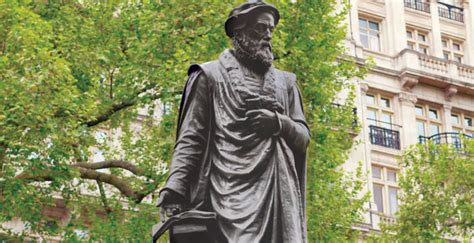
The False Friend for today’s post is the word, “man”. In order to demonstrate why I believe this is a False Friend for the modern English reader I am going to employ the work of Anthony Esolen [pictured above]. Dr. Esolen is Writer-in-Residence at Magdalen College of the Liberal Arts, translated the whole of Dante’s Divine Comedy, is about as Roman Catholic as they come, and is no KJV-Onlyist.

In his book, Angels, Barbarians and Nincompoops…and a lot of other words you thought you knew, Esolen offers ~200 pages of entries of words with their etymological and definitional content. It is a semi-scholarly work aimed at showing the reader that the words he uses are far more colorful and full of meaning than the ways we use them today. What is more, the implication is that when the reader uses these words it is better that he know the fuller meaning so as to be a better student and user of his language. One of the entries is, “Man”. Esolen writes,

No other word will do. We need a word that is not just general but universal. Out goes human being, which is singular but not a universal term. Out goes person, same reason. We need a word that is concrete, not abstract. Out goes humanity. We need a word that is singular, embracing all human beings in one, at once. Out goes men and women, human beings, people, we, all, humankind, and even mankind. We need a word that is intensely personal. We need to see all human beings as represented in one, not a collective, not a quality, not a generality, but a singular, concrete, personal, all-embracing representative. In English only man remains. There is no other word, nor any combination of words that can perform that linguistic work. To disallow the universal and genuinely inclusive use of man is to forbid the very thought that all human beings may be represented in one. [83]

Esolen has two points here to make. The first is that “man” is the only word in English which meets all the criteria mentioned above for a singular word which is also universal without being abstract and yet remaining personal. And why is this important?

Because without such a word we would not be able to express the idea of all human beings as represented in one without being abstract and impersonal. One more time, what is that important? It is important because Adam is that one man who represents all human beings while being concrete [therefore not abstract] and is personal. In this man who represents all human beings in a concrete and personal way, we all fell into sin.

In like manner, the use of “man” is important because Christ is also one man who represents all human beings while being concrete [therefore not abstract] and is personal. In this man, who represents all human beings in a concrete and personal way, atonement was made.

So linguistically and theologically “man” means far more than the male gender of homo sapiens. In fact, as far as Esolen is concerned, there is no other word in the English language that can do the linguistic work that “man” can. Put in more concrete terms, “man” is merely the generic thing, the base model. The “wo-” in “woman” denotes a modification to the base model, indeed an upgrade in so many ways. Similarly the words we have for children, like “boy” and “girl”, represent smaller versions of the base model and upgraded model. So “man” in English concretely, personally, and universally encompasses the whole of human beings in a singular word.

And so here is where the False Friend part comes in. People think they know what “man” means but in the end they do not and this truth is clearly evident in many of the modern translations. Observe first the KJV:

KJV: And God said, Let us make man in our image

Now modern versions:

NIV: Then God said, “Let us make mankind in our image
NLT: Then God said, “Let us make human beings in our image
NASB: Then God said, “Let Us make mankind in Our image,
CEV: God said, “Now we will make humans, and they will be like us
GNT: Then God said, “And now we will make human beings; they will be like us and resemble us
NET Bible: Then God said, “Let us make humankind in our image

My point is that these translators think they understand what “man” means but clearly they do not seeing that they replace “man” with impersonal, abstract, and incomplete terms like humankind as if these have equivalent meaning to “man”. What is more, they have produced Bibles, some of which are very popular, which means that many people reading these Bibles think they know what “man” means but clearly do not otherwise it seems they would protest at the replacement of “man” with “human beings”. As such, it seems that “man” is a False Friend these days among Bible translators and Bible readers. You can thank me later, Mark.

N.B. – With the replacement of “man” with “humankind”, “mankind”, and “human beings” in the Bible, the ground and foundation of a Judeao-Christian society, is it any wonder that we have drifted into terms like, “peoplekind” and “gestational parent”? Just asking. I mean, if Christians can’t get “man” right why should we wonder at “chest-feeding”? This is the part where Ward comes in to remind us all that we need to use language that people can understand like the plowboy whose gestational parent chest-fed instead of going the formula route, like, because of the supply-chain shortages.

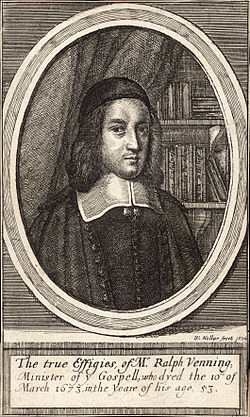
Ralph Venning (1622-1674) on Scripture as the Infallible Rule

Of Venning’s style, John Edwards (1637-1716) remarks in “The Preacher ‘”(1705, i. 203): “He turns sentences up and down, and delights in little cadences and chiming of words.”

Of special interest in this short excerpt:

  1. Scripture is “our judge.”
  2. Scripture is “this rule” from which all opinions are judged “to see whether they be of God or no.”
  3. Scripture has a “divine right upon any opinion.”
  4. Scripture is an undoubted, perfect, and infallible rule. The same Scripture will judge the world in the last day.
  5. 1 John 5:7 is quoted as authentic.
  6. Scripture is to be believed “though reason cannot find out the reason of it.”
  7. The content of Scripture is a safeguard against the autonomous reason’s rejection of God.

“Seeing there is nothing to be practiced, believed, or taught, which is not agreeable to the mind of God, Let us make the Word of God our Judge.

The Scriptures (as is granted to all that I write to) are the touchstone by which all religious Principles and Acts are to be tried. To the Law and to the Testimony, if they speak not according to this rule, ‘tis because there is no light in them, Isa. 8:20. Let nothing pass for current coin, which hat not this stamp upon it.

Certainly no Christian will refuse to make the truth of God contained in the Scriptures the judge of all he holds and practices, it being the basis of both, if they be laid on their true foundation; tis the trial which tries all; and therefore bring your opinions to the light; to see whether they be of God or no.

If the Scriptures write jus divium, divine right upon any opinion, ‘tis then authentic; but all other authority is not sufficient to command either faith or practice. The Bereans [Acts 17:11] were called more noble than they of Thessalonica, because they did not take things upon trust, and believe implicitly, but searched the Scriptures daily, whether these things were so. If any man or Angel from Heaven bring any other doctrine, let him be accursed, Gal. 1:8.

Certainly these are the undoubted, perfect, and infallible rule, for all matters of faith and practice, or God could not judge the world by them in the last day.

Let us therefore as the wise me, when they saw the star, go up to Jerusalem, that is, the Law and the testimony, and willingly acquiesce in the Answer we receive from the Oracles of God….”

If Scripture speak it, believe it, though reason cannot find out the reason of it. The Scripture saith in Job 26:7 that the earth hangeth on nothing. The Scripture saith, that one is three, and three are one, 1 John 5:7. How can reason think this true? And yet ‘tis true, and speaks nothing but truth, saith ‘tis so.”

Yea, let me add, that could God be comprehended by our reason, we might think it reason to think he were not God.

Ralph Venning, Mysteries and Revelations of the Explication and Application of several Extra-essential and borrowed  names, allusions, and metaphors in the Scripture (London: Printed for John Rothwell at the Sunne and Fountain in Pauls Church-yard, 1652), 31-32, 39

How Can You Believe in the TR/KJV Exclusively w/o Besmirching the Belief of Christians in the Past?

Chas recently wrote in asking the following question:

My question for the day – I had asked you regarding the faith of Erasmus – I used him because as I understand it he would not have had a perfectly collated TR in his hand thus it was still in need of maturing. Thus if as you have said true faith must have a perfect Bible as its object what would you say regarding his faith in what he had as well as all others before 1611? How do you describe faith in something which was not then perfect?

This is a question we have dealt with in two of our printed works, but I think it would be good to address it here as well.

Often the TR/KJV side is charged with special pleading because we claim the TR/KJV to be special, and to our opponents, we give no reason for making that claim. This objection quickly morphs into, “Well, what about the people before 1611? Did they not have the Bible? Did God all of a sudden just show up in 1611 while leaving the rest of the faithful to languish without a Bible?”

To answer this question I offer a historically viable scenario as an example which goes something like this:

1.) Before the writing of the NT all the 1st Century Church had for Scripture was the OT.

2.) Those who held to the OT as the only rule of faith and practice were moral and biblical in holding that belief mentioned in #1.

3.) Then at some point in the 1st Century Paul wrote 1 Corinthians, which is currently thought to be the earliest written book of the NT.

4.) Believers who held to the OT alone as the rule of faith and practice came in contact with 1 Corinthians.

5.) By the Spirit speaking through His words [1 Corinthians] the believing community accepted by faith the belief that the Canon is now the OT + 1 Corinthians.

6.) Furthermore, those believers came to believe that the Canon was not only the OT.

7.) Arguably there were saints that believed the OT to be the Canon but did not know about 1 Corinthians and yet did know about Ephesians.

8.) So then you could quite possibly have one group of believers that believed the whole Canon was just the OT, another group that believed the Canon was the OT + 1 Corinthians, and yet another group that believed the Canon as the OT + Ephesians.

9.) Each group is morally and spiritually justified in their belief so long as they don’t come in contact with these other books of the NT.

10.) If and when they do, the Holy Spirit will speak to His people through His words and in time all three groups of believers will believe the Canon is composed of 66 books – the 39 books of the OT and the 27 of the NT.

Now apply this not to books of the Bible but to words of the Bible. Erasmus was like the believers who held to the whole OT and some of the NT [e.g. the OT + 1 Corinthians]. I argue that the maturing of the TR’s is like the 1st Century Church coming to realize which books were from God and which were not [i.e., a more “mature Canon”] except for the Reformation Church that realization was on a word-by-word level rather than a book-by-book level.

As a result, Erasmus in Erasmus’ time and place could regard his TR with full confidence that it was indeed the very words of the total and original Canon of the NT, much in the same way the 1st Century saint believed that the OT + 1 Corinthians was the total and original Canon. But when a further refinement of Erasums’ TR was developed, Scrivener’s for example, it is not that Erasmus was morally and theologically wrong for believing what he believed at his time any more than we can fault 1st Century Christians for believing the whole Canon was the OT + 1 Corinthians.

But we can fault the 1st Century Christian after the advent and knowledge of the entire Canon for believing the whole Canon to be merely the OT + 1 Corinthians when really the whole Canon is the 39 books of the OT and the 27 books of the NT. In like manner, we can look back on Erasmus’ text and claim that it is not complete, it is has not matured. Put tersely, Erasmus’ belief was warranted and rational in his time and place, but his belief is not rational and warranted in our time and place.

This is why we construe this change [Erasmus’ belief in time and place and our belief in our time and place] as an act of sanctification of the Holy Spirit. Indeed, a sanctification of the mind in Christ. At one point 1st Century saints believed the total Canon was the OT. At another point they believed that the total Canon was the OT + 1 Corinthians. And yet at another point God’s saints come to believe that the total Canon was the OT + 27 books of the NT.

Never in the moment are the 1st Century saints castigated for their “poor Bibliology.” Only when there is a refinement, and a refinement that the Christian is aware of, do we then look back on prior iteration [e.g., OT only or OT + 1 Corinthians only] do we call that belief into question. Questioning doesn’t come in the moment. Questioning comes after a refinement and the Christian’s knowledge of that refinement.

Take for example those in the 1st Century Church who had received the baptism of John but not the baptism of the Holy Ghost [Acts 19:1-5]. Paul doesn’t blast them and tell them they are not Christians because they had not the baptism of the Holy Ghost. Now, once the Holy Ghost had come upon men at Pentecost and once these saints who had only John’s baptism had come come to know of the baptism of the Holy Ghost, then those saints would be compelled to accept the truth of the Holy Spirit’s baptism, and if they did not then they would be rejecting the teaching of Christ.

In like manner, at one point many believed Erasmus’ text to be the complete words of God in Greek equal to the original, and in the moment we don’t question their belief. Then at a different point in time the Holy Spirit led His people to believe Scrivener’s TR was the complete words of God in Greek equal to the original, at which point we can then look back on Erasmus’ text and question its maturity.

The question now is, “Are the modern versions and critical texts a refinement?” Well, first, who determines what a refinement is? We would say God the Spirit speaking through His words to His people in the pew will determine what is or is not a refinement. Has the believing community determined if there has been a refinement of the TR/KJV? If so, which text is that? Are we not told by our Critical Text overlords that all variants are relatively minor and that no major doctrine is at stake? So what refinement, given their own testimony, have they affected? At best it is negligible and that by their own admittance rather than the admittance of the believing community.

At the moment things are upside down. The academic popes are telling the believing community what they should believe. In this sense they have put themselves in the place of God, truly anti-God where the Greek preposition “ἀντί” means “instead of”. The textual critics stand in God’s stead to tell God’s people which words are God’s words. When it is the reverse that is true. The correct order of operation is God tells the believing community what is or is not God’s word and then the believing community “tells” the academic popes and they submit to that leading and with great humility carry on their work.