Around here we often make the case that we know what words are God’s words by the Spirit of God moving through the words of God in the hearts of the people of God. More colloquially we look to the average Spirit-filled Christian and not the scholar to tell us what belongs in the Bible and what does not.
For over 150 years the Critical Text/Multiple Version Only position has tried to replace the TR and KJV. They have have co-opted the colleges and universities and have incessantly badgered anyone who claims the KJV is the word of God to the exclusion of all other versions. Yet with all this artillery leveled against the KJV as well as those who hold it, the KJV remain.
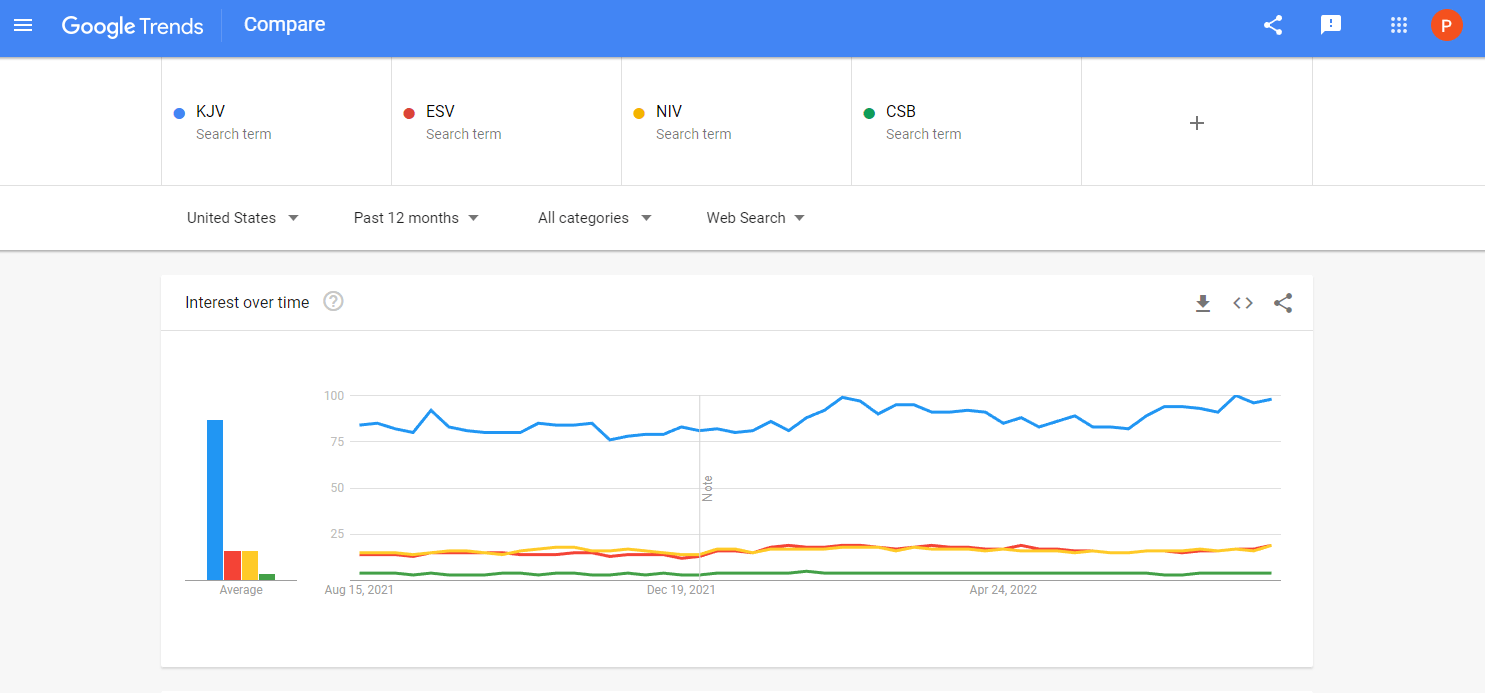
In this vein, I asked myself, “What version of the Bible are people in the USA and around the world searching for?” To give us some sense of an answer to this question I went to Google Trends and compared the following terms: KJV, ESV, NIV, and CSB. The time span for these figures stretches over the last year. Here are the results for searches in the USA,
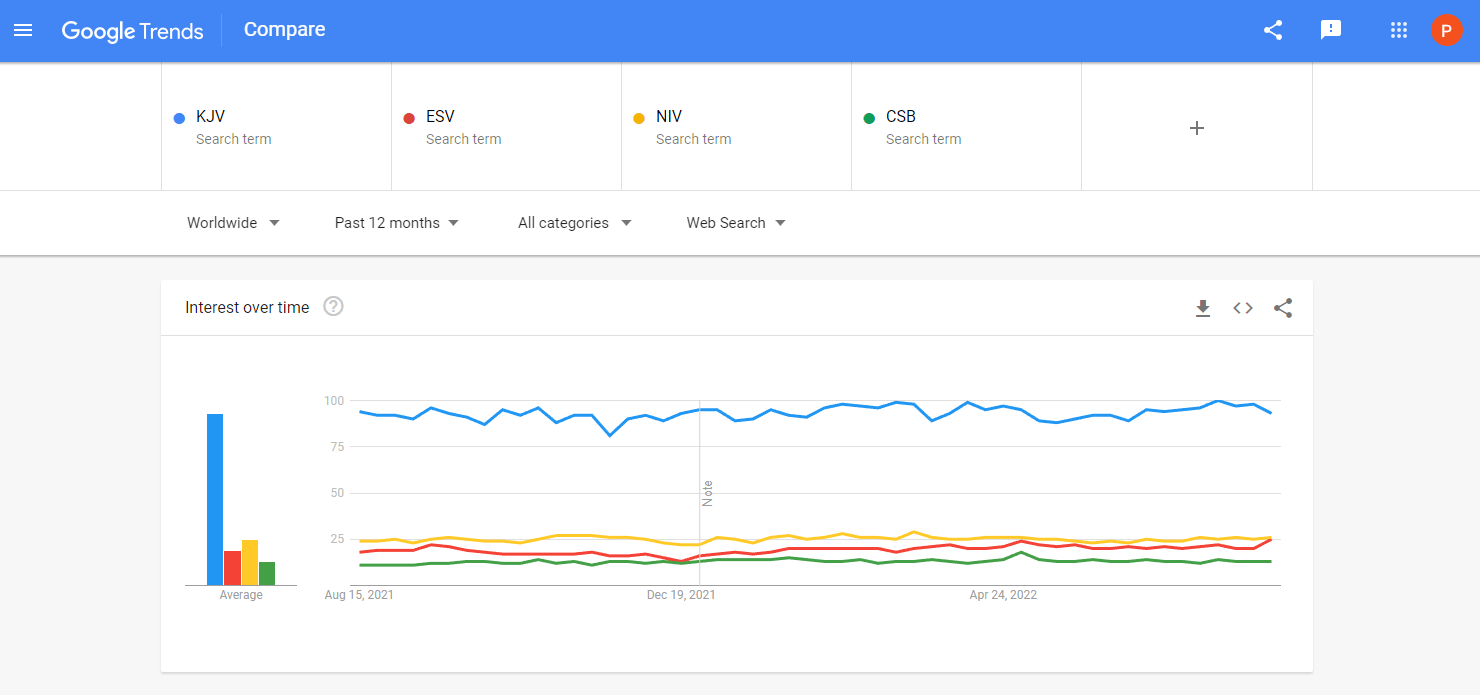
As you can see the blue line (KJV) is far and away the most popular search term among the four in Google. But what about worldwide? Perhaps things will be different there.
No, in fact searches for KJV are more popular worldwide than they are in the USA while the other search terms (ESV, NIV, and CSB) remain virtually unchanged in comparison with the KJV. How can this be given those pesky False Friends? **The Mind Boggles**
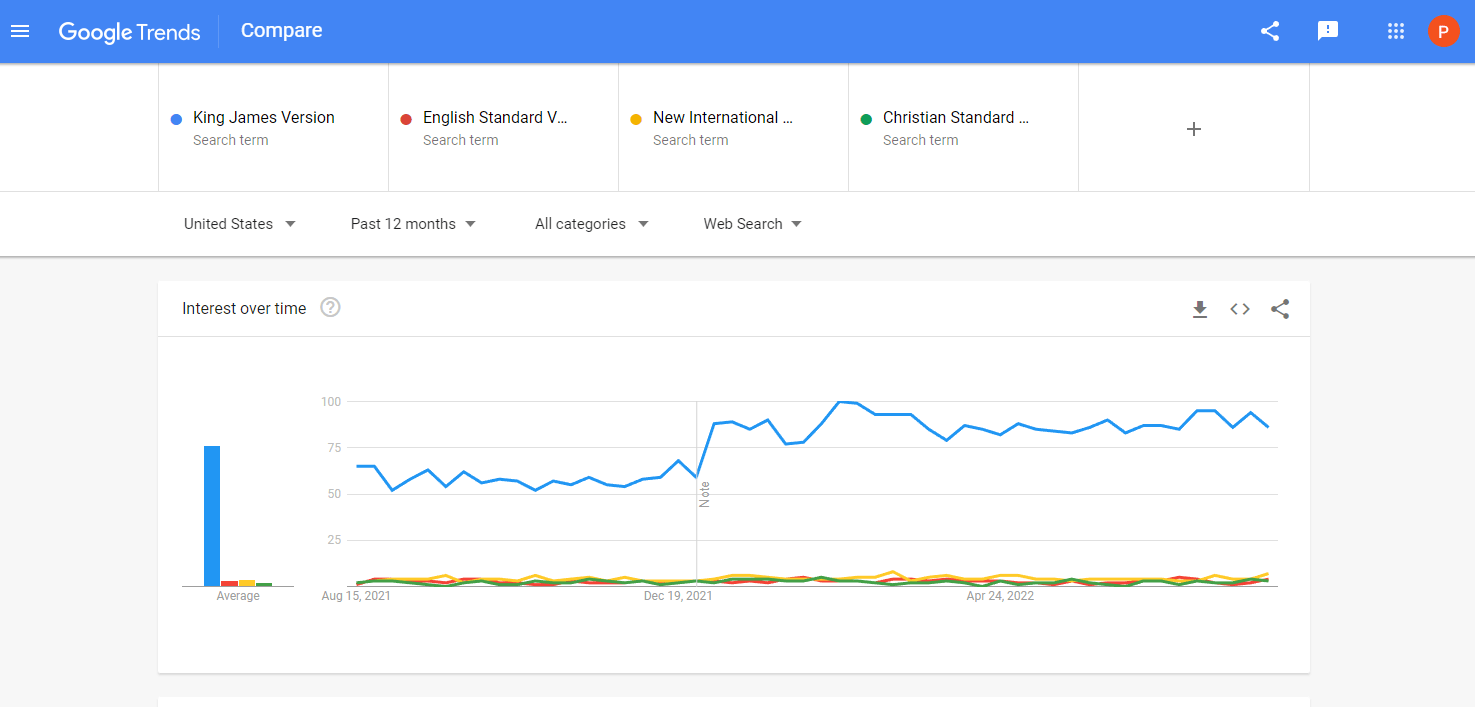
But let’s change the search term. Perhaps a more specific term will render different results. Instead of comparing the acronyms let’s compare the actual names of the respective versions i.e., King James Version, English Standard Version, New International Version, and Christian Standard Bible. Our results are as follows:
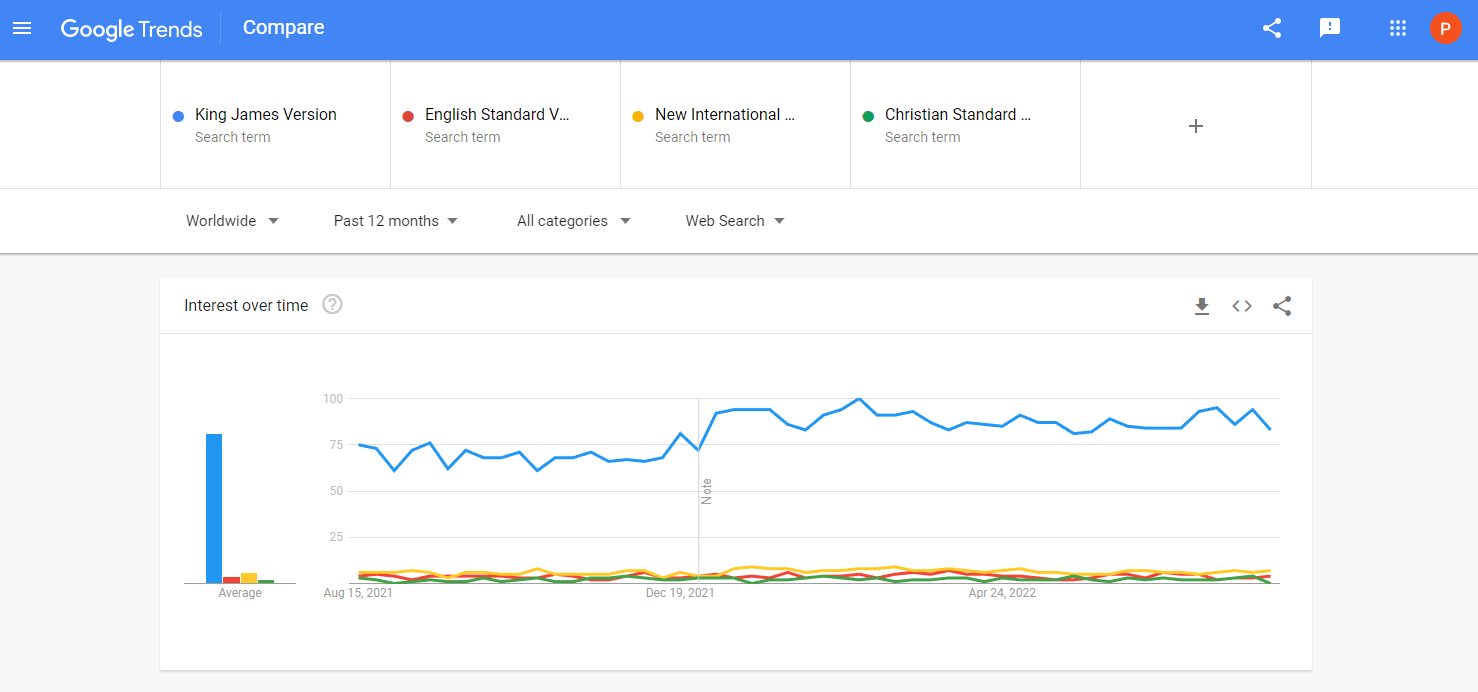
Nope, things get worse for the modern versions. Have things changed on the worldwide scene? Let’s take a look.
And…no, things have not changed. In short, when using the names of the versions the King James Version is still the most popular term while the other versions when searched for in this way hardly register on the graph by comparison.
In sum, it is quite clear given the evidence above that despite all the work of the CT/MVO academics and those like the so called Textual “Confidence” Collective, the KJV is still far and away the most searched for English version of the Bible in the USA and worldwide when compared to the ESV, NIV, and CSB according to the world’s largest search engine.
Don’t shoot the messenger. I don’t make the rules.
If you hold to Confessional Bibliology or you have listened to considerable amounts of argumentation made in favor of said position you know that questions of Canonicity overlap strongly and often with questions of which TR and which Bible. Regarding whether the KJV needs an update is no exception.
Once upon a time, all New Testament Christians had for written revelation was the 39 books of the Old Testament. This was the Canon. So much so that it was used to judge the words of the apostles as to whether they were true or false apostles.
Along came the writings of Paul which began to add to the Canon, then the work of the Gospel writers and the General Epistles. When all was said and done an additional 27 books were added to the original 39 book Canon of the OT. At the conclusion of the apostolic writings which ended somewhere in the late first century, the Christian Canon was now 66 books.
At the writings of these 27 books, the Canon was closed.
No more additions, modification, or changes. Some have tried by suggesting the Gospel of Thomas belonged in the Canon or that Apocrypha should be regarded as inspired Scripture or Marcion who rejected the whole of the OT as Canon. Still, while these suggestions and objections were raised, they were not accepted by the Church. Why?
Certainly we could look at the testimony of the Church Fathers and artifacts like the Athanasius’ Easter Letter, but the primary way the Church came to believe these 27 books and only these 27 books were to be added to the 39 books of the OT was by the Spirit of God speaking through the words of God into the hearts of God’s people who then received those canonical words, and by extension the Canonical books, by faith.
As the Westminster Confession of Faith says,
”We may be influenced by the testimony of the church to value the Bible highly and reverently, and Scripture itself shows in so many ways that it is God’s word; for example, in its spiritual subject matter, in the effectiveness of its teaching, the majesty of its style, the agreement of all its parts, its unified aim from beginning to end (to give all glory to God), the full revelation it makes of the only way of man’s salvation, its many other incomparably outstanding features, and its complete perfection. However, we are completely persuaded and assured of the infallible truth and divine authority of the Bible only by the inward working of the Holy Spirit, who testifies by and with the word in our hearts.”
WCF, 1.5. [Bold: Mine]
So now let’s ask the question, “Does the KJV need to be updated?” Well, how would we come to know if the KJV needed an update? Who has the authority to claim and then enforce an update? Certainly educated people can have their opinion just like Marcion did, but how can mere educated opinion serve as an authority and have the power to enforce that opinion?
The only “opinion” which had sufficient authority to limit the Canon to 66 books was almighty God Himself in the person of the Holy Spirit speaking through His authoritative words in the hearts of His people. As such, it stand to reason that the only “opinion” which has sufficient authority to call for an update of God’s word is almighty God Himself in the person of the Holy Spirit speaking through His authoritative words in the hearts of His people.
Ward, Wallace, and White can all have their opinions and with all the honesty they can muster declare that the KJV needs to be replaced or updated, but in the end, the only means and mechanism whereby such a thing could take place is the same means and mechanism whereby God has done it in the past. The Holy Spirit must move His people through His words to that revision.
Question, Has the Holy Spirit done that?
Those who hold to the KJV say, no. Those who do not keep making the argument “…but but but the evidence.” In other words, the KJV side says the Holy Spirit has not so pointed to a better version and then those calling for a revision are somewhere in left field majoring on the evidential minors. Taken together, it does not appear to either side that the Holy Spirit has pointed His English-speaking Church to a new or updated text of Scripture.
Objection: “But look at the plethora of versions out there. That must mean that the Holy Spirit wants us to move to a different translations.” Bah…just stop it! What if I said, “But look at the plethora of religions out there. That must mean that the Holy Spirit wants us to move to a different religion.” Many ecumenical Christians are making such a case, and they are wrong for doing it. Or how about, “But look at the plethora of denominations out there. That must mean that the Holy Spirit wants us to move to a different denomination.” Right, so all you Presbyterians need to become Southern Baptists and all you Baptists need to become Missouri Synod Lutherans. Most of our opponents would think my examples ridiculous and yet the truth or error of religions and denominations is dependent upon the Scriptures. So “plethora of religions” and “plethora of denominations” is not grounds to change but “plethora of versions” is?
In one of the greatest SNL skits of all time Rock legend Bruce Dickinson [Christopher Walken], yes, the Bruce Dickinson, meets with the members Blue Oyster Cult to record Don’t Fear the Reaper. As the recording session goes on there is something missing and Dickinson being a Rock legend was able to put his thumb on it, “I got to have more cowbell, Baby!”
At first the cowbell was too much for the band, but finally everyone was able to work out their differences. Right before the last take, Dickinson exclaims, “Babies, before we’re done here you all will be wearing gold-plated diapers.” To which Chris Kattan’s character replied, “What does that even mean?!” To which Dickinson replies, “Never question Bruce Dickinson.”
I listen to all kinds of preachers from different denominational backgrounds and educational experience. Most of them do not hold to a standard sacred text. Most of them believe that the Bible they are preaching from and the Greek NT which underlies their Bible is not the word of God down to the jot and tittle.
And yet surprisingly enough, as they begin their sermon they say something like, “Turn with me in your copy of God’s word.” or “Turn with me in your copy of God’s inspired infallible word” or before the preacher starts to read he says, “Hear the word of God.” A couple of guys I listen to end the reading of Scripture by saying something like, “The grass withers and the flower fades but the word of God endures forever.”
But to quote Kattan, “What does this even mean?” Why do able and alert ministers of the Gospel regularly talk about their Bible as a copy of God’s word without qualification or as the inspired infallible word of God when under their own rubric they know it is not? In fact, if you pin down the most able and educated [e.g., Dan Wallace and James White], they will tell you that we are not certain, beyond a shadow of a doubt, of any of the words in Scripture being the actual original words of Scripture.
Certainly these pastors by declaring “your copy of God’s word” or “your copy of the inspired infallible word of God” don’t mean the whole of the manuscript tradition, or the body of the text + the textual apparatus. So they don’t mean “all of the manuscripts” and they also don’t believe their Bible to be the word of God in every word. If this is the case then it seems these pastors are engaging in some kind of empty rhetoric or superstitious tradition, and are not saying what they believe. They begin their sermon by saying something they don’t believe and they do it every week.
Then just today I saw a guy on Facebook interacting with Mark Ward asking in effect, “If you believe the Bible is inspired and infallible where is it? Show me the physical book that you believe is the Bible so defined.” Time and time again I have seen the answer to the question to be the equivalent of “Never question Bruce Dickinson.”
The point is that unless you have a Bible that you believe is the inspired infallible word of God equal in certainty and authority as the originals, it is probably best you begin your sermon with something like, “Turn with me in your copy of what is probably mostly God’s word” and “The grass withers the flower fades and so do some of God’s words, at least as far as we know.” Yet, somehow these don’t seem to have the same ring and force.
Or you can believe and assert a standard sacred text and in so doing be able to say with confidence, true textual confidence, that every word of your Bible is God’s word. And so begin your sermon with, “Hear the word of God.”
In the video below, count the number of times those in white shirts pass the ball to each other.
After watching the video to the end, how did things turn out for you?
The above example serves as a stark reminder to us all that in order for us to know what is or is not the word of God there must be an external and objective source for knowing what is or is not the word of God. Otherwise we put too much attention on the quality of manuscripts or our subjectively concocted method. When we do that, we are doomed to miss the elephant in the room, that God’s words are right in front of our face and we can’t see them.
This is why we argue for an objective transcendent method, a method which begins with the Spirit of God using the words of God in the hearts of the people of God who accept the words of God by the God-given gift of faith. In this way the limitations of our subjective noetic and affective faculties can be mitigated and even overcome thus producing an authoritative and certain Scripture. And because we believe this to be the primary means whereby the Church comes to know what are or are not the words of God, by default, modern textual criticism is relegated to minor servant-type role.
But before we go, and in order to drive the point home, let me remind you of Dan Wallace’s position regarding what would happen if God’s words were right in front of a text-critic,
“We do not have now in any of our critical Greek texts – or in any translation – exactly what the authors of the New Testament wrote. Even if we did, we couldn’t know it. There are many many places in which the text of the New Testament is uncertain.”
Daniel Wallace, “Foreword” in Elijah Hixson & Peter Gurry. Myths & Mistakes in New Testament Textual Criticism. xii. [Italics: Mine]
The point is, no matter how many times a text-critics look at manuscript evidence, compare manuscript evidence, and come to conclusions based on that work, they are incapable of seeing the gorilla and even if they did see the gorilla, they couldn’t know it. Thanks to Dan Wallace for the clarification.
This is the third part of Christopher Yetzer’s treatment of the KJV Translator’s Preface to the Reader. You can find Part 1 here and Part 2 here. Thanks again to Christopher for allowing us to repost his work without modification. Blessings.
Because the preface is the words of just one translator, it is not always known how well it represents all the translators or the historical truth in general. Before all the complaints and accusations hail down upon just the mention of such a possibility, give me just a moment to clearly demonstrate this happening in another British religious book written by committee in the 17th century. The Italian annotations by Giovanni Diodati were translated into English and printed in 1643. 2 years later around 12 English scholars, perhaps including one KJV translator, printed their own annotations. In the preface (possibly written by John Downame) to the first printing of those annotations it was said, “We have made speciall use of the Italian Annotations of Deodat, and of the Dutch Bibles…” and “…[we] have submitted our private Dictates to the censure and correction of our Colleagues in this Service daily assembled together, for the perusall of every ones part.” Normally neither of these points would be any problem at all and are fine points of publicity. However the next time Diodati’s annotations were printed, it’s preface, talking about the scholars of the 1645 English annotations, mentions, “they, I say, all so highly approve of Diodati’s Annotations, that any one who shall please to compare those severall Notes of theirs, with the first Impression of this in English, shall finde many thousands of this our Authours inserted, but especially in Ezekiel, Daniel, and all the minor Prophets, where there is hardly any one Note of Diodati’s forborn, but in theirs printed verbatim by our Translation:” Plagiarism! It was such a grave accusation that the English annotators had to respond and they did, “The Annotations of the foresaid Divines were finished, and given up to the Stationers the year before the first Edition of Diodati’s Annotations, translated into English, were published: so as they could have no help from that English Translation. As for the Italian, in which language, Diodati’s Annotatations were first composed, many of the foresaid Divines understood not that tongue: nor had any translation thereof for their help… one of the Annotators to whose share, Ezekiel, Daniel, and the smaller Prophets fell, hath manifested himself to be Plagiarius; shall his crime be imputed to all the rest…”
In summary:
1643 Diodati’s annotations printed
1645 English annotations printed. The preface claims that they made “special use” of Diodati.
1648 preface to 2nd edition of Diodati’s annotations claims that the 1645 annotations plagiarized Diodati’s work.
1651 preface to the 2nd edition of the English annotations claims that most of them didn’t know Italian or have a translation available.
An analysis of the 1645 English annotations demonstrates that 2 sections of the work contain heavy plagiarism from the English translation of Diodati’s notes. 3 other sections contain many of Diodati’s annotations but most likely from his Italian Bible and not from the English translation. The rest contain small traces of acceptable use of Diodati as a source. Which preface lied, the 1645, the 1651 or both? The point here is only to demonstrate that in the 17th century the preface was a commercial product of publicity and secondarily that the authors of them often had agendas and at points were errant or dishonest. The English Annotations were not the only ones either. [see this authors unpublished work on Diodati’s annotations.]
Possibly one misleading example from Smith’s preface in KJV can be found in the phrase “for we have seen none of theirs of the whole Bible as yet.” Smith claims that the KJV translators had not yet seen a whole English Bible translation by the Catholics. The Rheims New Testament was printed in 1582 and clearly available and used by the translators (see John Bois’ notes during translation). The Old Testament was printed at Douai, France in two volumes in 1609 and 1610. According to the 1609 preface, these were made to complete the work of the 1582 Rheims New Testament and create a whole Catholic translation of the Scriptures. The approbation for both volumes is dated November 8, 1609. The first volume surely would have been available at least to the general committee which met in London. Bois’ letters to Casaubon near the end of 1610 demonstrate that most likely the second volume would have been available as well.[Labourers in the Vineyard of the Lord – Revising the King James Apocrypha by Nicholas Hardy] There also appears to be evidence within the text of the KJV that shows use of both volumes.[For some examples from the first volume see Genesis 48:22 “took”, 50:15, “requite”, 50:26 “coffin” etc.] Rather than go through lists of examples from the first volume, we will concentrate only on the second edition since it was the later of the two to be printed.[There is some probability that both the KJV and the Douai translators came to the same readings simultaneously, or that the Douai translators actually copied from the KJV, “But as we heare in a new Edition (which we have not yet sene) they translate it almost as in the first.” – Preface to the 1610 Douai. ]
Psalms 145:21
AV1611 – My mouth shall speake the praise of the Lord: and let all flesh blesse his holy Name for euer and euer.
Bishops(printed 1602) – My mouth shall speake the praise of the Lord: and let all fleshgive thankes unto his holy name for ever and ever.
Geneva(printed 1606) – My mouth shall speake the prayse of the Lorde, and all flesh shallblesse his holy Name for ever and ever.
Douai – My mouth shal speake the prayse of our Lord: and let al flesh blesse his holie name for ever, and fore ever and ever.
Coverdale, Great and Matthew’s all have “let all flesh give thanks”.
Psalms 147:11
AV1611 – The Lord taketh pleasure in them that feare him: in those that hope in his mercie.
Bishops(printed 1602) – But the Lordes delight is in them that feare him: and put their trust in his mercie.
Geneva(printed 1606) – But the Lord delighteth in them that feare him, and attend upon his mercie.
Douai – Our Lord is wel pleased toward them that feare him: and in them, that hope upon his mercie.
Coverdale, Great and Matthew’s all have “delight” for the first word and “trust” for the second.
Proverbs 20:12
AV1611 – The hearing eare, and the seeing eye, the Lord hath made euen both of them.
Bishops(printed 1602) – The eare to heare, the eye to see, the Lord hath made them both.
Geneva(printed 1606) – The Lord hath made both these: even the eare to heare. and the eye to see.
Douai – The eare hearing, and the eie seing, our Lord made both.
Coverdale and Matthew’s both have “hearing/sight”, while the Great Bible reads like the Bishops’ and Geneva.
Proverbs 26:4
AV1611 – Answere not a foole according to his folly, lest thou also be like vnto him.
Bishops(printed 1602) – Give not the foole an answer after his foolishnesse, lest thou become like unto him.
Geneva(printed 1606) – Answere not a foole according to his foolishness, lest thou also be like him.
Douai – Answer not a foole according to his follie, lest thou be made like to him.
The other English Bibles have “foolishness”. [There is a book titled A Commentarie Vpon the Booke of the Prouerbes of Salomon published in 1596 that has this reading]
1 Maccabees 1:17
1611AV – Wherefore he entred into Egypt with a great multitude, with chariots, and elephants, and horsemen, and a great nauie,
Bishops(printed 1602) – Upon this entred hee into Egypt with a strong hoste, with charets, elephants, horsemen, and a great number of ships,
Geneva(printed 1606) – Therefore hee entred into Egypt with a mightie companie, with Charets, and Elephants, and with horsemen, and with a great navie,
Douai – And he entered into Egypt with great multitude, with chariots and elephants, and horsemen, and a copious multitude of shippes:
1 Maccabees 12:10
AV1611- for there is a long time passed since you sent vnto vs.
Bishops(printed 1602) – For it is long since the the time that ye sent word unto us.
Geneva(printed 1606) – for it is long since the time that ye sent unto us.
Douai – for much time is passed, since you sent to us.
Like Downame’s (or whoever the author of the 1645 English Annotations preface might have been) denial of using Diodati’s annotations, Smith denied seeing all the volumes of the Douay-Rheims Bible. The text of the English Annotations proves Downame wrong as the text of the KJV appears to prove Smith wrong. The problem is that often students and scholars have taken Smith at his word without understanding the context of the 17th century preface. In the last section of this study I made reference to Smith replying primarily to the 1582 Rheims preface. That is true, but it also seems that he may have made use of the 1609 preface which itself often repeats the information found in the Rheims preface.
Smith’s 1611 KJV preface: on the other side we have shunned the obscurity of the Papists, in their Azimes, Tunike, Rational, Holocausts, Præpuce, Pasche, and a number of such like,
1609 Douay preface: And why then may we not say Prepuce, Phase or Pasch, Azimes, Breades of Proposition, Holocaust, and the like? Rather then as Protestants translate them: Foreskinne, Passeover, The feast of swete breades, Shew breades, Burnt offerings: &c.
1582 Rheims preface: The Pasche. The feaste of Azymes. The bread of Proposition. Which they translate The Passeover, The feast of swete bread, The shew bread.
Besides the words which match the 1609 preface better, another reason this may more clearly represent the 1609 text is that the 1582 Rheims used breast-plate in Ephesians 6:14 and 1 Thessalonians 5:8 instead of rational which was only used in the Douai Old Testament. Also the New Testament never used tunic as the Old Testament did. These points seem to eliminate the possiblity that Smith might have written the preface much earlier than is normally thought or that he was simply unaware of what other resource the other translators might have been using.
At times Smith seems to represent well the group and at other times he might have embellished a bit to accomplish his task. In order for one to claim “the translators believed” in reference to words in the preface, there should be some effort made in analyzing if the words might reasonably have been believed by all the translators or if there is any external evidence to support the claim. Some of Smith’s statements are upheld by separate witnesses and others seem to be refuted by them. Here are two very clear statements which are backed up by other witnesses and at times other translators and an analysis of the text.
Miles Smith in the KJV preface: Another thing we think good to admonish thee of, gentle reader, that we have not tied ourselves to an uniformity of phrasing, or to an identity of words, as some peradventure would wish that we had done,
Possible first Oxford Company translator Daniel Featley in Transubstantiation Exploded 1638: The same word in divers places of Scripture may be diversly taken, according to the diversity of the matter and circumstances of the Text.
Textual analysis: “dabhar (word or thing) is translated by eighty-four English words, panim (face) by thirty-four, sim (to set or place) by fifty-nine, shubh (to turn back) by sixty, nasah (to lift up) by forty-six, abhar (to passover) by forty-eight, and rabh (much) by forty-four.” [A Monarch’s Majestic Translation: The King James Bible by Donald Brake]
Example number two where agreement can be found is in regards to the works the translators consulted.
Miles Smith in the KJV preface: Neither did we think much to consult the translators or commentators, Chaldee, Hebrew, Syrian, Greek, or Latin, no, nor the Spanish, French, Italian, or Dutch;
Second Oxford Company translator George Abbot in The Reasons Which Doctor Hill Hath Brought for the Upholidng of Papistry 1604: There is not in the world, any fit meanes to come to the right sence of Scripture, which our men doe not frequent. They seeke into the Original tonges, wherin the booke of God was written. They conferre translations of all sortes: they lay one text with another, & expound the harder by that which is lesse difficult: they compare circumstances of Angecedents and Consquents: they looke to the Analogy of faith prescribed in the Creede of the Apostles, They search what the first Councels did establish: they seeke what was the opinions of the Fathers concerning textes in question, and refuse not therein to cope with you about the highest points…
This same fact is also demonstrated by the notes taken by Second Cambridge Company translator John Bois. He cites the Rheims New Testament at Colossians 2:18, Latin at Romans 9:6 and 1 Corinthians 9:5, “old Interpreters” at 1 Corinthians 11:10, Septuagint at 2 Timothy 2:19, Italian at Revelation 7:15, “major number of translators” at Hebrews 10:12 and “others” is mentioned throughout. John Selden who was a friend of several translators also said, “The Translators in King James’s time took an excellent way. That Part of the Bible was given to him who was most excellent in such a Tongue, (as the Apocrypha to Andrew Downs); and then they met together, and one read the Translation, the rest holding in their Hands some Bible, either of the learned Tongues, or French, Spanish, Italian, etc. if they found any Fault, they spoke, if not he read on.”
Analyzing the text itself is difficult because of the number of possible sources consulted and the fact that those sources commonly agree with one another. Here are some possible examples: Genesis 23:6 most translations have something like “Prince of God”, but the KJV translates it as “mighty prince” similar to the 1588 French Bible which read “Prince excellent”; Genesis 37:36 most of the previous English translations have “chief steward” or something similar, but the KJV has “captain of the guard” similar to the 1569 Spanish which read “capitan de los de la guarda”; Hebrews 11:28 most English translations had “effusion” but the KJV uses “sprinkling” similar to Diodati’s 1607 Italian Bible which read “spruzzamento”; Matthew 9:4 most English translations had “seeing” but the KJV uses “knowing” possibly following the quote by Chrysostom; 2 Corinthians 2:10 most English translations had “in the sight” but the KJV uses “in the person” like the 1582 Rheims; 1 Corinthians 7:35 most English Bibles had “separation”, but the KJV uses “distraction” like Beza’s Latin translation which read “distratione”.
Other instances of agreement could be noted: John Bois’ quotes from a paragraph of the preface in An Exposition of the Festivall Epistles and Gospels and the opinion that Christ and the Apostles quoted from the Septuagint is cited in several different translators’ works. So while some of the preface is substantiated by other sources, it is not true that every word of the preface accurately and universally represented the opinions of all the translators, even though Smith’s intention was certainly to do so as much as his agenda would permit. KJV researcher Timothy Berg, in talking about the section titled A satisfaction to our brethren, has noted that Smith’s, “rebuttal of Puritan objections to the project for example could hardly be said to reflect the thinking of, say, John Rainolds.”
Clearly not all the translators could have ratified the final draft of the preface given that a few of them had died before Smith’s quill was dipped into the inkwell for the first stroke (Richard Eedes 1604, Edward Lievely 1605, Ralph Hutchinson 1606, William Dakins 1607, John Rainolds 1607, Thomas Ravis 1609, John Harding 1610, John Aglionby 1610, Richard Bancroft 1610). Besides this, there seems to be some evidence that at least a few of the translators might have disagreed with some of the wording in the preface.
Miles Smith in the KJV preface: we have at the length, through the good hand of the Lord upon us, brought the work to that pass that you see.
The youngest KJV translator[if he was one] at the time of publication (29 years old), Daniel Featley, in The Dippers Dipt: a worship of God devised by man may be taken in a double sense, either for a whorship wholly devised by man, without any precept or president in Scripture; and such a worship is not agreeable unto God, but condemned in his Word, under the name of will-worship: or for a worship in substance prescribed by God, but in some circumstance, manner, or help thereunto devised or composed by man; and such may be and is acceptable unto God: as for example, reading Scripture is a religious act prescribed by God, yet the translation of the Originall into the Mother-tongue, divisions of the text into Chapters and Verses, diverse readings, interlineary glosses, together with the Contents, and fitting them to the times and seasons, are from man.
Miles Smith seemed to have believed that God had an active part in the work, while Featley talks of a very human, yet pleasing to God, process. Likewise the example below possibly shows a slight difference in the words the translators might have used to describe the Geneva Bible.
Miles Smith in the KJV preface: Truly, good Christian reader, we never thought from the beginning that we should need to make a new translation, nor yet to make of a bad one a good one…but to make a good one better, or out of many good ones, one principal good one, not justly to be excepted against; that hath been our endeavour, that our mark…. And to the same effect say we, that we are so far off from condemning any of [the brethren’s] labours that travailed before us in this kind, either in this land or beyond sea,
Daniel Featley in The Dippers Dipt: Featley: “none ought to take upon them the Office of a Pastour, or Minister of the Word, who are not able to reprove and convince Hereticks, and all gain-sayers: but your lay and unlettered men are not able to convince Hereticks, and stop the mouthes of gain-sayers, because they can alledge no Scripture but that which is translated into their mother-tongue, in which there may be and are some errours: for, though the Scriptures be the infallible Word of God, yet the Translators were men subject to errour, and they sometimes mistooke.” Scotch-man: “Will you say that those learned men who translated the Bible at Geneva committed any errour in their Translation?” Featley: “I will…I could produce many other errours in that translation, which are corrected in the Kings translation.”
Leader of the Second Westminster Company William Barlow speaking of the opinions concerning the Geneva and Bishops Bibles by First Oxford Company translator John Rainolds and King James himself at Hampton Court: [Reinolds] moved his Maiestie, that there might be a new Translation of the Bible…After that, he moved his Maiestie, that there might be a new Translation of the Bible, because those which were allowed in the reignes of king Henry the eight, and Edward the sixt, were corrupt and not answerable to the trueth of the Originall… (professing that hee coulde never, yet, see a Bible well translated in English, but the worst of all his Maiestie thought the Geneva to bee)[The Summe and Substance of the Conference, which, it pleased his Excellent Maiestie to have with the Lords bishops, and other of his Cleargie, (at which the most of the Lordes of hte Councell were present) in his Maiesties Privie-Chamber, at Hampton Court. 1605]
Again William Barlow in One of the foure Sermons preached before the Kings Majestie1606 spoke about a passage , “which the Geneva hath not well translated”.
John Bois in An Exposition of the Dominical Epistles 1610 laments the Latin translation of Erasmus and Beza at Matthew 24:34 and goes on to attack the footnote of the Geneva translation, “and the translators of Geneva following them in our lesser English Bible, This age shall not passe: but as well the translation as the observation is defective…”
At least 3 translators and King James were critical of the Geneva Bible in some places in their published works. Possibly their actual feelings about the Geneva would be slightly different than the charitable speech of the preface. KJV researcher Timothy Berg has summarized, “I think it is wise to speak of the preface as having a “sole author” (Miles Smith) who was commanded to write “in the name of all the translators” (to quote from the editor of his 1632 collection of sermons). This can help us most fruitfully dialogue without the – to my mind unwarranted – claims that “all the translators” either agreed perfectly with Smith at every point, or disagreed in unison with him at any point.”
So episode five of the Textual Confidence Collective [TCC] dropped today. My first reaction was to exclaim, “Someone call an ambulance! They are special pleading all over the place!” But I will try to avoid that route in this post. The perennial critiques of modern textual criticism remain firmly intact and completely unaddressed by the TCC. Those critiques are:
1.) What authority do textual critics have to determine what is or is not God’s word? There appears to be none and the TCC offers none. 2.) By what standard are a textual critic’s observations considered trustworthy? The TCC simply asserted that they are but offer no rationale as to why other than their love for the work and the need for scholarship. 3.) What is the Church’s role in the modern text critical process? Again, as far as I can tell, the Church is merely and simply a recipient of the knowledge of text critics unless of course someone in the Church were to become a text critic himself. So much for the plowboy. Ward’s silence on the point was deafening. 4.) When will their work be done? “Never” seems to be the answer. If the future is anything like the past the TCC would have us doubt something of the Bible until Jesus comes. 5.) What exegetical grounding does the TCC have for treating the Bible the way they do? Certainly they have Scripture on how to treat people, or the environment, or governments, or the Church, or their money, or their sin, but they seem to have exactly zero exegetical grounding for how they treat the Bible.
These things aside, let’s get into some of the things they did say.
1.) I am convinced that the TCC is simply a moderate form of Textual Skepticism. Remember how the TCC lumps all kinds of folks into the Textual Absolutist position and then go on to declare two groups as extreme and three groups as moderate and all on a sliding scale from extreme to more moderate. The same it true here for the TCC. They ardently resist the label of “absolutist” while simultaneously insisting on a measure of doubt in believing in the Bible. So, while the TCC is not as extreme as a Bart Ehrman who doubts all of Scripture; the TCC does in fact hold to and preach an unavoidable and necessary bit of doubt regarding portions of the Scriptures. In other words, the TCC is a moderate position under the greater umbrella of Textual Skepticism.
2.) In this episode, the doubt exhibited by the TCC is far more than I originally thought. In this post I observed the following regarding the TCC. They
1.) Doubt that the TR is the word of God down to the very words and letters. 2.) Doubt that “jot and tittle” means jot and tittle in Matthew 5:18. 3.) Stories of their own personal doubt [a doubt so strong 3 of the 4 rejected the doctrine of Preservation at some point in their professional journey]. 4.) Doubt that anyone’s English Bible is absolutely God’s word. 5.) Doubt that the Bible even teaches Providential Preservation. 6.) Doubt that Psalm 12:6-7 speaks of preserving God’s words. 7.) Doubt that we will ever have every word of God between two covers. 8.) They attempt to cast doubt on Confessional Bibliology. 9.) Doubt that we can understand Early Modern English.
But episode five added more to this list, which are,
10.) There is doubt concerning how many New Testament witnesses we really have. [Starting at 11:48] 11.) There is doubt regarding the checking-test-passages method of assessing manuscripts. [45:35] 12.) There is doubt regarding what manuscripts are trustworthy. [49:39] 13.) Depending on the scholar, there is doubt about the goal of textual criticism. [50:10] 14.) There is doubt regarding what counts as a viable variant. [01:05:00] 15.) There is doubt regarding what counts as a meaningful variant. [01:05:00] 16.) There is doubt regarding the intention of the scribe. [01:06:55]
Two points, first there seems to be a whole lot of admitted doubt on issues central to the TCC program. It seems quite unnatural and even unlikely then that the TCC really understandings the difference between confidence and skepticism if this is how they go about instilling confidence. Perhaps confidence is another False Friend. Second, it seems that doubt is part and parcel of the whole whole TCC enterprise. In other words, it appears that confidence in the Biblical text cannot be had unless a necessary measure of doubt be part of that confidence.
I really don’t want to go back to this but it keeps coming up. The trauma of the TCC led them to doubt their Bible [i.e., the KJV] and now instead of overcoming that doubt they are simply asking others to come join them in doubting their current Bible at least a little bit, but this time it’s ok. So they traded doubt in their Bible for doubt in their Bible. Brilliant strategy!
3.) Then there is the question of the reliability of the text critical process itself which should cause us all to doubt it. Hixon says at [11:48] that sometimes we are not sure if Papyri manuscripts are from the Bible or from someone commenting on the Bible. Hixon goes on to say of the Minuscules, that of manuscripts of the NT these account for the largest portion [19:00]. But Hixon goes on to say that there are so many Byzantine manuscripts that most are left unstudied [45:55]. Hixon then says at [24:00] that lectionaries which also account for a large number of the manuscripts tradition are the least studied [23:10]. So what manuscripts are left? Majuscules the most prominent of which are Sinaiticus and Vaticanus. The point, and the TCC helps us make this point, is that the modern textual criticism has focused the greater majority of its work on a handful of papyri scraps and a few hundred Majuscules two of which are ***surprise surprise*** considered to be the oldest and best. And why study the Byz manuscripts when Westcott and Hort regarded them as the most unreliable while the Sinaiticus and Vaticanus were considered the Neutral Text? Very objective. Very scientific. Very trustworthy.
4.) Then there is the inherent doubt that we have in men as a general rule. The TCC overlooks this and to their own hurt. At [58:00] of episode three Peter said, “The people on in the congregation should trust what I say unless I give them reason other wise.” At [49:39] of episode five Hixon sets himself or those like him to be the judge of what is a “trustworthy” manuscript. Then at [01:04:14] Ward quotes Dan Wallace and Hixon disagrees with Wallace and Ward by implication on what counts as a viable and meaningful variant. Then at the [01:10:20] mark Peter tells us “the scribes had all sorts of influences on them and they made all sorts of mistakes and fundamentally the scribes didn’t change it very much and most of the changes that they made [at least the ones Peter and his friends know about] we can reverse because we know how scribes from over a thousand years ago tend to operate.” In short, scribes made mistakes, we know they made mistakes, even God knows they made mistakes, but that’s ok so get over it.
I can just feel my confidence in God and His word surging through my veins. Thanks TCC!
In sum, the TCC is rife with doubt and doubtful methods and that by their own testimony. Their claims to confidence seem quite disingenuous. They conveniently lump Confessional Bibliology into Textual Absolutism but totally miss their own ingrained skepticism which puts them more in the camp of Bart Ehrman than they realize.
In episode three of the Textual Confidence Collective Mark Ward makes the following observation, “If the Spirit is going to guide us into all truth, I’m expecting that people in the history of the Church would, you know, largely be getting things like this right and I could not find anybody who used Psalm 12:7 and especially the second half of that ‘thou shalt preserve them form this generation forever’ I couldn’t find anybody in the history of the Church until King James Onlyism. I could be wrong though. I’m trying to find as many references as I can” [08:30].
And wrong he is. Dr. Van Kleeck Sr. has dealt with this extensively in his book, An Exegetical Grounding for a Standard Sacred Text. He has also dealt with it several times on this blog, here and here for example, but thanks to Dr. Riddle, the instruction continues.
In response to Wards claim that Psalm 12:7 wasn’t used regarding preservation until KJVO, Dr. Riddle has devoted Word Magazine #245 to helping Ward with some of his research. I mean, what are friends for? You can listen to Riddle’s response below. Blessings.
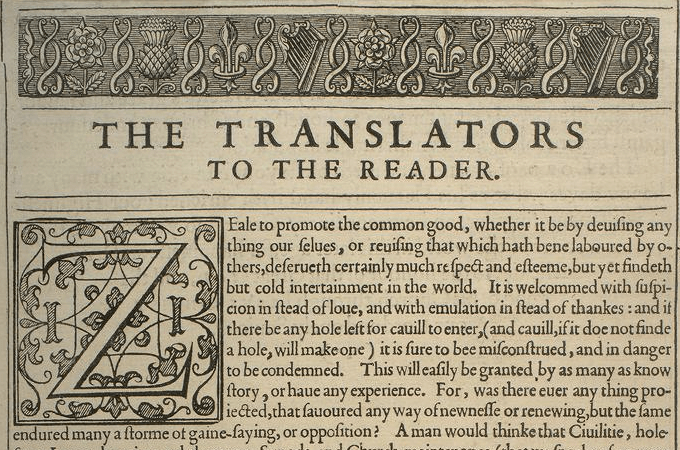
The following is Part 2 of Christopher Yetzer’s treatment of certain terms found in the KJV Translator’s Preface to the Reader and the specifically the role of translations in the Church. If you are looking for Part 1 you can found it here.
Yetzer here observes that the KJV translator had several audiences they were trying to reach and recognize, so I think it fair to conclude that the KJV was in this sense eclectic in its presentation and ecumenical in its publication.
Part of the reason for the Translators’ Preface was to address certain nay-sayers, both Protestant and Catholic. Here Yetzer points out that it is rationally permissible to maintain that certain terms in the Preface were aimed at Roman Catholic critiques regarding translation and as such the term “very vulgar” used by the KJV Translators was an appeal to the non-scholar rather than the under-educated or non-literate.
Again, I appreciate Yetzer’s work on this point and again thank him for allowing me to repost his work without modification here on StandardSacredText.com. Blessings.
Historically the KJV preface was the work of one translator, Miles Smith. To understand it best, one must understand the context in which it was written. That context was first and foremost a commercial product of the early 17th century. As such Smith had several important audiences and for each one different objectives to accomplish. He had to prepare the general public for the acceptance of a new translation without maligning the ones they believed to have been accurate representations of the words of God and were defended as such[A Defence of the Sincere and True Translations of the Holy Scriptures into the English Tongue, 1583]. He also had to prepare them for the criticisms which Smith knew would come as well as inform them on some particulars of the book. The most consuming portion of the preface was a defense against the Anglicans’ primary rivals whom Smith calls “Adversaries”, “Papists”, “Romanists” and not without objection “Catholics”. Smith also had to create unity among the theologians of differing positions in England whom he refers to as “brethren” and “Puritans” and twice describes them as “scrupulous”. Apart from those audiences which he was actively working to refute or convince, he also had a few which he was simply trying to honor. Possibly the most important of these was King James who had his own dedication printed separately from the general preface, but also had a place in the preface where Smith called him “Majesty”, “King” and “Sovereign”. Lastly he had to represent the other translators. The word “we” appears 143 times in the preface although a fair amount of them are simply inclusive with the general Christian reader.[Throughout this article the preface I am using for the text is found on wikisource as well as images of a 1611 KJV preface found on archive]
As mentioned, the largest portion of the preface is Smith’s attempt at responding to the papists’ arguments, and primarily the ones made by Gregory Martin in the preface to the 1582 Rheims New Testament[unpublished article by Timothy Berg] but also in a lesser manner to the material in his book against the English Translations published the same year as the New Testament. KJV translator Francis Dillingham said, “Master Martins discouery of our translations argueth either blinde ignorance or extreame malice”[A Disswasiue from Poperie, 1599] and translator William Barlow, “Indeede Gregory Martin hath, in his Pharisaicall discoverie, compassed sea and land, traversed much grounde mounted himselfe upon every molehill, ransackt all corners, to descry our translatours ignorance and malice, and when all is doone, it is but the suruay of drunken zebull, Jud. 9. A shadow of mountains, for a band of souldiers.”[A Defence of the Articles of the Protestants Religion, 1601]
In the preface to the Rheims New Testament, Martin had included a lengthy text defending the suppression of Bible reading by the general public. He introduces their excuses by saying, “due preservation of this divine worke from abuse and prophanation, and for the better bridling of the intolerable insolencie of proude, curious, & contentious wittes, the governours of the Church guided by Gods Spirit, as ever before, so also upon more experience of the maladie of this time then before, have taken more exacte order both for the readers and translatours in these later ages, then of old…” He makes it clear that “we must not imagin that in the primitive Church… the translated Bibles into the vulgar tonges, were in the hands of every husbandman, artificer, prentice, boies, girls, mistresse, maide, man: that they were sung, plaied, alleaged, of every tinker, taverner, rimer, minstrel: that they were for table talke, for alebenches, for boates and barges, and for every porphane person and companie.” Further on, after explaining that the Scriptures were maintained by the institutions of the church, he then adds, “The poore ploughman, could then in laboring the ground, sing the hymnes and psalms either in knowen or unknowen languages, as they heard them in the holy Church, though they could neither reade nor know the sense, meaning, and mysteries of the same.” and “the word of God can not be preached nor certaine mysteries uttored to all men alike, but are to be delivered according to the capacitie of the hearers: as he proveth both by S. Paules example, who gave not to every sort strong meate but milke to many, as being not spiritual, but carnal and not capable: and by our lords also, who spake to some plainely, and to others in parables, & affirmed that he had many things to utter which the hearers were not able to beare. How much more may we gather, that all things that be written, are not for the capacitie and diet of every of the simple readers, but that very many mysteries of holy writte, be very far above their reach, & may and ought to be (by as great reason) delivered them in measure & meane most meete for them?”[All quotes from Martin’s preface are from one of two sources Rhemes and Doway, 1855 or scans available on gallica]
Miles Smith handled the above claims mostly in paragraphs 5 titled Translation necessarie, 8 The translating of the Scripture into the vulgar tongues and 9 The unwillingnes of our chiefe Adversaries, that the Scriptures should be divulged in the mother tongue, &c. of the KJV preface. However the phrase under consideration is found at the end of paragraph 16 Reasons inducing us not to stand curiously upon an identitie of phrasing. Here Smith returned to his adversaries once more and assailed them because they “of purpose darken the sense” by using terms such as Holocaust or Pasche. [One might wonder if he would not say the same thing about modern translators and their use of Sheol.] Then Smith adds the subsequent point, “But we desire that the Scripture may speak like itself, as in the language of Canaan, that it may be understood even of the very vulgar.” By including this at the end of paragraph 16 directly after his point concerning the clarity of terms, was not Smith referencing the vocabulary used more than the overall intelligibility of the Scriptures? Was he responding more clearly to this portion from the Rheims preface, “most shamefully in all their versions Latin, English, and other tonges, corrupting both the letter and sense by false translation, adding, detracting, altering, transposing, pointing, and all other guileful meanes…To say nothing of their intolerable liberty and licence to change the accustomed callings of God, Angel, men, places, & things used by the Apostles and all antiquitie, in Greeke, Latin , and all other langauges of Christian Nations, into new names, sometimes falsely, and always ridiculously and for ostentation taken of the Hebrues: to frame and fine the phrases of holy Scriptures after the forme of prophane writers, sticking not, for the same to supply, adde, alter or dimish as freely as if they translated Livie, Virgil, or Terence. Having no religious respect to keepe either the maiestie or sincere simplicity of that venerable style of Christes spirit, as S. Augustine speaketh, which kind the holy Ghost did choose of infinite wisedom to have the divine mysteries rather uttered in, then any other more delicate, much lesse in that meretricious maner of writing that sundrie of these new translators doe use… that we have used no partialitie for the disadvantage of our adversaries, nor no more licence then is suffereable in translating of holy Scriptures: continually keeping our selves as neere as is possible, to our text & to the very words and phrases which by long use are made venerable, though to some prophane or delicate eares they may seeme more hard or barbarous, as the whole style of Scripture doth lightly to such at the beginning.”?
By using burnt offering in place of the Rheims holocaust, passover in place of pasche, robe in place of tunic, unleavened bread in place of azymes, breastplate in place of rational, and uncircumsized in place of prepuces, the language of the KJV was more on the level of the common man, but that does not necessarily mean that the phrasing or sense was entirely intelligible or that that was their goal. The Puritan William Sclater just 8 years later would argue that the translators didn’t go far enough and words in the KJV were still unintelligible to the people, “But how apparent is it, even where the meanes of knowledge have beene most plentifull, wee are many, such as need to be instructed; shall I say in the rudiments of Christian faith? yea, surely in the very language of Scripture. Insomuch that to this day, the termes of Redemption, Vocation, Justification, are strange to our people; and wee seeme Barbarians, when we mention these things in their eares.”[An Exposition with Notes upon the Frist Epistle to the Thessalonians.] All three words he used as examples were found in the text of the KJV.
One might still argue that word choices and grammar leads to intelligibility, which is not always incorrect, but sometimes the one does not bear fruit by means of the other. Here are two examples from the text of the KJV which demonstrate this:
At Deuteronomy 32:14, the Bishops’ Bible had “the fat of the most plenteous wheate”, the Geneva, “the fat of the graines of wheat”. Here the KJV changed what was the Bishops’ reading closer to something similar to the Geneva but literal to the Hebrew, “the fat of the kidneys of wheat”. While every one of the words chosen by the KJV translators was most likely clear and understandable to the very vulgar, the combination of them was certainly less clear than was the Bishops’ or the Geneva.
At 1 Samuel 24:3 both the Bishops’ Bible and Geneva had “to do his easement”. “Easement”, like “plenteous”, is a more complex word. The KJV translators changed this to, “to cover his feet”. Again, while the individual pieces are simpler, the whole is more complex. In other words the words were more vulgar, but the sense less intelligible.
1.) False Friends – the TCC in general and Ward specifically like the idea of “False Friends” yet it appears they completely misunderstand what a False Friend is. Allow the following example to illustrate,
This my friend is a real False Friend which is a word in a foreign language that sounds like a word in your native language. You may check my data at Google translate in case you’re skeptical.
2.) Early Modern English [i.e., the English of the 1611 KJV] is a foreign language – Ok, judge for yourself…
Oh my, so foreign…
3.) Divine Providence – Regularly it seems that the TCC takes the Scottish Common Sense Realism approach of B.B. Warfield and totally miss the point that God’s providential work is not always to preserve; sometimes His providence allows for something to be destroyed. Allow Dustin Benge via C.S. Lewis to elucidate,
4.) That study is not the answer to understanding the KJV and therefore retaining it – I have two examples here. First, a quote from Yehudi Menuhin, widely considered to be the one of the best violinists of the 20th century,
The process where by someone migrates from misunderstanding the KJV to understanding the KJV is…practice, like everything else in the world worth doing.
When I was young my Dad told me that if doctor goes to school in order to train to be a physician, why would not a minister of the Gospel get training before becoming a physician of the soul? In like manner I would like to say, if a violinists will train to learn the language of music why would not a Christian labor to learn the language of Scripture?
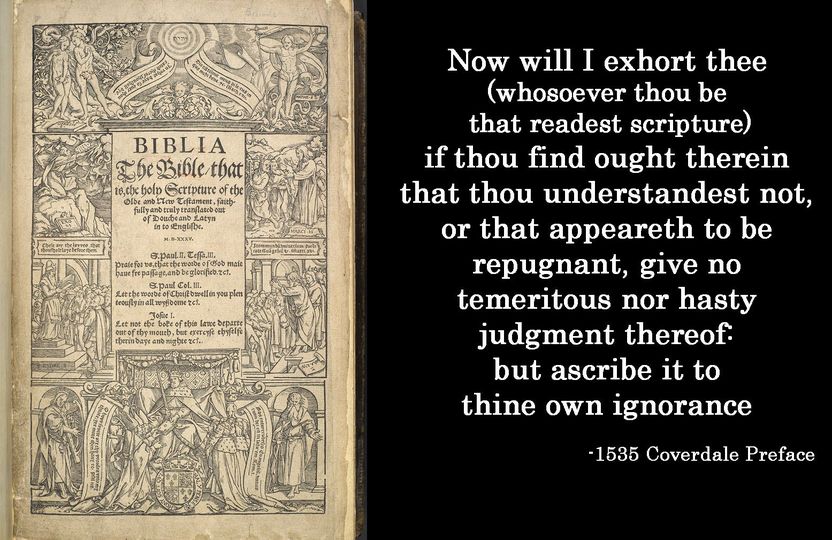
My second example comes from the second page of the Apologe to the Reader in Coverdale’s 1535 New Testament,
That mean ol’ Coverdale telling people the reason why they cannot understand Scripture is because of their own ignorance. The TCC would rather foster their ignorance than call attention to their ignorance as a bad thing. That wouldn’t be charitable apparently.
5.) Finally, in light of the TCC’s truncated and naïve view of Christian charity I give you a quote from the inimitable G.K. Chesterton,
Dear reader, sometimes disobedient children need to be taken over the parent’s knee, sometimes a wayward sheep gets his leg broken by the shepherd, sometimes the husbandman prunes the vine, and sometimes the TCC behaves like scoundrels and are in need of a strong rebuke. Calm down TCC, the wounds of a friend are faithful [Prov. 27:6].
In this section Tyndale argues strongly against specialized training for the understanding of Scripture based on the proven ambivalence of scholarship. Such ambivalence and disagreement foment division and sects. Scholars “corrupteth the scripture, and fashioneth it after his own imagination, as a potter doth his clay.” Tyndale is referring to popish theologians but the overlap with modern Evangelical text critics is conspicuous. Tyndale writes “God is that only which he testifieth of himself.” This early statement was later described as Scripture being autopistos, or self-authenticating and self-attesting. Tyndale presses the point as a matter of spiritual standing and sanctification writing, “and to imagine any other thing of God than that, is damnable idolatry” – “Man’s wisdom is plain idolatry: neither is there any idolatry than to imagine of God after man’s wisdom.” This idolatry is the reconstruction of Scripture to make God after the vacillating imagination of man.
“But now do ye clean contrary: ye drive them from God’s word, and will let no man come thereto, until he have been two years master of art. First, they nosel them in sophistry, and in benefundatum. And there corrupt they their judgments with apparent arguments, and with alleging unto them texts of logic, of natural philautia, of metaphysic, and moral philosophy, and of all manner books of Aristotle, and of all manner doctors which they yet never saw. Moreover, one holdeth this, another that; one is a Real, another a Nominal. What wonderful dreams have they of dreams of their predicaments, universals, second intentions, quiddities, haecceities and relatives; and whether species fundata in chimera be vera species; and whether this proposition be true, Non ens est aliquid; whether ens be cequivocum, or univocum. Ens is a voice only, say some. Ens is univocum, saith another, and descendeth into ens creatum, and into ens increatum, per modes intrinsecos. When they have this wise brawled eight, ten, or twelve or more years, and after that their judgments are utterly corrupt, then they begin their divinity; not at the scripture, but every man taketh a sundry doctor; which doctors are as sundry and as divers, the one contrary unto the other, as there are divers fashions and monstrous shapes, none like another, among our sects of religion. Every religion, every university, and almost every man, hath a sundry divinity. Now whatsoever opinions every man findeth with his doctor, that is his gospel, and that only is true with his doctor withal, corrupteth the scripture, and fashioneth it after his own imagination, as a potter doth his clay. Of what text thou provest hell, will another prove purgatory; another limbo patrum; and another the assumption of our lady: and another shall prove of the same text that an ape hath a tail. And of what text the gray friar proveth that our lady was without original sin, of the same shall the black friar prove that she was conceived in original sin. And all this do they with apparent reasons, with false similitudes and likenesses, and with arguments and persuasions of man’s wisdom, Now there is no division or heresy in the world save man’s wisdom, when man’s foolish wisdom interpreteth the scripture. Man’s wisdom scattereth, divideth, and maketh sects; while the wisdom of one is that a white coat is best to serve God in, and another saith a black, and another a gray, another a blue; and while one saith that God will hear your prayer in this place, another saith in that place; and while one saith this place is holier, and another that place is holier; one religion and this religion is holier than that; and this saint is greater with God than that; and an hundred thousand like things. Man’s wisdom is plain idolatry: neither is there any idolatry than to imagine of God after man’s wisdom. God is not man’s imagination; but that only which he saith of himself. God is nothing but his law and his promises; that is to say, that which he biddeth thee to do, and that which he biddeth thee believe and hope. God is but his word as Christ saith, John viii. “I am that I say unto you;” that is to say,That which I preach am I; my words are spirit and life. God is that only which he testifieth of himself; and to imagine any other thing of God than that, is damnable idolatry. Therefore saith the hundred and eighteenth psalm, “Happy are they which search the testimonies of the Lord;” that is to say, that which God testifieth and witnesseth unto us. But how shall I that do, when ye will not let me have his testimonies, or witnesses, in a tongue which I understand ? Will ye resist God ? Will ye forbid him to give his Spirit unto the lay as well as unto you? Hath he not made the English tongue? Why forbid ye him to speak in the English tongue then, as well as in the Latin?”
William Tyndale, “The Obedience of a Christian man,” Doctrinal Treatises and Introductions to Different Portions of the Holy Scriptures, edited for the Parker Society(Cambridge: The University Press, 1528, 1848), 156-161.









 Standard Sacred Text.com