Debate Commentary: Van Kleeck’s Rebuttal

We are back in the recording saddle this week. Drs. Van Kleeck were finally able to complete their commentary of the debate between Peter Van Kleeck Jr. and James White. We pick up commentary at the beginning of Van Kleeck’s rebuttal.

The aim of this commentary is to shed some light and add some color to the debate by commenting on the background and motivations of our arguments as well as to add some color and light to why I interacted with JW as I did.

TULIP Bibliology

Perhaps it would be helpful for my Reformed brothers to conceive of Confessional Bibliology [CB] in terms of Soteriological Calvinism [SC]. When seen through this lens the parody between the two is quite striking. To my non-Reformed brothers this argument will of course not carry as much weight.

So let us begin…

1.) T in SC stands for Total Depravity. In short, this doctrine teaches that man cannot save himself nor does he rightly desire to be saved apart from the work of the Holy Spirit in his heart.

In like manner for CB, man cannot locate, verify, or prove what words are God’s words apart from the Spirit of God working in the heart of the Christian. Indeed, such things are spiritually discerned. Only the Spirit through His words to His people who accept these words by faith can locate, verify, and prove what words are God’s words.

2.) U in SC stands for Unconditional Election. Here God is said to choose those who would be saved and united to Christ just as God chose Jacob rather than Esau before either of them had done good or evil.

In like manner for CB, God chose specific words which He dictated to the penmen of Scripture [i.e., Moses, David, Luke] who then faithfully and willingly wrote those words. Those words are called inspired, infallible, and authoritative Scripture.

3.) L in SC stands for Limited Atonement. Here Christ’s sacrifice for the sins of mankind is often expressed as “sufficient for all but efficacious only for the elect.” That is, Christ’s atoning sacrifice did not save everyone but rather a specific mass of elect individuals of every people, tongue, and nation. What is more, because Christ actually saved people on the cross, He did not merely make salvation possible.

In like manner for CB, God’s work of providentially inspiring and preserving that mass of authoritative words applies only to those words and to no others. Certainly God could have inspired all the words of men, but He chose to inspire only a certain number and only at a certain time. What is more, God’s inspiring and preserving is not a mere possibility but rather an actuality. Indeed, these inspired and infallible words have been kept pure in all ages.

4.) I in SC stands for Irresistible Grace. The Holy Spirit always accompanies the hearing of His words but in the specific case of salvation the voice of the Spirit draws the lost soul to Christ by giving that soul a desire for Christ. Through that God-given desire and the hearing of the word he who was once lost becomes found by accepting Christ as Savior through faith.

In like manner for CB, the Holy Spirit always accompanies the hearing of His words but in the case of recognizing His words as God’s words the voice of the Spirit speaks to the Christian through those words because they are His words. Through His speaking, the Christian, having a God-given ability and desire to hear God’s voice, recognizes the voice of his Shepherd and accepts by God-given faith those words as indeed the words of God and not men. When the Spirit speaks through His words to His people who accept those words by faith in such a way the conclusion that said words are the words of God is irresistible.

5.) P in SC stands for Perseverance of the Saints. Simply put, no man, including one’s own self, is able to pluck a Christian out of the Father’s hand. As such, all true Christians will ultimately remain faithful to Jesus Christ though that faithfulness may fluctuate given the storms of life and our propensity for doubt.

In like manner for CB, the Holy Spirit will always preserve his words as He preserves all those who have been given to the Son. As a result, no man is able to pluck a single word from Scripture, the living Voice of God, any more than a man is able to pluck a Christian out of God’s hand. No child of God and no word of God can ever perish. In light of these truths we have no grounds to doubt a single word in our Bible has been lost any more than we have ground to doubt a single saved sheep has been lost from among Christ’s fold even amidst our propensity to doubt which is brought about by academic interpretations of manuscript evidence.

Trinitarian Bible Society: Text and Translation Conference Lectures

Yesterday the Trinitarian Bible Society released the audio recordings of September’s Text and Translation Conference. There are four lectures in total. You can find each at the following links:

1.) Dynamic or Literal Translation? Lessons from the Spanish Bible Project by William Greendyk
2.) The Case for the Received Text by Jeff Riddle
3.) The Doctrine of the Holy Scripture by John Thackway
4.) The Holy Scriptures for the Persian People by Pooyan Mehrshahi

Give them a listen. I’m sure they will encourage you and equip you to continue the work in defending the Textus Receptus and even the KJV.

Blessings.

Richard Muller, The Textus Receptus, and Authoritas Divina Duplex

Yesterday on Jeff Riddle’s Word Magazine podcast he took the time to delve into Richard Muller’s Dictionary of Latin and Greek Theological Terms and specifically the terms Textus Receptus and Authoritas Divina Duplex.

These terms make exceedingly important distinctions in historic Reformed Bibliology and are foundational to the relationship of a translation to the original text. We have written on both of these terms. You can find out treatment of Textus Receptus here and our treatment of Authoritas Divina Duplex here.

Give a listen to Dr. Riddle as explores the richness and value of these terms both for the Protestant Scholastics and for us today.

Also, here is an assessment of my recent debate with James White written by Kent Brandenburg. Thanks to Kent and Thomas for their input and observations.

Meta-Didactics and the Word of God

Let’s start first with a very mundane example. Suppose there is a college professor teaching a class on English Literature. This class has lectures, assignments, tests, and quizzes. This is the content of the class, but there is also a kind of meta-education, an education happening beyond the content of the class. That meta-education includes things like the role of the syllabus, when and how to hand in assignments, punctuality, time management, study habits, how best to take notes, how to listen etc.

In every class there is an education happening which is often not explicitly contained in the content of the class. It is an education which is outside the scope of English Literature but is nevertheless part and parcel to a class on English Literature. And of course it is counterproductive when the meta-education and the content of the class come into conflict [e.g., the professor is chronically late, the syllabus is inaccurate]

Let us now consider a more theological example. Suppose you and I are walking the streets of ancient Jerusalem. Suppose further that you are a Christian and I am not.

Say that we stop for lunch right around noon time and while eating our lunches Jesus of Nazareth walks by. To this point I have not met Jesus nor have I heard His teaching and in this context you say, “That person is God manifest in the flesh.” Until that point I knew nothing of this Jesus and now I am being told that this man who has no form or comeliness is the living and true God.

From my lost and dying disposition I am being taught something about Jesus without ever hearing His teaching. That something is that that man over there is God Himself. That is, there is a meta-teaching taking place, a teaching beyond the locutions of Jesus, in that moment. Jesus “teaches” us that He is the Son of God equal with the Father by simply existing as the Son of God. As soon as you inform me of the truth that Jesus is God I have learned something about Jesus and God without ever hearing a single word from Jesus’ lips. And again, if Jesus told a lie or if it was found out that Lazarus wasn’t actually dead this meta-teaching would be defeated by the content of this Jesus’ words and actions.

With these two examples in mind let us now consider the Scriptures. Say I put the Nestle/Aland 28 on a table and let us suppose you are lost, dead in your trespasses and sins. Let us suppose further that you have never read a single word of Scripture. After placing the NA28 there on the table I say, “This is God’s revelation to man and most of its contents are divine” or “This is God’s revelation to man and somewhere in the body and apparatus of this NT are found the words of God.”

Without ever opening the NA28, such statements teach us something in a meta-didactic kind of way. Nowhere in the NT is such a claim made that “most of its contents are from God” nor does the Bible claim that “somewhere in the body and apparatus of this NT are found the words of God.” Nevertheless evangelicals regularly assert such things are the case. They tell the world these things are what God’s word teaches by its very existence.

The current accepted claim among Christians is that God’s NT as it currently exists is to some degree an amalgamation of God’s words and men’s words.

No Christian wants to so plainly make this claim but it is nevertheless the standard argument used by Christians to other Christians both from behind the pulpit and from behind the academic lectern.

Neither the assertion that “most of the content of the NA28” is Scripture nor the assertion that “every word of God is found in the body or apparatus of the NA28” is exegetically grounded. Yet it is in vogue to assert something like God’s NT as it currently exists is to some degree an amalgamation of God’s words and men’s words.

As such men are teaching something which the Bible does not teach about itself. They are teaching that it is Christian to believe something about the Bible which the Bible does not teach about itself. Current evangelicalism holds to a teaching about the Bible’s current existence which is beyond or outside of the teaching of the Bible, a meta-teaching, a meta-didactic. What is worse that meta-didactic is contrary to the teaching of Scripture with regard to its existence and function.

In sum, the content of Scripture itself defeats the meta-teaching that the NA28 is God’s word because most of the content of the NA28 is Scripture and the assertion that every word of God is found in the body or apparatus of the NA28. Evangelicalism must abandon these claims unless they are able to ground them in Scripture which at present they seem wholly unable to do.

We on the other hand believe what the Bible says about itself when is claims that every word of God’s word is pure. We assert further that the New Testament Textus Receptus is the word of God. Therefore, we assert that the Textus Receptus is the pure word of God in every word.

Our opponents may dispute our conclusion in favor of the TR but at least our belief is consistent with the teaching of Scripture. Likewise, we dispute the conclusion that the NA28 is pure word of God but worst of all, our opponents position that the NT word of God = what is in the body of the NA28 + something of NA28’s textual apparatus is wholly ungrounded in the teaching of Scripture.

For the sake of argument, we may be wrong but at least our belief is consistent with Scripture’s teaching. Our opponents may also be wrong and their belief is inconsistent with Scripture’s teaching.

What Another Year Will Bring SST

I want to thank Dr. Van Kleeck for inviting me to contribute to the posts on Stand Sacred Text. The goal of the blog, written by Dr. Van Kleeck, is stated in the sub-title, “Belief in Scripture to Change the World.” It is not enough to make a cogent and convincing argument for a standard sacred text; the apologetic must serve to unite the Church around a standard copy of Scripture to the glory of God as a bulwark against the inroads of the Adversary in the battle for the eternal souls of men. While there will be strongly held beliefs on how the Scripture should be rendered, true unity between brothers in Christ about what is and is not Scripture must first be restored. Dr. David Otis Fuller had Reformed ministers in the Wealthy Street Baptist Church pulpit knowing there were differences in ecclesiology and eschatology but when it came to the center of the center of the Christian faith, the vicarious death of Christ, a high view of sin, the necessity of separation from the world and the pressing need to reach the lost with the gospel, the message was the same, the power of the preaching was the same, all because those concerned served the Lord and preached from same standard sacred text.

You will find over the past year that the posts are didactic, apologetic, and polemic. Much of what is written is meant to inform the reader, especially dealing with Reformation era authors and relevant secondary sources upon which much of our apologetics is based. The blog also contains an apologetic defense of the Faith historically, theologically, exegetically, and philosophically. And there is a polemic element in exposing those ideas, systems, and advocates that have compromised the unity the Church once experienced around a standard sacred text.

Dr. Van Kleeck has shown that non-traditional, philosophical methods also effectively serve in the defense of a standard sacred text, and that future favorable arguments need not be hemmed in by traditional means. Why one would not take advantage of every discipline in the defense of Truth should be conspicuous. The narrow empirical focus of interlocutors leaves them ill-prepared to deal with the scope of an argument that encompasses theology, history, exegesis, and philosophy. Even then it is incumbent on opponents to maintain the current understanding of the evidence, no matter how narrowly construed. In other words, Dr. Van Kleeck has demonstrated that a robust defense of a standard sacred text can be made apart from the archaic appeal to manuscript evidence and that it can be effectively defended by anyone who allows the Scripture to make the argument for them.

At StandardSacredText we look forward to the opportunities God in His sovereignty will open this coming year encouraging the saints to trust their Bible.

Blessings!

Isa. 59:21; Acts 4:12

The Year in Review

With all the excitement around the debate I have not had the opportunity to celebrate and give thanks for the first year of StandardSacredText.com. We started this website on September 25, 2021. In this post I wanted to share some of the incredible things the Lord has done over this last year.

1.) It was my intention to write every day with the exception of Sundays and by God’s grace we were able to do that. Between Dr. Van Kleeck Sr. and myself we were able to post over 500 articles to StandardSacredText.com. These articles amounted to over 370,000 words.

2.) As far as exposure in our first year we have reach people from around the globe whether in Singapore, Australia, the UK, as well as people in Canada and the USA. All told we have reached people from 94 different countries in the first year of this blog.

3.) In our first month we had 1 view per day and by the end of our first year we had 255 views per day. In total we had over 20,000 views and nearly 7,500 visitors to the website in our first year.

4.) We have had over 2,000 shares of our material across Facebook, Twitter, and email and hundreds of comments.

5.) Over this last year we have put out four books – Then He Poked the Bear, A Philosophical Grounding for a Standard Sacred Text, An Exegetical Grounding for a Standard Sacred Text, and A Theological Grounding for a Standard Sacred Text. By God’s grace we have been able to sell on average 1 book a day in our first year.

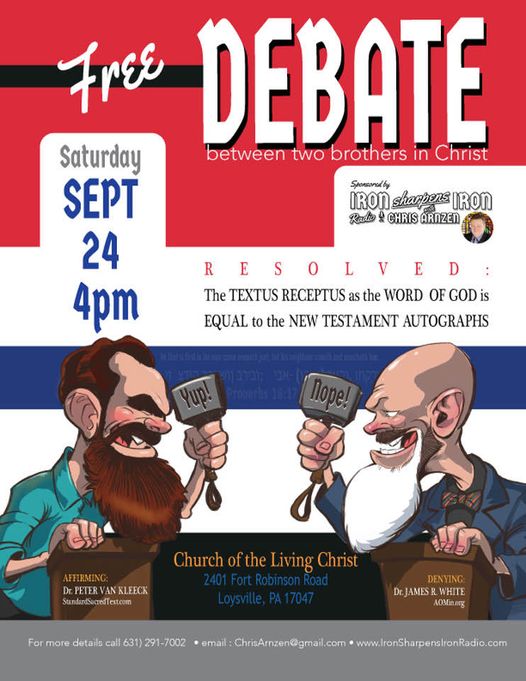
6.) On September 24th, one day before the first anniversary of this website, I was able to have the opportunity to debate Dr. James White on the subject of the Textus Receptus, which I thought was a gracious and fitting conclusion to our first year of work here at StandardSacredText.com

For all of this we praise the Triune God of Heaven and Earth. We praise Him for strength and words and perseverance. We praise him for the years of provision in learning and studying and preparing which has brought us to this place. We praise Him for His word and that it is in our own language. We praise the God of all comfort who has brought others alongside us to challenge us and encourage us. We praise Him for a year of life and breath and we ask that in His grace and according to His will that our Creator and Sustainer continue to lift up His countenance upon us that we may continue this work.

AMEN

Confessional Bibliology and James White

On the July 25, 2022 edition of the Dividing Line James White addressed the first chapter of the London Baptist Confession. While it is clear that JW has a well-worn historical argument it seems that his Confessional commitments are not as obvious or as obviously employed in his defense of the biblical text and translations.

The following quotes were in my debate materials on the night of the debate. The goal was to answer some of JW’s questions with his own words. But as it turns out he never really got around to asking any theological questions so the employment of his words as a rebuttal tactic were less germane to his line of questioning.

Still, I think it is instructive in a number of ways to take a look at what JW actually said about the Scriptures and how we believe what they say.

1.) [25:12] – “The Tenak is just as much theopneustos as the New Testament is.” “Is” not “was”. Very true, but this of course yields a bit of a contradiction. If the OT and NT ARE God-breathed then it stands to reason that all the words of the OT and NT are currently God-breathed. Otherwise the more accurate statement would be, “The OT and NT are mostly theopneustos.” At best then JW is equivocating and at worse the above quote is unintelligible given his Bibliology and its dependency upon man’s interpretation of the manuscript evidence.

2.) [28:25] 1.1 – First quoting the LBC then commenting he says, “‘The only’ – scripture is in a class by itself – it is the only thing we have that is from God that is God breathed – sufficient, certain, and infallible rule of all saving knowledge, faith, and obedience.” Present tense again “IS” as well as sufficient, certain, and infallible to boot. Sounds like Dr. White has the Autograph in hand, seeing his Scripture is sufficient, certain, and infallible. Again, given #1 JW’s position is either equivocating or unintelligible on this point.

3.) [31:25] He goes on, “there is always a natural rebellion toward a sufficient revelation from God we always want upgrades, that’s the corruption of the flesh, the malice of Satan, and of the world.” I completely agree. The funny things is that JW is calling for an upgrade to the TR without accounting for the fact that he himself has argued that the desire for upgrades could easily be evidence of “the corruption of the flesh, the malice of Satan, and of the world.” As such, it is incumbent upon him to provide sufficient reasoning which simultaneously asserts his NT as necessarily better than the TR while dodging or resolving the claim that “upgrades” may be a result of the corruption of the flesh, the malice of Satan, and of the world.

4.) [34:14] He goes on to address section 1.4, “The authority of Scripture for which it ought to be believed is itself.” And again, [35:18] “The authority of Scripture is not built up by the number of arguments you can come up with” Indeed, and as such the number of arguments for this or that reading is not the ground for which that reading is believed to be the word of God. JW and I both agree that the way we recognize the authority of God’s words is not through presenting arguments, even arguments from manuscripts. If not arguments, what then?

5.) [36:19] And then he doubles down, “Put your hand on the Bible and swearing by a higher authority than you. The collection of man’s arguments can’t be piled up to equal an authority higher than God.” Dr. White and I both agree that piling up man’s arguments cannot equal the authority of the Holy Spirit speaking through His words to His people. As such it stands to reason that the piling up of arguments based on manuscript evidence cannot equal the higher authority of the Spirit of God speaking through the word of God to the people of God.

6.) [38:00] “God being truth itself demonstrates the ultimacy of authority and the circularity of authority – ultimate authority cannot appeal to a higher authority to validate its authority.” Indeed, it seems JW and I agree on the ultimacy and circularity of God authority in Scripture. The Holy Spirit gave us Scripture by inspiration and we must wholly lean on him in order to recognize His words [circularity and ultimacy]. It is puzzling then why JW accuses me of circularity in his closing statement.

7.) [40:23] – Quoting then commenting JW continues, “the author thereof, if you believe God is the author of all Scripture you are a small minority – if God speaks it, it is true by nature not by proof “oh, look at that archeology over there!” – [42:07] “am I diminishing archeology? no. But that is not sufficient to establish God is speaking.” Amen and Amen. I too agree that the deliverances of archeology i.e., manuscript evidence is not sufficient to establish God is speaking. Only the Holy Spirit through His words in His people can do that work. It seems that JW would agree, but apparently he doesn’t.

8.) [45:15] Continuing on JW says, “it’s not from the arguments. Our full persuasion of the divine infallible authority of Scripture is the work of the Holy Spirit within us and that Holy Spirit comes in regeneration and so only the regenerate man is going to have that full persuasion and assurance.” Amen. JW and I both understand that full persuasion and assurance is a work of the Holy Spirit through His words in the hearts of His people by faith, yet that nowhere came out in the debate unfortunately.

9.) In his treatment of the LBC JW skips 1.8 interestingly enough.

10.) [57:05] Finally, JW concludes, “The supreme judge, by which all controversies of religion are to be determined…can be nothing other than the Holy Scripture delivered by the Spirit into which Scripture so delivered our faith is finally resolved…A-MEN. Going to my grave defending that, going to my grave defending that.” Seeing JW is not in his grave we all expect his sufficient, certain, and infallible Scripture to serve as the cornerstone of his rebuttals, to be the supreme judge. Our debate was a religious debate, around a religious controversy. I fully expected JW’s presentation to begin with Scripture, because as we both know, “Scripture is the supreme judge of all religious controversies.” But of course it did not.

In sum, it is unclear why JW does not readily use these truths in his argumentation while defending the Scriptural text. If he would have I think he and I would have had a lot of common ground. Perhaps if he did so he thinks he would have to accuse himself of a “category error”. Perhaps he has yet to find a way to reconcile his historical presuppositions with his theological commitments. Whatever it may be, it certainly seems to be a kind of theological schizophrenia which is in urgent need of attention. All told, if JW could make such an adjustment I believe we would be more on the same page than perhaps JW realizes.

Dr. Jeff Riddle’s Commentary on the Van Kleeck vs. White Debate

In this episode of Word Magazine Dr. Riddle makes seven observations/critiques regarding the recent Peter Van Kleeck vs. James White debate. A synopsis of his seven observations are as follows:

1.) I felt there were many aspects of the debate that were not handled in a fair or evenhanded manner.
2.) PVK began his opening statement with a very generous and charitable overture toward JW and those who hold to the modern text.
3.) Simply on technical, forensic grounds, PVK clearly won this debate, as he rightly pointed out in his closing statement.
4.) Even though PVK was not attempting to make an empirical defense of the TR but a more philosophical and theological defense of it, he did offer some meaningful rejoinders to JW’s evidential-based arguments.
5.) One of the highlights of the debate was in PVK’s cross-examination of JW, where he effectively showed (again) that, in the end, JW cannot point to a single verse in the Bible that might not be subject to change based on new manuscripts discoveries or the development of new manuscript discoveries.
6.) It was striking how JW in his cross-examination of PVK mocked the distinct spiritual aspects of the Protestant approach to Scripture (even comparing it to Mormonism).
7.) Finally, PVK took his own unique approach to this debate and chose to argue on more philosophical grounds than evidential grounds. I think he could have pushed back with some evidential arguments at points.

Venning contra White

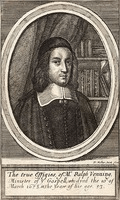
“Ralph Venning (c.1622-1674) was an English nonconformist Christian. The son of Francis and Joan Venning, he was born in Devon, perhaps at Kingsteignton, about 1621. He was the first convert of George Hughes, the puritan vicar of Tavistock. He was educated at Emmanuel College, Cambridge, where he was admitted as a sizar on 1 April 1643, graduated B.A. 1646, and proceeded M.A. 1650.” http://digitalpuritan.net/ralph-venning/

“Seeing there is nothing to be practiced, believed, or taught, which is not agree to the mind of God, Let us make the Word of God our Judge.

The Scriptures (as is granted by all that I write to) are the touchstone by which all religious Principles and Acts are to be tried. To the Law and to the Testimony, if they speak not according to this rule, ‘tis because there is no light in them, Isa. 8:20. Let nothing pass for current coin, which hath not this stamp upon it.

Certainly no Christian will refuse to make the truth of God contained in the Scriptures the judge of all he holds and practices, it being the basis of both, if they be laid on their true foundation; ‘tis the trial which tries all; and therefore bring your opinions to the light, to see whether they be of God or no.

If the Scriptures write jus divium, divine right upon any opinion, ‘tis then authentic; but all other authority is not sufficient to command wither faith or practice. The Bereans [Acts 17:11] were called more noble than they of Thessalonica, because they did not take things upon trust, and believe implicitly, but searched the Scriptures daily, whether these things were so. If any man of an Angel from heaven bring you any other doctrine, let him be accursed, Gal. 1:8.

Certainly these are the undoubted, perfect, and infallible rule, for all matters of faith and practice, or God could not judge the world by them at the last day.

Let us therefore as the wise men, when they saw the star, go up to Jerusalem, that is, the Law and to the testimony, and willingly acquiesce in the Answer we receive from the Oracles of God.”

Ralph Venning, Mysteries and Revelations (London: Printed by John Rothwell at the Sunne and Fountain in Pauls Church-yard, 1652), 31-32.