
In this episode, Dr. Van Kleeck Jr. addresses the idea of having an exegetically based methodology for determining what are and are not the words of God.
Belief in Scripture to Change the World
In this episode, Dr. Van Kleeck Jr. addresses the idea of having an exegetically based methodology for determining what are and are not the words of God.

“Howbeit when he, the Spirit of truth, is come, he will guide you into all truth: for he shall not speak of himself; but whatsoever he shall hear, that shall he speak: and he will shew you things to come.”
John 16:13
I have been told on several occasions that Jesus meant to address only the disciples in John 16:13 and that I should not use said verse in discussion or debate because it does not apply directly to the Church in general.
Turning again to to my old Westminster notes we see something quite to the contrary. By comparing the words of Jesus in John 16 and the words of Paul in 1 Corinthians 2 my Dr. Richard Gaffin came to a very different conclusion.
_____________________________________
Unifying Role of the Spirit- Perhaps more than any other passage of Scripture, we see the over-arching, comprehensive, and unifying role of the Spirit in revelation. The Spirit is searcher, has his origin with God and extends to the reception by the people.
Abraham Kuyper- In the theological effort, there is unity because it is the one and same Spirit who is at work throughout. The Spirit gave us the principium, revealed source and norm, of Scripture and superintends the application of our principium. The exegesis of Holy Scripture is correct and complete only when the Holy Spirit interprets that Scripture in the Church of God. (Principles of Sacred Theology, 585). The Holy Spirit has not merely given us a book and then withdrawn himself from our scene action, but that same Spirit continues to be our leader. The Spirit is the Master Theologian, Teacher of the Church.
1 Cor. 2:14-15 – Our passage highlights the heart of the Reformation tradition. The principle is spiritus cum verbo or the “Spirit working with the Word.” This is the unbreakable bond between Word and Spirit. There is a correlation between faith and revelation.
The passage here is evidence of the fulfillment of the promise Jesus made to his disciples in John 16:13: “When the Spirit comes, he will come as the Spirit of Truth; and lead the church into all truth.” This should not be understood in an individualistic way, but in a corporate, churchly dimension. In the 1 Corinthians passage, the Spirit does lead the Church into all truth. This activity of the Spirit promises the Church that the study of hermeneutics will not overcome the Church. There are problems of Biblical interpretation, but these will never so engulf the Church, so as to bring about a crisis of uncertainty concerning the truth. Luther had discovered that the Holy Spirit was not a skeptic.
_______________________________
Since indeed the Spirit will guide us into all truth it stands to reason that the Spirit is able to speak through those words which are His words and in so doing evince to the Christian reader that those words are the words of God. In sum, the Holy Spirit has not merely given us a book and then withdrawn himself from our scene action, but that same Spirit continues to be our leader in determining what words are God’s words and that without modern text-critical input.

The following quote can be found in my Westminster class notes[pp. 4-5] found here and particularly the ST 101 – Introduction to Systematic Theology notes. As a reminder, come the end of the semester those notes will be replaced with new notes from different classes sometime in January. Blessings.
______________________________
The historic conviction of the Church, clarified at the Reformation, is that the self-revelation of God is the only norm for understanding who God is – Sola Scriptura – Scripture alone. We may not veil from ourselves that in terms of the commitment to the principium, there are only two alternatives: (1) Affirm our principium, embracing it in faith; faith that can only come by the hearing of Christ (Rom. 10:17), or (2) Reject our principium in unbelief. We cannot from a neutral standpoint prove that the Bible is God’s word. We cannot prove Scripture in an a priori or a posteriori, inductive or deductive way. How do we prove that God spoke through prophets and through his Son? We can speak convincingly only as we speak from faith to faith. To seek to demonstrate your principium, or your ultimate norm is to show you do not understand your principium. This veils from ourselves that we have a different or more ultimate principium. This does not mean that it is a waste of time to reflect on our principium, nor to give reasons why we hold to our foundational norm. We can give reasons for holding our principium, but such efforts are meaningful only in the circle of faith; only among those who believe.
Faith is not a principle of subjectivity; it is not my own subject-centeredness. What we need to break out of is the mindset that my reason gives me my objectivity and my faith is my subjectivity. Faith is a gift from God; more specifically, faith is the result of the Sovereign working of the Spirit of God. Considering faith as a gift of God, is in one important sense, has nothing of its own: “Lord, I believe; help my unbelief” (Mark 4). Faith is what it is only in relation to its object- – Jesus Christ. Faith’s object and focus is in Jesus Christ. Faith depends upon this object; focused and bound to this object; faith is radically “extra-spective” or looking away from itself. Faith is focused on the Word of God and the saving relationship in Christ. Without Christ faith has nothing. Rom. 10:17- “Faith comes by hearing and hearing from the Word of Christ.” Eph. 3:19- “As believers we may be filled up with all the fullness of God.” Christ dwells in our hearts through faith. Because faith in itself is nothing, it possesses everything. 1 Cor. 3:22- “All things are yours.” By faith, we are better than our faith. “We are shut up to the circle of the Spirit’s working.” It is not that faith is subjective; we cannot set up reason as objective and faith is subjective.
From these observations, it is plain that to insist on the unbreakable correlation between faith and revelation, or that theology is the truth of faith, to insist on this is not a sacrificing of the Church to subjectivism. Error has come into the Church through misdirected appeals to feelings and faulty uses of reason, and religious sentiment and tradition. It is because of this that the Church has not stayed faithful to the Word of God. Faith, no matter how partial or imperfect, it holds fast and unerringly to Christ and His Word. This is the true, distinguishing essence of faith. John 10:27- “My sheep hear my voice.” Faith is drawn to the Word of God. Belief in the inerrancy of Scripture is not a necessary component, it is an intricate and normal component of saving faith.
__________________________________
I hope you can see that our dependence here at StandardSacredText.com upon the Spirit/word/faith paradigm is not something we cooked up, but something we were taught over and over – first in the Scriptures and then at school. All we are doing is carrying this torch in the 21 century in order to share the same light with others.
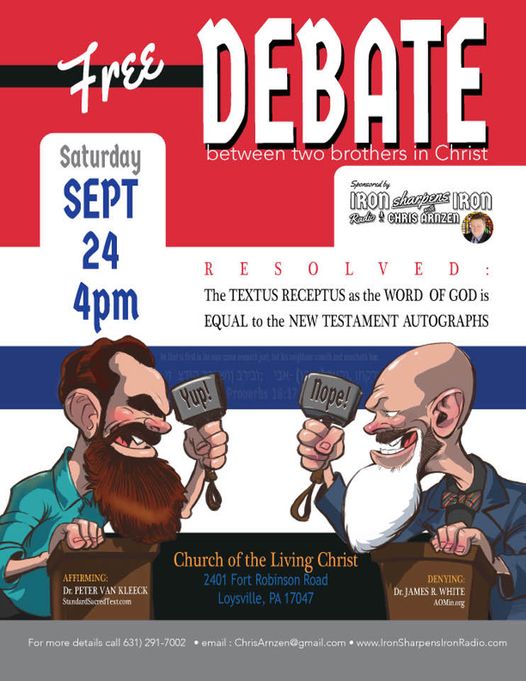
In this episode Drs. Van Kleeck comment on the closing statements of the debate. Overall, we very much appreciated the opportunity of the debate and the fruits that have come from it. I want to thank Dr. James White for taking the debate and for Chris Arnsen for setting things up. It was a joy and a blessing in so many ways and I praise the Lord for it.
On another note, here is another commentary on the debate recently offered by Robert Vaughn. Go ahead and take a look at that.
Finally, I have heard your demands and have published Then He Poked The Bear as a paperback. I want to remind you of the glowing endorsement that James White gave of the book when he said in the debate that Then He Poked The Bear was “The most skeptical attack upon any critical approach to the New Testament I’ve ever seen in my life, ever.” Thank you, Dr. White.

In this episode Drs. Van Kleeck engage with Dr. James White’s second cross-examination. We note again that JW apparently was unable to pivot from his cursory reading of our published words to the debate topic and positive arguments of the night. This was the last chance JW had to offer informed cogent rebuttals or defeaters to my arguments and once again, now 2 hours and 20 minutes into the debate, was unable to do so. Seeing JW has had 178 moderated debates to this point it still baffles the mind as to how he was unable to make this most crucial pivot. Maybe JW is too busy, but his lack of debate prep for both this debate and for the ones he had with Dr. Jeff Riddle was apparent which is unfortunate for all parties involved.
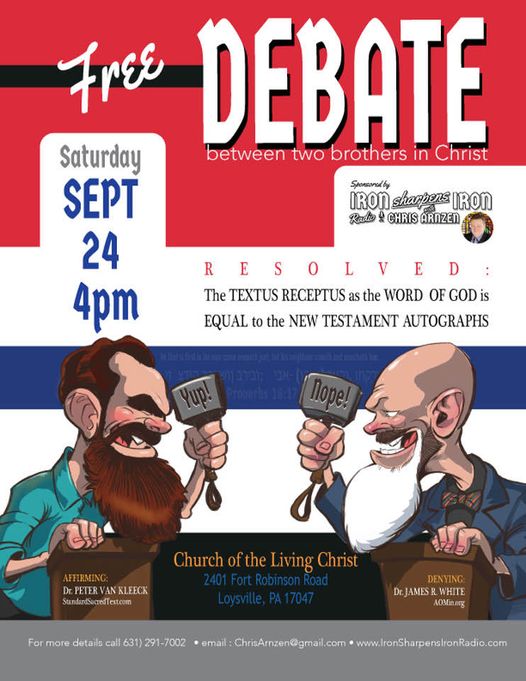
In this episode Drs. Van Kleeck conclude their observations regarding Van Kleeck Jr.’s second cross-examination. Obviously this series is getting long and we have two more episodes to go. I hope that it is becoming clear if it is not already that what was presented at the debate was merely the tip of a very large iceberg which represents a defense of the Textus Receptus.
There are other defenses we can offer. Defense from explanatory ultimate, Scripture itself, properly basic belief, history, and church history. The defense of the TR is deep and wide. As such, don’t ever get sucked into the trap that only historical arguments can be made in defense of your Bible. Even worse, don’t get sucked into the trap that the best arguments are merely historical and the best way to argue these arguments is by assuming your opponent’s methodology. There is no good reason to entertain either of these traps whether you have a graduate degree or not.
Remain faithful to your Bible and defend it with distinctively Christian argumentation. With these two practical admonitions we will see belief in the Bible to change the world.

In this episode Drs. Van Kleeck examine the second round of cross-examinations beginning with Van Kleeck Jr. We have quite a few comments in this cross-examination so it was broken up into two parts.
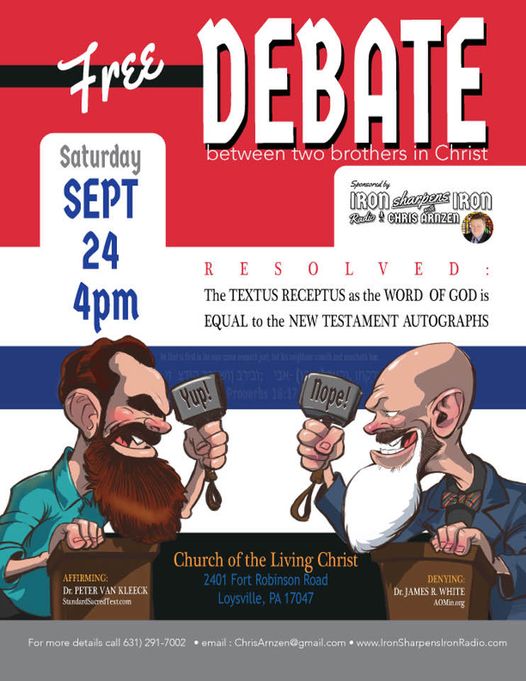
In this episode Drs. Van Kleeck discuss Dr. James White’s first cross examination from the recent debate he had with Dr. Van Kleeck Jr. Our hope is that by giving this commentary greater light can be shed on why I answered the questions they way I did and why I refused to answer some of the questions in distinctly evidential terms.
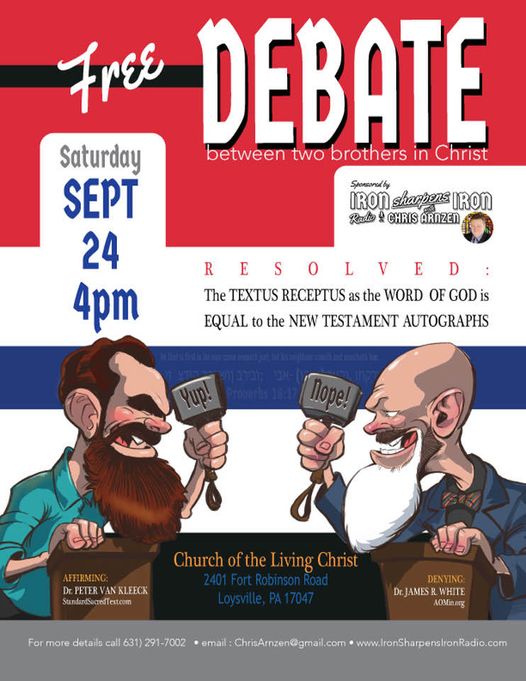
In this episode Drs. Van Kleeck discuss Dr. Van Kleeck Jr.’s first cross examination in his recent debate with James White.
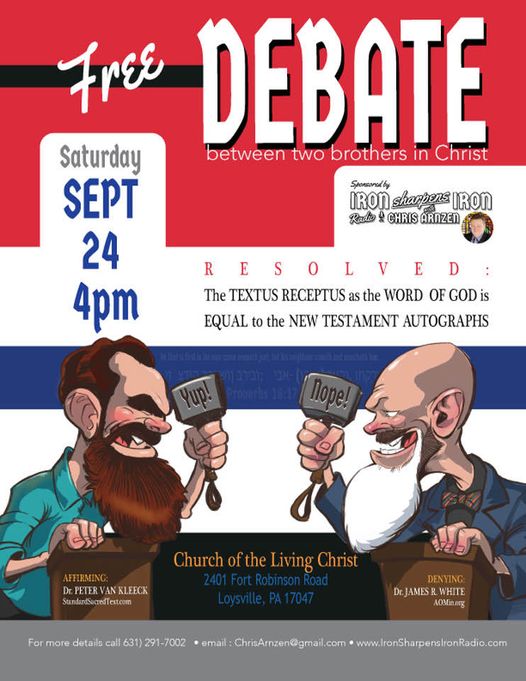
In this episode Drs. Van Kleeck offer their commentary on Dr. James White’s rebuttal statement as it appeared in the recent debate between Dr. Van Kleeck Jr and Dr. James White.

 Standard Sacred Text.com