Textual Criticism and Modern Versions: What Could Possibly Go Wrong?

In 2018 the inimitable Jordan Peterson was asked by an attendee, “If you had five minutes with Prime Minister Trudeau what would you say to him to help him understand the error of his ways.” After a long pause Peterson offered an answer that I believe is exceedingly relevant to the current discussion/debate surrounding the version controversy.

First, Peterson cautions his listeners against ideological possession. That is, some are so possessed by an idea or a paradigm that it is the idea or paradigm which is speaking and not the person. This takes the form of parroting political party talking points or the bare repetition of what you hear on the news sans critical assessment as if the news is on its face only true. One way to guard against ideological possession says Peterson is to consider the possibility of your idea or paradigm going “spectacularly sideways.” What is the worst possible outcome that your idea could engender? Such a calculation is indicative of epistemic humility and wisdom.

If such a calculation was made by the like of Wescott and Hort or Warfield or Wallace or Gurry it is by no means plain. Even to this day there seems to be little clear apprehension on the part of modern evangelical text critics as they continue to work on and meddle with the Greek New Testament. Is there any prominent place in the modern text critical literature which speaks to the feasible detriment the multiplication of versions would have on the English-speaking believing community? Peterson warns Trudeau of tribalism while we in the church are divided among this Greek text or that text critical method or textual family and that English version or even those other versions to the exclusion of yet others.

The point is, for the last 150 years modern evangelical textual criticism has been so ideologically possessed that they haven’t taken the time to even consider let alone observe what would happen if their idea/paradigm were to go spectacularly sideways. I say “observe” because the Christian’s doubt in the Scripture is observable. In fact is it so the case that William Mounce thought it necessary to write a book entitled, Why I Trust the Bible. And both he and the publisher thought the topic so relevant that the book was published in 2021. Not only have the modern evangelical textual critics not considered the worst possible scenario, they can’t see the worst possible scenario even as it bites them in the face.

Second, Peterson goes on to use the Founding Father’s establishment of government as an example of epistemic humility. They did not assume a utopian society in which wise men would lead and represent courageous and temperate people. They understood that things could go spectacularly sideways, thus they instituted the balance of powers among the three branches of government. Modern evangelical textual criticism shows itself to again be ideologically possessed in that there are no checks and balances enumerated for the text critic. They haven’t the humility to say, “We are men capable of horrible things. As we must be governed by an authority greater than the academy and popular opinion. We must be governed by the Spirit of God through the word of God in the work of textual criticism.” Nope, you get nothing of the sort. In fact, Daniel Wallace rejects this kind of arrangement.

“A theological a priori has no place in textual criticism.”

Daniel B. Wallace, “Challenges in New Testament Textual Criticism for the Twenty-First Century” in Journal of the Evangelical Theological Society Vol. 52, Iss. 1 (March 2009): 79-100. 51.

In the same article Wallace writes,

“I would question whether it is an epistemologically sound principle to allow one’s presuppositions to dictate his text-critical methodology.”

Daniel B. Wallace, “Challenges in New Testament Textual Criticism for the Twenty-First Century” in Journal of the Evangelical Theological Society Vol. 52, Iss. 1 (March 2009): 79-100. 93.

While at the same time we here at StandardSacredText.com have made the case repeatedly that the authority to determine what is or is not the New Testament, what is or is not the word of God rests with the Spirit of God through the word of God to the people of God by faith. If there is any sure way to avoid ideological possession it is to be filled with and led by the Holy Spirit who is the Good, the True, and the Beautiful.

Third, Peterson goes on to explain how, what he dubs, wise social scientists go about helping their clients and building structures to improve society. Paramount to a wise social scientist’s perceptual set is the notion that the probability of their plan equaling the expected “positive outcome” to the exclusion of all others is about 0. In fact, the data show that the highest probability is that the proposed plan will kick back and make the situation worse. Consider a situation where a given apparatus is 85% efficient and you want to implement a plan to raise efficiency to 90%, a meager increase of 5%. The probabilities that you make things worse with your plan are far greater than the probabilities of you making things better. As Peterson points out, any fool can decrease the efficiency of a company by 50%, but to increase the efficiency of an already efficient company by 5% is very difficult.

The burning question is, “Has the modern evangelical textual critic increased the ‘efficiency’ of the Bible?” Where there was once a standard sacred text, now there is not. Where there was once a Bible to hand down generation after generation, now there is not. Where once there was once a common ecclesiastical language derived from the Bible, now there is not. In fact, modern evangelical text-critics have so utterly failed in their quest to find the original text of the New Testament in Greek that many text-critics have moved the goalposts to a more modest goal of finding the text which lies immediately behind the manuscripts we currently have. The feasibility of finding the autographs is no longer on the table.

Modern evangelical textual criticism thought itself able to better the text of Scripture which has served the church for over 400 years and thereby better the believing community. In their hubris we lost our language, we lost our tradition, we lost our home, and the proposed replacements are only better relative to the fickle affections of a consumer Christianity. That is consumers of academia, consumers of academic celebrity, and the idolatry of credential. None of the modern evangelical text-critics argue that the reason we need a new Bible is because the Spirit of God is moving through the word of God in the people of God by faith to that end. As such, and until some future time, the accusation of fickle affective Christian consumerism stands.

Finally, Peterson, as a clinical psychologist, invokes the Hippocratic Oath – First, do no harm. The TR/KJV tradition and scholarship associated therewith was exceedingly efficient. So efficient that most critical proponents admit the KJV to be an excellent formal translation. Furthermore, much of their translation accords with the KJV in word and word order. With an exceedingly efficient Original and translation in the balance, the modern evangelical text critic thought himself competent enough to increase said efficiency by a meager amount and they have yet to prove they have accomplished such a feat. If a doctor’s first aim is to do no harm to the body, it seems only obvious that the modern evangelical text-critic should refrain in the same way seeing his subject is the received words of God, being received by Christ’s bride for over four centuries.

Yet, the modern evangelical text-critic’s first response was not, to do no harm. Instead, it was to throw out the TR and start fresh. Not only with a new text but also with a new method. Essential to that method is the wholesale repudiation of orthodox theological a prioris in the work of textual criticism. Then came the insertion of the dogma that the oldest, shortest, and hardest reading was best. Now we have the CBGM. No harm done, right? Except the believing community seems to disagree otherwise why would we constantly need to be reassured that all is well.

Berkhof writes,

“…no one doctrine of religion is changed, not one precept is taken away, not one important fact altered, by the whole of the various readings collectively taken.”

Louis Berkhof, Systematic Theology, 159.

Then Timothy Paul Jones,

“What’s more, it’s almost always possible – through the discipline of known as textual criticism – to compare manuscripts and to discover where and when the changes were made…Most important, none of the differences affect any central elements of the Christian faith.”

Jones, Misquoting Truth, 43-44.

Then Daniel Wallace,

“I would argue that no cardinal doctrine is jeopardized by any viable variant.”

Wallace, Inerrancy and the Text, 2.

And Geisler and Roach,

“While there are changes in the text of Scripture, not all changes are equal in significance. Most of them were trivial, not changing the meaning of the text.”

Geisler and Roach, Inerrancy, 80.

But wait there’s more. Again, Geisler and Roach,

“These kinds of errors are known, but they do not discredit any theological doctrine. Hence, these kinds of scribal changes to not affect the reliability of the New Testament manuscripts in conveying the original message.”

Geisler and Roach, Inerrancy, 80.

And finally for today’s montage Anderson and Widder,

“When we consider that the Bible was transmitted by hand in a harsh climate for thousands of years, we can only marvel that, even though there is variation in the text, most of these variants are insignificant copying errors, and nearly all variants involve no significant doctrinal issue.”

Anderson and Widder, Textual Criticism, 184.

They keep saying it because the believing community does not trust their Bible, and its hard to say if they trust the above scholars either. Modern evangelical text-critics have done harm and they continue to do so. They have not taken the time to assess the feasibility of the plan going spectacularly sideways. They assume that they can better the Bible, but they have not by any objective measure. Nor have they bettered the church by any objective measure. In fact, the church is objectively worse because of the shortsightedness of modern evangelical textual criticism. For that matter the world is objectively worse off and for the same reasons. Indeed, and in this case, “the children of this world are in their generation wiser than the children of light” [Luke 16:8]. If only the modern evangelical textual critic had the circumspection of a deist stoic clinical psychologist from Canada with the last name of Peterson.

But of course, it can’t end there. How does the modern evangelical textual critic amend his ways? Recall C.S. Lewis’ discussion on the most progressive man. He asks, Is the most progressive man the one who continues on an erring road or is the most progressive man the one who recognizes he is on an erring road, turns around, and reclaim the true path. Of course, it is the latter that is the most progressive. How is that done practically?

1.) Recognize the whole modern textual critical enterprise has not delivered on its promises. Said method has not objectively made the Bible or the church better. In fact, the modern textual critical enterprise has made things objectively worse for the Bible and for the church.
2.) Temporarily cease and desist the work of textual criticism. Stop kicking up more and more textual dust. All you are doing is trumping up validation for the existence of your job and most interested parties know it.
3.) Realize the only way to do textual criticism properly is with your orthodox theological precommitments firmly intact.
4.) Realize that the driving force behind moving from one text to another [e.g., from the Geneva to the KJV] is ultimately an act of the Holy Spirit working in His people through the word of God. Textual criticism and the textual critic are merely the maidservants of the church.
5.) Then and only then you may again take up text critical work as bondslave to Christ and His bride – the church – waiting for the moving of the Spirit as He listeth.


What if there is a known error in the Greek text?

I. In a recent interview Peter Gurry and Elijah Hixon were asked about an error in Romans 8:1 and how they would preach that verse given the error. The TR/KJV tradition includes the phrase “who walk not after the flesh” while the CT/MVO position excludes that phrase. Gurry and Hixon suggested that the preacher encountering this passage as he makes his way through the book of Romans should either ignore it or address it after first preparing his people on topics surrounding text critical errors. In the end, both Gurry and Hixon tried to take the teeth out of the dilemma by equating uncertainty regarding a reading of Scripture with uncertainty about some difficult to understand passage of Scripture. What if there is a known error in the text? What is at stake and how are we to handle that known error? Gurry and Hixon’s approach and conclusion on this question is puzzling to say the least and for the following reasons:

1.) Either God in space/time parted the Red Sea or He did not. If He did, we must agree that He did. If He did not, and we say He did, then we have attached God’s name to something He has not attached His name to. This is one of the ways we can take God’s name in vain. False prophets of the Old Testament did this very thing all the time. The False prophet said that God said X, when indeed God did not say that.

In like manner, God in space/time inspired “who walk not after the flesh” of Romans 8:1 or He did not. Hopefully given that immediately above, we understand this dilemma is no minor dilemma to be treated with a simple hand wave and a nod of the head. To treat it as such and saying “No major doctrine is affected” is to grossly misunderstand and/or mischaracterize the state of the case. Assuming Gurry and Hixon recognize the gravity inherent in determining what is or is not the New Testament, it is unclear how they establish warranted belief in favor of including or excluding “who walk not after the flesh” while being in accordance with what God actually did in space/time.

2.) In the broader religious discussion particularly between the major world religions, we understand that on the point of sacred texts the basic locus of dispute is, Did God say that? The Muslims ask it of the Christians and their Testaments and the Christians of the Muslims and their Quran. Indeed, this question is foundational to Satan’s rhetoric when tempting Eve, “Yea, hath God said, Ye shall not eat of every tree of the garden?” The question, Did God say “who walk not after the flesh” in Romans 8:1 is the same kind, the same species as Satan’s question or those making competing religious claims.

What is more, when a Muslim asks this very question of a Christian, the astute Christian knows that the Muslim is making a play to diminish the Christian’s epistemic foundation for their Christian beliefs. Certainly, that is what the Devil was doing with his rather benign question about fruit bearing trees. But apparently for Gurry and Hixon that is not what is going on when we ask, Did God say “who walk not after the flesh” in Romans 8:1. Unfortunately for us, neither Gurry nor Hixon explain why the Romans 8:1 question is a different species of question from those offered above.

3.) Gurry and Hixon’s attempt to equate a hard-to-understand passage with whether or not a passage is the New Testament is unfortunate. The former is epistemological in nature and the latter is ontological in nature. The former asks, what does this passage of Scripture mean? The latter asks, “Is this Scripture?” Their comparison not even a difference between apples and oranges. The difference is more like “What is the molecular makeup of this apple?” versus “Is this an orange?” In sum, the comparison is unwarranted and as such uncompelling.

4.) Neither Gurry nor Hixon hold to what they call immaculate preservation. This is to say that when Jesus said not one jot or one tittle will pass from the law, He did not mean that literally. He meant that the meaning of the text will not pass. As such, the Bible is allowed to have a certain number and certain kind of error, inclusion, or omission. It is unclear how that certain number is calculated. Gurry and Hixon simply assert it. Still, they don’t run from the idea that certain errors can be meaningful. To this phenomenon they conclude that we are to be humbled before God when God does not keep those words for His bride, because God can do as He pleases and apparently it pleases God to keep His word mostly pure. Gurry and Hixon’s sentiment is summed up when they conclude that God does not owe us the truth as if we, contingent creatures, could somehow compel God to give us truth He has not already given.

Agreed. But it is not the Christian who compels God to give us this or that truth. God compels Himself. God declares that Lazarus rose from the grave. God declares the Red Sea parted. God declares that mana fell from the sky. God declares that not one jot or one tittle will pass from the law until all of the law is fulfilled. Because God has declared these things, He is compelled by His own word that they be true. So why is it that Gurry and Hixon do not believe every jot and tittle of the Bible is preserved? Not having a clear answer from them in the interview I assume it is because their interpretation of the evidence compels them to say what they do. But that is hardly a compelling reason in this context.

What evidence compels them to believe Lazarus rose from the dead? What evidence compels them to believe the Red Sea parted? What evidence compels them to believe that mana fell from the sky? These are all the same species of belief. I assume they believe what they believe about Lazarus, the Red Sea, and mana because the Bible says so despite the evidence, but not so with the source of those beliefs – Scripture. Scripture is the source of beliefs regarding Lazarus, the Red Sea, and mana. The beliefs derived from Scripture enjoy acceptance despite the evidence while the source of those beliefs and beliefs concerning that source seem wholly subject to the evidence at least on the point of whether errors occur in that source of Christian belief – the Scriptures.

II. A Brief Response: While it is often easier to poke holes in the arguments of those with whom you disagree, it is necessary that a replacement be offered to fill the resulting void. To that end, how would we here at StandardSacredText.com answer the question of how to handle a known error in the text?

1.) The idea of “kept pure in all ages” does not necessitate “between two covers in all ages.” This applies especially in the first century where much of the canon was not between two covers but that does not mean any of God’s words had fallen from existence. That is, all the words of Scripture were kept uncorrupted despite the fact that the church in Thessalonica did not have them all.
2.) When Jesus said jot and tittle He meant jot and tittle. Jesus literally meant that not a single letter or even a piece of letter would pass away. Again, Jesus’ promise here does not necessitate that every jot and tittle be between two covers at all times. See the first century church.
3.) How then does the TR/KJV advocate know that every word and every letter of Scripture is present between two covers in the original languages? Because the text claims it to be so as much as the text claims the parting of the Red Sea to be so and the resurrection of Lazarus to be so.
4.) Ok, so what do you do with those Christians in history who were TR/Geneva adherents or TR/Tyndale adherents or Erasmus TR adherents? Their beliefs are no different than any other beliefs in which the church grows in sanctification. The church did not always agree on whether Jesus was of the same or of similar substance as the Father. Some believed one way, and some believed another way. To be orthodox you must now believe that Jesus is the same substance as the Father. The church did not always agree on whether the Holy Spirit proceeded from the Father or from the Father and the Son. Some believed one way, and some believed another. To be orthodox you must now believe that the Spirit proceeds from the Father and the Son. The church did not always agree on whether the Geneva was the word of God in English or the KJV was. Still after 30-40 years the KJV became the standard sacred text of the English-speaking believing community in the place of the Geneva and that for over 400 years.

Was the church of the past wrong? In a qualified sense yes, but also no. Yes, in that we now know through the Spirit guiding His people into all truth that Jesus is of the same substance as the Father. No, in that God’s people were truly seeking the leading of the Spirit and the truth gleaned thereby and sanctification takes time. Sanctification is not instantaneous in this life. The Spirit guiding His church into all truth takes time. Simply because a saint does not understand the innerworkings of election does not make them wrong. They have yet to grown in the grace and knowledge of our Lord Jesus Christ. Christian belief in the iterations of TR and those of the KJV tradition over time were growing beliefs, maturing beliefs.

One more example and I’ll be done. When the originals were written they were not all between two covers. So, when 1 Thessalonians was written the church in Thessalonica had the word of God and to say they did was correct. When 2 Thessalonians came along, that did not make the first belief concerning 1 Thessalonians false or heretical. It merely made it incomplete. As books were recognized and united together the church prior to the formal establishment of the canon were not wrong nor were their beliefs in error except insofar as they were incomplete. So how is it that the believing community can believe in multiple iterations of the TR and still claim kept pure in all ages?

In short, the Spirit of God was speaking through the different iterations of the word of God to the people of God by faith and in so doing pointing His people to the next iteration. Thus, the Spirit was doing a simultaneous work of refining the church by pointing her to the next iteration and refining his word by His singular care and providence. Is the Bible due a further refining? That is for the church to decide but she is currently busy trying to figure out if she should ordain women to the ministry or to include critical race theory as part of orthodox theological formulation or to scatter the sheep for a season because, you know, COVID.

In conclusion, Gurry and Hixon seem to be pleasant in disposition and competent in their field but their answers to the known existence of errors in the text seem to me to be sloppy at best. Admittedly there could be more to their position then they had opportunity to present. Perhaps one day we could discuss these things over a cup of coffee and a piece of pie.

Early Church Fathers and the TR Tradition, part 1

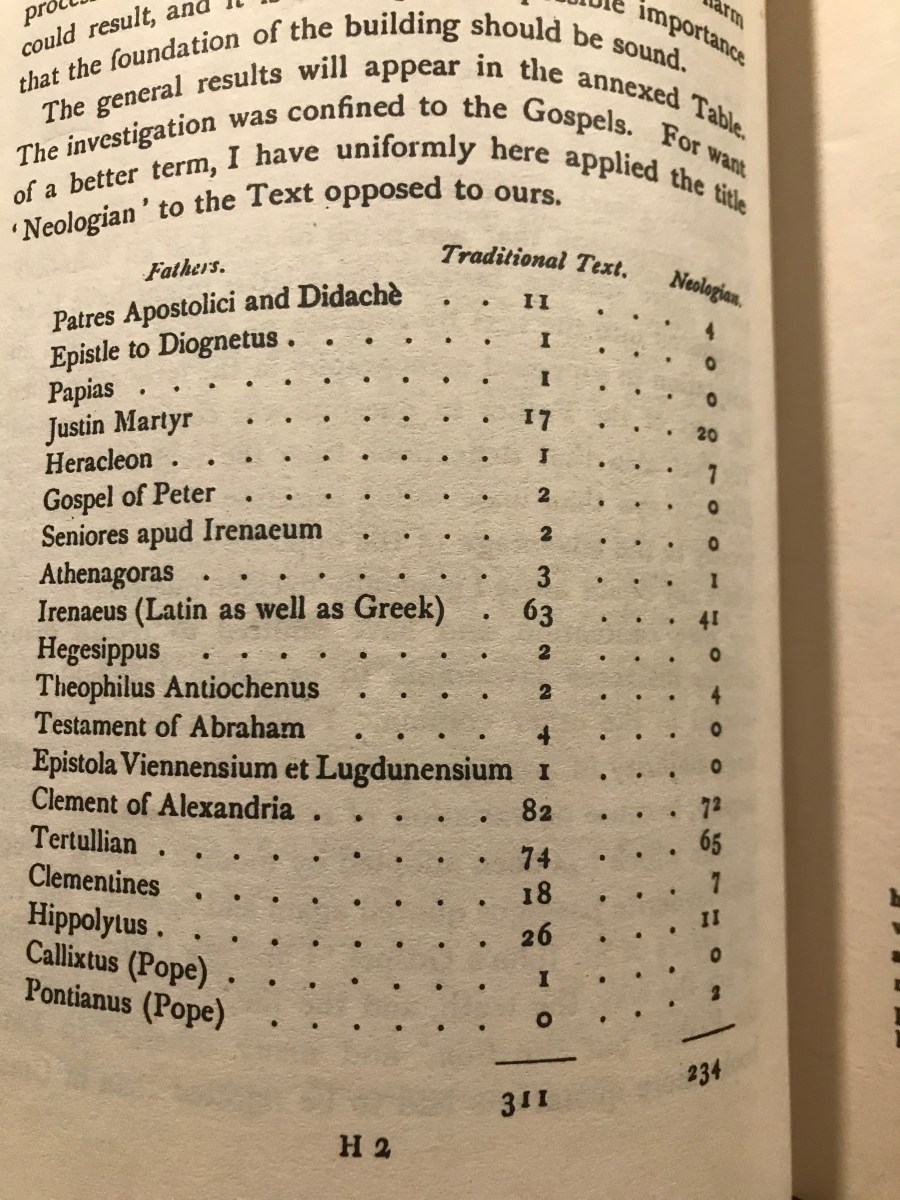
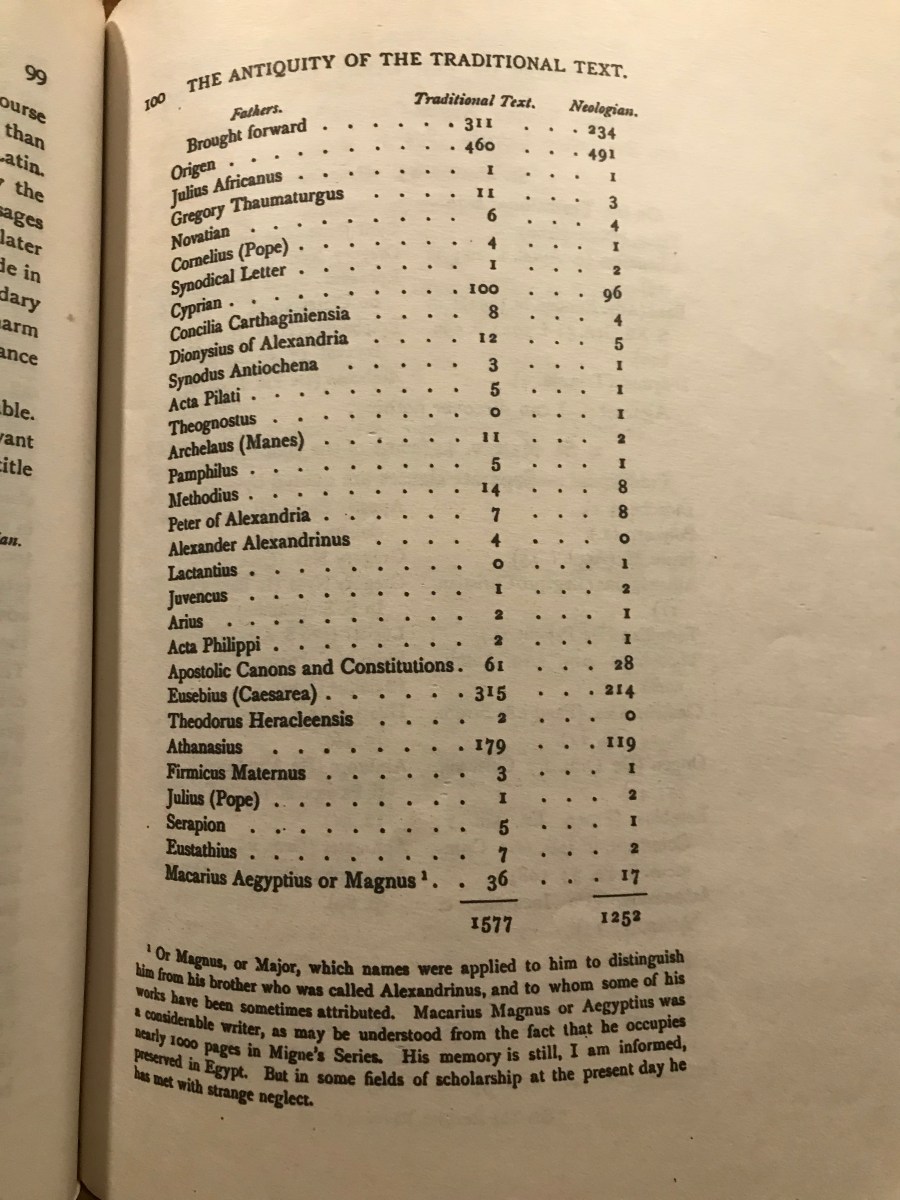
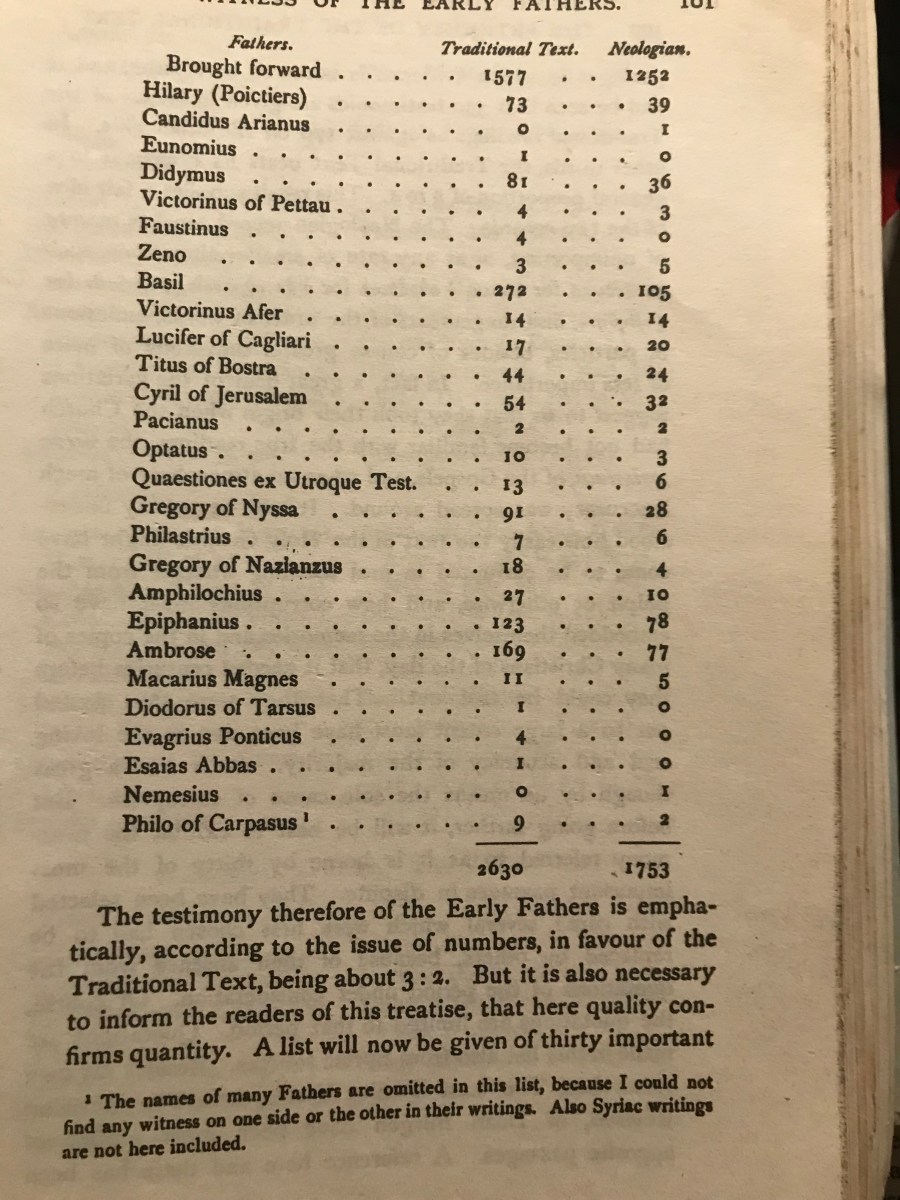
The church fathers before 400 a.d. quote the Traditional text or the Greek text that supports the KJB over the Critical Text tradition in a 3:2 preponderance of the time (2630/1753 quotes). The early church fathers quoted the TR tradition and extensively. See John William Burgon, The Traditional Text, 1896, 99-101. While doing undergraduate work, the quotes of the church fathers were enough for a non-TR professor to say, and I quote, “The TR/KJB position is the only logically defensible position, but don’t get the idea I’m in your camp.”

Why the King James Version?

As of January 10, 2022, at 12:39pm StandardSacredText.com has reached 139 posts. We have largely concluded our two series of A Bibliology Primer and Essential Vocab. A large portion of our argument has been laid out for your examination and perusal. We hope that you can see that it is not King James Onlyism popularly understood. Still, it is an argument for a standard sacred text in both the original languages as well as receptor languages. In our case that language is English. Among the English translations we believe the King James Version is the standard sacred text for the English-speaking community and we believe this for the following 12 or so reasons.

1.) First and primarily, Dr.’s Van Kleeck hold to the KJV because it has been the English version of the Bible which speaks to them and continues to sanctify them and grow them in the knowledge and grace of our Lord Jesus Christ. It is the living voice of God in English.

2.) We hold to the KJV because it is quite apparent that the believing community held to this book for over 400 years. As the Spirit of God has led the church to believe in the great things of the Gospel so the Holy Spirit has led His people by faith to accept His words in the form of the English language. Those accepted words have taken the form of the KJV for the English-speaking church for more than four centuries.

3.) We hold to the KJV because we believe that Early Modern English is a sublime form of human language in general and of English in particular. For us and for most of Western thought the Good and the True are accompanied by the Beautiful. That is, not only must the word of God be good and true, but because it is good and true, it must be beautiful. And though the content of the Bible is beautiful regardless of the translation, the KJV is a particularly beautiful translation in content and form.

4.) We hold to the KJV because it is a good translation. Even those who do not hold to the KJV admit this truth. As formal equivalence translations go, the KJV is a very good translation.

5.) Because the believing community has held to the KJV for so long and because much of the Christianized West has been exposed to the KJV as the standard sacred text of the English-speaking believing community, there has arisen both in the church and outside the church a common parlance, a common language. To this day, many who have memorized Scripture have memorized it in the KJV. A great host of commentaries and devotionals center on the KJV. The Scripture language of the KJV is what we expect when we hear the word of God read or go to recite the Lord’s prayer. If there ever was an English version of the Bible which served as the language of English-speaking ecclesiastical culture, the KJV is that version.

6.) While many versions seem to hope to be a standard for the English-speaking believing community [e.g., English Standard Version, Legacy Standard Version, Christian Standard Version], none of them has acquired such a status. Even after the advent of so many different versions, some so obviously aiming for the status of standard, only one remains the standard and often in a much-derided segment of Christendom and it is those who hold to the KJV. In other words, to this day and generally speaking, the only folks who seem to hold to a standard sacred text are the King James Version folks.

7.) Not only has the KJV served the English-speaking church for over 400 years and has provided us with a common language from which to carry on our theology and devotion, it is also the book that has been handed down from one generation to the next. Fathers have read these words in the ears of their sons and then these sons have read the same words in the ears of their sons and on and on. The KJV is home in a homeless world. It is home for the individual, for the family, and for the church. Those who do not hold to the KJV do not have a home. They often go from one house to another trying this or that couch, but they never really have a home. KJV folks do.

8.) We hold to the KJV because it is not the possession of any company or board of trustees. The KJV belongs to the people. It is not copywritten by this or that publisher and therefore under threat of being discontinued because the great god, Bottom Line, calls for a sacrifice in the burgeoning printing portfolio.

9.) Negatively, there has yet to arise any serious non-trivial argument or movement of the Spirit of God for some other standard sacred text in English to the exclusion of all others. For example, there does not appear to be a strong ESV or NIV only presence in the English-speaking believing community. In short, no meaningful alternative to the KJV has been offered by the English-speaking believing community.

10.) Negatively, the believing community seems to be in a great bit of disarray from the leadership to the laity. And we need look no further than the COVID crisis. We here in the USA scattered the sheep in the name of COVID and at the behest of government, only to turn around and clamor for their return a year or two later. And why should they return after the leadership expressly scattered the sheep and told them to leave? This is not a time to seek a new standard sacred text.

11.) Negatively, after the rise of Rationalism, the Enlightenment, and the boon of modern textual criticism, where is that paragon of textual purity held to be the word of God first in Greek and Hebrew and then in English by scholar and preacher and layman? After 150+ years no such product exists. In fact, many in the field of modern textual criticism have now abandoned the quest to find the original text of Scripture in the Greek and Hebrew. When do we agree to say that the rationalist enterprise as touching the identity of the New Testament has failed at least as it concerns the church?

12.) BONUS: The KJV is the Bible Eli memorized in post-apocalyptic sun-scorched America. Checkmate.

Textus Receptus

“Textus Receptus: the Received Text;

i.e., the standard Greek text of the New Testament published by Erasmus (1516) and virtually contemporaneously by Ximenes (the Complutensian Polyglot, printed in 1514 but not circulated [i.e., published] until 1522), and subsequently reissued with only slight emendation by Stephanus (1550), Beza (1565), and Elzevir (1633).

Richard Muller, Dictionary of Latin and Greek Theological Terms: Drawn Principally From Protestant Scholastic Theology, Term: Textus Receptus.

Of particular note here is Muller’s observation that the 5 texts mentioned all fall under the title, Textus Receptus. Indeed, the term is popularized by the Elzevir text, and Muller observes as much when he writes,

“The term Textus Receptus comes from the Elzevir preface: Textum ergo habes, nunc ab omnibus receptum, ‘Therefore you have the text now received by all.'”

Muller, Dictionary, Textus Receptus.

But the practical and historical reality is that this tradition of Greek texts was and is regarded as the standard and received Greek text of the believing community. We see this stance quite clearly propounded by the Confessional Text position. Again, Muller observes,

“The term [Textus Receptus] was adopted as a standard usage only after the period of orthodoxy, although it does refer to the text supported by the Protestant scholastics as the authentic text quoad verba, with respect to the words of the text.”

Muller, Dictionary, Textus Receptus.

In sum, the term Textus Receptus refers to a tradition and to specific temporally conditioned textual artifacts [i.e., the five Greek texts mentioned above]. In this specific sense, Textus Receptus refers to a compiled copy of the autographs which was defended and supported by the Protestant Scholastics as the authentic standard Greek text quoad verba, concerning the words. This belief in the quoad verba quality of the Textus Receptus is how the Protestant Scholastics could believe and proclaim that the Greek text, the Textus Receptus, was the Original. They believed their Greek text was the authentic word of God quoad verba. Here at StandardSacredText.com all we argue that that same belief in the Textus Receptus remains warranted and rational today.

Bible Texts and possible Worlds.

            “If something is not necessarily true, it is possibly false.” This axiom succinctly delineates the philosophical quandary the modern church finds itself in relation to the possible worlds reflected in bible texts and versions. If the truth of God’s Word as we possess it today is not “necessarily true,” then it is possibly false, and as such, would allow for actualization of the possible world of any future archeological or textual discovery. Though only possible, this possibility alone, would be grounds for questioning or contradicting the truth as we know it, nullifying every notion, methodology and conclusion previously derived from the contemporary disciplines of archeology and textual criticism. The possibility of biblical and theological reconstruction is equivalent to saying that the truth as the Church knows it is not the truth, but only a truth accepted out of ignorance of yet undiscovered possibilities and each finding’s corresponding “truth.” The post-critical Church lives with its provincial, sectarian truth, not because it is correct but because it is the only choice left to the modern Church having rejected pre-critical orthodox principles.

            For example, omitting dia tou aimatos autou, “through his blood” from Colossians 1:14 illustrates the creation of a possible world. Because revelation is Grammatical/Historical, changing the words necessarily changes the event. For this modern omission in Col. 1:14 only part of the question is whether the textual critic or manuscript evidence supports or rejects a text — it is also whether the words where actually written in the first place, the event of writing dia tou aimatos autou. The possible world which admits the truth that Paul did not write these words could, among other considerations, conclude either, that,

  1. Paul (S) did not think this phrase (p).
  2. S meant to write p but because of a physical distraction he involuntarily omitted p.
  3. S was told by an angel not to write p.
  4. S was threatened with bodily harm if p was included so p was omitted.
  5. S fell in love and p was offensive to his fiancé, so he omitted p.
  6. et cetera.

            Each critical text, each modern bible version, represents only one of an infinite number of possible worlds, each edition in conflict with the other by virtue of the inherent variations raised by readings that define the scope of the editor’s and translator’s skills and investigation. Because the text or translation is only a truth and not the truth, then it is one manifestation of an infinite number of possible worlds and capable of exceptional absurdity. Did the Ethiopian eunuch confess Christ before being baptized or not in Acts 8:37? Either he did or he did not, and the editor of the modern version, of his own accord, is going to create a world in which there was no confession. Only God, speaking for Himself through His Word which is the truth will save the Church from believing a historic record, claimed to be divine, that is spurious.

Thus, to retain the exclusivity of the truth I am the way, the truth and the life: no man cometh unto the Father, but by me (John 14:6) it is imperative that the Scripture exist externally to the Church, the critic, and the publisher; that Scripture imposes itself upon the Church and not become an object that anyone can shape according to their own natural inclinations; and that from outside,the Church may be assured that it is the viva vox dei, the living voice of God alone, revealing the truth which they hear in the pages of Holy Scripture.

Scripture as Supreme and Infallible Judge of All Controversies and Interpreter of Itself (Part 3)

We are now in our third installment of Turretin’s argument on Scripture as infallible judge of controversies and interpreter of itself. In part 2 we discussed the first four of Turretin’s arguments in support of the claim that the Scripture is such a judge and interpreter. In this installment we will discuss the final three of his arguments. To that effect, Turretin first argues that if man is the final judge and interpreter of Scripture: 1.) Why did Christ not mention such a person? 2.) Why did Paul not mention such a person? 3.) Why did Peter not mention such a person? and 4.) Popes have not shown themselves to be infallible. The point of course is that it does not appear the Scriptures anywhere make such a claim, that in some future time a man, whether scholar or Pope, was going to be the rightful judge of controversies and final interpreter of Scripture.

As a reminder, we have argued to this point in our discussion that the current disputes over which Bible ought the English-speaking believers to read is a controversy. Furthermore, the disputes about whether the woman caught in adultery, the long ending in Mark, and I John 5:7 are also controversies all of which fall within the jurisdiction of the Scripture as judge and self-interpreting. In short, neither scholar nor Pope is equipped with the necessary tools, nor are they put upon morally or scripturally to determine the validity of this or that text of Scripture. Indeed, they believe the evidence points to this or that conclusion but that is exceedingly different than saying they have the true reading. Fair enough?

Turretin goes on in his next argument to declare that the institutional church is not able to be its own judge and therefore cannot be the final judge of what is Scripture and what is not. Turretin writes,

“The church cannot be regarded as the judge of controversies because she would be a judge in her own cause and the rule of herself. For the chief controversy is about the power and infallibility of the church, when the very question is whether the church is the judge, or whether the church can err.”

Turretin, Institutes, vol. 1, Second Topic, Q. 20, Sec. XIII.

Here Turretin has in mind the authority of the Roman Catholic Magisterium. The church in this sense has neither the power nor the moral right to claim that they are infallible in this or that regard and the Bible is not. Therefore, it is claimed that the church is the final judge of controversies and interpreter of Scripture. If they were, it seems quite apparent that a conflict of interest would soon arise. To be clear, the same goes for the academy. Now I have heard in recent days, per Peter Gurry, that he does not see himself in the place to tell the believer what is or is not the word of God. He claims to say only what he believes the evidence demands. Fair enough. I do want to know, given certain Christian pre-commitments, what is the fundamental difference between saying the evidence compels me to believe X is part of the New Testament and the evidence compels me to believe X is part of God’s word?

Moving on. Turretin’s seventh and final argument for this question is a compilation of quotes from the ancients showing their reliance on the Scripture as final judge of controversies and interpreter of itself. Those quotes are as follows.

Constantine writes, “‘therefore laying aside warring strife, we may obtain a solution of difficulties from the words of inspiration.'”

Turretin, Institutes, vol. 1, Second Topic, Q. 20, Sec. XIV.

“Optatus writes, ‘You say it is lawful, we say it is not lawful; between your permission and our prohibition the minds of the people fluctuate and waver. No one believes you, no one believes us, a judge must be sought from heaven, on earth we can get no decision; but why should we knock at the door of heaven when we have the Testament here in the gospel?'”

Turretin, Institutes, vol. 1, Second Topic, Q. 20, Sec. XIV.

“Augustine says, ‘We are brethren, why should we contend? Our father did not die intestate; he made a will…open it, let us read, why should we wrangle?'”

Turretin, Institutes, vol. 1, Second Topic, Q. 20, Sec. XIV.

Augustine goes on in another place, “‘This controversy requires a judge. Christ shall judge; the apostle with him shall judge.”

Turretin, Institutes, vol. 1, Second Topic, Q. 20, Sec. XIV.

“Lactantius says, ‘God speaks in the divine writings as the supreme judge of all things, to whom it belongs not to argue but to pronounce.'”

Turretin, Institutes, vol. 1, Second Topic, Q. 20, Sec. XIV.

“Gregory of Nyssa writes, ‘The inspired writing is a safe criterion of every doctrine.'”

Turretin, Institutes, vol. 1, Second Topic, Q. 20, Sec. XIV.

To all of this, all seven of these arguments, Turretin concludes,

“As a prince must interpret his own law, so also God must be the interpreter of his own Scriptures – the law of faith and practice. And the privilege allowed to other authors of interpreting their own words ought not to be refused to God speaking in the Scriptures.”

Turretin, Institutes, vol. 1, Second Topic, Q. 20, Sec. XIV.

AMEN.

Quips and Quotes from G.K. Chesterton

Welcome to the Brickyard. This is a place to find quotes for use in your own research and writing. The bricks are free, but the building is up to you. The following quotes are from The Quotable Chesterton edited by Marlin, Rabatin, and Swan. It is a compilation of quotes from G.K. Chesterton across a host of topics. Enjoy.

Argument

“It is generally the man who is not ready to argue, who is ready to sneer.”

The Quotable Chesterton, 26.

Authority

“Authority ruling men must be respected; it must even be loved. Men must in the last resort love it; for the simple reason that men must in the last resort die for it.”

The Quotable Chesterton, 33.

Simplification

“The simplification of anything is always sensational.”

The Quotable Chesterton, 325.

“…it’s natural to believe in the supernatural. It never feels natural to accept only natural things.”

The Quotable Chesterton, 336.

Testimony

“…the more we study it the more queer the whole question of human evidence becomes. There is not one man in twenty who really observes things at all. There is not one man in a hundred who observes them with real precision; certainly not one in a hundred who can first observe, then remember and finally describe.”

The Quotable Chesterton, 341.

Theology

“Theology is only thought applied to religion.”

The Quotable Chesterton, 343.

Thinkers (Modern)

“A modern ‘thinker’ will find it easier to make up a hundred problems than to make up one riddle. For in the case of the riddle he has to make up the answer.”

The Quotable Chesterton, 345.