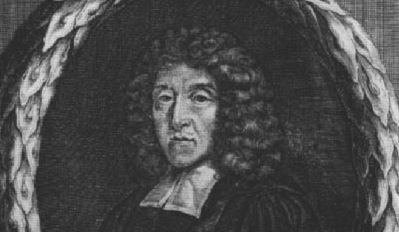
Thomas Ford, 1667 Scripture’s Self-Evidence: a 17th century answer to a 21st century question

The Controversy: How Does Scripture Prove Itself to be the Word of God?

It is well known, that this question hath been much disputed between us, and our Adversaries, for many years, and that two things especially have been insisted on by them, to prove the Scripture no competent Rule of Faith, viz. the obscurity, and the imperfection of it. In this dispute they have labored to puzzle and plunge us, by putting us to show, how Scripture proves it self to be (what we account it) the Word of God.

First Principle

To this we may justly think it a sufficient answer to say, (as one, yea may have said long since) that in every profession the Principles are indemonstrable, assented to without discourse; and the Scriptures are the Principles of Christian Religion, and therefore first we must grant them to be the very Word of God, and then say, they contain all points needful to be known. And since Scripture avoucheth it self to be the word of God, 2 Tim. 3.16. 2 Pet. 1:20, 21. Luke 1:70. It is rational in us to believe it. Notwithstanding our Adversaries are not satisfied, but insist much on this question, viz. How we know, that the Scripture, that faith it is in the Word of God, is so in very deed.

Summary of the Argument

To this the Protestants have long since answered, “That they know this first and principally by the illumination of God’s Spirit, as the inward means, and then by the testimony of the Scriptures themselves, as the outward means; and lastly, by the ministry of the Church inducing us to assent.”

Scriptures Self-Authentication

Here we do not say, that the certainty of Scripture is written in any particular place, or Book of it, but the virtue and power that showeth it self in every line and leaf of the Bible, proclaimeth it to be the Word of the eternal God; and the sheep of Christ discern the voice and light thereof, as men discern light from darkness, and as children are known by their faces and favors, resembling their parents.

Thomas Ford, Scripture’s Self-Evidence: to prove its Existence, Authority, Certainty in it Self, and Sufficiency (in its kind) to ascertain others, That it is inspired of God to be the Only Rule of Faith (London: Printed for Edward Brewster, and are to be sold at Mr. Marriotts at Scrivener; over against Hicks-Hall, in St. Johns Street, 1667), 39-41.

Cornelius Van Til (1895-1987): Christian Apologist, Theologian, and Author, Professor at Westminster Theological Seminary, Philadelphia

“For what you have really done in your handling of the evidence for belief in God, is to set yourself up as God. You have made the reach of your intellect, the standard of what is possible or not possible. You have thereby virtually determined that you intend never to meet a fact that points to God. Facts, to be facts at all–facts, that is, with decent scientific and philosophic standing–must have your stamp instead of that of God upon them as their virtual creator.”

Cornelius Van Til, Why I Believe in God

The Great Bible, 1540 and the preservation of the saints

The work of the historian is a precarious one. Reporting on the past without prejudice is a passing discipline. George Orwell’s 1984 said it best, “Who controls the past controls the future. Who controls the present controls the past.” As a record of God’s providence, the progression of history does not fit a logically linear, prescribed formula from the historian’s perspective, nor as an investigative study is the work ever complete. Preconceived formulations of the past based on current ideologies are the historian’s greatest obstacles. The past has never heard of you and for the past to be rendered correctly it cannot afford to have your modern ideas foisted upon it. To avoid being a contributor to Orwell’s dystopian world, just report what you find.

This short series is drawn from a Ph.D. paper submitted at Calvin Theological Seminary in Grand Rapids, MI. The paper’s theme was to determine whether the Church historically understood Psalm 12:6-7 to teach the preservation of pure words. What was said at the outset of the study, was that the ecclesiastical exegetical tradition appears divided on this passage, but in this division one interpretation  is the preservation of pure words. Historians should give all the information they have, not censoring or prejudicing the data if it does not agree with their reconceived notion of what they wished the research would say.

During the research on this passage, microfilm of  the 1540 Great Bible was examined. If one were trying to make a biased case for the preservation of pure words because “the present controls the past” the material that follows would be omitted. If one were trying to make a biased case for the people being preserved because “the present controls the past” the material that follows would be highlighted and other findings for the preservation of the pure word omitted. Challenging both scenarios, if, however, the research is the reporting of history, all findings whether they align or not with the premise should be included. The following is part of that historical reporting.

Primarily the work of Coverdale, the Great Bible was so called because it measured 16 ½ by 11 inches. The Old Testament is Matthew’s (Rogers/Tyndale/Coverdale) edition, revised based on Sebastian Munster’s Latin translation of 1535. The result of Coverdale’s careful editorial supervision, The Great Bible was the only revised edition of the John Rogers’ Matthew’s Bible, which was the most complete presentation of the translation work of William Tyndale.[1]

The 1540 edition of the Great Bible muddies the translational water by its literary format. Psalm 12 in this edition was written in two paragraphs: verse 1-6 and 7-8. The paragraph break between verses 6 and 7 create an interpretive issue by making “Thou shalt keep them…” beginning v. 7 the main statement of the new paragraph rather than subordinate to the direct antecedent “pure words.” This literary structure of the Psalm lends support to the editors’ interpretation that “them” and “him” are the same people.

“The words of the lord are pure words, even as the silver, which from the earth is tried and purified seven times in the fire. Thou shalt keep them (O Lord), thou shalt preserve him from this generation for ever.”[2]


[1] Price, Ancestry, 256.

                [2] The Bible in English 1540 (Ann Arbor, MI: University Microfilm). The 1549 Great Bible no longer followed the two-paragraph format but is written in separate verses.

Understanding the CBGM: An Introduction (Part 2)

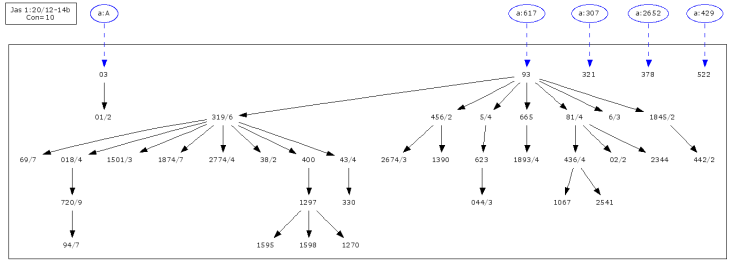
Continuing our discussion from yesterday on the CBGM we turn now to the changes that have come about given the mechanism that is the CBGM. Again, and for the remainder of this series I will be drawing on Wasserman and Gurry’s A New Approach to Textual Criticism: An Introduction to the Coherence-Based Genealogical Method. We still remain in the first chapter of their work and particularly the latter half of the chapter. In this latter half our authors discuss five significant difference which the CBGM has brought about. Wasserman and Gurry observe,

“The first and most obvious changes introduced by the use of the CBGM are changes to the text of the NA/UBS editions.”

Wasserman and Gurry, A New Approach, 5.

They go on to say,

“In the Catholic Letters, there are a total of thirty-four such changes, and in Acts there are fifty-two.”

Wasserman and Gurry, A New Approach, 6.

In Wasserman and Gurry’s opinion most of these changes don’t matter, but a few do. They mention the choice of subject in Jude 5, an issue of Christian suffering and the glory of God in I Peter 4:16, and whether the earth and all its works will be found as mentioned in 2 Peter 3:10. It is important to note that many of these changes have come about because the Byzantine Text-Form is now being regarded as an important witness to old readings. More on that later.

Our authors go on,

A second type of textual change is less obvious but still worth noting. Along with the changes to the text just mentioned, there has also been a slight increase in the ECM editors’ uncertainty about the text, an uncertainty that has been de facto adopted by the editors of NA/UBS.”

Wasserman and Gurry, A New Approach, 6.

There are a couple things to note here. Frist, more changes have come to the critical text which makes the text as a thing more uncertain. Second, the editors of the ECM [Editio Critica Maior/Major Critical Edition] have become slightly more uncertain about the text containing the original readings of the autograph. Now here Wasserman and Gurry use the word “slight” to indicate this increase. But of course, “slight” is relative and also subjective.

Subjective in that the value of the change can far outweigh the number of changes. Back in the day when Bill Gates was the richest man on earth it was said of him that if he were to buy a Lamborghini that purchase would have as much impact on his financial stability as the average American’s financial stability when buying a can of beans. If the words are the words of God and not merely beans to be counted, then an increase in uncertainty may be slight in quantity but overwhelming in quality.

Relative in that the beginning of the modern text-critical project began by totally rejecting the Scriptures of the believing community as a standard i.e., they rejected and continue to reject TR priority in their work. As such, when the change is total from the beginning, it is easy to construe subsequent changes as “slight.”

Third, note that the editors of the N/A and UBS critical texts have adopted a de facto uncertainty in doing their work. De facto simply means “in fact or in effect.” So, the editors of the N/A and UBS already assume a posture and measure of doubt in their work. It is woven into the system of their work. Now they have added more doubt to their already assumed position of doubt. Wasserman and Gurry explain this increase doubt in the following terms,

“In all, there were in the Catholic Letters thirty-two uses of brackets compared to forty-three uses of the diamond and in Acts seventy-eight cases of brackets compared to 155 diamonds. This means that there has been an increase in both the number of places marked as uncertain and an increase in the level of uncertainty being marked. Overall, then, this reflects a slightly greater uncertainty about the earliest text on the part of the editors.”

Wasserman and Gurry, A New Approach, 7.

In short, brackets were the old way to demonstrate the editors’ uncertainty in the Greek text. The new system predicated on the ECM uses diamonds instead to indicate uncertainty of a reading. Overall, given the ECM/CBGM, the instances of uncertainty in the General Epistles increased by ~33% and the instances of uncertainty in Acts increased by ~100%. These apparently are examples which Wasserman and Gurry’s define a slight. Interesting to say the least.

Regarding the third change, our authors write,

“The most significant, and for that reason, controversial is that it has convinced the editors to abandon the concept of text-types used to group and evaluate manuscripts.”

Wasserman and Gurry, A New Approach, 7.

This is indeed a huge shift in the modern text-critical enterprise and even for the TR position. For over 150 years the modern text-critical position has been that the Byzantine Text-From is obviously inferior to the Alexandrian Text-From and now proponents of the ECM/CBGM are “abandoning” the concept of text-forms. Indeed, Wasserman and Gurry admit that in the past

…the notion of text-types is absolutely essential to [Bruce Metzger’s] explanation of the history of the New Testament text and, with it, to the practice of textual criticism.”

Wasserman and Gurry, A New Approach, 8.

Quoting Eldon Epp, our authors observe,

“Their [text-types’] importance is well captured by Eldon Epp, who says that ‘to write the history of the NT text is to write the history of the text types, and concomitantly to write also the history of the criteria for the priority of readings.'”

Wasserman and Gurry, A New Approach, 8.

Strangely enough the idea of text-types is not wholly rejected. Can you guess which of the text-types remains “a distinct text form in its own right”? Wasserman and Gurry observe,

“One exception here is that the editors still recognize the Byzantine text as a distinct text form in its own right.”

Wasserman and Gurry, A New Approach, 9.

I am unclear on the full implications of this recognition, but Wassserman and Gurry go on to point out in the fourth change that editors of the ECM have,

“reevaluated it [the Byzantine Text-Form] and concluded that it should be given more weight than in the past…the Byzantine manuscripts have been disparaged by a majority of New Testament textual critics as the least valuable for recovering the ‘original text’ when considered as a whole. But when the CBGM was first used on the Catholic Letters, the editors found that a number of Byzantine witnesses were surprisingly similar to their own reconstructed text. This unexpected discovery encouraged a second look and led to a renewed appreciation for these manuscripts and their shared text. This, in turn, led them to revise all their earlier decisions where they had chosen against this shared Byzantine text.”

Wasserman and Gurry, A New Approach, 10.

I appreciate the admission here by Wasserman and Gurry about the undo mistreatment of the Byzantine Text-Form. Whether it was out of ignorance or prejudice, that depends on the text-critic. What is more, the Byzantine Text-Form is getting a second more meaningful look. Is this change in appreciation for the Byzantine Text-Form a case of the atheist historian finally reaching the mountain top only to find a thriving community of Christian theologian there waiting for him? Perhaps. We’ll have to see what else the CBGM turns up on this point. Our authors observe that

“As a result, ten of the twelve changes between their [the ECM editors’] first use of the CBGM on the Catholic Letters and their second use are in favor of the Byzantine text, and they now consider it to be ‘an important witness to the early text’ overall.”

Wasserman and Gurry, A New Approach, 10-11.

How about the book of Acts? Wasserman and Gurry explain that

“The situation in Acts is similar. There were fifty-two changes to the critical text. In thirty-six cases the changes were made in conformity with the Byzantine text and in only two cases against the Byzantine text. Further, in 105 of the 155 passages where the editors leave the decision open about the initial text, the Byzantine witnesses attest to the reading deemed to be of equal value to variant a (=NA 28). In twenty of the 155 passages the Byzantine witnesses side with variant a.

Wasserman and Gurry, A New Approach, 11

All in all, modern text-critical theory and practice misunderstood the Byzantine text in important ways since Wescott and Hort. We’ll see if the arguments made over the last 150 years which were based in this misunderstanding will be retracted or revised as the ECM expands.

Finally, the fifth change is a change in goal. The goal is now the “initial text” rather than the original text. This change has occurred because given the apparent “slight” rise in uncertainty

“Some believe that the term original text is simply too vague to be meaningful and is therefore a cause of confusion. Others go further and argue that the very notion of a single, authorial text for the New Testament is indefensible.”

Wasserman and Gurry, A New Approach, 11.

All things being equal, this observation by Wasserman and Gurry seems to militate against the idea that there has only been a slight rise in uncertainty among professionals regarding the text. Regardless, the editors of the ECM using the CBGM have opted for pursuit of the Ausgangstext or initial text. But what exactly is the initial text? In short, the initial text, according to Gerd Mink the one who coined the term, has one meaning and several possible referents. The meaning of “initial text” is

“the reconstructed form of the text from which the manuscript transmission started.”

Wasserman and Gurry, A New Approach, 12.

So, what is the referent? What is the concrete particular that is “the reconstructed form of the text from which the manuscript transmission started”? Well, it could be the original text. That is true, but it could equally be a revised edition of the original text or a corrupted and revised edition of the original text or simply the text which lies immediately behind the texts we currently have which is at least a copy of a copy of a copy. Or as Wasserman and Gurry put it

“From this definition its follows that the initial text may refer to the author’s text or to something later.”

Wasserman and Gurry, A New Approach, 12.

And because it could be the author’s text or something else, modern text-critics can all be pursuing the initial text while simultaneously pursuing different referents e.g., the original, a corrupted original, a revised corrupted original, a copy of a copy of a copy, or simply the text that immediately founds some 6th century uncial. To say that these scholars are all pursuing the same thing is to put on a clinic about equivocation while at the same time failing to be distinctly Christian.

Thus ends our introduction to the CBGM. Lord willing, tomorrow we will turn to a more in-depth treatment of the CBGM method. Blessings.

Understanding the CBGM: An Introduction (Part 1)

For the benefit of our readership, I thought it good that we present a primer of sort on the CBGM or the Coherence-Based Genealogical Method. To do this I will lean almost exclusively on Dr. Wasserman and Dr. Gurry’s work, A New Approach to Textual Criticism: An Introduction to the Coherence-Based Genealogical Method. As you might imagine having read their book, I have many questions but for now let us keep those to a minimum and instead wrap our heads around the method of the CBGM and some subsequent implications.

What is the importance of doing this? Well at a minimum it is important to know what our opposing interlocutors are doing and thinking in the field to which our mutual discussion pertains. Or more simply, to paraphrase Sun Tzu’s Art of War, If you know neither yourself nor your enemy then you will lose in every battle. If know only yourself, you will prevail in only half your battles and if you know both yourself and your enemy then you will prevail in every battle. While I don’t generally consider my interlocutors to be enemies, certainly our positions are opposed and opposed in significant ways. To the end of understanding our opposition I think it good to understand their tools, methods, and conclusions so as to avoid strawman-ing our brother opponents.

Beginning with the Chapter 1 – Introduction, Wasserman and Gurry define the CBGM simply and without admitted necessary qualification as,

“…a method that (1) uses a set of computer tools (2) based in a new way of relating manuscript texts that is (3) designed to help us understand the origin and history of the New Testament.”

Wasserman and Gurry, A New Approach, 3.

Our authors first not that the CBGM focuses not on manuscripts as artifacts but on the text contained in them. That is, the focus in not on the age and family of the manuscript, rather the focus is on each word as they appear in the artifacts known as manuscripts. As will be noted later, the notion of Text Types is almost wholly rejected in the work of the CBGM. This seems to be in large part the case because the analysis of the text is an analysis first of the words recorded and preserved by ink on paper. Wasserman and Gurry observe,

“A text of a manuscript may, or course, be much older than the parchment and ink that preserves it.”

Wasserman and Gurry, A New Approach, 3.

As such the search for the initial text [which we will get to later] has become more focused. Instead of starting with a definition of “witnesses” as whole document to defining “witnesses” as being the words or absence of words within that document.

Wasserman and Gurry offer an illustration of how the CBGM works with the text in the following words,

“…consider two manuscripts, A and B. At any point of comparison, their text can be related in only one of these ways: 1. They agree with each other: A = B 2. They disagree with each other, and either 2a. One derives from the other: A -> B or A <- B, or 2b. Their relationship is uncertain A -?- B It is the use of the 2a type of relationship (where one text derives from the other) that really sets the CBGM apart from the other geneological methods. Where other such methods only use select agreements (A =B) to relate texts of manuscripts, the CBGM also uses the direction of their disagreements (A -> B or A <- B).”

Wasserman and Gurry, A New Approach, 4.

Here in simple summary is at least part of the “new way of relating manuscript text” mentioned above. In all honesty, this not being my field of study, I was surprised that such comparisons were new. I assumed that every word of every manuscript was being compared with each other and then based on the presupposition of Alexandrian Priority the older word was deemed older and better.

That said, don’t think that the computer tools do all the work. This would be a misconstrual of the CBGM. Wasserman and Gurry write,

“At its [the CBGM] most objective, deciding whether two texts agree at a point of comparison involves minimal judgment (it does require some, as we will see). At its most subjective, the CBGM requires the user to make his or her own decisions about how variant readings relate to each other.”

Wasserman and Gurry, A New Approach, 4-5.

Our authors go on to explain,

“Whether A -> B or A <- B at a particular point is determined by the user of the method, not by the computer. This determination involves all the traditional skill and ability that textual critics have practiced for centuries. In this way, even as the CBGM can offer new help in making such judgments, it actually requires more work from the editor, not less, since it builds on thousands of such decisions.”

Wasserman and Gurry, A New Approach, 5.

I was hoping, for the sake of my opposing interlocutors, that “objective” computer tools were going to have significantly more sway in the decision-making process, but in fact, the human element, the subjective element, the “artful” element of textual criticism is even more in play than before. This makes their case less certain and less stable, and they admit as much as we will see in tomorrow’s blog. Furthermore, we will also observe that the computer tools ask for the input/judgment of the text-critic and factors that input into the overall conclusion the computer draws. In sum, more human subjectivity rather than less is in the text-critical mix. Or as Wasserman and Gurry put it,

“The more detail we have about how witnesses relate, the better we know how much weight to give them when dealing with the differences between them.”

Wasserman and Gurry, A New Approach, 5.

Thus, we have a brief introduction to Wasserman’s and Gurry’s Introduction to the CBGM. I couldn’t help but notice that neither of these men attempted to offer a robust theological grounding for their endeavors and assertions. And while some may object by claiming that Wasserman and Gurry’s book aims to address a new method in the science of textual criticism rather than theological groundings, the fact is that the Bible is unlike any other object of consideration.

As Christians a plant or a rock is the object of consideration from which we derive information and knowledge via our sense and reason. The Bible is not this way. The Bible examines the Christian as an object of consideration. The Bible is the examiner, and we are the thing examined. This is because the Spirit of God accompanies His words, and in so doing teaches us about ourselves, exhorts us to godly living, and corrects our waywardness. Certainly, we receive the teaching, exhortation, and correction through faith and through our reason, but unless you are a materialist rocks do not serve as mirrors into our soul, but the Bible does. For example, to treat a human being as something other than a divine image bearer is to treat him as substantially something other than he is no matter if you are doing biology or theology. Thus, to handle the Bible as if it were merely an object of inquiry is to treat the Bible as substantially something other than it is no matter if you are doing textual criticism or theology.

Certainly, if you are not one of Christ’ sheep you will not hear his voice in Scripture and as such will not hear the word’s examination of your heart and behavior. But if you are one of Christ’s sheep it seems improbable that you would not hear His voice in His own words and as such, make that part of your criteria for what is or is not the NT. But alas, such a criterion is wholly omitted from what is said to be a Christian evangelical endeavor insofar as it is done by Christian evangelicals. Puzzling to say the least.

Lord willing, tomorrow we will discuss how the CBGM as changed the text-critical landscape and the disagreements contained therein. Blessings.

First Principles, the voice of the Lord in Scripture, and learning the truth

Clement of Alexandria (153-217?): The Stromata, or Miscellanies

For we have, as the source of teaching, the Lord, both by the prophets, the Gospels, and the blessed apostles, “in divers manners and at sundry times,” leading from the beginning of knowledge to the end. But if one should suppose that another origin was required, then no longer truly could an origin been preserved.

He, then, who himself believes the Scripture and voice of the Lord, which by the Lord acts to the benefiting of men, is rightly [regarded] faithful. Certainly we use it as a criterion in the discovery of things. What is subject to criticism is not believed till it is so subjected; so that what needs criticism cannot be a first principle. Therefore, as it is reasonable, grasping by faith the indemonstrable first principle, and receiving in abundance, from the first principle itself, demonstrations in reference to the first principle, we are by the voice of the Lord trained up to the knowledge of the truth.

For we may not give our adhesion to men on a bare statement by them, who might easily state the opposite. But if it is not enough merely to state the opinion, but if what is stated must be confirmed, we do not wait for the testimony of men, but we establish the matter that is in question by the voice of the Lord, which is the surest of all demonstrations, or rather is the only demonstration.

Philip Schaff, ed., The Ante-Nicene Fathers, vol. 2 (Grand Rapids: Eerdmans, 1989), 7.16, 551.

Athanasius’ 4th century Thirty-Ninth Festal Epistle and the Christocentricity of a Closed Canon

In 367, Athanasius of Alexandria (A.D. 296-373), the most prominent theologian of the fourth century who served as bishop of Alexandria wrote the following in his Thirty-Ninth Festal Epistle commonly referred to as his “Easter Letter.” [1] His was the first official pronouncement of a list of canonical books identical with our present-day list. Athanasius’ list was not a hierarchical decision but a widely acknowledged recognition that the list contained the books the church already recognized as authoritative. After the list he declares,

“These are the fountains of salvation, that he who thirsts may be satisfied with the living words they contain. In these alone the teaching of godliness is proclaimed. Let no one add to these; let nothing be taken away from them. For concerning these the Lord put to shame the Sadducees, and said, Ye do err, not knowing the Scriptures. And he reproved the Jews, saying, Search the Scriptures, for these are they that testify of me.”[2]


[1] Philip Schaff, ed., The Nicene and Post-Nicene Fathers, 2nd series, vol. 4 (Grand Rapids: Eerdmans, 1989), 551-552. Sections 2-7.

[2] Philip Schaff, ed., The Nicene and Post-Nicene Fathers, 2nd series, vol. 4 (Grand Rapids: Eerdmans, 1989), 552.

The Matthews Bible 1537, (1549) and Psalm 12:6-7


John Rodgers, a staunch disciple, and friend of William Tyndale edited the Matthew’s Bible under the pseudonym of Thomas Matthew in the hope that his work would not be immediately recognized as that of Tyndale.[1] Tyndale’s martyrdom cut short his translation of the Old Testament completing the Pentateuch and Joshua through 2 Chronicles.[2] For the remainder of the Old Testament, including the Psalms, Rogers relied upon Coverdale. In Psalm 12 :6-7 Rodgers translated, “The words of the Lord are pure words, even as the silver, which from the earth is tried and purified vii times in the fire. Keep them therefore (O Lord) and preserve us from this generation for ever.”[3]

Following Coverdale, Rogers again makes a clear connection in his translation between the pure words being the antecedent to “them keep” by omitting any intervening words between the noun and verb. Rodgers also continued the divided rendering of “keep them,” the words, and “keep us,” the people, indicative of the principle that God’s covenantal promises with Israel and the Church assure the safety, care, and salvation of both. By this translation The Matthew’s Bible contributes to the argument that Psalm 12:6-7 speaks to the providential preservation of God’s word. John Rodgers was the first to be martyred at Smithfield in 1555 under the reign of Mary I of England who sought to restore Roman Catholic rule. It was said of Rodgers that in his death, “He broke the ice valiantly.”

Rest assured; this is never going to happen to an advocate of the historical critical method. The historical critical method has far more in common with those that martyred Rodgers than with Rodgers who gave his life for the Scripture in English including, for example, a central controlling committee, elite arbitrators of the text, and scholarly usurpation of canonical authority.


[1] Olga S. Opfell, The King James Bible Translators (Jefferson, NC: McFarland, 1982), 18-19.

[2] See Gustavus S. Paine, The Learned Men (New York: Thomas Y. Crowell Co., 1959); Robert McCrumm, William Cran, Robert MacNeil, The Story of English (New York: Viking Penguin Inc, 1986); Ira Maurice Price, The Ancestry of Our English Bible (Philadelphia: The Sunday School Times Co., 1923); Brian H. Edwards, “Tyndale’s Betrayal and Death,” Christian History, 6 (1988).

[3] The Bible Which all the Holy Scripture translated into English by Thomas Matthew, 1537 (Ann Arbor, MI: University Microfilm).

Scripture as the Object of Faith

In Volume 2 of Francis Turretin’s Institutes of Elenctic Theology (1696) he discusses the question of the object of faith, or toward what is faith aimed and from which does faith come? To answer this question, Turretin offers four propositions.

“First proposition: ‘The object of faith ought to be true and nothing false can come under it.'”

Turretin, Institutes, Fifteenth Topic, Q. XI, Sec II.

Turretin goes on in the same section to explain,

“The reason is that the word of God (which is most true) is the sole object of faith and cannot be exposed to any error or falsehood, no more than God himself (its author, who is the truth itself and who, as he cannot be deceived, so he cannot deceive anyone, not knowing how to lie).”

Turretin, Institutes, Fifteenth Topic, Q. XI, Sec II.

Most trained evangelicals would argue that there are no “major” errors, whatever that means, but there are probably errors in the “small stuff,” whatever that means. Here though it is important to note, and as we will see later, that nothing false can be the object of faith. That is, if there are words in Scripture which are not Scripture then they cannot be the object of faith. For the modern evangelical text-critic, the woman caught in adultery is not Scripture, yet it remains in all their subsequent versions. As such, said story cannot be the object of faith.

On another note, to claim that Greek edition X is the word of God while simultaneously saying that all the words contained therein are only probably God’s word is to also claim that those words are only probably the object of faith. How probable? That depends on what scholar you ask and what passage concerning which he is asked. That is, the probability that the word of God here or there is the object of faith varies from word to word and in the case of the woman caught in adultery, the probability is around zero.

Finally, note that Turretin maintains a position which claims that the Scripture may no more err than God Himself. This is High-Bibliology and it is of a particular theological sort which seems to be missing from the current evangelical repertoire.

Turretin later declares that one need not know all of the Scripture to be saved Turretin does declare that

“…it is of faith and necessary to salvation to believe all things were committed to writing by the inspiration (theopneustos) of God for the fulness of the knowledge of the church.”

Turretin, Institutes, Fifteenth Topic, Q. XI, Sec XIII.

In other words, a tract is sufficient to save a soul but to deny that every word of Scripture is inspired by God for the purpose of the fulness of the knowledge of the church is to deny a truth “necessary to salvation.” Not my words..

Turning now to the second proposition, Turretin writes,

“Second Proposition: ‘The object of faith is none other than the written word of God according to the measure of revelation.'”

Turretin, Institutes, Fifteenth Topic, Q. XI, Sec IX.

Whether the OT or NT the object of faith is the written word of God. If we do not have the written word of God or if we only probably have the written word of God, then we either don’t have an object of faith or we only probably have an object of faith. The modern evangelical text-critic’s insistence on probability leaves us something like, “Faith probably has a cause and aim, but maybe not.” We on the other hand argue that we know we have the word of God, and we know this because of the Spirit of God moving in the through the word of God to the people of God by faith.

“Third proposition: ‘The object of faith is either material or formal.'”

Turretin, Institutes, Fifteenth Topic, Q. XI, Sec XI.

Here material means the things believed i.e., the things the Bible teaches both about itself as well as all other propositions contained therein. As to formal, this is the reason or cause by which we believe. The reason or cause of our belief is as Turretin puts it

“the authority of God, the only one credible of himself (autopistou) as the first and infallible truth, revealing himself in the word, in which is granted the ultimate analysis of faith (as in its own formal object, which alone can establish divine faith because it rests in no one except God alone Jer 17:5, 7).”

Turretin, Institutes, Fifteenth Topic, Q. XI, Sec XI.

As such the cause of our faith is God who alone is self-credible revealing Himself through the word of God to the people of God by faith. Sound familiar?

Regarding justifying faith Turretin observes in the fourth proposition,

“Fourth proposition: ‘The object of faith is either general and common or it is proper and special.'”

Turretin, Institutes, Fifteenth Topic, Q. XI, Sec XIII.

Touching the general and common Turretin explains,

“The general is the whole word of God, which is proposed to us that it may be believed, whether in respect of histories (which narrate things done) or of prophecies (which predict things future) or of doctrine and precepts (which regard no difference of time) or of promises and threatenings (which re made to the pious or impious). All these fall under the object of faith, although in different ways according to the nature and condition of each.”

Turretin, Institutes, Fifteenth Topic, Q. XI, Sec XIII.

Concerning the proper and specific object of justifying faith Turretin writes,

“…is the doctrine concerning Jesus Christ and the promise of the remission of sins and of salvation in his blood.

Turretin, Institutes, Fifteenth Topic, Q. XI, Sec XIII.

How many of the words of your Bible are the words of the autograph? How do you know? Your answer to these two questions will tell you about the nature and source of your faith.