For the next couple days I wanted to write concerning the places wherein we agree with our opposing interlocutors. For this series “opposing interlocutor” means those of the Critical Text persuasion and its translational cousin Multiple Versions Only-ism. The reason for marking where we agree is two-fold: 1.) It is important for those who would disagree with us to understand where we have common ground on the topics of the textual issue and the version debate. It is important because an understanding of our common ground should save on ink spilt in make our respective cases. Additionally, it will help focus the conversation on the places of most import, the places where we disagree. 2.) It is equally important for our interlocutors to hear us plainly admit to our points of agreement so that they also may have a point of reference from which to understand out position. That is, if they cannot join us on our side perhaps they can join us at certain common places and from there interpret both these common places and our position with respect to those common places.
The first place of common ground between our two opinions is that we both believe that the original documents written at the hand of Moses or David or Paul or John have been lost to the attrition of time and use.
As a result, the second rhetorical commonality we share is that given the absence of the original documents all that we have at our disposal are copies. Indeed, in most cases we have copies of copies or copies of copies of copies etc.
Third, we mutually recognize that no two of these copies agree in every word. They are all different, some to greater and some to lesser degrees when compared among themselves.
Our fourth place of mutual agreement is that the New Testament in particular has far more manuscripts and far more complete manuscripts attesting to it than any other book of antiquity.
Fifth, we agree with our opposing interlocutors that some form of textual criticism is part of the process of getting the word of God into the hands of God’s people.
So let us start here with these common places.
Tomorrow, Lord willing, we will deal with those common places we share with regard to the nature of the Bible and its present power among God’s people.
If you ever visit the Nation’s Capital, you will want to visit the Holocaust Museum just south of independence Ave SW. The walk through three stories of exhibits is a sobering and visceral reminder of the unspeakable evil that resides in the heart of man. In a previous post entitled “Time to Get in the Fight” we addressed the endorsement of Hitler as God’s choice to lead the German nation by the German Evangelical church and theological scholars. In this post we want to drill down a little further into the theological underpinnings of this ecclesiastical and academic support.
For over 50 years the historical-critical method was the means of theological formulation. History had replaced the inspired apograph and the new hermeneutic in Germany. Hans Frei, in his book Types of Christian Theology observes of the German theological compromise in accepting Nazism, writes “In dogmatics they asserted the indispensable methodological coherence of autonomous anthropology, the fruit of reflexive analysis of subjectivity and of the contemporary culture, with a biblical doctrine of God’s relation to man.”
Frei notes that two things about the theological dogmatics of that era: the methodological coherence of, 1. “autonomous anthropology;” and 2. a biblical doctrine of “God’s relation to man” or providence. “Autonomous anthropology” speaks to the historical one-dimensional man, who in his autonomy was no longer under the authority of God. Providence speaks of God’s work in history in the affairs of men. The theology of the “contemporary culture” of which Frei writes was one of the abasements of pre-critical Protestant Orthodox theological structures and the adoption of autonomous methods for the formulation of anthropology and God’s providence. Of this “methodological coherence,” Frei continues,
“They then quite logically united this dogmatic compromise to a similar political-theological one for which (again) God made himself known in Scripture but also in the special vocation, culture, and laws of particular nations at particular times.” (Frei calls the compromise “political-theological,” but history bears out the political overriding and crushing of the theological.)
Expanding “autonomous anthropology” to include the realm of the political, Frei identifies a “political-theological” compromise making a theological way for God to speak through Scripture but also through providence which he describes in terms of “special vocation, culture, and laws of particular nations at particular times.” This led to “the Nazi intrusion into the Church,” the “fanatical ‘German Christian Movement’ which envisioned Naziism as the fulfillment of Christianity” and that in 1933 Hitler’s rise to power called the “national renewal was being acclaimed as divinely sanctioned.”
In 1934 Germany, “God making himself known in Scripture” was a rejection of pre-critical categories of a preserved, inspired Word and an attempt to reconstruct the Scripture according to historical critical parameters. The compromise Frei speaks of was between a critically formulated text and a notion of providence in terms of a God’s oversight of a particular nation at a particular time, or the rise of Nazi Germany. While perhaps on an ecclesiastical level this was a compromise, from the academy’s perspective, the text and providence complemented each other. There was no Scripture to stand above the German church to hold it accountable for its misguided notion of providence. Autonomously reconstructed Scripture simply affirmed the church’s autonomous interpretation of providence. As the possession of the Church, the Scripture confirmed a political view of providence.
How treacherous, then, is the historical critical method, when the Scripture becomes subservient to the Church, having lost its transcendent qualities by being subjected to historical limitations and reconstructed according to proportional standards? when the text can be rendered to support the most misguided of political atrocities?
This leads to the question, “Can the Bible you read speak in terms beyond its collation or historical critical construction?” The advocate of the KJV can say yes. In the text you hear the viva Vox Dei, the living voice of God which surpasses all historical limitations. New versions, however, are manmade. Are they able to speak to issues that surpass their origin? The answer must be no. The scientific method confirms the object predicated by the subject. Because the subject, or critic, cannot create something that surpasses his capabilities, the predicate is unable to surpass its source. This is to say, that modern versions are limited to the historical. Distributivity, or there are parts where there is overlap between the preserved Word of God and the critical text, but collectively, or Canonically, the preserved Word of God is the viva Vox Dei, and the critical text is manmade.
Canonically, the bibles accepted by MVOism are manmade documents limited to the historical. This “autonomous anthropology” in bible creation and acceptance is the first step to repeating history. Next, is moving autonomous anthropology into the political sphere because of some providential cultural or national event. After that, a collective autonomous theological or ecclesiastical declaration is all that remains to affirm that the politics of the day are providentially ordained of God, and that the “national renewal was being acclaimed as divinely sanctioned” no matter how horrendous. When you read “horrendous” think of it in terms of 1934 Germany rendered, “good for us all.” The table has been set. Now we wait for the invitations to be sent and for the guests to arrive.
The teaching and preaching the KJV has kept America free, and now many have forsaken the Bible that has kept us free. If you get to Washington DC, make plans to visit the Holocaust Museum. You will get to know yourself and your fellow man better.
Hans Frei, Types of Christian Theology (New Haven: Yale University Press, 1992), 154-157.
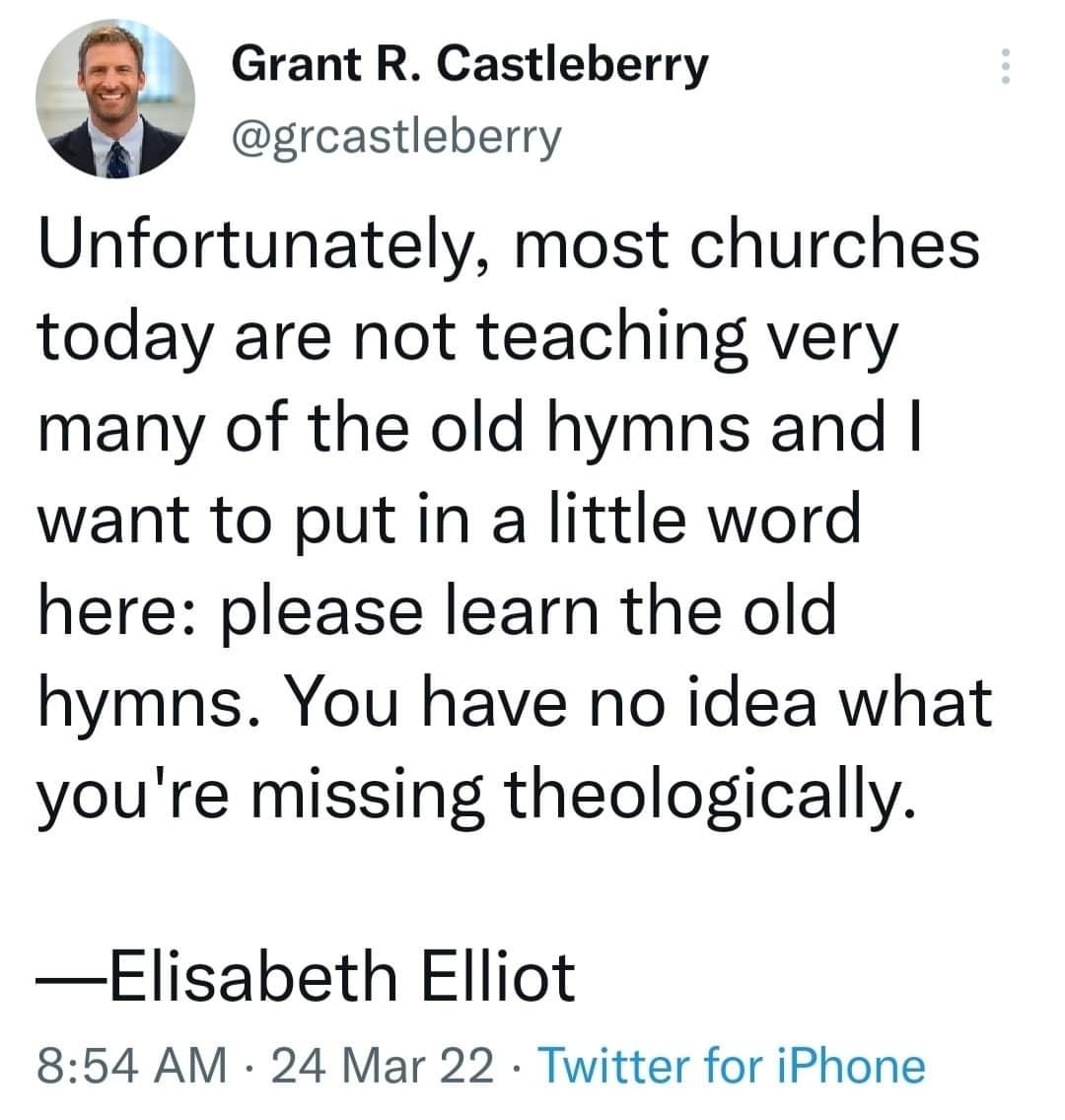
I came across this tweet before I came across the one from yesterday’s post. Let me give the tweet and then we’ll makes come comments.
So of course we have a kind of retweet here. Elisabeth Elliot, wife of martyred missionary Jim Elliot, is being quoted by Pastor Castleberry. And is my want to do perhaps we could phrase Elliot’s quote like this,
Unfortunately, most churches today are not teaching from the old KJV and I want to put in a little word here: please learn the old KJV. You have no idea what you’re missing theologically.
Things your are missing are teachings like the long ending in Mark, the story of the woman caught in adultery, and the only explicit reference to the Trinity in 1 John 5:7. Then of course there are all the theological implications of abandoning the the old KJV for a Multiple Versions Only position or abandoning the Bible altogether as in the case of Barth Ehrman.
But for us the more striking thing is the obvious plea to return to the old hymns or at least retain them in public worship. And seeing that Pastor Castleberry has “retweeted” Elisabeth Elliot it seems he is in agreement with this conclusion in the 21st century. I love the old hymns especially those of the Psalmody sort, but my how we promote the old songs and the old liturgy and the old confession and the old theology but we no longer promote the old King James Bible.
We love the songs from the Reformation, the theology from the Reformation, and the confessions from the Reformation even with all their several and respective archaic words and “False Friends” falsely so called, but we do not love the Bible of the Reformation. Again, as I have said many times by now, we love to advocate for old songs, regulative principle of worship, Reformed theology, and Reformed confessions, but these things are all ruled by the Rule of Scripture. And the Rule we leave up to preference, “Read the version that sounds best to you. I mean, the best version is/are the version or versions you understand. Amiright?”
The Bible as the Rule tells us what the sovereignty of God is and how we are to relate to it. Imagine telling a cage-stage Calvinist that Molinism is the appropriate interpretation of the phenomena of Scripture. The experience to follow is akin to putting a lid on an active volcano. Take that same cage-stage Calvinist and tell him that there is one standard sacred text and he will most likely be that same unhinged eruption and will argue that there are many Rules that are sufficiently reliable Rules. So for his theology there is only one defensible position but for the Rule that governs his theology he will accept any sufficiently reliable Rule. So why doesn’t he accept any sufficiently reliable accounting of God’s sovereignty? Because of course that which is ruled now governs the Rule.
Theology and old hymns have become the Rule and the Scripture is simply there to support our theology and use of old hymns. We have convictions about our theology but preferences about what Bible we read, and then sit around scratching our heads, asking why the Church in America is dying. It is dying because the Rule is a mere predicate of our theology rather than our theology being predicated upon the Rule that is Scripture, not a Rule or Multiple Rules Only.
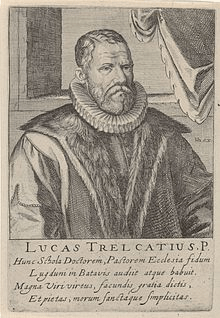
Under “The Principles of Divinity,” Trelcatius introduces his two-fold method for the study of Theology. His method of moving from the Cause to the Effect and from the Effect to the Cause in modern terms is both Deductive and Inductive, a priori and a posteriori. Divinity, he writes for both approaches “holdeth the first and principal place.”
And this is the nature and verity of Divinity: now we will briefly show the Method of our Instruction concerning the same.
There is a two-fold Method of teaching, the one from the Principle, the other unto the Principles, the one a Priori preceding from the Cause to the Effect, and from the first and highest to the lowest and the last. The other a Posteriori, proceeding from the Effect to the Cause, or from the last and lowest to the highest and first. The use of the former is chiefest and sciences contemplative, of the latter, in the practice (or active.)
Now whereas Divinity in both these holdeth the first and principal place (by reason thereof some have distinguished into Contemplative and Active) and for that it affordeth a faculty both of knowing and doing well, which is the right way of wisdom. It hath fallen out that Divinity hath been handled in a diverse Method by diverse men, yet by all of them profitably and faithfully.
For whereas all order is taken either from the nature of things to be considered, or from the better and easier knowledge thereof, Calvin, Melancthon, Ursinus, have done well who observed an order of their better knowledge in a method, unfolding by way of analysis. I like manner Hiperius Musculus, Hemingius, Zanchius, have done well observing the order of Nature in a Method of composing and couching things handsomely together. We in this Institution [Leiden] will join both together, borrowing from the Method of unfolding in the invention of the same, that from both the full Divinity which we have in hand may arise.
Therefore by an order Synthetical (as we term it) we begin from the first Principles, that by means we may come to the last. But we will set down a declaration such as we call Analytical, of the first, middle, and last things. First we teach the truth by way of confirmation, then in reproving falsehood by way of confrontation: that, by the help and benefit of every point of Divinity, and by the Analysis of the same, through causes thereof: but this is, by the Appendix (or addition) of the general solutions, which we lay under every place (or point) and set against the principal arguments of our adversaries, especially Bellarmine: this is the Method.
Trelcatius hits upon two pivotal issues when discussing Scripture. First, Bibliology as a portion of the larger body of Theology is essentially Theocentric. The study and defense of Scripture is included when Trelcatius writes “The thing being considered is God himself, and all things disposed to God.” Secondly, he deals with the manner of considering of how Theology should be considered. He writes that the way the Scripture should be considered must be “proportional to God’s truth” which would be to consider the revelation of God to be absolutely true.
In this brief excerpt Trelcatius explains his Theological method including deductive and inductive reasoning, first Principles being primary, the topic under consideration, God himself, and the proper manner to consider God and his revelation proportional to what God says about himself, a good method for any theological discourse or Theological writing.
Lucas Trelcatius, A Brief Institution of the Common Places of Sacred Divinitie wherein the Truth of every place proved, and the sophisms of Bellarmine are reproved, translated by John Gawen (London: Imprinted by T. P. for Francis Burton, dwelling in Pauls Church-yard, and the sign of the Green Dragon, 1610), 5-8.
I came across this tweet a couple days ago and I thought that there is an interesting comparison to be made between the current academic authorities behind what counts as the New Testament and the current academic authorities behind public school curriculum. The latter is mentioned in the tweet below and the former follows.
For our current context the above tweet would go something like…
To be clear, “non-textual critic” is “layperson in the pew.” Now read it again. Now read the KJV.
Non-textual critics repeat after me: Just because I read the Bible doesn’t mean I know what the original says or get a say in what textual critics criticize.
Textual critics know what they are doing. They have many degrees in their respective fields. They make yearly comprehensive text-critical apparati. They are the experts.
You are not.
Perhaps you think me too harsh or that I have inappropriately commandeered this tweet. Before you decide to pull the lever on the Guillotine and dispatch me with my appropriated tweet, go start a debate with a text-critic on Twitter or Facebook over the story of the woman caught in adultery and see how long it takes them to flex their credentials, tell you that you don’t have all the data, or ignore you. And if the text-critic won’t address your question, then prepare to contend with a host of his acolytes. After that experience I think you will find that my requisitioned tweet is not far from the truth. In fact, you may find that I’ve struck the bullseye Robinhood style.
In the early 60’s when I was learning to read, it was a big deal when my Dad asked if I wanted to read the Bible for family devotions. That was when the King James Version was just the Bible before we were aware of something as ludicrous as making a new one. Since elementary school, I have been reading the King James Bible, memorizing the King James Bible, doing Bible Drills with the King James Bible, (you have to know all the books of the Bible in sequence) and listening to others preach out of the King James Bible, and I would say, probably most believers in their 60’s had similar experiences.
So along come my sons and daughter in the late 70’s, early 80’s and 90’s and when they were old enough, they read the King James Bible for family devotions. Now my elementary school grandkids read the King James Bible for family devotions. Five generations altogether and four generations of elementary school age kids have grown up reading the King James Bible in family devotions.
I have said many times that reading the King James Bible when I was a kid made me a better reader overall. Reading Scripture in family devotions moved you as a by-stander to an active participant. And not only a participant, but one who shared in providing the most important part of family devotions, hearing what God had to say to us in his word. It was a big deal. Sure, everyone gets help, but in a surprisingly short amount of time, reading the King James Bible was like riding a bike. It’s challenging when you’re young, but it’s the challenge that makes you better. This happened at family devotions after the evening family supper. Everybody’s schedule is different, but this was ours. The Dads are always there to help. There is no earthly influence with more power than a godly Dad.
This bit of reminiscing prompted me to wonder, “Do MVOists sing ‘The B-I-B-L-E, yes that’s the Book for me? I stand alone on the Word of God, the B-I-B-L-E!’” We’ve sung the chorus in Sunday School, Bible School, and summer camp. In the current post-critical milieu, is the popular chorus still in vogue? or has it undergone historical critical clarification and now exists in one of its multiple iterations and revisions. Is “yes that’s the book for me” overly dogmatic and presumptuous? I suspect one iteration might go as follows, The B-I-B-L-E-A-D- I-N-F-I-N-I-T-U-M, Yes, those are the versions for me! I stand on all of the versions I call the word of God, the B-I-B-L-E-A-D-I-N-F-I-N-I-T-U-M!
In this episode Dr.’s Van Kleeck continue their treatment of the nature and scope of the version debate and particularly the terms used in that debate. Regarding the definition of terms, renowned logician, Peter Kreeft, observes,
“Definition is crucial to logic. For a definition tells us what a thing is; and if we do not know what a thing is, by the first act of the mind, we cannot know what to predicate of it in the second act of the mind, and thus we have no premises for our reasoning (the third act of the mind).”
Peter Kreeft, Socratic Logic, (South Bend, IN: St. Augustin Press, 2008), 123.
Those following Standard Sacred Text have noted that our defense is modeled after the Apostle Paul’s instruction to the church in Corinth in 1 Cor. 2 with special reference to verse 14. There are essentially only two methods of argumentation not only for the Biblical text but for all things considered – the Spiritual, or that governed by the Spirit in and by the word and the natural, without the Spirit, man functioning in his fallen, natural state. There is no middle or common ground between the two methods. The present textual debate enigma is that those who would make a personal claim to be Spiritual have succumbed to natural arguments for their flavor of the defense of the Faith once delivered unto the saints.
Since my first venture into the KJV debate in the 80’s certain patterns have emerged coming from MVOists. It is important to note that every objection is limited by the capacity of the opponent to formulate one, but among these variables, one factor remains consistent. For the KJB position the Scripture’s self-authentication confirms the object (Scripture’s authority) predicated by the subject (the KJB advocate). To make the case for the KJB nothing needs to be borrowed from a contrary position to find common ground, because the KJB position is self-contained. Other issues are discussed but not out of necessity. Allowing the Word and Spirit to speak for themselves is consistent with Paul’s admonition in 1 Cor. 2.
This however is not the case for objectors. Because the objection confirms only the object (or argument) predicated by the subject (the objector) it is impossible that the objection remotely relates to the self-contained KJB position unless the objector borrows some common ground between the objection and that which is objected against, or, for the sake of discussion, the KJB defender allows an exchange for some didactic purpose. Standing apart from the Word and Spirit this line of argumentation falls under the paradigm of natural. Because there is no common ground between the Spiritual and natural, the natural argument must borrow elements of the Spiritual argument to enter the sphere of a Biblical discussion. The natural perspective possesses no Spiritual elements.
The critical biblical polemic is like showing up on a baseball field with a football and trying to make the case for the fallacy of homeruns while pressing the point for field goals. To be relevant, with football in hand, some element of baseball is borrowed, such as both football and baseball use balls, to make the natural premise credible. The single point of contact may be similar, but the games are entirely different. This borrowing, no matter how minimal, argues against or at least marginalizes the credibility of the initial objection. The objector must borrow from a self-contained apologetic system he is attempting to prove invalid by utilizing the system he is trying to prove invalid.
But one might protest, how can you claim that it is impossible that the number of paperback books critical of the KJB only remotely relate or do not relate at all to Standard Sacred Text apologia for the KJB? A cursory review of the literature will quickly show a pedantic, redundant, evidential similarity of such consistency that the whole can be lumped into one genre reminiscent of the Byzantine “text type.” There are not a host of arguments critical of the KJB; rather, there is one evidential conglomerate published ad infinitum critical of the KJB with such consistency as to be predictable and with such frequency as to be worn out. The monolithic objection only confirms the object (or argument) predicated by the subject, which in this case is plural subjects. Our answer to claims of success to the overthrow of the KJB is simply, “Of course you end up with that answer if that is where you start” because the scientific method confirms the object predicated by the subject. If you make the rules, you can win the game, as if forgetting God has already given his Rule to which all lesser rules must yield. Any capacity of the critic to relate to the self-contained apologetic system of the self-authenticating text must borrow elements from the system being disparaged. The protest is thus answered.
For instance, manuscript evidence is vitally important to an evidential defense of the quantified canonical collating process but is secondary or tertiary to the self-contained argument of Scripture’s own self-authentication. We greatly appreciate the work but the argument for evidence will only confirm the object predicated by the subject and within these self-imposed limits is merely sectarian and provincial, secondary, and tertiary to Scripture’s claims for itself. Furthermore, there is no common ground between the relativity of the proposed evidence and the absolute certainty of God’s word. The evidence only becomes valid as it aligns itself with the self-authenticating Word. If the critic is to locate common ground, something about the certainty of God’s word must be borrowed to create a bridge to the evidence, because certainty does not exist in the critical world.
This “something” is highly problematic to the critic. Consider the following example, “I do not believe the minority reading can be self-attesting.” In this statement we identify a splendid example of an evidentialist borrowing from the KJB apologetic by using the term “self-attesting” thereby establishing a bridge between the two positions. The relative use of percentages and numbers common to evidential arguments are foreign to the terms the Bible uses for itself, but in this statement the relative use of numbers is tied with the pre-critical argument for Scripture’s self-attestation, which by definition means, it does not need numbers or percentages to validate its Authority. Though the statement was not developed, are we to assume then, that a majority reading is self-attesting? Once self-attestation is integral to the argument, the full weight of Protestant Orthodox theology comes to bear on the evidence, but this is not what the evidentialist asks for. Indeed, if it were, they would cease being an evidentialist altogether. And if not inferring the majority reading is self-attesting why say it at all?
How then should one proceed considering this bridge? The idea of a “bridge” begs the question “A bridge to what?” or “Common ground to what purpose?” As noted above, the bridge is necessary for the critic to have a perceived impact upon the self-contained nature of a KJB defense but does not seem intended to provide the common ground of congruence or agreement as noted in continuing discussion. After all, the critic is standing on a baseball field with a football saying, “Listen to me. I have a ball!” The bridge is therefore only conceptual, a device to borrow apologetic credibility for an evidential system incapable of achieving its goal of determining what is and is not Scripture.
The solution is a change in logical sequence of the critic’s debate. For the critic, the change does not require a change in the strength of the evidence, only a subjugation of the evidence to the self-attesting Word. This change of sequencing accepts the self-contained argument for the self-attesting Word as primary while providing credible secondary evidential support for the self-attesting word. And this change in sequence is not an insurmountable dilemma, having already identified the value of borrowed pre-critical categories, no matter how slight, for objections against the pre-critical apologetic.
Because the scientific method confirms the object predicated by the subject, the scientific method by any definition is incapable of relating to the word of God just as the natural man considers the things of the Spirit foolishness. If you want to call the critical text, the majority text, the XYZ text the word of God, as the word of God, the next line in the discussion must be, the text is the self-attesting, self-authenticating, self-interpreting canonical collation of the preserved apograph. After borrowing these words from the Standard Sacred Text defense of the TR/KJB there would indeed be common ground for additional discussion. But until then, the critic with his football must retire to the bleachers, or head over to the football field, while those who have come to enjoy America’s pastime, cruise over in their Chevy Corvette, enjoy a hotdog at the concessions stand and in the warm summer breeze hear the words, “Batter up!” Blessings!
This marks our 300th post here at StandardSacredText.com and the beginning of several new initiatives in the StandardSacredText.com trajectory for the future.
The material presented thus far has come at a significant pace and with that pace the inevitability that some crucial details have been overlooked. As such, we have decided to change gears a bit by presenting our material on a more personal level.
To that end, we are announcing several additions to our current methodology:
1.) Lord willing, by the end of June we hope to have published a A Theological Grounding for a Standard Sacred Text. After which time…
2.) We are going to return to our podcast in order to finish up our presentation of the Standard Sacred Text position there. As part of the podcast we would like to answer any questions you may have regarding clarification of the position discussed and its constituent points. In order to better interface with your questions you can email them to standardsacredtext@gmail.com.
3.) This Fall, we will be offering a free-to-attend 15 week LIVE online seminar. While we are still putting together the finer points of this offering we currently intend the seminar to be on Monday nights for 15 consecutive weeks. The content of the seminar will be divided into three sections: 1.) 5 weeks on a philosophical grounding for a standard sacred text, 2.) 5 weeks on an exegetical grounding for a standard sacred text, 3.) 5 weeks on a theological grounding for a standard sacred text. Each Monday night will include two 50 minute lectures.
Come for some of it or come for all of it. It will be like a college class. You will receive a class syllabus and a PDF copy of each our three books as part of your attendance. Also, for all those homeschool parents out there, if you would like to have your child receive Bible/theology or elective credit we can make a written assignment available in addition to the lectures.
As part of the seminar there will be an opportunity to interact with us LIVE in and after class on specific topics or questions relating to the Standard Sacred Text position. Look for more details and sign-up opportunities as Fall 2022 approaches.
All are welcome to attend.
4.) Both Dr.’s Van Kleeck live in Virginia, one in the north of the state and one in the south. If you find yourself in VA and you would like to meet for coffee some place and talk these things over, we would love to meet with you, talk theology, and fellowship over a piece of pie and a cup of coffee. If you would like us to come your way then I’m sure we could make that happen as well.
We are really excited for the year ahead and for what the Lord has in store for StandardSacredText.com. Thank you all for stopping by StandardSacredText.com and for your comments and interactions.
Continuing our examination of Expressive Individualism and its particular manifestation in the Multiple Version Only Movement, we pick up again with Pastor Ben Wright’s post that we discussed yesterday. Pastor Wright observes,
“As Jonathan Leeman puts it in One Assembly, there are unintended consequences to our churches’ expressions both of our members’ individual preferences and our pastoral preferences. He writes, ‘The devices of the marketplace aren’t exactly conducive to encouraging people to eat in another guy’s restaurant. You’ll never see a McDonald’s commercial celebrating their common cause with Burger King in solving the problem of hunger’ (113). We’ve unintentionally undermined our partnerships with our sister churches and with the mission Jesus entrusted to us.”
We are in agreement with Pastor Wright on this point, and to drive the point home with greater clarity regarding the problem that is Multiple Version Only-ism [MVO] let us co-op Wright’s words above and make a few minor changes.
“There are unintended consequences to our churches’ expressions both of our members’ individual preferences of the version they read and our pastoral preferences regarding the version he reads. The devices of the marketplace aren’t exactly conducive to encouraging people to read another guy’s version. You’ll never see an ESV advertisement celebrating their common cause with the Message in solving the problem of biblical illiteracy.’ We’ve unintentionally undermined our partnerships with our sister churches and with the mission Jesus entrusted to uswhen we prefer Multiple Versions Only.”
We see again, as we saw yesterday, that the formula is the same. All that needed to be changed was the variable. Where in the original quote the variable in question was “preferences in worship” and in the modified quote I have changed the variable to “preferences in choosing versions of the Bible.” In sum, the MVO movement boldly calls for the proliferation of versions and accepts such a proliferation as a device of the markets. As a result, ESV publishers don’t encourage people to read the KJV or the NIV. ESV publishers encourage people to read ESV’s. Then the believing community is encouraged to embrace as many Bibles as they like and all based on their given preferences.
On the point of preference Wright concludes his article this way,
“The cancer is the tendency in your people – and yourself – to think we need our church to express what we prefer, what makes us comfortable. When our comfort undermines our mission, it’s an idol. Kill that idol. But save the body.”
We could not more heartily agree. At StandardSacredText.com we argue that the Rule, the Holy Scripture, “chooses” you by the power of the Spirit speaking through those words to the people of God who accept those words, not by preference, but by faith to be the word of God to the English-speaking Church. In like manner we have also argued in the same vein as the quote above, the comforts and preferences of the MVO position have undermined the mission of the Church [see yesterday’s post] and as such are idols to be killed in order to preserve the body of Christ.







 Standard Sacred Text.com