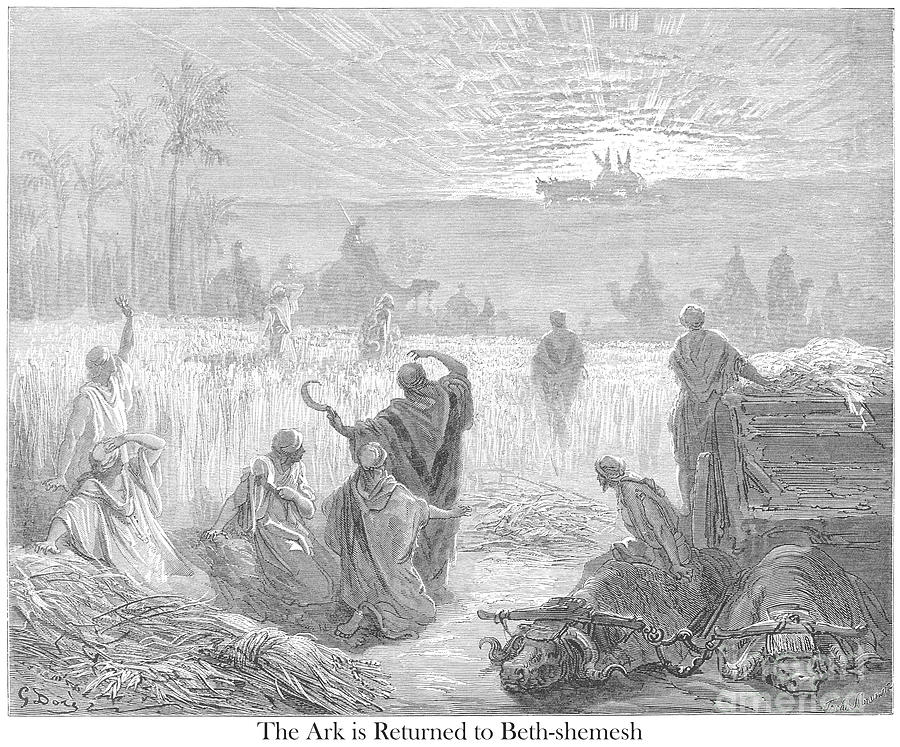
1 Samuel 6:19-How many men died?

The modern versions would like to dispute the number of dead recorded in 1 Samuel 6:19. The Authorized Version reads 50,070, but modern versions go with 75, 70, or 50. Obviously we have a huge discrepancy between these translations. So which is it?

The text in the Authorized Version reads,

“And he smote the men of Bethshemesh, because they had looked into the ark of the LORD, even he smote of the people fifty thousand and threescore and ten men: and the people lamented, because the LORD had smitten many of the people with a great slaughter.”

1 Samuel 6:19

Here Will Kinney offers a reasonable answer for why the Authorized Version translation is perfectly fine. The following is an excerpt from his articles entitled, 1 Samuel 6:19 How many men died – 50,070, or 70 or 75, or 70 men 50 chief men, or 50 oxen of a man? You can read the full article here.

____________________________________________________

In a note on 1 Chronicles 11:11 the NIV 1984 edition has this statement: ?Many disagreements between numbers in Samuel and Kings, and those in Chronicles, are alleged. Actually, out of the approximately 150 instances of parallel numbers in these books, FEWER THAN ONE-SIXTH DISAGREE. (Boy, that’s reassuring, isn’t it?)  GOD GAVE US A BIBLE FREE FROM ERROR IN THE ORIGINAL MANUSCRIPTS. IN ITS PRESERVATION through many generations of recopying, HE PROVIDENTIALLY KEPT IT FROM SERIOUS ERROR, ALTHOUGH HE PERMITTED A FEW SCRIBAL MISTAKES.”

There you have it. This is the view of all modern Bible translators. “Only the originals were inspired, text garbled, error in transmission, desire to embellish the record, no serious error, a few scribal mistakes.”

Mr. Archer does not dispute the Hebrew reading of 50,070, but he says it is an error, and thus we have the reading of “70 of them” in the NIV. 

“He struck SEVENTY MEN of them” is the reading of the RSV, NRSV 1989, ESVs 2001, 2007, 2011 and 2016 editions, NEB 1970, Darby 1890, the Living Bible 1971, Amplified bible 1987, Easy To Read Version 2006 (Hey, it’s WRONG, but at least it’s “Easy to Read”, right?) Expanded Bible 2011 (Thomas Nelson), the 2011 Names of God Bible 2011, Common English Bible 2011, Lexham English Bible 2012, and the New Living Translation 2013. 

The footnotes found in the RSV, NRSV and ESV all tell us: “Hebrew – of the people seventy men, fifty thousand men”.  They all admit that this is the number found in the Hebrew texts. 

The absurd paraphrase called The Message says simply: “Seventy died.” 

The New Life Version 1969 has: “He killed 70 (50,070) men.”  Huh?

Young’s “literal” translation reads: “He smiteth among the people SEVENTY MEN – FIFTY CHIEF MEN.”  

The Jubilee Bible 2000 says: “he smote FIFTY THOUSAND OF THE PEOPLE AND 70 PRINCIPAL MEN.”

Lamsa’s translation of the Syriac Peshitta 1933 – “the LORD smote FIVE THOUSAND AND SEVENTY MEN of the people”  

Green’s “literal” 2005 and the Hebraic Roots Bible 2012 are different still, reading: “Yea, He struck SEVENTY among the people, FIFTY OUT OF A THOUSAND MEN.” (What does that even mean???)

The NKJV reads the same as the KJB in the text, but it has a ridiculous footnote that reads “OR, He struck SEVENTY men of the people AND FIFTY OXEN OF A MAN.”!

The New Living Translation of 2013, whose text reads “The Lord killed 70 men”, also mentions in their footnote: “Perhaps the text should be understood to read ‘The LORD killed 70 men AND 50 OXEN.”!

But the modern scholars are not done yet. 

The Holman Christian Standard Bible 2009 has come up with a reading that is different from them all. The HCSB now says: “He struck down 70 men out of 50,000 men.”

And The Voice of 2012, one of the new Critical Text versions, actually says: “God struck down 75 men” and then Footnotes “50,000 and 70 men”!!!  

Do you think there may be a chance that modern version translators are losing their minds because they keep messing with The Book?

Dan Wallace’s NET Version

Surprisingly, even Daniel Wallace and Company’s generally goofy NET version also follows the Hebrew texts here and says 50,070 men slain. Then they give us this interesting footnote: “The number 50,070 is surprisingly large, although it finds almost unanimous textual support in the MT and in the ancient versions. Only a few medieval Hebrew mss lack 50,000, reading simply 70 instead. However, there does not seem to be sufficient external evidence to warrant reading 70 rather than 50,070, although that is done by a number of recent translations (e.g., NAB, NIV, NRSV, NLT). The present translation (RELUCTANTLY) [Note – he actually puts the word “reluctantly” there in his footnote] follows the MT and the ancient versions here.” 

50,070

The Bible versions that correctly read that God struck down 50,070 men are Wycliffe 1395, Coverdale 1535, the Great Bible 1540, Matthew’s Bible 1549 – “And he slue of the people fyftye thousand and thre skore & ten persones.”, the Bishops’ Bible 1568 -“he slue among the people fiftie thousand and three score and ten men”, the Geneva Bible 1587, the Douay-Rheims 1610, the King James Bible, The Bill Bible 1671, Webster’s 1833, The Lesser Bible 1853, the Julia Smith Translation 1855, The Wellbeloved Scriptures 1862, The Jewish Family Bible 1864, the Smith Bible 1876, The Revised English Bible 1876, The Sharpe Bible 1883, the Revised Version 1885, the ASV 1901,  Rotherham’s Emphasized Bible 1902, The Ancient Hebrew Bible 1907, The Improved Bible 1913, the JPS (Jewish Publication Society) 1917, Hebrew Publishing Company Bible 1936, the 2004 Hebrew Complete Tanach, the NASB 1972 – 1995, the Complete Jewish Bible 1998 – “He killed 50,070 of the people.”, the Third Millennium Bible 1998, the International Standard Version – “He struck down 50,070 men among the people” and the 2012 Natural Israelite Bible – “He struck FIFTY THOUSAND AND SEVENTY MEN OF THE PEOPLE.”, The Hebrew Names Version 2014 and The New English Septuagint Translation 2014. 

Other English translations that follow the Hebrew text and tell us that “God stuck 50,070 men” are  The New Jewish Version 1985, God’s First Truth 1999, The World English Bible 2000, The Sacred Scriptures Family of Yah 2001, The Word of Yah 1993, The Apostolic Polyglot Bible 2003, The Complete Apostles’ Bible 2005, The Revised Geneva Bible 2005, the Bond Slave Version 2009, Hebraic Transliteration Scripture 2010, Online Interlinear 2010 (André de Mol), Holy Scriptures VW Edition 2010, The New Heart English Bible 2010, the Conservative Bible 2011 – “even he smote of the people fifty thousand and threescore and ten men”, The New Brenton Translation 2012, the Interlinear Hebrew-Greek Scriptures 2012 (Mebust), World English Bible 2012 – “he struck fifty thousand seventy of the men”, the International Standard Version 2014 – “He struck down 50,070 men”, and the Holy Bible, Modern English Version 2014. And this Interlinear Hebrew Old Testament 

 http://studybible.info/IHOT/1%20Samuel%206:19 

Foreign Language Bibles

Among foreign language Bible that correctly have the Spanish Sagradas Escrituras 1569, Cipriano de Valera 1602, Biblia de las Américas 1997, Reina Valeras of 1909-2011 – “Hizo morir a CINCUENTA MIL SETENTA HOMBRES del pueblo.”,  Luther’s German Bible of 1545 and German Schlachter Bible 2000 – “Und er schlug des Volks fünfzigtausend und siebenzig Mann.”, the Portuguese de Almeida 1681 and the Almeida Actualizada “CINQUENTA MIL E SETENTA HOMENS”,  the Italian Diodati of 1649 -“percosse ancora del popolo CINQUANTAMILA E SETTANTA UOMINI.”, the French Martin 1744, the French Ostervald of 1996 and the French Louis Segond of 2007 – “Il frappa 50’070 hommes” and Rumanian Cornilescu and the 2009 Romanian Fidela Bible , the Hungarian Karoli Bible – “Megvere pedig a nép közül ötvenezer és hetven embert.”, the Russian Synodal Bible – ” и убил из народа пятьдесят тысяч семьдесят человек” = 50,070 men, the Tagalog Ang Dating Biblia 1905 – “sa makatuwid baga’y pumatay siya sa bayan ng pitong pung lalake at limang pung libong tao.”, the Dutch Staten Vertaling Bible, 

and the Modern Greek bible – “και επαταξεν εκ του λαου ανδρας πεντηκοντα χιλιαδας και εβδομηκοντα·” 

The Explanation of the large number 50,070 men. 

The number of 50,070 is the total number of all the people, both Israelites and Philistines, that were slain by God from the time the ark was first taken to this final day of death when the men of Bethshemesh (the 70 men?) looked into the ark.

In 1 Samuel 4:2-3 we read: “And when they joined in battle, Israel was smitten before the Philistines: and they slew of the army in the field about FOUR THOUSAND MEN. And when the people were come into the camp, the elders of Israel said, Wherefore hath the LORD smitten us to day before the Philistines?” Notice it was the LORD who smote them.

In verse 10 we read of another battle in which “and there was a very great slaughter; for there fell of Israel THIRTY THOUSAND FOOTMEN.” In 5:6,9,11,12 and 6:9 we read of additional men being slain by the LORD. It was God Himself who was behind this great slaughter of both the children of Israel and the Philistines. 

Four thousand, thirty thousand, and easily a few thousand more in the succeeding battles; thus the figure of 50,070 total men slain by God is quite believable.

Notice the wording of 1 Samuel 6:19 “And he smote of the men of Bethshemesh, because they had looked into the ark of the LORD, even he smote of the people fifty thousand and threescore and ten men: and the people lamented, because the LORD had smitten many of the people with a great slaughter.”

It is possible to read this with the understanding that God smote the men of Bethshemesh because they looked into the ark (possibly the 70 men), and the total number of people slain, both Jews and Philistines, throughout this whole episode with the ark of the covenant being taken and its recovery was 50,070.

Matthew Henry also notes: “Some think the seventy men were the Beth-shemites that were slain for looking into the ark, and the 50,000 were those that were slain by the ark, in the land of the Philistines.”

John Gill and another commentator also mentions the view (one of many) that the number of 50,070 includes both the large number of people killed during the battles that occurred during this event of the taking of the ark and when the men of Bethshemesh looked into it.

The modern bibles are riddled with false readings, false statements and unbelief. They are false witnesses to the truth of God, and they are translated by men who do not believe God has been able to preserve His words for us today. 

I and many other Christians believe God Almighty has preserved His inerrant words and we have them today in the King James Holy Bible.

___________________________________________________

Again, a reasonable answer defending the reading of the Authorized Version on this point is only a few clicks away. If you really want to know, the answer is at your fingertips. Thanks again to Will Kinney and brandplucked.webs.com for writing the article and for allowing us to repost his findings.

N.B. – Don’t forget that we have book deals going on all 4th of July weekend. Check out this post for more details.

James Ussher, 1647, on Scripture as the Unchanging Rule

The Scripture you say are a rule and a line: but are they not (as the Church of Rome imagineth) like a rule of lead, which may be bowed everyway at men’s pleasure.

“They are as a rule of steel, that is firm and changeth not. (Matt. 5:18; Psalm 19:9) For seeing they are sufficient to make us wise unto salvation, (as is before proved): it followeth of necessity, that there is a most certain rule of truth for instruction both of faith and works, to be learned out of them, by ordinary means of reading, prayer, study, the gifts of tongues, and other sciences, to which God promiseth and assistance of his grace (Job 5:39; James 1:5). And this sword of the Spirit, which is the word of God written, (as the example of Christ, our General Captain showeth, Matt. 4) is delivered unto us by the Holy Ghost, both to defend our faith, and to overcome all our spiritual enemies, which the Devil and his instruments, false Prophets, Heretics, Schismatics, and such like. (Eph. 6:17) Therefore the holy Scriptures are not a nose of wax, or a leaden rule, (as some Papists have blasphemed) that they may be so writhed every way by impudent Heretics, but that their folly and madness (as the Apostle saith, 2 Tim. 3:9) may be made manifest to all men.”

Ussher identifies two practical purposes for the Scripture being an unchanging standard – apologetic and polemic. Scripture is unchanging as the basis for Christian apologetic and as the grounds to “overcome all spiritual enemies” which he goes on to elucidate. Spiritual warfare the Scripture speaks of throughout its pages is a topic ignored by modern text critics and contemporary Evangelicalism. Muslim apologists identify an insurmountable weakness in the Christian Faith because of the low and changing view of Scripture brought on by modern text critical practices.[1] Uncertainty has replaced divine faith, handicapping the Church and transforming the once bold assertion of “Thus saith the Lord,” into a pusillanimous whimpering of ambivalent concessions.

The Devil does have his instruments but the modern Evangelical acts as if the unchanging Scripture is unnecessary to defeat his schemes. Considering most modern English Bibles remove any reference to Lucifer in Isa. 14:12, in another generation, the fallen angel, Lucifer, may no longer be believed to exist. And if there is no Lucifer, who Satan is, if there is such a person or thing, becomes problematic. The most skillful of enemies are the ones who convince those they wish to defeat that they do not exist. See Daniel 8:25, “And through his policy also he shall cause craft to prosper in his hand; and he shall magnify himself in his heart, and by peace shall destroy many: he shall also stand up against the Prince of princes; but he shall be broken without hand.”


[1]See Hava Lazarus-Yafeh, “Some Neglected Aspects of Medieval Muslim Polemics against Christianity,” Harvard Theological Review, 89:1 (1996), 61-64. The historical critical method has not only had negative impact on Christianity in the West but also on the world stage: “Muslim scholarly criticism of the Hebrew Bible and New Testament never brought about a corresponding study of the Qur’an. When European biblical criticism was brought to the Muslim East in the nineteenth century, it served only as an additional corroboration of the traditional polemical arguments about the falsification and unreliability of the Hebrew Bible and New Testament.”

Roe v. Wade and the Quest for a Standard Sacred Text

For almost 50 years Christians of all stripes and denominations as well as politically conservative Americans have been speaking, writing, and lobbying for the overthrow of legalized abortion here in the States. Last week a huge advancement legally as well as a significant symbolic step took place last week with the Supreme Courts’s overturning of Roe v. Wade.

For many, such a reversal seemed unlikely if not impossible. The right to abortion seemed woven into the fabric of American life and the legal definition of the right to privacy. But here we are. The legality of abortion has been put on the shoulders of individual states. Local politics matter now more than ever.

My family and I have decided to make June 24 a kind of family holiday to commemorate and celebrate the overturning of such an unjust judgment as Roe v. Wade and to offer thanks and gratitude to the Lord for His mercy in this way and in the saving of so many lives.

When such a momentous change took place I couldn’t help but hope that other seemingly unlikely or impossible changes could also come about. One of those of course is the hope that the English-speaking church would return to a single text of Scripture as a united rule of faith and practice.

Certainly, Anglicans, Presbyterians, and Baptists differ on church governance but they can all share the same English text of Scripture. We may differ on the efficacy of the communion elements or the mode of baptism but we can agree on a standard sacred text. We may even disagree on the nature and scope of the creation account in Genesis and even the role of free will in light of divine sovereignty, but we can all hold to, read from, teach from, and evangelize from one English text of Scripture.

In this way we could be united as a Church by the Spirit around the words of our Savior in a way the Church has never enjoyed in the modern and post-modern eras. And why not? What does the proliferation of versions provide that such unity in the word of God does not overshadow?

Roe v. Wade seemed unconquerable, and so does the continual commercialization of and experimentation on the Scriptures. But that is not the case, which is why we must all continue in the work and remain faithful. Perhaps in my lifetime a new family holiday will be in order and that for the reuniting of God’s people around God’s word by the power of God’s Spirit.

N.B. – Don’t forget that we have book deals going on all 4th of July weekend. Check out this post for more details.

Free Book and Discounted Books for Independence Day

In celebration of Independence Day we bring you Independently Published eBooks at a discounted price. The free Kindle app can be downloaded to your Apple iPhone here, your Android Phone here, your Mac here, or PC here.

Starting today through July 4th you can get:

1.) Then He Poked the Bear: A Dozen or So Arguments Against Modern Biblical Textual Criticism and its Fruits for FREE or exactly 0.00 dollars.

In this book Dr. Van Kleeck Jr. offers 12+ arguments against the assumptions and epistemology of modern biblical textual criticism. Some arguments are more practical like the fact that modern biblical textual critics castigate TR/KJV advocates for claiming to have a standard while simultaneously advocating for the English Standard Bible, the Christian Standard Bible, and the Legacy Standard Bible. Then there are exegetical arguments showing that an assumed original is a theological concern not a merely historical concern. And finally there are philosophically robust arguments claiming that modern biblical textual criticism is merely an exercise in abduction, one giant Gettier problem, and subject to diminishing probabilities.

Get yours today right here for FREE.

2.) A Philosophical Grounding for a Standard Sacred Text: Leveraging Reformed Epistemology in the Quest for a Standard English Version of the Bible is now, or will be soon depending on how long it takes Amazon to catch up, 50% off. For $3.49 you can get access to our philosophical work in defense of the TR/KJV as the standard sacred text of the English-speaking church. The thrust of the work employs Alvin Plantinga’s version of Reformed Epistemology to one end, to show that belief in one’s own Bible, to the exclusion of all others, is a rational and warranted belief. Put simply, if you believe that your Bible is the Bible and all other versions of the Bible are mostly the Bible or merely contain the Bible, then you are rational and warranted to believe in this way. Currently, there seems to be only one group of English-speaking Christians who hold their Bible and only their Bible to be the word of God in English, the KJV folks.

Get yours today right here for $3.49 [As of 11:21 EST the 50% discount is not yet live on Amazon, but it will be. Stay tuned.]

3.) An Exegetical Grounding for a Standard Sacred Text: Towards the Formulation of a Systematic Theology of Providential Preservation eBook is now, or will be soon depending on how long it takes Amazon to catch up, 50% off. For $3.49 you can get access to our exegetical work in defense of the TR/KJV as the standard sacred text of the English-speaking church. In this book Dr. Van Kleeck Sr. exegetes 10 passages of Scripture all dealing with the inspiration and preservation of Holy Scripture. The work would certainly be a help to any pastor seeking to preach on the topics of biblical inspiration and preservation and is looking for a faithful rendering of these passages. Some of the passages treated include Isaiah 59:21, Psalm 12:6-7, Matthew 5:18, and 2 Timothy 3:16.

Get yours today right here for $3.49 [As of 11:21 EST the 50% discount is not yet live on Amazon, but it will be. Stay tuned.]

4.) A Theological Grounding for a Standard Sacred Text: An Apologetic Bibliology in Favor of the Authorized Version eBook is now, or will be soon depending on how long it takes Amazon to catch up, 50% off. For $3.49 you can get access to our theological work in defense of the TR/KJV as the standard sacred text of the English-speaking church. In this book we first address the idea of epistemological first principles only then to turn to the ideas of self-attesting, self-authenticating, self-interpreting Scripture as well as the role of the Holy Spirit identifying which words are God’s words. The final chapter contains a couple dozen or so arguments in favor of the KJV as the standard sacred text of the English-speaking church.

Get yours today right here for $3.49. [As of 11:21 EST the 50% discount is not yet live on Amazon, but it will be. Stay tuned.]

Finally, real friends share news of free and discounted books. If your friends find out they could have free or discounted books and you keep it all to yourself like Smaug hording the treasure under the mountain, your friends may never forgive you.

William Twisse (1578-1646) on Scripture as the Only Source of “faith divine.”

The entire book, The Scriptures Sufficiency to Determine All Matters of Faith: or, That a Christian may be infallibly certain of his Faith and Religion in the Holy Scriptures, is comprised of stating a position that deals with the ambivalence among believers as the correctness of Popish, Calvinistic, and Lutheran doctrine. Twisse raises objection after objection to which position is correct and then argues didactically from Scripture to say that one can have certain and infallible faith in God’s written word. Because of Twisse’s renown as for his extraordinary knowledge of logic, philosophy, and divinity, in 1643 he was nominated, by order of Parliament as prolocutor [presiding officer] to the Westminster Assembly of Divines. What follows is a brief excerpt of Twisse’s argument.

In this section below Twisse deals with the source of faith and thus the nature of the faith based on the source. In the first paragraph he argues for a certain faith based on the examples found in Hebrews 11 and particularly that of Abraham. This certain faith is not hypothetical or theological but practical and demonstrable. In the second paragraph Twisse, for the sake of argument, questions his own conclusions as to whether certain faith can be derived by natural means which he rejects by references to Matt. 16, 1 Cor. 2:14, Isa. 53:1, John 12:39, Rom. 8:8, Acts 18:27, Phil. 1:29, and Rom. 11:30. In the last paragraph Twisse shows that the nature of faith is determined by the speaker – men, angels, God. Only faith in God’s Word is divine faith and can thus be held certainly forever. Twisse argues that it is absurd “seeing faith is no faith, unless it depend upon some word, that God should work his faith by another word than his own, is an uncouth and contradictious assertion I should think as ever was heard among the learned.”

“Let us inquire, Whether a man can have any certain faith at all? 1 answer. 1. They may, for many have had it, as it is defined by S. Paul, Heb. 11. to be the evidence of things not seen, the ground for things hoped for, and there the Apostle reckons up a catalogue of many that had such faith. I presume the propounder of this, if he be Christian, makes no question thereof. And that Abraham the Father of the faithful, Rom. 4:18, 19, 20, was such a one. Who against hope believed in hope, and being not weak in the faith, he staggered not at the promise of God through unbelief, but was strong in faith, giving glory to God, and that all true children of Abraham had like faith as Abraham had.

But then let us distinguish when we treat of possibility, this may be understood either in reference to the power of nature, or in respect of the power of God. And according to this distinction I answer, that it is utterly impossible to believe this by the power of nature, Matt. 16, Flesh and blood had not revealed this unto thee, but my Father which is in heaven; and 1 Cor. 2:14, The natural man perceives not the things of God, for they are foolishness unto him, neither can he know them because they are spiritually discerned; and Isa. 53:1, Who hath believed our report? And to whom is the arm of the Lord revealed?; and John 12:39, Therefore they could not believe, because Esaias saith again. He hath blinded their eyes, and hardened their hearts, that they should not see with their eyes, nor understand with their hearts, and be converted, and I should heal them. And Rom. 8:8, They that are in the flesh cannot please God, and consequently they cannot have faith, for surely by faith we please God. But then on the other side, it is most true, that by the power of God a man may believe, Acts 18:27, They believed through grace; and Phil. 1:29, To you it is given not only to believe in him, but to suffer for him, and to believe and find mercy at God’s hands are all one, Rom. 11:30.

Now if it be granted that faith may be had in what degree of certainty forever, what sober Christian can make doubt but that if question be made about the means whereby we may have it, it may be had by holy Scriptures as well as by any other means? Yea and far better, considering that faith is in the proper notion thereof the assent to somewhat from the authority of the speaker, and if the speaker is but a man, it is no better that human faith; if the speaker be God, that and that alone makes it to be faith divine. Now we all confess, that the holy Scripture is the Word of God, and therefore if by any word faith may be had in what degree of certainty forever, sure it may be held by the Word of God. Yes, and that no other way can Divine Faith be had by the Word of God, not by the word of the creature, whether man or Angel. And if faith may be wrought by the power of God’s Spirit in the heart of any man, he that makes question whether this may be done by the holy Scriptures, had need of some good measure of Ellebore [a natural medication] to purge his brain, for he seems to me to be in the next degree to a madman. For seeing faith is no faith, unless it depend upon some word, that God should work his faith by another word than his own, is an uncouth and contradictious assertion I should think as ever was heard among the learned.”

[Restating Orthodox Protestant theology, faith in God is derived only from the Word of God and not through some human intermediary. This is one reason why Bullinger argues, to summarize, that the only authority the Church possesses is to say those things God has already said in his Word. According to Twisse, presiding officer of the 1643 Westminster Assembly, faith in anything other than God’s Word is not faith at all. It is “faith human” as he describes it, or faith that places its confidence in man rather than God. Such faith cannot be certain or forever in that its object is relative and finite. With the bifurcation of Bibliology from Orthodox theology by critical scholars and Evangelical surrogates, the origin of the contemporary uncertainty and relativity of Scripture becomes clear. Faith in man has usurped faith in God.]

William Twisse (1578-1646), The Scriptures Sufficiency to Determine All Matters of Faith: or, That a Christian may be infallibly certain of his Faith and Religion in the Holy Scriptures (London: Printed for Matthew Keynton, at the Fountain in St. Pauls Churchyard, 1656), 17-20.

A List of Archaic Words Appearing in the NIV, NASB, NKJV, and NRSV

Drawing again from Laurence Vance’s Archaic Words and the Authorized Version we turn to Appendix 4 where he lists all the archaic words he found in the NIV, NASB, NKJV, and NRSV. It seem fair to conclude that archaic words would fall among those most suited to be False Friends seeing that archaic words have either passed out of use or are on the verge of passing out of use. As such English-speakers may very well think they know what these words mean but in the end do not which is the very definition of a False Friend according to Mark Ward.

The trouble for Ward is that such archaic words, False Friends, and potential False Friends occur in modern versions and in significant numbers as the following lists show.

Archaic Words in the NIV

abode, ancients, aright, asunder, away with, beckon, begotten, bier, bewitched, bowels, calved, celestial, coney, confections, convince, cormorant, decked, deride, distill, dung, effect, estate, forevermore, fowl, girdle, hallowed, haunt, heresies, infamy, inasmuch, insatiable, jeopardy, kernels, laden, lance, lusty, mantle, mattock, naught, nurtured, odious, osprey, pangs, phylacteries, plowshare, rend, respite, rushes, soothsayer, spoil, suckling, temperate, tetrach, trafficked, unto, usury, vaunt, vestments, vex, wanton, yokefellow.

Archaic Words in the NASB

abase, abated, abode, adjure, alms, ancient, apparel, aright, art, asunder, away with, backbiting, beget, beseech, bewail, bewitched, bondwoman, bowels, breeches, brimstone, calves, canst, cleave, comely, constrains, cormorant, coaches, covert, crib, dainty, dearth, deck, deride, didst, distill, doest, dost, doth, dung, effect, eminent, engines, estate, evermore, familiar, feigned, fetch, firstlings, fleshhook, footmen, forbearance, fowl, fuller, gaiety, garners, gavest, girdle, graven, gross, guile, handmaid, harrow, hast, haunt, heresies, hinds, importune, impotent, inasmuch, issue, jeopardy, know, laden, laud, layer, lightness, litters, lordly, lunatic, lusty, mail, maintenance, mammon, mantle, maranatha, mattock, milch, mill, nether, nurtured, odious, offscouring, pangs, paramours, perdition, phylacteries, pipes, plowshare, presbytery, principalities, putrefaction, raiment, rampart, ravening, remission, rend, reprobate, requite, riot, rushes, seemly, seest, seethe, shalt, sherd, speakest, stay, strait, suckling, swaddling, tares, temperate, tenons, teraphim, tetrach thee, thereon, thine, thou, thy, timbrel, trafficked, travail, unto usury, vagabond, valor, vaunt, venture, verily, vermilion, vex, virtue, wanton, warp, wayfarers, whence, wherewith, woof, wrought, yea, yonder

Archaic Word in the NKJV

abase, abode, alms, amiss, anise, apparel, aright, austere, away with, backbiters, beckoned, beggarly, begot, bemoan, beseech, bewail, bewitched, bittern, bondwomen, brimstone, calves, carnal, celestial, circumspect, cloven comeliness, concourse, confederacy, convince, covert, crib, dainties, daubed, dayspring, debased, decks, deride, dispensation, disquiet, distill, dung, effect, epistle, eventide, evermore, familiar, fan, feigned, fetch, flanks, flay, footmen, forbearance, foursquare, fowl, fuller, gad, godhead, graven, greyhound, gross, hallowed, haunts, hemlock, henceforth, heresies, immutable, impudent, inasmuch, issue, jeopardy, jot, know, laden, laud, laver, litters, lordly, lusty, mail, mammon, mantle, mattock, mill, mite, nativity, offend, offscouring, omnipotent, or ever, pangs, paramours, phylacteries, pipes, plowshare, potentate, principality, prognosticators, shod, smith, soothsayer, spoil, straits, suckling, tares, temperate, tenons, terrestrial, tetrarch, therein, timbrel, tittle, unto, usury, vagabond, valor, vehement, verity, vermilion, vestments, vex, virtue, visage, wanton, warp, wayfaring, whence, whereupon, whet, winebibber, woof, wrought, yea, yonder

Archaic Words in the NRSV

abase, abate, abode, adjuration, alms, apparel, assuage, asunder, augment, away with, backbiting, beget, beggarly, bemoan, beseech, bewail, bewitched, bier, bowels, calving, cleft, clemency, comely, coneys, constraints, cormorant, covert, crib, dainty, debased, decked, delectable, disquieted, dissembles, distill, dromedaries, dung, effect, enjoined, ensign, ensues, estate, eventide, evermore, execration, familiar, firmament, firstling, flagon, flay, footmen, forbear, foursquare, fowl, fuller, gad, garner, goodly, gross, guile, hallowed, haltingly, harrow, haunt, henceforth, hoarfrost, impudent, inasmuch, isles, know, laden, lance, laud, laver, litters, lusty, mail, maintenance, mantle, mattock, milch, mill, naught, noontide, obeisance, pipes, plowshare, pound, rampart, ravening, remission, rend, riotous, soothsayer, stay, straits, stripling, supplant, surfeit, swaddling, temperate, teraphim, thereupon, thrice, timbrel, trafficked, unshod

Of the 25 “False Friends” which Ward treats in his book, 5 are present in the modern translation: bowels, heresies, issue, spoil, and haltingly.

If edification requires intelligibility understood in a Wardian way, and so he declares the Authorized Version an unsuitable version of the Bible for modern day English-speakers, then to remain consistent he should include, at a minimum, the NIV, NASB, NKJV, and NRSV as unsuitable translations as well and by the same standard. Why? Because even the modern versions retain words which Ward regards as False Friends. Additionally, these modern versions contain a slew of dead/archaic words.

Again, Ward is a nice guy, but his scholarship on this point is spotty at best. And it is this point that rest at the very foundation of this argument and contribution to the textual/version discussion. It is my hope that he would have the integrity to walk back the greater part of his contribution to the textual/version issue and then rethink his aim and trajectory should he continue in this discussion. It is quite apparent. There is just too much he hasn’t thought about and too little that he has read on this topic.

On a separate note, in honor of the 4th of July we will be discounting ebooks over the course of the weekend. Stay tuned for more info and let your friends know because friends tell friends about free books.

Another Verse on Verbal Preservation: Isaiah 40:6-8

            1 Peter 1:24 is a citation of Isaiah 40:6-8. This passage, within its immediate context is a powerful testimony to the faithfulness of God to Israel because “the word of our God shall stand forever.” The first voice of chapter 40 in found in verse 3 which prophetically speaks of John the Baptist preparing the way for the Messiah, (Matt. 3:3; Luke 3:4). The prophet hears a second voice in verse 6, “The voice said, Cry.” And he said, “What shall I cry?” A third voice heralds the Messiah as their God in verses 9 and following. Within the context of this three-part announcement, the second voice “celebrates the divine word of promise in the face of the approaching fulfillment and appoints a preacher of its eternal duration.”[1] The theme of his message is the perishable nature of all flesh and the imperishable nature of the word of God. Keil and Delitzsch comment,

Men living in the flesh are universally impotent, perishing, limited; God, on the contrary (ch. xxxi. 3), is omnipotent, eternal, all-determining; and like Himself, so is His word, which, regarded as a vehicle and utterance of His willing and thinking, is not something separate from Himself, and therefore is the same as He.[2]

            Verse 7a describes what happens to the grass and the flower. The spirit, ruach, of “the Lord bloweth upon it,” i.e., “the ‘breath’ of God the Creator, which pervades the creation, generating life, sustaining life, and destroying life, and whose most characteristic elementary manifestation is the wind.”[3] The verse goes on to say that the people or the human race are the perishable grass; “such grass withereth and such flower fadeth, but the word of our God (Jehovah, the God of His people and of sacred history)” יקום לעולם “shall stand forever.” The word “rises up without withering or fading, and endures forever, fulfilling and verifying itself through all times.”[4] Keil and Delitzsch continue,

If this word of God generally has an eternal duration, more especially is this case with the word of the parousia of God the Redeemer, the word in which all the words of God are yea and amen. The imperishable nature of this word, however, has for its dark foil the perishable nature of all flesh, and all the beauty thereof. The oppressors of Israel are mortal, and chesed with which they impose and bribe the perishables; but the word of God, with which Israel can console itself, preserves the field, and ensures it a glorious end to its history. Thus, the seal, which the first crier set upon the promise of Jehovah’s speedy coming, in inviolable; and the comfort which the prophets of God are to bring to His people, who have now been suffering so long, is infallibly sure.[5]

            The certainty of Christ’s coming and the consolation He will bring as the God of Israel is made “infallibly sure” by the word of God. This is the passage Peter draws upon when writing verse 25, “But the word of the Lord endureth for ever.” From the pen of Isaiah, the truth of chapter 40 is referred to by Peter within a New Testament, salvific context. The gospel that is preached by Peter is the imperishable, infallibly sure word of God, the same word Isaiah wrote of Christ’s coming bringing hope and security to the Israeli people. Peter’s word of God “which liveth and abideth forever” is Isaiah’s word of God which “shall stand forever.”

            Note that the eternal word is tied directly to promise of Christ bringing spiritual renewal in Isaiah 40:30-31 and the promise of being born again in 1 Peter 1:23. Considering this connection in the light of Isaiah 59:21, the dynamic between the Spirit, Word, and believer at work in the flow of redemptive history is unmistakably demonstrated.


[1] Keil, Delitzsch, Isaiah, 143.

[2] Keil, Delitzsch, Isaiah, 143. For the comparison of man with flowers and grass see Isa. 37:27, Job 8:11-12, and 14:2, Psalm 90:5-6

[3] Keil, Delitzsch, Isaiah, 144.

[4] Keil, Delitzsch, Isaiah, 144.

[5] Keil, Delitzsch, Isaiah, 144-145.

Edification Does Not Require Intelligibility (Part 2)

Following up on a prior post in the same vein, I am reminded of the words of the Apostle Peter. A fisherman from Galilee who walked with our Lord, the master teacher, for 3 years. Peter was with the Lord on the Mount of Transfiguration and preached at Pentecost. Yet with these overflowing credentials Peter proclaims that the Apostle Paul, an Apostle born out of due time and least among the Apostles, has put forward things hard to be understood.

The Apostle Peter writes in his second epistle,

“And also in all his [Paul’s] epistles, speaking in them of these things; in which are some things hard to be understood, which they that are unlearned and unstable wrest, as they do also the other scriptures, unto their own destruction.”

2 Peter 3:16

As I noted in my prior post, Mark Ward is fond of saying that “Edification requires intelligibility.” I went on to point out that “intelligible” means, “able to be understood.” Here the Apostle Peter by the inspiration of the Holy Spirit proclaims that the Apostle Paul writes things that are “hard to be understood.” And what is Peter’s critique of these “hard to be understood” things?

Albert Barnes observes in his Notes on the Whole Bible,

“Things pertaining to high and difficult subjects, and which are not easy to be comprehended. Peter does not call in question the truth of what Paul had written; he does not intimate that he himself would differ from him. His language is rather that which a man would use who regarded the writings to which he referred as true, and what he says here is an honorable testimony to the authority of Paul.”

Albert Barnes, Notes on the Whole Bible, 2 Peter 3:16.

Barnes begins by pointing out what Peter is not doing. Peter is not questioning Paul’s words though He is eminently capable of choosing different words. Nor is Peter employing his office as an Apostle to withstand Paul to the face because, “Edification requires intelligibility and sometimes Paul is unintelligible to people.” Seeing that 1 Corinthians is currently regarded as one of the earliest if not the earliest written book of the NT, Peter could have said, “Paul in your first letter to the Corinthian Church, you said ‘except ye utter by the tongue words easy to be understood, how shall it be known what is spoken [14:9]?’ And now here you are writing things hard to be understood even by me. Paul, you are doing the very thing you tell other people not to do.'”

This would have been the perfect time for Peter to withstand Paul to the face for contradicting his own message to the fledgling church. Paul declares himself to speak in tongues more than all in Corinth (1 Cor. 14:18) and commands that people speaking in tongues ought speak words “easy to be understood” (1 Cor. 14:9). Yet, according to Peter, he [Paul] insists on writing things hard to be understood (2 Peter 3:16).

So Ward has either got to run with the idea that Paul is contradicting his own command in inspired Scripture or he is going to need to nuance his position a bit more. Maybe something like, Paul in 1 Corinthians 14 is talking about foreign languages via the sign gifts and Peter is talking about things that will need study and with that study understanding will come. The former talks about unlearned foreign languages and the latter is things you need to learn in your own language or through a teacher.

So when TR/KJV folks encourage their brothers in Christ to study, read, get the dictionary out, get out the lexicon, and use the online study helps, are they not simply falling in line with the Apostle Peter here? This won’t be the first time you will need study helps. In fact, the brightest and most able among us still use study helps in understanding the Bible. You know why? Because some places in Scripture are hard to be understood.

Indeed, as Barnes points out,

“… those portions of the writings of Paul, for anything that appears to the contrary, are just as ‘hard to be understood’ now.”

Albert Barnes, Notes on the Whole Bible, 2 Peter 3:16.

Peter goes on to tell us what happens when certain people, certain unlearned and unstable people come in contact with Paul’s hard to be understood writings. That is, Peter tells us that the unlearned and unstable twist, contort, and torture the words of Paul. Who exactly are the unlearned? The word Peter uses ἀμαθής means “ignorant”, or those who cannot or will not learn. How about the unstable? Who are they? Peter uses the word ἀστήρικτος meaning those who are not established in the faith, who lack proper moorings.

So those who will not or cannot learn and also those who lack proper moorings in the faith, take Paul’s hard to be understood words, and wrest, twist, and torture them. What again is Peter’s response? Does he call Paul to change his words for the sake of the unlearned and unstable? Does he exhort Paul to be consistent with his command in 1 Corinthians 14? Wouldn’t it better if Paul would simply use more easily understood words? I mean, doesn’t he know that he is speaking to the poor, the wretched, and the slave of the region? How many of Paul’s recipients in Corinth or Galatia or Philippi were steeped in Jewish ritual and tradition or had Paul’s education and upbringing? Even the Apostle Peter who walked with the Lord for three years calls Paul’s writings hard to be understood, how much more so a temple prostitute in Ephesus, and yet Paul persists in his hard-to-be-understood writing.

In sum, 1.) simply because something is hard to be understood does not mean it needs to be changed or abandoned. Rather, for the Apostles Peter and Paul, the expectation was that the reader, the Christian would change which is exactly what we have been saying. Study not only to grow in your theological education but to grow in your literary, grammatical, syntactical, and linguistic education as well. 2.) As it currently stands, Mark Ward’s interpretation of 1 Corinthians 14:9 seems to give rise to a contradiction in Scripture via 2 Peter 3:16. In the former Paul commands things easy to be understood and in the latter Peter observes that Paul goes against that command by offering things that are hard to be understood.

In conclusion, I leave you with words from the Westminster Confession 1.7,

“All things in Scripture are not alike plain in themselves, nor alike clear to all.”

Westminster Confession of Faith, 1.7.

If Ward is going to start calling himself a Reformed Baptist, he may need to brush up on the Perspicuity of Scripture and its relationship to intelligibility and edification.

For the Church, whatsoever your hand finds to do, do it with your might. So read, study, and investigate the Scriptures with all your might. Some of your study will be hard, but the fruit of that labor will satisfy your very soul. Beyond that, the blessing and unity resulting from a standard sacred text among the English-speaking church far outweighs the difficulties we all face from time to time in the study of God’s word.

Henrich Bullinger, 1504-1575, on the Perfection of Scripture’s Authority from the Holy Ghost and Scripture’s Self-authentication

[For those readers familiar with the Standard Sacred Text, Bullinger’s comment further demonstrates the historic orthodox understanding of Scriptural authority. From the abundant testimony of Reformation era writers from the Continent and England the theological continuity on this point is conspicuous. Bullinger’s commentary is of an intimate character showing the continuity between the work of the Holy Spirit in the giving of the autographa and the Holy Spirit’s work in confirming the authority of the preserved Scripture to every believer. Note his citation of the gentle work of the Spirit in the life of Augustine turning his heart from being resistant to this truth to “at last thoroughly persuading him.” The same Spirit that assured Augustine assures the believer today that Scripture is indeed God’s Word. Also note the Shepherd/sheep reference and the relationship every believer has with Christ as grounds for accepting the Scripture. As you read, please consider the rich, unifying theological heritage of pre-critical Orthodox theology forsaken by modern text critics compared to the vacuous and divisive critical approach of recent history.]

Chapter IX

That the Canonical Scripture hath the chief perfection of her authority from the holy Ghost, and of herself: And contrarily that the Church receiveth her authority from the Scripture.

Hitherto we have yielded many reasons for the most excellent authority of the Canonical Scripture. Now the question is, from when the scripture hath or received this most excellent and perfect authority, or by whom the Canon was made, whereunto the Canonical books pertain. The papists say that the Scripture hath her authority from the Church, and that therefore the authority of the Church is greater than the authority of the Scriptures. As though the word of God, which endureth forever (Isa. 40:8), were subject to men’s decrees, as though God his truth should entreat men top authorize it. It is not so. The word of God is of itself most sure, and needeth not the propping up of men, but holdeth up all things. “Heaven and earth shall pass away, but my words shall in no wise pass away” (Matt. 24:35). The Scripture receiveth her strength or authority chiefly from God, from whom it was revealed. That is to say, that it came not by the will of men (2 Tim. 3:16; 2 Peter 1:21) but that the men of God, being moved by the holy Ghost. Both spake and wrote. Whom being chosen and elected for this office, God adorned with many and sundry miracles and divine testimonies.

So that there is no doubt at all, that those things were given by God by inspiration which they wrote and set down. And the selfsame spirit, which hath caused these things to be written, assureth us, that they are not the inventions of men. And when the spirit of God doeth herein witness to our spirit, it seals up the Scripture in our hearts, the faithful soul doeth marvelously rejoice and is greatly confirmed. Therefore we being illuminated by the virtue of the spirit, do not now believe, either through our own judgment, or through the judgment of others, that the Scripture is of God, but do most certainly persuade ourselves above man’s judgment, none otherwise then if we did behold therein the power of God, that the Scriptures are come unto us, even from the very mouth of God by the administration of men.

Therefore the Spouse in the Ballets sayeth with marvelous joy, “My beloved said unto me.” I say nothing of that, which everyone, which is lightened with the light of true faith sayeth, must needs find by experience in himself. By this experience wrote once Augustine the man of God, how God by a little and a little tempered and disposed his heart with his most meek and most merciful hand, and at the last thoroughly persuaded him, so at the last he knew and believed, that those books were delivered to mankind by the Spirit, and the only true and most true God. Therefore the authority of the Scripture doth depend not on the judgment of Church, but by the inward testimony of the holy Ghost: “Neither is it to be doubted that we become Christ’s sheep through the power of the holy Ghost, that we follow not falsehoods, errors, corruptions, and heresies, which are the voice of strangers, but hear only the voice of Christ.”.

And John witnesseth, the Christ said thus, concerning the Spirit, “If God were your father, why do ye not know my speech?” (John 8:42-43). For it is most certain, that we are adopted to be sons of God, by the means of the holy Ghost, which when we have obtained, Christ witnesseth in this place, that we by the lightning of the same Spirit, may so discern his speech from strangers, that it may be manifest and certain unto us. In the selfsame sense, Christ sayeth also in another place (John 10:2-5), “He that entereth in by the door, is the shepherd of the sheep. To him the porter openeth, and the sheep hear his voice, andn he calleth his own sheep by name, and leadeth them out. And when he shall put forth his own sheep, he goeth before them, and the sheep follow him, for they know his voice. A stranger they shall in no wise follow, but fly from him, for they know not the voice of strangers.” Neither is it to be doubted that we become Christ’s sheep through the power of the holy Ghost, that we follow not falsehoods, errors, corruptions, and heresies, which are the voice of strangers, but hear only the voice of Christ, that is to say, embrace the natural sense of the Scripture. And Paul sayeth to the Corinthians (1 Cor. 2:14-15) “The natural man receiveth not the things of the spirit of God, for they are foolishness unto him: neither can he known them, because they are spiritually discerned.” And in the same place (1 Cor. 2:10) “The spirit searcheth the deep things of God.” And Christ also sayeth (John 14:26) “The comforter, which is the holy ghost, shall bring all things to your remembrance , whatsoever I have said unto you.” Also John hath said these words in his Epistle (1 John 2:27) “The anointing teacheth you of all things,” Again, (1 John 4:6) “He that knoweth God heareth us.”

To be brief, Augustine in the place lately cited sayeth, “Therefore when as we were weak to find forth the truth by clear reason, and when we had need of the authority of the holy Scriptures, for the same purpose, I began to believe forthwith, that thou wouldest by no means give so excellent authority unto that Scripture throughout all lands, but that they will was, that thou wouldest be sought by it, and wouldest be believed by it.”[1] Behold, it is God, I say, it is God, which hath established his holy books with so great authority in all nations. And August. added the cause why God will be sought through them, is why he will be believed through them.

I conclude therefore, that the scripture hath not her authority chiefly from the Church. For the firmness and strength thereof dependeth upon God, is not of men. And the word being both firm and sure, was before the Church, for the church was called by the word (Eph. 2:20). And seeing the doctrine of the prophets and of the apostles is the foundation of the Church, it must needs be, that the certainty of the Church must consist in the said doctrine, as in her foundation and groundwork, before the said Church can take her beginning. (Eph. 2:20) For if the Church of Christ were founded in the beginning by the writing of the Prophets, and with the preaching of the Apostles. Wheresoever the said doctrine be found, certainly the allowing of the doctrine went before the Church, without the which doctrine the Church could never have been. And because the spirit of God wrought in the hearts of them, which heard the word of God (and read it, that they might acknowledge that it was not the word of man, but of God. Undoubtedly, the word of God receiveth authority from the spirit, and not from the Church.

Henrie Bullinger, A most godly and learned discourse of the worthiness, and sufficiency of the holy Scripture: Also of the clearness, and plainness of he same, and of the true use thereof. Translated out of the Latin into English by John Tomkys (London: Ponnsonby, [1571] 1579), Chapter IX


[1] Updated translation: “Thus, since we are too weak by unaided reason to find out truth, and since, because of this, we need the authority of the Holy Writings, I had now begun to believe that thou wouldst not, under any circumstances, have given such eminent authority to those Scriptures throughout all lands if it had not been that through them thy will may be believed in and that thou mightest be sought.”

The Church’s 1st Century Text-Critical Heritage

Speaking of the Bereans, Luke writes,

“These were more noble than those in Thessalonica, in that they received the word with all readiness of mind, and search the scriptures daily whether those things were so.”

Acts 17:11

John speaking of the Ephesian Church writes the following in a similar vein,

“…thou hast tried them which say they are apostles, and are not, and hast found them liars.”

Revelation 2:2

At the inception of the Church, generally speaking, first century Christians had three forms of special revelation: the sign gifts, the Old Testament, and the Apostolic Message. In both of the passages mentioned above we see that the Church, the fledgling Church, the Church without commentaries and study helps, was able to and accurately performed the work of determining what was the Apostolic Message and what was not – what was the word of God and what was not.

Indeed, as the Westminster Confession of Faith observes,

“All synods or councils, since the Apostles’ times, whether general or particular, may err; and many have erred. Therefore they are not to be made the rule of faith, or practice; but to be used as a help in both.”

WCF 31.3

How exactly were they, the Church, able to determine what was the Apostolic Message, what was the word of God, and what was not? By the analogy of faith. In Acts 17:11, the Bereans compared Scripture with Scripture to see “whether those things be so.” In Revelation 2:2, John records that the Ephesian Christians tested/tried those who claimed to be apostles but where not. In like manner, we see in 1 John 4:1 that the Church is “believe not every spirit, but to try the spirits whether they are of God: because many false prophets are gone out into the world.”

Albert Barnes commenting on 1 John 4:1 writes,

“If they taught what God had taught in his word, and if their lives corresponded with his requirements, and if their doctrines agreed with what had been inculcated by those who were admitted to be true apostles, 1 John 4:6, they were to receive them as what they professed to be.”

Albert Barnes, Notes on the Whole Bible, 1 John 4:1.

Again the impetus and power to determine what is or is not the word of God is to compare what is said by a true or false apostle with the words of Scripture. This of course assumes, that the Church in the first century assumed the Old Testament, which was a copy of a copy of a copy of a copy of a copy and on and on was indeed the word of God and superior to the authority of a person professing to be a apostle whether that be Paul or some other.

What is more, I would like to ask my Critical Text/Multiple Version Only [CT/MVO] brothers whether they believe any one of the myriad of Bibles they hold to is a sufficiently reliable source to critique the Apostle Paul or the Apostle Peter? Put more concretely, in a world where the Old Testament shadows and figures are fulfilled in Jesus, and then Paul in Romans or the writer of Hebrews begins to show how the Gospel has gone to the Gentiles and that Jesus of Nazareth is greater than angels and the entire Jewish sacrificial system, do you believe that your subjective appraisal of the Bible as “sufficiently reliable” is going to be able to authoritatively persuade you and the Apostle Paul if he errs in his presentation?

It is also interesting to point out that the Church was able to determine the words of God, the Apostolic Message without the means of textual criticism. Certainly a form of textual criticism existed at that time seeing that there were many copies and manuscripts of the Old Testament. Still, the Scripture does not call the saint to employ textual criticism. Instead, they are commanded to search the Scriptures.

My point is this, 1.) if you put the words of God in front of God’s people whether they be the words of an Apostle or the words of the Old Testament, they can determine whether those words are from God or not by hearing the voice of the Shepherd through the power of the Spirit. It is no different now and they can do it without the subjective artistic commentary of the textual scholar.

2.) There is no guarantee nor is their any meaningful argumentation for the CT/MVO position that a sufficiently reliable Scripture is suited to withstand an Apostle of Christ to the face should that Apostle stray from the message given to them by Christ. In short, you need to raise the bar for “sufficient reliability” by orders of magnitude from “You can get saved out of this Greek NT or version” to “You can rightfully question and even oppose an Apostle of Christ out of this Greek NT or version”. And as I’m sure you know, Apostles talked about more than the way to salvation. Or as Barnes points out,

“No one should be received as a religious teacher without the clearest evidence that he has come in accordance with the will of God.”

Albert Barnes, Notes on the Whole Bible, 1 John 4:1.

This includes the version from which you read, Christian. Putting Barnes’ words another way, “No Bible should be received as a religious teacher without the clearest evidence that it has come in accordance with the will of God.” But for our CT/MVO brothers they trade “clearest evidence” for “sufficiently reliable evidence”.