Critical Text Advocates Don’t Like Our Argument Because It Doesn’t Bow To Their Gods

Before we get into today’s post I want to make sure we avoid a potential False Friend. Throughout today’s post I will be using the word “rancor” which means “bitter deep-seated ill will” as opposed to “the Rancor” from Star Wars: Return of the Jedi pictured above. I just wanted to make sure there was no confusion.

I have oft asked myself, “Why is that such rancor, especially by Christian academics, is leveled at average Christians who hold to the TR and the KJV as their standard sacred text to the exclusion of all others?” In order to answer this question, allow me to illustrate with pictures.

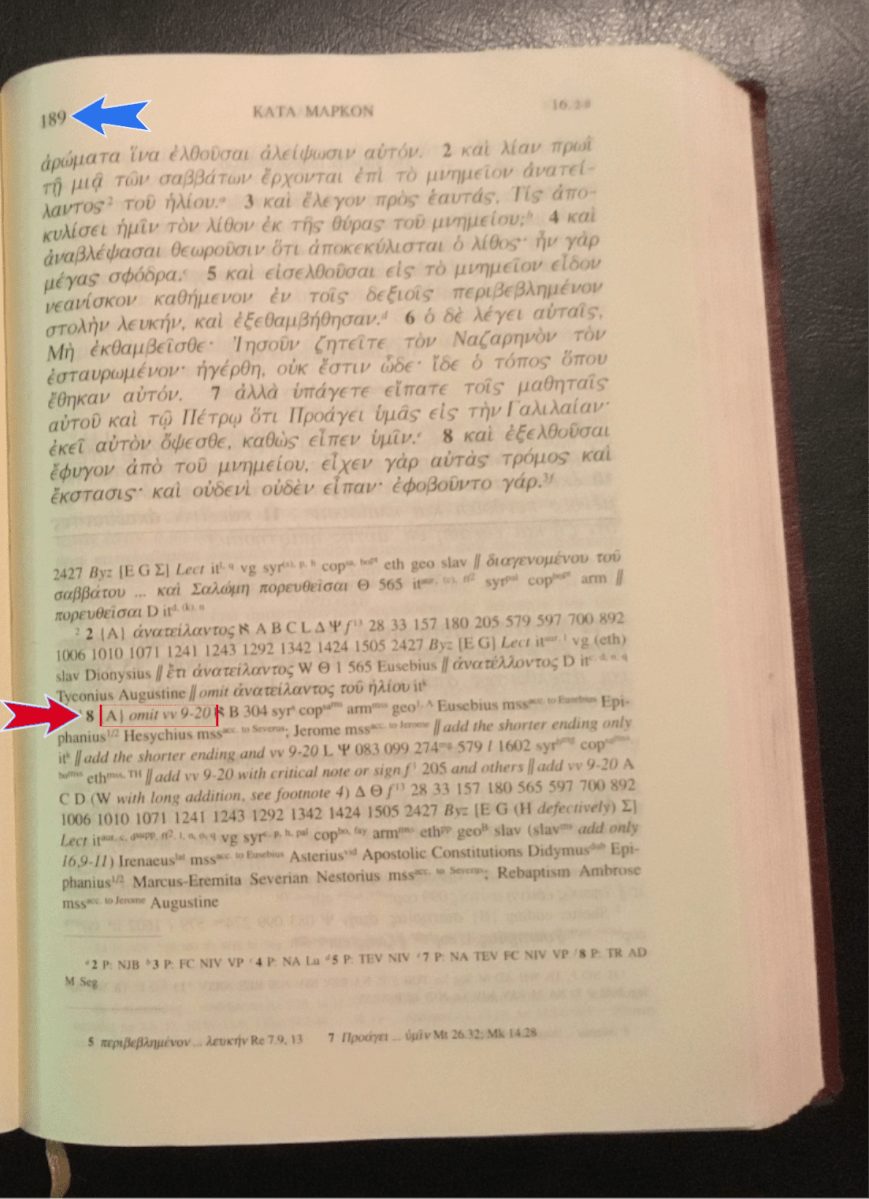
The image immediately above is a picture I took this morning of my UBS 4th Ed. Revised. It is a picture of Mark 16:2b-8. Note first the blue arrow pointing at the page number. The reason this is important is actually very simple. We are going to look at the very next page and see what that page contains, but first let’s take a look at the red arrow.

The red arrow is pointed to a portion of what is called the textual apparatus or the textual footnotes. Here text-critics include the manuscripts they consider relevant to the choice they made regarding a given variant. As most of you know the “Long Ending of Mark” is an infamous variant because Critical Text advocates believe it should not be in the Bible while TR advocates believe it should be in the Bible.

Take a look at what is in the red square, “[A] omit vv 9-20”. What does [A] mean? Well in the introduction of the UBS, the editors explain,

“The letter A indicates that the text is certain.”

UBS 4th Ed. Revised, Introduction, 3.

“[A] omit vv 9-20” therefore means to the editors of the UBS that they are certain that Mark 16:9-20 should be omitted from the biblical text because in their estimation it is not original. Again, the word here is “certain”. They have no doubt that the Long Ending in Mark should be removed from the text of Mark.

Not long ago I asked a Critical Text advocate why the Long Ending of Mark is printed in the modern versions. He said, “Because scholars are unsure whether the text is original or not.” Not according to the editors of UBS. They are certain the Long Ending does not belong.

Ok, so as promised let’s look at the next page and see what is printed there.

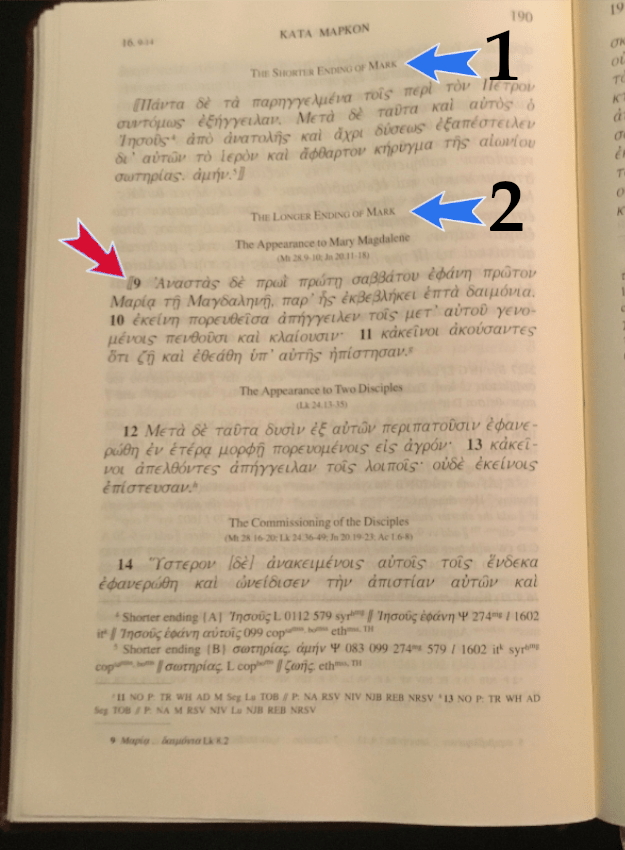
Notice at the top right of the page shown that we are now looking at page 190. What do you see printed in the body of the text? A second shorter ending as indicated by blue arrow 1, and right below that the Longer Ending as indicated by blue arrow 2. Both are printed in the body of the text.

Now there is a lot to disagree about here and I don’t want to diminish the gravity of those things, but it is important to note that the Longer Ending is printed in the body of the UBS 4th Ed. Revised even after the editors rated vss. 9-20 with an “A” to omit. That is, they are certain 9-20 does not belong in the text and yet the thing they are certain does not belong in the text…is in the text.

All that is done to differentiate this text, which certainly does not belong there according to textual scholars, from the rest of the text is to include a “[[” right before vs. 9 as indicated by the red arrow and a “]]” at the end of 20.

The point of this observation on page 190 is that text of the Long Ending is in the body of the New Testament even though the editors are certain that it does not belong there.

What about the story of the woman caught in adultery? Consider the following image,

Now you may not be able to read Greek but you can read the heading on this page, The Woman Caught in Adultery. Again from the UBS 4th Ed. Revised, we see that the story of the woman caught in adultery is printed in the body of the New Testament text as indicated by blue arrow 1.

Looking at the red arrow and the red box we see exactly what we saw with the Long Ending in Mark, “[A] omit 7.53-8.11]”. So again, the editors of the UBS are certain that the story of the woman caught in adultery does not belong in the text and yet they print the story and set if off with “[[“.

So, textual scholarship is certain that the Long Ending in Mark and the story of the woman caught in adultery are not original and therefore do not belong in the text, buuutttt they still print the certainly-not-original text in the body of the New Testament. And here is where the rub comes into the picture when answering my initial question at the top of this post, “Why is that such rancor, especially by Christian academics, is leveled at average Christians who hold to the TR and the KJV as their standard sacred text to the exclusion of all others?”

The TR and the KJV include both of these passages of Scripture in the body of the New Testament. Interestingly enough, the Critical Text and the modern versions include the same passages albeit with brackets in the body of the New Testament. This tells me that our Critical Text brothers are not or at least should not be upset with the TR/KJV folks for included these two passages in the body of Scripture.

The fact that most text-critics consider themselves to practice some kind of science yet their product [i.e., the printed UBS text] goes direct against their “scientific conclusions” [i.e., [A] to omit] makes their work, at a minimum, untrustworthy regarding these passages. I mean what other science does this and remains credible?

Chemistry: “Our investigation of Enchanted Thorium has concluded that it is not a real element.” ***2 months later*** “Enchanted Thorium is now included in the periodic table of elements.”
Biology: “Only women can get pregnant”***5 years later***”Men can get pregnant too.”
Textual Criticism: “The Long Ending is not part of the New Testament.”***1 year later***”Prints the Long Ending as part of the New Testament + a couple of these [.”

Then Critical Text advocates have the gall to call TR/KJV irrational and illogical while CT and multiple version only folks won’t even follow their own conclusions.

With the above point aside, where is the problem? What is the difference between our two positions? It’s not that we include those texts in the body of the NT. The UBS and the modern versions do the same.

We believe those texts are the word of God, should not be omitted, and therefore we include them in TR/KJV with an “[A] to include.” Our opponents on the other hand do not believe those texts are the word of God, that they should be omitted, yet they include them in CT and modern versions.

CT and multiple version only advocates have no problem including these passages in the New Testament so long as the reader believes/knows the passages shouldn’t be there. But when those passages are included in the text AND the reader believes/knows the passages SHOULD be there, then comes the rancor.

Why?

Because we have not appropriately bowed to the academic idols. Because we have not paid appropriate homage and obeisance to academia which looks like “taking their scholarly-word for it.” And their scholarly-word takes the form of first printing these passages in their New Testaments only to say, “Well, those readings are weakly attested” or “Those readings are not among the oldest, shortest, and hardest” or “Those readings are not contained in the best manuscripts.”

Then we say, “I don’t care if it’s weakly attested. And who is the ‘authority’ of what counts as ‘weakly’ anyway? And why is ‘authority’ binding on me?” or “I don’t regard oldest, shortest, and hardest to be reliable criteria for determining was is or is not the word of God” or “What gives you the authority to claim what the ‘best manuscripts’ are?” Language like this will only anger the academic gods.

I can’t help at this point to observe a similarity here with the emperor worship of the 1st and 2nd centuries AD. Rome did not care if you worship your God so long as you also worshipped the emperor. Modern textual critics don’t mind if you include these passages in the body of the New Testament so long as you also acknowledge their opinion that these passages don’t belong in the New Testament.

You can believe the KJV is the word of God so long as you also say most or all of the modern translations are equally the word of God. If you don’t say this here comes the wrath of the academic gods. You can say that the TR is the word of God so long as you speak of it only in terms of it being sufficiently reliable like all the other critical texts. If you say that the TR is equal to the originals, then here comes the that holy academic fire sent to purify you of your ignorance.

Which takes the form of chiding, silly jokes, lumping you in with double-inspiration, informing you that your position is ignorant, teaching as if there is no other meaningful position out there, refusing to print any of your material, when you submit material for publication you receive no meaningful feedback as to the veracity of your arguments, asserting that you’ve “got them all wrong” and thus you are doubly ignorant, telling you straight-out to “Get another version” as happened in my Ph.D. defense and on and on.

Failure to believe in the emperor as god meant death or exile.
Failure to believe in textual criticism means academic exile.

The TR/KJV position is not exiled because it includes the Long Ending of Mark and the story of the woman caught in adultery in the Bible. It is exiled because it does not submit to the prevailing academic consensus to omit those passages while still printing them.

If you believe these passages should be omitted but you desire to print them anyway, then you will be accepted.
If you believe these passages should be included and therefore print them, then you will be exiled.

So here’s your choice, gross inconsistency or exile.

See you on Patmos.

How to Study the Bible, or for all the secular-thinking Christian scholars out there, it’s not too late to get things right.

Hard braking

In the study of Scripture, the saint’s position is one of dependence upon God. Following the example of Samuel, our hearts say, “Speak Lord, for thy servant heareth.” Theologians are by necessity listeners. If there is no listening, there will be no knowledge of what the proper theological questions are. The fact that all knowledge must pass through the colored lenses of the fallen consciences, mandates the apriori recognition of this negative bias, and requires listening and submissiveness, not assertion and imposition to prevent transforming theology into anthropology.

The apriori of faith is the faith that precedes the evidence. The apriori of faith is described by the Latin term principium or the principle of theology. The principium refers to the beginning of theology, cf., John1:1, “In the beginning was the Word,” En arch o logoV. This “before the evidence” faith in God’s Word is the source of our knowledge of God. Theology has two principia or fundamental principles of theology: Scripture and God — the revelation and the one who reveals himself and was divided into a study (locus) of Scripture and a study (locus) on God. This “beginning” brings us to either embracing it by faith or rejecting it. Faith is a response to hearing God’s word, but we cannot demonstrate the Bible is God’s word from a neutral vantage point. A meaningful explanation of the special principle can only occur within those who hold God’s Word to be true because the claims of the text are our only source of knowledge of God.

Calvin in the Institutes, 1.4.15 demonstrates that man’s mind is a non-stop factory of idols, materially and intellectually and therefore what we think, our opinion, feelings, sentiments, etc., are irrelevant to orthodox exegetically based theological formulation. [John Calvin, Institutes of Christian Religion, edited by John T. McNeil, translated by Ford Lewis Battles (Philadelphia: Westminster Press, 1960), 1.4.15: “For at the same time we have enjoyed a slight taste of the divine from contemplation, we raise up in his stead dreams and speculations of our own brains, and attribute to anything else than the true source the praise of righteousness, wisdom, goodness and power.”] We must think about God the way He wants us to think about Him. We must see God “with the aid of spectacles,” or in the pages of His Word. We are not to master God but are to be mastered by Him and in the submission of listening spiritual renewal comes to the student. Thus, a right approach to the principium is imperative for our learning and spiritual well-being.

The Necessity of Humility and Repentance

The holiness of God requires that all theological thinking is penitential (begging God for forgiveness) thinking. The student of God’s Word is to study to be humble and repentant. As such, theology has its proper goal in doxology that can be summarized “Theology is worshipping God with your entire mind.” Where sin is entertained, spiritual renewal and the knowledge of God is dissipated and vice versa. True worship, then, is grounded in true theology – Scripture based worship.

In Scripture, theology is set in the sphere of doxology. The psalmist writes in Psalm 27:4, “One thing have I desired of the Lord, that will I seek after; that I may dwell in the house of the Lord all the days of my life, to behold the beauty of the Lord, and to inquire in his temple.” The “house of the Lord” has always been the best place to do theology. Which begs the question as to where the seminary stands in relationship to theological work. It is here, in the Church, that there is a union of the quest of the intellect and the heart. In the ‘house of the Lord’ the beauty of God is manifested. Worshipping and praising God with the entire mind protects the student from deviating from a Theo-centric to anthro-centric theological formulation. True worship springs from a mind wholly given over to hearing what God says in His Word. Within the sphere of listening to God and worshipping Him, the believer learns the truths that God has already revealed about Himself. The writing down of those things learned within this doxological context and spiritual exchange is orthodox theology.

A Recent Interaction With Mark Ward

Whether on YouTube or a blog you can always listen to/read what the author has to say and then you can scroll down to the comments. Depending on the topic and the people that make their way to the comments section, sometimes the comments can be helpful and sometimes you can read threats of bodily violence. In short, if the internet is the Wild West then the comments section is the O.K. Corral. You can watch but the longer you do the chances of getting hit with a stray shot or two begin to escalate. Peruse at your own risk.

In a recent post I critiqued Mark Ward’s broader thesis as well as several specifics. First, Ward’s comments are always welcomed here. We disagree and quite sharply on several points, but I am thankful for his interactions. Second, occasionally Ward does make his presence known here in the comments section. Over the last couple days we have had, I think, a profitable back and forth which aptly shows each of our positions and subsequently the differences of our positions regarding his thesis of false friends and the casting off of the AV. The discussion to this point went as follows:

WARD: I am mostly content for people to listen to what I say, listen to what you say, pray, read their Bibles, and come to their own conclusion.

The only place I’d like to offer follow-up is on what you said here:

“The reason why the KJV is archaic is not because it is archaic in itself but because for the last 150 years scholarship and her ecclesiastical acolytes have variously redirected the attention of God’s people to other Bibles and as such the language of the standard sacred text has fallen out of use both in the church and day-to-day living.”

If this is the case, Peter, why did Noah Webster complain of many of the same false friends—in almost precisely the same way I did—way back in 1833, when the KJV was still the universal standard? Webster actually updated the KJV, and he wrote in the preface to his update:

“Some words have fallen into disuse [dead words]; and the signification of others, in current popular use, is not the same now as it was when they were introduced into the version. The effect of these changes, is, that some words are not understood by common readers, who have no access to commentaries, and who will always compose a great proportion of readers. While other words, being now used in a sense different from that which they had when the translation was made, present a wrong signification or false ideas [false friends!]. Whenever words are understood in a sense different from that which they had when introduced, and different from that of the original languages, they do not present to the reader the Word of God.”

A substantially less godly source, Benjamin Franklin, said something similar 50 years prior to Webster:

“It is now more than 170 years since the translation of our common English Bible. The language in that time is much changed, and the stile being obsolete, and thence less agreeable, is perhaps one reason why the reading of that excellent book is of late much neglected.”

Language changes over time, my friend. It isn’t my lack of sanctification or Christians’ past apostasy that led me to be ignorant of the words “fitches” (Ezk 4:9), “flakes” (Job 41:23), and “furbish” (Her 46:4). The reason I did not know these words was that I don’t speak the same English used by the KJV translators.

VAN KLEECK: Mark, as always it is good to have you make your presence known on the blog here.

Unfortunately your appeal to Webster and to a lesser degree Franklin is to really betray your position’s rather myopic approach to history and specifically the Bible in history. I do not doubt Webster said those words and sincerely carried that sentiment regarding the AV. What it seems you have wholly missed is that by the time Webster gives that quote the ground and structure for modern textual criticism was already built by Lochmann and Griesbach. What is more Wescott and Hort’s work is only a couple decades in the future from Webster’s quote. The world at that time was ready to mistreat the Bible. Webster is merely a symptom of that reality.

Furthermore, by offering this historically uncontextualized quote simply to try to leverage an appeal to authority it seems clear to me that you have not read Carl Trueman’s Rise and Triumph of the Modern Self. Else you would have realized that the mid-19th century was the place where the soul of Expressive Individualism came to be. Expressive Individualism regards the Bible and Christianity as a thing to be admired then conquered – a Deathwork. Right around the time you pull this quote from Webster, Marx is writing making the case that religion is a drug and must be overthrown. Rousseau has already laid the ground for Emotivism. The Bible is already under attack by the work of Greisbach and Lochmann and soon by Wescott and Hort. This time also included the work of Percy Bysshe Shelley which popularized the idea of sexual freedom, emancipation from religion, and the rise of Expressive Individualism. Only 20 years after your quote here the world of science was ready to hear Darwin’s theory of Biological Evolution. What is more, because of the men here named, in a generation or so the socio-cultural religious ground would be ready for Freud and his insistence that religion is mere wish fulfillment.

Then you quote Franklin who was at best a Deist who would regard the Bible as a hinderance to certain of his moral choices shall we say. Simply put, he would have an axe to grind with the Bible.

So are we to believe that Webster was untouched by the sinister evil rising up all around him in economics, textual studies, psychology, biology, and poetry? Trueman, a world renowned Church Historian says that all of us, including those in the present day Church are Expressive Individualists and don’t know it. So I infer, “No, Webster did not remain untouched by the evil around him.”

So all you’ve done by quoting Webster and Franklin is show that your arguments are strongly in line with those in the 1800’s who sought to diminish and destroy the power and value of God’s word for the Church and for the West and whose work has indeed done that and caused the Church great harm. And what is worse, you don’t appear to have the slightest idea that you have done so.

I fear your attempt to support your position by “proof-texting” Webster and Franklin has only shown that you neither understand your position nor do you understand mine.

WARD: Here is my published review of Trueman’s book: https://seminary.bju.edu/files/2021/04/JBTW1.2-Book-Reviews.pdf

Now: can I get some clarity? Are you saying that the word “besom” changed to “broom” ultimately because of the rise of unbelief in post-Reformation Europe? That the phrase “by and by” once meant “immediately” and now means “eventually” in part because of expressive individualism? That English would not have changed—we’d all be speaking and writing like the Elizabethans now—if the English-speaking world had remained consistently as Christian as it was in 1611?

How about words and phrases that do not occur in the KJV whose meanings have changed? Were those changes morally licit? To pick an example I noticed recently on a BBC show my wife and I enjoy, was it wrong for some English speakers to start calling a “slaughterhouse” an “abattoir” instead? Or, probably a little more germane, you used the word “enthusiasts” in this post, and you used it (quite naturally, as I would expect) in its contemporary sense: “a person who feels or displays keen interest in, passion for, or enjoyment of a particular activity or subject” (OED). But the OED says that this sense is comparatively recent, that in 1611 the word would have normally been used to refer to “a person who falsely or erroneously claims to receive divine communication or inspiration.” Or perhaps “a person (supposedly) possessed by a god, demon, spirit.” The use of “enthusiast” has changed over time. You used it in a modern sense that came about only after the rise of the various kinds of unbelief you’ve named. Shouldn’t you insist on using it in the historical way, and reject any new sense(s)? With proper time, I feel quite certain I could repeat this exercise dozens of times—probably hundreds—using words from your blog. Language changes, Peter. Sometimes ideological forces push it, but usually not. I read an entire detailed Greek grammar in seminary (Nigel Turner on Syntax) that repeatedly said the same thing: “This construction used to have a more specific meaning in the Attic period, but this meaning had eroded by the Κοινή period.”

Peter, these are honest questions as far as they go. Not honest in the sense that I’m open to persuasion to the view I believe you are putting forward: I find your view of language change to be so baffling, so counter to everything I know about language, that I find it impossible to imagine entering your world. What you’re saying is, frankly, to me, completely bizarre. I don’t think even you can live in the world you’ve created, hence my argument about “enthusiast.” But my questions are honest in the sense that I’m open to the idea that I’m just misunderstanding you.

A final note: I ask that you get into specifics and not generalities. Talk about individual KJV words. I have 57 false friends on my YouTube channel. I talk specifics. To your credit, you’ve done some of that, too—more than almost all my opponents in this debate. And I do still hope to offer some thoughts on your lists of archaic words found in contemporary Bible translations. I think that is a fair argument strategy. And it gets into details in a way this philologist can appreciate. Help me understand you here, Peter.

VAN KLEECK: > “Are you saying that the word “besom” changed to “broom” ultimately because of the rise of unbelief in post-Reformation Europe? That the phrase “by and by” once meant “immediately” and now means “eventually” in part because of expressive individualism? That English would not have changed—we’d all be speaking and writing like the Elizabethans now—if the English-speaking world had remained consistently as Christian as it was in 1611?”

No, I’m saying something far more modest. I’m saying that these old words should still bear their meaning in addition to the meanings they currently have. For example, “by and by” would mean “immediately” and “eventually” depending on the context. Thus the English would become more robust, more diverse, and more beautiful.

On the point of “enthusiast”, I hold all the definitions you mentioned to be viable definitions because such definitions are used regularly in the writings of the translations of the Reformers. Turretin comes to mind here [1]. Again, you seem bent on excluding definitions for a given word while I am for the broadening of definitions. A word can have more than one meaning. The context limits the meaning of a word.

It seems to be a manifest truth that we are closer now to 1984’s Double-Speak than we are to Shakespeare’s English. I attribute this to, among other things, the rise of Rationalism and specifically the Enlightenment and its fruits. Trueman observes such downgrade in the fields of politics, sexuality, economics, biology, and psychology. His conclusions seem equally applicable to Post-Enlightenment textual criticism of which your position seems to be of the same species though more tepid.

Mark, it seems to me that the reason you cannot “enter into my world” is because your entire position is bent on the supposed virtue of truncating the English language. My response is that all the words you have referenced could be and in many places still are used e.g., in pulpits where the KJV is preached out of. Indeed, the real virtue is in retaining the words and in retaining the meaning of the words in the KJV along with the words and meaning of the words currently held.

In the end, my position contra yours has little to do with textual criticism. Rather, my opposition to your arguments is grounded in my philosophy of education. Part of that philosophy is that having less words in the English language is a bad thing. Having more words is a good thing. Less meaning given to a word is a bad thing. More meanings given to a word is a good thing. It is virtuous/excellent to expand our vocabularies, expand our understandings of words. Your position on the other hand recognizes the deterioration of the English language and instead of trying to stem the tide you are simply going with the flow which I think is bad enough. But then you ask others to follow your lead and question the reliability of the KJV while your at it.

On another point regarding my philosophy of education, the word for school comes from the Latin, scholae. Scholae means leisure. Only those who have leisure have time to go to school. When you aren’t fighting for your life, constantly hunting for food, or searching for clean water you have time for scholae. The American Church has more scholae than any other Church in the history of mankind. But instead of learning more words and more meaning of words, the American Church finds other more important things to do like calling the Creation story mytho-history, or binging Netflix, or watching hours of every sport imaginable and on and on. Many Christians can hardly use their scholae to attend one church service a week, or hand out one track or say one word for Christ or pray over their food in a public place.

Then comes your arguments which make excuses for why the Church’s misuse of scholae has nothing to do with why they don’t understand the KJV. In fact, anytime myself or Riddle challenge your suppositions with “study more” you treat our challenge with nothing more than a hand wave. In this sense, your arguments contribute to the American Church’s misappropriation of scholae and do so without even touching the breaks.

And why is it that the American Church so regularly misappropriates her scholae? Consumerism, Expressive Individualism, political entities have become her socio-cultural savior [Obama or Trump depending on which side of the isle you affiliate with], church-hopping, pastor-hopping, church services centered on emotionalism, and on and on are all culprits in the degradation of American culture, society, and church. And instead of resisting this degradation, your arguments make way for it with something like, “Hey if the plowboy of this degraded American culture, society, and church can’t understand the KJV the answer is not to employ the plowboy’s scholae in learning it. No, the answer is absorb the plowboy’s degraded American culture, society, and church, and choose a Bible more consistent with that degradation because then he’ll understand the Bible.” Which of course only kicks the can down the road where your kids will have to fight the next downgrade, but such things don’t appear to be on your radar.

There is so much more I have to say on this topic. I am disappointed that “everything you know about language” does not seem to include the broad reaching socio-cultural and ecclesiastical affects of your arguments. The assault on the KJV is more than an assault on a version of the Bible, it is an assault on the very precondition of truth for Western society of the last 400 years.

[1] Francis Turretin, Institutes of Elenctic Theology vol. 1, 71. “Unless unimpaired integrity characterize the Scriptures, they could not be regarded as the sole rule of faith and practice, and the door would be thrown wide open to atheists, libertines, ENTHUSIASTS and other profane persons like them for destroying its authenticity (authentian) and overthrowing the foundation of salvation. For since nothing false can be an object of faith, how could the Scriptures be held as authentic and reckoned divine if liable to contradictions and corruptions? Nor can it be said that these corruptions are only in smaller things which do not affect the foundation of faith.” [Capitalization and italics are mine]

13 Things To Remember When You Do Your Undergraduate or Graduate Work

These 13 things have coalesced over many years of undergrad, grad, and post-grad college and seminary education. After reading what Dr. Van Kleeck wrote regarding young men throwing off their early theological training for their professors’ lectures, I thought this to be a timely list. This is not comprehensive, but it has been very helpful negotiating the academic minefield that is higher education.

  1. The professors owe you an education. You are paying dearly for it. Your family is under time, financial, and personal pressures. They are there to teach you because you have paid them to do a service.
  2. Because they owe you an education because you are paying for it, there should never be a question that they are unable to answer. They are being paid to answer your questions. The notion that they are above this help is an indication of the Professor’s misguided sense of his role in the teaching process.
  3. The syllabus is a contract that is not to be violated. You are going to schedule your life around its content – when tests are given, when papers are due. The professor is not free to change the contract in mid-semester.
  4. Professors are not your friends. They may be gracious, but you are just one student among countless others. To give your allegiance to them rather than to those who really love you (your pastor or parents) is misplaced loyalty. The loyalty they hope to engender in you is to demonstrate that they can extend their ideas through you.
  5. The only difference between you and the professor is time. Given enough time you will be able to read, study, and digest everything they have. Professorship is not another thing; it is just part of the same continuum you are on.
  6. A professor can be just as full of nonsense as anyone else. The degree makes them informed, not wise.
  7. Good students are critical thinkers and would never go along with a lecture simply because it was given by a Ph.D.
  8. Don’t be hesitant to disagree with your fellow students cordially but strongly. Publicly debate with them; test your argument; see if your position holds up under scrutiny; grow in your self-assurance that what you are saying is not only consistent but undefeatable. If your argument holds up under scrutiny in grad and post-grad school, responding to objections after graduation will be to rehearse proven arguments.
  9. Take the good and filter out the bad. Professors and institutions have varying skill sets and capabilities. Not everyone you study under is worth your time. Use the institution to accomplish what you want out of it.
  10. If you’re not echoing the institutions status quo, it is especially important that you are not happy with anything but “A’s.” If you claim to have the truth but your work is deficient, it’s hard to convince others that you know what you’re doing.
  11. If your goal is to be approved of by the Institution, you have already forsaken the critical spirit necessary to get the most out of your education. This is when the term “inbred” is applied to professors who receive all their education at the Institution where they presently teach. Such lectures are predictable, and the student’s response to the lectures are also expected to be predictable.
  12. Never turn in a late paper.
  13. The one truth that can never be forsaken, is that the Bible is without error. This one truth will enable you to thrive in a critical academic environment.

The Emotional Trauma Behind the Textual Confidence Collective

Having watched the first episode of Mark Ward’s Textual Confidence Collective it seemed to me that all those involved, with possible the exception of Hixon, were taught poor Bibliology. That Bibliology could not stand significant scrutiny which led to traumatic experiences for at least Mark, Peter, and Timothy. For the latter two there was familial upheaval where they were accused of apostatizing from the faith by varying degrees.

It seems that their turn from KJV-Onlyism happened just prior to their enrollment in higher-education or at some point during their higher-education experience. Again, this turn left them as Christians exposed to all sorts of theological dangers and uncertainties. To the man, they went to schools that embraced modern textual views on the manuscripts and the version issue but they were without an anchor in Bibliology because the Bibliology they were taught as young men basically disintegrated out from under them as it fell under academic scrutiny.

But while in college or seminary each man found greater stability in the position of their professors and in the modern books that they read when compared to the Bibliology they were taught as young men. Admittedly, modern text-critical arguments have explanatory force and scope in ways KJV-Onlyism does not.

Unfortunately, the members of the Collective now cling to that stability like the KJV position they formerly and desperately clung to. I can’t help but see the comparison between the journey of those in the Collective and that of Bart Ehrman. Ehrman was once an evangelical going to trusted evangelical institutions of higher learning, as Mark Ward likes to prop up.

One day Ehrman’s understanding of Bibliology did not stand up to academic scrutiny, in fact some professing evangelical scholars undermined his understanding of Bibliology, and so Ehrman began to doubt the Bible and naturally began to doubt Christianity seeing that Christianity is wholly based on the Bible. Now Ehrman is a leading scholar in the field of textual criticism and a staunch opponent of Christianity.

Those in the Textual Confidence Collective seemed to have a similar journey, though by God’s grace they did not come to doubt all of Christianity when their Bibliology failed even though “doubting all of Christianity” is the logical next step when one’s epistemological ground [i.e., the Bible] is doubted. Still, instead of building a robust Pre-Enlightenment Bibliology/Reformed Bibliology they embraced much of Ehrman’s position with some Christianity sprinkled in. In short, the Collective went from the frying pan into the fire.

Of course, the benefit of the Collective’s current position is that most academics think what they think so they have more friends and it is also a much safer place for them versus being out on the fringe of KJV Onlyism. The problem is that the place where they landed is equally as wrong but nearer the liberal distinctively non-Christian side of the pendulum swing. In sum, they’ve traded one bad Bibliology for another.

The primary lesson we learn from this is that families and specifically dads need to teach their kids the truth with all of its difficulties and nuances. This means that dads need to take the time to learn all the difficulties and nuances of the things their family needs to know and of the things which come to challenge his family in our current socio-cultural context.

It is interesting, in Paul Vitz’s book, Faith of the Fatherless: The Psychology of Atheism he examines the lives of famous atheists up until modern day and makes the argument that a major contributor to an athiest’s atheism is the fact that he often has a bad relationship with his earthly father which contributes to his rejection of his heavenly Father.

After hearing the testimonies of the Textual Confidence Collective I could not help but see the correlation with Vitz’s book. Certainly we cannot teach our children all they need to know to live a full Christian life but we can lay solid nuanced groundwork while keeping the lines of communication open with our growing children. When we fail as dads it is clear that our failures can and in many ways do adversely affect Christ’s Kingdom.

Dads, stay vigilant. Seek the truth. Buy the truth. Sell it not and by God’s grace neither will your children.

Does the Devil Just Hold to Textual Variants?

Gen. 3:4, And the serpent said unto the woman, “Ye shall not surely die.” In this passage Satan contradicts the word of God in Gen. 2:17, “for in the day that thou eatest thou shalt surely die.” Considering the latitude given Evangelical text critics and in the spirit of giving them the benefit of the doubt, perhaps it is time to do the same for the devil. After all, contradicting God’s word is a common practice of those who claim the name of Christ while maintaining a critical approach to the Scripture. For instance, consider the normative negation of God’s command found in Deut. 12:32, “What thing soever I command you, observe to do it: thou shalt not add thereto, nor diminish from it.” Contradicting the word, once considered a work of the devil has gained respectability among the ecclesiastical intellectual elite and wandering sheep. And in this sphere of respectability, perhaps its time for the ecclesiastical social imaginary to recognize and accept the intuitive congruence between scholars and the devil. Maybe it’s time for a kinder, gentler approach to the devil; after all the contradiction of God’s Word has become so common place as to make it part of the fabric of modern ecclesiastical social imaginary. A less hypocritical Church would also be less critical of the devil.

Also note the devil’s quotation of Scripture in Luke 4:10, “For it is written, He shall give his angels charge over thee, to keep thee. And in their hands they shall bear thee up, lest at any time thou dash thy foot against a stone.” First note that the devil introduces the quote from Psalm 91:11 in the same manner as does the Lord in verse 8. This shared convention of informing the reader that what follows is drawn from the Old Testament should be the first consideration why the modern Evangelical reader should consider tempering his/her attitude toward the devil as a negative influence. After all, the devil’s introduction to the Old Testament citation is exactly that of the Lord.

Secondly, please note that Psalm 91:11-12 is in the Hebrew text is 14 words:

כי מלאכיו יצוה-לך לשמרך בכל-דרכיך

על-כפים ישאונך פן-תגף באבן רגלך

In the BHS there is no entry in the critical apparatus for either verses 11 or 12; there are no other contending readings, LXX or otherwise, to the Hebrew text in these verses. The LXX in Psalm 91:11 is consistent with the BHS and reads, ἐν πάσαις ταῗς ὁδοῗς σου, “in all the ways of you” or “in all thy ways.”

Of the 14 words the devil omitted only 2 — בכל-דרכיך – “in all thy ways.” That is, the devil quotes the Scripture correctly 86% of the time, only deviating by the omission 14% of the time. This high ratio should fall under the accepted category of sufficiently reliable. Additionally, the omission “in all thy ways” could easily be considered superfluous. In the angelic realm, “in all thy ways” should be understood considering what the Scripture tells us about the power of angels. “In all thy ways” falls under the paradigm of changes that do not affect sound doctrine. There is a high degree of intrinsic probability of “in all thy ways” being inferred by what the devil said without the necessity of it being restated. Thus, to quibble negatively about the devil’s omission creates more heat than light.

And thirdly, what then, can we make of the claim made by the Apostle John in the Apocalypse chapter 12, verse 9, “And the great dragon, was cast out, that old serpent, called the Devil, and Satan, which deceiving the whole world: he was cast out into the earth, and his angels were cast out with him.” Is the omission of “in all thy ways” really some kind of well-played, subtle, demonic deception meant to undermine God’s Word or merely an insignificant textual variant? Considering the continuity between the words of the devil in Luke 4 and the words of Moses in Psalm 91, and the relative insignificance of the omission, it would be reasonably difficult to argue that the exclusion was any part of a grander scheme in “deceiving the whole world.” It seems reasonable that within the relative degrees of doubt allowed by the editors of the UBS Greek text, the devil should be allowed equal latitude without accusing him of the moral sin of deception. Before harsh judgments are made, the devil’s omission should first be given minimally either a C or D rating or a conjectural emendation. Additionally, the devil may have access to more ancient manuscripts not yet discovered. It only seems like the fair-minded, balanced, scholarly thing to do. After all, in the current social imaginary of the Therapeutic man our teleological perspective should focus on pleasing each other’s feelings.

Ward Continues to Show Himself To Be Out of His Depth

Ward recently offered reasons for why he believes KJV-Onlyism and Confessional Bibliology are for all intents and purposes the same argument. Dr. Riddle took the opportunity to help Ward with his confusion on this point in a recent Word Magazine episode. Below is a video of that episode where Riddle carefully works through the fallacy of Ward’s conflationary and unfortunate assertion.

Ward continues to show himself largely out of his depth in dealing with Confessional Bibliology, Reformed Epistemology, Reformed Bibliology, and apparently even KJV Onylism given his penchant to equate KJV-Onlyism and Confessional Bibliology.

To make matters worse, in addition to Ward being out of his depth so frequently, there seems to be blood in the water around Ward’s entire enterprise. All major elements of his argument [e.g., false friends, KJVO/Confessional Text equivalence, and textual confidence etc.] have been eviscerated under only mild scrutiny.

Thanks to Dr. Riddle for his patient and careful treatment of Ward on this point. Check out more of Riddle’s work here: http://www.jeffriddle.net/

A Recent Discussion with Elijah Hixon (Part 2)

In yesterday’s post I shared a portion of a discussion I had with Dr. Elijah Hixon over the weekend on Mark Ward’s Facebook wall. Here is the rest of that discussion.

_______________________________________________________________________________

Hixon: Peter Van Kleeck Thanks for this. Your reasoning with your credentials sounds a little close to saying I should trust that you’re right because you’ve been “validated by the best institutions of the day.” No, I’m saying that I’m an active researcher in that area, and I’ve read your descriptions, and they are not accurate. It’s not my job to do your homework for you. If all your degrees haven’t been enough to give you an accurate understanding of textual criticism, then maybe there is another problem (such as a problem with your approach to studying it). Again, this isn’t a problem with Byzantine prioritists, so it’s not that someone has to agree with mainstream textual criticism to be able to understand it.

That being said—by your logic, it seems that you are suggesting that the vast majority of Christians are not following the Holy Spirit, and you and a small band of TR defenders are alone trying to fend for God. Both can’t be right in the way you define it, so am I without the Holy Spirit? Are all those Christians worshipping Baal? My argument is not majority=right, it’s “1. you’ve made a claim that only Christians can hear she Shepherd’s voice in the Scriptures, 2. You have defined “the Scriptures” in such a way that the ESV, CSB, NIV, etc. are excluded,” so 3. it’s hard to escape the conclusion that to be consistent, you must be implying that none of us are regenerate or are at least living in sin and deaf to the Spirit’s voice, so what do you do with that?” Again, Jesus said ye shall know them by their fruits, and the fruits of TR advocates when it comes to this issue are regularly rotten in a way other believers’ fruits are not—so why not consider that either you haven’t defined “Scriptures” accurately, or perhaps it is your camp that is blinded by sin on this issue and not the millions of others who (in my experience) usually default to trusting the (modern) Bibles in their hands until someone like you tell them not to?

//To claim that textual criticism done on New Testament is not an “explicitly theological setting” is perhaps the greatest distillation of why the position you hold is confused, dangerous, and must be refuted. The New Testament is by its very nature theological in a way that nothing else in the world is. Yet by your words, you believe the opposite. Indeed, you believe what is clearly false by the lights of elementary Christian teaching.//

No, see this is just plain wrong, and it’s a very uncharitable way to read what I said. As I mentioned above—”Augustine put it well: an author can only be understood through friendship.” If you’ve decided beforehand that anyone who disagrees with you is an enemy and an opponent and “must be refuted”, do you have the humility to see what they believe as it really is? Do you know what most text-critical research is? I wrote a whole book on scribal habits in the 6th-century that has almost nothing to do with what the original text *is*, and it’s been decently well-received as text-critical research because outside of editing editions or arguing for one reading over another (which are other matters altogether), most text-critical research is actually historical work with historical documents and looking at what was happening historically. For example: “here’s a collation of all the manuscripts at John 18” (and it is not inherently a theological exercise to record what words are on a manuscript and what words are not, other than that everything we do should be done with God in mind), or “here’s a set of manuscripts that were copied from other known manuscripts, and here’s how that copy-process went.” Or: “here’s a new manuscript we just discovered—here’s what its text is and here are some notes about how it agrees/disagrees with other manuscripts.” Does someone need to be a Christian to be able to accurately say what letters a manuscript has on it, or do they need to ground those claims about what letters are on a manuscript in Scripture? Your comments are dangerously close to Prov. 18:2: “A fool hath no delight in understanding, but that his heart may discover itself.”

Van Kleeck: Elijah Hixson > “Your reasoning with your credentials sounds a little close to saying I should trust that you’re right because you’ve been ‘validated by the best institutions of the day.'”

All I was trying to communicate is that I have experience with it and I have come to the conclusions that I have. You say, my conclusions are wrong. Demonstrate it.

> “That being said—by your logic, it seems that you are suggesting that the vast majority of Christians are not following the Holy Spirit, and you and a small band of TR defenders are alone trying to fend for God.”

No, this is not what I am saying. My argument on this point is one of sanctification not salvation. I believe you are my brother in Christ, but I also believe the position you hold lacks necessary and proper exegetical and theological underpinnings. Simply put, your thoughts on the version issue, not being in submission to and grounded in Scripture are not in captivity to Christ [2 Cor. 10:5] i.e., are not sanctified. [Note how I pointed out how your representation of my position is inaccurate without pulling the go-do-your-own-study-and-find-out-for-yourself card.]

>” If you’ve decided beforehand that anyone who disagrees with you is an enemy and an opponent and “must be refuted”, do you have the humility to see what they believe as it really is?”

No, again I think you misunderstand me. I do see you as a brother and as a friend/professional acquaintance. This is what real friends do, they challenge each other. Iron sharpens iron [Prov. 27:17]. This is a metaphor that includes considerable friction, collision, and/or confrontation. Paul was no enemy of Peter when the former withstood the latter to his face. I do not equate disagreement with being an enemy. In fact, I find it as a mark of brotherhood in Christ and brotherhood in humanity. Rather, it seems that you do. It has been my experience that defending the TR and KJV has only been met with jesting and derision because descension on this point is largely unallowed in academic circles. [See our current discussion/thread for examples and the jesting in the OP article.] If there is anyone who has equated “disagreement” with “enemy” it is the Critical Text position and especially in academic environments.

>” I wrote a whole book on scribal habits”

If we are talking about textual criticism of Plato’s Republic then Christian theology is less germane. If we are talking about textual criticism of the Acts of the Apostles, then the work is necessarily theological in nature. New Testament scribal habits are by default theological habits because said scribes are copying the New Testament. Any work with the New Testament is necessary and properly theological because the New Testament is and can be nothing other than at the ground of Christian theology.

> “For example: “here’s a collation of all the manuscripts at John 18″ (and it is not inherently a theological exercise to record what words are on a manuscript and what words are not, other than that everything we do should be done with God in mind)”

Again, rather than backing up you seem to be digging the hole deeper. Manuscripts of John 18 are not merely historical artifacts. They contain the inspired words of the Creator God graciously given to fallen man for the salvation of his soul and as a guide for all life and practice. To treat them as mere artifacts to be collated is to treat them as something they are not. Manuscripts of John 18 are records of divine words from the one living and true Triune God. So where Ward calls us to look to men to give us God’s word, you unabashedly and repeatedly affirm that God’s words can and in certain academic circumstances should be treated as mere artifacts for collation and comparison.

>”Does someone need to be a Christian to be able to accurately say what letters a manuscript has on it, or do they need to ground those claims about what letters are on a manuscript in Scripture?”

I’ve never made this claim. Certainly, non-Christians can count and collate manuscripts. What they cannot do is know and therefore tell us what is the word of God and what is not.

>”Your comments are dangerously close to Prov. 18:2: ‘A fool hath no delight in understanding, but that his heart may discover itself.'”

So I make the claim that perhaps you need to grow in the sanctification of your mind on this topic and you infer that my comments put me on the verge of being a fool which Christ expressly warns against you doing in the Sermon on the Mount [Matt. 5:22]. This is exactly that cool, calm, even-tempered, text-critical attitude that I’m used to. Thanks for making me feel right at home.

This conversation is and continues to be very fruitful for me so, thank you. I applaud your candor and appreciate the fact that those reading this can observe the readiness wherewith your position casts off exegetical and theological moorings in order to maintain that position. It makes my job much easier.

Hixon: Peter Van Kleeck Thanks for this. I have already hinted at a correct representation of textual criticism, and you have rejected it—let believing text critics be Christians. As far as my own position on the version issue, I do think it is grounded in Scripture. You are free to disagree, of course.

At first, I spoke of research published outside of an explicitly theological setting, and you claim that this is unscriptural and needs rebuke, but then you agreed with me: “>” Does someone need to be a Christian to be able to accurately say what letters a manuscript has on it, or do they need to ground those claims about what letters are on a manuscript in Scripture?”

I’ve never made this claim. Certainly, non-Christians can count and collate manuscripts. What they cannot do is know and therefore tell us what is the word of God and what is not.” [and the language of “tell us what is the word of God and what is not” definitely deserves its own discussion, but that’s another can of worms]

You’re missing the point—most text-critical research is *not* saying anything about what is and is not the [ontological] Word of God. By your own admission, non-Christians *are* able to do that kind of work. That seems to allow Christians to also publish the same kind of research in the same kinds of settings without being unChristian the same way that as a Christian I can drive a car, just like a non-Christian can. I might have a different set of underlying beliefs accompanying my drive, but that doesn’t mean I can’t drive a car without first putting a Jesus fish on the bumper or turning the key in some distinctly Christian way.

I‘m not sure how to read your objection to the manuscripts though, because throughout your book, you’ve given me the impression that two things can’t be the same thing in the same way at the same time, and from that, you conclude that the ESV, TR, NIV, etc. can’t be the Bible in the way the TR is. If that is true, then those manuscripts of John 18, etc. are *not* the words of Scripture (by your definition) because they don’t completely agree with the TR. Sure, they have some words of Scripture in them, but if I understand your definitions right, they can’t be Scripture because there aren’t any that agree fully with the TR, and if they aren’t Scripture, then is it really a theological exercise to study them? If they are *sufficiently* Scripture, then sure, but that undercuts your position’s ability to exclude things like the ESV, NIV, NASB, etc. As to my own position, I allow something to be sufficiently Scripture such that I *do* consider them to be the words of Scripture, but my definition of ‘sufficient’ allows fallen man to have made mistakes that aren’t powerful enough to thwart God’s purposes.

All that being said, we still have the issue that things like recording what readings are found in what manuscripts is most of the work text critics do, which is not the same as saying what is and is not God’s Word, unless you have some postmodern view of the text that says all manuscripts are equally God’s Word (distinct from my position that due to the providence of God in his preservation of Scripture, all manuscripts are *sufficiently* God’s Word). So on the one hand, you say that scribal habits *is* theological because it has to do with how God’s Word was copied, but on the other hand, you seem to say that unbelievers can do anything with manuscripts but know what the original text is—I don’t get it. Scribal habits themselves don’t tell you what the original text is; they have to be applied. Moreover, throughout the Scriptures we see God using non-believers to accomplish his purposes. Sure, it would be ideal if everyone was a believer, but that doesn’t mean God can’t (and doesn’t) use non-believers.

No, I don’t affirm that artifacts of God’s Word *should* be treated as mere artifacts—at least not as a Christian. Nothing we do should be done as if God doesn’t exist (just like I don’t think we should drive cars as if God doesn’t exist), yet you still accuse me of believing that. That being said, I do think God’s word is powerful enough that manuscripts of it *can* be treated as such by non-believers, and that won’t thwart God’s purposes, even if it would be better if they were always treated as God’s Word by believers. (something-something here about Jewish scribes preserving the Hebrew Bible as well.)

I guess fundamentally, my issue is that the definitions and illustrations that you give make me think that you might not really be familiar with enough text-critical research to make the claims about it that you make. Maybe that is my own pride—maybe I am not humble enough to put myself in the mind of another and grasp how someone can actually understand what I do and conclude what you conclude about it.

But I agree, sanctification is indeed a huge issue. We just have to be very careful to make sure we are on the right side of it. You’ve accused me of believing something that I don’t, and presumably that’s because you took words that I said and assumed they could only mean what you think they mean and then came to the wrong conclusion (if so, this would not be the first time a TR person has done this. There was once a time when rumors circulated that I was an annihilationist because misunderstanding something I said, assuming the worst and spreading the rumor). If that is true (and I hope it isn’t), is it possible you’ve done so elsewhere as well?

As far as enemies/opponents are concerned, you say that you aren’t interacting as an opponent here, but is this not your website, that makes repeated reference to “our opponents”, and did you not write this post? Your name is at the bottom. If this is you, do I believe what you are saying here in these comments or what you said there at the blog? This is the post I had in mind when I made those comments above. (https://standardsacredtext.com/…/gotcha-questions-in…/)

Van Kleeck: Elijah Hixson > “You’re missing the point—most text-critical research is *not* saying anything about what is and is not the [ontological] Word of God. By your own admission, non-Christians *are* able to do that kind of work. “

Yes, you have conflated a couple things here. Lost men can do text-critical work but that does not mean their work ceases to be theological. What is more, the fact that they treat the NT as a mere artifact tells us about their theology.

>” If that is true, then those manuscripts of John 18, etc. are *not* the words of Scripture (by your definition) because they don’t completely agree with the TR.”

That is why I specifically said the manuscripts from John 18 “contain” the words of God. There is a vast difference between a cup containing water and a cup being water. I hope you can see that distinction here when it comes to manuscripts.

>”As to my own position, I allow something to be sufficiently Scripture such that I *do* consider them to be the words of Scripture, but my definition of ‘sufficient’ allows fallen man to have made mistakes that aren’t powerful enough to thwart God’s purposes.”

Yes, and we both disagree quite sharply on the notion that “sufficient reliability” is a properly suited adjective to apply to God’s Holy Scripture.

>” Sure, it would be ideal if everyone was a believer, but that doesn’t mean God can’t (and doesn’t) use non-believers.”

Agreed, but simply because Assyrians slaughtered Israel’s infants as an act of providential divine judgment doesn’t somehow make the acts of the Assyrians moral. In fact, for such immorality, God judges them quite severely. The same goes for the Babylonians. Simply because unsaved text-critics are doing textual criticism on the NT does not mean what they are doing is morally good in the eyes of God. Here it seems you have conflated God’s decretive will with His prescriptive will. An unfortunate theological gaffe.

>”Nothing we do should be done as if God doesn’t exist (just like I don’t think we should drive cars as if God doesn’t exist), yet you still accuse me of believing that.”

Ok, if God exists then God gets a say in every choice that is made concerning His own words, right? How does modern textual criticism factor in what God says regarding His own words? How does a text-critic determine what word God says is His word and what word is not? What is the mechanism to determine this? How is that mechanism consistent with what Scripture teaches? What verses do you appeal to in order to construct that mechanism within the scope of modern textual criticism? How many verses do you have?

An axiom of apologetics is that one’s behavior betrays their beliefs. I see nothing in mainstream evangelical textual criticism that invokes Scripture, theology, or church history to ground their methodology in a robust way. I accuse evangelical text-critics in the fashion I do because within the sphere of textual criticism the shoe seems to fit their behavior. Even in this brief conversation, you resisted my calls to distinctively Christian textual criticism by making claims to the unsaved, genre studies, and apparent NT scribal practices having nothing to do with theology.

>”As far as enemies/opponents are concerned, you say that you aren’t interacting as an opponent here, but is this not your website, that makes repeated reference to ‘our opponents'”

Opponent, yes. Enemy, no, and it is “enemy” which I have demured on in this thread. Again, iron sharpens iron. I have no idea how one sharpens a knife except that the whetstone opposes the knife. I have no idea how one grows in strength unless the barbell opposes lifter. It seems odd that you are hung up here, but perhaps this is not something you are used to among your peer group. That is unfortunate.

Perhaps the most disappointing thing for me in this discussion is the fact that I have repeatedly characterized your position as strongly leaning naturalistic, largely devoid of Christian precommmitments in the actual work of textual criticism, and charged your position with a lack of exegetical and theological support. But instead of putting these concerns to rest, you have doubled down on them making no effort to show your robust theological position for modern text-critical practices of making decisions based on mere historical evidence or trained subjective artistry.

There has been no exegesis put forth that modern textual criticism is God’s vehicle for finding and knowing what words are God’s words. B.B. Warfield tried but even he is now abandoned because few share his dependence on Scottish Common Sense Realism. None on your side of the debate have yet to find a meaningful place for the Spirit of God moving through the word of God in the people of God to accept God’s word by faith in the text-critical process. Rather, all I hear lecture after lecture from Hixon, Gurry, Wallace, White, et al are arguments for mere evidential probabilities coupled with snide remarks toward TR/KJV users. It’s an old tune but a familiar one to be sure. Where in the Bible does Scripture claim our faith rests in mere evidential probabilities that this or that reading is indeed the word of God and not men? The Critical Text side of this discussion should have answers to these questions at the tip of their tongues, but alas they are not.

Well, my wife just finished teaching and I told her I would be done when she was done, so I leave the last word to you, Elijah. As always I appreciate the interactions. Perhaps one day we could meet face to face, get a cup of coffee, and a donut or two from the local bakery. Until next time.

Hixon: Peter Van Kleeck Thanks for this. I think the fundamental issue for me is how you are characterizing “How does a text-critic determine what word God says is His word and what word is not?”, which as I mentioned deserves its own discussion, too much for here. I am a bit perplexed why I would need to articulate a theological argument in light of the existence of TR editions. We know a lot about what they are and how they were made, and while I actually agree with much of what you say about a regular Christian trusting the Bible in his hands, I’d put a strong emphasis on “sufficient” and place the object of that trust in *God who preserves his words sufficiently* and not in editors, whether they be editors of the NA/UBS/ECM or of TRs. Or to flip it, if TR defenders can accept the TR by faith, it doesn’t seem right to me for TR defenders to say that ESV believers aren’t allowed to accept their ESV (as at least sufficient) by faith (and I’ll add that the mischaracterization “we don’t have a Bible so neither can you” that I’ve seen more than once is slander and is not remotely what I or any other believing text critic I know believes). Consequently, I don’t see anything in a theological grounds of textual criticism (that accurately understands textual criticism and allows a Christian approach) that excludes modern work without cutting off its own feet. Or to put it another way, it’s hard for me to understand how you can want me to give a theological grounding for my work on ‘my’ text when you have already accepted a theological grounding for the same kind of work involving your text, if you really do understand what the work is.

That being said, if you want a theological treatment, Frame’s Doctrine of the Word of God is a great example of a reformed, confessional theologian getting into textual criticism, understanding it and allowing it to be done by Christians. Lorraine Boettner has a little book called The Inspiration of the Scriptures that’s good too.

Some feedback on your book though as I have been reading it—Have you considered filtering what Calvin said though the fact that he engaged in conjectural emendation at times in his exegesis? In light of how he worked out his theology in the way he dealt with textual issues, his view of the sufficiency/certainty of the Scriptures seems more in line with my position than yours. I could be wrong though.

Thanks again.

A Recent Discussion with Elijah Hixon

Over this last weekend I was in a Facebook discussion with Dr. Elijah Hixon. Some of his credential are: (PhD, University of Edinburgh) is a research associate at Tyndale House in Cambridge. He completed his doctoral thesis on a trio of manuscripts from the sixth century and their scribes. His areas of research include New Testament textual criticism, papyrology, early Christian apocrypha, early Christian theology, and apologetics.

This is now the third time at least he and I interacted in a prolonged discussion on the text/version issue. I have to say, having spoken with him these many times he is easily the most intelligent interlocutor I have thus far engaged on this topic. I always appreciate his comments and the foil he offers on the text and version discussion.

Below you will find the first part of last weekend’s discussion. I think it will be fruitful to read his statements in particular. Note specifically how readily he defends mere evidential and naturalistic means. It is as if being Christian doing textual criticism is enough to claim that textual criticism is a Christian enterprise steeped in robust exegetical and theological support.

Here is the first part of our conversation which took place on Mark Ward’s FB wall after he posted a cheeky article in the Baptist Bulletin:

Hixon: A scenario: My wife’s uncle was a faithful pastor for 20 years and never strayed from the teaching of God’s Word. However, at one point several people in the church decided that he *had* strayed from God’s Word. Most of the faithful Christians who took the time and trouble to study God’s Word and weigh what he was preaching against the Scriptures came to the conclusion that he was, in fact, preaching God’s Word. The problem was that there were many people on the church membership roll who lacked the humility to study the Scriptures honestly and though they were willing to claim he was being unbiblical, they were unwilling to study to learn what is and is not biblical and historically orthodox. Much of what they accused him of was a straw man. The church ended up splitting over it.

I have yet to read a single TR person who has summarized and described modern textual criticism accurately (I haven’t finished your book yet, but I am at the last chapter), and many who have described it objectively incorrectly have doubled-down in their misrepresentation when challenged on it. On the other hand, there are millions of Christians who believe the ESV, NIV, NASB, CSB and trust it because they hear the Shepherd’s voice in it, and they rightly understand that those words are not authenticated by any human scholars anymore than the words of the KJV/TR are. Could it be that TR ‘activists’ (not counting the simple Christian here) are not the Protestants resisting the pope in your analogy, but rather the church members who don’t like what the pastor is saying [=a believing text critic saying that we can have confidence in a non-TR edition] and feel like they are entitled to have an opinion more valuable than his without having to study the Scriptures to see if what he is saying is true? You actually touch on this on p. 46 of your book, but you brush it off saying there’s “little merit in the charge of egoism”. Yet Jesus said ye shall know them by their fruits, and I am hard-pressed to find very many TR defenders willing to admit that they made a mistake about anything. It’s more common to see comments deleted when someone is called out for misrepresenting/being factually wrong (two examples are the way Matthew Rose’s comments have been deleted from the YouTube chats of a couple of Christian McShaffrey’s videos when he has rightly called McShaffrey or Riddle out for mistakes/taking things out of context, and how the Confessional Bibliology group hides behind the private group settings—such behavior reminds me of John 3:20: “For every one that doeth evil hateth the light, neither cometh to the light, lest his deeds should be reproved.”). It’s not usually a problem with Byzantine prioritists though, nor do I see it a whole lot from the reasoned eclectics who are actually doing the work. Just something to consider. Jesus said “ye shall know them by their fruits”, and unwillingness to repent/persistence in misrepresentation is easier to see and understand than complex issues in textual criticism/how to read minuscule text/Byzantine liturgical history/papyrology, etc.

Van Kleeck: It is always good to hear from you. That is a horrible story about your wife’s uncle. No doubt sin can enter into the church and cause the very thing you described. That said, it is the Barean church members [Acts 17:10-11] and the saints in Ephesus [Rev. 2:2] that critiqued and judged the words of apostles and supposed apostles. Most NT scholars hold that the early church was largely composed of illiterate slaves and yet it was they who were commended by Luke and John for the capacity to discern the true Apostolic Message from the false one. If the Church of the first century could discern what words of professing apostles were God’s words and what words were not, certainly the Church of today having the same Christ, the same Spirit, and the preserved words of God can do the same when a text-critic [who is not an apostle] claims this or that about the content of Scripture [i.e., the Apostolic Message].

In all honesty, I don’t want to get textual criticism wrong. I don’t want to strawman the position. Every book I read on textual criticism is not distinctively Christian. All or the vast majority of the words could have been written by Bart Ehrman with minor or no change at all. Peter Gurry’s introduction to the CBGM could easily have been written by a godless Christ-hating atheist. Apparently, the discipline of textual criticism operates just fine without ever appealing to the theological realities which gave rise to God’s words. Christians and non-Christians alike can spill thousands of pages of ink without even mentioning let alone treating these theological realities and be applauded and published for such fine work.

The current evangelical position has not relinquished Alexandrian priority though interestingly enough Byz now holds greater sway in the advent of the CBGM. It seems to me that text-critics are two-faced to the Church regularly and publicly when they tell the Church we have an “embarrassment of riches” because we have so many manuscripts only to turn around in the privacy of the academy and tell young scholars that Byz (which accounts for the vast majority of the “embarrassment of riches”) is the most corrupted text-form, that Byz is often only counted as 1 source in the apparatus, and that the number of manuscripts is not what matter but the quality/age of the manuscript.

I may be wrong on these things. Perhaps Gurry’s book is a monolith of exegetical and theological erudition grounding and supporting the CBGM and I just missed it. Perhaps Sinaiticus and Vaticanus are no longer the best manuscripts and I just missed the news. Perhaps I am wrong in thinking that of written manuscripts minuscules count for the largest share and of that share Byz accounts for nearly 80% of those manuscripts. I am open to correction but I think I’m spot on or at least in the neighborhood with these conclusions.

Then there’s the claim by the OP that we “get God’s words” by trusting “well-validated academic men.” The hubris is palpable and it tastes like Roman Catholic dogma dressed in doctoral regalia.

Then there’s the modern practice of textual criticism which seems wholly absent of any exegetical, theological, or church historical guardrails. But this post is already way too long. In sum, if you will offer an accurate [your word] summary of modern textual criticism and assuming there are no meaningful follow-up questions I’d be willing to accept that summary and move forward with it in my apologetics and polemics on this topic.

Hixon: Thanks for your reply. A few days ago, one of my former professors included this in one of his posts: “Augustine put it well: an author can only be understood through friendship.”

If you have taken it upon yourself to teach others about textual criticism, it is not my responsibility before God to do your work for you and give you an accurate definition of it—you should be having that as your top priority. If you’re looking for reasons to be against it rather than seeking to understand how a believer can have this position, you’ll never understand it. Maybe you don’t read text-critical works that way, but it’s hard to escape the conclusion that many TR advocates do (Jeff Riddle’s recent review of Myths and Mistakes being one example). I doubt many text critics (assuming they have the time to do so) would be opposed to reading your description and giving you feedback, but asking someone to do your work for you is asking too much. I forget who said it but “a desire to preach without the burden to study is a desire to perform”—the same goes for positions in which we teach others about things like textual criticism. I spend more time reading KJV/TR literature and bibliology these days than I spend reading actual textual criticism and papyrology because I do want to know what y’all are saying and what y’all’s arguments are.

What seems to be the elephant in the room is that most text critics are actually professing believers, and millions of Christians trust non-TR translations as their Bibles (I’d argue that there are probably more Christians who are led by the Spirit to trust these Bibles as God’s Word than there are TR defenders, so if that is your argument and both can’t be right, it does raise the question of who is in sin). Not all equally conservative, for sure, but at the same time, not all are flaming liberals either. I don’t think I have ever seen a TR person have the attitude of “wow—these guys have spent years of their lives studying this issue and know WAY more about this stuff than I do, and yet they have this position that doesn’t seem right to me. What am I missing? How can we reconcile these two positions?” There’s not even a need to agree with text critics to have that approach—just look at nearly any Byzantine prioritist for an example of how that’s possible—Dwayne Green, Maurice Robinson, Jonathan Borland, etc.

What unspoken theological underpinnings are at work in people who are not writing in an explicitly theological setting? There’s an aspect of genre in academic writing (not everyone would agree with it, but it’s a thing). Reading some of the academic works by Pete Williams on Syriac translation technique, Simon Gathercole on the Gospel of Thomas, Dirk Jongkind on scribal habits, if you knew nothing else about them, you might not know that they are all members (at one point at least some of them were elders) at the reformed Baptist church that Mark Dever attended when he lived in Cambridge, but it would be a mistake to say that because they didn’t explicitly mention their theological presuppositions in an academic context, their content is on par with Ehrman’s. A parallel example might be my undergraduate research supervisor. In organic chemistry, green chemistry, etc. he would come across exactly like one of the token atheists in the department (in fact, he and one of them were among the organic chemistry professors). But if you asked his personal beliefs, he would tell you that he saw chemistry as obedience on his part to the command to “Be fruitful, and multiply, and replenish the earth, and subdue it: and have dominion over the fish of the sea, and over the fowl of the air, and over every living thing that moveth upon the earth,” so his research was an outworking of his active obedience to the Scriptures (he also said that when it came to the age of the earth, there was only one who was there to see it, and since He told us what He did, we should believe him). Nobody ever accused him of having atheistic positions because they allowed him to be a Christian.

Why don’t TR defenders ‘allow’ believing, conservative, evangelical text critics to be believing, conservative, and evangelical Christians?

Van Kleeck: Thanks, Elijah Hixson If you are unwilling to offer an “accurate” description of modern textual criticism then I will continue to believe I am accurate. I have indeed taken it upon myself, and my professors across my BA, 3 graduate degrees and a Ph.D. have all compelled me to hear their arguments, read their books in favor of your position, and write like papers. This is the conclusion I have come to. If textual criticism is so Kingdom-oriented perhaps your side should spend more time talking about the exegesis that grounds your position rather than the supposed objective evidential superiority of Vaticanus.

You say that the elephant in the room is that “most text critics are actually professing believers, and millions of Christians trust non-TR translations as their Bibles.” This is hardly an argument. To use your own words, “Most worshipping Baal at the foot of Mt. Sanai were professing Jews, and millions of Jews on that day trusted in a non-I AM being as their god.” You must know that your reasoning on this point does nothing to support the claim that modern textual criticism is a Christian enterprise grounded in exegesis and Christian theology.

>”What unspoken theological underpinnings are at work in people who are not writing in an explicitly theological setting? “

To claim that textual criticism done on the New Testament is not an “explicitly theological setting” is perhaps the greatest distillation of why the position you hold is confused, dangerous, and must be refuted. The New Testament is by its very nature theological in a way that nothing else in the world is. Yet by your words, you believe the opposite. Indeed, you believe what is clearly false by the lights of elementary Christian teaching.

>”but it would be a mistake to say that because they didn’t explicitly mention their theological presuppositions in an academic context, their content is on par with Ehrman’s.”

Ok, so in a world where babies are being torn apart at the behest of their mother, where the average age for being exposed to porn is 8, where men are “transitioning” to women, where it is increasingly difficult for academics to define what a woman is, and the Protestant Church is slowly shrinking you think now is not the time to state our explicitly Christian precommitments in an academic sphere of textual criticism? Indeed, in your last post you defend such private holding of beliefs. If not now, when? By the looks of it your answer is, never.

It is always good to interact with you Elijah.

_______________________________________________________________________________

Part 2 comes tomorrow. Blessings.

The Historical Flow and the Authoritative Means: How Do We Know What is Scripture?

Over the weekend I had several fruitful conversations with Critical Text/Multiple Version Onlyists. These conversations are going to serve as the larger bulk of my musings this week on the textual/version issue.

One conversation I had over Sunday lunch with a very hospitable family form my church. At one point in the discussion I began to explain that academic conclusions about manuscript evidence do not possess the requisite authority to declare whether the story of the woman caught in adultery is Scripture or not. To which the wife, a dyed in the wool James White fan, declares, “It’s all about the manuscripts.”

To which I replied, “Then where is the place in a discussion that’s ‘all about the manuscripts’ for the Spirit of God speaking through the words of God to the people of God who then receive the true words of God by faith?” Really no place was provided for the content of my question. My gracious interlocutors merely stated that God does that, but they did not locate it anywhere in the knowing and determining what is or is not Scripture.

So in thinking about it since that conversation I think there needs to be a clear nuance between a decidedly non-Christian Historical Flow of how the Bible comes to the Church and a decidedly Christian Authoritative Means whereby the Spirit-led Church, as the only determiner of what is Scripture, determines what is or is not Scripture. Below is a rough comparison of how I believe these two should be divided.

In the left column is the Historical Flow which is how the Bible comes to the Church through the moments of history which any deity from any Abrahamic religion could do. The right column is the distinctively Christian Authoritative Means whereby the Church evaluates the Bible as it comes to them through history. These of course are generalities aimed at presenting the basics of these distinctly different sides. As such, these sides can generally be applied to anytime the Bible has come to the Church through historical means, but only one makes specific room for the Holy Spirit in determining which words are His and which are not.

1.) Textual Scholars evaluate the textual
evidence and make the best judgement
they can based on the data and their
own subjective judgment.

2.) The decisions of the textual scholars are passed down to the Church through the Greek text and the subsequent versions translated from the Greek.

3.) Left to itself, the Historical Flow makes the textual scholar to be the authority in determining what are or are not the words of God, and the Church merely submits to those decisions.

Observation 1: There seems to be little to no place in this system accounting for the role of the Holy Spirit in authoritatively determining what words are and are not His words.

Observation 2: Assuming the flow of the above, there is little difference today between the way God’s people submit to what words are God’s words via textual scholars and the way God’s people submitted to what words are God’s words as declared by the Catholic priest or Pope.

Observation 3: If this flow or something near it accounts for how the modern evangelical textual critics account for how the Bible rightly comes to Christ’s Bride in time and space and how Christ’s Bride is to submit to those chosen words as the words of God, then the Confessional Text/Standard Sacred Text position is correct in labeling such a method godless, transcendentless, and worthy of opposition and ultimate defeat.

If it is not, then the literature and lectures offered by the modern evangelical textual scholar have largely failed to indicate that such is not the case.

1.) Textual Scholars evaluate the textual
evidence and make the best judgement
they can based on the data and their
own subjective judgment.

2.) The decisions of the textual scholars are passed down to the Church through the Greek text and the subsequent versions translated from the Greek.

3.) The Church, recognizing that while several Greek texts/versions contain the Gospel, each Greek text/version differs and God does not differ with Himself in the slightest. Therefore each of the several Greek texts/versions cannot equally be the word of God in totality.

4.) As a result the Church, by the Spirit of God recognizing the voice of the Shepherd in the words of God, accepts and/or rejects some or many of the decisions made by textual scholars because the Church does or does not hear the voice of the Shepherd in some or many of the readings chosen by the textual scholar. In short, the Christian plumber and stay-at-home mom tell the textual scholar that his choice to put in or take out these or those words was a mistake or acceptable.

5.) The textual scholar as a servant of the Church humbly accepts the decision of God’s people and as a result the scholar retracts their choice as unacceptable.

Observation 1: In this flow there is a robust exegetically and theologically based position for the role of the Holy Spirit in authoritatively determining what words are and are not His words.

Observation 2: Assuming this flow is to plainly and clearly remain in the vein of our Reformation era forefathers in rejecting man, whether Pope or textual scholar, as the one who declares to the Church what is or is not God’s word. Rather this flow, preserves the Reformation truth that the Scriptures are autopistos, trustworthy in and of themselves needing no scholar to bolster or supplement that trustworthiness.

Often an objection comes up at this point which says, “Assuming that the Church is the final authority in determining what is or is not the word of God, can’t they make a mistake and choose something that is not God’s word thus calling the whole method into question?”

Indeed, the Church could make a mistake but that is not grounds to reject the method of having the Church as the final arbiter of what is or is not the word of God. Could we not say that pastors make mistakes? Indeed we could. Does that mean we ought to do away with the office of the pastor? The same goes for deacons. Has the Church at times, even now, failed to perform its duty as the instrument of God’s will in the world as salt and light? Indeed, it has, but that doesn’t mean that now the local Moose Lodge and 4H Group is now the means of salt and light in the world while the Church is not. Yes, the Church can be mistaken but that doesn’t somehow make textual scholars the final arbiter of what words are or are not the words of God.

The Spirit guides His people into all truth including the truth of what words are God’s and what words are not. This is the way.

Another objection is, “Well what do you do with the fact that the Church at one point held to the Latin Vulgate, a translation, and now the Church holds to the Hebrew/Greek, and you hold to the KJV in the English. How can all of those be right and also wrong?”

First, in order for there to be a contradiction there must be contradiction in time and way. Are the Latin Vulgate and the Hebrew/Greek the word of God at the same time and in the same way? No. Without getting into necessary details the Latin only contained the words of God while the Biblia Hebraica Stuttgartensia and the TR are the word of God. The difference of course here is the difference between an glass containing water and a glass being water. Furthermore, the Latin can only at best possess the substantia doctrinae of the original while the Hebrew/Greek possess the substantia doctrinae and the substantia verbae. As a result of these two reasons, among others, the Holy Spirit’s voice is more clearly and completely heard by the people of God in the Hebrew/Greek original than in Rome’s Latin translation.

“But what about modern versions?”, you say. The same applies. In many of the modern versions the voice of the Shepherd can be heard in them so that the reader can come to saving knowledge in Jesus Christ. But in many other ways the opposite is true.

Take for instance the fact that many of the most popular modern versions, excluding the KJV at this point, include the long ending in Mark and the story of the woman caught in adultery albeit in brackets and/or with a footnote mentioning that the oldest and best manuscripts do not include these texts.

Why the contradiction? The scholars claim these passages aren’t original, and yet they are printed in our English modern versions. The reason is that the Authoritative Means still reigns because that is the way God intended to inform His people of His words.

What do you mean?

Well, in an interview with Daniel Wallace, he was asked why the publishers of these modern versions continue to publish the long ending of Mark and the story of the woman caught in adultery? His reply was that publishers are afraid that if people in the Church pick up a new Bible and that Bible doesn’t have the story of the woman caught in adultery, those people will return that Bible, news will spread, and no one will buy that Bible which will be a huge financial cost to the publisher. So instead, against the advice of the scholars, the publishers leave these texts in because the publishers recognize what the people want.

Such a scenario is the very definition of the Authoritative Means: 1.) The textual scholar says X should not be in the Bible. 2.) God’s people disagree. 3.) The Bible retains X despite the expert opinion of the textual scholar. The problem is that the textual scholars are too proud to submit to God’s people and so they persist in their rebellion against Christ’s Bride.

In this sense then it is fair to say that the ESV, which retains and brackets the story of the woman caught in adultery, is as a translation more reliable, more accurate, and more the Scripture than the Greek of the NA 28. Put simply, in this case a translation [i.e., the ESV] is superior to the original [i.e., NA 28].

Just as the KJV informed Scrivener regarding what is now the TBS Greek NT, so the ESV is informing the NA 28. But where Scrivener was humble enough to make the changes, the modern evangelical text critics remain in their hubris and rebellion to the Church as the Authoritative Means or final arbiter of what are or are not the words of God.

At this point you could offer servings of irony by the spoonful.