I just started a new job and it wants more of my time. Also, it’s Saturday so sit back, relax, and laugh a little. May the Lord’s Day be a day of doctrine, reproof, correction, and instruction in righteousness.
Blessings.
Belief in Scripture to Change the World
I just started a new job and it wants more of my time. Also, it’s Saturday so sit back, relax, and laugh a little. May the Lord’s Day be a day of doctrine, reproof, correction, and instruction in righteousness.
Blessings.
What about Christianity is better with multiple versions? By “better” I mean closer to Scriptural truth and teaching?
Would Christianity be better with multiple versions of God?
Would Christianity be better with multiple versions of the Trinity?
Would Christianity be better with multiple versions of Jesus?
Would Christianity be better with multiple versions of the atonement?
Would Christianity be better with multiple versions of salvation?
Would Christianity be better with multiple versions of justification?
Would Christianity be better with multiple versions of Heaven?
Would Christianity be better with multiple versions of Hell?
Would Christianity be better with multiple versions of marriage?
Is Christianity better for having multiple versions of Christianity?
And what if the versions were by definition 99% the same and only 1% different? It seems throughout history that in each of the above cases multiple versions led to multiple schisms, fractures, and splits within the Church.
Yet where do we get our distinctively Christian definitions of all the above – of God, the Trinity, Jesus etc.? From the Scriptures and yet we are told to believe that multiple versions of the Scripture, of the source of all our distinctly Christian Theological deliverances, is healthy and unifying for God’s people.
But we know that multiple versions are not, even apart from the text and tradition debate. Consider the fact that the pastor reads a version and congregants read a different version and as such are not untied. One version is used in Sunday Service, one in Sunday School, another for family devotions and perhaps another for personal devotions. First Presbyterian reads one version and First Baptist reads another and the local non-denom church read another.
One Sunday your pastor reads from one version and the next Sunday he preaches from another version and the Sunday after that he may preach from yet another. Scholars read one version and children learning to read learn from another. Your grandfather read from one version. You read from another and your son will probably read from yet another. You read one version and your spouse reads another. Your church reads one version and your college another and each chapel speaker reads from another.
If your grandfather believed in one version of salvation and you a different version and your son a different version still, would we call such a thing “healthy” and “uniting”? If you believed in one version of the virgin brith and your pastor in a different version, would that be the recipe for spiritual vitality in the church?
In God’s economy of revelation isn’t the Bible just as important as the Apostolic Message seeing the Bible is the means whereby God has chosen to communicate the Apostolic Message to us? What if we had multiple versions of the Apostolic Message, of the Gospel? Paul tells us,
“I marvel that ye are so soon removed from him that called you into the grace of Christ unto another gospel: Which is not another; but there be some that trouble you, and would pervert the gospel of Christ. But though we, or an angel from heaven, preach any other gospel unto you than that which we have preached unto you, let him be accursed. As we said before, so say I now again, If any man preach any other gospel unto you than that ye have received, let him be accursed.” – Galatians 1:6-7
What accounts as “another gospel?” In sum, anything that is not identical with the Apostolic Message.
So in the present day, we are being told that we can’t have multiple versions of the Gospel but oddly enough we are being told, nay, being shamed into believing, that we should have multiple versions of the epistemic source of the Gospel. And if we can have multiple versions of the epistemic source of the Gospel, then we could just as easily have multiple versions of the ontological source of the Gospel. That is, multiple versions of Jesus. And before you pull up the reins in disbelief just take a look at the popularity of The Chosen among everyday Christians. If you can believe a 99% Bible is a 100% Bible then you can believe a 99% Christ is a 100% Christ especially given the fact that the Bible leaves out a whole bunch of stuff about the life of Christ, indeed, most of His life.
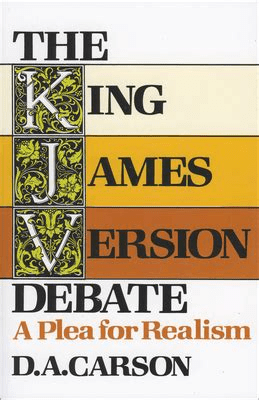
Some might be thinking that it’s unfair to hold Carson’s 1979 offering to contemporary “standards” as if Carson’s writing is reminiscent of your local weatherman’s forecast. No one holds the meteorologist liable for erroneous forecasts, except in sever circumstances, due to the always fluctuating conditions of seasonal weather. But Carson, who received his Ph.D. from Cambridge University, has not chosen an intrinsically fluid topic upon which to write; he has decided to comment on the immutable principium cognesendi of the Christian Faith. As such he is striking at the very foundation of Christianity. And while he argues that the differences between manuscript traditions are minor, he is asking the reader to accept a 35-inch yardstick because it is mostly a yard. Indeed, anyone who argues for the importance of the inch is unreasonable and unrealistic, which is to whom he pleads for realism. After all, just be realistic in evaluating the evidence and everything will be fine. The 36-inch yard stick people are the schismatics because they will not settle for Carson’s definition of realism. Now, after 40 years of building the spiritual house of the church with a mostly one-yard stick of the critical method, how has the Church fared under the tutelage of a Ph.D. from Cambridge? Rather than being the “pillar and ground of the truth” the Church has been loosed from its foundation and has been shook to is core as Carl. R. Trueman’s book, “The Rise and Triumph of the Modern Self” has so acutely illustrated.
In 1979 text types were still in vogue (chapter 3) and the shortest, hardest, and transcriptional probability as source for others paradigm was considered valid (chapter 4). Chapter 4 concludes with these words meant to reassure the reader that in spite of the technical issues, the person in the pew has nothing to worry about because, “the vast majority of lines of the Greek New Testament may be regarded as textually certain. A number of others are certain to a high degree of probability. A relative handful constitute famous problems that are debated constantly in books and journal literature.” p. 31. The notion of “textually certain” is a straight up prevarication in that, for the text critic, every word of Scripture is subject to the textual critical method. The notion of “high degree of probability” is likewise nonsense in that the text of Scripture is again subjected to the evaluation of the critic. The last outright rejects portions of Scripture as “famous problems” that have arisen since the 19th century such as the rejection of the long ending of Mark and the Pericope de Adultera.
Carson’s reference to the shortest and hardest readings to be preferred sets the stage to discredit the Byzantine text which is over all longer and easier to read. In Myths and Mistakes, we read “The entire textual stream – including the Byzantine tradition – is far more stable than typically admitted.” p. 115, and on p. 116, “Distinctly Byzantine readings often have ancient roots.” Pleased note how wrong a Ph.D. from Cambridge University was on this issue in 1979, and yet, his writings were published by Baker, and with other books of this ilk, erroneously lead readers to believe that this is the course, the realistic course, the Church should take.
Chapter 5 is entitled the “Origins of the Textus Receptus” which is a regurgitation of Bruce Metzger’s evaluation of the role of Desiderius Erasmus (1469-1536). Carson wanted to make sure he did not deviate from party orthodoxy on this pivotal point in his argument arguing against the authenticity of 1 John 5:7. Nestled close to Metzger he could be assured of wide academic approval. Carson, Metzger, et al, have found Erasmus to be a manageable starting point for their attack of the Reformation Greek and English Bible tradition. With minimal primary source documents, the usually a-historical critical apologist fills in the many early 16th c. blanks with analysis favorable to their argument giving the impression that the Received Text depended on one historic link, Erasmus, which the critic will argue was very weak. As with all poor scholarship, it wins the day by omitting evidence because of information dominance giving the reader the impression that theirs is the only reasonable answer. See however substantiation for 1 John 5:7, for example, in Francis Antony Knittel,, New Criticisms on the Celebrated Text, 1 John 5:7, translated by William Alleyn Evanson (London: C. and J. Rivington, St. Paul’s Church-yard, J Hatchard and Son, Piccadilly, 1829, 1785), Translators Preface, ix-xi, xxv-xxviii. The church fathers before 400 a.d. quote the Traditional text or the Greek text that supports the KJB over the Critical Text tradition in a 3:2 preponderance of the time (2630/1753 quotes). The early church fathers quoted the TR tradition and extensively. See John William Burgon, The Traditional Text, 1896, 99-101. On 1 John 5:7 Francis Turretin in the Institutes Q. XI, Sec. X writes, “all the Greek copies have it [habent tamen omnia Exemplaria Graeca], as Sixtus Senensis[1] acknowledges: “they have been the words of never-doubted truth, and contained in all the Greek copies from the very times of the apostles” [et in omnibus Graecis exemplaribus ab ipsis Apostolorum temporibus lecta] (Bibliotheca sancta [1575], 2:298). Also, earlier in his 1566 edition of the Bibliotheca Sancta, Sixtus writes the following regarding 1 John 5:7, “there has always been the undoubted truth in all Greek copies from the very times of the apostles” [indubitatæ semper veritatis suisse , & in omnibus græcis exemplaribus ab ipsis apostolorum]. Sisto (da Siena), Biblotheca Santa (Bavarian State Library: Franciscius, 1566, digitized Nov. 30, 2011), 972. 1,069 pages
Do you think a Ph.D. from Cambridge, who writes on this topic, should be familiar with Turretin, Knittel, and Burgon? Just asking.
Erasmus, nor any individual or body of translators, would not have the last say as to what was and was not New Testament Scripture, including 1 John 5:7. Whether 1 John 5:7 should be in Scripture was determined by the Apostle John when he penned the words, the Church would be the final arbitrator of the manuscript evidence, and was impelled to receive the passage as authentic over 500 years ago. The point is, Carson is caring water for a post-critical textual tradition that wanted to be freed from ecclesiastical oversight and created a novel text. Erasmus is merely a convenient focal point in the demonization of the ecclesiastical text.

Keep it up. The more we keep these issues in the greater evangelical conversation the better for pre-critical Bible defense. We’ll see who gets the chance.

After being taught by my dad that the Bible was God’s Word, as he was taught, and indeed, as the Christian tradition believed for centuries, in 1974, after HS graduation I went off to the Baptist Bible College in Clarks Summit PA, to begin my preparation for the ministry. In my innocent idealism I actually thought that I was going to be prepared for the pastorate. It didn’t take long for me to realize that was not going to happen, I was confronted for the first time with the notion that the Bible was “riddled with errors.” This meant everything that my dad had taught me and his teachers had taught him about the Bible was wrong, and that what I was learning was going to be the beginning of a new theological foundation. With my fledgling understanding of what I had recently learned I returned home to tell my dad what I had learned. He listened and listened to my “a little information is a dangerous thing” apologetic for the critical text. Having figured that my pathetic argument was sufficient to win the day, my dad said, “Two thing that are different cannot be the same.” That was the entirety of his rebuttal as I sat in our living room stymied about to how to answer. That was almost 50 years ago and today Standardsacredtext continues to respond in the same manner. If God gave inspired words to the original penmen, then there are specific words that are God’s; each of them of infallible, or not capable of error, infinite importance, and because God is the Author, these words are immutable. These words were designed to be translated into other providentially prepared receptor languages. This means for the Scripture, the word cannot be in the text and not in the text, the verse cannot be in the text and not in the text, the pericope cannot be in the text and not in the text and still be called God’s word. Only God can speak for Himself; we can only say about God what God has already said about Himself. Except now, it has become normative in American Christianity to speak for God because the Academy and Church cannot seem to figure out how God can speak for Himself throughout the ages of Church History without loosing his place on the page. Somehow, He can create and sustain the created worlds, sustaining the cosmos, and every everything corporeal and non-corporeal but the providential preservation of Scripture is just too much for God – until the 19th c. when finally, standard rejecting scholars came along side God to give Him a hand. And then, everything was better. But everything was not better, is not better.
So the Academy gaslighted the Church. While watching the news with a building engulfed in flames the reported says the riot was mostly peaceful, the Academy reports to the Church while the Western culture is in serious decline and is morally ablaze, that the Bible is mostly God’s Word, nothing to see here, move along. Those that say this experiment to replace the standard sacred text of the Church has proven itself to be a dismal failure are deemed the extremists. Corrupt information dominance through the publishing companies and Academy have undermined historic Christian orthodoxy, censured opposing views, and say the critical approach is the sole method for determining what is and is not God’s Word. Professors, fearful of professional ostracization and dismissal pusillanimously fall in line with the status quo.
In 1979, D. A. Carson writes the small book, hubristically entitled The King James Version Debate: A Plea for Realism. It’s not all he could say on the subject but if he were to write any more, it would have merely been more of the same. Carson is saying that the pre-critical approach to the Bible version debate was unrealistic, because it was not radically historical, as if the Scriptures were merely historical documents. This is the same, pathetic, unconvincing argument we heard from James White, but you see how comfortable White was regurgitating the same old lines; this apologia has been argued for many years.
In Chapter 1 The Early Circulation of the New Testament, Carson, on page 16 presents a scenario that cannot be answered empirically, that is by modern textual critical methods, and yet he persists in his plea and continues to write for another 118 pages. He writes of copyists, “Without saying anything, he might decide to correct such errors. Unfortunately, because he did not have the autograph at hand by which to correct his own work, he might think he detected an error where there was none! In that case his ‘correction’ was itself an error.” Here Carson has stumbled an insurmountable problem.
First, there may have initially been an error in the exemplar that required correction, making the correction genuine, but how would anyone know not being in possession of the autograph. Carson does not need the autograph to keep writing because the autograph is unimportant. Critics are building the text according to their methodology and that does not include appeal to the autographs, inspiration, or preservation. Second copy errors due to proximity to the autograph could have been accepted as authentic. Textual critically, who could tell which draft represented the Original? Carson writes, “The textual critic sifts this material and tries to establish, wherever there is doubt, what reading reflects the original or is closest to it.” Such misleading drivel populates the paperback books of this genre, and in 1979 this passed for scholarly writing. How does the critic know what is closest when he has no access to the exemplar? This manner of writing has successfully misled the Church for over 40 years. Carson by inference would have the popular reader believe that he can tell by the textual critical method which reading is closest to the original while admitting in the prior paragraph that such could not be known after the first copy. The inference that the method can discover the autograph has been one of the most successful ruses perpetrated on the Church.
On page 17, hyperbole meant to detract from the insurmountable problem of not possessing the autographs, is utilized where Carson writes, “In no instance do we possess the autograph; and I suspect it is as just as well, for undoubtedly we would make an idol out of it.” “In no instance do we possess the autograph” should have been an early give away to the failure of the modern method, and empirically, he is correct. It is impossible for Carson to know if he does or does not have the autograph, but he lumps the reader in with himself. This throw-away line was unnecessary to his argument but solidified his place as a critical scholar and an opponent of the standard sacred text. Here Carson takes a cheap shot at those who hold to a standard sacred text as “Bible worshippers” expressing the danger those who hold to a standard sacred text are to Christianity. Modern textual criticism will protect the Church from idolatry.
How do you think such words written by a scholar were received by the reader. If you were in the critical camp, your new methodology was a means of keeping he Church free from those who would make an idol out of the providentially preserved word. If you held to a standard sacred text, then you realized the Academy was not your friend. Note for all the claims that the KJB guys are bombastic, there is plenty of that criticism to go around. The Academy also had its part in fomenting hard feelings among brothers and churches.
As I wrap this post up, please note that since 1979 virtually nothing has changed in the critical method. Once the Academy did away with a standard sacred text, real substantive change was no longer necessary. Sure there will be continued changes but the damage has been done. The only hope for the Church is a return to a pre-critical understanding of Scripture and return to the historic Scripture of the Church preserved as written documents throughout history, culminating in the TR and for English reading people, the KJB.

“A further distinction can be made between (1) providentia ordinaria, ordinary or general providence, by means of which God conserves, supports, and governs all things through the instrumentality of secondary causes in accord with the laws of nature; and (2) providentia extraordinaria, extraordinary or special providence, according to which God in his wisdom performs special acts or miracles (miracula, q.v.) that lie beyond the normal possibilities inherent in secondary causality and that can therefore be termed either supra causas, beyond or above causes, or contra causas, against or over against causes.”
Richard Muller, Dictionary of Latin and Greek Theological Terms, providentia.
For the sake of clarity or to add some meat to the your understanding of divine providence consider again the words of Muller above in light of the confessional statement that Scripture is has been kept pure in all ages by God’s “singular care and providence.”
Here of course we take “singular” to apply not only to “care” but also to “providence.” As such we place the providential preservation of the Scriptural text in the category of providentia extraordinaria. Therefore, the preservation of Scripture is supra-causal and even contra-causal.
And why not believe this? Most would willingly admit that we probably don’t have the original words of Socrates but Christians vehemently argue that we do indeed have the original words of the OT and NT and that by the preserving power of the Holy Spirit. We know, insofar as epistemic humility demands, that we have lost some if not all of the original words of many ancient texts. That is the way of the world.
Such a loss of ancient words is the effect of the causal depredations of war, time, and use. In other words, it is the natural thing for an ancient document to lose something of its content or that the transmission stream so corrupted or unrecognizable so we are unable to know for sure what is original and what is not. By God’s ordinary providence books fall out of use, disappear from history, are corrupted, or only fragments remain.
This is not so with the Scriptures. The preservations of the Scriptures breaks the rules so to speak. Not only do we have the words of Scripture, Christians know they have the words of Scripture. No other ancient book can properly lay claim to such potent preservation. And why is this?
It is because God’s providentia extraordinaria works above the normal causal structures of ordinary written verbal preservation [supra-causal]. And not only does it work above those structures but it also works in spite of and contrary to those structures [contra-causal].
The very fact that we have all the original words of God between two covers demonstrates that the Christian Scriptures are a historical artifact that has come to the Church across time and space and in a way contrary to and above the normal cause and effect structures that afflict all the written works of mere men.
As such it is only proper that we argue as the Westminster Divines did; that God’s word has been and is kept pure by the extraordinary care and providence of God. A providence which belongs to no other book in the history of man than to the Scriptures of the Old and New Testaments.

My wife and I homeschool our children and have been doing so for 14 years. From time to time we would join a homeschool co-op to supplement our home education. One year I was asked to co-teach a 9th grade science class.
As usual I would have the textbook and my Bible on the table throughout the time of lecture and discussion. About half way through the semester one of the students noticed that I read from the KJV and reflexively commented, “Oh, the KJV. That Bible is difficult to read.”
With the fraction of a second I had, I wanted to dispel the idea that the KJV was difficult to read while making the whole exchange fun and memorable.
Without breaking eye-contact with the student I reached over to my KJV and put my thumb in a random place among the pages and then opened my Bible to that place. Then, while still maintaining eye-contact with the student, I told the student to tell me when to stop. At which point I began to run my finger down the page until the student said, stop.
I stopped and promptly read the verse out loud to the class and then asked the student if he knew what that verse meant, which of course he did. The whole class erupted in judgmental “oooooo’s”.
The KJV was not too hard to read. So much so that a randomly chosen verse was understood by a 9th grade non-KJV reading student in the 21st century.
Try it sometime. I promise. It’ll be fun.

When discussing topics regarding text and translation with those who object to the TR and KJV invariably my interlocutor reminds me that “You can get saved out of other versions” or some variation of this truth. This claim seems to imply that all credible versions [whatever that means] are equal because they each contain the Gospel. Overall this is true, but the bar is set so low. A Gospel tract for example could meet this criteria of, “Does it contain the Gospel?” Does that make a Gospel tract equal to the Scriptural canon?
Then there are those of the opposing persuasion who take this argument a step further and make the claim that no major doctrine is fundamentally changed between any two Greek texts or “reliable” translations. To expand on that, the claim is that none of the ten major doctrines of the Christian faith are adversely affected by a change of a word here or there between Greek manuscripts. These doctrines are: the doctrine of God, doctrine of Christ, doctrine of the Holy Spirit, doctrine of Scripture, doctrine of man, doctrine of sin, doctrine of salvation, doctrine of the Church, doctrine of angels, and the doctrine of last things.
This gets more complicated because it seems that some Christians believe in a God that gave 1 John 5:7 by inspiration and some Christians believe in a God that did not. This is a doctrine of God issue. As a result, some Christians believe 1 John 5:7 is Scripture and some Christians believe 1 John 5:7 is not. This is a doctrine of Scripture issue. It seems then that the claim that no major doctrine is adversely affected given the deliverances of modern textual criticism does not entirely hold water.
That said, the apostle Peter tells us that Scripture contains all things that pertain to life and godliness which extends beyond the confines of the Gospel message proper and a carful articulation of the ten major doctrines of the Christian faith. Scripture is centrally about the Gospel but human life and godliness extend beyond the moment of adoption into the family of God.
So how broad is the category of “life and godliness”? Into how many sectors does Scriptural teaching extend? It seems impossible that a careful and complete list could be constructed. In the West though, some have concluded a provincial list which can be found in the two volume Syntopicon of the Great Books of the Western World. These terms and the ideas they represent lie at the foundation of Western thought and as such at the foundation of all life in the West. The list is as follows:
Angel – Animal – Aristocracy – Art – Astronomy and Cosmology – Beauty – Being – Cause – Chance – Change – Citizen – Constitution – Courage – Custom and Convention – Definition – Democracy – Desire – Dialectic – Duty – Education – Element – Emotion – Eternity – Evolution – Experience – Family – Fate – Form – God – Good and Evil – Government – Habit – Happiness – History – Honor – Hypothesis – Idea – Immortality – Induction – Infinity – Judgment – Justice – Knowledge – Labor – Law – Liberty – Life and Death – Logic – Love – Man – Mathematics – Matter – Mechanics – Medicine – Memory and Imagination – Metaphysics – Mind – Monarchy – Nature – Necessity and Contingency – Oligarchy – One and Many – Opinion – Oppression – Philosophy – Physics – Pleasure and Pain – Poetry – Principle – Progress – Prophecy – Prudence – Punishment – Quality – Quantity – Reasoning – Relation – Religion – Revolution – Rhetoric – Same and Other – Science – Sense – Sign and Symbol – Sin – Slavery – Soul – Space – State – Temperance – Theology – Time – Truth – Tyranny and Despotism – Universal and Particular – Virtue and Vice – War and Peace – Wealth – Will – Wisdom – World
To know these terms and to have some sense of their interconnectedness is the ground and foundation of a truly liberal arts education. As such it is no accident that so many of the words here are found in the Bible, directly addressed by the Bible – the perfect law of liberty. When we begin to ask what the Bible teaches us, we find that it teaches us about the 102 ideas expressed above as well as aggregates of these ideas. Touching the text and translation issue, God’s word teaches us about God’s view of Truth, Sign and Symbol, Language, and Opinion. Thus when you change a Scriptural word here or there or claim that one word is not as important as another you run up against at least five major ideas as presented in Western thought and that’s without referencing Gospel and theological considerations.
So we began with the Gospel, with the one major and central head. We then moved onto the ten major doctrines of the Christian faith and briefly saw that even there the claim that no major doctrine has been adversely affected does not seem to entirely hold water. But when we look into the 100 great ideas of the Western World we find that a robust Christian worldview must be exceedingly broad and interconnected if it is to properly address, at a minimum, the Western mind.
Given the incredible breadth and interconnectedness of these ideas, how much does one of God’s words, an seemingly innocuous word of Scripture matter in the formulation of Christian worldview that addresses these ideas?
In sum, the words of Scripture exist to teach us godliness and all of life and unless any one of us has a perfect grasp on “all of life” perhaps we should refrain from saying that this or that word of Scripture doesn’t affect doctrine. Even if that were true, it seems quite impossible that this or that word of Scripture doesn’t affect some aspect of “all of life.”

Grant Castleberry is currently the senior pastor of Capital Community Church in Raleigh, NC and was the executive director for the Council on Biblical Manhood and Womanhood. I’ve shared his tweets here before. Largely because I think they’re great and this one is no different.
But as I read this one there seems to be something missing. His thought is accurate and I think it is true, but something is off.
I recognize that the focus of Standard Sacred Text can render our commentary quite focused at time, though Lord willing we will be broadening our scope in the near future. But doesn’t it seem that the oddity, the misplaced reference is his insistence that the word of God is permanent?
One may be tempted to take Castleberry’s statement in a non-concrete, immaterial, or ideal sort of way but such a route seems impossible seeing that he references the words of Scripture, indeed, the written words of Scripture in space and time. He certainly can’t mean the original language in the Greek. The ECM [representative of the most recent Greek NT conclusions] is currently impermanent as a document and when it is finished some expression of the ECM will replace the current NA28.
Castleberry can’t mean the manuscript tradition because every year we are adding to the number of NT manuscripts while at the same time others are being lost, recollated, or destroyed. Nevermind the deliverances of the CBGM. He can’t mean any of the modern translations seeing that most if not all publishers are unwilling to codify the language of their respective translations. As far as I know Castleberry does not hold to the TR or KJV as his standard sacred text so he is not speaking of permanence in that regard.
Most of Christian academia does not believe the Bible occupies some permanent state. Textual criticism is an ongoing enterprise and presumably will be ongoing until the Lord returns. Most of the Church is not reading the Bible their grandfather read. I wouldn’t be surprised if most of the Church is reading from a different Bible than the one they were reading 5 years ago.
No one in broader evangelicalism seems to be claim that all the words their Bible, Greek, English, or otherwise, are the permanent words of God. As such it does not appear that the Church is treating their and their neighbor’s respective Bibles as permanent. So the modern Church does not believe the Bible is permanent because they don’t believe all the words in their Bible are permanent.
But if you agree with Castleberry and claim that all the words in your Bible, say the TR or KJV, are the permanent words of God, then holy napalm of indignation is poured out on you like a great and terrible Day of Evangelical Wrath.
As such, it seems then that the thing we are missing is that we are ready to name the book which contains all the permanent words of God. If you don’t name the book then you are well received. If you do name the book you are the ecclesiastical equivalent of homeless and crazy.
Saying that we have all of God’s words in a book and then saying the name of that book will most assuredly incur the wrath of our Christian overlords. Thus is the state of the Christian Church. What a time to be alive.
Class dismissed.

For those familiar with Ward’s “False Friends” argument you know that the central feature is that the Church is reading words it does not understand with the secondary addendum that the Church does not know that she does not understand those words. The latter is an addendum because without the central feature the addendum is nonsensical.
If the Church understood all the words she read in the Bible, then she would know the words she is reading in the Bible. Simply put, not understanding the words precipitates not knowing. As such, while Ward likes to emphasis the “not knowing that she doesn’t understand part” his primary contention is that the Church does not know the words of God, particularly in the KJV, and therefore the Church needs to find a new English version of the Bible.
There is another Bible that most of the English-speaking Church does not understand. That Bible is the Hebrew Old Testament and the Greek New Testament. The central feature of Ward’s argument applies here too and so does the claim that the Church needs a new NT every time another edition of the Nestle/Aland. And Ward’s primary contention remains the same, the Church does not know the words of God, particularly in the Greek, and therefore the Church needs to find a new Greek NT whenever the next edition of the Nestle/Aland is printed.
The Church doesn’t understand, but Mark Ward does. He could advocate for the Church’s learning and thereby the understanding of the words in question, but Ward regularly dismisses that out of hand. He could make his book and YouTube channel about teaching God’s people about “False Friends” and thereby solidifying the KJV in the hearts and minds of God’s people. But, no. Instead, he leverages his arguments against the use of the KJV. Why?
Why doesn’t Ward, as the apostle to the KJV crowd, take all of his research and help KJV folks better know and appreciate the KJV and thereby cling to their copy of God’s word even more. Why is it that Ward has chosen to use his mind to cast doubt particularly about the KJV? He could just as easily find words in other versions which God’s people do not know, but he doesn’t. What would possess a man who recognizes that the Church needs to learn about her Bible to use the Church’s ignorance to cast doubt on her Bible?
William Shakespeare, that paragon of False Friends, once wrote, “Some are born great, some achieve greatness, and some have greatness thrust upon them.” I would like to add that some assume they are great simply because they are educated and because what they say accords with the prevailing evangelical academic mind.
Consider this brilliant and humble commentary offered by Ward when comparing the KJV defender and the brilliant prevailing scholarly mind.
Interestingly enough Ward does exactly as I have described in today’s post. He starts with the Church’s ignorance about words in the KJV, transitions to the Church’s overall ignorance of the original languages, and then makes a plea to trust the scholars, a group in which he includes himself on a couple occasions in the video.
Do Pearl’s arguments constitute the most robust defense of the KJV? Probably not, but this lack of showing his belief in the KJV does not make the knowing of his belief in the KJV somehow unreasonable or immoral.
In the end, Ward knows most of the Church does not know Greek and Hebrew. Furthermore, he knows that KJV adherents do not understand certain words in the KJV. Who then is to guide the unlearned? Brilliant scholars and the prevailing evangelical scholarly opinion is that the Church doesn’t have a standard sacred text, it shouldn’t want a standard sacred text, and if it does, it wants something it currently cannot have without being unreasonable or immoral according to scholarly opinion.
It seems then that once you give up that your translation is best chosen by the scholars then it stands to reason that the Greek and Hebrew which underlies that translation is best chosen by the scholar. And if such is the case, then who and based on what authority is the final call about what is or is not God’s word made? It seems to me that the answer is clearly and plainly, the fallible human scholar. Full stop.
N.B. – It is important to note that we have said here over and over that insofar as modern translations reflect the original words of Scripture those words are the very words of God in the substantia doctrinae. That said, our major contention has not been that Multiple Version Onlyists do not have the Bible. Rather our major contention has been that the most able of them, the most educated among them, cannot provide a robust method of knowing they have the inspired infallible Bible apart from standard probability arguments which apply to all books of antiquity.

 Standard Sacred Text.com