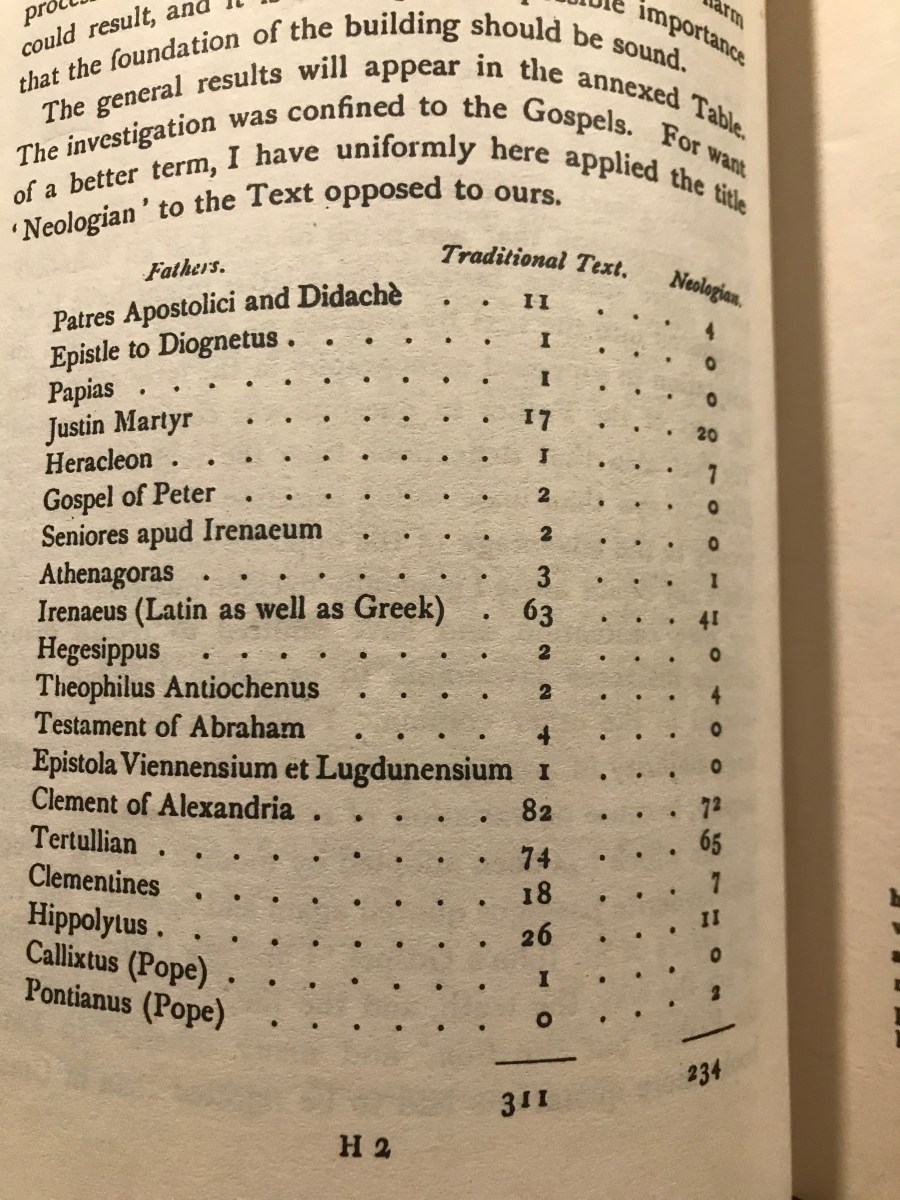
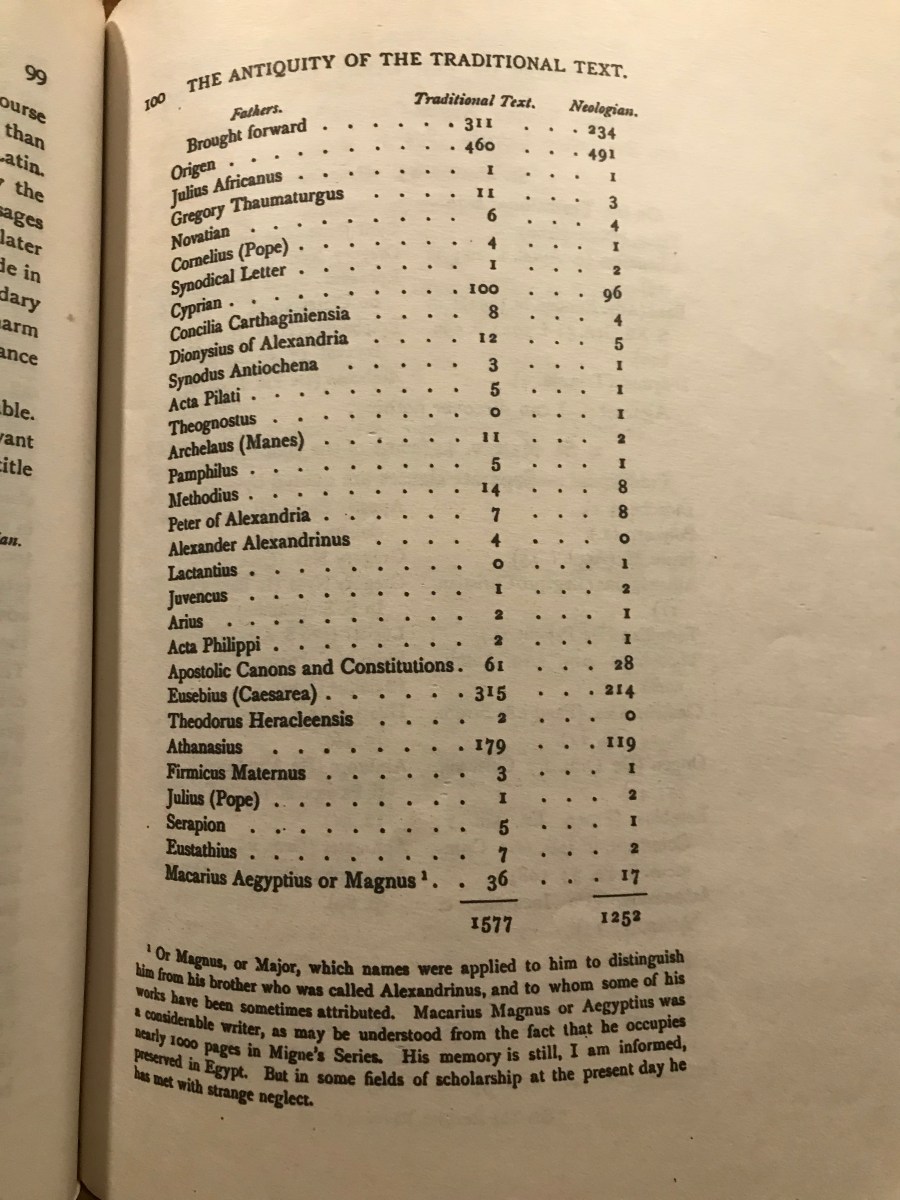
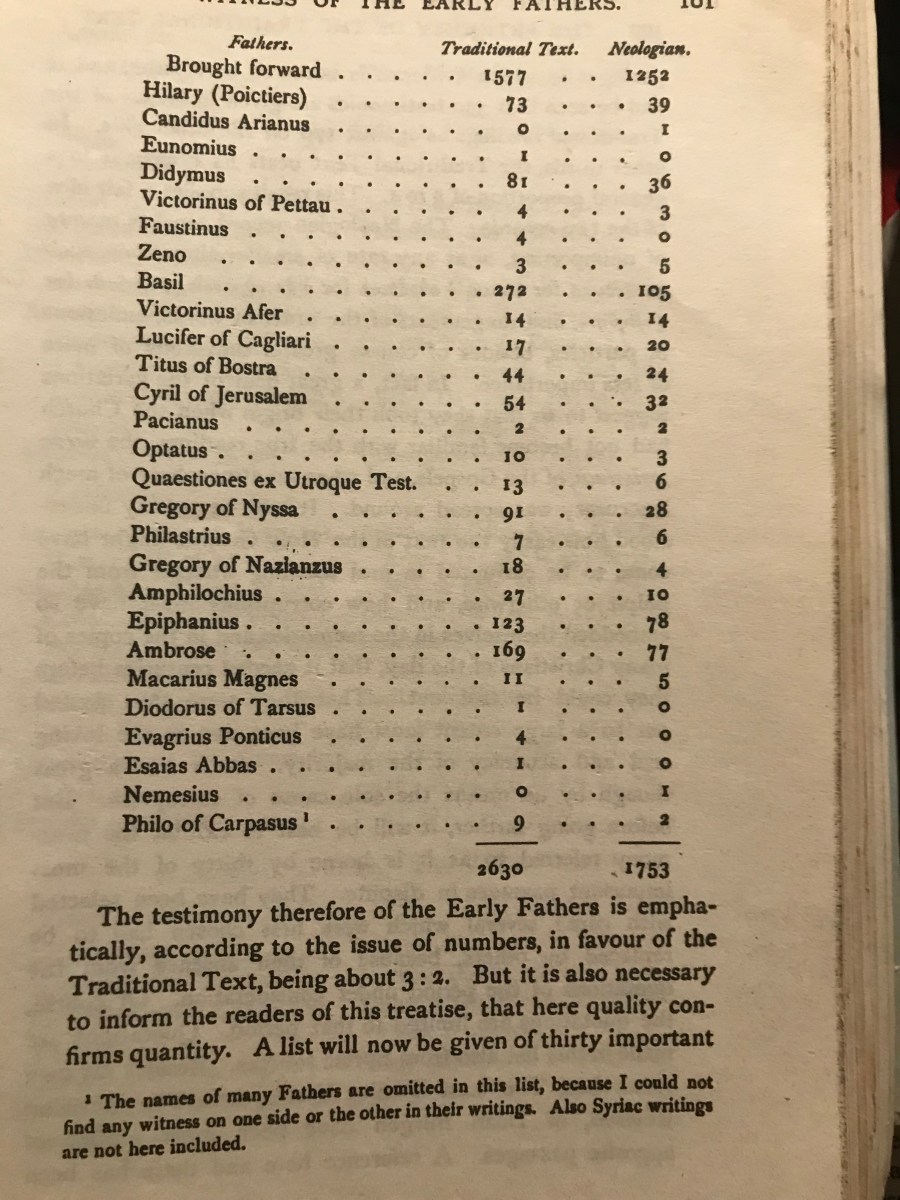
Dean John William Burgon, The Traditional Text, 1896, 99-101
Belief in Scripture to Change the World
Dean John William Burgon, The Traditional Text, 1896, 99-101
In this episode of Warrior Theology Podcast Dr.’s Van Kleeck discuss the interrelation between faith, knowledge, and certainty as they pertain to a Christian’s belief in the Scriptures.
The church fathers before 400 a.d. quote the Traditional text or the Greek text that supports the KJB over the Critical Text tradition in a 3:2 preponderance of the time (2630/1753 quotes). The early church fathers quoted the TR tradition and extensively. See John William Burgon, The Traditional Text, 1896, 99-101. While doing undergraduate work, the quotes of the church fathers were enough for a non-TR professor to say, and I quote, “The TR/KJB position is the only logically defensible position, but don’t get the idea I’m in your camp.”

As of January 10, 2022, at 12:39pm StandardSacredText.com has reached 139 posts. We have largely concluded our two series of A Bibliology Primer and Essential Vocab. A large portion of our argument has been laid out for your examination and perusal. We hope that you can see that it is not King James Onlyism popularly understood. Still, it is an argument for a standard sacred text in both the original languages as well as receptor languages. In our case that language is English. Among the English translations we believe the King James Version is the standard sacred text for the English-speaking community and we believe this for the following 12 or so reasons.
1.) First and primarily, Dr.’s Van Kleeck hold to the KJV because it has been the English version of the Bible which speaks to them and continues to sanctify them and grow them in the knowledge and grace of our Lord Jesus Christ. It is the living voice of God in English.
2.) We hold to the KJV because it is quite apparent that the believing community held to this book for over 400 years. As the Spirit of God has led the church to believe in the great things of the Gospel so the Holy Spirit has led His people by faith to accept His words in the form of the English language. Those accepted words have taken the form of the KJV for the English-speaking church for more than four centuries.
3.) We hold to the KJV because we believe that Early Modern English is a sublime form of human language in general and of English in particular. For us and for most of Western thought the Good and the True are accompanied by the Beautiful. That is, not only must the word of God be good and true, but because it is good and true, it must be beautiful. And though the content of the Bible is beautiful regardless of the translation, the KJV is a particularly beautiful translation in content and form.
4.) We hold to the KJV because it is a good translation. Even those who do not hold to the KJV admit this truth. As formal equivalence translations go, the KJV is a very good translation.
5.) Because the believing community has held to the KJV for so long and because much of the Christianized West has been exposed to the KJV as the standard sacred text of the English-speaking believing community, there has arisen both in the church and outside the church a common parlance, a common language. To this day, many who have memorized Scripture have memorized it in the KJV. A great host of commentaries and devotionals center on the KJV. The Scripture language of the KJV is what we expect when we hear the word of God read or go to recite the Lord’s prayer. If there ever was an English version of the Bible which served as the language of English-speaking ecclesiastical culture, the KJV is that version.
6.) While many versions seem to hope to be a standard for the English-speaking believing community [e.g., English Standard Version, Legacy Standard Version, Christian Standard Version], none of them has acquired such a status. Even after the advent of so many different versions, some so obviously aiming for the status of standard, only one remains the standard and often in a much-derided segment of Christendom and it is those who hold to the KJV. In other words, to this day and generally speaking, the only folks who seem to hold to a standard sacred text are the King James Version folks.
7.) Not only has the KJV served the English-speaking church for over 400 years and has provided us with a common language from which to carry on our theology and devotion, it is also the book that has been handed down from one generation to the next. Fathers have read these words in the ears of their sons and then these sons have read the same words in the ears of their sons and on and on. The KJV is home in a homeless world. It is home for the individual, for the family, and for the church. Those who do not hold to the KJV do not have a home. They often go from one house to another trying this or that couch, but they never really have a home. KJV folks do.
8.) We hold to the KJV because it is not the possession of any company or board of trustees. The KJV belongs to the people. It is not copywritten by this or that publisher and therefore under threat of being discontinued because the great god, Bottom Line, calls for a sacrifice in the burgeoning printing portfolio.
9.) Negatively, there has yet to arise any serious non-trivial argument or movement of the Spirit of God for some other standard sacred text in English to the exclusion of all others. For example, there does not appear to be a strong ESV or NIV only presence in the English-speaking believing community. In short, no meaningful alternative to the KJV has been offered by the English-speaking believing community.
10.) Negatively, the believing community seems to be in a great bit of disarray from the leadership to the laity. And we need look no further than the COVID crisis. We here in the USA scattered the sheep in the name of COVID and at the behest of government, only to turn around and clamor for their return a year or two later. And why should they return after the leadership expressly scattered the sheep and told them to leave? This is not a time to seek a new standard sacred text.
11.) Negatively, after the rise of Rationalism, the Enlightenment, and the boon of modern textual criticism, where is that paragon of textual purity held to be the word of God first in Greek and Hebrew and then in English by scholar and preacher and layman? After 150+ years no such product exists. In fact, many in the field of modern textual criticism have now abandoned the quest to find the original text of Scripture in the Greek and Hebrew. When do we agree to say that the rationalist enterprise as touching the identity of the New Testament has failed at least as it concerns the church?
12.) BONUS: The KJV is the Bible Eli memorized in post-apocalyptic sun-scorched America. Checkmate.

“Textus Receptus: the Received Text;
i.e., the standard Greek text of the New Testament published by Erasmus (1516) and virtually contemporaneously by Ximenes (the Complutensian Polyglot, printed in 1514 but not circulated [i.e., published] until 1522), and subsequently reissued with only slight emendation by Stephanus (1550), Beza (1565), and Elzevir (1633).
Richard Muller, Dictionary of Latin and Greek Theological Terms: Drawn Principally From Protestant Scholastic Theology, Term: Textus Receptus.
Of particular note here is Muller’s observation that the 5 texts mentioned all fall under the title, Textus Receptus. Indeed, the term is popularized by the Elzevir text, and Muller observes as much when he writes,
“The term Textus Receptus comes from the Elzevir preface: Textum ergo habes, nunc ab omnibus receptum, ‘Therefore you have the text now received by all.'”
Muller, Dictionary, Textus Receptus.
But the practical and historical reality is that this tradition of Greek texts was and is regarded as the standard and received Greek text of the believing community. We see this stance quite clearly propounded by the Confessional Text position. Again, Muller observes,
“The term [Textus Receptus] was adopted as a standard usage only after the period of orthodoxy, although it does refer to the text supported by the Protestant scholastics as the authentic text quoad verba, with respect to the words of the text.”
Muller, Dictionary, Textus Receptus.
In sum, the term Textus Receptus refers to a tradition and to specific temporally conditioned textual artifacts [i.e., the five Greek texts mentioned above]. In this specific sense, Textus Receptus refers to a compiled copy of the autographs which was defended and supported by the Protestant Scholastics as the authentic standard Greek text quoad verba, concerning the words. This belief in the quoad verba quality of the Textus Receptus is how the Protestant Scholastics could believe and proclaim that the Greek text, the Textus Receptus, was the Original. They believed their Greek text was the authentic word of God quoad verba. Here at StandardSacredText.com all we argue that that same belief in the Textus Receptus remains warranted and rational today.
“If something is not necessarily true, it is possibly false.” This axiom succinctly delineates the philosophical quandary the modern church finds itself in relation to the possible worlds reflected in bible texts and versions. If the truth of God’s Word as we possess it today is not “necessarily true,” then it is possibly false, and as such, would allow for actualization of the possible world of any future archeological or textual discovery. Though only possible, this possibility alone, would be grounds for questioning or contradicting the truth as we know it, nullifying every notion, methodology and conclusion previously derived from the contemporary disciplines of archeology and textual criticism. The possibility of biblical and theological reconstruction is equivalent to saying that the truth as the Church knows it is not the truth, but only a truth accepted out of ignorance of yet undiscovered possibilities and each finding’s corresponding “truth.” The post-critical Church lives with its provincial, sectarian truth, not because it is correct but because it is the only choice left to the modern Church having rejected pre-critical orthodox principles.
For example, omitting dia tou aimatos autou, “through his blood” from Colossians 1:14 illustrates the creation of a possible world. Because revelation is Grammatical/Historical, changing the words necessarily changes the event. For this modern omission in Col. 1:14 only part of the question is whether the textual critic or manuscript evidence supports or rejects a text — it is also whether the words where actually written in the first place, the event of writing dia tou aimatos autou. The possible world which admits the truth that Paul did not write these words could, among other considerations, conclude either, that,
Each critical text, each modern bible version, represents only one of an infinite number of possible worlds, each edition in conflict with the other by virtue of the inherent variations raised by readings that define the scope of the editor’s and translator’s skills and investigation. Because the text or translation is only a truth and not the truth, then it is one manifestation of an infinite number of possible worlds and capable of exceptional absurdity. Did the Ethiopian eunuch confess Christ before being baptized or not in Acts 8:37? Either he did or he did not, and the editor of the modern version, of his own accord, is going to create a world in which there was no confession. Only God, speaking for Himself through His Word which is the truth will save the Church from believing a historic record, claimed to be divine, that is spurious.
Thus, to retain the exclusivity of the truth I am the way, the truth and the life: no man cometh unto the Father, but by me (John 14:6) it is imperative that the Scripture exist externally to the Church, the critic, and the publisher; that Scripture imposes itself upon the Church and not become an object that anyone can shape according to their own natural inclinations; and that from outside,the Church may be assured that it is the viva vox dei, the living voice of God alone, revealing the truth which they hear in the pages of Holy Scripture.
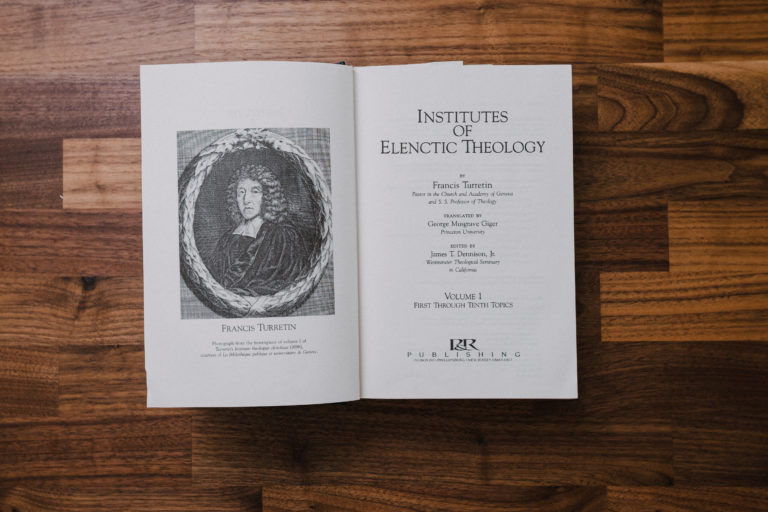
We are now in our third installment of Turretin’s argument on Scripture as infallible judge of controversies and interpreter of itself. In part 2 we discussed the first four of Turretin’s arguments in support of the claim that the Scripture is such a judge and interpreter. In this installment we will discuss the final three of his arguments. To that effect, Turretin first argues that if man is the final judge and interpreter of Scripture: 1.) Why did Christ not mention such a person? 2.) Why did Paul not mention such a person? 3.) Why did Peter not mention such a person? and 4.) Popes have not shown themselves to be infallible. The point of course is that it does not appear the Scriptures anywhere make such a claim, that in some future time a man, whether scholar or Pope, was going to be the rightful judge of controversies and final interpreter of Scripture.
As a reminder, we have argued to this point in our discussion that the current disputes over which Bible ought the English-speaking believers to read is a controversy. Furthermore, the disputes about whether the woman caught in adultery, the long ending in Mark, and I John 5:7 are also controversies all of which fall within the jurisdiction of the Scripture as judge and self-interpreting. In short, neither scholar nor Pope is equipped with the necessary tools, nor are they put upon morally or scripturally to determine the validity of this or that text of Scripture. Indeed, they believe the evidence points to this or that conclusion but that is exceedingly different than saying they have the true reading. Fair enough?
Turretin goes on in his next argument to declare that the institutional church is not able to be its own judge and therefore cannot be the final judge of what is Scripture and what is not. Turretin writes,
“The church cannot be regarded as the judge of controversies because she would be a judge in her own cause and the rule of herself. For the chief controversy is about the power and infallibility of the church, when the very question is whether the church is the judge, or whether the church can err.”
Turretin, Institutes, vol. 1, Second Topic, Q. 20, Sec. XIII.
Here Turretin has in mind the authority of the Roman Catholic Magisterium. The church in this sense has neither the power nor the moral right to claim that they are infallible in this or that regard and the Bible is not. Therefore, it is claimed that the church is the final judge of controversies and interpreter of Scripture. If they were, it seems quite apparent that a conflict of interest would soon arise. To be clear, the same goes for the academy. Now I have heard in recent days, per Peter Gurry, that he does not see himself in the place to tell the believer what is or is not the word of God. He claims to say only what he believes the evidence demands. Fair enough. I do want to know, given certain Christian pre-commitments, what is the fundamental difference between saying the evidence compels me to believe X is part of the New Testament and the evidence compels me to believe X is part of God’s word?
Moving on. Turretin’s seventh and final argument for this question is a compilation of quotes from the ancients showing their reliance on the Scripture as final judge of controversies and interpreter of itself. Those quotes are as follows.
Constantine writes, “‘therefore laying aside warring strife, we may obtain a solution of difficulties from the words of inspiration.'”
Turretin, Institutes, vol. 1, Second Topic, Q. 20, Sec. XIV.
“Optatus writes, ‘You say it is lawful, we say it is not lawful; between your permission and our prohibition the minds of the people fluctuate and waver. No one believes you, no one believes us, a judge must be sought from heaven, on earth we can get no decision; but why should we knock at the door of heaven when we have the Testament here in the gospel?'”
Turretin, Institutes, vol. 1, Second Topic, Q. 20, Sec. XIV.
“Augustine says, ‘We are brethren, why should we contend? Our father did not die intestate; he made a will…open it, let us read, why should we wrangle?'”
Turretin, Institutes, vol. 1, Second Topic, Q. 20, Sec. XIV.
Augustine goes on in another place, “‘This controversy requires a judge. Christ shall judge; the apostle with him shall judge.”
Turretin, Institutes, vol. 1, Second Topic, Q. 20, Sec. XIV.
“Lactantius says, ‘God speaks in the divine writings as the supreme judge of all things, to whom it belongs not to argue but to pronounce.'”
Turretin, Institutes, vol. 1, Second Topic, Q. 20, Sec. XIV.
“Gregory of Nyssa writes, ‘The inspired writing is a safe criterion of every doctrine.'”
Turretin, Institutes, vol. 1, Second Topic, Q. 20, Sec. XIV.
To all of this, all seven of these arguments, Turretin concludes,
“As a prince must interpret his own law, so also God must be the interpreter of his own Scriptures – the law of faith and practice. And the privilege allowed to other authors of interpreting their own words ought not to be refused to God speaking in the Scriptures.”
Turretin, Institutes, vol. 1, Second Topic, Q. 20, Sec. XIV.
AMEN.

Welcome to the Brickyard. This is a place to find quotes for use in your own research and writing. The bricks are free, but the building is up to you. The following quotes are from The Quotable Chesterton edited by Marlin, Rabatin, and Swan. It is a compilation of quotes from G.K. Chesterton across a host of topics. Enjoy.
Argument
“It is generally the man who is not ready to argue, who is ready to sneer.”
The Quotable Chesterton, 26.
Authority
“Authority ruling men must be respected; it must even be loved. Men must in the last resort love it; for the simple reason that men must in the last resort die for it.”
The Quotable Chesterton, 33.
Simplification
“The simplification of anything is always sensational.”
The Quotable Chesterton, 325.
“…it’s natural to believe in the supernatural. It never feels natural to accept only natural things.”
The Quotable Chesterton, 336.
Testimony
“…the more we study it the more queer the whole question of human evidence becomes. There is not one man in twenty who really observes things at all. There is not one man in a hundred who observes them with real precision; certainly not one in a hundred who can first observe, then remember and finally describe.”
The Quotable Chesterton, 341.
Theology
“Theology is only thought applied to religion.”
“The Quotable Chesterton, 343.
Thinkers (Modern)
“A modern ‘thinker’ will find it easier to make up a hundred problems than to make up one riddle. For in the case of the riddle he has to make up the answer.”
The Quotable Chesterton, 345.
1 Peter 1:23, “Being born again, not of corruptible seed, but of incorruptible, by the word of God, which liveth and abideth for ever.”
The significance of maintaining the “common salvation” by “earnestly contending for the faith” is taught in Jude 3, “Beloved, when I gave all diligence to write unto you of the common salvation, it was needful for me to write unto you, and exhort you that ye should earnestly contend for the faith which was once delivered unto the saints.” “Contending” is necessary to preserve that “commonly” believed or the common Christian Faith. What follows is a central element of the “common salvation,” the work of Regeneration, or being born again, and the unified role of the Spirit and Word.
The word of God is the objective instrument in bringing to consummation that spiritual change produced by the Holy Spirit. The Word addresses us consciously while the Spirit’s work in regeneration is a subconscious work. Regeneration is comprised of both aspects of the Word and Spirit’s power, working both consciously and subconsciously. We learn that reading the Bible without the Spirit’s teaching is unprofitable, 1 Cor. 2:14, “But the natural man receiveth not the things of the Spirit of God: for they are foolishness unto him: neither can he know them, because they are spiritually discerned.” Furthermore, the Spirit without the Word will convict of sin but will not save. John 16:8, “And when he is come, he will reprove the world of sin, and of righteousness, and of judgment.” 2 Cor. 2:15-16, “For we are unto God a sweet savour of Christ, in them that are saved, and in them that perish: To the one we are the savour of death unto death; and to the other the savour of life unto life. And who is sufficient for these things?” Faith only comes through hearing the Word, Rom. 10:17, “So then faith cometh by hearing, and hearing by the word of God.” Repentance is likewise a gift of God, 2 Tim. 2:25, “In meekness instructing those that oppose themselves; if God peradventure will give them repentance to the acknowledging of the truth.” Finally, regeneration is entirely the work of God, John 3:5, “Jesus answered, Verily, verily, I say unto thee, Except a man be born of water and of the Spirit, he cannot enter into the kingdom of God.”
In regeneration, Word and Spirit are brought together to create a new creature in Christ, 2 Cor. 5:17, “Therefore if any man be in Christ, he is a new creature: old things are passed away; behold, all things are become new.” Regeneration is the outreach of the gospel as a direct creative act of the Holy Spirit that involves the transformation of the whole man. Internal illumination of the Word by the Spirit for the mind and will of the elect is inextricably tied together with the regenerating work of the Spirit. The new birth takes place in the womb of the teaching of God’s Word. Thus, to read the Word is to hear the message of Jesus mediated by the Holy Spirit. The Bible alone does not regenerate. The Bible is the truth, John 17:17, “Sanctify them through thy truth: thy word is truth.” This truth is utilized by the Spirit to produce faith. Faith is the gift of the Spirit derived through the cognitive (mundane-phenomenal) understanding of Scripture. Eph. 2:8-9, “For by grace are ye saved through faith; and that not of yourselves: it is the gift of God: Not of works, lest any man should boast.” Spiritual discernment of the Bible is necessary to be born again and the Spirit gives this discernment.

In our last post on this point, we framed the question and asserted that disputes over what is or is not the New Testament and therefore what is or is not the word of God fall under the jurisdictional authority of the Spirit of God as supreme autocratic judge speaking through the words of God to the people of God by faith. Today we are going to discuss the first four of Turretin’s arguments to this point. He has a total of seven and we will address the latter three in the next post on this topic.
To summarize his first four argument, Turretin affirms that the Scriptures or God speaking in them are “the supreme and infallible judge of controversies” because 1.) The Bible sends us to itself to judge controversies, 2.) Christ sends us to the Bible to judge controversies, 3.) The Spirit is Himself an infallible judge, and 4.) Man is not an infallible judge. Beginning with the first, Turretin writes,
“God in the Old and New Testaments absolutely and unconditionally sends us to this judge – ‘and thou shalt do according to the law which they shall teach thee (Dt. 17:10); ‘to the law and the testimony, etc.’ (Is. 8:20); ‘They have Moses and the prophets; let them hear them’ (Ll. 16:29).”
Turretin, Institutes, vol. 1, Second Topic, Q. 20, Sec. VIII.
Having asserted what the Scriptures teach, Turretin takes the opportunity to point our attention to what is conspicuously absent from the list of final judges and interpreters: man.
“Christ does not say they have the priests and scribes (who cannot err), but they have Moses and the prophets (viz., in their writings), implying that they are abundantly sufficient for full instruction and their authority must be acquiesced in.”
Turretin, Institutes, vol. 1, Second Topic, Q. 20, Sec. VIII.
We may as well add textual critics to the list of priests and scribes. And for those fair-handed textual critics out there, if you do not profess to tell the church what is or is not the New Testament, then who does and by what standard(s)?
Moving onto Turretin’s second argument we see that he moves his emphasis from the revealed word to the Archetypal Word – Jesus Christ and the apostolic message. Turretin writes,
“The practice of Christ and his apostles confirms this for in controversies of faith they appeal to the Scriptures (Mt. 4:4, 6, 7; 22:29; Jn. 5:39; 10:34, 35; Acts 17:2, 11; 18:28; 26:22) and profess to know nothing besides Moses and the prophets (Lk. 24:44; Acts 26:22).”
Turretin, Institutes, vol. 1, Second Topic, Q. 20, Sec. IX.
If we are to be imitators of Christ and if Paul calls us to be imitators of him as he is an imitator of Christ it stands to reason that we also should look to the Scriptures for the same reasons and in the same way. Because it is Christ doing it and because we are called to be as He is, then in these descriptions of Christ’s treatment of controversies we receive a prescription of how we too ought to do the same.
In Turretin’s third argument he emphasizes the particular person of the Holy Spirit and the kind of person He is. Turretin writes,
“A supreme and infallible judge is one who never errs in judgment, nor is he able to err; is uninfluenced by prejudice and from whom is no appeal…God speaking in the Scriptures claims these as his own prerogatives alone, as incapable of error in judgement, being truth itself, uninfluenced by partiality, being no respecter of persons (aprosopoleptes); nor can any appeal be made from him because he has no superior.”
Turretin, Institutes, vol. 1, Second Topic, Q. 20, Sec. X.
God does not err. God cannot err, neither in His words nor in His judgments. God is truth itself. So, when God speaks through His word as an act of confirming His word as His word this speech will be the unerring truth. Now, will man receive it as such? Perhaps not, but that does not impeach the truth that such a phenomenon is happening in space and time and that the Spirit-filled believer can and does by faith hear God speaking in this way.
We come now to Turretin’s fourth argument which is stated as follows:
“Man cannot be the infallible interpreter of the Scriptures and judge of controversies because he is liable to error. Our faith cannot be placed in him, but upon God alone from whom depends the sense and meaning of the Scriptures and who is the best interpreter of his own words.”
Turretin, Institutes, vol. 1, Second Topic, Q. 20, Sec. XI.
Turretin’s critique here is really twofold. One, scholars and popes are infallible interpreters in the controversy of what is or is not the New Testament and thereby what is or is not the word of God. People who assume themselves to be in this place are not suited for the responsibilities which appertain. Two, those of us who would like to put our faith in these men, and in many cases do, have erred according to the Scriptures. The Scriptures call us to look into the Scriptures. Christ and the apostles looked to the Scriptures to solve their controversies. We are called to do the same today and especially on the controversies surrounding whether or not this or that text should be counted among the words of the New Testament.

 Standard Sacred Text.com