Richard Allestree,1678, on the Preservation of Scripture
6. And for this, God (whose care is equal for all successions of men) hath graciously provided, by causing Holy Scriptures to be written, by which he hath derived on every succeeding age the illumination of the former. And for that purpose, endowed the writers not only with that moral fidelity requisite to the truth of history, but with a divine Spirit, proportionable to the great design of fixing an immutable rule of faith and manners. And to give us the fuller security herein, he has chosen no other penmen of the New Testament, than those who were first oral promulgators of our Christian religion, so they have left to us the very same doctrine they taught the Primitive Christians. He that acknowledges them divinely inspired in what they preached, cannot doubt them to be so in what they wrote. So that we may enjoy virtually and effectively what wish of the devout Father, who desired to be Saint Paul’s auditor, for that hears any of the Epistles read, is as really spoken to by Saint Paul, as those who were within the sound of his voice: Thus God who in times past spake at sundry times, and in diverse manners to the prophets, and in the latter days by his son, Heb. 1:1-2, continues still to speak to us by these inspired writers, and what Christ once said to his disciples in relation to their preaching, is no less true of their writings: He that despiseth you, despiseth me, Luke 10:16. All the contempt that is any time flung on these sacred Writings, rebounds higher, and finally devolves on the first Author of those doctrines, whereof these are the registers and transcripts.
Richard Allestree, The Lively Oracles Given to us or The Christian’s Birth-right and Duty, in the custody and use of the Holy Scripture. By the Author of the Whole Duty of Man (At the Theater in Oxford, 1678), 4-5.
Multiple Version Onlyism (MVO) and the 1978 Chicago Statement on Inerrancy
Perhaps the most useful convocation of Evangelicals for the propagation of MVO was by the writing and signing of the Chicago Statement on Inerrancy in 1978. Signed by 300 noted Evangelical leaders, (including James Boice, Norman L. Geisler, John Gerstner, Jay Grimstead, Carl F. H. Henry, Kenneth Kantzer, Harold Lindsell, John Warwick Montgomery, Roger Nicole, J. I. Packer, Robert Preus, Earl Radmacher, Francis Schaeffer, R. C. Sproul, and John Wenham), all advocates of MVO, their endorsement of the statement did much to support the credibility of MVO, something the statement’s drafters, the International Council on Biblical Inerrancy, thought was falling into question.
For those less familiar with MVO, personal endorsements are essential to the movement, both for the endorser and that being endorsed. The endorser shows his allegiance to MVO orthodoxy while also lending their notoriety to the credibility of the position. It is not an overstatement to say that the endorser’s entire reputation as a credible scholar hinges on their dedication to MVO orthodoxy. While approving of the aggregate, endorsements by an advocate of MVO gives the sense of “better” without compromising the whole. Because the aesthetics of the version’s content is not decisive, endorsements become determinative within MVO. Through prominent endorsements and subsequently by applying the statement to MVO, each version of the aggregate was considered inerrant, a needed response to the recognized versional dissonance within MVO.
Differences within the aggregate were codified by the statement as variations on the same theme and not errors empowering the position MVO held in the Academy and Church with this statement on p. 13, signed by the 300 Evangelical leaders: “Similarly, no translation is or can be perfect, and all translations are an additional step away from the autograph. Yet the verdict of linguistic science is that English-speaking Christians, at least, are exceedingly well served in these days with a host of excellent translations and have no cause for hesitating to conclude that the true Word of God is within their reach.”
Utilizing historic orthodox categories regarding inspiration, the work of the Holy Spirit, and authority gave the statement the ring of historic theological authenticity. More importantly, with the statement, MVO was codified as the position of the Evangelical believing community, replacing pre-critical theological bibliology that, due to prejudiced irreconcilable errors, were excluded from the statement. But like all organized systems that relate to MVO, the Chicago Statement on Inerrancy, after serving its purpose has slipped into the sphere of forgotten documents.
After the initial fanfare, the statement is rarely spoken of, and when it is mentioned, the statement is more of a novelty than confession-like. The statement smacked of the long-forgotten oversight of a theological standard of a single self-attesting, self-authenticating, and self-interpreting authoritative text and version, the antithesis of MVO. Holding to MVO while agreeing to the statement in the final analysis could not be justified in the mind of the adherent. MVO had too powerful an influence on the conscience to accept the validity of a unified statement. The apparition of the 1978 Chicago Statement on Inerrancy remains in force conceptually though the body of the proposition has long since been buried, because 1978 Chicago Statement on Inerrancy has no actual theological application within MVO.
Can Multiple Versions Equally Be God’s Word?
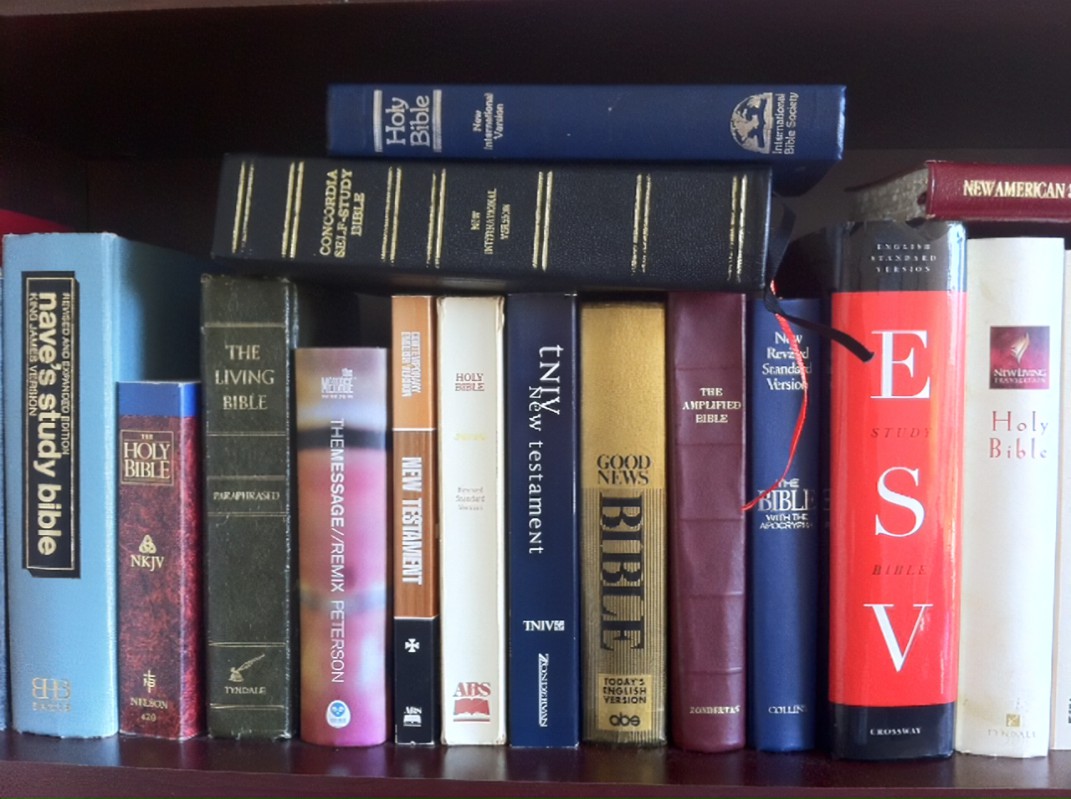
In a recent discussion I had in the Wild West of Facebook back-and-forth I was told by a couple of my interlocutors that multiple differing manuscripts, multiple differing Greek texts, and multiple differing versions were all the word of God. I found this puzzling and I found it puzzling for the following reasons:
1.) Premise 1: There is only one God.
Premise 2: There is only one voice of God.
Premise 3: There is only one actualized timeline.
Premise 4: When the one God using His one voice in the one actualized timeline spoke inspired words to the penmen of Scripture, one set of inspired words were spoken.
Premise 5: Only those words spoken by the one God using His one voice in the one actualized timeline are God’s words. No more. No less.
Conclusion: Claiming that the TR and the NA28 or version X and version Y are the word of God is indefensible if there are indeed only one set of words. Given this argument, claiming one is the word of God is far more defensible.
2.) Consider the following example, in 1 Kings 22 Ahab calls his prophets or shall we say his false prophets and asks them to prophesy of the coming battle. This is what they say,
“And Zedekiah the son of Chenaanah made him horns of iron: and he said, Thus saith the LORD, With these shalt thou push the Syrians, until thou have consumed them. And all the prophets prophesied so, saying, Go up to Ramothgilead, and prosper: for the LORD shall deliver it into the king’s hand.”
1 Kings 22:11-12
First, these prophets assume themselves to be prophets of God and so they present their prophecy. Second, others i.e., Ahab, assume these men to be prophets of God. Third, the message is brought in the name of the LORD. That is, these prophets are claiming that God said one thing and not another. These prophets are claiming that God said that victory is assured and that defeat is not.
Notice the phrase, “Thus saith the LORD.” These prophets are claiming that what is tantamount in our time as the word of God, Scripture. Furthermore, they are invoking the name of the Covenant Keeping God to make this claim. They are not prophesying in the name of Baal or Moloch but in the name of the living and true God. The God that brought Israel out of the land of Egypt.
As the story goes, contrary to Ahab, Jehoshaphat does not accept the prophecy of these prophets and asks if there are any other prophets of the LORD who have not spoken. Ahab says that there is one, Micaiah, but Ahab hates Micaiah because he does not prophesy ”good things” of Ahab. Still, Micaiah is called and asked to prophesy. Micaiah says,
“And the king said unto him, Micaiah, shall we go against Ramothgilead to battle, or shall we forbear? And he answered him, Go, and prosper: for the LORD shall deliver it into the hand of the king. And the king said unto him, How many times shall I adjure thee that thou tell me nothing but that which is true in the name of the LORD? And he said, I saw all Israel scattered upon the hills, as sheep that have not a shepherd: and the LORD said, These have no master let them return every man to his house in peace.”
1 King 22:15-17
Micaiah believes himself to be a prophet and so he prophesies. Others believe he is a prophet and so he is called by two kings. Micaiah prophesies in the name of the LORD, the name of the covenant keeping God. Yet, Micaiah prophesies a very different prophecy; a prophecy of the death of the king and the scattering of the sheep. In other words, Micaiah prophesies defeat and not victory. Can both the prophecy of Macaiah and that of Zedekiah both be the word of God? It seems the answer is manifestly, no. If that is the case, can a version which has the long ending in Mark and a version which has not the long ending in Mark both be the word of God? Again, at least at that point in the Scripture, it seems the answer is manifestly, no.
3.) Picking up with the example above, there is an additional moral component with saying God said something He didn’t or to say that God didn’t say something when he did. In the case of the Zedekiah, as in all claims that God said this or that, he prophesied that God said something He didn’t say [i.e., there will be victory]. Additionally, Zedekiah also failed to prophesy something that God said [i.e., catastrophic defeat]. As a result, what happens to Zedekiah for this very infraction? The Scripture tells us,
“And Micaiah said, Behold, thou shalt see in that day, when thou shalt go into an inner chamber to hide thyself.”
1 Kings 22:25
Many commentators here observe that Micaiah predicts that when the news returns to the palace that the king is dead in battle, Zedekiah will be on the run for his life because he is a false prophet and his false prophecy contributed to if not directly caused the death of the king. Some commentators argue that Zedekiah’s false prophesy contributes to Jezebel’s slaughter of the prophets of God because so many of them claimed to speak for God, where proven wrong, and therefore were proven to be charlatans. In short, Zedekiah’s false prophecy lead to the threatening of his life and perhaps even the death of many of the prophets of the LORD.
I make this point only to say, that if #2 above holds, then claims in opposition to #2 situate that claimant in the same company of Zedekiah et al. In short, there is great gravity in saying this is Scripture and this is not. If only our modern evangelical textual critics where as the wicked king Ahab on this point. He could at least recognize that Zedekiah’s prophecy and Micaiah’s prophecy cannot be the word of God at the same time and in the same way.
4.) I ask you to consider that there is a significant difference between making claims about what God said or did not say, and making claims about what God meant by what He said. The former postulates two different God’s while the latter reveals different understandings of the same God.
For example, on the one hand, you observe the phenomena of Scripture which teaches that God is sovereign and that man is free. Christian A observes these phenomena and ascribes to Molinism. Christian B observes these same phenomena and ascribes to Arminianism. Christian C does the same and ascribes to Calvinism. Assuming no one is questioning what God has said, at least not knowingly, the dispute here is over what God means not whether God acted or did not act in history via inspired speech.
On the other hand, if you say that God inspired the long ending in Mark but your neighbor says that God did not inspire the long ending in Mark. You hold to a God that acted in time while your neighbor holds to a God that did not act in time in this way. Put another way, it is like one of you believes Jesus raised Lazarus from the dead and one of you believe Jesus did not. This is not the same God. Unlike with Abraham, one of you is not believing what God said therefore your belief is not counted to you as righteousness.
5.) What is the doctrinal gravity of Micaiah and Zedekiah’s words? Could we lose those words from the canon and still have a sufficiently reliable text? It seems for the modern evangelical text critic the answer is, yes. Yet, Micaiah pronounces judgement upon Zedekiah for his “non-doctrinally significant” words. We learn at least two things from this:
One, simply because a word is not regarded by this or that person as doctrinally significant does not mean that said word can be cast aside without significant repercussions to the one casting. According to Scripture and this passage in particular, in addition to the doctrinal significance of a word discussed in the next point, there is also a truth quality [did God say X or did He not], and a moral quality [it is immoral to say you speak for God when you don’t e.g., God said its time for me to get a private jet. Send in your seed money.]. As such, the no-major-doctrine-is-affected-by-errors argument is both shallow and indefensible.
6.) Finally, given #4, it seems there is great doctrinal significance even to the smallest of words. Apart from the fact that many of Christ’s teaching and Paul’s teachings hang on one seemingly insignificant word, and apart from the fact that man is incapable of determining which of God’s words are insignificant as if that is a judgment that could be made, to say that God did not inspire a word like “and” or ”who walk not after the flesh” when He did is very grave business. Admittedly, to say God inspired something which He did not is also grave business, but let’s be clear. The reason why it is grave business is because we are making a claim about what God did in history when we say He inspired reading X or did not inspire reading X. But to imply that He did both when saying, ”There are many good translations” is both grave business and, on its face, indefensible and even the wicked king Ahab knew it.
An Introduction to Multiple Version Onlyism
The notion of Multiple Version Onlyism (hence MVO) arguably began in 1901 with the American Standard Version and has developed unabated until the present day. MVO holds to the uncritical, inclusive approval of the aggregate content of every English version since 1901 as God’s Word in English. MVO includes both formal and dynamic equivalency including paraphrases, idiosyncratic translations such as the New Revised Standard Version’s inclusion of Psalm 151, and niche interpretations based on feminist readings, for example. The sole exclusion to this aggregate is the King James Version.
Initially, MVO accepted all renderings as equally valid because it was held that no substantive doctrinal differences existed in the aggregate: all renderings were simply variations of the same theme. Choice of preferred bible versions could only be aesthetic. But with the proliferation of bible versions, the sheer number of various renderings brought every reading into question until no one knew for sure what the bible was saying.
Questions about the bible are responded to according to a scale from most unlikely to most likely correct but not in terms of infallibility. With the addition of each successive translation, what was first conceived to make a “better” translation, instead exacerbated the growing epistemological malaise by expanding the translational perspectives and options within the aggregate. Subsequent translations were not seen as “better” or replacements of previous editions as was the case with the historic development of the King James Version from Tyndale onward but were simply added to the dissonance of previously printed versions.
At this juncture in MVO transitioned the bible from being a sacred text to the research of academics. The viva vox dei, “living voice of God,” was replaced with a seat in a Ph.D. course on history, linguistics, and theology. The professors in this case are the versions, which as witnesses to their authors, the scholars, is open to the same critical inquiry common in Ph.D. courses. Answers and conclusions are not asserted right or wrong but are decided by whatever the student deems most valid. Critical thinking minds take and leave what they hear from which they formulate their own ideas and systems. And so it is with MVO functioning within a personal and ecclesiastical context. The subject, the MVO adherent, the final authority, ultimately determines what in the MVO aggregate is consistent with their own ideas and systems. The most skilled in MVO produce their own translation.
The Role of Evidence in Christian Belief

Recently I was asked how evidence fits into my overall argument in favor of a standard sacred text of Scripture for the English-speaking believing community. First, I will try to be as succinct and clear as possible then I will go onto offer an explanation for my view.
Yes, use evidence. Use as much as is relevant to your case. Use evidence with mouse. Use evidence with a house. Use evidence here and there. Use evidence everywhere. Use evidence with a fox. Use evidence with box. Use evidence in a train, in the rain, and on a plane.
The issue, as I see it, concerns the priority of evidence. Evidence is not the foundation of Christian belief. The Holy Spirit speaking in and through the Scriptures is the foundation of Christian belief. Evidence is secondary, supporting, and servant to the teaching of the Holy Spirit through the word of God. In other words, there is an order of belief, and it begins with the Spirit of God, not evidence.
First, the Spirit of God speaks through His words to His people and His people accept those words by the spiritual gift of faith. This is how people come to believe Jesus is the Son of God and their Savior. This is how people come to believe any teaching of the Holy Spirit in Holy Scripture.
Second, once the Christian comes to hold a given belief, they then go on to amass evidence, arguments, extra-biblical examples, artifacts, testimony, etc. All of these are then used to support the belief already held. Support is the key word here. Supports are not the foundation. They are only there to assist in what is already firmly founded and grounded in the teaching of the Holy Spirit through the word of God.
Third, such a stance is not “Presuppositional”. It is Christian. When you observe your pastor preaching on being a godly husband by saying the Bible says you are supposed to nourish and cherish your wife do you respond, “Oh, there the pastor goes again on his Presuppositional hobby horse”? No, you see the words in the text and observe that what the pastor is saying is in accordance with the words in the text, the Holy Spirit bear witness with your spirit, and you are either encouraged in being a good husband or you are convicted for being a bad one.
The source of Christian belief is not evidence it is faith and faith comes by hearing the word of God. As such, the Christian’s belief in his Bible as the word of God is first founded by faith and that faith comes by the word of God. Only after this firm founding of one’s believe does evidence come to support that belief. Should the evidence supplant the Christian’s faith-founded belief then we have a significant moral and theological dilemma because whatsoever is not of faith is sin [Romans 14:23] and faith depends on nothing for its existence or efficacy except God and His word.
Fundamentalism’s Folly? revisited
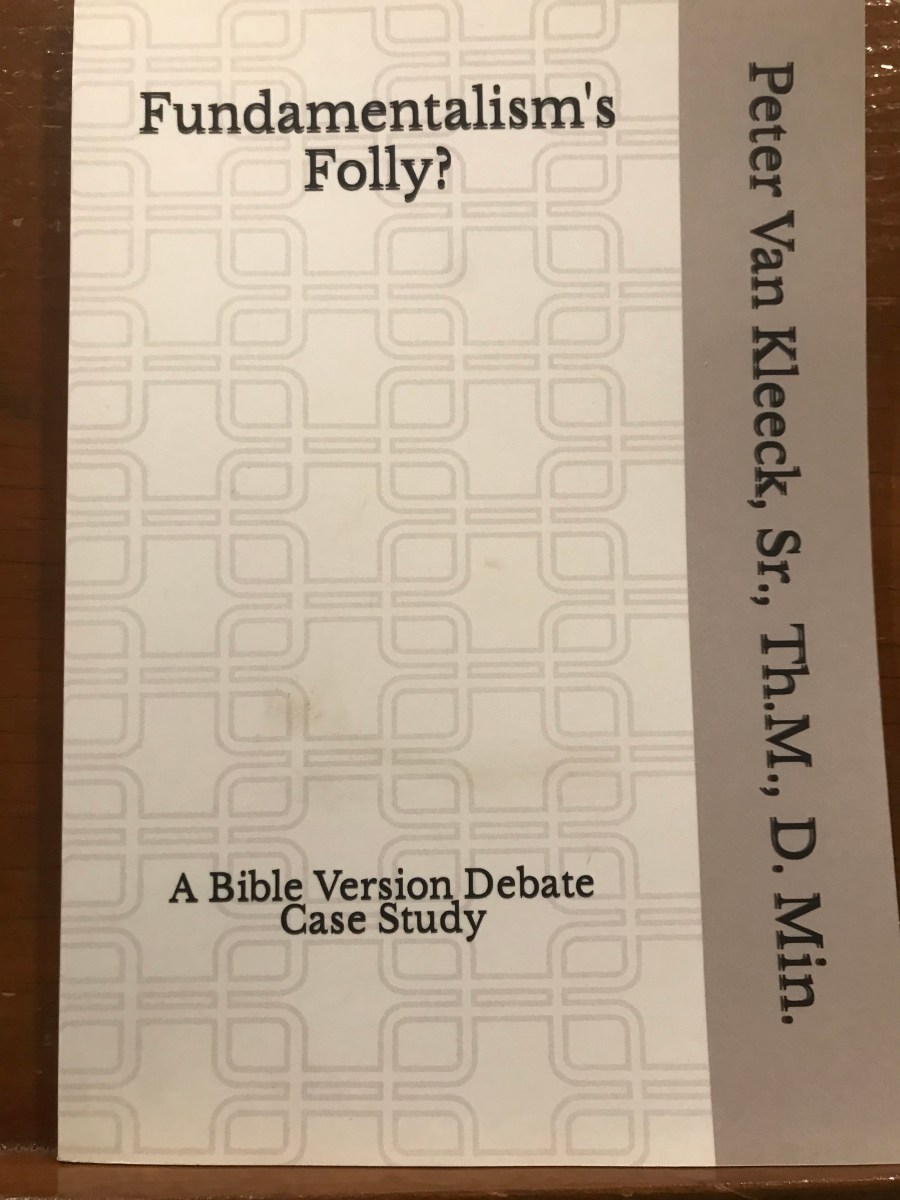
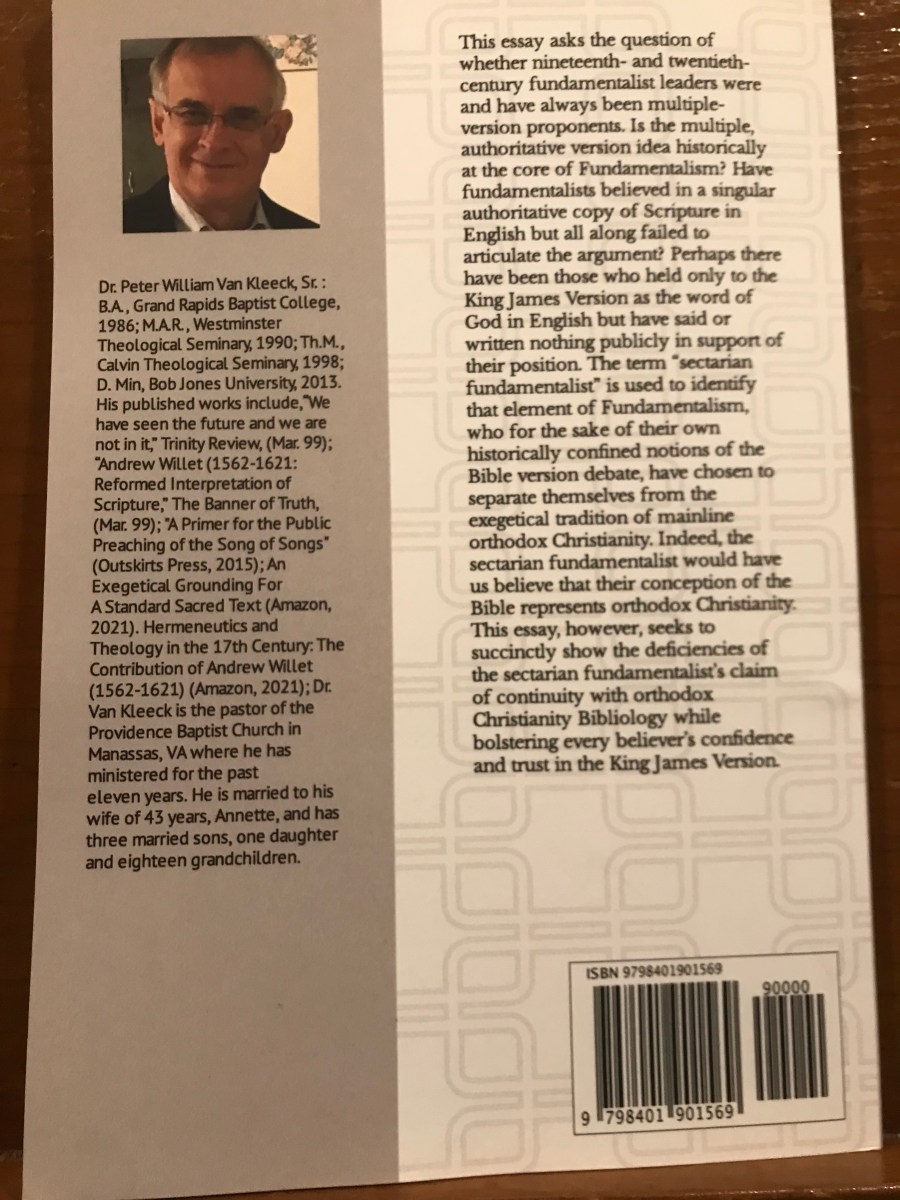
In 1998 Peter Van Kleeck, Sr. published a monograph entitled Fundamentalism’s Folly? A Bible Version Debate Case Study in response to a symposium entitled The Bible Version Debate: The Perspective of Central Baptist Theological Seminary released by Central Baptist Seminary in Minneapolis, MN, 1997. Of particular interest was the finding that the leaders of Fundamentalism were always multiple version only advocates.
For many years the printed lecture that became Fundamentalism’s Folly? has been out of print but now an expanded revision of the 1998 edition is again available on Amazon in both paperback and Kindle formats. The following is a short excerpt from the printed lecture.
“The sectarian aspect of this work is identified when the interpretation of Central Seminary’s historical perspective is done only by nineteenth- and twentieth century fundamentalists.[1] This emphasis begs the question of whether Central Seminary’s fundamentalists forefathers were disconnected from the history of interpretation and exegesis on the capital doctrine of providential preservation. Would these forefathers have supported the claim that no verse of Scripture argues for providential preservation against the ecclesiastical history of the sacred text and subsequent versions?
If such support were forthcoming, it would be correct to say the Central Seminary is consistent with sectarian Fundamentalism but is isolated from the exegetically informed churchly tradition. This sectarian fundamentalist break with orthodoxy becomes more evident when advocates of providential preservation must depart from Fundamentalism for a truly historical defense of Reformation Bible traditions and particularly the continuing worth of the King James Version. For instance, Dr. Donald Waite, a fundamentalist depends on the Anglican John William Burgon for his polemic. Dr. Edward F. Hills, a Presbyterian, provides a covenantal, erudite defense of Scripture’s providential preservation. Dr. Theodore Letis, a Lutheran, likewise presents a sound and compelling argument. A Princeton-trained Baptist, Dr. David Otis Fuller, was also abandoned by his fundamentalist brothers for his defense of the King James Version. Dr. Larry D. Pettegrew is apparently correct when he writes that one is “actually less of a fundamentalist” if he holds to the King James Version.[2] The question, then, is whether to be identified with Central Seminary’s form of sectarian Fundamentalism on this point is commendable.
Among sectarian fundamentalists there is an earnest if not perplexing desire to maintain sound doctrine. This tension is due to the struggle that ensues between maintaining the tenets of the faith while also arguing for a fluid source of exegesis. An uncritical assessment of this tension is made early by Dr. Douglas R. McLachlan, who writes, “We believe there is merit in investigating and probing the abundance of available manuscripts evidence which is accessible to the serious student. The we can preach and teach with the authority of a true biblicist, speaking God’s absolute truth accurately, passionately and relevantly into the hearts and minds of our post-modern world.”[3] If we can speak “God’s absolute truth,” one might contemplate how this is to be done when distinguishing between two divergent readings of Hebrews 2:16, “For verily he took not on him the nature of angels; but he took on him the seed of Abraham” (King James Version) and “For indeed He does not give aid to angels, but he does give aid to the seed of Abraham” (New King James Version). The validity of McLachlan’s assertion is never proven by these essays. The idea of “God’s absolute truth” is spoken of dogmatically, implying that no major doctrine is infringed upon, but clearly McLachlan’s words do little to resolve the doctrinal tension indicative of this illustration and other similar passages. In keeping with the conclusions drawn by the sixteenth- and seventeenth-century exegetes, apart from exegetical confirmation, McLachlan’s claim to being able to speak “God’s absolute truth” is absurd.
This essay is not confined to a narrow sectarian scope of history perceived by nineteenth- and twentieth-century fundamentalists, but accesses the writing of leading figures of the historic churchly exegetical tradition to ask, “How can we claim to have developed a satisfactory approach to the Bible version debate if our findings are incompatible with the way God’s people have read the Scriptures throughout the centuries? If what is being said is not consistent with the exegetical tradition, how can we know if it is orthodox?”
[1] Grisanti, Bible Version Debate Ibid., 137, 139. The oldest bibliographical resourse cited are those of F. H. A. Scrivener (1874, 1884, 1894); and W. Hort (1888). For noted fundamentalists see 10-12.
[2] Grisanti, Bible Version Debate, 13.
[3] Grisanti, Bible Version Debate, 4; cf. 105 n. 43.
Canonicity (Part 1)
In this episode Dr.’s Van Kleeck begin their discussion on the nature of the Scriptural Canon. The meaning of canon and the church’s role in recognizing the canon.
William Bucanus, 1659, Professor of Divinity in the University of Lausanne, on Scripture’s Self-attesting Witness
Common Place IIII.
Of the Holy Scripture
What is the Scripture called?
The Scripture, putting one name for another is used for the writings of the Prophets and Apostles, which the company of the faithful doth religiously use for the instruction in godliness. And it is called holy, because, being delivered of God, it containeth holy things necessary unto eternal life. And in the same sense it is called the written word of God, and the unappealable Judge of all controversies of religion. Isa. 8:20; Luke 16:29-31.
Who is the Author of it?
God himself, who did commit his will unto writing by men called immediately of himself, and inspired by the Holy Ghost as his servants at hand, (as his penmen and public notaries) 2 Peter 1:21. For the Prophecy was not at any time brought by the will of man, but the holy men spake as they were moved by the holy Ghost. Hereupon all the Prophets do with one accord repeat this, The mouth of the Lord hath spoken it, Isa. 58:14. These things saith the Lord, Eze. 12:25, 28. 2 Tim. 3:16, The whole Scripture is given of God by inspiration. 1 Cor. 2:13, Which things we speak, not in the words which man’s wisdom teacheth, but which the Holy Ghost teacheth. Whereupon depend the adjuncts of the Scripture, as the authority, the excellency, the truth, and fulfilling of them, which is necessary, as it must needs be that God is true. Whence also it comes to pass, that the Scripture alone is to be believed, for its self of its self is worthy to be believed. Neither is it subject to the censure, addition, diminution, or alternation of angels or men, Deut. 12:32; Rev. 22:18. It alone is without all error, and we are bound to believe it alone upon the bare affirmation thereof. By it alone all opinions which men shall read, are to be confirmed and to be decided. This alone is perfect, and containeth all things necessary unto life eternal. Lastly, it is firm and constant, Deut, 17:9,10; Isa. 8:20; Mal. 2:7; Acts 17:2; Joshua 1:8; Job 5:39; Acts 17:11; Psalm 19:8; Luke 16:29; John 15:15; Acts 20:20, 27; 2 Tim. 23:16,17; 2 Peter 1:19.
How may it appear that the writings of the Prophets and Apostles were indicted of God?
Partly by testimonies, partly by reason. And the testimonies, partly inward, partly outward. The internal witness is one alone; namely of the holy Ghost inwardly speaking to our heart, and persuading us that those writings are inspired of God, and sealing them up in our hearts, Eph. 1:13; 1 John 2:20, 27, Ye have an anointment of the Lord, and this anointment teaching you all things. For whosoever are led by the Spirit of God, can easily discern his power speaking in the Scriptures. As it is said, 1 Cor. 2:15, The spiritual man discerneth all things, and Isa. 53:1, The arm of the Lord is not revealed to all men. So, Luke 8:10 and Mark 13:11, The mysteries of the kingdom of heaven are not revealed to all men, but to whom it is given of God. And this testimony properly maketh for our confirmation, and this alone doth satisfy us, being known of them alone that are converted unto Christ, which doth evermore agree with the Scripture, without which the testimony of the Church can be no weight with us. For as none but God alone is a fit witness to testify of himself in his word, even so the word never findeth credit in our hearts, till such time as it be sealed up unto us by the inward testimony of the Spirit.*
*Note the continuity of Bucanus’ commentary with that of the Westminster Confession of Faith, 1647, Ch. 1.5., “yet notwithstanding, our full persuasion and assurance of the infallible truth and divine authority thereof, is from the inward testimony of the Holy Spirit bearing witness with and by the Word in our hearts.”
William Bucanus, Body of Divinity or Institutions of the Christian Religion; framed out of the Word of God, and the writings of the best divines, methodically handled by was of questions and answers, fit for all such as desire to know and practice the will of God. Written in Latin. Translated into English by Robert Hill and Fellow at St. Johns College in Cambridge, for the benefit of the English Nation. (London: Printed for Daniel Pakeman, Abel Roper and Richard Tomlins, and are to be sold in Fleet-street, and at the Sun and Bible near Py-corner, 1659), 42, 45-46.
Which Translation is the Most Accurate?
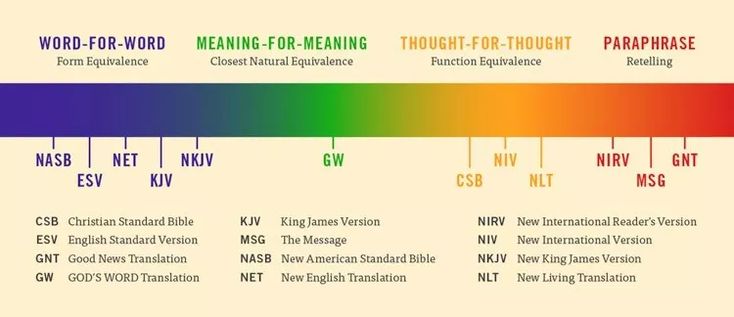
In this video, Dr. Robert Plummer of Southern Seminary is asked whether the KJV is the most accurate translation. In the end, Dr. Plummer says that the KJV is not the most accurate translation but offers nothing in its place except to say there are many good translations out there to choose. So, I suppose they all equally miss the mark while simultaneously hit the mark in the same way? Assuming the argument offered here at StandardSacredText.com cannot answer the above question, how then do we answer this question of which translation is the most accurate?
Accuracy implies a target or goal. Furthermore, accuracy implies an approximation to the target or goal. That is, accuracy is relative. Some X is more accurate than some Y. This again takes us back to the target or goal. Furthermore, it assumes there is some object intended to reach that goal whether an arrow to the bullseye or a soccer ball to the soccer goal or a basketball to the hoop. But who establishes that target and the aimed object? As we see it, the answer is either God or men.
Assuming the former, where would we find shape and dimensions of the target or goal. Perhaps God has defined a hockey goal or a basketball hoop and man a rugby goal. How are we to know what God has prescribed as the goal or target for our accuracy so that we could say which translation is the most accurate? Even further, how are we to know that the thing aimed is suited to meet the goal or target. Shall we include a bow and arrow as a means to score a touchdown in football or a dirt bike to score a 10 in synchronized swimming? Though such additions would certainly make things interesting, it seems the thing aimed does not fit the goal or target.
Then of course the goal and target are prescribed, they are standardized. AT&T Stadium, the home of the Dallas Cowboys, and Ford Field, the home of the Detroit Lions both have endzones. If there is a game in Dallas between these two teams the Lions cannot score touchdowns in Detroit even though there are endzones there. There are rules and standards. Both teams are expected to abide by those standards if they want to be counted among the teams of the NFL. Similarly, what are the rules and standards set up for what counts as an accurate translation and then the most accurate? Who made these rules and why do their opinions count?
Seeing our argument is largely dismissed by those who apparently know best, it seems that God has not prescribed the rules regarding the size and shape of the target, nor the object used in achieving that target, nor the rules and standards which govern both the target and the aimed object. In our day and age, in the church, in our seminaries and divinity schools, men do this work. Men tell us what the original is and where it is located. Men then determine the approximate value of formal equivalency and dynamic equivalency. Men tell us that the objected aimed is modern textual scholarship applied to the “embracement of riches” that is the manuscript tradition. Men tell us that the long ending in Mark may or may not belong in the Bible. They tell us that the story of the woman caught in adultery most certainly does not belong in the Bible. And when they say these things, they believe themselves to have hit the goal or target that they have set up for themselves.
As a result of assuming this largely transcendentless position Dr. Plummer does not give an answer to which version is the most accurate. Rather he simply states that the KJV is not the most accurate. Plummer has merely stated the party line. The fact is that for Plummer and those of his persuasion, there is no “most accurate” translation. “There are many good translations,” is the approved contemporary evangelical position. No one is truly more accurate than the other. Which of course is like saying, no shot on goal is truly more accurate than any other. For the modern evangelical textual critic, the goal is rather wide. Plummer considers the ESV, NASB, CSB and NLT to all be touchdowns. Who says? Well Dr. Plummer of course, but of course Dr. Plummer is one of the players and not the creator of football.
The players are telling us what counts as a goal or touchdown. The Creator of the game has been sidelined in the current modern evangelical text critical endeavor, only players get a say and especially the smart. The players debate about what is or is not the New Testament. There is no objective third will to adjudicate the call. We’re not allowed to ask the Creator of the game about how the game is supposed to be played. The players get to say what is out of bounds, and what is in bounds. They determine whether it’s a fourth-and-one or a first down. They determine the length of the field and who gets to play. So, of course, they are the ones to declare the touchdowns, hattricks, and hole-in-ones. They set their own standard, get close in meeting that standard, and then declare victory or simply changes the target from the Original to some other text and then change the method to the CBGM.
Finally, a most accurate translation does not exist. All that exists is good and bad translations. So, they are all equally accurate or inaccurate? They are all equally bullseyes? It’s like that part in Robin Hood where he strikes the bullseye with one arrow only to split that arrow with a second. Apparently, modern textual critics and translators have become the Robin Hood of Robin Hoods. They have shot a dozen arrows where each consecutive arrow splits the prior arrow at the bullseye. Well done! What is more likely though is that the goal is rather wide. So instead of a bullseye it is more like a soccer goal without a goalie where once the shot is taken the players stand around and declare, “Close enough is good enough. Yes, and Amen!” Certainly, if close enough is good enough for God’s word, then close enough is good enough for God. Amiright?
 Standard Sacred Text.com