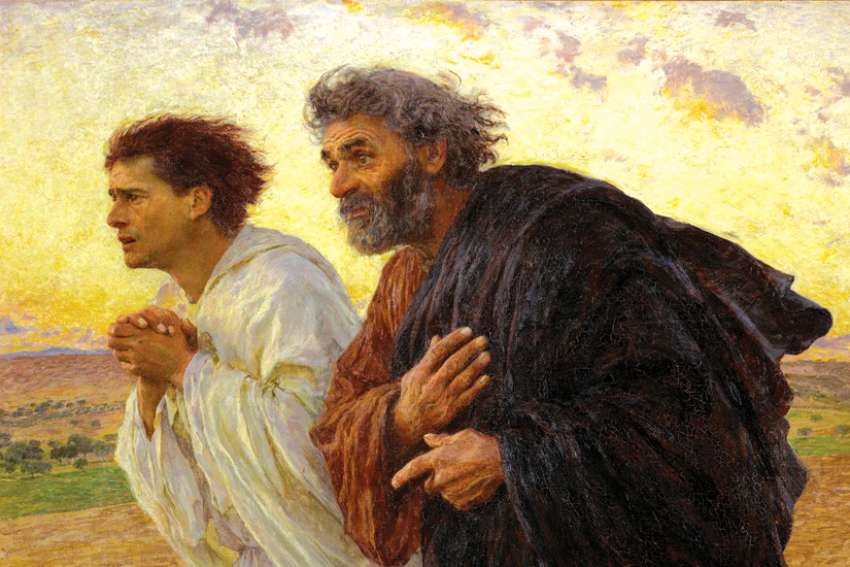
“If Christ is risen, nothing else matters. And if Christ is not risen—nothing else matters.”
Jaroslav Pelikan on his deathbed.
Belief in Scripture to Change the World
“If Christ is risen, nothing else matters. And if Christ is not risen—nothing else matters.”
Jaroslav Pelikan on his deathbed.

Matthew 28:1-20
28 In the end of the sabbath, as it began to dawn toward the first day of the week, came Mary Magdalene and the other Mary to see the sepulchre.
2 And, behold, there was a great earthquake: for the angel of the Lord descended from heaven, and came and rolled back the stone from the door, and sat upon it.
3 His countenance was like lightning, and his raiment white as snow:
4 And for fear of him the keepers did shake, and became as dead men.
5 And the angel answered and said unto the women, Fear not ye: for I know that ye seek Jesus, which was crucified.
6 He is not here: for he is risen, as he said. Come, see the place where the Lord lay.
7 And go quickly, and tell his disciples that he is risen from the dead; and, behold, he goeth before you into Galilee; there shall ye see him: lo, I have told you.
8 And they departed quickly from the sepulchre with fear and great joy; and did run to bring his disciples word.
9 And as they went to tell his disciples, behold, Jesus met them, saying, All hail. And they came and held him by the feet, and worshipped him.
10 Then said Jesus unto them, Be not afraid: go tell my brethren that they go into Galilee, and there shall they see me.
11 Now when they were going, behold, some of the watch came into the city, and shewed unto the chief priests all the things that were done.
12 And when they were assembled with the elders, and had taken counsel, they gave large money unto the soldiers,
13 Saying, Say ye, His disciples came by night, and stole him away while we slept.
14 And if this come to the governor’s ears, we will persuade him, and secure you.
15 So they took the money, and did as they were taught: and this saying is commonly reported among the Jews until this day.
16 Then the eleven disciples went away into Galilee, into a mountain where Jesus had appointed them.
17 And when they saw him, they worshipped him: but some doubted.
18 And Jesus came and spake unto them, saying, All power is given unto me in heaven and in earth.
19 Go ye therefore, and teach all nations, baptizing them in the name of the Father, and of the Son, and of the Holy Ghost:
20 Teaching them to observe all things whatsoever I have commanded you: and, lo, I am with you always, even unto the end of the world. Amen.

We admit in agreement with our opposition that it is possible to be saved out of other versions of the Bible beside the KJV so long as that version contains the substantia doctrinae of the original language. That said, we do not regard the salvific power of a document to be the sole or even primary reason to accept a version of the Bible as the word of God in a given language and that for two reasons:
1.) Most Christians understand and many have experienced that it takes only a handful of verses for the power of God unto salvation to penetrate the heart of a lost soul. As a concrete example, tracts do this quite effectively. Perhaps the tract is only the size of 3×5 card containing the Romans Road. The Scripture contained therein is sufficient to lead someone to Christ and His salvation. In the case of a tract, the vast majority of the Scripture is omitted from the text of the tract, and yet with all that Scripture missing from the tract it is still possible for the person reading the tract to receive Jesus Christ as Savior. Furthermore, the mere presence of parts of Scripture in the tract does not transform the tract into the Bible, the inspired canon of Scripture. The tract contains verses from the Bible but it is not the Bible. In other words, the tract is sufficiently reliable to lead someone to Christ while at the same time the tract is not the inspired canon of Scripture. So, like tracts, versions which contain portions of the inspired canon of Scripture can in these places lead someone to saving knowledge in Christ.
2.) In dealing with the question of whether or not a soul can be saved out of another version, I often ask the question, “To whom is the Scripture written, the lost or the saved?” After some back and forth the answer must be that the Scripture or at least the greater portion of Scripture is written to the saved, to and for God’s people. The Bible is not primarily a book about salvation. Rather, it is a book about conformity to Christ, salvation being the first step in that journey. The greater portion of the Scripture revolves around teaching and examples, both positive and negative, of how we ought live, of how we ought to conform to the image of Christ. In a word, the Bible is about sanctification – being set apart unto God and away from the world. The apostle Paul tells us in 2 Timothy 3:17 that inspired Scripture is profitable for doctrine, reproof, correction, and instruction so that the man of God may be perfect or complete. Hebrews 13:21 tells us that our salvation is secured through the blood of Christ in order that we be made “perfect in every good work to do his will.”
To the point, it is not enough that a version of the Bible be able to lead someone to Christ. That we admit. But more to the reason for which Scripture exists, the version must serve to perfect the saint in every good work in order that he may do the will of God.
The stream cannot be more pure, more perfect, than the fountain. It is not possible therefore that the man of God be made perfect or complete if the Bible from which he reads is not perfect or complete. Or he can only be as perfect as his Bible is perfect.

While it is fun discussing and defending the Standard Sacred Text position I must say that doing Christian Apologetics on university campuses is more fun. Over the last six years or so I’ve been going to the local university and “putting out my sign and chairs.”
The Lord has blessed me with opportunities to interact with students in this way on the campuses of the University of South Florida, the University of North Florida, Hillsborough Community College, Trinity Baptist College, and Virginia Tech. In short, I find a place near the student’s center, put down my sign and chairs, sit in one chair, and wait for someone to sit in the other. The sign usually has a theological, philosophical, ethical, or political question on it which is meant to provoke conversation. Every time I’ve been out someone comes and sits in the other chair.
The goal then is to meet that person where they are in an attempt to ascertain their worldview and from that place begin to point them to the truths of Scripture and to Christ. Today the Lord gave me the opportunity over the course of three hours to meet with nine students. Some atheist, some agnostic, and one Roman Catholic. In each case I was able to share the truths of Christianity while simultaneously deconstructing something of the student’s atheist/agnostic worldview.
Additionally, a local Blacksburg pastor accompanied me to see how the process goes. He was able to talk with several students as well. Overall it was a great day.
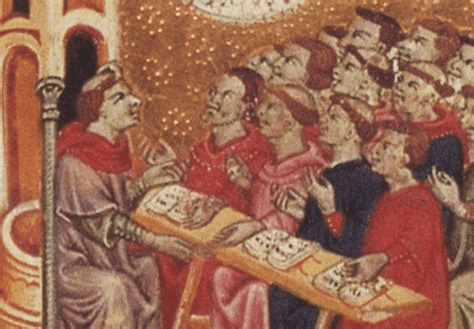
Several changes in perspective accompany the transition from MVO to the King James Version. There is a greater emphasis on the role of the Church and a diminished emphasis on the importance of the Academy. There is a renewed emphasis on the value of good literature and a diminished acceptance of contemporary writing styles. There is a greater emphasis on the word of God in the present than upon a proposed eschatological discovery. There is a renewed emphasis on the home as the source of theological teaching rather than the Church or Academy. There is a greater emphasis on God at work in history rather than history hemming in the work of God. There is a greater emphasis upon the significance of each believer rather than an academic elite. Inspiration means something today not just in the past. Manuscript evidence is actual not hypothetical. Theology is exegetical not by consensus. Christianity has historical continuity and is not a product of critical re-creation. Truth is drawn for extant writings not from philosophical formulation. Two things that are different cannot be the same. God’s singular care and providence preserved Scripture not textual critics. Every word of God is important to Holy Scripture not enough of the words of God to make it Scripture.
So while we write about the superiority of the KJV, it is not simply a change in vernacular Bibles that is in view. With the acceptance of the KJV comes a worldview paradigm shift away from the contradictory notions of MVOism. If someone wants to hang on to the priority of the Academy over the Church and home, has a bent toward modern writing styles, believes history not God is the solution to men’s ills, that inspiration only belongs in the past, that manuscript evidence is intrinsically actual, that Christianity is in the process of re-creating itself in another image, that consensus is the theological method, that truth is a philosophical formulation, that two things that are different can be the same, that critics preserve the Scripture, and that enough words, not all the words of God are necessary to be called Scripture, then replacing your MVO with the single KJV may be a bridge too far. It’s not impossible, but an entirely different approach to God, the world, and your self must be the prerequisite. The KJV represents a consistent, historical, and robust Christian worldview that bolsters Scripture based institutions, emphasizes the priesthood of the believer and his interaction with the Holy Spirit, and believes the Bible is the self-authenticating all the words of God. MVOism isn’t just holding all Bibles as authentic, it represents a worldview foreign to historic Protestant orthodoxy.
When this kind of shift from the authority of God’s word to some other authority occurred, it took 1,000 years to recover. The Renaissance and ad fontes, and the Reformation and sola Scriptura put the Western world back on the right track. Right now, rather than moving into the theological and cultural clarity of the Renaissance and Reformation, Western culture is running headlong back into the superstition and confusion that beset much of the Middle Ages. And a great deal of the modern Church and Academy would have it so. But even in a larger failed trajectory there are some who are not buying what the fallen culture, pusillanimous Church, and pontificating Academy are selling. Received as the Word of God in English for over 400 years, the KJV alone is suited to produce the ecclesiastical and academic shift back to grounding Christian truths and principles that will change Western culture.

We believe as do most of our interlocutors that people of all languages ought be able to read God’s word in their own language. If they ought to read God’s word as it is in their own language then this “ought” implies that they can read God’s word as it is in the own language. This of course assumes that God’s word can be translated into other languages. And not just that, but that all of God’s words can be translated into other languages which assumes that we have all of God’s words. Unless, of course we are to believe that vernacular translations cannot translate all of God’s words because we don’t have all of God’s words.
Most of our interlocutors would retort that we do have all of the words of God. It is just that we are not sure if they are in the apparatus or the body of the Greek text. Does that same criteria go for the version as well? Are we to believe that the translation of the CSB is the word of God or are we to think that perhaps something of God’s word was left in the textual apparatus of the N/A27 and thus never translated into the CSB?
If it is true that all of God’s words are either in the textual apparatus or the body of the Greek NT and the textual apparatus is not present in modern versions of the Bible, then it is quite possible according to most Critical Text advocates that all modern translations do not have all of the words of God. So why should the modern church around the world believe she has all the words of God in her Bible if we know, admit, and regularly teach first year seminary students that the words of God are either in the text or apparatus and modern versions don’t translate the apparatus?
“But what about the marginal notes,” says the critic, “sometimes the marginal notes may have the other rendering from the textual apparatus.” Indeed, but if it is God’s word in the margin, then the editors of that translation have quite literally marginalized God’s word. Well played.

I believe that we and our interlocutors agree on the point that the word of God should be publicly preached in public worship and that is should be preached as the power and authority of God in all things that pertain to life and godliness.
Such an agreement should then exclude preaching things we know are not the word of God for these kind of things are not the power and authority of God in all things that pertain to life and godliness.
Additionally, we ought to avoid preaching things we are unsure are the word of God because in doing so the preacher is unsure if the words he is preaching are indeed the power and authority of God in all things that pertain to life and godliness. And any conscientious preacher would rather avoid preaching certain words as if they were the words of God and as if they possessed the power and authority of God when in fact it is possible that said words are not the words of God and do not carry the authority and power of God in all things that pertain to life and godliness.
So then the question of the hour is, “Do preachers preach the word of God because they know it to be the word of God as such the power and authority of God in all things that pertain to life and godliness?”
If they do know, how do they know? If the argument propounded here at StandardSacredText.com is rejected, then the natural transcendentless alternative seems to be something like, “Because my professor says so” or “Because I like the way this is the version of God’s sounds” or “Because the editors of the ECM are smart guys and I trust them.”
The I-like-the-way-it-sounds response is merely Expressive Individualism wearing dressed up in its Sunday bests and ought to be flatly rejected as a primary reason for reading the Bible. Regarding the professor and the editors of the ECM responses, the follow-up question would be, “Well, how do they know?” They don’t know. Rather they think it is probable that this or that reading is the Bible based on evidence. As such the Red Sea probably parted, Lazarus probably rose from the dead, and Jesus probably fed 5,000 people from a small lunch, and the belief that Jesus died on the cross for our sins is probably true.
Finally, then, our Christian faith is anchored in something that is probably true which makes faith itself probable seeing it is said to be a deliverance of Scripture [i.e., faith comes by hearing and hearing by the word of God]. So those who profess faith in Christ are probably saved.
And before you say that I’ve gone to far in that last line, both Dr.’s Van Kleeck have pressed this line of argumentation regarding the probability of faith with professors whose names you would recognize if we were to name them, and these professors have, in front of the whole class, admitted that in the interest of epistemic humility and given the limitations of the human capacities to know and believe they could only be at best 99% sure that they were saved by faith in Christ. In other words, for these two prominent evangelical professors from two different schools, it is only highly probably that they are saved and they are so sure of this fact that they are willing to say it out loud in class. I can’t imagine what they expect from us who are less informed and are not as gifted intellectually.
In sum, if the Bible you read is probably the word of God then the best you can say is that you are probably a child of God and therefore probably going to Heaven.
If the Bible you read is the word of God, then all other Bibles are not the word of God. They merely contain large amounts of the word of God. So then here are the two ways you can have it:
Option 1: My Bible is probably the word of God and as such I am probably saved by accepting its teachings.
Option 2: My Bible is the word of God and as such I am saved by accepting its teachings, but all the other Bibles which differ from God’s word are not the word of God at least in the places they differ. Still, a Bible that is 75% God’s word and 25% men’s word is not properly called God’s word.

In this episode of Warrior Theology Podcast, Dr.’s Van Kleeck continue their discussion of the preservation and collation of the canon of Scripture as a ground for treating the preservation and collation of the canonical words of Scripture.

Four initial points: 1.) we agree without our interlocutors that double inspiration is not supported in Scripture 2.) we agree with our interlocutors that God immediately inspired the original words written by Moses, Paul, Peter etc. 3.) we believe that the inspiration present in the words written by the canonical writers has been preserved for us down to this day. 4.) we believe that this inspiration can be present in vernacular translations via the categories of substantia doctrinae and derivative inspiration.
Regarding the first of these four we find perfect agreement with out opposing interlocutors. Regarding the second of these four we find relatively perfect agreement with our inerrantist interlocutors. Regarding the third of these four our interlocutors are rather muddled and so it is difficult to conclude whether we agree on this point or not. But the fourth of four, our interlocutors seem wholly unware that such a thing exists. If they are aware of such inspiration in vernacular translations then it seem to take the shape of something like, “If the translation is faithful to the originals then it is in this way inspired.” Setting aside the fact that we don’t have the originals and the fact that our interlocutors have only a naturalistic mechanism whereby they determine what is or is not original and the fact that such an unsupported declaration is hardly robust enough to stand under its own weight, it seems our interlocutors may be onto something which may one day grow into right thinking and right practice.
Until then it seems that in the place of a disagreement we have a void. It is not that we disagree on this point with our interlocutors it is that they have nothing on offer to fill this place in their system. And if they do, as I’ve said, it is rather anemic.
We believe and have asserted several times on this blog and in print that inspiration is to be understood in two parts: 1.) the inspiration of the accidents of writing [i.e., the shape of the letters] which in this case is the shape of Greek and Hebrew, the languages of the originals and 2.) the inspiration of the substance of writing [i.e., the meaning of the words]. So while a translation cannot have #1 seeing that a translation is not written in Greek or Hebrew and as such has different accidents of writing; translations can have #2 regarding the substance or meaning of the inspired words.
This we call derivative inspiration as distinguished from immediate inspiration. The latter happened at a moment in time and was unique to that person [e.g., Moses, David Paul etc.] and that unique time. Derivative inspiration is when a vernacular translation of a given inspired original word bears the substance of the original word. In such a circumstance the translated word is not inspired as to the accidents of writing but it is inspired, indeed equally as inspired as the original word, as to the substance of the word. In this sense, the words of a vernacular translation are inspired and are therefore profitable for doctrine for reproof for correction and for instruction in righteousness that the man of God may be perfect or complete unto all good works.
And how are we to determine which words are the inspired words in a vernacular translation? If you’ve been with us long you know the answer. The Spirit of God through the substantially inspired vernacular words of God speaks to the people of God and in those substantially inspired vernacular words the people of God hear the voice of the Good Shepherd and receive those substantially inspired vernacular words as indeed the words of God in the vernacular and not the words of men.
But you say, “Aren’t there substantially inspired vernacular words in some of the other modern translations?” Yes, there are, but for all my programming friends out there, there is a huge difference between an “Is A” relationship and a “Has A” relationship. A translation may have words of God but that is different from saying a translation is the word of God. Furthermore, no two vernacular translations agree at every point regarding that substance spoken of above and especially when comparing the KJV to most modern translations which bracket or footnote or wholly remove large portions of Scripture or significant portions of verses. In this sense, all versions when compared to each do not manifest the same “substantially inspired vernacular words.” Put simply, many vernacular translations add or omit words which the editors of such translations have determined are or are not the substantially inspired vernacular words of God.
Turning again to the Law of Non-Contradiction, The ESV as the word of God and the NIV as the word of God cannot both be the word of God at the same time and in the same way. And the same goes for any other versions you would like to compare: KJV, NKJV, CSB, NASB and on and on. Given that the words of a translation can be the substantially inspired vernacular words of God then either the ESV or the NIV or the KJV or the NKJV or the NASB or the CSB or the LSB are the substantially inspired vernacular word of God. But they cannot all be the word of God at the same time and in the same way. Why because the translated words can and do bear the inspiration of the original words of God written at the hand of Moses, David, Paul, Luke, etc. via the substantia doctrinae of inspiration making even the words of a translation to be inspired.
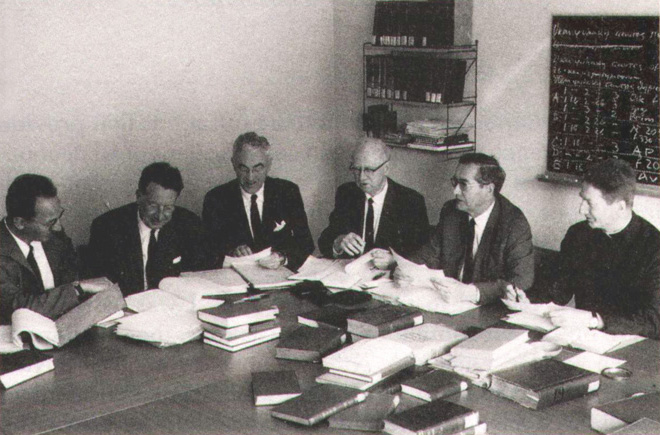
Interestingly enough, we here at StandardSacredText.com agree with our interlocutors that some form of textual criticism is and should be employed by capable scholars. We believe it was done at the time of the formulation of the TR and before that and we believe something of textual criticism ought to practiced today for the benefit of the Church.
But as you can imagine we disagree with our interlocutors in certain key areas and more specifically with regard to the nature of the practice and the method as it is carried out.
Regarding the nature of the practice, we believe that the work of New Testament textual criticism ought to be done in a distinctively Christian environment by professing Christians who set their Christian exegetically based precommitments at the ground and foundation of their text-critical practices and conclusions. We will address what I mean by Christian environment in just a minute, but our focus begins with Christians doing distinctively Christian textual criticism.
So what exactly does Christians doing distinctively Christian textual criticism look like? First, all work done on the New Testament must be understood as and treated as an act of submission to the Scripture itself. All who do textual criticism must be in submission to Scripture if they are to do textual criticism right. Which is to say, that at a minimum they ought to do their work guided by faith for whatsoever is not of faith is sin.
Furthermore, as part of their submission to Scripture all textual critics must see themselves as slaves or bondservants to the Spirit-led bride of Christ. One particular manifestation of that submission is to place the authority of the believing community above whatever scholastic conclusions are drawn by the academy regarding the Scriptures. As such, NT textual scholars have miserably failed on this point in that they along with Wescott and Hort have abandoned the TR as the Greek standard sacred text of believing community. The reception of the TR by the believing community is of greater import and of greater worth to the Church than all the readings accepted by all the scholars in all the world. To jettison the TR in favor of the “neutral text” of Sinaiticus and Vaticanus was simply an act of rebellion toward rather than submission to the Spirit-led bride of Christ. A rebellion that has yet to be repented of and is instead loudly persisted in.
Additionally, rather then marginalizing or ignoring one’s Christian precommitments in the work of textual criticism, the text-critic ought to make his Christian precommitments front and center in his work. Every act, every thought, every conclusion must be in submission to Christ as Lord, and that submission is defined in the words of Scripture. Furthermore, there must be a regular and clear assertion and acknowledgement that every time a word is thought in need of addition or omission that such an addition or omission may very well be an addition or omission of the very words of God. Fear, holy fear, ought to regularly penetrate the heart of every NT textual scholar when they as men think to claim this or that word to be God’s word when it is not or to think God’s word is something other than God’s word.
Why? Because every time a scholar speaks dogmatically or in terms of high probabilities that Word X is the New Testament then they are speaking dogmatically or in terms of high probabilities that God gave Word X by inspiration. But did He? If God didn’t, then the scholar is dogmatically asserting that God said something He did not. Such behavior – claiming that God said something that He really did not – is the very definition of being a false prophet or shepherd made with men’s hands. Both types of people are roundly condemned in Scripture.
There is more to say on this first point but I must move on. As a point of contention on our part, we assert that the environment of textual criticism is not an academic one. It is an ecclesiastical one. Real textual criticism, that part where words are said to be or not to be the New Testament/word of God, does not come about via textual committees. Real textual criticism is done by everyday Christian folk, by stay-at-home moms, truck drivers, little league coaches, computer programmers, dentists, dairy farmers and the like. It is the body of Christ by faith that hears the voice of their Good Shepherd in the Shepherd’s words and in hearing His words recognize His voice and follow Him. In the end, ultimately this is how we know what words are the New Testament and what words are not. In a right world, Christian textual critics only offer suggestions, are careful with their dogmatism, and when they do make a suggestion they do so with great trepidation.
But the textual critic is not wholly to blame. The believing community has a part to bear in this fiasco. Just like dads have pawned off the spiritual formation of their children to the church, and the church has pawned off its responsibility for the poor to the government and the government pawns off its ineptitude in caring for the poor on society and society pawns off its responsibility to God or Naturalism, so too the church has pawned off the real work of textual criticism to the academy and the academy, like the government, is happy to fill the void with false promises of achieving the original and perpetuated credential worship or the Cult of the Experts.
So, you get two thumbs up from us here at StandarSacredText.com for the use of textual criticism, but to be done right it must be done by faithful Christians holding to and expressing their distinctive Christian precommitments in submission to Christ’s Spirit-led bride who is ready to embrace her calling to hear the voice of the Good Shepherd in His revealed words and to have the boldness to reject all other words as counterfeit. All other forms of textual criticism are at best lessers and at worst immoral and blasphemous.

 Standard Sacred Text.com