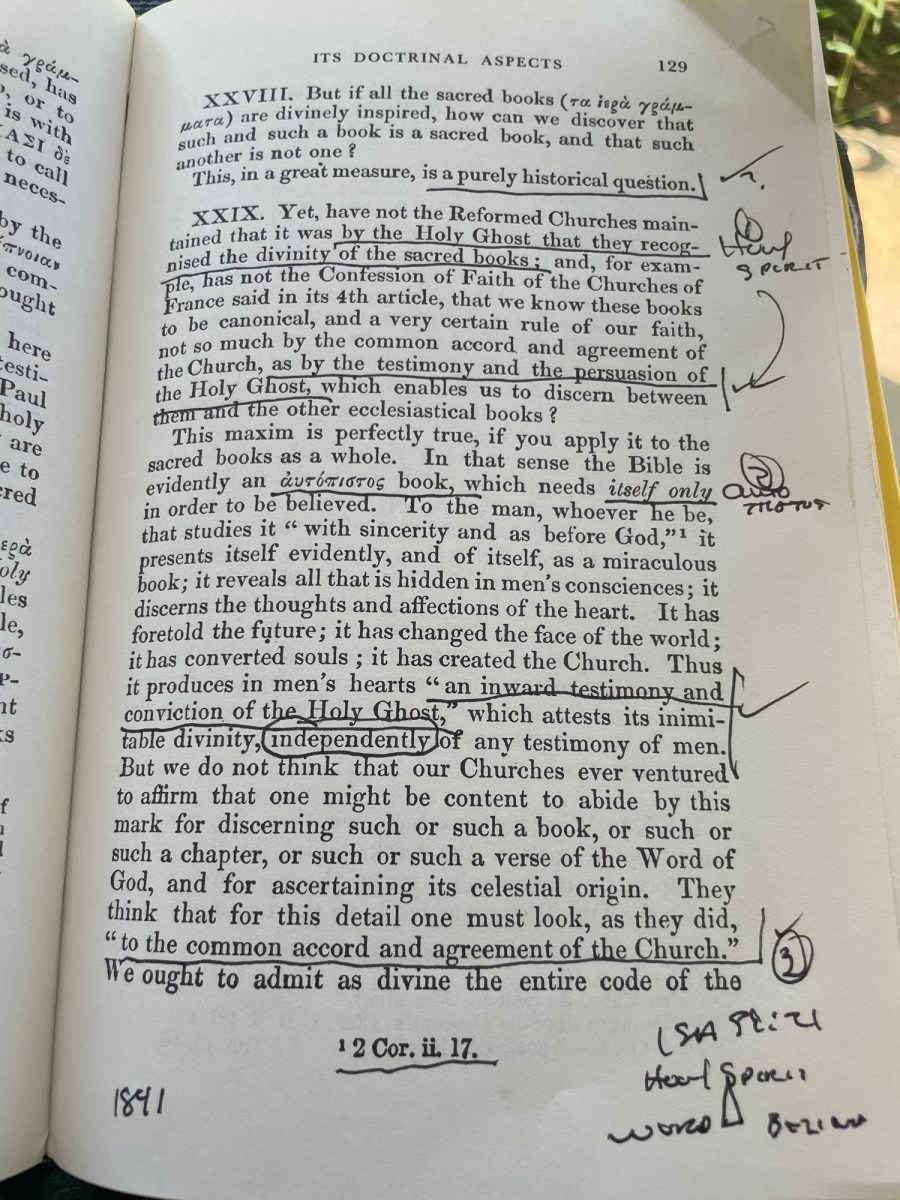
Gaussen, Divine Inspiration of the Bible, 1841, p. 129
One historic proof of how quickly and decidedly the Church can drift from orthodoxy is demonstrated in the Bible version debate, specifically the paradigm shift from exegetically based conclusions to empirically based confusion. Gaussen published Divine Inspiration of the Bible in 1841, only 40 years before the infamous novel and corrupted Greek text of 1881. A pre-critical theologian writing in a post-critical era, Gaussen asserts the three factors that decided Christian epistemology when determining what is and is not inspired Scripture — the Holy Spirit, that Scripture is self-attesting (autopistos), and the believer. On page 129, a section modeled after a catechism, Gaussen succinctly summarizes the issue.
“The testimony and the persuasion of the Holy Ghost.
“The Bible is evidently an autopistos book, which needs only itself to be believed.” “Thus it produces in men’s hearts ‘an inward testimony and conviction of the Holy Ghost,’ which attests its inimitable divinity, independently of any testimony of men.”
“To the common accord and agreement of the Church.”
See Isaiah 59:21, “As for me, this is my covenant with them, saith the Lord; My spirit that is upon thee, and my words which I have put in thy mouth, shall not depart out of thy mouth, nor out of the mouth of thy seed, nor out of the mouth of thy seed’s seed, saith the Lord, from henceforth and for ever.”
These three elements are exegetically grounded, theologically formulated, and practically exercised for the epistemological means of recognizing Holy Scripture — until 1881 when Fundamentalist and Evangelical leaders lead students and Churches away from sound doctrine into the current Bibliological muddle so many today seem to relish. The most epistemologically sound assertion one can make in reference to the Bible, is to say that we believe it is the Bible because it says it is. This apologetic was still being published in the 19th century 300 years after the first wave of the Reformation and we at Standardsacredtext.com continue in this proven defense of the faith.
Once you have the autopistos self-authenticating Bible, historical support is a virtuous discipline, but if history and empirical discovery is “leading” you to that Bible, then you have forsaken the apologetics of our theological forefathers and adopted the Roman, and then Enlightenment notion of the impossibility of an infallible Word of God in any language.
The identity of the “little book” in Revelation 10 can be established through five key theological and exegetical considerations:
Its origin – The book is given to the Apostle John from the hand of a mighty angel.
Its content – What does the little book contain, and how should its message be understood?
Its recipient – The book is entrusted to John, a plenipotentiary of Jesus Christ and member of the Apostolate.
Its twofold nature – The content is both sweet and bitter, reflecting a message of grace and judgment.
Its purpose – The message is to be proclaimed globally to all peoples, nations, tongues, and kings.
Introduction
The design of this paper is to examine the interpretive background of Revelation 10 to determine the origin and nature of the “little book.” Central to this inquiry is a theological question: does the creative act of immediately inspired Scripture originate solely with God, or is it shared in some measure with the human authors? This inquiry raises the credibility of a position commonly held by post-critical theologians—that the creative process of inspiration was not unilateral but involved a unique union of divine and human agency. [1]
Representing this post-critical viewpoint, Augustus Strong, in his Systematic Theology (1st ed., 1907), offers a robust and carefully articulated defense. Under the heading “The Union of the Divine and Human Elements in Inspiration,” Strong writes: “The Scriptures are the production equally of God and man, and are therefore never to be regarded as merely human or merely divine.” [2] Such a position stands in contrast to a more classical understanding of inspiration, found in Edward Leigh’s, A Treatise of Divinity published in 1647. In it, the common thread of the Holy Spirit, immediate inspiration, dictation, and godly penmen are brought succinctly together. Leigh here and in other places notes the personal virtues of the men chosen to write holy Scripture, writing that,
All other disciplines were from God, and every truth (whosoever speaks it) is from the holy Ghost; but the Scripture in a singular manner is attributed to the Holy Ghost; he immediately dictated it to holy men of God….The candour and sincerity of the Pen-men or Amanuenses, respecting God’s glory alone…The Penmen of holy Scripture were holy men: called, sent, inspired, by the Spirit, which had denied the world with the lusts and affections thereof, and were wholly consumed with zeal for the glory of God, and salvation of men.”[3]
The trajectory of this section is to show from Revelation 10 and supporting passages that God alone is the creative agent of inspired Scripture and that having created the inspired word so permeates the penmen, that it can properly be said to be their own. God makes His Word an integral part of the writer making God’s Word also secondarily, the word of the penman.
What is the “Little Book?”
Examining the comments made on Revelation 10, several common threads are described, most prominent is the uncertainty of the content of the “little book.” Stefanovic has gathered
some thirty proposals concerning the identity of the sealed scroll from the history of interpretation; such as, the Old Testament, the entire Scripture, the Book of Judgment, the Book of Life, God’s decrees or secret purposes, the New Covenant, the history of the church or of humankind, a part of Daniel’s prophecy, a will or testament, and a double inscribed contract-deed.[4]
The little book of Revelation 10 is regularly discussed within the context of Ezekiel 2:9-3:4, the Old Testament passage commonly considered the interpretive framework for Revelation 10.[5] The thematic parallels between the two passages are as follows:
Eze. 1:28, “This was the appearance of the likeness of the glory of the Lord.” — Rev. 10:1, “And I saw another mighty angel come down from heaven
Eze. 1:9, “A hand was upon me.” — Rev. 10:2, “And he had in his hand.”
Eze. 2:10, “And he spread it before me.” — Rev. 10:2, 8, “a little book opened”; “take the little book which is open.”
Eze. 3:2, “So I opened my mouth, and he caused me to eat the roll.” – Rev. 10:9, “Take it, and eat it up.”[6]
Eze. 3:3, “It was in my mouth as honey for sweetness”—Rev. 10:9, 10, “but it shall be in thy mouth sweet as honey”; “it was in my mouth sweet as honey.”
Eze. 2:10, “written therein lamentations, and mourning, and woe” – Rev. 10:9, 10, “make thy belly bitter”; “my belly was bitter.”
Both Ezekiel and John are sent as messengers with God’s word but the audience is different. Ezekiel is to go to “the house of Israel, and speak with my words unto them.” John, however, is to go “before many peoples, and nations, and tongues, and kings,” Rev. 10:11.
Jean-Louis D’Argon comments that,
Ezekiel’s prophetic investiture (2:8-3:3) is the inspiration for this [Revelation 10] description. The action of eating (Jer. 15:16) symbolizes John’s complete assimilation of the contents of the little scroll.[7]
Some elements of the narrative should be considered supportive to the little book being the Word of God, the foremost being the intended global audience. The magnitude of the mission field lends support to the little book being the Word of God. Jerome in Letter 7, on Revelation 10:9-10, writes that John is to “eat God’s book.”[8] Preterist Albert Barnes identifies Revelation 10 in his commentary[9] with the Protestant Reformation and multiple times refers to the little book as the Bible. More recently, John Walvoord notes:
The book itself seems to be a symbol of the word of God…The testimony to which John is called is that of faithfully delivering the word of God as it is commited to him…To John, the word of God is sweet…the word of God is a precious assurance of his eternal salvation… Partaking of the word of God is indeed sweet….The word of God, which is sweet to John’s soul also has its bitter aspects….It is probable that the little book in chaptger 10 of Revelation is the word of God itself.[10]
Angelic Intervention
Another point of theological continuity—one that hinges in part on the parallelism between the visions of Ezekiel and John—is the heavenly origin of the “little book.” In both accounts, neither Ezekiel’s scroll nor John’s book originates from earth. Rather, in both instances, from God or by the mediation of angelic beings, the Word of God, whether in part or in whole, is delivered to the Prophet and Apostle from heaven. In the case of Ezekiel, the scroll corresponds to the content of his prophetic book, addressed primarily to Israel. In John’s vision, the context suggests the contents of the “little book” correspond either to the whole of Scripture or, at least, to the portion of divine revelation committed to him. Given the global context of the passage in Revelation, the latter seems most plausible: that the contents of the “little book” are the inspired Scriptures destined for a universal readership.
The origin of the “little book” and Ezekiel’s scroll is heaven, something given to the prophet and Apostle, and not of their own derivation. Something was given to them that was not initially in their possession and though the exact content of the scroll and book are open for discussion, that they are Scripture is not in question. Synecdochically and in keeping with John 10:35, that Scripture cannot be broken, if this is true of any part of Scripture, it is also true of the whole. The message’s origination point transcended the Prophet and Apostle, was brought to them by the hand of God and an angel, and this message was given to them to totally assimilate. Angelic participation in the delivery of the word of God did not introduce a new eschatological methodology. Though the exact scope of this intervention is uncertain, Deuteronomy 33:2, Acts 7:53, Galatians 3:19, and Hebrews 2:2 speak of the varying roles of angels in giving the Law on Mount Sinai.[11]
Apostolic Mediation
John receives this vision late in his life, likely near the end of his earthly ministry. It is, therefore, improbable that the command of the mighty angel in Revelation 10:11 — “Thou must prophesy again before many peoples, and nations, and tongues, and kings”—could have been fulfilled by John in a personal capacity. The scope of the commission exceeds the ability of the aged apostle, exiled on Patmos, to execute by himself. This observation strongly suggests that the prophesying is to be fulfilled through the writing and transmission of the inspired text.
As with the rest of the Apostolate, John did not function as an isolated or freelance spiritual agent. He was a plenipotentiary of Christ, a fully authorized representative, only insofar as he was united to the body of the Apostolate (ἀποστολῆς, apostolēs, Acts 1:25). According to the apostolic qualifications in Acts 1:21–22, such a person had to be among the followers of Jesus during His earthly ministry and an eyewitness to His resurrection. John fulfilled this criterion, but by the time of his Patmos exile, his role as an active witness was constrained by age and isolation.
Consequently, the prophetic commission given to him in Revelation 10 mirrors Christ’s earlier charge to the disciples in Acts 1:8: that the Gospel should go “unto the uttermost part of the earth.” The fulfillment of this global evangelistic command occurs not through John’s physical travel, but through the written Word. The “little book,” internalized and then written down by John, becomes a vehicle for divine proclamation to all nations. Thus, the commission of Revelation 10:11 is fulfilled through the inclusion of John’s writings in the inspired canon of Scripture, by which the Gospel is proclaimed to the world.
Eating the Little Book
Mounce, with others, identifies the eating of the little book with John’s “complete appropriation” and “assimilation” of its content.
In John’s case it led to a real act (although within a visionary experience), which in turn symbolizes the complete appropriation of prophetic revelation. John is to assimilate the content of the scroll before communicating it to others. Every true prophet of God knows the necessity of this crucial requirement.[12]
The concept of “complete appropriation” and “assimilation” is expressed metaphorically through physiological terms, namely, eating and tasting. This imagery parallels the act of consuming food, wherein nutrients are digested, absorbed into the body, and transformed into the very substance of the person. Some flavors are sweet and favorable; others are bitter and harsh. Yet, regardless of taste, both types are fully assimilated, becoming part of the individual. The food becomes the person.
As late as 1841, only 40 years before the novel text of 1881 was published, Louis Gaussen in his summary of immediate inspiration writes of this assimilation in incarnational terms. He writes of reading the Scripture, and describes this total assimilation, admonishing,
O man, we have said, it is here especially that you are called to wonder and admire! It [Scripture] has spoken for thee, and like thee; it presents itself to thee, wholly clothed in humanity; the Eternal Spirit (in this respect at least, and in a certain measure) has made himself man in order to speak to thee, as the Eternal Son made himself man, in order to redeem thee.[13]
That is, the transcendent message that originates in heaven is made immanent through the prophet’s act of eating—through total assimilation. Thus, the prophet or apostle fully internalizes the divine message, such that the Lord can say of the prophet, “speak with my words” (Ezek. 3:4). This deep identification of the messenger’s voice with the divine Word parallels the metaphorical contrast of sweet and bitter flavors in Scripture. The dual nature of the Word—life-giving to some, condemning to others—is reflected in several biblical passages. In Matthew 3:11, John the Baptist speaks of Christ baptizing “with the Holy Ghost” (unto salvation) and “with fire” (unto judgment). Similarly, Paul writes in 2 Corinthians 2:16, “To the one we are a savour of death unto death; and to the other the savour of life unto life.” The same duality is evident in the Law: “I have set before you life and death, blessing and cursing” (Deut. 30:19).
This moral dichotomy, described metaphorically through the language of taste, is emphatically affirmed in Isaiah’s warning to Israel: “Woe unto them that call evil good and good evil… that put bitter for sweet, and sweet for bitter” (Isa. 5:20). These categories—good and evil, light and darkness, sweet and bitter—are not open to subjective redefinition. Rather, they represent objective moral realities, rooted in the divine Word and its reception. Through the metaphor of eating, Scripture conveys the total assimilation of God’s words, and the consequential experience—either sweet or bitter—based on one’s relationship to that Word.
John, like Ezekiel is not
merely to eat, i.e. take it into his mouth, but he is to fill his body and belly therewith, i.e. he is to receive into his innermost being the word of God presented to him, to change it, as it were, into sap and blood.[14]
And like the little book of Revelation 10, the word of God described as lamentation, sorrow and woe by Ezekiel and bitter by John, for Ezekiel precisely (and John)
tasted to him sweetly, because its contents was God’s word, which sufficed for the joy and gladness of his heart (Jer. xv.16); for it is “infinitely sweet and lovely to be the organ and spokesman of the Omnipotent,” and even the most painful of divine truths possess to a spiritually-minded man a joyful and quickening side (Hengstenberg on the Apoc. x. 9).[15]
It is evident from the commentary of Keil and Delitzsch that both the scroll in Ezekiel 2 and the little book in Revelation 10 are understood as manifestations of the Word of God. While the precise extent of Scripture referenced in each case remains an open question, the content of the little book is undoubtedly composed of inspired words. In Ezekiel’s case, the scroll likely encompasses the whole book bearing his name. In Revelation, however, the contents of the little book are less defined. What is clear in both instances is this: the scroll and the little book originate either from the Lord God Himself (Ezek. 2:4; cf. 2 Tim. 3:16) or from a great angelic messenger (Rev. 10:1). In either case, the Word of God descends from heaven to the Prophet or Apostle.
This observation establishes the theological trajectory for the arguments that follow. The little book is not a creaturely artifact. Its divine origin implies its preexistence either in the mind of God or, taken literally, as a heavenly written book. This notion is consistent with its supernatural source (cf. Ps. 119:89; 2 Tim. 3:16). The origin of the written Word, according to the parallel between Revelation 10 and Ezekiel 2–3, is not collaborative between God and the prophet; rather, it proceeds entirely from God and is entrusted to His chosen penmen for complete assimilation, assimilation so profound the Word of God can rightly be called the word of the penman.
This process involves the giving of the content of Scripture to a prophet, who is then tasked with writing it. These men were specifically appointed to inscribe the words given to them by God. The little book is given to John not merely to read or recite, but to eat, to ingest, so that the Word becomes part of his very person. The Word of God becomes so intimately united with the Apostle that his proclamation is rightly regarded as the very Word of God.
This radical internalization described metaphorically as “eating,” signifies a total assimilation of the message. The prophet and the Word become one. The prophetic experience is described in terms of taste, both sweet and bitter, symbolizing the mixed reception of God’s message as it is declared to its intended recipients through the written word.
Conclusion
Turretin arguing that only the Hebrew Old Testament and Greek New Testament are authentic reasons,
because the sources alone are inspired of God both as to the things and words (2 Tim. 3:16); hence they alone can be authentic. For whatever the men of God wrote, they wrote under the influence of the Holy Spirit (2 Peter 1:21), who, to keep them from error, dictated not only the matter but also the words, which cannot be said of any version.[16]
Reformation era writers and as we have seen, at least one mid-19th century author used the word “dictation” to accent the active, creative instrumentality of the Holy Spirit in the balance between the Divine and human elements of inspiration, and specifically to establish the superiority of the apographa over versions, especially the Latin. On this point Turretin states,
For no version has anything important which the Hebrew or Greek source does not have more fully, since in the sources not only the matter and sentences (res et sententiae), but even the very words were directly dictated (dictiae) by the Holy Spirit.[17]
The active, creative instrumentality was called the mandatum scribendi, an assumption of the doctrine of verbal inspiration, viz., that the Spirit initiated the writing of Scripture and provided a mandatum,(command) or the impulsium (impulse) to write (2 Peter 1:21).[18] At issue is not the role of human penmen but the sharing of the creative factor of inspiration.[19] Turretin, on this issue, comments,
They could write both on the presentation of an opportunity and yet by divine command and by divine inspiration. Yea, they must have written by the divine will because God alone could present such an occasion, for it was neither presented to them without design nor employed of their own accord.”[20]
Dictation was not meant to infer that the penmen were mere “tools” or that inspiration was “mechanical”[21] removing the personalities of the writers from the writing. Dictation described in these terms was a misappropriation of the word used by the Protestant Reformers, utilized pejoratively by post-critical commentators to disparage the pre-critical formulation of the total assimilation and therefore the infallibility of immediate inspiration. Our Reformation era forefathers used the word “dictation” in a technical sense to underscore the Divine process of Scripture’s inspiration and the infallible canon it produced. Gaussen describes every word inspiration as
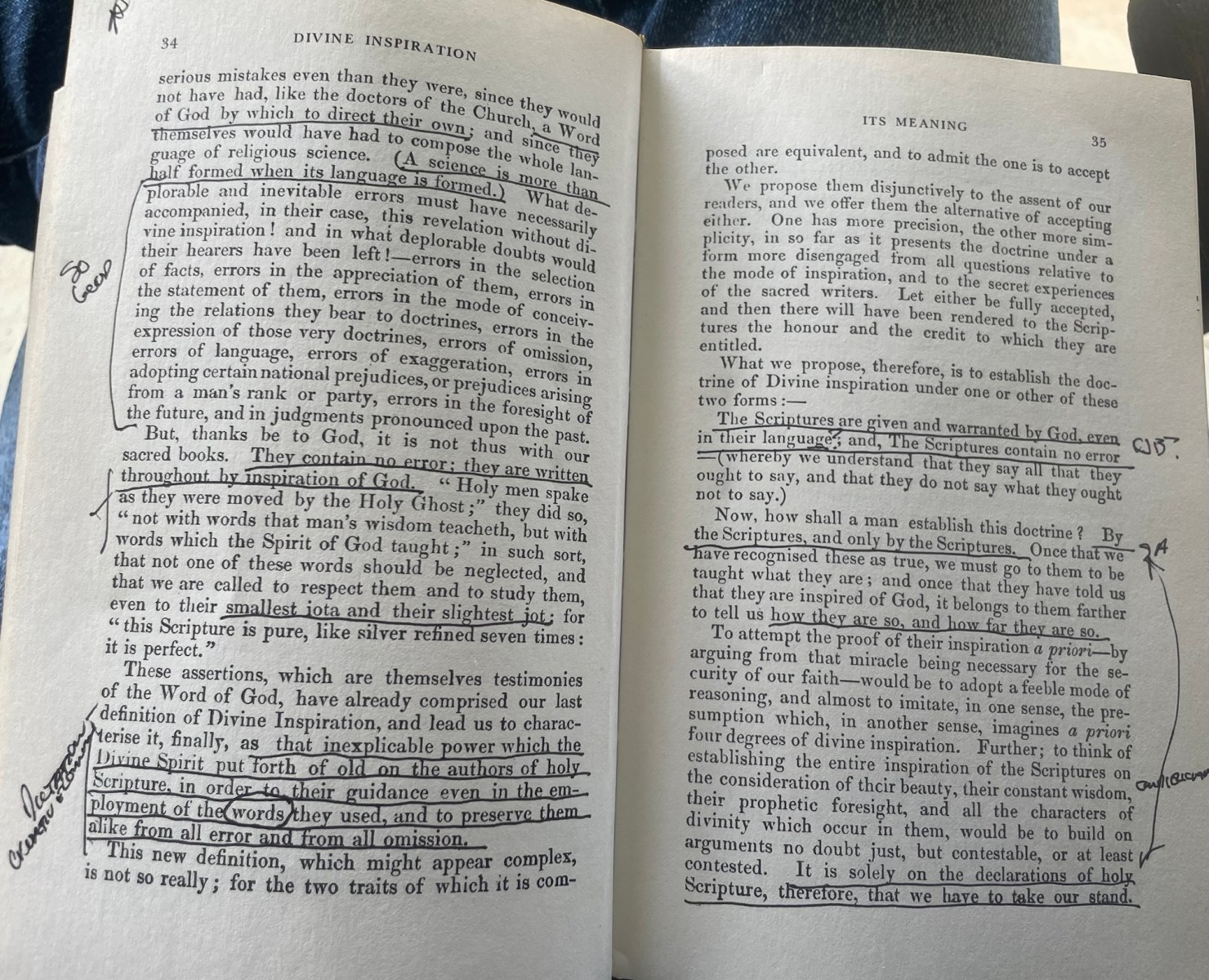
The inexplicable power which the Divine Spirit put forth of old on the authors of holy Scripture, in order to their guidance even in the employment of the words they used, and to preserve them alike from all error and from all omission.[22]
Drawn from Ezekiel 2-3 and Revelation 10, the “total assimilation” of God’s Word described through the metaphor of “eating,” may be summarized as follows:
The inspired Word to be declared to Israel or globally originates with God.
The creative element of inspired Scripture is not shared but originates solely from God.
The eternal word of God, by total assimilation of Scripture, was so internalized by the penmen that the inspired Word was said to be their own, which “in no way deprives them even momentarily of their reason, their usual forms of expression, or of the thought-patterns typical of their time in history and specific culture.”[23]
Jeremiah 1:9, “Then the Lord put forth his hand, and touched my mouth, And the Lord said unto me, Behold, I have put my words in thy mouth.”
[1] Michael Glenn Reddish, Revelation (Macon, GA: Smyth & Helwys Publishing, Inc., 2001); E. W. Bullinger, Commentary in Revelation (Kregel, 1984); Daniel L. Akin, Christ-Centered Exposition Commentary: Exalting Jesus in Revelation (B & H Publishing Group, 2016); Joseph L. Mangina, Revelation (Grand Rapids: Brazos Press, 2019); John R. Yeats, Revelation (Scottdale, PA, 2003); James M. Hamilton, Jr., Revelation: the Spirit Speaks to the Churches, Wheaton: Crossway, 2012); George Eldon Ladd, A Commentary on the Revelation of John (Grand Rapids: Eerdmans, 1972); David E. Aune, “Revelation 6-16,” Word Biblical Commentary, vol. 52B (Nashville: Thomas Nelson, 1998); Grant R. Osborne, Revelation (Grand Rapids: Baker, 2002); Stephen S. Smalley, The Revelation of John: A Commentary on the Greek Text of the Apocalypse (Downers Grove: Intervarsity Press, 2005); Robert L. Thomas, Revelation 8-22: An Exegetical Commentary (Chicago: Moody Publishers, 1995); Robert H. Mounce, The Book of Revelation (Grand Rapids: Eerdmans, 1977).
[2] Augustus H. Strong, Systematic Theology (Valley Forge, PA: Judson Press, 1993 [1907]), 212.
[3] Edward Leigh, A Treatise of Divinity(London: Printed by E. Griffin for William Leigh, and are to be sold at his shop at the Turkes-head in Fleetstreet, near Ram-alley, 1647), 9, 17.
[4] David E, Holwerda, “The Church and the Little Scroll (Revelation 10, 11),” Calvin Theological Journal, 34 no 1 Apr 1999, p 151 citing Ranko Stefanovic, The Backgrounds and Meaning of the Sealed Book of Revelation 5 (Berrien Springs: Andrews University Press, 1996).
[5] Michael Glenn Reddish, Revelation (Macon, GA: Smyth & Helwys Publishing, Inc., 2001); E. W. Bullinger, Commentary in Revelation (Kregel, 1984); Daniel L. Akin, Christ-Centered Exposition Commentary: Exalting Jesus in Revelation (B & H Publishing Group, 2016); Joseph L. Mangina, Revelation (Grand Rapids: Brazos Press, 2019); John R. Yeats, Revelation (Scottdale, PA, 2003); James M. Hamilton, Jr., Revelation: the Spirit Speaks to the Churches, Wheaton: Crossway, 2012); George Eldon Ladd, A Commentary on the Revelation of John (Grand Rapids: Eerdmans, 1972); David E. Aune, “Revelation 6-16,” Word Biblical Commentary, vol. 52B (Nashville: Thomas Nelson, 1998); Grant R. Osborne, Revelation (Grand Rapids: Baker, 2002); Stephen S. Smalley, The Revelation of John: A Commentary on the Greek Text of the Apocalypse (Downers Grove: Intervarsity Press, 2005); Robert L. Thomas, Revelation 8-22: An Exegetical Commentary (Chicago: Moody Publishers, 1995); Robert H. Mounce, The Book of Revelation (Grand Rapids: Eerdmans, 1977).
[6] References to the metaphor of the word of God being sweet when eaten: Ezekiel 3:1-4, “Moreover he said unto me, Son of man, eat that thou findest; eat this roll, and go speak unto the house of Israel. So I opened my mouth, and he caused me to eat that roll. And he said unto me, Son of man, cause thy belly to eat, and fill thy bowels with this roll that I give thee. Then did I eat it; and it was in my mouth as honey for sweetness. And he said unto me, Son of man, go, get thee unto the house of Israel, and speak with my words unto them.” Jeremiah 15:16, “Thy words were found, and I did eat them; and thy word was unto me the joy and rejoicing of mine heart: for I am called by thy name, O LORD God of hosts.” Psalm 19:9-10, “The fear of the LORD is clean, enduring for ever: the judgments of the LORD are true and righteous altogether. More to be desired are they than gold, yea, than much fine gold: sweeter also than honey and the honeycomb.”
[7] Jean-Louis D’Argon, “The Apocalypse,” The Jerome Biblical Commentary (Englewood Cliffs, NJ: Prentice Hall, Inc., 1968), 480.
[8] Philip Schaff, ed., The Nicene and Post-Nicene Fathers, 2nd series, vol. VI (Grand Rapids: Eerdmans, 1989), 9. Also see Johan Lust, “Notes to the Septuagint: Ezekiel 1-2,” Ephemerides Theologicae Lovanienses, 75 no 1 (Apr 1999), 29: “The LXX reading is important in Jerome’s view. He interprets it as referring to the opening page or ‘exordium’. It implies that the prophet did not have to eat the whole book. Jerome applies this interpretation also to Rev 10,9-10 where, in a reference to Eze. 2,9, John is commanded to eat a βιβλαρίδιον (‘booklet, little scroll’).”
[9] Alfred Barnes, Barnes’ Notes on the New Testament, (Grand Rapids: Kregel, 1966), 1636 – 1637.
[10] John Walvoord, The Revelation of Jesus Christ (Chicago: Moody Press, 1989), 173-174.
[11] The reference to the words “spoken” (λαληθεὶς) by angels, in Hebrews 2:2, and that these words are “steadfast,” (βέβαιος) contribute to the position that the administration and ordination of angels on Sinai spoke the words of God and specifically the “commands of the Mosaic law.” The unambiguity of speaking helps settle the sticky interpretive issues of the corresponding passages. Also see Ellicott on this passage: https://biblehub.com › commentaries › hebrews › 2-2.htm. “Or rather, through angels (comp. Hebrews 1:2): the word was God’s, but angels were the medium through which it was given to men. In accordance with the tone of the whole passage (in which the thought is not the reward of obedience, but the peril of neglect of duty), ‘the word’ must denote divine commands delivered by angels, and—as the close parallel presented by Hebrews 10:28-29, seems to prove—especially the commands of the Mosaic law. Hence this verse must be joined to the other passages (Acts 7:53; Galatians 3:19; comp. also Acts 7:38) which bring into relief the ministration of angels in the giving of the Law; and the nature of the argument of this Epistle gives special importance to the subject here. The only passage in the Pentateuch which can be quoted in illustration is Deuteronomy 33:2: ‘The Lord came from Sinai… He came from amid myriads of holy ones.’ The Greek version (introducing a double rendering of the Hebrew) adds, ‘at His right hand were angels with Him;’ and two of the Targums likewise speak of the ‘myriads of holy angels.’”
[12] Mounce, Revelation, 209. Mounce cites Kodel who writes, “The prophet’s task is to appropriate and internalize God’s message entrusted to him.” (215) Pearson writes, “Witnesses first become what they then say. If witness is to be anything more than gossip about God, it must be the word internalized.” (107)
[13] Louis Gaussen, Divine Inspiration of the Bible (Grand Rapids: Kregel, 1979 [1841]), 350. Gaussen’s references to inspiration given by dictation permeates the volume. See pages, 24, 30, 45, 47, 48, 49, 65, 66, 67, 71, 72, 78, 158, 349, etc.
[14] C.F. Keil, F. Delitzch, Commentary on the Old Testament in Ten Volumes, vol. 9, trans. from the German by James Martin. (Grand Rapids: Eerdmans, 1976), 51.
[15] C.F. Keil, F. Delitzch, Commentary, vol. 9, 51-52.
[16] Francis Turretin, Institutes of Elenctic Theology, vol. 1 (Phillipsburg, NJ: Presbyterian and Reformed, 1992), 114. Gaussen, DivineInspiration, 34. The sacred books “contain no error…even to their smallest iota and their slightest jot.” Also see p. 328.
[18] Richard A. Muller, Dictionary of Latin and Greek Theological Terms: Drawn Principally from Protestant Scholastic Theology (Grand Rapids: Baker Book House, 1989), 183.
[19]Augustus H. Strong, Systematic Theology (Valley Forge, PA: Judson Press, 1993), 212. Strong writes, “The Scriptures are the production equally of God and man, and are therefore never to be regarded as merely human or merely divine.” In this sharing of the creative element of inspiration, the Scripture is no longer conceived as uncapable of error and certain, or infallible, and is now only inerrant to certain degrees.
[20] Turretin, Institutes, 60. Contra James Leo Garrett, Systematic Theology: Biblical, Historical and Evangelical (Grand Rapids: Eerdmans, 1990), 116., Garrett writes, “[Turretin] taught the utter passivity and sheer instrumentality of the biblical writers under the sway of the Holy Spirit, and the consequent inerrancy of the Bible.”
[21] Strong, Systematic, 208: Of the Dictation theory Strong writes, “This theory holds that inspiration consisted in such a possession of the minds and bodies of the Scripture writers by the Holy Spirit, that they became passive instruments or amanuenses – pens, not penmen, of God.”
The following post is an excerpt from Eschatological Grounding and is a component part of the argument for the perpetual utility of Scripture throughout the Eternal State. At the core of this discussion perfection is understood as being on a trajectory of infinite spiritual progression. This trajectory is fundamentally established on the reality that the glorified saint will forever remain infinitely less perfect than God. Only God and His Word posses both moral and teleological perfection – both are eternal and immutable.
THE BIBLICAL DEFINITION OF PERFECTION
שָׁלֵם: shalem — complete, whole, full, perfect, at peace.
תָּמִים: tamim — complete, whole, perfect, blameless, without blemish.
teleioV, teleios – having reached the end, term, limit, hence, complete, full perfect.
artioV, artios – complete, capable, proficient, able to meet all demands. Only 2 Timothy 3:17.
The quote that follows succinctly summarizes creaturely perfection and accurately reflects the interpretive breadth of the original language words translated “perfect.” Perfection in Scripture,
is the Christian idea and aim, but insomuch as that which God has set before us is infinite – “Ye therefore shall be perfect, as your heavenly Father is perfect” (Mt 5 48) – absolute perfection must be forever beyond, not only any human, but any finite being; it is a Divine ideal forever shining before us, calling us upward, and making endless progression possible. [1]
Based on this observation, the sections that follow develop the idea of “perfection” as it applies to the eternal state and the idea the teleological gradation of infinite progression.
A theologically accurate definition of “perfect” challenges the common belief that creaturely perfection is a passive, terminal state. In contrast, creaturely perfection manifests itself in a state of infinite progression without an endpoint. Only God and His Word possess eternal, immutable perfection, both in terms of goodness and of completeness. For God and His Word, there is no change: God remains the same yesterday, today, and forever, as does His Word. Divine perfection should be seen as “forever beyond” all contingent and finite beings. For the saint perfection is inaugurated by the positional event of regeneration by the Holy Spirit (John 3:3) after which the saint is placed on a progressive trajectory of infinite progression, glorification an inevitable transitional change on that progressive trajectory.
The next section examines the eternal state concerning both consummation and infinite progression. The aim is to demonstrate that the perfection associated with infinite progression under the curse is “less perfect” than that of infinite progression after the curse is eradicated in the eternal state. This concept of infinite progression will be appealed to later in the volume to support the conception that the impartation of Scripture in the eternal state is “more perfect” than the internalization of Scripture in the current sin-cursed age.
What, then, does the perfection of infinite progression imply for the role of Scripture in the eternal state? Instead of viewing glorification as a final state of consummated perfection, the infinite progression of perfection suggests that Scripture’s spiritual utility remains eternally effective as a vital part of glorification. This proposal, along with Scripture’s own affirmation of its preservation despite the passing of heaven and earth, supports the proposal that Scripture’s Divine impartation is integral to glorification.
ESCHATOLOGICAL CONSUMMATION RECONSIDERED
Eschatological consummation refers to the complete fulfillment of God’s redemptive plan as revealed in Scripture. Everything God does and His word are both good and perfect in terms of being absolutely complete, a truth that identifies His word directly with Himself. When God’s redemptive and cosmic plan is fulfilled in every aspect, that fulfillment is called eschatological consummation. While the cosmos and the redeemed may achieve moral perfection through God’s transformative work of glorification and the eradication of the curse, they will never attain to perfection in the sense of completeness, perfection being a “Divine ideal” that allows for endless progression.
Creaturely or created perfection must not be equivocated with the perfection of the Creator or His Word. The purpose of the new heaven and earth will never reach Divine completion, and heaven, though free from the curse, will never be fully complete as the dwelling place of the redeemed. The sinless perfection of Heaven, as the dwelling place of the redeemed and angels remains infinitely less perfect that God in the sense of its eternal and immutable completion. The glorified saint in heaven will eternally grow in knowledge of the Lord Jesus Christ, never reaching absolute completeness. The physical bodies of the damned will endure eternal suffering in the Lake of Fire, while the redeemed will be glorified, experiencing the eradication of the curse being placed on an infinite journey of learning and growth in the knowledge of God initiated by their salvation.
The following section presents an argument through gradation, comparing the end times under the curse with the perfection of the eternal state free of the curse. The eternal state is the ultimate standard, allowing us to describe the eschaton under the curse as “less perfect.” The methodology involves discussing redemptive history under the curse as “less perfect” than the eternal state, which is “more perfect” than the eschaton still burdened by the curse. For the purposes of this paper, “less perfect” and “more perfect” refer specifically to the trajectory of infinite progression in the eternal state.
AQUINAS’S ARGUMENT FOR GRADATION
The glorification discussed above surpasses everything presently experienced by the saint in this life. Whatever knowledge the saint has of God and His Word will be exceeded in glory through eternal communion with the glorified Lord. No completion in this sin-cursed world can be deemed better than the continuous growth toward the Divine ideal of perfection in the eternal state. The eschatological journey of the saint in glory transcends the limitations of the current fallen state.
To clarify the reality of the eternal state, appeal is made to the fourth of Thomas Aquinas’ five arguments for the existence of God, found in the Summa Theologiae. Aquinas argues from the “gradation found in things,” noting that “some things are more and some less perfect, true, noble, and so forth.” He points out that comparatives depend on their resemblance to a maximum, such as how a thing is considered hotter as it approaches the hottest. Consequently, there must be the cause of all beings, goodness, and perfection which is God. Aquinas writes,
more or less are predicted of different things according to as they resemble in their different ways something which is the maximum, as a thing is said to be hotter according as it more nearly resembles that which is hottest; so that there is something which is truest, something best, something noblest, and, consequently something which is most being, for those things are greatest in truth are greatest in being, as it is written in Metaph. ii. Now the maximum of any genus is the cause of all in that genus, as fire, which is the maximum of heat, is the cause of all hot things, as it is said in the same book. Therefore there must also be something which is to all beings the cause of their being, goodness, and every other perfection: and that we call God.[2]
Aquinas’ fourth proof rests on the absolute perfection of God as the source of all being, goodness, and perfection. For all creatures, perfection is understood in terms of gradation—measured in relation to the absolute perfection of God. Though God’s creation is morally perfect (cf. Gen. 1:31), the manner in which that moral perfection is reflected varies according to each created being’s alignment with its Creator.
The unfolding narrative of redemptive history reveals the moral perfection and goodness of God in contrast to the mutability and fallenness of humanity. Created as mutable beings, humans are characterized by potential, growth, and life. Yet sin introduces a contrary trajectory—one of decay, corruption, and death. Through the imputed righteousness of Christ, the regenerate individual is declared morally righteous, despite remaining mutable. Nevertheless, the fullness of perfection, understood as completeness in God, will remain the saint’s eternal pursuit, as their knowledge of and communion with God expand without end.
This chapter will examine perfection in terms of degrees of completeness rather than moral uprightness. While God acts in perfect wisdom and goodness in all His decrees, in creation, providence, and redemption, created reality—even in its glorified state—can never reach the absolute perfection of the Creator. The eternal state is indeed the maximal environment for the creature, yet it remains categorically distinct from the perfection of God Himself. Even so, the trajectory of redemptive history moves from a state of fallenness toward consummation in the eternal state—a state characterized by the removal of the curse and the full realization of the creature’s capacity to reflect God’s glory.
For goodness, truth, and nobility to be objective and not subjective, they must be measured against a fixed, unchanging reference point of the highest possible quality—namely, the absolute perfection of God. This is the logic underlying Aquinas’s fourth proof for God’s existence. Drawing upon Aristotle’s concept of the great chain of being, Aquinas argues that gradations of perfection observed in the created order imply the existence of a being that is maximally perfect and thus the source and standard for all other beings and goodness. Applied eschatologically, this logic positions the eternal state as the highest possible created environment, yet one that remains infinitely less than the Creator. Fallen creation, by contrast, is objectively and teleologically less perfect in every respect.
The gradation from less perfect to more perfect within redemptive history illustrates that beings and conditions subject to the curse are on the same divine trajectory of infinite progression as those in the eternal state. However, those in glory are free of the curse and thus more perfectly conformed to that trajectory. The Divine ideal of infinite growth in knowledge, love, and communion with God is most fully realized not in the present, but in the consummated eternal state. There, the glorified saint will no longer see “through a glass, darkly” (1 Cor. 13:12), but will instead behold God more clearly, though still never exhaustively.
Knowing and understanding God is the highest privilege granted to the creature. Only in the eternal state does the saint begin the infinite journey of perfect praise and ever-deepening communion with the Triune God. The current epoch of redemptive history, while rich with benefits, is “less perfect” than what awaits. Glorification ushers in a sanctification that transforms the entire being—intellect, emotion, will, body, and spirit. The “less perfect” of the present age yields to the “more perfect” of eternity.
This is evidenced by numerous Scriptural contrasts, which demonstrate the gradation of perfection within the ordo salutis. For example:
“That we suffer with him” is less perfect than “that we may also be glorified together” (Rom. 8:17).
“The bondage of corruption” is less perfect than “the glorious liberty of the children of God” (Rom. 8:21).
“A natural body” is less perfect than “a spiritual body” (1 Cor. 15:44).
“The image of the earthy” is less perfect than “the image of the heavenly” (1 Cor. 15:49).
“Corruptible” is less perfect than “incorruptible” (1 Cor. 15:53a).
“Mortal” is less perfect than “immortality” (1 Cor. 15:53b).
“It doth not yet appear what we shall be” is less perfect than “we shall be like him” (1 John 3:2).
“The earnest of our inheritance” is less perfect than “the redemption of the purchased possession” (Eph. 1:14).
“For now we see through a glass, darkly” is less perfect than “then face to face” (1 Cor. 13:12).
“Groaning within ourselves” is less perfect than “the redemption of the body” (Rom. 8:23).
The blessings enjoyed by the saints in this present, fallen world—though truly gracious are less perfect than those that will be realized upon the removal of the curse. Glorification involves the sanctification of the saint’s whole person, bringing the relative Christlikeness achieved through submission to the Word and Spirit into its most exalted, eternal form.
What the Church presently knows of Scripture will, in the eternal state, be internalized and experienced in ways that align with the Divine ideal of infinite growth. The glorified saint will continue to learn, grow, and worship in ever-deepening perfection. All present encounters with the Word and Spirit, though genuine, will give way to a more perfect experience in glory, when every faculty of the believer is unencumbered by sin.
[1] W. L. Walker, International Standard Bible Encyclopedia, vol. 4 (Grand Rapids: Eerdmans, 1978), 2321.
[2] Anton C. Pegis, “Introduction to Saint Thomas Aquinas,” Modern Library College Editions (New York: The Modern Library, 19480, 26-27.
Louis Gaussen, Divine Inspiration of the Bible, 1841
Published in 1841, 40 years before the notorious novel 1881 Greek NT the pre-critical theology of inspiration was still being articulated. On two pages we find 1. The failure of scholarship; 2. Jot and tittle infallibility; 3. The creative element of inspiration down to the very words (dictation); 4. Scripture’s self-attestation and self-authentication. Only the intellectually blind will miss the conspicuous corruption of orthodox Bibliology between 1841 and 1881. As if turning off the lights of spiritual illumination, the Church was confronted with academic prejudices and factual ambivalences as if such confusion was normative to the Christian faith. It’s past time to wake up brothers and sisters and accept the fact much of the Church has been duped and return to the orthodox Bibliology taught in the KJB and promulgated by our theological forefathers.
The Church gets along just fine without an intellectually intimidating Academy. The Church can easily do without being told they cannot read their Bible without some scholar or scholar wannabe’s pontification. The Church serves and pleases God without knowing a stich of Greek or Hebrew diction, syntax, or grammar. Do we really need to know the ridiculous opinions of Ward, White, and Wallace for the Church to move forward for the Gospel’s sake? I think not.
Scholarship is plagued by the sin of envy, a particularly ecclesiastical and academic sin – the sin of the Pharisees that drove the death of Christ. When the Bible says that knowledge makes one proud and arrogant, every saint should take that to heart. The modern scholar is envious of the of the same thing the Pharisees envied – the popularity of Christ by the masses. The Triumphal Entry when a young Rabbi, the God-man, Jesus Christ was received into Jerusalem as the King after having just raised Lazarus from the dead. When the stupid, untrained fishermen spoke eloquently and powerfully to the Sanhedrin, the scholars concluding that these men had been with Jesus. Who needs scholarship when you have Jesus? You see, modern theological scholarship is envious of what makes fishermen bold, confident, theologically erudite, and eloquent without formal training. That is, internalizing the Word of God, the teaching of their Master, Jesus Christ. It is the Bible, properly understood and practiced, the goal of every believer that makes scholarship look puny and feckless. It is the Church’s dedication to the Bible that the scholar envies. You “back-woods” fundamentalists, with your King James Bibles, you “basket of spiritual deplorables.” Don’t you know that the academy of Pharisees is where you get your theological training and not the Scripture. Scholars envy the Church’s faith in the Bible and the fact we ignore them. The Church does not need them. And for our forthright disregard for the intellectually intimidating Academy, they disdain and envy the Bible. If only they could have then ecclesiastical following the Bible does.
Scholars create problems so they can remain relevant. Can you imagine for one second how the publishing business would contract if there was only one standard sacred text? One Bible, commentaries, lexicons, grammars, software all tied to that one Bible? No more novel ideas about textual readings, collectives discussing perpetual changes, journals and lectures presenting the minutiae of textual questions? The Church could almost enjoy reading and obeying the Bible without the spiritual tinnitus of white noise constantly ringing in their ears. To be a true Bible scholar you must begin with submission to the God of the Bible and to His Word. True Bible scholars do not create problems, they resolve problems, create peace in the Church by sound scholarship that is not at odds with the Scripture. True scholarship edifies and asserts only those things God has already said about Himself in His Word. There has been and will always be a place in the body of Christ for this “begging for forgiveness” expression of “worshipping God with your entire mind” scholarship. And while many Pharisees took the route of Nicodemus and believed that Jesus was the Son of God, even while cowering fearful of being put out of the synagogue, many others were enemies of the Lord. Of modern Pharisaical theological scholarship advocating multiple version onlyism, splintering the Church has given them a platform to fulfill their goal to satisfy their envy by drawing the Church away from the Bible, from being fishermen, to be part of the “prestigious” 2025 Sanhedrin. You too can sit with Gamaliel and discuss the unjust, undeserved penalty due the fishermen that had been with Christ.
The King James Bible is not in need of scholarly assistance. The King James Bible exists as the English canon of Scripture and has for many centuries. It does not require academic tampering. This has long been established as a fact by the Spirit to the Church through the Word, all foolish, fishermen jargon for the academic elite but to those who believe it is the bedrock truth of God. And because fishermen are not trained theologians, the Academy believes it is prudent for the Church to turn the Bible over to them so it can be properly modified according to the highest modern standards. That the King James Bible is the Bible is a fact. To illustrate, King James Bible believers are theological botanists to use Gaussen’s terminology. Once the fact that cherries grow on cherry trees was known, no additional study was made of the cherry tree to see if peaches grew on the tree, or if the root system turned into the root system of an Oak, or if the bark changed into the white bark of a Poplar, or seeped sap like a White Pine. Once the common man, using common sense, understood the botanical facts, no more scholarship is necessary to say without doubt, confidently, that a cherry tree is a cherry tree. But for scholars, they are perpetually recreating the cherry tree. You see, the fact that cherry trees can be known to be such without a botanist, in the same manner that the believer by the common faith knows the fact that the King James Bible is the Bible. This fact is the grounds for contemporary orthodox, theological formulation.
The Church should care far more about the Bible says about them than what the Academy thinks and intimidates. Forsake any passion to be accepted by the Sanhedrin and join the ranks of Jesus’ fishermen. The Sanhedrin came to its end in 70AD – the fishermen are still here, fishing.
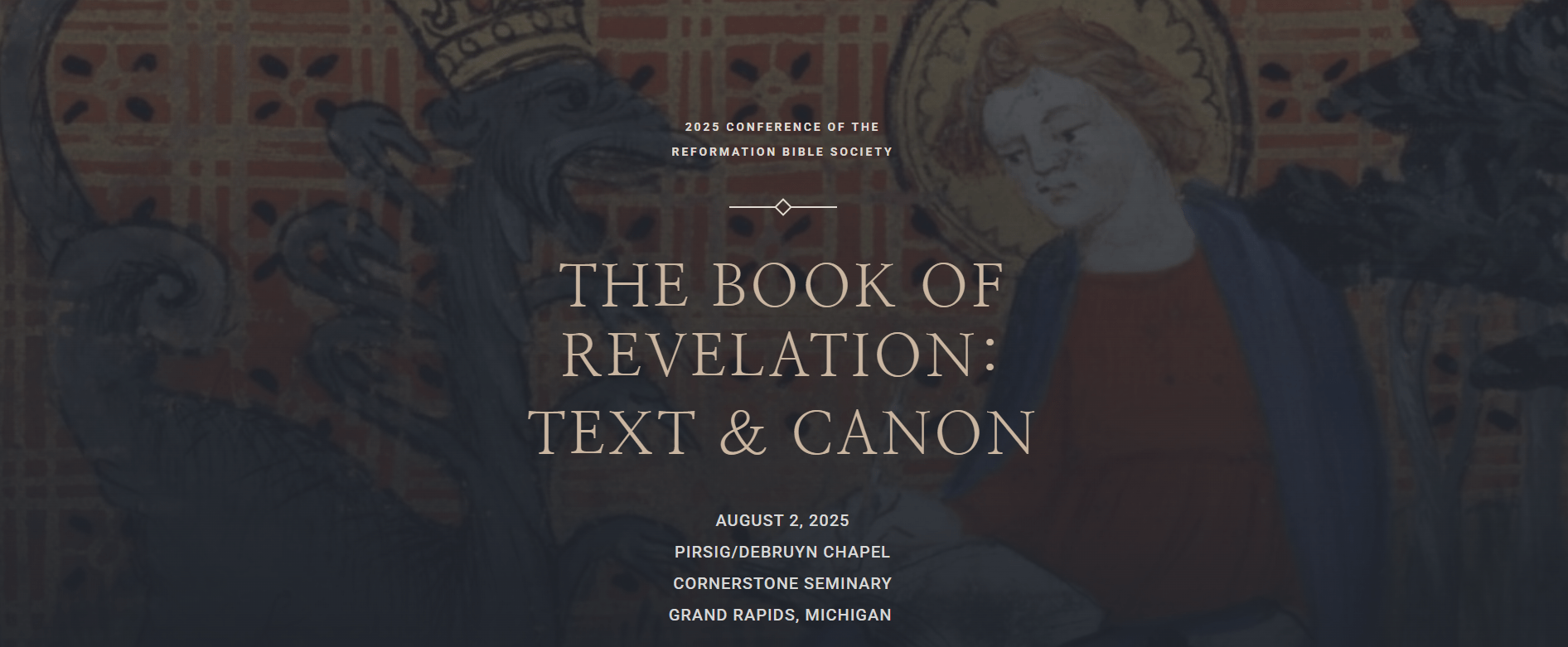
I am excited to announce the 2025 Conference of the Reformation Bible Society. We had a blast last year and I’m looking forward to another great conference. It’ll be great to be back in our old stomping ground at Calvin and Cornerstone.
We will be meeting at the Pirsig/Debruyn Chapel on the campus of Cornerstone Seminary – the alma mater of Dr. Van Kleeck Sr. (when it was called Grand Rapids Baptist Bible College).
We are thankful for the opportunity to once again present papers at this conference. Dr. Van Kleeck Sr. will present a paper on Revelation 10 and the concept of the “Little Book” as indicative of the written Scriptures given to God’s people. Dr. Van Kleeck Jr. will present a paper with a working subtitle, A Metonymic and Synecdochic Reading of Revelation as the Culmination of Biblical Revelation.
We’d love to see you all there – stay out late, talk Standard Sacred Text, get some pie, drink some coffee. Whether you are KJVO or MVO or somewhere in between this will be the place to be on August 2nd.
As many of you know we have both recently published books. Dr. Van Kleeck Sr. has published An Eschatological Grounding for a Standard Sacred Text which can be found here. Dr. Van Kleeck Jr. has published The 30 Best Arguments Against King James Version Onlyism* which can be found here.
Yesterday afternoon, we had the opportunity to speak with Nick Sayers about our work and to lay out some of the more salient details contained therein. Give it a watch when you have the time. We hope you enjoy. If you have any questions or would like to discuss these topics further with us, please reach out.
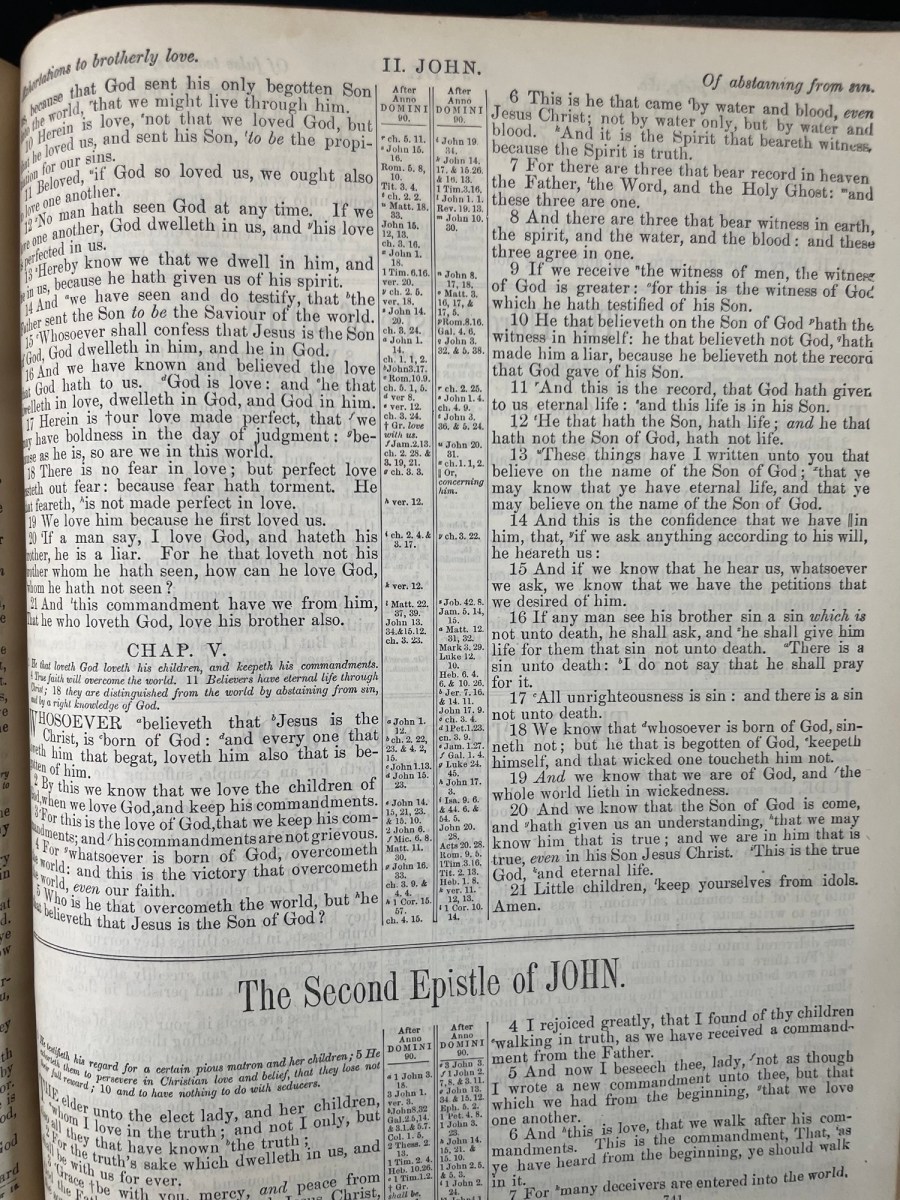
Moving some of my books I came across this 1876 Bible prepared to commemorate the American centennial. The first photo lists this edition’s commendations and why it was selected as the centennial edition. The second photo contains 1 John 5:7 which was present 5 years before the critical text corrupted this passage by its removal. Thanks to the divisions and ecclesiastical disharmony brought on by textual critics and their Evangelical collaborators, returning to this kind of national unity around a standard sacred text, the King James Bible, seems a formidable task, but nonetheless a worthy endeavor.