The Story of a Man from Another Country

There once was a man from another country and everything he said was true. He was incapable of falsehood or deception on any level of communication. Throughout the course of his life, everything he said, whether people liked it or not, was true. So others could also know the truth, he wrote the truth that he spoke in a book (2 Cor. 3:17) so after he returned to his home, others could read what he said. Everything in the book was true, but just like when he spoke the truth, some people did not like his writing any more than they liked his speech. The truth was not important to these people, so they neglected his book of truth and sometimes changed the words to suit themselves. Knowing that other men were adding falsehoods to and erasing words from his book the man from another country returned to the country to keep the book of truth free from errors.

When he returned to protect the book of truth, he made himself invisible to the men he once lived among. No one could see him. He also made himself everywhere at once so he could be wherever his written word was. Throughout the years after writing the book of truth the man from another country watched over his writing assuring every generation that they had a copy of the book of truth.

The men of the country could not understand how the book of truth had survived since the man from another country spoke and wrote the words so long ago. It seemed impossible to them because they did not know that the invisible and omnipresent man from another country had been watching over his book all the time. As their most precious possession, the people who loved the truth had been living their lives by the book of truth since it was first spoken and written.

The biggest problem in the country of men was their disagreement about the nature of truth. One prominent man asked, “What is truth?” They could not accept the truth spoken and written by the man from another country; they envied the authority of his truth. Their solution was to speak and write in the most prestigious and authoritative manner and call that speaking and writing “true.” “Perhaps other men will envy our writings the way we envy the writings of the man from another country,” they mused. But this kind of writing was a very difficult task for several reasons. There were not many prestigious and authoritative country writers to begin with. And then, after a few short years, they passed away. Generation after generation the speakers and writers passed, their writings forgotten, only to be replaced by many other men from the same country who spoke and wrote their “truths.” Above all, the greater issue was that they had no one to watch over their writings. The always-changing “truth” of the many generations of speakers and writers had no one to watch over their expression of “truth” or to standardize it as “the truth” and so the speaking and writing of “truth” had no end.

From the time of the man from another country there has been a struggle between the “truths” of many speakings and writings of the prestigious and authoritative country men and the one-time speaking and writing of the man from another country who only spoke and wrote only what was true. No end of this struggle is in sight, but the people that love truth and love the book of truth dwell in peace and safely knowing that the invisible speaker and writer of the truth is watching over their book.

In the book of truth, the man from another country wrote that he is coming back to the country to live with those that love truth and live their lives by the book of truth. Then the people who love the book of truth will learn how the invisible hand of the man from another country watched over the book of truth for so many years.

Is the Meaning of Original, Original?

Continuing our treatment of the places where we agree with out opposing interlocutors, we now come to certain crucial nuances between our two positions. To reiterate, we agree

“that the original documents written at the hand of Moses or David or Paul or John have been lost to the attrition of time and use.”

https://standardsacredtext.com/2022/04/01/places-where-we-agree-with-our-opposing-interlocutors-part-1/

But on the point of “original” there are several nuances which deserve attention. Those nuances are as follows:

Our position is that “original” means and only means the collection of words in specific first century documents written by the inspired writer [e.g., Moses, David, Paul etc.] at a specific time in that writer’s life and by the immediate bearing along of that writer by the Holy Spirit in writing those words. In other words, the only originals are the collection of words which the original penmen wrote in a document by the immediate inspiration of the Holy Spirit.

Our opponents maintain several different understandings of “original” and it is these nuances that we desire to get ironed out both here on the blog and in person if necessary.

1.) “Original” can merely mean first in the order of textual being. The original in this context is simply the first and progenitor of all other copies that follow. There is no need to employ criteria such as inspiration or the bearing along of the Holy Spirit to define “original” in this regard. If you pay careful attention to the argument of our interlocutors you will find that this is a widely used definition for “original” in evangelical and non-evangelical circles.

2.) “Original” in the mouth of someone like Bart Ehrman takes many forms. It may be the original message as it appeared in the mind of the penman which then took approximate shape on the page as he wrote down the words. It may be the first of all the copies that follow. It may be a corrected version of the first written document, kind of like what a second draft is to a first.

3.) “Original” may not refer to a specific document at all. We see this inferred in language surrounding the meaning and discussion of “jot and title.” Many prominent evangelical textual scholar assert that jot and tittle cannot mean the preservation of the original letters and parts of letters in a single document. Rather, the meaning is hyperbolic having to do with original meaning and not original words. Admittedly, for some, defining jot and tittle in terms of meaning may be oblique to the overall definition of “original.” Still, the point remains that the emphasis of original falls primarily on meaning and not on the inspired original words.

4.) There is a movement among the world’s leading textual critics to abandon the search for and reconstruction of the original words of the first documents which underlie the received books of the New Testament. Which is to say, not only has the general definition of “original” lost most if not all of its definitional supernatural elements, it is now thought to be wholly lost in document and word unless of course a Qumran-level discovery were to happen in our lifetime.

One caveat: Consider for a moment the Chicago Statement on Biblical Inerrancy. Doesn’t that clearly and concisely claim that the originals were indeed perfect and inspired? Indeed, it does. But note that the worth of the originals for the present day Church in this regard hangs quite heavily on the idea that the original documents are lost. Do they mean that God’s original words are lost? To admit as much has deep and negative theological implications for most evangelicals, so I don’t think they mean we lost God’s original words when they say the originals are lost.

So what then is the emphasis on this point of the originals being lost according to the Chicago Statement? The emphasis falls to a treatment of the originals as merely the first and progenitor of all subsequent copies, as a mere historical artifact. Put another way, the insistence upon the lostness of the originals in this way, especially within the context of modern textual criticism, implicitly defines the originals in terms of mere beginnings while simultaneously diminishing the supernatural characteristics of the Originals.

I am guilty of doing this very thing, but it seems to me that it is the words which make the Original the Original and no right-thinking Christian is going to say that any of the original words are lost. Does it not seem to be the case that without the original words written on a specific piece of ancient paper that paper could never be the Original. Thus when we say the originals are lost to the wastes of time and use we are speaking of mere paper upon which the original words are written. But nothing, not even the perishable paper upon which the original words of Scripture are written can render the Original lost.

Thus we have two kinds of lost originals. We have lost historical artifacts which contain the original inspired words of God and we have the question of whether or not any of the original, as to words, has been lost. Put simply we have lost original artifacts but no lost original words. It is because of this truth that Protestant Scholastics could speak of their canonical Greek apographa [i.e., copy] as the original. It was called Original not because it was the artifact written at the hand of John or Paul. It was called Original because their canonical Greek apographa was believed to be the Original as to words. And it is in this latter sense the Church has not lost the Original to the wastes of time and use.

For some you may think that we are splitting hairs, but that of course is the point of offering a nuance – a subtle difference in meaning. For others I hope that you can see the difference between our definition and the standard Critical Text/Multiple Versions Only definitions. As such, on the point of “original” these are some of the places we would like to carry on the discussion. We invite you to join us or to invite us to join you.

Preservation, Preaching, and Evangelism

On this Lord’s Day morning, we briefly consider the relationship between Scripture’s preservation, preaching and evangelism in Andrew Willet’s 1611 commentary on Romans. Under the heading “Places of confutation,” he engages in discussions with those who stand opposed to major Christian doctrines. The first controversy was “Against those which think it is against the nature of the New Testament to be committed to writing.” Willet has those with a “fanatical spirit” in mind, those who held that the writing of the law in one’s heart and through the Spirit (Jer. 32:33; 2 Cor. 3:3) make a written testament unnecessary. To this Willet replies that the writing of the Scriptures was given by the direct command of God (Rev. 14:13), “and St. Paul saith, that all Scripture is given by inspiration:  2 Tim. 3:6,”[1] and that “[T]he Spirit of God then moved them to put in writing these holy books of the New Testament; which are part of the Scripture.”[2] Reinforcing his answer, Willet writes,

“It followeth not because the Lord writeth the Gospel in our hearts by his Spirit, that therefore it is not to be written: for by the writing thereof which is preached and read, faith is wrought in the heart by the operation of the Spirit: As the Apostle saith, Rom. 10:17, that faith cometh by hearing, and hearing by the word.”[3]

Willet concludes his discussion by summarizing the three primary reasons the word of God was committed to writing: “1. Both in respect to that age present, for the preventing and stay of heresies, which might be more strongly resisted and gainsaid, by an evident and extant rule of faith; 2. In regard of those Churches, to whom the Apostles preached not by lively voice, it was necessary that they should have some perfect direction in writing; 3. And that the ages also to come might have a rule of their faith.”[4]

Blessings!


[1] HR, p. 5.  Read 3:16.

[2] HR, p. 5.

[3] HR, p. 5.

[4] HR, p. 5.

Places Where We Agree: The Need For Nuance (Part 2)

NUANCE

Noun

1. a subtle difference in or shade of meaning, expression or sound.

We don’t live in a world of nuance. We live in a world of extremes. Political punditry on the evening news boils down to “Those conservatives are bigots” or “Those liberals are insane.” You have to either be for Ukraine or against Ukraine, and anyone who tries to offer nuance in the situation is a Putin groupie and is calling for WW3. There is nothing we can learn from our opponents. They have no point. They have no case. They are totally, utterly, and completely wrong. The same goes for many religious discussions.

All people who disagree with the Gospel must be enemies. They can’t be in need of help. They can’t be lost. They can’t be intellectually poor or merely have gaps in their understanding. They must be enemies. And all who try to construe them as anything other than enemies are soft, naïve, and/or ecumenical. Pick your pejorative. The rule of the day is to never give your opposing interlocutor any credit, and if you must, do it more as a slight or in a backhanded way. It’s easier this way and there is no sign that things are going to change in the near future. So what are we to do?

Well, demonize our opponents, of course…

Nah, not for me. If we want to change the world through belief in what the Scripture says about God, Christ, and the word itself, then we are going to have to do some “opening and alleging” just like Paul did in Acts 17. That is going to include a host of nuances and those nuances are going to include places of agreement between us and our opponents.

And what makes our opponents our opponents? It is their arguments, primarily. We find their arguments to oppose ours and so we call those who propound arguments opposed to our own to be our opponents. Of course this is the similar situation in war time as well. It is not so much the man that is our opponent but the fact that that man is trying to kill us. It is his leaden “arguments” which we oppose and thus we return similar and, Lord willing, more accurate leaden arguments.

So just like yesterday’s post, here are some places where we agree with our opposition.

1.) We agree that God the Holy Spirit inspired the word of God via the inspired penmen of the autographic text.

2.) We agree that the Bible should be publicly preached in public worship.

3.) We believe that people of all languages should be able to read the Bible in their own language and that such a reading be profitable for doctrine, reproof, correction, and instruction in righteousness.

4.) We believe that the word of God in these vernacular languages is powerful enough to engender faith in the human soul and thus lead that soul to salvation in Christ.

5.) Furthermore, given #4, we here at StandardSacredText.com believe in agreement with our opposition that it is possible to be saved out of other versions of the Bible beside the KJV so long as that version contains the substantia doctrinae of the original language.

6.) Given #5, we also agree with our opposition that the Bible has been given to Christ’s bride for more than the work of salvation. It has also been given for all things that pertain to life and godliness [i.e., sanctification].

7.) We are in agreement with our opposition that the revealed word of God has come down to us today in different forms, iterations, and refinements.

8.) We are in agreement with out opponents that the KJV as a form, iteration, and refinement of the revealed word of God in English has served the English-speaking Church and Western society as a whole in unparalleled ways since 1611.

9.) We are in agreement with our opposition that the issue of what counts as the New Testament or what counts as the word of God are interesting questions and are worthy of focused effort aimed at offering solutions to those questions.

With the five common places from yesterday and the nine common places immediately above there seems to be significant common ground between our two positions. But then come the nuances, and it should be those nuances on which we focus our energies. In keeping with this doctrine, the following weeks’ posts will center on illuminating these nuances, these subtle but meaningful differences between the Standard Sacred Text position and the Critical Text/Multiple Versions Only position.

Dean John William Burgon on 2nd-5th Century Testimony to Mark 16:9-20

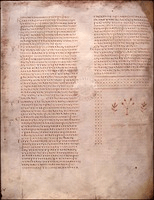
Codex Alexandrinus. 5th c

“II. That, at some period subsequent to the time of the Evangelist, certain copies of S. Mark’s Gospel suffered that mutilation in respect of their last Twelve Verses of which we meet with no trace whatever, no record of any sort, until the beginning of the fourth century.And the facts which now meet us on the very threshold, are in manner conclusive; for if Papias and Justin Martyr [AD 150] do not refer to, yet certainly Irenaeus [AD 185] and Hippolytus [AD 190-227] distinctly quote Six out of Twelve suspected Verses, –which are also met with in the two oldest Syriac Versions, as well as in the old Latin Translation. Now the latest of these authorities is earlier by a full a hundred years than the earliest record that the verses in question were ever absent from the ancient MSS. t the eighth Council of Carthage, (as Cyprian relates,) [AD 256] Vincentius a Thiberi, one of the eighty-seven African Bishops were assembled, quoted the 17th verse in the presence of the Council.

Nor is this all. Besides the Gothic and Egyptian versions in the ivth century; besides Ambrose, Cyril of Alexandria, Jerome, and Augustine in the vth, to say nothing of Codices A and C; –the Lectionary of the Church universal, probably from the second century of our era, is found to bestow its solemn and emphatic sanction on every one of thee Twelve Verses. They are met with in every MS. of the Gospels in existence, uncial and cursive, — except two; they are found in every Version; and they are contained besides in every known Lectionary, where they are appointed to be read at Easter and on Ascension Day.”

The overwhelming early evidence in Church history for the Mark 16:6-20 prior to the 4th century MSS Sinaiticus and Vaticanus speaks to the passage’s authenticity. If it was present before the 4th century, its absence in two manuscripts cannot erase the prior evidence of the passage’s inclusion at the end of Mark’s Gospel. Nevertheless, this failed reasoning lingers in modern Evangelical textual criticism and prompted the infamous note after Mark 16:8, “The most reliable early manuscripts and other ancient witnesses do not have Mark 16:9-20.” The two witnesses are Codices Sinaiticus and Vaticanus against conclusive testimony for the passage before and after the 4th century. As if plucking the two MSS out of the entire manuscript tradition the modern Church was brought to question the authenticity of these verses. One deeply sorrowful but reliable report was that a faithful churchman, trusting his pastor not to lead him astray, after being told that the verses were spurious took a black, felt-tipped marker and drew a black “X” across the nine verses, crossing then out. Burgon was not making a dogmatic assessment. The manuscript evidence does not support the exclusion of the passage. Stalin said “Those who vote decide nothing. Those who count the vote decide everything.” For modern textual critics, “The manuscript decides nothing. Those who adjudicate the manuscript decide everything.”

John W. Burgon, The Last Twelve Verses of the Gospel According to S. Mark (Erlanger, KY: Faith and Facts Press, nd, 1871), 328-329.

Codex A: Alexandrinus, 5th century

Codex C: Ephraemi Rescriptus, 5th century

Places Where We Agree with Our Opposing Interlocutors (Part 1)

For the next couple days I wanted to write concerning the places wherein we agree with our opposing interlocutors. For this series “opposing interlocutor” means those of the Critical Text persuasion and its translational cousin Multiple Versions Only-ism. The reason for marking where we agree is two-fold: 1.) It is important for those who would disagree with us to understand where we have common ground on the topics of the textual issue and the version debate. It is important because an understanding of our common ground should save on ink spilt in make our respective cases. Additionally, it will help focus the conversation on the places of most import, the places where we disagree. 2.) It is equally important for our interlocutors to hear us plainly admit to our points of agreement so that they also may have a point of reference from which to understand out position. That is, if they cannot join us on our side perhaps they can join us at certain common places and from there interpret both these common places and our position with respect to those common places.

The first place of common ground between our two opinions is that we both believe that the original documents written at the hand of Moses or David or Paul or John have been lost to the attrition of time and use.

As a result, the second rhetorical commonality we share is that given the absence of the original documents all that we have at our disposal are copies. Indeed, in most cases we have copies of copies or copies of copies of copies etc.

Third, we mutually recognize that no two of these copies agree in every word. They are all different, some to greater and some to lesser degrees when compared among themselves.

Our fourth place of mutual agreement is that the New Testament in particular has far more manuscripts and far more complete manuscripts attesting to it than any other book of antiquity.

Fifth, we agree with our opposing interlocutors that some form of textual criticism is part of the process of getting the word of God into the hands of God’s people.

So let us start here with these common places.

Tomorrow, Lord willing, we will deal with those common places we share with regard to the nature of the Bible and its present power among God’s people.

The King James Version and Freedom

If you ever visit the Nation’s Capital, you will want to visit the Holocaust Museum just south of independence Ave SW. The walk through three stories of exhibits is a sobering and visceral reminder of the unspeakable evil that resides in the heart of man. In a previous post entitled “Time to Get in the Fight” we addressed the endorsement of Hitler as God’s choice to lead the German nation by the German Evangelical church and theological scholars. In this post we want to drill down a little further into the theological underpinnings of this ecclesiastical and academic support.

For over 50 years the historical-critical method was the means of theological formulation. History had replaced the inspired apograph and the new hermeneutic in Germany. Hans Frei, in his book Types of Christian Theology observes of the German theological compromise in accepting Nazism, writes “In dogmatics they asserted the indispensable methodological coherence of autonomous anthropology, the fruit of reflexive analysis of subjectivity and of the contemporary culture, with a biblical doctrine of God’s relation to man.”

Frei notes that two things about the theological dogmatics of that era: the methodological coherence of, 1. “autonomous anthropology;” and 2. a biblical doctrine of “God’s relation to man” or providence. “Autonomous anthropology” speaks to the historical one-dimensional man, who in his autonomy was no longer under the authority of God. Providence speaks of God’s work in history in the affairs of men. The theology of the “contemporary culture” of which Frei writes was one of the abasements of pre-critical Protestant Orthodox theological structures and the adoption of autonomous methods for the formulation of anthropology and God’s providence. Of this “methodological coherence,” Frei continues,

“They then quite logically united this dogmatic compromise to a similar political-theological one for which (again) God made himself known in Scripture but also in the special vocation, culture, and laws of particular nations at particular times.” (Frei calls the compromise “political-theological,” but history bears out the political overriding and crushing of the theological.)

Expanding “autonomous anthropology” to include the realm of the political, Frei identifies a “political-theological” compromise making a theological way for God to speak through Scripture but also through providence which he describes in terms of “special vocation, culture, and laws of particular nations at particular times.” This led to “the Nazi intrusion into the Church,” the “fanatical ‘German Christian Movement’ which envisioned Naziism as the fulfillment of Christianity” and that in 1933 Hitler’s rise to power called the “national renewal was being acclaimed as divinely sanctioned.”

In 1934 Germany, “God making himself known in Scripture” was a rejection of pre-critical categories of a preserved, inspired Word and an attempt to reconstruct the Scripture according to historical critical parameters. The compromise Frei speaks of was between a critically formulated text and a notion of providence in terms of a God’s oversight of a particular nation at a particular time, or the rise of Nazi Germany. While perhaps on an ecclesiastical level this was a compromise, from the academy’s perspective, the text and providence complemented each other. There was no Scripture to stand above the German church to hold it accountable for its misguided notion of providence. Autonomously reconstructed Scripture simply affirmed the church’s autonomous interpretation of providence. As the possession of the Church, the Scripture confirmed a political view of providence.

How treacherous, then, is the historical critical method, when the Scripture becomes subservient to the Church, having lost its transcendent qualities by being subjected to historical limitations and reconstructed according to proportional standards? when the text can be rendered to support the most misguided of political atrocities?

This leads to the question, “Can the Bible you read speak in terms beyond its collation or historical critical construction?” The advocate of the KJV can say yes. In the text you hear the viva Vox Dei, the living voice of God which surpasses all historical limitations. New versions, however, are manmade. Are they able to speak to issues that surpass their origin? The answer must be no. The scientific method confirms the object predicated by the subject. Because the subject, or critic, cannot create something that surpasses his capabilities, the predicate is unable to surpass its source. This is to say, that modern versions are limited to the historical. Distributivity, or there are parts where there is overlap between the preserved Word of God and the critical text, but collectively, or Canonically, the preserved Word of God is the viva Vox Dei, and the critical text is manmade.  

Canonically, the bibles accepted by MVOism are manmade documents limited to the historical. This “autonomous anthropology” in bible creation and acceptance is the first step to repeating history. Next, is moving autonomous anthropology into the political sphere because of some providential cultural or national event. After that, a collective autonomous theological or ecclesiastical declaration is all that remains to affirm that the politics of the day are providentially ordained of God, and that the “national renewal was being acclaimed as divinely sanctioned” no matter how horrendous. When you read “horrendous” think of it in terms of 1934 Germany rendered, “good for us all.” The table has been set. Now we wait for the invitations to be sent and for the guests to arrive.

The teaching and preaching the KJV has kept America free, and now many have forsaken the Bible that has kept us free. If you get to Washington DC, make plans to visit the Holocaust Museum. You will get to know yourself and your fellow man better.

Hans Frei, Types of Christian Theology (New Haven: Yale University Press, 1992), 154-157.

Old Hymns and Old Bibles

I came across this tweet before I came across the one from yesterday’s post. Let me give the tweet and then we’ll makes come comments.

So of course we have a kind of retweet here. Elisabeth Elliot, wife of martyred missionary Jim Elliot, is being quoted by Pastor Castleberry. And is my want to do perhaps we could phrase Elliot’s quote like this,

Unfortunately, most churches today are not teaching from the old KJV and I want to put in a little word here: please learn the old KJV. You have no idea what you’re missing theologically.

Things your are missing are teachings like the long ending in Mark, the story of the woman caught in adultery, and the only explicit reference to the Trinity in 1 John 5:7. Then of course there are all the theological implications of abandoning the the old KJV for a Multiple Versions Only position or abandoning the Bible altogether as in the case of Barth Ehrman.

But for us the more striking thing is the obvious plea to return to the old hymns or at least retain them in public worship. And seeing that Pastor Castleberry has “retweeted” Elisabeth Elliot it seems he is in agreement with this conclusion in the 21st century. I love the old hymns especially those of the Psalmody sort, but my how we promote the old songs and the old liturgy and the old confession and the old theology but we no longer promote the old King James Bible.

We love the songs from the Reformation, the theology from the Reformation, and the confessions from the Reformation even with all their several and respective archaic words and “False Friends” falsely so called, but we do not love the Bible of the Reformation. Again, as I have said many times by now, we love to advocate for old songs, regulative principle of worship, Reformed theology, and Reformed confessions, but these things are all ruled by the Rule of Scripture. And the Rule we leave up to preference, “Read the version that sounds best to you. I mean, the best version is/are the version or versions you understand. Amiright?”

The Bible as the Rule tells us what the sovereignty of God is and how we are to relate to it. Imagine telling a cage-stage Calvinist that Molinism is the appropriate interpretation of the phenomena of Scripture. The experience to follow is akin to putting a lid on an active volcano. Take that same cage-stage Calvinist and tell him that there is one standard sacred text and he will most likely be that same unhinged eruption and will argue that there are many Rules that are sufficiently reliable Rules. So for his theology there is only one defensible position but for the Rule that governs his theology he will accept any sufficiently reliable Rule. So why doesn’t he accept any sufficiently reliable accounting of God’s sovereignty? Because of course that which is ruled now governs the Rule.

Theology and old hymns have become the Rule and the Scripture is simply there to support our theology and use of old hymns. We have convictions about our theology but preferences about what Bible we read, and then sit around scratching our heads, asking why the Church in America is dying. It is dying because the Rule is a mere predicate of our theology rather than our theology being predicated upon the Rule that is Scripture, not a Rule or Multiple Rules Only.

Trelcatius, 1610, on Theological Method

Under “The Principles of Divinity,” Trelcatius introduces his two-fold method for the study of Theology. His method of moving from the Cause to the Effect and from the Effect to the Cause in modern terms is both Deductive and Inductive, a priori and a posteriori. Divinity, he writes for both approaches “holdeth the first and principal place.”

The subject of this Theological wisdom are matters divine, both for their nature, and the manner of considering: for whereas a Subject hath two parts, the one that containeth the place of the matter, and is called the thing considered: the other of the form and is the manner of considering it: we observe then both in the explication of the subject. The thing considered is God himself, and all things disposed unto God, that is all things divine, either of their own nature or by revelation unto God. The manner of things considering is proportional to God’s truth, even the whole truth, and every part thereof alike (or equally) infused, fitted to the dignity of the deliverer to the nature of the argument, as also to the condition of those to whom it is delivered.

And this is the nature and verity of Divinity: now we will briefly show the Method of our Instruction concerning the same.

There is a two-fold Method of teaching, the one from the Principle, the other unto the Principles, the one a Priori preceding from the Cause to the Effect, and from the first and highest to the lowest and the last. The other a Posteriori, proceeding from the Effect to the Cause, or from the last and lowest to the highest and first. The use of the former is chiefest and sciences contemplative, of the latter, in the practice (or active.)

Now whereas Divinity in both these holdeth the first and principal place (by reason thereof some have distinguished into Contemplative and Active) and for that it affordeth a faculty both of knowing and doing well, which is the right way of wisdom. It hath fallen out that Divinity hath been handled in a diverse Method by diverse men, yet by all of them profitably and faithfully.

For whereas all order is taken either from the nature of things to be considered, or from the better and easier knowledge thereof, Calvin, Melancthon, Ursinus, have done well who observed an order of their better knowledge in a method, unfolding by way of analysis. I like manner Hiperius Musculus, Hemingius, Zanchius, have done well observing the order of Nature in a Method of composing and couching things handsomely together. We in this Institution [Leiden] will join both together, borrowing from the Method of unfolding in the invention of the same, that from both the full Divinity which we have in hand may arise.

Therefore by an order Synthetical (as we term it) we begin from the first Principles, that by means we may come to the last. But we will set down a declaration such as we call Analytical, of the first, middle, and last things. First we teach the truth by way of confirmation, then in reproving falsehood by way of confrontation: that, by the help and benefit of every point of Divinity, and by the Analysis of the same, through causes thereof: but this is, by the Appendix (or addition) of the general solutions, which we lay under every place (or point) and set against the principal arguments of our adversaries, especially Bellarmine: this is the Method.

Trelcatius hits upon two pivotal issues when discussing Scripture. First, Bibliology as a portion of the larger body of Theology is essentially Theocentric. The study and defense of Scripture is included when Trelcatius writes “The thing being considered is God himself, and all things disposed to God.” Secondly, he deals with the manner of considering of how Theology should be considered. He writes that the way the Scripture should be considered must be “proportional to God’s truth” which would be to consider the revelation of God to be absolutely true.

In this brief excerpt Trelcatius explains his Theological method including deductive and inductive reasoning, first Principles being primary, the topic under consideration, God himself, and the proper manner to consider God and his revelation proportional to what God says about himself, a good method for any theological discourse or Theological writing.

Lucas Trelcatius, A Brief Institution of the Common Places of Sacred Divinitie wherein the Truth of every place proved, and the sophisms of Bellarmine are reproved, translated by John Gawen (London: Imprinted by T. P. for Francis Burton, dwelling in Pauls Church-yard, and the sign of the Green Dragon, 1610), 5-8.

Non-Textual Critic = Layperson

I came across this tweet a couple days ago and I thought that there is an interesting comparison to be made between the current academic authorities behind what counts as the New Testament and the current academic authorities behind public school curriculum. The latter is mentioned in the tweet below and the former follows.

For our current context the above tweet would go something like…

To be clear, “non-textual critic” is “layperson in the pew.”
Now read it again. Now read the KJV.

Non-textual critics repeat after me:
Just because I read the Bible doesn’t mean I know what the original says or get a say in what textual critics criticize.

Textual critics know what they are doing. They have many degrees in their respective fields. They make yearly comprehensive text-critical apparati. They are the experts.

You are not.

Perhaps you think me too harsh or that I have inappropriately commandeered this tweet. Before you decide to pull the lever on the Guillotine and dispatch me with my appropriated tweet, go start a debate with a text-critic on Twitter or Facebook over the story of the woman caught in adultery and see how long it takes them to flex their credentials, tell you that you don’t have all the data, or ignore you. And if the text-critic won’t address your question, then prepare to contend with a host of his acolytes. After that experience I think you will find that my requisitioned tweet is not far from the truth. In fact, you may find that I’ve struck the bullseye Robinhood style.