Tomorrow will be the second lecture of the Standard Sacred Text lecture series. We will begin at 7:30pm EST and will be held on the Zoom meeting platform. The lecture should run 50 or so minutes with LIVE interaction and Q&A both as the lecture is going on as well as afterward.
This week we continue working our way through Then He Poked the Bear, a small book written by Van Kleeck Jr. in order to stir the scholastic pot. In this episode Dr. Van Kleeck, assuming a merely evidential method, will offer one historical argument, one example, and one modern phenomenon all with the aim of casting doubt on the quality of the NT originals.
Join us tomorrow at 7:30pm EST by clicking the button below. See you there.
Turning to the familiar passage describing the circumstances surround the birth of Jesus Christ in Luke 2, we want to examine the role the shepherds played in relaying an inspired message to those within their sphere of influence and especially the trust God placed in them.
Our first observation is that the shepherds represent the vast majority of all those God has called upon to serve Him. Most of the work of the Church throughout history has been performed by unnamed saints, just as the shepherds are unnamed. Within their epoch of time, believers lived with their families, friends, and acquaintances serving the Lord but have long since passed into glory.
And secondly, the shepherds represent most saints who had little if any formal theological training. The shepherds were not trained as were the lawyers and Pharisees in theological matters. They were simple men, common men of day, engaged in the humble and menial task of shepherding sheep. This post will argue that the capacity for the saint to recognize and comprehend the word of God has been underestimated by the academic elite and that God’s choice of shepherds to receive the inspired announcement gives an exegetical basis for that assertion.
Given these introductory observations we conclude that the individuals God trusted with an inspired, other-worldly message lacked both notoriety and specialized training, and that through the history of the Church these two characteristics are shared by most of the saints in the service of the Lord.
So what did God trust them with? God entrusted the shepherds with clearly comprehending the announcement of the birth of His Son. The angel of the Lord spoke to them with the full expectation and assurance that these humble, untrained men would understand what the angel would say. The angel spoke in words the shepherds understood, diction, grammar, and syntax that was not too complex for shepherds to understand. Understanding the angel did not take any special training. The angel spoke of things familiar to them – the city of David, v. 11 Bethlehem. Swaddling clothes, what you would expect a baby wrapped in, v. 12, lying in a manger, v. 12 – every shepherd knew what a manger was, which is to say, that the inspired words were suited to the shepherds. This is also the case made for the nature of the inspired written text. The language was suited to the reader and hearer in such a way that it could be easily understood.
We know what the angel said a transferal of the words of God because the angel’s words are part of the inspired record. The shepherd’s themselves say that it was the Lord that made these things known to them. Simple shepherds understood the word of God through the angels, while under duress and without any specialized training. That is, God speaks to the common man, the common man can fully comprehend the words, and this can be accomplished on an individual basis without institutional augmentation. For the shepherds, the entire episode was oral. They heard the spoken word of God and clearly understood.
Not only did God entrust the shepherds with the comprehension of the inspired announcement, but they were entrusted to act on the announcement to be the first outside witnesses of the birth of His Son, Jesus Christ – “let us go and see.” The announcement entailed a consequence for the shepherds. Having received the angelic announcement, they were to act upon it. A sign was given them to know they were at the right place.
It’s interesting to note, that the message was not rendered differently by each shepherd. What was known and agreed upon corporately. The fact that everyone heard the same thing, agreed on the same thing, and acted cohesively was a wonderful work of God’s grace in their lives. That is, the comprehension of God’s Word creates unity with such certainty that it will motivate the whole to a single purpose. This in turn speaks to the unity of the Church as it trusts a standard sacred text. A standard sacred text leads to unity in faith and action.
The shepherds hurried to confirm the message and found things exactly as they were told. They acted on the word of an angel fully believing that the angel spoke for God and what they were being told was absolutely true. We learn that the trust the shepherds had in the word of God, for believers, is inherent in the word. The angel did not have to make a case for the announcement’s truth; it was true because it was the word of God and as such announced a work of God. Because God said it, it is completely trustworthy, indeed, so trustworthy that it is worthy of faith to believe. We also learn that when God speaks, He makes it clear for everyone to understand. The angel’s message was not convoluted or opaque. When the announcement concluded none of the shepherds said, what was he trying to say? or I just don’t get it.
Do you think if the Sanhedrin had divine forewarning of the angel’s coming, that they would have sent shepherds to greet them? or would they have sent the best and brightest of the Hebrew scribes. After all, interaction with angels is not place for the common shepherd; to interact with heavenly beings, they would argue, requires a skill set only obtained by elite scholars. Besides, shepherds are too ignorant, they would just get it all wrong anyway. We need to send someone more reliable, more trustworthy to engage in this kind of work. And this is what we are told every day by evangelical text critics. The common saint is too unskilled to interact directly with providentially preserved word of God; they would just get it wrong, believe the wrong thing, trust the wrong thing, live their lives according to the wrong thing, act on the wrong thing, when all along it was the shepherd, the common man, that God trusts to get His most solemn work done. If critics were in the field that Christmas morning, after the announcement, they would have never made it to the manger. They first would have written an article and submitted it to a prestigious journal questioning the validity of what they saw, fearful of being overly dogmatic while maintaining their academic good standing. Simple faith and trust in God’s word is not their forte.
What should we learn from this?
1. God uses the weak things of the world to confound the wise
1 Cor. 1:26-29, “For ye see your calling, brethren, how that not many wise men after the flesh, not many mighty, not many noble, are called: But God hath chosen the foolish things of the world to confound the wise; and God hath chosen the weak things of the world to confound the things which are mighty; And base things of the world, and things which are despised, hath God chosen, yea, and things which are not, to bring to nought things that are:That no flesh should glory in his presence.
2. God loves the common man – he made so many of them. God loves the Church and through the Word/Church/Holy Spirit dynamic God is driving redemptive history toward eschatological consummation. This dynamic works, though in part comprised of the common saint, because of the common man’s willingness to believe God’s word as taught by the Spirit.
3. Being the common man makes you perfectly suited to be a servant of God – no specialized training is necessary to have a pivotal role in God’s eternal plan. God will use you. There were no scholars in the field the night the angels appeared, but “these men, at the bottom of the social scale in Israel, were chosen as the first preachers of the new-born King.” Pulpit Commentary
In this episode Dr. Van Kleeck explains the impetus behind Then He Poked The Bear and then goes on to lay the groundwork for subsequent arguments.
If we are allowed robust Christian precommitments regarding the state of the autographs at the time of their writing, then why not allow the same precommitments regarding the copy of God’s word in our hands? And if we are not allowed to say that every word of our Bible is from God based on what the Bible says about itself, then let’s be consistent and deny the assertion that first-century Christians believed every word of the original was the word of God. Perhaps the Church has never believed that every word of Scripture was from God.
Standardsacredtext.com has embarked on the next phase of Bible defense with the introduction of the live Tuesday night lectures. After publishing three “Grounding” volumes and “Then He Poked the Bear,” this venue gives insights into the authors’ thoughts, research, and rationale behind the writing. Now approaching 600 posts, we receive feedback indicative of the deep inroads radically evidentialist presuppositions, arguments, and methods have infiltrated the Church. Not only will the lectures provide substantive, exegetical, theological, historical, and philosophical content, but they will show how the content within the given genre generates a systemic defense of Scripture consistent with historic, Christian orthodoxy.
“Then He Poked the Bear” with its metaphorically familiarity and humor, speaks to the hopelessness of modern textual critical methodology simply by citing the critics own evaluation of the process. With so much material, how then should the apologist organize and disseminate the data in the most compelling manner? Dr. Van Kleeck’s lectures will give suggestions on how the content of the book can familiarly transition didactically, apologetically, and polemically within academic and ecclesiastical settings.
Following Dr. Van Kleeck, Jr’s, lectures, Dr. Van Kleeck, Sr. will work through “Exegetical Grounding” laying out the inception of the study and pre-critical exegetical categories. In that all Systematic Theology to be theology must reside with the upper and lower control limits of sound exegesis, the second series of Tuesday night lectures will lay the groundwork for “Theological Grounding.” The format of the “Exegetical Grounding” Tuesday night lectures is in its formative stage but there are thoughts toward providing a companion workbook that would provide those tuning in with a reference guide on how best to answer anticipated questions and design a personal lesson plan for future teaching.
Life often gets in the way of well-meaning intentions, but I encourage all those, experienced and unexperienced in the text and Bible version debate to take advantage of the Tuesday night lecture series with Dr. Van Kleeck, Jr. If Tuesday night does not fit your schedule, the lectures are being posted to view at a later date. We welcome any questions that the lectures may generate to the end that a robust defense of a standard sacred text will in turn aid the listener in the continued defense of a standard sacred text.
We look forward to seeing you at 7:30 pm next Tuesday night.
Tomorrow will be the first of the Standard Sacred Text lecture series. We will begin at 7:30pm EST and will be held on the Zoom meeting platform. The lecture should run 50 or so minutes with LIVE interaction and Q&A both as the lecture is going on as well as afterward.
This week we begin working our way through Then He Poked the Bear, a small book written by Van Kleeck Jr. in order to stir the pot. In this episode Dr. Van Kleeck will give some background to the work, address theological precommitments, Wallace’s Dictum, and the meaning of “original”.
Join us tomorrow at 7:30pm EST by clicking the button below. See you there.
Over the past year was have been cranking out the blog posts hand over fist. Material upon material. Starting next week we are switching the bulk of our content to a weekly [Lord willing] live lecture series where Van Kleeck Sr and Jr will begin lecturing through their printed works.
Lectures will be held live every Tuesday night @ 7:30pm EST.
Van Kleeck Jr will begin the lecture series with Then He Poked the Bear followed by Van Kleeck Sr treatment of An Exegetical Grounding for a Standard Sacred Text.
If you are not able to make it to the live lecture it will be edited and uploaded to YouTube for later viewing.
If you have any questions you can reach us in the comments section of this post.
Thesis 5: The argument to the effect that what the majority of believes in the history of the church have believed is true, is ambiguous at best and theologically dangerous at worst; and as applied to textual criticism, the argument proves nothing very helpful anyway.
I will point the reader to the following passages: The inseparability of the written word and Spirit – John 14:26, John 16:13-14. Also 1 Cor. 2:14-15 – the bond between the Word and Spirit. The Holy Spirit gave us the word and guides our application of the word. Our understanding if Scripture is only correct and complete when the Holy Spirit interprets the word in the Church. The Holy Spirit did not merely give us a book and then leave it to us to figure it out. He continues to be our Teacher. “The Spirit is he Master Theologian, Teacher of the Church.” Kuyper. The three-part dynamic of Spirit/Word/Believer permeates the Scriptures. I give but 4 examples; Isa. 59:21, word, spirit, believer God’s mechanism to bring his redemptive plan to eschatological consummation. Eph. 1:13 – heard the word of truth — word/ye were sealed – believer/with that Holy Spirit of promise/-Holy Spirit. Eze. 36:27 – Spirit, statutes and judgments, God’s Word, within you, the believer. John 16:13 – Spirit of truth, guide you into all truth, God’s Word, he will guide you – the believer
Calvin, reflecting this exegetical and theological truth, comments,
“[But] I reply, that the testimony of the Spirit is superior to all reason. For as God alone is sufficient witness to himself in his own word, so also the word will never gain credit in the hearts of men, till it be confirmed by the internal testimony of the Spirit. It is necessary, therefore, that the same Spirit, who spake by the mouths of the prophets, should penetrate into our hearts, to convince us that they faithfully delivered the oracles which were divinely entrusted to them…; because, till he illuminate their minds, they are perpetually fluctuating amidst a multitude of doubts.” Calvin, Institutes, 1.7.4.
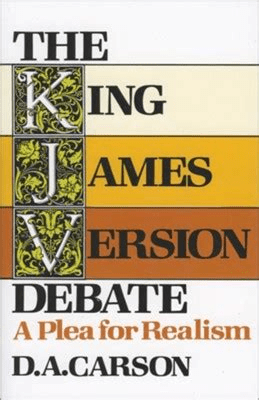
Carson, does himself and the reader a disservice with the inclusion of Thesis 5. Please note, that Carson, like White, says nothing of the role of the Holy Spirit as if to abandon the Church and the text to its own deductions and finally to a handful of textual critics. Carson’s secular approach to the text also looks at the Church as natural, 1 Cor. 2:14, where jot and tittle preservation (Matt. 5:18) is foolishness but omitting the central role of the Spirit at work through the saints and Word.
What Carson calls dangerous, if not obeyed, Tyndale calls idolatry, writing,
“God is not man’s imagination; but that only which he saith of himself. God is nothing but his law and his promises; that is to say, that which he biddeth thee to do, and that which he biddeth thee believe and hope. God is but his word as Christ saith, John viii. “I am that I say unto you;” that is to say, That which I preach am I; my words are spirit and life. God is that only which he testifieth of himself; and to imagine any other thing of God than that, is damnable idolatry.” William Tyndale, “The Obedience of a Christian man,” Doctrinal Treatises and Introductions to Different Portions of the Holy Scriptures, edited for the Parker Society (Cambridge: The University Press, 1528, 1848), 156-161.
Yet, this is precisely what Carson strives for; he is fabricating God out of his own imagination. God is what he says about Himself, but Carson has chosen to speak for God. When when speaks for God, creating God from their own imagination, Tyndale calls this usurpation “damnable heresy.”
I hope the reader recognizes the depth of Carson’s errors and the subsequent demonization of pre-critical theological thought all for the sake of hoping to engender trust in a failed and vacuous text critical method and resulting multiple version onlyism. And after 150 years of this textual and subsequent theological recreation, Ligonier reports the following:
“The 2022 State of Theology survey reveals that Americans increasingly reject the divine origin and complete accuracy of the Bible. With no enduring plumb line of absolute truth to conform to, U.S. adults are also increasingly holding to unbiblical worldviews related to human sexuality. In the evangelical sphere, doctrines including the deity and exclusivity of Jesus Christ, as well as the inspiration and authority of the Bible, are increasingly being rejected. While positive trends are present, including evangelicals’ views on abortion and sex outside of marriage, an inconsistent biblical ethic is also evident, with more evangelicals embracing a secular worldview in the areas of homosexuality and gender identity.” https://www.ligonier.org/posts/state-theology-survey-2020-results/
And before someone says, yes but not major doctrine is missing in the recreated text, stop, look around, and ask yourself whether that objection is at al relevant or meaningful. Even if that objection were valid, which it is not, that feckless half measure has still brought the Church and American culture to the spiritual decay we are now experiencing. Saying the Bible is the essentially the same is an entirely different category of assertion than saying the Bible is the infallible word of the living God. The first assertion carries no authority; the second statement asserts there is an Authority to which every man, woman and institution must yield.
And what would you expect when a trusted seminary professor is arguing for a critical method that excludes the Spirit/Church/Word paradigm and leaves the text in an always evolving state. If the proof of the pudding is in the eating, then Carson has been derelict in his duty to be a watcher on the wall. Instead, by opposing a standard sacred text he has contributed to opening the ecclesiastical gates to the spiritual enemies of the Church.
Thesis 4: The Alexandrian text type has better credentials than any other text type now available.
Quite a dogmatic statement, don’t you think, especially when you consider that Thesis 4 includes the adjective, “better.” On what grounds can Carson say that the Alexandrian text type has “better” credentials than the other 5,100 extant manuscripts? Well, after saying it has “better” credentials, Carson goes on to ay that it is not always “better” – “This does not mean that the Alexandrian tradition is to be preferred in all cases.” p. 54. So it is generally “better” but not always “better” and this is from a Cambridge Ph.D. You’d begin to think that this convoluted line of reasoning is purposely designed to weary the reader. Carson referenced sources who date P75 about 200 AD and perhaps earlier. p. 53. Myths and Mistakes more cautiously date P75 writing, “Always use the full range for the manuscript rather than the midpoint or early end of the date range. The date, ‘circa AD 200’ might imply either a range of 175-225 or a range of 150-250, and it does not convey that fact that the manuscript dated 150-250 is just as likely to be written in 248 as it is likely to be written in 156, or anywhere in between. We simply cannot be more precise.” The contributor of this chapter adds in a footnote, “At this point I must confess my own sins. In 2015, I gave the dates of P46 and P75 as “around A.D. 200’ in a chapter that I coauthored with Timothy Paul Jones, “How was the New Testament Copied?,” in How We Got the Bible, by Timothy Paul Jones, (Torrance, CA: Rose, 2015), 120. If I could do it over again, I would give the date ranges AD 200-300 for P75 and AD 176-250 for P46.” p. 108.
So what are we to gather from this material. That the dating of ancient manuscripts is in flux and should no spoken of in terms of giving a date range and not a date, and not inferring that the date may be earlier. The date could just as likely be later. But not for Carson because he has a dogmatic apologetic point to make which necessitates an early date for P75. Carson hopes to dismantle the “Hesychian hypothesis” where Hesychius according to Jerome produced an important revision of the Septuagint about AD 300. Some continental scholars have argued that Vaticanus [Alexandrian text type] came from the same hand as the LXX revision. If P75 [AD 200] predates Hesychius’ work by a century [AD 300], P75 proves the text type of Vaticanus antedates Hesychius by a century or more. P. 53. But, if the date range for P75 includes AD 300 which would make it contemporary with Hesychius’ revision of the Septuagint supporting Carson’s King James Version supporting interlocutors and making Carson’s argument mute.
Can you image how conclusive Carson’s argument must have sounded in 1979, and how many ungrounded saints gave up their standard sacred text based on this material, when all along it was feckless chatter.
Please also note that changing date ranges of manuscripts is tough, scholarly work. Good scholars make new discoveries and make changes to match the facts. It is the nature of any science. Dogmatism and scientific discovery are incompatible. For example, “if men were meant to fly, he would have wings.” “As far as we know,” or “according to the available sources and research,” or “according to our preliminary findings,” if not stated is inferred in scholarly scientific work. But Carson’s book is not the work of a measured scholar but of a mimicking apologist with an ideological bent. His work is not meant to inform but to persuade, and because his data is faulty those who follow his piping will be led astray.
Also note there is nothing in Thesis 4 that demonstrates that the Alexandrian text type is better other than that it is older. That the oldest is to be preferred is based on multiple erroneous assumptions. Of course, these assumptions don’t matter to Carson because Westcott and Hort’s method for determining the “better” manuscript was not to be deviated from. False assumption 1: there were minimal second, and early copy errors mistaken for the exemplar. 2. that an unconcentrated early epoch of accurate copies and therefore less possibility of an erroneous entry, when there was a concentrated number of copies made that included multiple errors. 3. that correcting by subtracting erroneous readings is superior to correcting by adding missing correct readings. 4. that a modern assessment and worth of the copy is consistent with the initial receivers’ validation of the copy. 5. that the older reading simply by its existence accurately represents one or more unknown intervening copies. 6. That the oldest reading is not the beginning of its own manuscript tradition. 7. And if not the oldest extant copy as the beginning of its own manuscript tradition, the lost copy from which it was translated was. 8. that the oldest reading was written for positive reasons and not for nefarious purposes. 9. that the oldest copy is intrinsically better is not a scholarly principle; it is really a crime looking for a culprit, an ideological prejudice that the oldest is best to support the overthrow of a standard sacred text and the usurpation of an evolving critical text. 10. Oldest is not to be preferred because it is historically older than other manuscripts but because of the value assigned to the copy by those who have transformed their prejudice into a scientific method. 11. That the critic has no original exemplar from which to judge the legitimacy of the copy. 12. All oldest copies are lost, including the autographs. The oldest copy is a copy of a no longer extant manuscript. Without the exemplar, the oldest extant copy’s credibility is suspect, unless one argued that the extant manuscript is the exemplar of a new manuscript tradition. And 13, the most egregious assumption is that science can determine what God says is His word. The Holy Spirit through the Church and written word is the final arbitrator of what is Scripture. While all these points can be argued, there is sufficient doubt to assert, that oldest is to be preferred fails as a scientific method and that it’s assertion as such is unfounded. For these 12 reason the radically empirical methodology that purports that oldest is best is a scholarly, waving of the hand, yes, we sawed the lady in half, prevarication.
Myths and Mistakes appreciates the work of Westcott and Hort writing, “It is also true that a very good and reliable text existed with Westcott and Hort’s edition [1881] published more than a century ago, when there were far fewer, manuscript available.” The leap of faith Carson wants us all to make is to accept the Westcott and Hort Greek text as the New Testament. Listen to Tyndale’s words in the prologue of his 1534 English NT: “Here thou hast (most dear reader) the new testament or covenant made with us of God in Christ’s blood.” Is this what Westcott and Hort gave us, or Carson wants us to believe? No, this reconstructed text, the text Carson is stumping for, is not spoken of in covenantal terms; it’s a mutable science project in appropriately called the “New Testament.” We get into the weeds with distributive changes of portions of the text, but collectively, canonically, is the W/H text the “covenant made with us of God in Christ’s blood?” No. I write this to say that only when the “science” of textual criticism encroached into the truth and purity of Holy Scripture did the critic begin to work out of his or her depth. And this encroachment is Carson’s part in the play. His role is to assert and synchronize secular notions with long standing theological doctrine in a way palatable to the passive church goer. So he jumps on the bandwagon protected by information dominance and writes his little book, and without ever seeing the autographs writes on p. 53 of the Alexandrian text type, “is the best text-type now extant: that is, closest to the original.” He writes as if the autographs are in his back pocket, and he can pull them out anytime he wants to check a reading. This writing is entirely irresponsible, a jaundiced zealot for party orthodoxy.
The so-called Alexandrian texts are valuable but not better, and they are old but not better.






 Standard Sacred Text.com