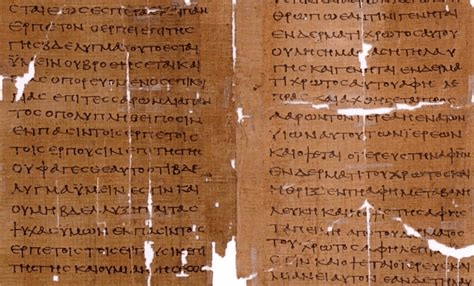
The Greek translation of the Old Testament, now commonly and rather carelessly labeled the Septuagint, is one of the most misrepresented and mythologized documents in biblical studies. The very name “Septuagint” is a historical confusion masquerading as a canonized fact. According to the lore of the Letter of Aristeas, seventy-two translators produced a Greek Pentateuch in seventy-two days. That story applies only to the Pentateuch, and even that legend is a fiction. Yet the name Septuagint was later pasted wholesale onto an ever-expanding assortment of Greek translations of varying quality, produced over a century and a half, often by anonymous hands of dubious ability. In other words, the label “LXX” is not history; it is marketing. It hides the reality that the so-called Septuagint is not a unified translation at all, but a patchwork quilt of inconsistent, frequently sloppy Greek renderings.
The corruption of the Greek text is not the complaint of a partisan defender of the Hebrew. It is admitted, almost with embarrassment, by mainstream scholarship. The International Standard Bible Encyclopedia documents this with dispassionate clarity: “The task of reconstructing the oldest text is still unaccomplished.” A major section of Jeremiah and Baruch “was incompetent,” exhibiting “flagrant examples” of translators choosing Greek words simply because they sounded like Hebrew words they did not understand. Some sections contain “free paraphrases” and “legendary additions.” If any other translation in Church history bore this level of acknowledged corruption, scholars would dismiss it outright. Yet the LXX continues to be treated with a mystical reverence wholly out of proportion to its origins.
The irony cannot be overstated. The same scholars who recoil at the suggestion that God might providentially preserve His Word through the traditional Hebrew text, or through the King James Bible that shaped the English-speaking Church for four centuries, are often the first to promote the LXX as if its very existence were a theological event. Versions, we are told, cannot be authoritative, except, apparently, when we are speaking of an ancient Greek version known to be corrupt. In light of these acknowledged textual deficiencies, the widespread confidence placed in the LXX is surprising. Some treat the Greek Old Testament as if its existence were providentially assured or even divinely sanctioned. Yet to claim such a status for the LXX, while denying the same to the Hebrew Scriptures or even to the English translations that carefully follow them, is inconsistent. Both the LXX and the King James Version are versions, translations from a source text. Yet those who would never elevate an English translation above the Hebrew often exhibit little hesitation in elevating the Greek Old Testament above the Hebrew from which it was derived. Roman Catholic apologists have long argued the priority of ancient versions (Greek and Latin) over the Hebrew; some modern defenders of the LXX adopt a similar posture. But such a position is at odds with the Reformation principle that versions derive their authority from the original-language texts, not the other way around. The Roman Church has long argued for the superiority of versions (Greek and Latin) over the Hebrew; now certain modern defenders of the LXX, functioning as Old Testament Ruckmanites, repeat the same error. If one were to claim for the King James Version what some claim for the LXX, outrage would follow. Yet the Greek translation, with all its documented blunders, is somehow permitted to sit in judgment over the inspired Hebrew text.
The Letter of Aristeas presents the translators of the LXX-Pentateuch as if they were prophets, each producing identical translations without collaboration. Philo heightens the myth, describing the translators as speaking “as though some unseen prompter were at their ears,” producing a miraculously uniform Greek text. If Philo meant what he said, then the LXX as he imagined it is not a translation but an act of possession, hardly the kind of miracle Christians should defend. And yet almost no modern scholar accepts the authenticity of Aristeas, nor does the surviving Greek text remotely resemble a miraculously uniform production. The truth is simpler and far less flattering: the LXX is a very human document, marked by the fallibility, ignorance, and inconsistency of its translators.
The mythology surrounding the LXX collapses when one asks a straightforward question: Where is the authoritative Septuagint text? The answer is equally straightforward: no such text exists. There is no universally accepted standard LXX. Textual critics are still attempting, after two millennia, to reconstruct what the “original” Greek might have been. The reason they cannot is because the “original” was never a unified work to begin with. Anyone who champions the LXX over the Hebrew must therefore admit that they have placed their confidence not in a single, divinely preserved text, but in an amorphous, ever-shifting reconstruction of a collection of inconsistent Greek translations.
The Reformation understood the danger of elevating versions above the inspired originals. Francis Turretin summarized the classical doctrine succinctly: “For no version has anything important which the Hebrew or Greek source does not have more fully, since in the sources not only the matter and sentences, but even the very words were directly dictated by the Holy Spirit.” Elenctic Theology, 125. Turretin’s position is devastating to LXX-prioritism: no translation, Greek or English, can surpass the authority of the original-language Scriptures. And if translations must be judged by the quality of their work, the LXX fails spectacularly. The Hebrew stands, and the Greek translation, valuable as a historical witness, yes, but a witness riddled with errors, cannot be elevated to a standard it never possessed.
 Standard Sacred Text.com
I agree, Dr. Van Kleeck, th
LikeLike
Just a question, has anyone ever seen the letter of Aristeas??? looks like it has as much historical background as satan claws a.k.a. santa claus.
LikeLike
Yes Richard. An English translation of the Letter of Aristeas is available on line. Blessings! Merry Christmas!
LikeLike