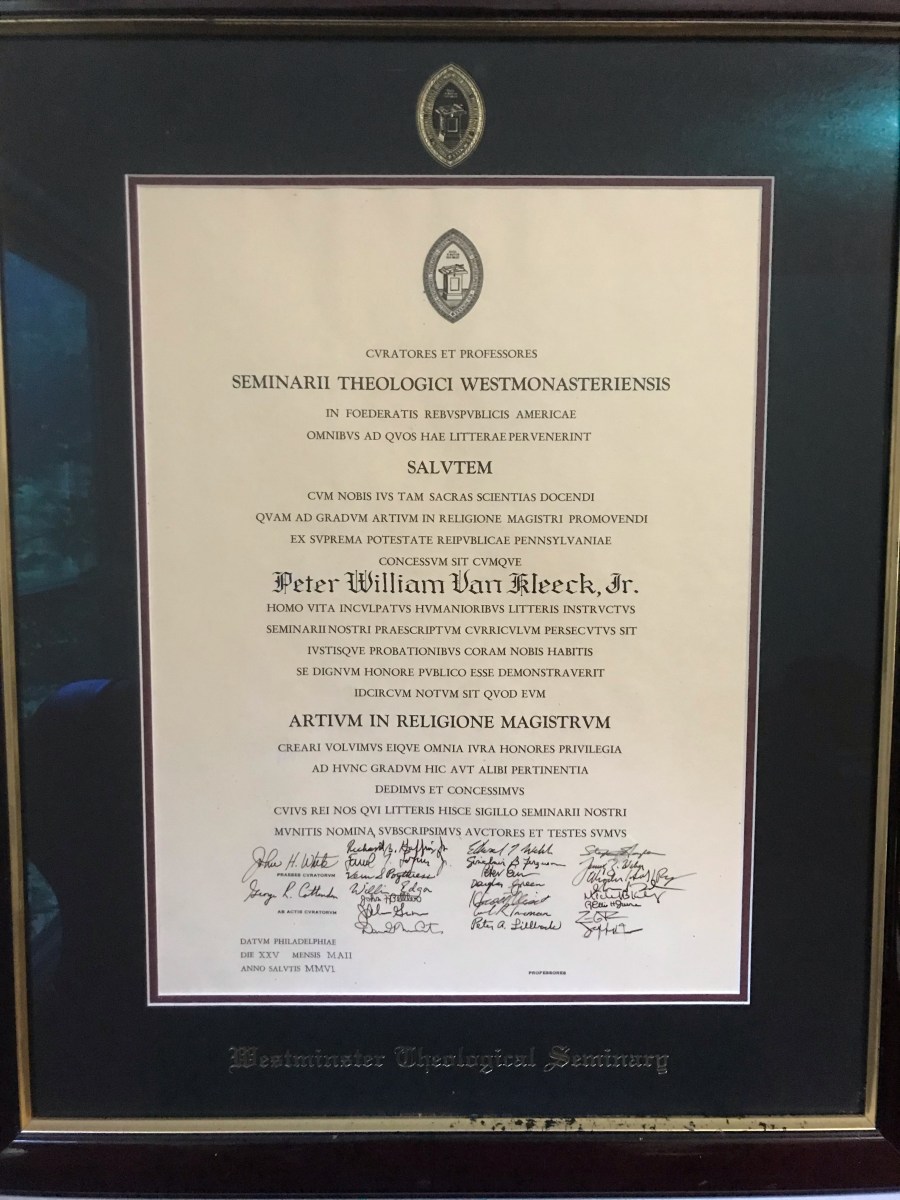
The above picture is my Westminster Theological Seminary diploma for a Master of Arts in Religion. It is easily my favorite diploma. My Calvin Theological Seminary looks like a standard high school/college diploma and while my PhD diploma is just as large as my Westminster one, it is not in Latin.
Though I have come to know certain Latin words and phrases over the years I’ve never learned the Latin language. I could translate very little if any of this diploma apart from my name and the name of my school. I could also identify most of my professor’s signatures there at the bottom. Touching the rest of the words I find them unintelligible for the most part and yet I simultaneously find my diploma an object of my own personal edification.
How is this possible if edification REQUIRES intelligibility?
It is feasible, indeed it is a reality that the above document edifies me though I do not understand it – I find it unintelligible – for the following reasons:
1.) When I received the diploma it was translated for my graduating class and me by someone who does indeed know Latin so I trust his translation even though the Latin is to unintelligible me even to this day.
2.) It is not necessary that I understand Latin to know that this document represents the completion of my work at Westminster (East) because of what it is…a diploma with my name on it.
3.) What I do understand (i.e., my name, the name of my school, and the signatures of my professors) edifies me even though the vast majority of the document is unintelligible to me. I remember going to that school, studying with those men, and completing my work there.
4.) Though I find my diploma mostly unintelligible, I still find it beautiful. I have an affection for it.
In the very same manner, the King James Version can edify the illiterate, the 8-year-old bus kid, the pastor, and the Ph.D. student in the following ways:
1.) When the illiterate and the 8-year-old bus kid have the word read and expounded in their ear by someone who understands the Bible and the English language they come to trust the Spirit of God who speaks through the reading of the Word and are thereby edified though they find the Bible largely unintelligible apart from a teacher.
2.) Because of #1, the illiterate and the 8-year-old bus kid can come to know the KJV under their arm is the word of God though they may find much of it unintelligible. In other words, they are edified that God has given His Word to them and that they hold it in their hand though when they read it they find most of it unintelligible.
3.) What the illiterate and the 8-year-old bus kid do understand edifies them even though the vast majority of the document may remain unintelligible to them. Perhaps they have memorized the Romans Road, John 3:16, or Psalm 23. What they do understand of those passages will indeed edify them though they may not understand fully words like halt, meat, justification, and reconciliation.
4.) The illiterate and the 8-year-old bus kid may find most of his King James Bible to be unintelligible but he may still find it beautiful, he may have an affection for it. It was the Bible he won in VBS or was the Bible given to him by his mother or his Sunday School teacher. It is equally feasible that he has come to love the Bible that he knows to be God’s Word even though he does not understand God’s Word. We love God even though we find many of His ways unintelligible. Why would things be any different with His words? And is not our love for God and His word edifying? Does it not build us up?
In sum, it seems rather plain that edification does not require intelligibility. In fact, as we have seen, a document can be nearly unintelligible and yet can still be edifying in a host of ways.
And just to be clear, simply because I find the Latin in my diploma to be unintelligible does not mean I am going to do away with my diploma and find another. In like manner, simply because certain English words or phrases in the King James Bible are unintelligible to certain readers doesn’t mean the KJV should be tossed for a newer and “better” model.
Unfortunately, Ward’s bumper sticker theology on this point is part of a long list of gaffes and theological missteps starting with his half-baked argument for “false friends” and his backing out of a debate with yours truly. Then there is that lopsided dumpster fire that is the Textual Confidence Collective – Season 1 and the largely irrelevant IFB recovery group sessions aka the Textual Confidence Collective – Season 2. Finally, we have this bumper sticker slogan, “Edification Requires Intelligibility” coupled with a blundering use of I Corinthians 14. Still, I do give Ward points for creativity and effort though the fruits of which bear little resemblance to the good, the true, and the beautiful.
 Standard Sacred Text.com
This is a poor argument as a diploma represents the culmination of hard work and opens doors in a way that is not true of the KJV. Further, if understanding doesn’t matter, the KJV STILL wouldn’t be used as people can just look at pictures of the manuscripts themselves. That you didn’t suggest this shows you don’t even believe your own argument
LikeLike
Thank you for the comment, Kenneth. It seems to me that the KJV does represent the culmination of hard work and has opened doors. It is the culmination of hard work in that translations are difficult to make in general, but the KJV is a masterpiece of English literature created by the greatest minds of its time. Hence, it represents the culmination of hard work. The KJV opens doors because it is God’s word in English. So the KJV translation is by very definition a thing that opens doors for English speaking and reading people.
My claim was not that “understanding does not matter” but that it is not necessary that one understand all of the words of a document to be edified by that document.
To borrow a bit from your own words, that you made these claims shows that you don’t even understand my argument.
LikeLike