Series 2, Lecture 6: Matthew 5:18 — Christ’s Hyperbole or Christ’s Indicative (Technical Difficulties)

For the saints who join for the Tuesday night lecture series I want to express my sincerest apologies, especially to those who regularly join with us, for not being able to overcome technical difficulties that sometimes plague on-line meetings. It was almost 8:00 pm before the issue was resolved.

I am going to save the Matthew 5:18 lecture until next Tuesday evening 3/7 at 7:30pm.

God bless and keep you all.

Peter, Sr.
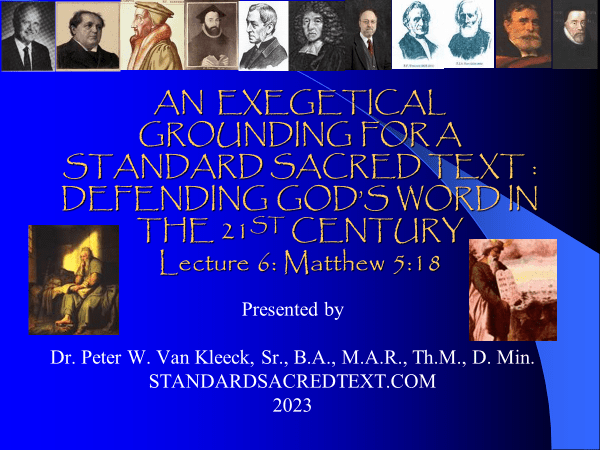
Series 2, Lecture 6: Matthew 5:18 — Christ’s Hyperbole or Christ’s Indicative

Tomorrow night, 2/28 at 7:30pm EST we hold the sixth lecture of a 10-week series on the Biblical basis for the theology we call the Providential Preservation of Scripture. Lecture 6 considers the words of Jesus during the Sermon on the Mount and specifically Matthew 5:18. Jesus’ teaching methods were simple; his lessons straight forward and easy for the common man to grasp. This simplicity corresponds with his “ordinary” or “intuitive” approach to the Scripture, a hermeneutic that resonated with the Jewish believers. His words and the Old Testament complemented one and other in that their subject and object was Jesus. The Old Testament was not an obstacle to the Jews that required Pharisaical comment to understand but was simply the message of Jesus written hundreds of years before. Nowhere in the Scripture does the message of Jesus cause doubt or question the cohesive relationship between the Scripture and Himself. Rather, as part of His Messianic ministry Jesus speaks of the authority and preservation of the text as a witness to who He is. Did those on the mount believe Jesus was exaggerating for effect, didn’t really mean jot and tittle, and was utilizing a common literary device, oriental hyperbole — or was he promising the preservation of the smallest elements of the Scripture? Don’t miss this important study of the ramification and significance of the preserved word in Matthew 5:18 as a promise of Jesus tomorrow tonight, 2/28, 7:30 EST.

Series 2, Lecture 5: Isaiah 59:21 and God’s sovereign plan driving redemptive history to eschatological consummation

Tomorrow night, 2/21 at 7:30pm EST we hold the fifth lecture of a 10-week series on the Biblical basis for the theology we call the Providential Preservation of Scripture. Lecture 5 considers the pivotal role the promises of Isaiah 59:21 are to the unfolding of God’s comprehensive redemptive plan and as an intricate element of the historically telescopic nature of the Abrahamic Covenant of Genesis 12:1-3. Don’t miss this important study of the ramification and significance of the preserved word in Isaiah 59:21 as an essential element of God’s salvific plan tomorrow tonight, 2/21, 7:30 EST.

Series 2, Lecture 4: Psalm 119:89 and a “Predestined Bible”

Tonight, 2/14 at 7:30pm EST we hold the fourth lecture of a 10-week series on the Biblical basis for the theology we call the Providential Preservation of Scripture. Lecture 4 considers the ramifications of Psalm 119:89 and God’s word being forever settled in heaven. Don’t miss the discussion of Psalm 1119:89 to the doctrine of providential preservation tonight, 2/14, 7:30 EST.

An Exegetical Grounding: Episode 3 – Psalm 12:6-7

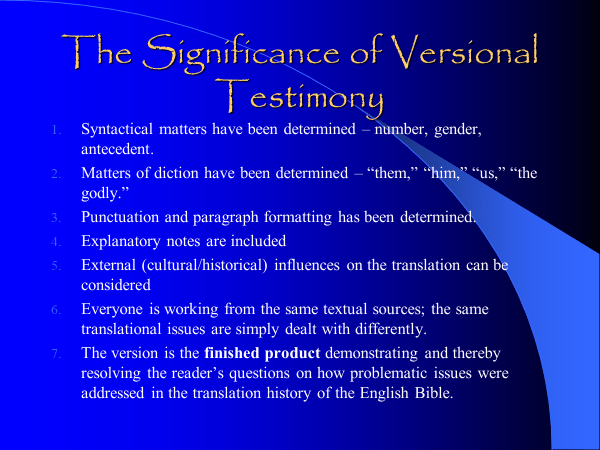
Lecture 3 is part 2 of a study on that much maligned portion of Scripture found in Psalm 12:6-7, the passage we were informed of by Dr. Ward et al, does not teach Scripture’s providential preservation. Indeed, according to contemporary evangelical scholarship no one can find a single scholar who argues that this passage teaches Scripture’s providential preservation. Last week we examined syntactical issues of Hebrew gender and number discontinuity. In this episode we discuss the translational testimony regarding Psalm 12:6-7.

Series 2, Lecture 3: Does Psalm 12:6-7 teach Scripture’s Providential Preservation considered throughout the Reformation Era English Bible Tradition.

Tomorrow evening 2/7 at 7:30pm EST we hold the third lecture of a 10-week series on the Biblical basis for the theology we call the Providential Preservation of Scripture. Lecture 3 is part 2 of a study on that much maligned portion of Scripture found in Psalm 12:6-7, the passage we were informed of by Dr. Ward et al, does not teach Scripture’s providential preservation. Indeed, according to contemporary evangelical scholarship no one can find a single scholar who argues that this passage teaches Scripture’s providential preservation. Last week we examined syntactical issues of Hebrew gender and number discontinuity. Tomorrow evening, we will consider the testimony of English versions and how this passage was translated. Don’t miss the discussion of Psalm 12 to the doctrine of providential preservation tomorrow evening, 2/7, 7:30 EST.

Series 2, Lecture 2: Does Psalm 12:6-7 teach Scripture’s Providential Preservation considered syntactically and historically

Tomorrow evening 1/31 at 7:30pm EST we hold the second lecture of a 10-week series on the Biblical basis for the theology we call the Providential Preservation of Scripture. Lecture 2 deals with that much maligned portion of Scripture found in Psalm 12:6-7, the passage we were informed of by Dr. Ward does not teach Scripture’s providential preservation. Indeed, he can find no one who argues that this passage teaches Scripture’s providential preservation, but then his research missed Jerome, Luther, Ayguan, Medieval Hebrew Scholars, Poole and Wesley to name a few. We will also examine syntactical issues of Hebrew gender and number discontinuity within the passage. Don’t miss the discussion of this important passage from Psalm 12 to the doctrine of providential preservation tomorrow evening, 1/31, 7:30 EST.

An Exegetical Grounding : Episode 1 – An Introduction

For the Church to possess such a doctrine there must be a sound exegetical grounding for this element of Systematic Theology and specifically, the Doctrine of Scripture or Bibliology. Since the mid-19th century what was once a robust element of Orthodox Theological formulation and grounding has dwindled even among advocates of the TR and KJV. If Christian theology and apologetics are ever again to meet the challenges of transcendentless, radically historical, solely empirical arguments, it must return to its exegetical roots. This series lays the groundwork for Volume 3, Theological Grounding, and a traditionally cohesive, timely formulation of the Doctrine of Scripture’s Providential Preservation.