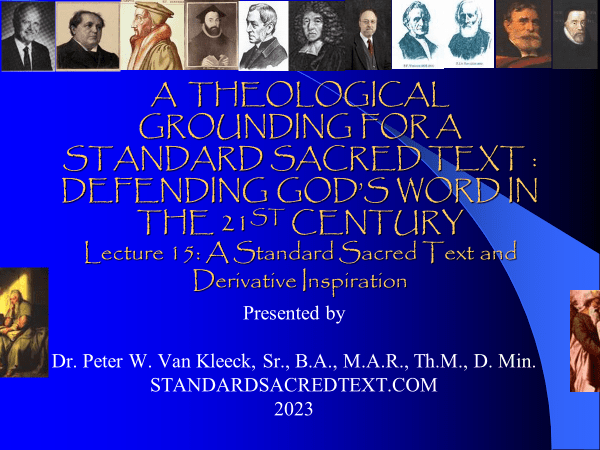
In our last lecture we discussed the work of Jonathan Edwards and the experiencing the words of God. Tonight, 11/28/2023, we are going to discuss what the Bible says about itself in terms of the Christian’s experience of Scripture. For the rest of the time we will deal with four potential defeaters to our argument for a philosophical ground for a standard sacred text.
There will be no class this coming Tuesday, 11/21/23 due to the Thanksgiving holiday. Lord willing we will meet next week, Tuesday 11/28/23. We will look briefly at the biblical language of experiencing the Bible and then we will turn to a treatment of potential defeaters to the philosophical grounding for a standard sacred text. If you have any questions you can place your question in the comments below this post.
There will be no class this coming Tuesday, 11/14/23. My family and I will be attending an event at our church on that night. Lord willing, we will resume the following Tuesday, 11/21/23. If you have any questions you can place your question in the comments below this post.
In our last two lectures we discussed the difference between propositional belief and properly basic belief. Tonight, 11/07/2023, we are going to discuss the interrelation of belief and experience. What kind of thing do we really, truly, and unmistakably experience when we read and believe God’s word? Is that experience veridical? Is it trustworthy?
In our last two lectures we discussed belief in the Bible as rational and warranted. In other words we dealt with what kind of belief our belief in the Bible is. Tonight, 10/31/2023, we are going to discuss how we believe. Do we believe the Bible based on a series of compounding arguments and reach a conclusion? Perhaps. Do we believe the Bible in a more immediate way, as if the Bible is a testimony from someone with whom you have little to no reason to doubt? What if this were the case? Are there any other beliefs we hold in similar ways? Click the link below and jump on with us tonight and join the discussion.
Last week we discussed Alvin Plantinga’s 5 criteria for warranted and rational belief: properly functioning faculties, in an environment conducive to those faculties, according to a design plan, aimed at truth, and successfully so aimed. Tonight, October 24th, 2023, we are going to apply those criteria to Christian beliefs as well as discuss the nature of de facto and de jure objections to our argument thus far.
What do you believe? How do you know your belief is a good one? Is there something about belief in your Bible that makes said belief special?
Tonight, October 17th, 2023, we are going to discuss the elements that make a belief true, justified, warranted, and rational. To do this we are going to explore Alvin Plantinga’s five criteria for warranted and rational belief: properly functioning faculties, in an environment conducive to those faculties, according to a design plan, aimed at truth, and successfully so aimed.
These things and much more will be discussed tonight. See you there.
Have you ever believed something that simply wasn’t what you believed?
“It Ain’t What You Don’t Know That Gets You Into Trouble. It’s What You Know for Sure That Just Ain’t So.”
– Anonymous
Tonight, October 10th, 2023, we are going to discuss wrong beliefs made right and more particularly how those beliefs are made right. How does one go from a Muslim, to a believer in Christ? How does one believe the world came about by time and chance to believing the Triune God created and upholds all things by the word of His power?
And what does it mean when a person changes their belief from error to truth? What does it mean for the person? Has the person changed? If so, how and in what ways? What does it mean for a person whose belief changes from truth to error? Has the person changed? If so, how and in what ways?
These things and much more will be discussed tonight. See you there.
Due to satellite issues, last Tuesday’s lecture was interrupted and moved to 9/19. Tomorrow night 9/19 at 7:30 we will hold the fifteenth lecture of series on “A Theological Grounding for a Standard Sacred Text –Derivative Inspiration
Turretin’s introductory statement is followed by three supporting arguments:
It is one thing to be an interpreter, quite another to be a prophet…The prophet as God-inspired (theopneustos) cannot err, but an interpreter as a man lacks no human quality since he is always liable to err.
All versions are streams; the original text is the fountain whence they flow. The latter is the rule, the former the thing ruled, having only human authority.[1]
Turretin’s first argument lay the groundwork for the complete paradigm by dividing inspiration into two categories: the inspiration of the “matter and sentences” res et sententiae, and the inspiration of the “very words” which he says was “dictated (dictiae) by the Holy Spirit.”
Res et sententiae means “according to the things or issues signified by the sentence or meaning.” In other words, the Holy Spirit inspired the meaning of the sentence. As Zacharias Ursinus wrote, “Now when we name the holy Scripture, we mean not so much the characters of the letters and volumes, but rather the sentences which are contained in them, which they shall never be able to prove to be of less antiquitie than the Church.”[2] Not only the meaning, or the substance of the sentence is inspired but the “very words” or the shape of the Greek and Hebrew words were dictated by the Holy Spirit. Both the form, outward appearance, and the meaning, what the word meant was inspired by the Holy Spirit. After changing the linguistic form, translation can only possess res et sententiae, or the meaning of the sentence.
Secondly, he makes a distinction between the “prophet” or the holy men that were moved by the Holy Spirit, and the interpreter of the apographa. The “prophet” could not err because his message was inspired, where the interpreter of the inspired message “is always liable to err.” Translating a version, unlike the Original, has intrinsic liabilities due to the human element.
And thirdly, in his comparison of the apographa with a version, the apographa is the source, or “fountain” while the translation is the “stream” or completely dependent upon the source for its existence. The apographa is the rule, standard, or canon that governs or “rules” the translation. The inspired source, the apographa, is authoritas because God is the Author, the thing ruled, the translation, relative to the apographa possesses only human authority.
“Nevertheless,” Turretin continues, “all authority must not be denied to versions.”[1] It is here that he builds upon his earlier argument distinguishing
a twofold divine authority: one of things (res), the other of words (verba). The former relates to the substance of the doctrine which constitutes the internal form of the Scriptures. The latter relates to the accident of writing, the external and accidental form. The source has both, being God-inspired (theopneustos) both as to the words and things; but versions have only the first, being expressed in human not in divine words.”[2]
With the writing of a version and the change of linguistic symbols, a trustworthy translation can be considered infallible only as regards the formal, inward authority of the translation- as to its substantia doctrinae, quaod res or what the words and sentences mean. “Hence it follows, Turretin continues,
that the versions as such are not authentic and canonical in themselves (because of human labor and talent). Therefore, under this relation (schesei), they may be exposed to errors and admit of corrections, but nevertheless are authentic as to the doctrine they contain (which is divine and infallible). Thus, they do not, as such, formally (formaliter– in regard to the writing and transmission) support divine faith as to the words, but materially (materialiter– with regard to the teaching transmitted) as to the substance of doctrine expressed in them.[3]
Translating exposes the version to errors. Nonetheless, a version can be “authentic as to the doctrine it contains (which is both divine and infallible). This derived authenticity in the version’s doctrinal substance supports divine faith.
[2] Zacharias Ursinus, The Sum of the Christian Religion: Wherein are debated and resolved the Questions of whatsoever points of moment, which have been or are controversed in Divinity. Translated into English by Henry Parrie, out of the last and best Latin Editions (Oxford: Printed at Joseph Barnes and are to be sold in Pauls Churchyard at the sign of the Tigers head, 1587), 16.
Don’t miss this important study of Derivative Inspiration for Christian theology, ecclesiology, and personal edification, Tuesday 9/19 at 7:30pm.
Tonight 9/12 at 7:30 we will hold the fifteenth lecture of series on “A Theological Grounding for a Standard Sacred Text –Derivative Inspiration
Turretin’s introductory statement is followed by three supporting arguments:
It is one thing to be an interpreter, quite another to be a prophet…The prophet as God-inspired (theopneustos) cannot err, but an interpreter as a man lacks no human quality since he is always liable to err.
All versions are streams; the original text is the fountain whence they flow. The latter is the rule, the former the thing ruled, having only human authority.[1]
Turretin’s first argument lay the groundwork for the complete paradigm by dividing inspiration into two categories: the inspiration of the “matter and sentences” res et sententiae, and the inspiration of the “very words” which he says was “dictated (dictiae) by the Holy Spirit.”
Res et sententiae means “according to the things or issues signified by the sentence or meaning.” In other words, the Holy Spirit inspired the meaning of the sentence. As Zacharias Ursinus wrote, “Now when we name the holy Scripture, we mean not so much the characters of the letters and volumes, but rather the sentences which are contained in them, which they shall never be able to prove to be of less antiquitie than the Church.”[2] Not only the meaning, or the substance of the sentence is inspired but the “very words” or the shape of the Greek and Hebrew words were dictated by the Holy Spirit. Both the form, outward appearance, and the meaning, what the word meant was inspired by the Holy Spirit. After changing the linguistic form, translation can only possess res et sententiae, or the meaning of the sentence.
Secondly, he makes a distinction between the “prophet” or the holy men that were moved by the Holy Spirit, and the interpreter of the apographa. The “prophet” could not err because his message was inspired, where the interpreter of the inspired message “is always liable to err.” Translating a version, unlike the Original, has intrinsic liabilities due to the human element.
And thirdly, in his comparison of the apographa with a version, the apographa is the source, or “fountain” while the translation is the “stream” or completely dependent upon the source for its existence. The apographa is the rule, standard, or canon that governs or “rules” the translation. The inspired source, the apographa, is authoritas because God is the Author, the thing ruled, the translation, relative to the apographa possesses only human authority.
“Nevertheless,” Turretin continues, “all authority must not be denied to versions.”[1] It is here that he builds upon his earlier argument distinguishing
a twofold divine authority: one of things (res), the other of words (verba). The former relates to the substance of the doctrine which constitutes the internal form of the Scriptures. The latter relates to the accident of writing, the external and accidental form. The source has both, being God-inspired (theopneustos) both as to the words and things; but versions have only the first, being expressed in human not in divine words.”[2]
With the writing of a version and the change of linguistic symbols, a trustworthy translation can be considered infallible only as regards the formal, inward authority of the translation- as to its substantia doctrinae, quaod res or what the words and sentences mean. “Hence it follows, Turretin continues,
that the versions as such are not authentic and canonical in themselves (because of human labor and talent). Therefore, under this relation (schesei), they may be exposed to errors and admit of corrections, but nevertheless are authentic as to the doctrine they contain (which is divine and infallible). Thus, they do not, as such, formally (formaliter– in regard to the writing and transmission) support divine faith as to the words, but materially (materialiter– with regard to the teaching transmitted) as to the substance of doctrine expressed in them.[3]
Translating exposes the version to errors. Nonetheless, a version can be “authentic as to the doctrine it contains (which is both divine and infallible). This derived authenticity in the version’s doctrinal substance supports divine faith.
[2] Zacharias Ursinus, The Sum of the Christian Religion: Wherein are debated and resolved the Questions of whatsoever points of moment, which have been or are controversed in Divinity. Translated into English by Henry Parrie, out of the last and best Latin Editions (Oxford: Printed at Joseph Barnes and are to be sold in Pauls Churchyard at the sign of the Tigers head, 1587), 16.
Don’t miss this important study of Derivative Inspiration for Christian theology, ecclesiology, and personal edification, Tuesday 9/12 at 7:30pm.