It was excellent! There were between 50 and 60 people in attendance. The plenary speakers did a splendid job laying the groundwork for the value and scope of the Septuagint so much so that I found myself better appreciating the LXX as an ancient resource. In like manner, I also came to better appreciate its limitations as both a scholarly work as well as an authoritative work in the task of translating the OT. The conference was indeed academic in that strove to identify and explicate the good and the bad, the strengths and the weaknesses of the Septuagint.
Perhaps the greatest element of the entire conference was the fact that this conference was a gathering of like-minded individuals on the topic of the text and translation without all of us being of the same mind on every other theological issue.
That is to say, even given our disparate positions we could all agree that with the right Bible comes the right theological path, a place where disparate positions are reconciled through the Word and Spirit by faith.
If you missed it, you missed a great time of fellowship and encouragement. There was talk of waiting until 2026 to have such a gathering again. I say, No. I say, spread the word and see you all next year.
Over the weekend I had the opportunity to debate the above question. Thanks again to Nick and Francis. Overall, I enjoyed the experience. There certainly is an opportunity to improve but I was pleased with the number of ideas articulated. I was particularly happy with the fact that my interlocutor tried to meet my arguments which allowed me to lay further ground and advance ideas with greater detail than in prior opportunities. Lord willing, Dr’s Van Kleeck with make an assessment of the debate, and offer some critiques as well as clarification and places for improvement. If you didn’t get the chance to watch we invite your observations and comments as you have time to watch.
On a separate note, if there is anyone out there who would like to engage us on the topics of the TR and KJV, whether in discussion or debate, we are available. All you need to do is comment here or on any of our blogposts and we will be notified of your message.
“Now the God of peace, that brought again from the dead our Lord Jesus, that great shepherd of the sheep, through the blood of the everlasting covenant, Make you perfect in every good work to do his will, working in you that which is well-pleasing in his sight, through Jesus Christ; to whom be glory for ever and ever. Amen.”
But the resurrection manifested his glory as the prince of life and conqueror of death and confirmed that the blood is the seal of the covenant that is eternal and that by this single offering of himself “he has perfected for all time those who are sanctified,” (10:14).[1]
The bloody death of the immutable Savior, Jesus Christ, (Hebrews 13:8) secured the everlasting, immutable covenant, the grounds for the eternal life of the saint sealed by the resurrection. The single means of revealing such otherworldly truths to the Church in writing, namely eternality, and immutability, is through a word that can never change or pass away.
Modern critics demands that the Church explain the origin, content, and meaning of “everlasting covenant” without Scripture, and do this in real time across generations. This impossible ecclesiastical and academic pressure is the impossibility the purveyors of post-critical thought have imposed upon the Church. Now manipulating and therefore corrupting the text of Scripture, the corrupters expect the Church to speak of an immutable and everlasting covenant while holding to an ever-changing, temporal document.
Make you perfect — καταρτίσαι ὑμᾶς
The “everlasting covenant” performs an eschatologically oriented work in the believer’s life of “making perfect.” Here, katartisai means to make fully ready; to put in full order; to make complete. The meaning here is that God would progressively, fully endow the saints with whatever grace was necessary to do his will and good works. This necessarily implies that the everlasting covenant serves a future, transgenerational purpose of sanctification in the Church. That is, the “everlasting covenant” is forward looking, in the same natural way birth is forward looking to physical maturity and rudimentary things of the gospel are foundational for more systemic truths.
Note that a mutable, temporal “covenant” fails the Church on multiple levels. First, mutability resists future spiritual growth by casting doubt upon the certainty of the sanctifying trajectory, or the words of Scripture. Much of the Church is no longer certain about what God expects from them or how spiritual growth manifests itself because the mutable scripture only serves the epoch of time in which it is empirically relevant. Second, because the mutable covenant is temporal, the transmission of the same covenant across generations has dismally failed, resulting in the transmission of contradictions.
Working in you — ποιῶν ἐν ὑμῖν
Here, this “doing” on the part of the believer is “through Jesus Christ.” Barnes notes “The idea is, that God does not directly, and by his own immediate agency, convert and sanctify the heart, but it is through the gospel of Christ, and all good influences on the soul must be expected through the Saviour.”[2] It is through the message of the everlasting covenant that doing things “well pleasing in his sight” is accomplished. That is Christ, and His word, are not separable; they cannot be sequestered, bifurcated, or broken, John 10:35. Christ, through his word does this eschatologically oriented, sanctifying work in the life of the believer, which says that the eternal God’s eternal word, will have eternal efficacy in the life of the Church culminating finally in permanent glorification. Novel versions miserably fail one necessary component of the dynamic which drives redemptive history to eschatological consummation, that is the everlasting word in the mouth of the covenant keeper, Isa, 59:21.
To whom be glory for ever and ever — ᾧ ἡ δόξα εἰς τοὺς αἰῶνας τῶν αἰώνων
And finally, eternal glory is ascribed to Jesus Christ as the resurrected Lord who sealed the everlasting covenant in his bodily resurrection from the dead. If the eternal covenant is mutable and temporal, the glorification of the Lord is impossible – the Church has only a glimmer maintained by ecclesiastical tradition of the purpose of this glorification. And it is here, that novel versions demonstrate profound evil. If Christ is not glorified, this void is being filled with something else to worship, Romans 1:21f. Because man is fundamentally a religious creature, he will create his own godless religion and give it some sweet and precious name.
Incremental ruin is tough to nail down because those living through it can always find vestiges of the old paths to ameliorate those that sound the alarm. But considered over generations, the case for spiritual deterioration is easier to build.
We should first remember that Dr. Ward is not a scholar in the traditional sense of doing high level research probing for yet undeveloped or underdeveloped truth. His “false friends” idea was neither original nor did it contribute to the literature on the King James Bible. It was rather the tract of a propogandist looking for an endorsement and congratulations from his managers. Dr. Ward suspended belief in the inherent authority of Scripture, acquiesced, and finally fully swallowed the propaganda that party orthodoxy is always true even when it is proven to be false by traditional scholarly research. Part of this falls to the manipulation of professors who students naturally feel that their teachers are there to help them (a terribly flawed and harmful submission) and part of this falls to the failure of Dr. Ward to challenge the status quo (which should be the intention of every post-graduate student). Rather, he is an erudite zealot driven by a secular ideology which, since the end of the 19th century, has become party orthodoxy for most of evangelical and reformed institutions of higher learning. Party orthodoxy means that the ideology for which he is a prominent spokesperson must remain the standard for what is true no matter what sound research to the contrary might discover. No amount of pre-critical research, no matter how historically, ecclesiastically, exegetically or theologically grounded can be allowed to usurp the preeminent position of the critical contradictions prevarications, which over the past 150 years have been uttered countless times, i.e., “I hold in my hand the inerrant word of God,” and “stand for the reading of God’s holy word,” while questioning the authority of the text based on the textual apparatus, because the text can be “better rendered” based on recent findings. Party orthodoxy affirms theologically, that the Scripture is God’s word, what is denied to the Scripture textually, that the Scripture is God’s word, rejecting any passage that may refer to Scripture’s self-attesting authority making Scripture a wholly phenomenalistic, empirical document. No passage exists in the Scripture for providential preservation because party orthodoxy says no such authority to make this claim exists.
Dr. Ward is under no compulsion to reverse himself in Psalm 12:6-7 because he cannot apostatize from this secular ideology without being ostracized by the party and be at the risk of losing not only his standing in the party but losing his job. The academic and financial threat of following historically sound research and not party propaganda is real. In truth, challenging party orthodoxy will result in putting your course grades at risk. This assessment is from personal experience and is anecdotal and must always remain so. College professors, violating their own consciences and compromising their academic and scholarly credibility, remain silent because of the control party orthodoxy holds over institutions of higher learning. Dr. Ward’s allegiance is not to scholarly research and the publication of unvarnished Ph.D. level research. Rather, he has sworn allegiance to maintaining the party’s status quo bifurcation of what Scripture is, the very preserve, inspired words of God, and, what it tells us about God. After all, he might argue, Scripture doesn’t have to be the word of God to tell us true things about God. It doesn’t have to possess transcendent qualities like inspiration or infallibility, or purity, or immutability, to tell us about a pure, immutable God. For Mark Ward, a corrupt, anthropologically grounded Scripture is at the core of party orthodoxy and Dr. Ward is the next generation propogandist for advance this abomination to historic, orthodox, ecclesiastical, theological formulation.
Because party orthodoxy is beyond questioning, no retractions for past publications since proven to be factually incorrect will ever be made because all contrary findings are marginalized and demonized. The party, bolstered by the information dominance of publishers constantly repeating old and worn-out pejorative slogans slavishly echoed by pastors and individuals would rather be liked than challenge the critical status quo. Think about it, what interloculars say and write today sounds like they’re stuck in the 1970’s, see James White. Institutions of higher learning keep the party members in stale, lock step together. What we are now witnessing is an epoch of the total secularization of Christianity within evangelicalism, a true paradigm shift away from the authority of Scripture to the authority of self-appointed religious bureaucrats, (think Pharisees).
For Dr. Ward and those he represents, truth is what party orthodoxy says it is and party orthodoxy says there are no verses in the Bible that teach providential preservation, therefore, Psalm 12:6-7 does not teach providential preservation. Scholarly research and unbiased findings are not the preeminent goal of zealots of party orthodoxy such as Dr. Ward, because truth for the party is not found preeminently in the person of Jesus Christ, truth is what the party says it is.
So, what do we do. First, our focus must be on the source of the faith, not the various ways we interpret the Scripture. Ecclesiastical, soteriological and eschatological differences between those of us who believe the Bible is the pure word of God must be laid aside so that together our single apologetic and polemic might be upon the preservation of Scripture by God’s singular care and providence.
Secondly, within our sphere of influence whatever that may be, we press the exegetically sound, historic defense of the faith one delivered to the saints with whenever we can and wherever we can. That will require reading and writing and speaking and networking and encouraging one another in the work.
And thirdly, there is a generation of young people for which this is all a new idea, who are open to listening, and who have no allegiance to the status quo. The Bible, speaking for itself, makes more sense to young Christian minds than Dr. Ward ever will. Take time to listen and be prepared to give an answer of why we do what we do. Virgina Tech engineering students make better Bible defenders than seminary grads. Hard science guys that know the Lord don’t have time to put up with Ward’s and White’s feckless, pickwickian quibbling.
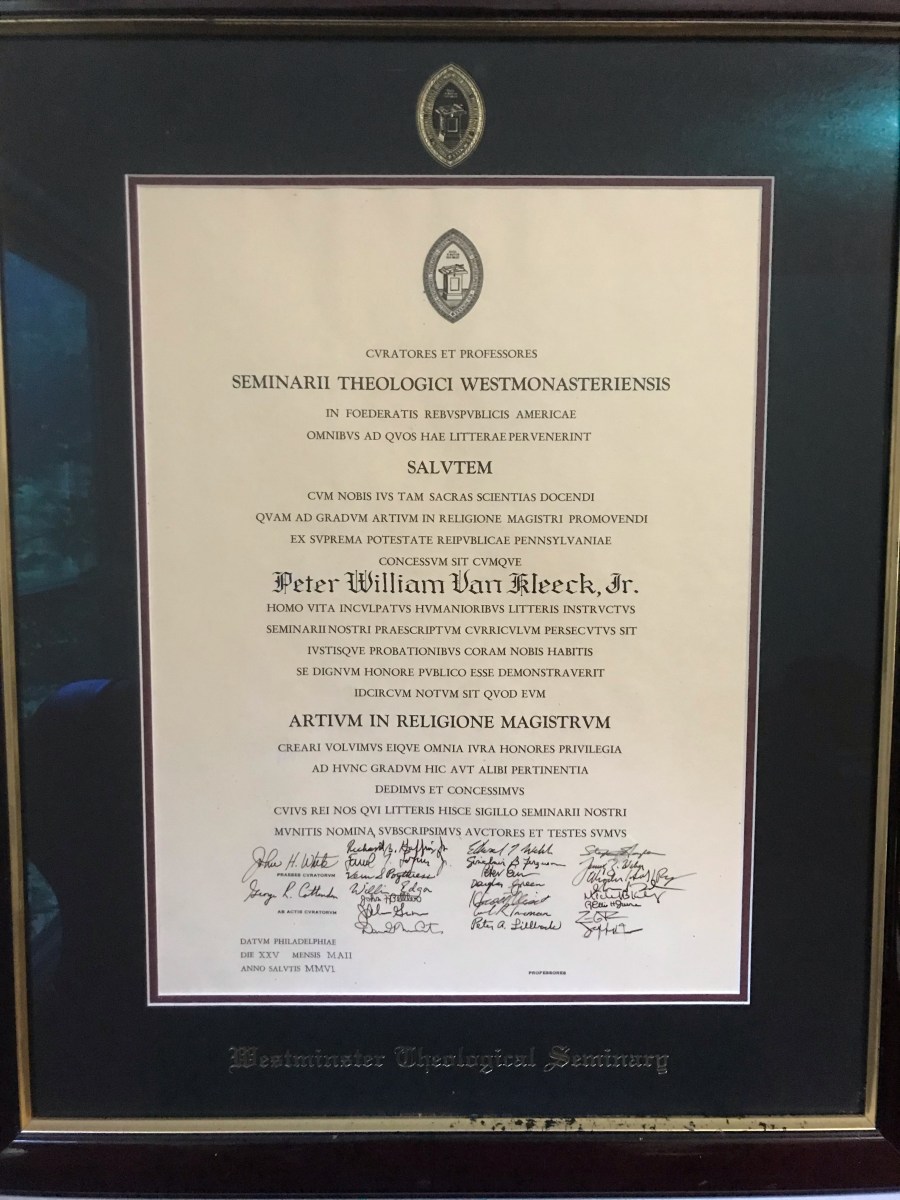
The above picture is my Westminster Theological Seminary diploma for a Master of Arts in Religion. It is easily my favorite diploma. My Calvin Theological Seminary looks like a standard high school/college diploma and while my PhD diploma is just as large as my Westminster one, it is not in Latin.
Though I have come to know certain Latin words and phrases over the years I’ve never learned the Latin language. I could translate very little if any of this diploma apart from my name and the name of my school. I could also identify most of my professor’s signatures there at the bottom. Touching the rest of the words I find them unintelligible for the most part and yet I simultaneously find my diploma an object of my own personal edification.
How is this possible if edification REQUIRES intelligibility?
It is feasible, indeed it is a reality that the above document edifies me though I do not understand it – I find it unintelligible – for the following reasons:
1.) When I received the diploma it was translated for my graduating class and me by someone who does indeed know Latin so I trust his translation even though the Latin is to unintelligible me even to this day. 2.) It is not necessary that I understand Latin to know that this document represents the completion of my work at Westminster (East) because of what it is…a diploma with my name on it. 3.) What I do understand (i.e., my name, the name of my school, and the signatures of my professors) edifies me even though the vast majority of the document is unintelligible to me. I remember going to that school, studying with those men, and completing my work there. 4.) Though I find my diploma mostly unintelligible, I still find it beautiful. I have an affection for it.
In the very same manner, the King James Version can edify the illiterate, the 8-year-old bus kid, the pastor, and the Ph.D. student in the following ways:
1.) When the illiterate and the 8-year-old bus kid have the word read and expounded in their ear by someone who understands the Bible and the English language they come to trust the Spirit of God who speaks through the reading of the Word and are thereby edified though they find the Bible largely unintelligible apart from a teacher. 2.) Because of #1, the illiterate and the 8-year-old bus kid can come to know the KJV under their arm is the word of God though they may find much of it unintelligible. In other words, they are edified that God has given His Word to them and that they hold it in their hand though when they read it they find most of it unintelligible. 3.) What the illiterate and the 8-year-old bus kid do understand edifies them even though the vast majority of the document may remain unintelligible to them. Perhaps they have memorized the Romans Road, John 3:16, or Psalm 23. What they do understand of those passages will indeed edify them though they may not understand fully words like halt, meat, justification, and reconciliation. 4.) The illiterate and the 8-year-old bus kid may find most of his King James Bible to be unintelligible but he may still find it beautiful, he may have an affection for it. It was the Bible he won in VBS or was the Bible given to him by his mother or his Sunday School teacher. It is equally feasible that he has come to love the Bible that he knows to be God’s Word even though he does not understand God’s Word. We love God even though we find many of His ways unintelligible. Why would things be any different with His words? And is not our love for God and His word edifying? Does it not build us up?
In sum, it seems rather plain that edification does not require intelligibility. In fact, as we have seen, a document can be nearly unintelligible and yet can still be edifying in a host of ways.
And just to be clear, simply because I find the Latin in my diploma to be unintelligible does not mean I am going to do away with my diploma and find another. In like manner, simply because certain English words or phrases in the King James Bible are unintelligible to certain readers doesn’t mean the KJV should be tossed for a newer and “better” model.
Unfortunately, Ward’s bumper sticker theology on this point is part of a long list of gaffes and theological missteps starting with his half-baked argument for “false friends” and his backing out of a debate with yours truly. Then there is that lopsided dumpster fire that is the Textual Confidence Collective – Season 1 and the largely irrelevant IFB recovery group sessions aka the Textual Confidence Collective – Season 2. Finally, we have this bumper sticker slogan, “Edification Requires Intelligibility” coupled with a blundering use of I Corinthians 14. Still, I do give Ward points for creativity and effort though the fruits of which bear little resemblance to the good, the true, and the beautiful.
On February 18, 2022, I posted an article entitled “Dr. Mark Ward, Psalm
12:6-7, and the Historic Exegetical Argument for the Providential Preservation
of God’s word.” Now surpassing the two-year anniversary of this response to Dr.
Ward’s opposition to Psalm 12:6-7 teaching the providential preservation of
Scripture, I thought I would follow up on Dr. Ward’s response to the posting. Based
on a shared contact with Ward on his planned response, Ward assured the brother
that his response would be included in a scholarly journal sometime in 2024. Now
June of 2024, with half of the year past, Ward is creating an increased sense
of anticipation by raising expectations for the impending journal article
refuting the pre-critical rendering of Psalm 12:6-7 to teach the providential preservation
of Scripture.
Up until today, Dr. Ward’s method seems to be to throw rhetorical rocks
through the exegetical windows of Psalm 12:6-7 and then run away hoping that
everyone will forget he has offered no rebuttal to the providential
preservation historically taught in the passage. But having raised expectations
of an upcoming journal article, all interested parties patiently wait, anticipating
the Ph.D. will write a robust, scholarly rebuttal to the historic, churchly,
exegetical tradition.
Just by way of reminder, for Dr. Ward and others who deny that any verse of
Scripture teaches providential preservation, for a leader in the evangelical
critical camp to allow this passage to stand without refutation is
significantly problematic. Indeed, allowing the passage to stand unchallenged
compromises an essential part of the critical position by moving Scripture’s
preservation from a solely phenomenal, evidential issue to an exegetically,
theologically grounded matter. Additionally, accepting one passage as grounds
for providential preservation, shifts the critical paradigm away from an
empirical premise to a position driven by prior Christian precommitments and the
probability of other supporting passages. Dr. Ward’s delay, if not culminating
in a robust refutation of Psalm 12:6-7, will be ensconced as an insurmountable,
paradigm shifting problem for the evangelical textual critic, whose only
defense will be that he has chosen to ignore hoping everyone will forget.
If, after two years and 10 months, or the close of 2024, no journal article
or Ph.D. level response is offered, it will become publicly and abundantly
clear that Dr. Ward’s best defense for rejecting Psalm 12:6-7 referring to
providential preservation is indeed simply hoping everyone will forget that his
dogmatic, drive by position is without historic grounding.
To rob the Church of the truth gleaned through the exegesis of Scripture, passages are wrested to diminish the substantive or intrinsic significance of the written word. For instance, counsel, covenant, truth, judgments, testimonies, and law are considered subjects taught uncoupled from the ontological character of God’s written word. These subjects may be pure and preserved but the words themselves which teach us possess no transcendent qualities, e.g. purity, holiness, eternality, immutability. The law will be fulfilled but jot and tittle preservation are not in hermeneutical view per Matthew 5:18. Theological purity is conceded but the purity of the very words of the which the theology is sourced is denied. Simply put, the Holy Bible teaches us holy things but the words that comprise the Bible are not intrinsically holy. A brief perusal of modern commentaries will sufficiently demonstrate this bifurcation. At best Scripture is a blend of man’s words and God’s words. The quintessential error of this modern hermeneutic is the belief that Scripture is not inspired, it is not God’s word, it is the word of Moses, David, Paul, etc. all men with a limited understanding of the world around them and prone to mistakes. Inerrancy, then, takes on varying applications governed by externally applied criteria.
Historic protestant orthodoxy exegetically maintained, rather, that the penmen wrote as secondary authors was God’s word, and as Primary and creative Author, the Holy Spirit protected the writing from all error which is the essential sum and substance of the orthodox definition of immediate inspiration. The channel of counsel, covenant, truth, righteous judgments, testimonies, and law is the pure, holy, eternal, and immutable written words of God.
The egregious modern error of decoupling the written word from the Holy Spirit resulted in the preeminence of the human element of the reconstructed notion of inspiration at the expense of omitting the primary and creative role of the Holy Spirit in the writing of the autographs. Essentially, the novel theological formulation of inspired Scripture is practically a thoroughly human, phenomenal document that teaches good, pure, and true lessons. The new phenomenal notion holds that Matthew 5:18 may be a written record of the words of Christ, subject to the findings of the textual apparatus but Matthew 5:18 is not the very words of Christ. From this interpretive paradigm shift liberty was given popular venues to say such things as “this passage may be better rendered” and “oldest and best manuscripts omit verses 9-20” as if the words of the Holy Spirit are now subject to the judgment of the teacher or preacher because Scripture itself is considered to be on a par of equality with the speaker.
There can be and is no middle ground when describing immediate inspiration. If Scripture is not God’s word, then Christianity is not theologically grounded but anthropologically sourced. Consider how nonchalantly interlocutors of pre-critical theological formulation dismiss any truth of Scripture’s own self-testimony – the self-attesting, self-authenticating, self-interpreting of Scripture, and how unreasonably they discount pre-critical exegesis of passages that speak the divine character of Scripture, see Ward and White. What we have witnessed and are witnessing is the normalizing of the secularization of Scripture. Because no middle ground exists between theologically grounded Christianity and anthropologically sourced “christianity,” the role of the pre-critical apologist is to appeal theologically and exegetically to the covenant keeper with robust arguments with the explanatory scope to answer and refute the secularization of the faith once delivered to the saints.
That the immutable written word’s delivery by immediate inspiration into a sin cursed world put the Scripture into a comprehensive, adversarial context cannot be underestimated. Everything and everywhere the pure word of God touched and was carried suffered under the devastation of the curse. And indeed, if left up to historic, sin-cursed methods, the immediately inspired word would not have survived its initial writing let alone its first copying. It is wholly impossible that such a unique book could survive as the sole exception to the ravages of such an all-corrupting environment if not for divine intervention. God alone, against such overwhelming corrupting pressures, can make the Scripture and keep the Scripture what the Scripture says about itself – inspired and preserved.
After the singular process of immediate inspiration, the Holy Spirit teaches the covenant keeper through the inspired product confirming in the mind of the saint what He initially said to the penmen. This is why the Church hears in Scripture the same words as were heard by the original writer. Both the original writer and subsequent believing readers hear the witness of the same Holy Spirit. The singular transgenerational witness of “one Spirit in the bond of peace” in and through the word creates the unity of one Lord, one faith, one baptism, one God and Father of all, Eph. 4:4-6. What the Spirit said by immediate inspiration and the Spirit Himself are inseparable. Scripture is the witness of the Spirit written by secondary authors, the penmen.
Since the inception of immediate inspiration, by necessity, the Holy Spirit has been teaching the saints its content, because Scripture to be understood must be “spiritually discerned.” Considering Scripture the voice of the Holy Spirit is foundational to having a high view of the intrinsic nature of Scripture and shifts the emphasis of any discussion of the written word away from its historicity to its Christocentricity. History, which in post-critical thought is the ultimately determinative qualifier of Scripture is rather simply the God ordained context for immediate inspiration’s delivery. History, in the providence of God, was predestined to provide the events the Holy Spirit would interpret by immediate inspiration thus producing what is called theologically grammatical/historical special revelation, that special revelation is both word and event.
With Scripture, the word of God, in hand, the Holy Spirit informs us about what He has given us telling us in part about Scripture’s own immutability and purity. And it is His voice in Scripture that creates a conflict in our minds, a tension either to overcome or to succumb to. That is, we are incapable of demonstrating an unbroken line of manuscript custody between the autographs and our current Greek NT. So, the Holy Spirit, through the word, is telling the Church one thing, while at the same time the Church cannot historically, empirically prove the word of God to be true.
This objection, for many, has been considered the principal defeater of pre-critical Bible defense. But pause for a moment and consider how shallow this objection is.
This is a negative polemic based on the unknown, fundamentally conceding that history and God’s providential hand are sequestered.
Furthermore, the providential preservation of Scripture cannot be classified, categorized, or easily referenced. A revealed work, Scripture’s preservation reflects the complexity of God’s eternal decree in the flow of redemptive history.
Providential preservation is evidence of an algorithm of Divine proportion, according to the eudokia, “good pleasure” of God and therefore is beyond the scope of human genius and ingenuity. If ever the words of Jeremiah 55:8-9, ring true, it is in the work of God’s providential preservation: “For my thoughts are not your thoughts, neither are your ways my ways, saith the Lord. For as the heavens are higher than the earth, so are my ways higher than your ways, and my thoughts than your thoughts.”
What the Holy Spirit teaches us in Scripture is by analogy the answer sheet of an infinitely long Divine equation. To know the equation is to have comprehensive knowledge of the mind of God. The Holy Spirit who “searches the deep things of God” informs the spiritual man of the mind of God in His word regarding “all things that pertain to life and godliness.” Keeping with the analogy, understanding the answer sheet does not answer all our questions on how we arrived at the answer, but this should not be considered problematic. We trust God.
So how do we handle interlocutors? Our apologetic is based on what we are informed of by the Holy Spirit in His word, and from that grounding we interpret the historical, empirical data. Only from this perspective can the covenant keeper have any confidence that his or her interpretation of the evidence is correct.
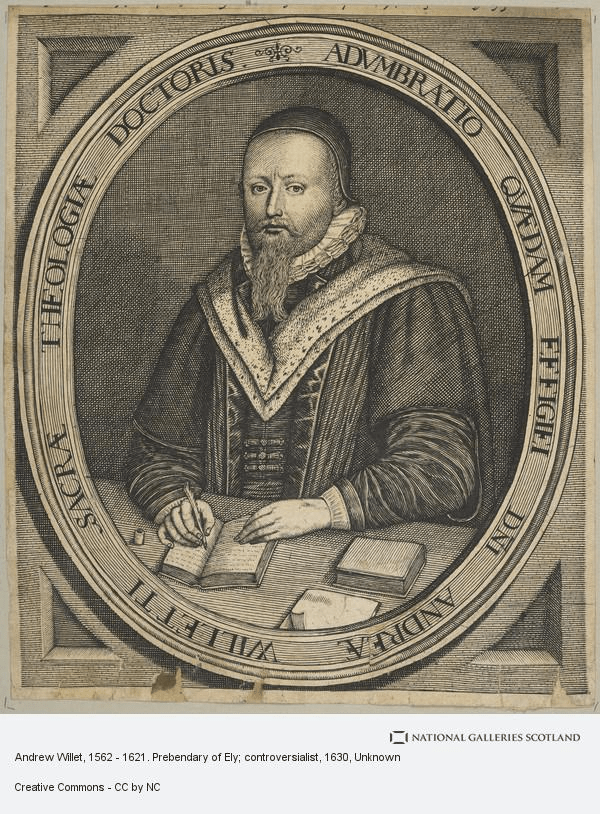
This post does not directly relate to an apologetic for a standard sacred text. What is does, however, is demonstrate the depth of study engaged in by our Reformation era forefathers before coming to an exegetical decision. Willet stands as perhaps the principal example of this era to the opposite of the claim of “nonscientific.” Ainsworth’s Annotations on the Pentateuch, Psalms and Song of Solomon, following a Talmudic model and critical in many respects, still lack the rigor employed by Willet to work and worry through the text and tradition. Furthermore, by the time Matthew Poole wrote his commentary it appears that much of the discussion raised by Willet and Ainsworth had been received as the best proved exegesis and codified. Rather than debating the text’s merits, Poole cites the received aspects of the exegetical tradition.[1] Jack Rogers qualified the 1646 Westminster Confession of Faith as a “pre-scientific statement,”[2] as if to say that “the ancients were not of a mindset to describe historical events, geographical details, or the natural world in ‘precise’ terms; they did not have at their disposal categories of measurement that could mesh in a meaningful way with those employed by participants in the ‘new science’ (post-1650?).”[3] If a work is described as prescientific one would expect a non-textual, contextual, dogmatic spiritualization of the written document in question, which in this case is the sacred text of the believing community. Contrary to this erroneous assertion, Willet is still arguing in his exegesis and commentary for the history, geography, diction, phonics, grammar, syntax, and manuscript support of the given passage in question.
Rather than subjectivism, Willet catalogs the exegesis of the entirety of the ecclesiastical tradition, both Roman Catholic and Protestant, as he sought to establish the prepositional basis for dogmatics. His voluminous commentaries were unrivaled by any exegete of this day and represent the intensity to which he worried through the exegetical tradition.
This post is one example of the investigative rigor of Willet on the knotty interpretation of Romans 7. A hallmark of the Reformation dogmaticians is that every reading of Scripture has only one interpretation, the interpretation intended by the Holy Spirit. Here, Willet works through multiple churchly, exegetical interpretations, winnowing the ten down to one and concluding that Paul is speaking of himself as a regenerate man.
Andrew Willet (1562-1621), Hexapla: That is, a sixfold commentary upon the most divine epistle of the holy Apostle S. Paul to the Romans (Printed by Cantrell Legge, Printer to the University of Cambridge, 1611), 335-338.
Romans 7: p. 335. 36. Quest. of the famous question, whether S. Paul does speak in his own person, or of another here in this 7. chapter.
1. Some think that the Apostle speaketh in the person of a natural man, not yet in the state of grace.
2. Some of a man regenerate, from v. 14 to the end.
3. Some that the Apostle indifferently assumeth the person of all mankind, whether they be regenerate or not, “and in everyone of these opinions there is great diversity.” p. 335.
1. Of the 1st opinion
1. “the Apostle speaketh in the person of a natural man, and sheweth what strength a man’s free will hath by nature without grace. So Julianus the Pelagian, with others of that sect, whose epistles Augustine confuteth. So Lyrannus, he speaketh in the person, generis humani capsi, of humankind after the fall.
2. Some will have the person of man described sub legge & ante leggem degentis, not living only before the law, but under it, having some knowledge of sin. So Chrysostome, Theophylact, whom Tolet followeth, annot.4.
3. Some think that the Apostle describeth a man not altogether under the law, nor yet wholly under grace, but of a man beginning to be converted, quasi voluntate & propositio ad meligra conversi, as converted in mind and desire unto better things, Origen. So also Basil in Regul. Brevior. and Haymo saith, the Apostle speaketh expersona hominis poenitentiam agentis, in the person of a man penitent, etc.
2. The second sort.
1. Augustine confesseth that sometime he was of opinion, that the Apostle speaketh in the person of a carnal and unregenerate man, but afterward he changed his mind upon better reasons, thinking the Apostle to speak of a spiritual man in the state of grace, lib. 1. etract.c.23.lib.5.contr. Julian.c.11. But Augustine retaining this sense, thinketh that the Apostle, saying, v. 15. “I allow not that thing which I do, speaketh of the first motions only of concupiscence, quando illis non consentiatur, when no assent is given unto them, lib. 3. contr. Julian.c.26. which concupiscence the most perfect man in this life can not be void of. So also Gregory understandeth, simplices motus carnius contra voluntatem, the simple motions of the flesh against the will, and hereunto agreeth Bellarmine, lib5. de amission. grat.c.10. Rhemist sect. 6. upon this chapter.
2. Cassianus collat.23.c.13. understandeth a man regenerate, but then by the inner man he would have signified the contemplation of celestial things, by the flesh, curam rerum temporalium, the care of earthly things.
3. a regenerate man, as yet that he may sometime become in a manner carnal. We see this in the example of Paul regenerate, etiam regeneratum non nunquam mancipium fieri peccati, that a regenerate man may sometime become the source of sin. Rolloch.
4. But the sounder opinion is, that the Apostle in his own person speaketh of a regenerate man, even when he is at the best, that he is troubled and exercised with sinful motions, which the perfectest can not be rid of til he be delivered from his corruptible flesh. Of this opinion was Hilary, habemus nunc nobis admistam materiam, qua mortis lege & peccato obnoxia est, etc., we have now mixed within us a certain matter, which is subject to the law of sin and death, etc., and until our body be glorified, non potest in nobis verae vitae esse natura, there cannot be in us the nature and condition of true life, Hilar. in Psalm 118. Of the same opinion are all our soundest new writers, Melancthon, Martyr, Calvin, Beza, Hyperius, Pareus, Faius, with others.
3. Of the third sort.
1. Some are indifferent, whether we understand the person of the regenerate or unregenerate, gloss. ordinar. and so Gorrhan showeth how all this, which the Apostle hath said from v. 18 to the end, may in one sense be understood to the regenerate, in another of the unregenerate.
2. some things may be applied unto the regenerate, as “I am carnal sold under sin,” but somethings solely can be applied to the regenerate, [p. 336] as these words, “I delight in the law of the Lord, etc.” Perer. disput.21.num. 38. And the rather inclineth to think, that the Apostle taketh upon him the person of a man regenerate. and Origen seemeth to have been of this mind, that sometimes the Apostle speaketh in his own person, as “I thank God through Jesus Christ,” and sometime in the person of a weak man, and young beginner, as in the rest.
3. take all this discourse of the Apostle to touch the regenerate, or unregenerate in the particular, but the nature of mankind in general. As Jerome noteth, that the Apostle saith not, “O wretched sinner,” but “O wretched man,” vt totam complecteret ur naturam omniun hominum, & non tantum peccatorum, etc., that he might comprehend the nature of all men, and not only of sinners. lib.2.contra. Pelag. So also Erasmus, humnai generis in se personam recipit, etc., he taketh upon him the person of mankind, wherein is both the Gentile without the law, and the carnal Jew under the law, and the spiritual man made free by grace, annot. in hunc locum.
“Now of all these opinions, which are ten in all, we embrace the forth of the second sort. And this diversity of opinion may be reduced to this point, whether the Apostle speaketh in his own person of a man regenerate, or in an assumed person of a man unregenerate. The other particular differences have been dispersedly touched before. Now then the arguments shall be produced with their answers, which are used on both sides. And first for the negative, that the Apostle giveth not instance here of a man regenerate, and spiritual, but carnal and unregenerate.”
Argum.1. Origen urgeth these reasons: first, the righteous man is not said to be carnal, 2 Cor. 10:3, “We do not war after the flesh,” but the Apostle here saith, vers. 14, “I am carnal.”
2. Of the righteous the Apostle saith, 1 Cor. 6:20, “Ye are bought with a price,” but here the Apostle saith, v. 14, “I am sold under sin.”
3. Of the righteous it is said, c.8.9, “The spirit of God dwelleth in you,” but the Apostle confesseth, “that no good thing dwelleth in him.”
4. Origen also presseth these words, v. 28, “In my flesh I serve the law of sin.” If the Apostle should speak thus of himself, desparationem mihi videtur incultere, it were about to strike despair into us, that there is no man who doth not serve sin in the flesh.
5. The regenerate, such as Paul was, do not only will that which is good, but performs it also. But this man cannot do, that he would, of whom the Apostle speaketh, vers. 15. Tolet.
6. The righteous and just man cannot be said to be captived unto sin, as the Apostle saith of that man, whose person he beareth, v. 23. Cassianus collat.22 in fine.
7. The Apostle speaking of himself, and of others which are regenerate, said before v.5.6, “When we were in the flesh, etc., the motions of sins, etc., had force in our members, etc., but now we are delivered from the law, etc. But here the Apostle speaketh of a man, that is captived [captured] unto the motions of the flesh, so that the Apostle if he should speak of here of a regenerate man, would contradict himself.
8. The scope of the Apostle is the shew the invalidity of the law, that it cannot take away sin, but sin is rather increased thereby, by reason of the weakness of man’s nature. It is therefore more agreeable to the Apostle’s intent, to give instance of a carnal man in whom sin yet reigneth, than of a regenerate man, that by grace is brought to yield obedience to the law. Tolet c.10. in tractat.
9. Jerome, and before him Origen shew, that the Apostle here assumeth the person of the other, like as Daniel being a just man, yet prayeth in the person, saying, c.9, “we have sinned, we have done wickedly,” Hierom. epist.151. ad algasiam.
The formal arguments answered
1. The regenerate simply are not called carnal but, secundum quid, after a sort they are carnal in respect of the unregenerate part. As the Apostle speaking to the Corinthians, that were believers, and justified, sanctified, 1 Cor.6:11, yet calleth them carnal, in regard to the sects and divisions among them, 1 Cor. 3:1. And one is said to be carnal in two ways, either he which is altogether obedient to the flesh and fleshly lusts, or he that doth not yield himself unto them, but striveth against them, and yet against his will feeleth the violent motions thereof. So that the Apostle confesseth, that “though he war not after the flesh, yet he walketh after the flesh,” 2 Cor. 10:3.
[p. 337]
2. The righteous is bought for a price, and redeemed from his sins, and yet in respect to his unregenerate part, the corruption of nature and the reliques of sin remaining, he is said to be sold under sin, not simply as the unregenerate is given over wholly, but in part only.
3. In the faithful as they are regenerate, the Spirit of God dwelleth, but in the unregenerate part sin inhabiteth. There is no inconvenience to grant, that two diverse inhabitants may dwell in one and the same house, in two diverse parts. For the Apostle speaking of the regenerate, saith, Gal. 5:17, “the spirit lusteth against the flesh, and the flesh against the Spirit and these are contrary one to the other.” They which feel not this fight and combat are either angelical, as the saints in heaven, or they have not received the spirit at all, as they which are carnal.
4. There are two kinds of services to sin, the one is a willing service, such as in the unregenerate, the other unwilling, and in a manner forced, as in the regenerate.
5. The unregenerate have no will at all to do good, “for the wisdom of the flesh is not subject to the law of God, neither can be,” Rom. 6:7. The regenerate receive grace to will, and sometime to perform, though not as they would. They are therefore regenerate though not perfectly, as none are in this life.
6. There are two kinds of captivity, the one when one is wholly captived under the bondage of his own voluntary sin, the other is forced captivity under the bondage of original sin. This is in the righteous, not the other.
7. The Apostle is not contrary to himself, for it is one thing to obey the lusts of the flesh, as the unregenerate and carnal, an other, to feel the motions of the flesh, and to strive against them, as in the regenerate.
8. The Apostle’s intent and meaning is the shew, that the law in itself is good and just, and that it cometh by reason of man’s own infirmity, that it is otherwise to him. And thereupon the Apostle to set forth the perfection of the law, giveth instance in the regenerate, that they are not able to keep the law, much less the unregenerate. So that it is more acceptable to the scope and purpose of the Apostle, to speak of a man regenerate, than of one unregenerate.
9. Even Daniel, though he be called a man of desires, that is, beloved, and accepted of God, yet had his sins, which he confessed in his own name, and person. As David is said to be a man after God’s own heart, yet he had his sins and imperfections.
Arguments for the affirmative past, the S. Paul speaketh in his own person as of a man regenerate.
First these two points must be premised, that the Apostle speaketh of himself, not another, still continuing his speech in the first person, “I am carnal,” “I will,” “I consent,” “I delight,” and so throughout, that it will be a great forcing of the Apostle’s speech to make him speak of another and not himself. Secondly, the Apostle from the 14 v. to the end, speaketh of his present state, (who was then regenerate) as may appear, because while he was yet under the law, he speaketh of the time past, v. 9, “I was alive,” and v. 10, “sin seduced me.” But of the time present, “I am carnal,” and so throughout the end of the chapter.
Arum. 1. Hence then is framed our first reason. The Apostle speaketh of himself, as he then was, because he speaketh in the present tense. But then he was a man regenerate, ergo.
Theophylact answereth, the Apostle saith, “serve,” v. 15, that is, serviebam, “I did serve.” cont. As the Apostle saith, “I serve,” so he saith, “I delight in the law of God,” v. 22. And in this verse 25, “I thank God, etc.,” which immediately go before the other, “I serve.” But those words must be understood, as they are uttered, of the same time present, therefore the other also.
2. Gregory urgeth these words, v.18, “to will is present with me.” He that saith “he will,” per infusion em gratia quae in se, am lateant semina ostendit, doth shew what seed lieth in him by the infusion of grace. lib.29 moral.c.15.
Ans. even the unregenerate by nature do will what is good. They may imperfecte velle bonum sine gratia in peccato, imperfectly will what is good without grace even in the state of sin. Tolet. in tractat.c.9.
Contra. There is bonum naturale, morale, spirituale, that which is naturally good, morally good, spiritually good. The first one by nature may desire, as brute beasts do the same, and therein they do neither good, nor evil. The second also in some sort as the heathen follow after moral virtues, but they did it not without sin, because they had no [p. 338] faith. But that which is spiritually good, the carnal have no mind at all unto, for it is God, which worketh both the will and the deed, Phil. 2:13.
Argum.3. Augustine presseth these words v.17, “It is not I that do it, but sin that dwelleth in me,” this is not vox peccatoris, sed justi, the voice of a sinner, but of a righteous man. lib.1.cont.2.epist.pelag.c.10.
Ans. A sinner may be said to do evil, not because he doth not consent unto it, but because he is not only moved of himself, but drawn my his concupiscence. Tolet. ibid.
Contra. There is nothing in a man to give consent unto any action, but either his spiritual or carnal part. But in the unregenerate there is nothing spiritual, but all is natural. Therefore, whatsoever such an one doeth he wholly consenteth. He himself is not one thing, and his sin another to give consent. But he is wholly moved and led to sin.
Argum. 4. Augustine addeth further, the Apostle thus beginning the 8. chapter, “There is condemnation to them that are in Christ Jesus,” which words follow as inferred upon the other, which sheweth that the Apostle spake before of those which were in Christ Jesus.
Ans. Nay rather those words following upon the other, “who shall deliver me, etc.,” which the Apostle uttereth of a man not yet delivered or freed from his sin, and maketh answer, “the grace of God, etc.,” shew that he spake before as one not being in the state of grace. Tolet. ibid.
Contra. 1. It is the bondage of corruption, which the Apostle desireth to be delivered from, as is shewed before, qu. 33. Neither doth the Apostle answer, “the grace of God, etc,” but, “I give thanks to God, ” as likewise hath been declared qu. 34 before. But one not in the state of grace, cannot give thanks unto God. Therefore, the immediate connection of these words, c.8. sheweth that he spake before of those, which are in Christ.
Argum. 5. Further Augustine this reasoneth: a carnal man cannot delight in the law of God, in the inner man, as saint Paul doth. Neither indeed is there any inner man, that is, regenerate and renewed in those which are carnal. Pareus.
Ans. The unregenerate man may delight in the law, as Herod did. And it is nothing else, but velle bonum, to will that which is good. Tolet. ibid. And they have also the inner man, which is the mind, as the outward man the body.
Contra. 1. The carnal cannot delight in the law, but they hate it, as Psalm 50:17, “thou hastest to be reformed, and hast cast my words behind thee.” Herod gave ear to John the Baptist, not of love, but for fear, for afterward he put him to death. Hypocrites and carnal men may stand in some awe, and fear a while, but it is not of love, nor in truth, or from the heart. 2. The inner part is that which is spiritual and renewed. But in the wicked their very mind is defiled, Tit. 1:5. Therefore in them there is no inner man. See before qu. 26.
Argum.6. The Apostle desireth to be delivered from his corruptible and sinful body, hoping then for perfect liberty. but in the resurrection the carnal shall have no such liberty. They shall rise to greater misery. Augustine.
Ans. The deliverance there spoken of is by justification from sin, not in the resurrection. Tolet. ibid.
Contra. The Apostle evidently speaketh of being delivered from “this body of death,” that is, his mortal body, which shall not be till the resurrection.
Argum. 7. The children of God, that are regenerate, do only find in themselves the fight and combat between the spirit and the flesh, Gal. 5:17, as the Apostle doth here, v. 22. Pareus.
Argum.8. The unregenerate do not use to give thanks unto God, but they sacrifice to their own net, as the prophet saith, Hab. 1:16, “they give praise to themselves.” But S. Paul here giveth thanks. Faius.
Argum.9. No man but by the spirit of God, can hate and disallow that which is committed against the law of God, as the Apostle doth here, v. 15. Hyperius.
Argum.10. To what end should the Apostle thus at large show the effects and end of the law for their cause, qui prorsus sunt a Deoalieni, which are altogether strangers from God, and care not for his law? Faius.
By these and such like reasons it is concluded, that S. Paul speaketh in the person of a man regenerate.
[1] Richard Muller, “Prolegomena to Theology,” in Post-Reformation Reformed Dogmatics, vol. 1 (Grand Rapids: Baker Book House, 1987), 13.
[2] Jack B. Rogers, Scripture In The Westminster Confession: A Problem of the Historical Interpretation for American Presbyterianism (Kampen: J. H. Kok, 1966), 306.
[3] John D. Woodbridge, Biblical Authority: A Critique of the Rogers/McKim Proposal (Grand Rapids: Zondervan Publishing House, 1982), 28. For a theological appraisal of this new science see Abraham Kuyper, Principles of Sacred Theology trans. By J. Hendrick De Vries (Grand Rapids: Wm. B. Eerdmans Publishing Co., 1989), 347-348.



 Standard Sacred Text.com