By L. Gaussen
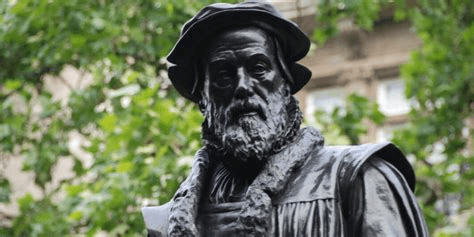
See at the same time Tyndal, in England, fleeing from his native country never to return, concealing himself first in one city and then in another on the banks of the Rhine, from his persecutors, till at last he was enabled, according to his heart’s desire, to give to the English, in English, the Word of their God. See him till the day when, for having done this work, he will, by order of the king of England and the emperor of Germany, be hunted out, betrayed, thrown into prison, strangled, and burnt! See his two fellow-labourers, Bilney and Frith, seized for the same crime, and burnt alive in England! All three had been prepared by God for this task; they were learned in the sacred languages; with secular knowledge they had also faith; and all three took their life in their hands to offer it to their Redeemer. But at last, behold the angel of the Reformation, who only waited till they had ended their work, to commence his own, and who made his mighty voice resound through all Europe like the roaring of a lion. Very soon thousands of confessors and martyrs will shew themselves in France, in Germany, in England, in Italy, in Flanders, in Belgium, in Holland, in Spain, in Poland, in Transylvania, in Bohemia, in Hungary, in Denmark and Sweden, and the world will appear shaken to its foundations.
I confess that nothing has made me discern more vividly the Divine grandeur of this dispensation, and the profound interment from which the Scriptures then came forth, than to trace the labours and sufferings of these men of God in order to give His Holy Word to their generation. Trace Tyndal’s career, and from him judge of all the rest.
642. Having left the English universities, this young and learned scholar lived in peace, happy and respected, in the noble mansion of Sir John Walsh, where he discharged with credit the double office of chaplain and tutor. Sir John and Lady Walsh placed confidence in him, and took delight in hearing him speak of the gospel, with which he had been powerfully impressed by reading the Greek New Testament, which the learned Erasmus had just published at Bale in 1516, and brought it to England in 1519. No sooner was he converted than this heroic young man felt a resolution formed in his heart to renounce everything in order to translate and give to his countrymen the Scriptures of his God in English. “I will consecrate my life to it,” he said, “and if necessary, I will sacrifice it;” and when an English priest at Sir John Walsh’s pointed out to him the danger from the laws of the Pope and the artfulness of the priests, he had the holy imprudence to reply, “For this I will set at defiance the Pope and all his laws; for I vow, if God spare my life, that in England, before a few years are gone by, a ploughman shall know the Scriptures better than I do.”[1] He had preached the gospel fervently in the neighborhood where he resided; but seeing his labours too often rendered fruitless by the opposition of the priests, he said, “Assuredly it would be quite different if this poor people had the Scriptures. Without the Scriptures it is impossible to establish the laity in the truth.”
He was well aware that his life was in peril, and he was not willing that his noble friends should share those dangers which he was ready to brave alone. He resolved to leave. Only three years before, the same year in which he left Cambridge, the pious Thomas Mann had been burnt alive for having professed the doctrine of the Lollards, which had now become his own; so also a lady named Smith, the mother of several young children, for having been convicted of making use of a parchment on which were found written in English the Lord’s Prayer, the apostle’s creed, and the ten commandments. Moreover, everybody in England recollected that, one hundred and forty years before, the pious Wickliffe, for having attempted the same task of translating the Bible into English for the English, had been constantly persecuted; that the House of Lords, and the Convocation of the Clergy in St Paul’s, London, had strictly prohibited the use of that book ; and such was the horror they had of a Bible in the vulgar tongue, that they not only burnt it when they discovered it, but burnt also, with the Bible hanging from their neck, the men who had read it ; and better to express in what abhorrence this work was held, they had ordained, forty-four years after his death, that the corpse even of Wycliffe should not have a secure grave on the soil of England, — that his bones, disinterred, should be burnt, and their ashes thrown into the river Swift.[2] The venerable Lady Jane Boughton, eighty years old, was burnt for reading the Scriptures; her daughter, Lady Young, had to undergo the same punishment. John Bradley, shut up in a chest, was burnt alive in Smithfield before the valiant Henry, then Prince of Wales; and the noble Lord Cobham was burnt on a slow fire in St Giles’s.
Tyndal having quitted his protectors, betook himself to London, to seek there, in a more secret retreat, the means of pursuing his sacred work, but soon had reason to fear that punishment would interrupt his task. “Alas! I see it!” he exclaimed,”all England is closed against me!” And as there was then in the Thames a vessel about to sail for Hamburgh, he got on board, having only his New Testament, and for the means of living only £10 sterling. He quitted his native country, and was never to see it again. Nevertheless, he left it with a holy confidence. “Our priests,” he said, “have buried God’s Testament, and all their study is to prevent its being raised from the tomb; but God’s hour is come, and nothing henceforward shall prevent His written Word, as in former times nothing could prevent His incarnate Word, from bursting the bonds of the sepulcher, and rising from among the dead.”[3] Tyndal augured rightly; but it was the work of God alone.
We must follow this martyr of the Scriptures in his agitated and suffering life, pursued from city to city; first of all to Hamburgh in 1523, where he had to endure every species of privation, poverty, debt, cold, and hunger, with his young and learned friend John Frith, his son in the faith, who had accompanied him to labour in the same work. Yet he had already the satisfaction of sending secretly to his friends in England the Gospels of Matthew and Mark; but he was soon obliged to flee to Cologne to conceal himself again. We must follow him there, especially in his new troubles, where a priest, who had. pursued his track, unexpectedly discovered at a printer’s the first eighty pages of his book, and hastened to give information of it, both to the senate of Cologne and the King of England.” Two Englishmen who are concealed here, sire,” he wrote, “wish, contrary to the peace of your kingdom, to send the New Testament in English to your people. Give orders, sire, in all your ports, to prevent the arrival of this most pernicious kind of merchandise.”[4] With admirable promptitude, Tyndal, forewarned, anticipates the prosecution of the council of Cologne, runs to his printer, and throws himself, with the first ten sheets already printed, into a vessel that was going up the Rhine, and takes refuge in Worms! To disconcert the proceedings of his enemies, he changes the form and size of his book from a quarto to an octavo. In vain the Bishop of London had already assailed this work, which was so odious in his eyes, and denounced it in England. Tyndal, after so many exertions and prayers, had the happiness to finish the whole about the end of 1525, and entrusted its conveyance to England to some pious Hanseatic merchants, who could not bring it to London but at the peril of their lives. Let us listen to the man of God thus expressing his pious joy: ” ow, 0 my God,” he exclaims, “take from its scabbard, in which men have kept it so long unused, the sharp-edged sword of Thy Word; draw forth this powerful weapon, strike, wound, divide soul and spirit, so that the divided man shall be at war with himself, but at peace with Thee.” And we may see the same bishop secretly commissioning a merchant to purchase the whole edition, in order to give it to the flames, and Tyndal at a distance receiving the money, which will enable him to pay his debts, and prepare immediately another edition better printed and more correct. Lastly, we have to see this faithful man settled at Antwerp, always in danger, always concealed, always suffering innumerable privations, but already at work, commencing his translation of the Old Testament, with his pious friend, John Erith. Nevertheless, for each of them, their labours were soon to end, and their rest in God was to begin. The king of England sent secret emissaries to discover Tyndal’s retreat, and to secure his person. These persons, it is said, were not able to see him close at hand without being almost gained over to his sentiments. At last he was surprised and betrayed, and the officers at Brussels were prevailed upon to seize him and throw him into prison. There he remained two years, during which time he wrote those admirable letters which we still possess, addressed to his young fellow-labourer, Frith, who having returned to England, was destined very soon to be a martyr before him. On the sixth of October 1536, fastened to a stake in the public square of Augsburg, Tyndal gave up his life for the Holy Word. In his last moments, he was heard to raise his voice, and exclaim aloud, “Lord! open the King of England’s eyes!” It was on the application of Henry VIII., and by order of Charles V., that he was taken from Brussels to Augsburg, to undergo the punishment of death. He was strangled, and his body committed to the flames. His son in the faith, and fellow-labourer, the amiable Frith, had been burnt alive at Smithfield, in 1533, for having been engaged in the same work, as also had been, in 1528, the affectionate Thomas Bilney, the friend of his youth, with whom he had so devoutly commenced his labours.
643. In this manner the Holy Scriptures were brought back to England in 1525. They returned moistened with the blood of their translators and martyrs, at the same time when other faithful men of God, exposed to similar conflicts, and braving similar dangers, translated them into the language of their respective countries, and restored them equally to the Church of God.
Other affecting recitals of the same kind might be given, relating to those struggles out of which the Scriptures made their way as from the tomb, to render the first calls of the Reformation audible to God’s chosen ones. For, independently of the translations which were then made of the New Testament, the whole Bible was translated into Flemish in 1526,[5] into German, by Luther, in 1530; into French, by Olivetan, in 1535;[6] into English, by Tyndal and Coverdale, in 1535; into Bohemian, by the 590 United Brethren, ever since 1488; into Swedish, by Laurentius; into Danish, in 1550; into Polish, in 1551; into Italian, by Bruccioli, in 1532, and by Teotilo in 1550; into Spanish, by de Reyna, in 1569; into French-Basque, by order of the Queen of Navarre, in 1571; into Sclavonian, in 1581; into the language of Carniola, in 1581; into Icelandic, in 1581; into Welsh, by Morgan, in 1588; into Hungarian, by Caroli, in 1589; into Esthonian, by Fischer, in 1589. Thirty versions may be counted, it is said, for Europe alone.
This universal resurrection of the holy book, and of its sacred canon, in the face of such obstacles, presents us no doubt with an impressive proof of the protection which guards it from age to age; but we shall recognize this protection far better, if we come to consider the prodigious effects of this book, whence once laid open to the sight of the nations.
Those effects were immediate; they were holy; they were everywhere the same; they were similar to those witnessed in the most glorious days of the Church; they were of a power evidently Divine, by their moral grandeur in the spiritual world, and by their external grandeur in the political world, or on the general destinies of humanity.
644. Those effects were immediate. Scarcely had the Flemish Bible, Luther’s Bible, Tyndal’s Bible, Olivetan’s Bible, issued from, the tomb, but directly the angel of the Reformation made his powerful voice from God heard through all Europe. It came from heaven sudden, unexpected, by the most humble instruments, and at once the astonished world felt itself shaken to the foundations. Everything indicated an agency from on high. At the end of a few months, in Germany, in Switzerland, in France, in Flanders, in England, in Scotland, and soon afterwards in Italy, and even in Spain, the sheep of Jesus had heard His voice and followed Him, Great emotions had agitated them. Consciences were awakened by the Holy Word. A deep and powerful work had been effected in men’s souls; and very soon their idols were overthrown, and their traditions were cast away. They turned to the living and true God, and, like the Thessalonians, “received the Word in the midst of great tribulation, with joy of the Holy Ghost.” Their hearts were softened; righteousness, peace, and joy, had descended into them. The face of the world was changed, and, after 900 years of slavery, half of Europe appeared already delivered from Rome. Would it then be too daring, in describing this vast movement, so visibly originating from above, to speak of it as the excellent and learned Mr. Elliot[7] has done in his exposition of the Prophet of Patmos, and to say with him, that this was the “mighty angel” that John saw “come down from heaven clothed in a cloud.” “A rainbow was upon his head,” a symbol of the peace of God, “and his face was as it were the sun,” for he brought to the world the sublime illuminations of faith. His progress was irresistible, ” is feet were as pillars of fire.” But whence came the power of his progress, its promptitude, its unity, its Divine security? Hearken! He had in his hand a book, a little book, (bibliaridion) but an open book, open and not closed, open to all nations, — the everlasting gospel. Very soon he “placed his right foot on the sea, and his left foot on the earth,” for he had to carry beyond the ocean the good news of grace, to lead nations in both hemispheres to the most glorious destinies, and to make known God’s salvation to the utmost ends of the earth, — his action was powerful, and “he cried with a loud voice.”
We said that this great movement which restored the gospel to the earth came evidently from heaven; and we said that it could be judged at once by its effects, for they were immediate, rapid, holy, everywhere the same, and from a power evidently Divine.
L. Gaussen, D.D., The Canon of Holy Scripture from the Double Point of View of Science and of Faith, 3rd ed. (London: James Nisbet and Co., 21 Berners Street, 1863), 585-591.
[1] Our readers should follow Tyndal’s career as exhibited in the admirable work of Merle d’Aubignd, 1854. [The fullest account of Tyndal’s life and biblical labours is contained in Mr. Anderson’s Annals of the English Bible; 2 vol., 8vo. London, 1847. A second edition condensed in 1 vol., 1861. — Tr.]
[2] The Book and its Story, pp. 128-131
[3] The Book and its Story, p. 152.
[4] Merle daubing, History of the Reformation, v., 308, 309.
[5] Reuss, Geschichte der Schriften N. T., §§ 470-477. Le Fevre had finished his translation of the New Testament in 1523.
[6] The College of La Tour in the Valleys possesses a copy of it. At the end of the volume the acrostic verses indicate to whom the edition was owing. Joining the initial letters we shall read — ” Les Vaudois, peuple evangelique, Ont mis ce tresor en publique.”
[7] In his Horae Apocalypticae, vol. i., p. 39. London, 1851.
 Standard Sacred Text.com