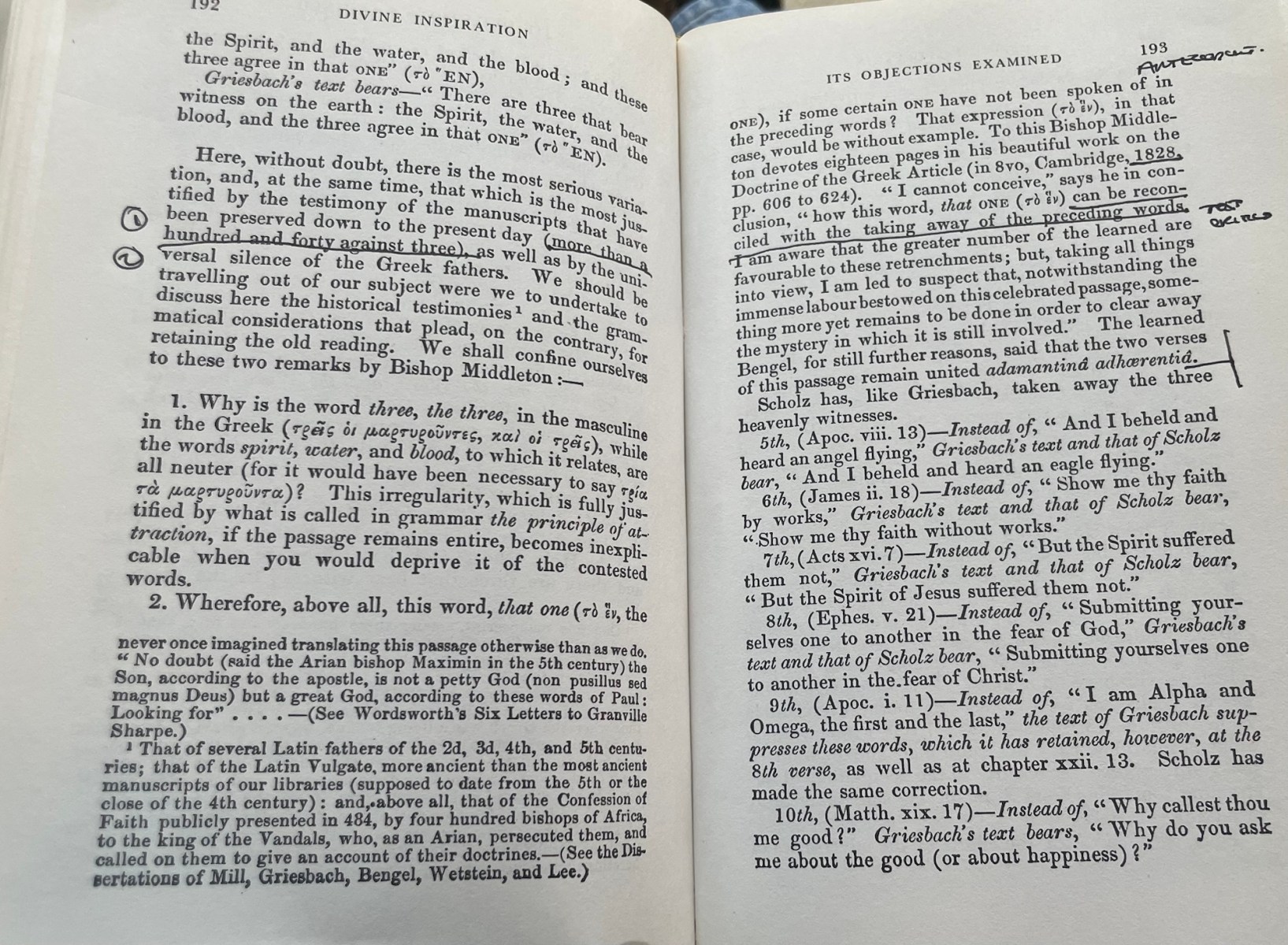
Gaussen, Divine Inspiration of the Bible, 1841, pp. 192-193.
Gaussen compares the traditional inclusion of 1 John 5:7 with the corruption by deletion of Griesdach’s text omitting “in heaven: the Father, the Word, and the Holy Ghost: and these three are one; and there are three that bear witness.”
In summary, Gaussen makes the following points for inclusion:
The grammatical form “the principle of attraction.”
Latin fathers 2nd-5th c.
Latin Vulgate 4rth-5th c.
484 Confession of Faith
The omission leaves “the one” without an antecedent as noted by Middleton (1828).
Bengal argued that “the two verses of this passage remain united adamantina adherentia — unbreakable cohesion; cannot be separated.
This, of course, is not exhaustive but lends mid-19th c. support for the inclusion of the passage. Additionally, study of the question of the passage’s authority reveals scant evidence for its omission.
Dr. Peter William Van Kleeck, Sr. : B.A., Grand Rapids Baptist College, 1986; M.A.R., Westminster Theological Seminary, 1990; Th.M., Calvin Theological Seminary, 1998; D. Min, Bob Jones University, 2013. Dr. Van Kleeck was formerly the Director of the Institute for Biblical Textual Studies, Grand Rapids, MI, (1990-1994) lecturing, researching and writing in the defense of the Masoretic Hebrew text, Greek Received Text and King James Bible. His published works include, "Fundamentalism’s Folly?: A Bible Version Debate Case Study" (Grand Rapids: Institute for Biblical Textual Studies, 1998); “We have seen the future and we are not in it,” Trinity Review, (Mar. 99); “Andrew Willet (1562-1621: Reformed Interpretation of Scripture,” The Banner of Truth, (Mar. 99); "A Primer for the Public Preaching of the Song of Songs" (Outskirts Press, 2015). Dr. Van Kleeck is the pastor of the Providence Baptist Church in Manassas, VA where he has ministered for the past twenty-one years. He is married to his wife of 43 years, Annette, and has three married sons, one daughter and eighteen grandchildren.
View more posts
 Standard Sacred Text.com