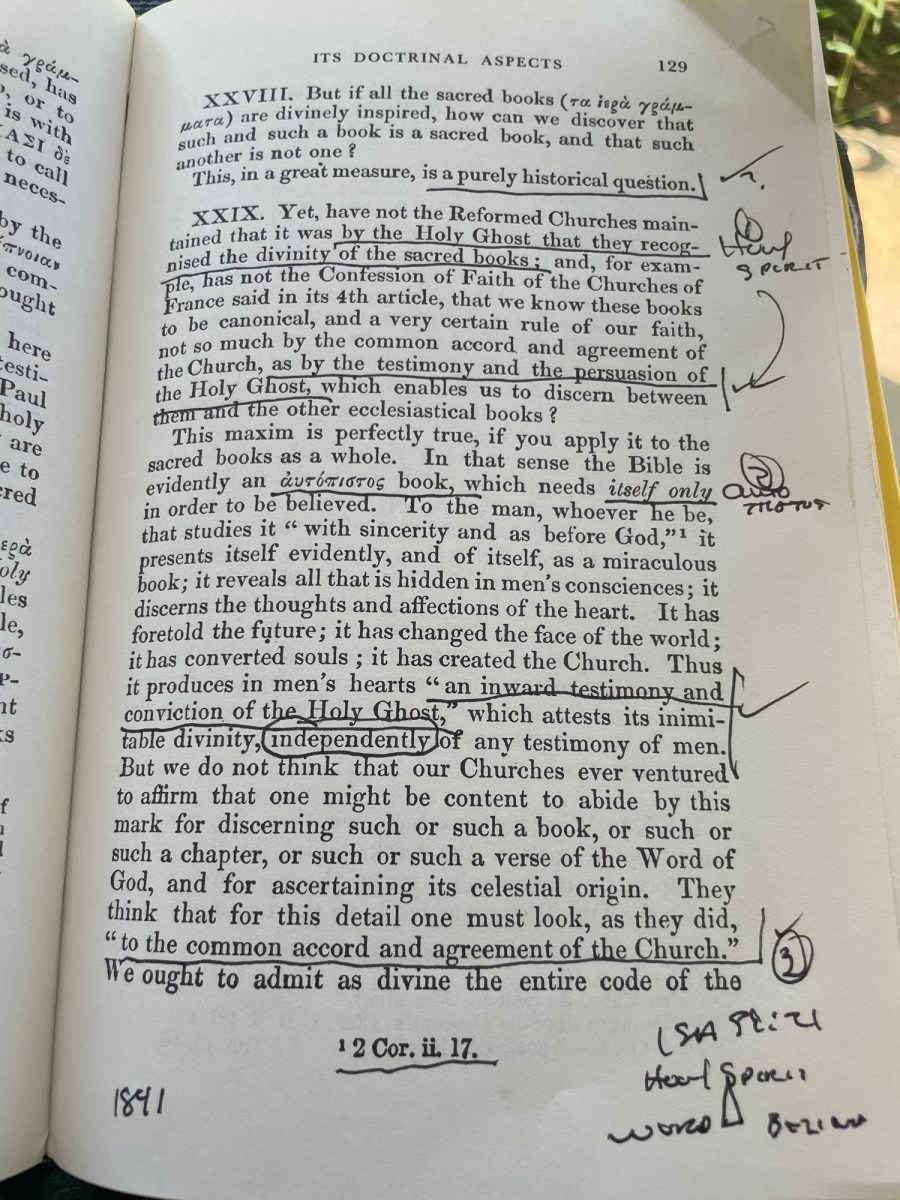
One historic proof of how quickly and decidedly the Church can drift from orthodoxy is demonstrated in the Bible version debate, specifically the paradigm shift from exegetically based conclusions to empirically based confusion. Gaussen published Divine Inspiration of the Bible in 1841, only 40 years before the infamous novel and corrupted Greek text of 1881. A pre-critical theologian writing in a post-critical era, Gaussen asserts the three factors that decided Christian epistemology when determining what is and is not inspired Scripture — the Holy Spirit, that Scripture is self-attesting (autopistos), and the believer. On page 129, a section modeled after a catechism, Gaussen succinctly summarizes the issue.
- “The testimony and the persuasion of the Holy Ghost.
- “The Bible is evidently an autopistos book, which needs only itself to be believed.” “Thus it produces in men’s hearts ‘an inward testimony and conviction of the Holy Ghost,’ which attests its inimitable divinity, independently of any testimony of men.”
- “To the common accord and agreement of the Church.”
See Isaiah 59:21, “As for me, this is my covenant with them, saith the Lord; My spirit that is upon thee, and my words which I have put in thy mouth, shall not depart out of thy mouth, nor out of the mouth of thy seed, nor out of the mouth of thy seed’s seed, saith the Lord, from henceforth and for ever.”
These three elements are exegetically grounded, theologically formulated, and practically exercised for the epistemological means of recognizing Holy Scripture — until 1881 when Fundamentalist and Evangelical leaders lead students and Churches away from sound doctrine into the current Bibliological muddle so many today seem to relish. The most epistemologically sound assertion one can make in reference to the Bible, is to say that we believe it is the Bible because it says it is. This apologetic was still being published in the 19th century 300 years after the first wave of the Reformation and we at Standardsacredtext.com continue in this proven defense of the faith.
Once you have the autopistos self-authenticating Bible, historical support is a virtuous discipline, but if history and empirical discovery is “leading” you to that Bible, then you have forsaken the apologetics of our theological forefathers and adopted the Roman, and then Enlightenment notion of the impossibility of an infallible Word of God in any language.
 Standard Sacred Text.com