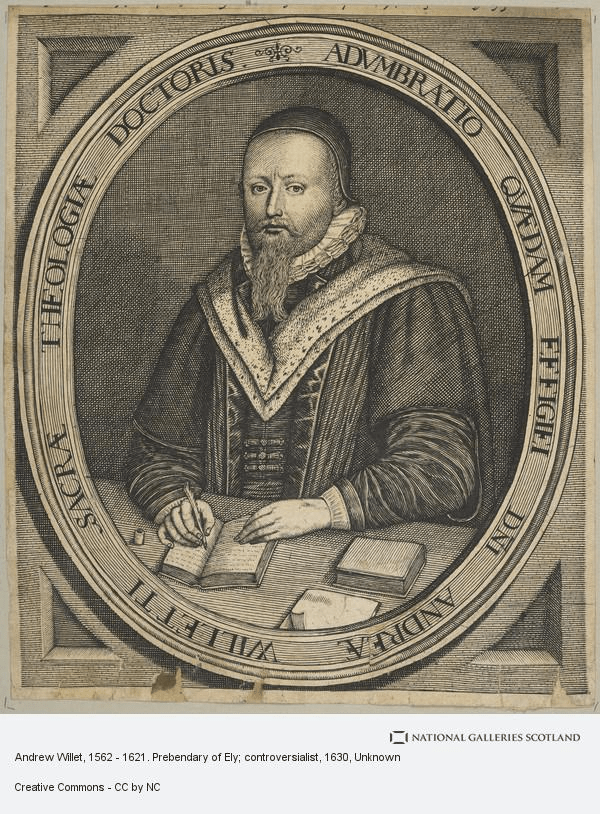
This post does not directly relate to an apologetic for a standard sacred text. What is does, however, is demonstrate the depth of study engaged in by our Reformation era forefathers before coming to an exegetical decision. Willet stands as perhaps the principal example of this era to the opposite of the claim of “nonscientific.” Ainsworth’s Annotations on the Pentateuch, Psalms and Song of Solomon, following a Talmudic model and critical in many respects, still lack the rigor employed by Willet to work and worry through the text and tradition. Furthermore, by the time Matthew Poole wrote his commentary it appears that much of the discussion raised by Willet and Ainsworth had been received as the best proved exegesis and codified. Rather than debating the text’s merits, Poole cites the received aspects of the exegetical tradition.[1] Jack Rogers qualified the 1646 Westminster Confession of Faith as a “pre-scientific statement,”[2] as if to say that “the ancients were not of a mindset to describe historical events, geographical details, or the natural world in ‘precise’ terms; they did not have at their disposal categories of measurement that could mesh in a meaningful way with those employed by participants in the ‘new science’ (post-1650?).”[3] If a work is described as prescientific one would expect a non-textual, contextual, dogmatic spiritualization of the written document in question, which in this case is the sacred text of the believing community. Contrary to this erroneous assertion, Willet is still arguing in his exegesis and commentary for the history, geography, diction, phonics, grammar, syntax, and manuscript support of the given passage in question.
Rather than subjectivism, Willet catalogs the exegesis of the entirety of the ecclesiastical tradition, both Roman Catholic and Protestant, as he sought to establish the prepositional basis for dogmatics. His voluminous commentaries were unrivaled by any exegete of this day and represent the intensity to which he worried through the exegetical tradition.
This post is one example of the investigative rigor of Willet on the knotty interpretation of Romans 7. A hallmark of the Reformation dogmaticians is that every reading of Scripture has only one interpretation, the interpretation intended by the Holy Spirit. Here, Willet works through multiple churchly, exegetical interpretations, winnowing the ten down to one and concluding that Paul is speaking of himself as a regenerate man.
Andrew Willet (1562-1621), Hexapla: That is, a sixfold commentary upon the most divine epistle of the holy Apostle S. Paul to the Romans (Printed by Cantrell Legge, Printer to the University of Cambridge, 1611), 335-338.
Romans 7: p. 335. 36. Quest. of the famous question, whether S. Paul does speak in his own person, or of another here in this 7. chapter.
1. Some think that the Apostle speaketh in the person of a natural man, not yet in the state of grace.
2. Some of a man regenerate, from v. 14 to the end.
3. Some that the Apostle indifferently assumeth the person of all mankind, whether they be regenerate or not, “and in everyone of these opinions there is great diversity.” p. 335.
1. Of the 1st opinion
1. “the Apostle speaketh in the person of a natural man, and sheweth what strength a man’s free will hath by nature without grace. So Julianus the Pelagian, with others of that sect, whose epistles Augustine confuteth. So Lyrannus, he speaketh in the person, generis humani capsi, of humankind after the fall.
2. Some will have the person of man described sub legge & ante leggem degentis, not living only before the law, but under it, having some knowledge of sin. So Chrysostome, Theophylact, whom Tolet followeth, annot.4.
3. Some think that the Apostle describeth a man not altogether under the law, nor yet wholly under grace, but of a man beginning to be converted, quasi voluntate & propositio ad meligra conversi, as converted in mind and desire unto better things, Origen. So also Basil in Regul. Brevior. and Haymo saith, the Apostle speaketh expersona hominis poenitentiam agentis, in the person of a man penitent, etc.
2. The second sort.
1. Augustine confesseth that sometime he was of opinion, that the Apostle speaketh in the person of a carnal and unregenerate man, but afterward he changed his mind upon better reasons, thinking the Apostle to speak of a spiritual man in the state of grace, lib. 1. etract.c.23.lib.5.contr. Julian.c.11. But Augustine retaining this sense, thinketh that the Apostle, saying, v. 15. “I allow not that thing which I do, speaketh of the first motions only of concupiscence, quando illis non consentiatur, when no assent is given unto them, lib. 3. contr. Julian.c.26. which concupiscence the most perfect man in this life can not be void of. So also Gregory understandeth, simplices motus carnius contra voluntatem, the simple motions of the flesh against the will, and hereunto agreeth Bellarmine, lib5. de amission. grat.c.10. Rhemist sect. 6. upon this chapter.
2. Cassianus collat.23.c.13. understandeth a man regenerate, but then by the inner man he would have signified the contemplation of celestial things, by the flesh, curam rerum temporalium, the care of earthly things.
3. a regenerate man, as yet that he may sometime become in a manner carnal. We see this in the example of Paul regenerate, etiam regeneratum non nunquam mancipium fieri peccati, that a regenerate man may sometime become the source of sin. Rolloch.
4. But the sounder opinion is, that the Apostle in his own person speaketh of a regenerate man, even when he is at the best, that he is troubled and exercised with sinful motions, which the perfectest can not be rid of til he be delivered from his corruptible flesh. Of this opinion was Hilary, habemus nunc nobis admistam materiam, qua mortis lege & peccato obnoxia est, etc., we have now mixed within us a certain matter, which is subject to the law of sin and death, etc., and until our body be glorified, non potest in nobis verae vitae esse natura, there cannot be in us the nature and condition of true life, Hilar. in Psalm 118. Of the same opinion are all our soundest new writers, Melancthon, Martyr, Calvin, Beza, Hyperius, Pareus, Faius, with others.
3. Of the third sort.
1. Some are indifferent, whether we understand the person of the regenerate or unregenerate, gloss. ordinar. and so Gorrhan showeth how all this, which the Apostle hath said from v. 18 to the end, may in one sense be understood to the regenerate, in another of the unregenerate.
2. some things may be applied unto the regenerate, as “I am carnal sold under sin,” but somethings solely can be applied to the regenerate, [p. 336] as these words, “I delight in the law of the Lord, etc.” Perer. disput.21.num. 38. And the rather inclineth to think, that the Apostle taketh upon him the person of a man regenerate. and Origen seemeth to have been of this mind, that sometimes the Apostle speaketh in his own person, as “I thank God through Jesus Christ,” and sometime in the person of a weak man, and young beginner, as in the rest.
3. take all this discourse of the Apostle to touch the regenerate, or unregenerate in the particular, but the nature of mankind in general. As Jerome noteth, that the Apostle saith not, “O wretched sinner,” but “O wretched man,” vt totam complecteret ur naturam omniun hominum, & non tantum peccatorum, etc., that he might comprehend the nature of all men, and not only of sinners. lib.2.contra. Pelag. So also Erasmus, humnai generis in se personam recipit, etc., he taketh upon him the person of mankind, wherein is both the Gentile without the law, and the carnal Jew under the law, and the spiritual man made free by grace, annot. in hunc locum.
“Now of all these opinions, which are ten in all, we embrace the forth of the second sort. And this diversity of opinion may be reduced to this point, whether the Apostle speaketh in his own person of a man regenerate, or in an assumed person of a man unregenerate. The other particular differences have been dispersedly touched before. Now then the arguments shall be produced with their answers, which are used on both sides. And first for the negative, that the Apostle giveth not instance here of a man regenerate, and spiritual, but carnal and unregenerate.”
Argum.1. Origen urgeth these reasons: first, the righteous man is not said to be carnal, 2 Cor. 10:3, “We do not war after the flesh,” but the Apostle here saith, vers. 14, “I am carnal.”
2. Of the righteous the Apostle saith, 1 Cor. 6:20, “Ye are bought with a price,” but here the Apostle saith, v. 14, “I am sold under sin.”
3. Of the righteous it is said, c.8.9, “The spirit of God dwelleth in you,” but the Apostle confesseth, “that no good thing dwelleth in him.”
4. Origen also presseth these words, v. 28, “In my flesh I serve the law of sin.” If the Apostle should speak thus of himself, desparationem mihi videtur incultere, it were about to strike despair into us, that there is no man who doth not serve sin in the flesh.
5. The regenerate, such as Paul was, do not only will that which is good, but performs it also. But this man cannot do, that he would, of whom the Apostle speaketh, vers. 15. Tolet.
6. The righteous and just man cannot be said to be captived unto sin, as the Apostle saith of that man, whose person he beareth, v. 23. Cassianus collat.22 in fine.
7. The Apostle speaking of himself, and of others which are regenerate, said before v.5.6, “When we were in the flesh, etc., the motions of sins, etc., had force in our members, etc., but now we are delivered from the law, etc. But here the Apostle speaketh of a man, that is captived [captured] unto the motions of the flesh, so that the Apostle if he should speak of here of a regenerate man, would contradict himself.
8. The scope of the Apostle is the shew the invalidity of the law, that it cannot take away sin, but sin is rather increased thereby, by reason of the weakness of man’s nature. It is therefore more agreeable to the Apostle’s intent, to give instance of a carnal man in whom sin yet reigneth, than of a regenerate man, that by grace is brought to yield obedience to the law. Tolet c.10. in tractat.
9. Jerome, and before him Origen shew, that the Apostle here assumeth the person of the other, like as Daniel being a just man, yet prayeth in the person, saying, c.9, “we have sinned, we have done wickedly,” Hierom. epist.151. ad algasiam.
The formal arguments answered
1. The regenerate simply are not called carnal but, secundum quid, after a sort they are carnal in respect of the unregenerate part. As the Apostle speaking to the Corinthians, that were believers, and justified, sanctified, 1 Cor.6:11, yet calleth them carnal, in regard to the sects and divisions among them, 1 Cor. 3:1. And one is said to be carnal in two ways, either he which is altogether obedient to the flesh and fleshly lusts, or he that doth not yield himself unto them, but striveth against them, and yet against his will feeleth the violent motions thereof. So that the Apostle confesseth, that “though he war not after the flesh, yet he walketh after the flesh,” 2 Cor. 10:3.
[p. 337]
2. The righteous is bought for a price, and redeemed from his sins, and yet in respect to his unregenerate part, the corruption of nature and the reliques of sin remaining, he is said to be sold under sin, not simply as the unregenerate is given over wholly, but in part only.
3. In the faithful as they are regenerate, the Spirit of God dwelleth, but in the unregenerate part sin inhabiteth. There is no inconvenience to grant, that two diverse inhabitants may dwell in one and the same house, in two diverse parts. For the Apostle speaking of the regenerate, saith, Gal. 5:17, “the spirit lusteth against the flesh, and the flesh against the Spirit and these are contrary one to the other.” They which feel not this fight and combat are either angelical, as the saints in heaven, or they have not received the spirit at all, as they which are carnal.
4. There are two kinds of services to sin, the one is a willing service, such as in the unregenerate, the other unwilling, and in a manner forced, as in the regenerate.
5. The unregenerate have no will at all to do good, “for the wisdom of the flesh is not subject to the law of God, neither can be,” Rom. 6:7. The regenerate receive grace to will, and sometime to perform, though not as they would. They are therefore regenerate though not perfectly, as none are in this life.
6. There are two kinds of captivity, the one when one is wholly captived under the bondage of his own voluntary sin, the other is forced captivity under the bondage of original sin. This is in the righteous, not the other.
7. The Apostle is not contrary to himself, for it is one thing to obey the lusts of the flesh, as the unregenerate and carnal, an other, to feel the motions of the flesh, and to strive against them, as in the regenerate.
8. The Apostle’s intent and meaning is the shew, that the law in itself is good and just, and that it cometh by reason of man’s own infirmity, that it is otherwise to him. And thereupon the Apostle to set forth the perfection of the law, giveth instance in the regenerate, that they are not able to keep the law, much less the unregenerate. So that it is more acceptable to the scope and purpose of the Apostle, to speak of a man regenerate, than of one unregenerate.
9. Even Daniel, though he be called a man of desires, that is, beloved, and accepted of God, yet had his sins, which he confessed in his own name, and person. As David is said to be a man after God’s own heart, yet he had his sins and imperfections.
Arguments for the affirmative past, the S. Paul speaketh in his own person as of a man regenerate.
First these two points must be premised, that the Apostle speaketh of himself, not another, still continuing his speech in the first person, “I am carnal,” “I will,” “I consent,” “I delight,” and so throughout, that it will be a great forcing of the Apostle’s speech to make him speak of another and not himself. Secondly, the Apostle from the 14 v. to the end, speaketh of his present state, (who was then regenerate) as may appear, because while he was yet under the law, he speaketh of the time past, v. 9, “I was alive,” and v. 10, “sin seduced me.” But of the time present, “I am carnal,” and so throughout the end of the chapter.
Arum. 1. Hence then is framed our first reason. The Apostle speaketh of himself, as he then was, because he speaketh in the present tense. But then he was a man regenerate, ergo.
Theophylact answereth, the Apostle saith, “serve,” v. 15, that is, serviebam, “I did serve.” cont. As the Apostle saith, “I serve,” so he saith, “I delight in the law of God,” v. 22. And in this verse 25, “I thank God, etc.,” which immediately go before the other, “I serve.” But those words must be understood, as they are uttered, of the same time present, therefore the other also.
2. Gregory urgeth these words, v.18, “to will is present with me.” He that saith “he will,” per infusion em gratia quae in se, am lateant semina ostendit, doth shew what seed lieth in him by the infusion of grace. lib.29 moral.c.15.
Ans. even the unregenerate by nature do will what is good. They may imperfecte velle bonum sine gratia in peccato, imperfectly will what is good without grace even in the state of sin. Tolet. in tractat.c.9.
Contra. There is bonum naturale, morale, spirituale, that which is naturally good, morally good, spiritually good. The first one by nature may desire, as brute beasts do the same, and therein they do neither good, nor evil. The second also in some sort as the heathen follow after moral virtues, but they did it not without sin, because they had no [p. 338] faith. But that which is spiritually good, the carnal have no mind at all unto, for it is God, which worketh both the will and the deed, Phil. 2:13.
Argum.3. Augustine presseth these words v.17, “It is not I that do it, but sin that dwelleth in me,” this is not vox peccatoris, sed justi, the voice of a sinner, but of a righteous man. lib.1.cont.2.epist.pelag.c.10.
Ans. A sinner may be said to do evil, not because he doth not consent unto it, but because he is not only moved of himself, but drawn my his concupiscence. Tolet. ibid.
Contra. There is nothing in a man to give consent unto any action, but either his spiritual or carnal part. But in the unregenerate there is nothing spiritual, but all is natural. Therefore, whatsoever such an one doeth he wholly consenteth. He himself is not one thing, and his sin another to give consent. But he is wholly moved and led to sin.
Argum. 4. Augustine addeth further, the Apostle thus beginning the 8. chapter, “There is condemnation to them that are in Christ Jesus,” which words follow as inferred upon the other, which sheweth that the Apostle spake before of those which were in Christ Jesus.
Ans. Nay rather those words following upon the other, “who shall deliver me, etc.,” which the Apostle uttereth of a man not yet delivered or freed from his sin, and maketh answer, “the grace of God, etc.,” shew that he spake before as one not being in the state of grace. Tolet. ibid.
Contra. 1. It is the bondage of corruption, which the Apostle desireth to be delivered from, as is shewed before, qu. 33. Neither doth the Apostle answer, “the grace of God, etc,” but, “I give thanks to God, ” as likewise hath been declared qu. 34 before. But one not in the state of grace, cannot give thanks unto God. Therefore, the immediate connection of these words, c.8. sheweth that he spake before of those, which are in Christ.
Argum. 5. Further Augustine this reasoneth: a carnal man cannot delight in the law of God, in the inner man, as saint Paul doth. Neither indeed is there any inner man, that is, regenerate and renewed in those which are carnal. Pareus.
Ans. The unregenerate man may delight in the law, as Herod did. And it is nothing else, but velle bonum, to will that which is good. Tolet. ibid. And they have also the inner man, which is the mind, as the outward man the body.
Contra. 1. The carnal cannot delight in the law, but they hate it, as Psalm 50:17, “thou hastest to be reformed, and hast cast my words behind thee.” Herod gave ear to John the Baptist, not of love, but for fear, for afterward he put him to death. Hypocrites and carnal men may stand in some awe, and fear a while, but it is not of love, nor in truth, or from the heart. 2. The inner part is that which is spiritual and renewed. But in the wicked their very mind is defiled, Tit. 1:5. Therefore in them there is no inner man. See before qu. 26.
Argum.6. The Apostle desireth to be delivered from his corruptible and sinful body, hoping then for perfect liberty. but in the resurrection the carnal shall have no such liberty. They shall rise to greater misery. Augustine.
Ans. The deliverance there spoken of is by justification from sin, not in the resurrection. Tolet. ibid.
Contra. The Apostle evidently speaketh of being delivered from “this body of death,” that is, his mortal body, which shall not be till the resurrection.
Argum. 7. The children of God, that are regenerate, do only find in themselves the fight and combat between the spirit and the flesh, Gal. 5:17, as the Apostle doth here, v. 22. Pareus.
Argum.8. The unregenerate do not use to give thanks unto God, but they sacrifice to their own net, as the prophet saith, Hab. 1:16, “they give praise to themselves.” But S. Paul here giveth thanks. Faius.
Argum.9. No man but by the spirit of God, can hate and disallow that which is committed against the law of God, as the Apostle doth here, v. 15. Hyperius.
Argum.10. To what end should the Apostle thus at large show the effects and end of the law for their cause, qui prorsus sunt a Deo alieni, which are altogether strangers from God, and care not for his law? Faius.
By these and such like reasons it is concluded, that S. Paul speaketh in the person of a man regenerate.
[1] Richard Muller, “Prolegomena to Theology,” in Post-Reformation Reformed Dogmatics, vol. 1 (Grand Rapids: Baker Book House, 1987), 13.
[2] Jack B. Rogers, Scripture In The Westminster Confession: A Problem of the Historical Interpretation for American Presbyterianism (Kampen: J. H. Kok, 1966), 306.
[3] John D. Woodbridge, Biblical Authority: A Critique of the Rogers/McKim Proposal (Grand Rapids: Zondervan Publishing House, 1982), 28. For a theological appraisal of this new science see Abraham Kuyper, Principles of Sacred Theology trans. By J. Hendrick De Vries (Grand Rapids: Wm. B. Eerdmans Publishing Co., 1989), 347-348.
 Standard Sacred Text.com