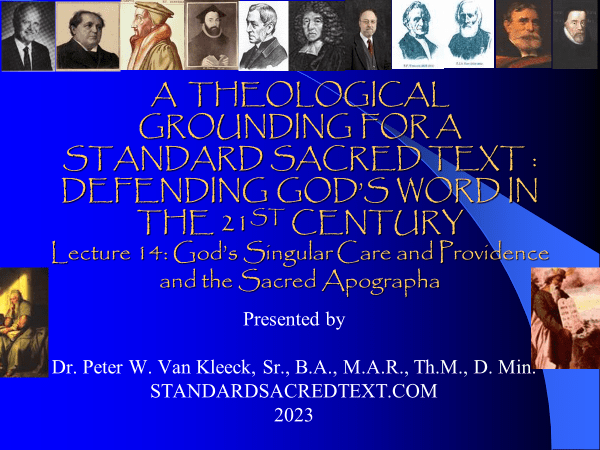
Tonight 9/5 at 7:30 we will hold the thirteenth lecture of series three on “A Theological Grounding for a Standard Sacred Text –The
Role of B..B. Warfield
Leading up to the national implications of replacing Scripture with history in Germany, was the wide-ranging impact of this theological transition in the lectures of Benjamin Breckinridge Warfield, (1887-1921) Professor of Theology at Princeton Seminary. Perhaps the most impactful miscarriages of the application of providence were the redefinition of the 1647 Westminster Confession of Faith, chapter 1, section 8, “and by his singular care and providence kept pure in all ages, are therefore authentical.” Having returned from Germany, being immersed in the historical critical method, Warfield’s Oxford lectures forever changed the theological trajectory of the American academy and subsequently the Church. If ever such egregious words were penned, Warfield wrote,
In the sense of the Westminster Confession, therefore, the multiplicity of copies of the Scriptures, the several early efforts towards the revision of the text, the raising up of scholars in our own day to collect and collate MSS., and to reform the text on scientific principles – of our Tishendorf’s and Tregelles, and Westcotts and Horts – are all part of God’s singular care and providence in preserving His inspired Word pure.[1]
[1] Benjamin Breckenridge Warfield, The Westminster Assembly and its Work (Grand Rapids: Baker Book House, 1991), 239. Also see Karl Barth, Der Romerbrief (Bern: G. A. Baschlin, 1919), preface, as cited in James M. Robinson, “Hermeneutics Since Barth,” in New Frontiers in Theology, vol. 2, The New Hermeneutic, ed. James M. Robinson and John B. Cobb, Jr. (New York: Harper and Row, 1964), 22. Barth writes, “The critical historical method of Biblical research has its validity. It points to the preparation for the understanding that is never superfluous. But if I had to choose between it and the old doctrine of inspiration, I would decidedly lay hold of the latter. It has greater, deeper, more important validity, for it points to the actual work of understanding, without which all preparation is useless. I am happy not to choose between the two.” Note the similarity between Barth’s modulation of the relationship between inspiration and historical criticism with that of Princeton Theologian Benjamin Warfield.
Don’t miss this important study of the Immediate inspiration for Christian theology, ecclesiology, and personal edification, Tuesday 9/5 at 7:30pm.
 Standard Sacred Text.com