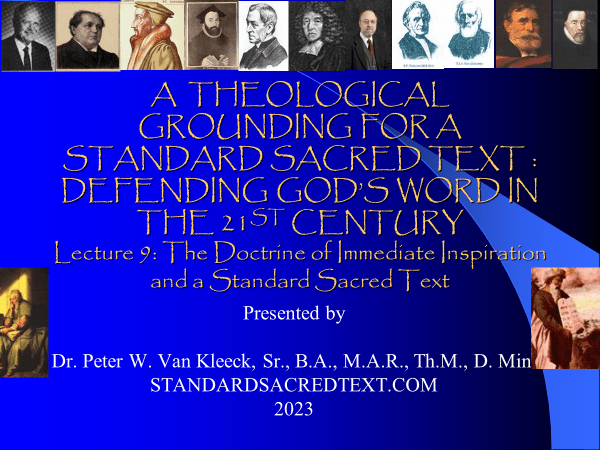
Tonight 8/22 at 7:30 we will hold the thirteenth lecture of series three on “A Theological Grounding for a Standard Sacred Text –The issue of Dictation
Lamothe likewise writes, “When the Old Testament is cited by the Apostles, they usually call it the Scripture by way of excellency; as when St. Paul, speaking of an Oracle dictated by the mouth of God Himself, says, For what saith the Scripture, cast out the bondwoman and her son (Gal. 1:30),”[1] Again, quoting Eusebius, Lamothe finds that,
“in the Ecclesiastical History that the heretics who denied the Divinity of our Lord, had the confidence to falsify the Scripture, to accommodate the Text to their opinions. Upon which the author of the primitive ages says, that it was not likely that the heretics were ignorant how criminal an enterprise of the nature was: For, says he, either they believed not that the Sacred Scriptures were dictated by the Holy Ghost; and so were infidels; or they imagine themselves to be wiser than the Holy Ghost, and then what are they other than demoniacs.” Euseb. h.e.1.5.c.ult.[2]
God was the primary author of sacred Scripture, the Holy Spirit the active creative agent, and the penmen were secondary, the writers of inspired text. Ames says that Scripture’s inspiration “may serve to admonish us, not so much to meddle in the Scriptures, as if we were in another man’s ground, or in those things which belong unto others and not unto ourselves,”[3] good and timely counsel for today.
[1] C.G. Lamothe, The Inspiration of the New Testament Asserted and Explained in Answer to some Modern Writers (London, Printed for Thomas Bennet, at the Half-Moon in ST. Paul’s Church-yard, 1694), 24.
[2] Lamothe, Inspiration, 32.
[3]Ames, Exposition, 251.
Don’t miss this important study of the Immediate inspiration for Christian theology, ecclesiology, and personal edification, Tuesday 8/22 at 7:30pm.
 Standard Sacred Text.com